Bipolar 2 From Inside and Out

Posts tagged ‘my experiences’

The Creative Bipolar Brain

Sun or shade
feel or know
safe or strayed
stall or flow

Thought or whim
drought or rain
sink or swim
heart or brain

Stop or start
bound or free
light or dark
bipolar me

I have a lot of friends who are creative – writers, musicians, singers, woodworkers, knitters, and other craftspeople. I also have a lot of friends who have assorted mental or emotional disorders – depression, bipolar, PTSD, OCD, autism spectrum disorders, and probably many more that I don’t know about. In many cases, the two categories overlap.

Common wisdom holds that there is a link between creativity and madness. Look at Van Gogh, for example. People have spent years debating what specific disorder he may have had, but nearly everyone agrees that he had something. The question is, would he have been the great artist without the mental or emotional disorder? Or, perhaps, would he have been an even greater artist if his brain functioned in a more typical matter? Science so far has given us no answers.

Many creative people realize that their everyday functioning is impaired, but they are reluctant to seek treatment for it. They fear that tampering with their brain or thought processes will somehow inhibit their creativity – make them less than they were in some fundamental way. When you start tampering with brain chemistry, who knows what will happen?

It’s a valid concern.

Throughout my life, my brain has been all that I have, or nearly so. My intelligence and creativity were the things I was most proud of. How could I risk losing those simply because I was eternally miserable? The question seems absurd now.

Eventually I decided that I had plenty of brain cells to spare, and that if taking Prozac took away a few of them or lessened their ability, I could live with that. (Just in case, I took up pursuits that are supposed to strengthen the brain – math puzzles in addition to word puzzles, music in addition to writing. Not everything I tried was a success, but I hope they stretch my brain muscles.)

My experience with that first psychotropic med convinced me that Better Living Through Chemistry is not just a chemical company’s slogan. It turns out that – surprise, surprise – thinking more clearly and feeling more well-adjusted actually empower one’s creativity. My output changed from poems full of young adult angst to creative nonfiction, personal essays, and the occasional short story. I now make my living doing freelance writing and editing – an unstructured process that I couldn’t have made a go of before having my mood disorder treated. The ability to concentrate – to focus – is what enables me to sustain a creative effort.

So to all those people out there who wonder if they are sabotaging themselves and their creative impulses by seeking treatment, I say go for it! You have nothing to lose but your immobility. You have everything to gain – the ability to create, to express yourself and do it clearly, and the possibility to create something truly wonderful.

Sylvia Plath was a poetic genius. But she could have given so much more of her talent and vision to the world if she had not killed herself. Perhaps her poetry, had she been treated for her mood disorder, would not have been as searing and powerful. The point is, we will never know. Would she have become more ordinary, or more extraordinary? Dying young obviates the answer.

I believe – for me – that psychological treatment, appropriate medication, and more stable moods have expanded my creative process. And I try to prove it every week when I post in this and my other blog. Whether I succeed is for you to determine.

Have I lost a step? Maybe. But two forward and one back beats the hell out of one forward and two back.

Yes, I Am Crazy. Thanks for Asking.

I’ve been called a lot of things in my time, from schoolyard taunts (loony tunes, weirdo) to psychiatric labels (clinically depressed, bipolar 2). This used to bother me, but anymore, I don’t mind.

It’s not because of the old saying, “Sticks and sones can break my bones, but words will never hurt me. We all know that’s a damn filthy lie. I think it’s because I’ve developed a sense of humor about the “crazy” thing. If Al Yankovic can embrace “Weird,” I can embrace “squirrel-bait” or “wacko.” Even “bat-shit” or “bug-fuck” crazy don’t get me riled, though many find them offensive – and I can’t fault them for that. Everyone has a different level of tolerance and sense of what’s funny.

Take, for example, the time when my sister Kathy gave me a t-shirt that said, “Leave Me Alone. I’m Having a Crisis.” Her husband was dubious about the gift, thinking that I would be offended. I wasn’t. Kathy thought it was a hoot and so did I. (I just bought a t-short that says, “You Won’t Believe the Crazy Shit That Happens Next…” I’m going to wear it to my next psychotherapist appointment.)

I admit to being disconcerted when publicly confronted by a person who asks “Are you the one there’s something wrong with?” or “Do you have mental problems?” (In the first case, the elderly gentleman was thinking of my sister-in-law, who had MS, and in the second, the person recognized me from the psychiatrist’s waiting room.) But I’m not offended. Mostly I regret that I didn’t have snappy come-backs. (I thought of some great ones later.)

There are still some assumptions that do offend or at least irritate me. Here’s a link to an article that enumerates a few of the touchy subjects and unwelcome phrases.

10 Harmful Myths About People with Bipolar Disorder

That sums it up pretty well. I’m not going to walk into a fast food outlet and start shooting up the place. Mania is not fun. I’ve decided not to reproduce, but nobody can tell me that I shouldn’t.

Oh, and there’s one other thing. In the past, when I’ve mentioned my mood disorder to acquaintances or co-workers, they feel obliged to take my emotional temperature five times a day. “Are you okay? How are you feeling?” So I would add to the list: Not all people with bipolar disorder are rapid cycling.

So, am I crazy? Yes. But I don’t think that’s necessarily a bad thing. Most people use the word “crazy” to describe how they feel when they’re in love. And I’m good with that.

Not Waving but Drowning

Consider this a trigger warning. The third section is going to talk about some difficult stuff, although in mostly general terms.

Here’s a list of how I know how bad my mood disorder is at any given time. Being bipolar, I cycle in and out of these phases, along with periods of reasonably competent functioning and even, occasionally, contentment or even happiness.

There are basically three stages of increasing dysfunction.

Starting to Sink
My sense of humor takes a hike.
I need more alone time.
I take mega-naps.
I forget that music can help.
I snap at my husband.
Noises irritate me.
I can force myself to work.

Floundering
I don’t want to eat.
I turn off my phone.
I sleep up to 14 hours a day.
Attention span is one hour (or one average book chapter).
I can trick myself into working.

Going Under
Can’t sleep.
Can’t work.
Can’t read.
Attention span: 15 minutes max.
Thinking “Maybe the plane will crash and I won’t have to deal with this anymore.”
Regretting I flushed my stash of pills.
Urge to cut.

Fortunately, I am well-medicated enough that category 3 doesn’t happen nowadays, though I remember it clearly and am appalled. At that point, the only things I can do are keep seeing my doctors and taking my meds. And remember to thank my husband when I come out of it.

(The title of this post is from a poem by Stevie Smith. The last two lines are: I was much too far out all my life / And not waving but drowning.)

In Defense of the Armadillo

Let’s consider the armadillo. Better yet, let’s consider this brief video. Take note of the armadillo’s defense mechanisms, if you will.

I have always identified with the armadillo, for a variety of reasons. It is the symbol of Texas music, which I love. I have a purse shaped like an armadillo. I also have toy armadillos, crocheted armadillos, wooden, stone, cement, armadillo jewelry, you name it. My uncle and I have a catch-phrase: El armadillo amarillo de mi tía es sobre la mesa.

What does all this have to do with bipolar disorder? I’m glad you asked.

Most of all, I admire the armadillo for its defense mechanisms, which resemble some of mine. For those of you who skipped the video, here’s a recap.

The armadillo has armor (obviously). I have tried to construct a similar impervious shell. When I have been even partially successful, it has proved counterproductive. When you wall off feelings, you wall off the good ones too.

The armadillo rolls up in a tight ball. I isolate. This has also proved counterproductive. If sorrow shared is halved and joy shared is doubled, then isolation – well, you do the math.

The armadillo leaps vertically when threatened. My anxiety makes me jump and release fight-or-flight hormones. This defense is also counterproductive, both for the armadillo and for me. One of the armadillo’s main predators is the automobile; the armadillo jumps straight up to bumper height. I waste energy on panicky behaviors even when I’m not threatened.

The armadillo has a low body temperature and is therefore useful for research on leprosy. This is not a defense mechanism, but it is a Fun Fact to Know and Tell. I have never had leprosy.

All things considered, the armadillo is not a good role model for a person (me) with bipolar disorder. But I like them anyway. They remind me that I need to check whether my defenses are doing me harm rather than good.

Plus, with my armadillo handbag I get lots of practice in the social skill of making light conversation strangers – and even children!

Erma

Erma

The Universe vs. Me

I set out Friday to drive from Ohio to Michigan – about a 3-4 hour drive, depending on traffic.

Five miles out, the Saturn stopped working. Called husband and AAA. Towed to local mechanic. Probably bad clutch.

So we switched my luggage to my husband’s Blazer. About 30-40 miles away from home, car stopped working. Called cell phone emergency road service. Towed to nearest garage. No idea what’s wrong with it, or if the random mechanic is any good.

So my husband picked me up and put my luggage in the back of his ’84 pickup. Halfway home, the radiator blew. I had a meltdown. Called AAA. Towed home. Had pizza delivered.

That’s it on the vehicles. Not even a bicycle left.

Also, there is No Money, except maybe enough to pay the mortgage and health insurance for February.

I have my Abilify, but it hasn’t kicked in yet.

A couple of friends suggested that this was the universe’s way of telling me not to go to Michigan, thereby avoiding something even more heinous that would happen there.

My questions regarding this theory are:

Did the universe really want us both stranded at home, with no way to get to the store or pharmacy, or for that matter, to the other cars?

Did the universe really want Dan to miss more work and lose more pay, especially since he lost nearly a month’s pay going to stay with his mother while she recovered from surgery?

Did the universe really want us to invest yet more money in the cars, when we just bought two of them new wheel bearings?

My answer: No.

The universe is not conspiring against us. This is not divine retribution for a life of sin. This is not bad karma because I was a cannibalistic serial killer in a past life. This was not caused by some higher power that knew I shouldn’t go to Michigan because the place where I was going to stay would spontaneously burst into flames in the middle of the night.

But sometimes it sure feels like it.

I believe there is no larger “because.” Just the fact that we have crappy vehicles and can’t afford the upkeep.

I have no idea what to do, except go to bed, finish having my meltdown, and stay there till the Abilify revs up.

The Lighter Side of Insomnia

I’ve had insomnia. Lots. January seems to be an especially bad time of year for me. A sleeping pill reduced the frequency, but nothing banishes it completely – the obsessive thoughts, the catastrophizing, the worrying, the worrying about how worried I am. We’ve all been there at 3:00 a.m., trying to will ourselves to sleep.

What could possibly be light-hearted about that?

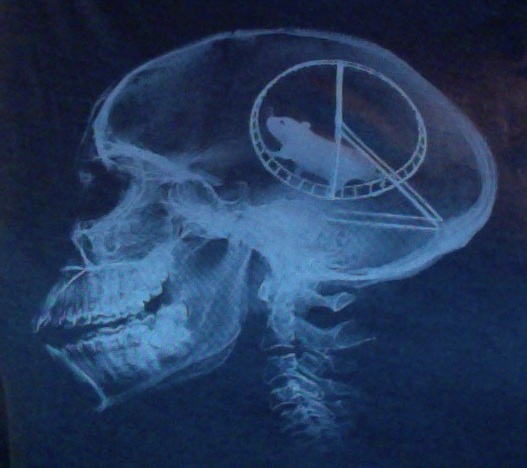
Just this: An actual x-ray of my insomniac self:

T-shirt by Headline Shirts. Photo by me.

Indeed, my friend Leslie and I, both afflicted with insomnia, recognized this as our mutual problem. We began to end our late-night commiseration with the sign-off, “Death to Hamsters!”

Our mutual friend, the incomparable, incorrigible Tom Smith, heard of this and ran with it. Here is the result, for your amusement.

Imagine, if you will, this performed as a sing-along with a hundred people joining in on the chorus. It may not put you to sleep, but at least it puts insomnia in some kind of loony perspective.

At least it does for me.

Notes:

No hamsters were harmed in the making of this blog post. A rubber duck may have been squeezed, but it had nothing to squawk about. So if you’re with PETA, chill already.

Lyrics to Hamster Brain available here: http://www.tomsmithonline.com/lyrics/hamster_brain.htm.

The Myth of Closure

For some reason, it’s called “closure.” But for some wounds there is no such thing. And for some of us – those with emotional and mental disorders – there is no way to achieve closure.

Take, for example, the invisible injuries I experienced while living with Rex (a pseudonym), for a year in college. He was a master of intermittent reinforcement, the trap that keeps abused women (and men sometimes) from getting themselves out of the situation to someplace safe. He was never physically abusive, which I have vowed never to put up with (and to this day haven’t), but verbally and emotionally, he was, well, a veritable artist of psychological bullying.

Here are just a few examples.

When he was unhappy with me for some reason, he would sigh and glare. I swear he could sigh and glare even over the telephone. And when I would freeze up and not be able to think of any word that would make things better, he said my silence made him want to kick me.

I slept in the car on the streets of Buffalo if there was a late-night party he wanted to go to. It was out of the way to take me back to where we were staying.

When I was responsible for feeding guests, and botched it, he said I had tarnished his honor.

He took the decision to tell my parents about our relationship out of my hands, ripping apart the face-saving fiction that I was renting a room in his large house. After I left, I even sent him money to pay the supposed rent.

When I asked him to go to couples counseling with me, he said, “Are you sure? The therapist and I could have you declared a danger to yourself and have you put away.” At the session, he tenderly held my hand and asserted that he just wanted to get help for me.

So what does this all have to do with mental health? I certainly wasn’t mentally healthy when I met him, and was a basket case by the time I left. When I was immobilized, I was not embracing his projects with “alacrity.” When I was insomniac, only his cat comforted me. When I was in the Pit of Despair, everything was All My Fault.

So what do people tell you in cases like this?

Look how much you learned from the experience. And I always reply that the lesson wasn’t worth the price I paid. All that I want to keep from that time are a few dear friends.

Forgive and forget. I can’t do either. The memories have faded over time and seldom give me flashbacks anymore. (The dreams still come.) As for forgiving? He’s never asked for it and never would. I’m sure he doesn’t think he did anything that needed forgiving. If that makes me a hard-hearted bitch or a bad Christian, so be it.

That emotional abuse happened, and I can’t forget it. It was my first serious relationship and I left chunks of my soul and most of my barely existent self-esteem in that house on the hilltop. I had failed – at the relationship, at meeting my parents’ expectations, at so many things. I felt I was the one who needed forgiveness and spent much of the following years repeating incessantly, “I’m sorry.”

Let go of anger; it will only hurt you. When I first left, I didn’t feel anger toward Rex. I felt a lot of other things, mostly directed at myself. But I didn’t recognize or own my anger until much later, after lots of therapy and the good kind of love. Now that I realize I was (and am) angry, it feels wrong to think of him without feeling that. The things he did were wrong, and it is not irrational of me to still believe that. I earned that anger. It is part of me now. I can lay it aside to the extent that I don’t have revenge fantasies, but that’s about all.

So, closure? Not a chance. Saying as Oscar Wilde did, “Living well is the best revenge”? That’s more like it. Even learning to live well has been an uphill battle. I’m still struggling with the definition.

The wound may scab over, or it may continue to trickle blood at times. Some of it may even form scars. But take my word for it, the wounds are still there. They never really close.

Why I’m Not Like Sheldon Cooper

Obviously, I’m not a man or a theoretical physicist or a character on The Big Bang Theory. But also, I can’t say, as he often does, “I’m not crazy. My mother had me tested.” I’d like to have that t-shirt, but it would be false advertising.

I am crazy and my childhood was entirely free of psychological testing.

It probably shouldn’t have been, because the crazy had taken full hold during my tender years. Crippling depression. Massive anxiety. But both my parents were ordinary folk from Kentucky transplanted to a bland Ohio suburb. They stayed true to their roots and never considered testing or counseling for me or my sister. According to their upbringing, having crazy relatives might be upsetting or embarrassing, but that’s just the way it was. You tried to shelter them from the outside world – and vice-versa – but you didn’t involve agencies or doctors or hospitals.

My crazy got too obvious to ignore when I was in junior high school. I developed a nervous tic – my head would jerk up and to the left uncontrollably. This was very distracting, not only to me, but to whoever was sitting behind me in class. It got me noticed.

It did not, however, get me to a psychologist or other mental health professional. I didn’t want to see one anyway, because I had the irrational notion that being “shrunk” would go on my permanent record and I would never get into a good college.

Instead, I was taken to our family doctor. He prescribed Valium, which did stop the twitching but did absolutely no good for my depression.

Later, during my college years – at a good school, I might add – I had another run-in with Valium. This time my symptom was pain like a railroad spike being driven into the side of my head. Naturally, I thought it was a brain tumor.

I went to the doctor, who said, “I can do any test you want, but I can tell just by looking at you what your problem is. Your jaw is crooked.” He diagnosed me with temporomandibular joint (TMJ) disorder, explained that tension made my muscles contract unevenly and cause excruciating pain in my temples. He sent me away with a prescription for Valium. Which helped with the stabbing pain, but again not with the depression. (Also, I was self-medicating with wine, which just made the crazy train run faster.)

It was not until years later, after college, that I got half a diagnosis – depression – and a non-Valium prescription – Prozac. And many years after that until I got the more accurate diagnosis (bipolar 2) and an appropriate regimen of drugs, which does include Ativan, but not prescribed alone or with wine.

And that’s another thing I don’t have in common with Sheldon Cooper. He’s not taken any psychotropics (or wine) and is happily stuck in his supposed non-craziness. I’ve accepted my craziness, gotten help for it, and am slowly rising, if not above it, at least to where I can peek over the top of it.

Family Matters

No one in my family understands me.

Actually, no one in my family understands my illness.

My mother-in-law doesn’t believe that mental illness exists. And in a way she has a point. If she hasn’t experienced something, for her it doesn’t exist. Most people are a bit like that sometimes, especially regarding mental disorders. There are only a few varieties of broken arms, and when you’ve got one, you know it. When you’re talking synapses and neurotransmitters, thoughts and feelings, it’s obvious why “invisible illnesses” aren’t obvious or well understood.

I didn’t understand my disorder at first, either. I remember driving past a building with a sign: South Community Mental Health. I didn’t know what I was feeling, but I was pretty sure it wasn’t mentally healthy. I went in and began the journey.

My family had the following reactions when I told them I was going into therapy and when I first started taking medication:

Dad: Just as long as I don’t have to go.

Mom: I’ve heard Prozac is a ticking time bomb.

Mom (later): I thought you would feel better after you found a good job.

Sister: Why should you spend $100 a month just to talk to someone? (The clinic was on a sliding scale, so I actually paid only $5 per visit.)

I understand some of those reactions. Dad had heard about how psychologists blame parents for messed-up kids and he wasn’t going to someone to be told he was crazy, and a bad parent besides. And his fear was not that unreasonable. Dysfunctional kids often do come from dysfunctional families. But underlying my disorder was brain chemistry. I never asked him to join the couch gang.

Mom watched Phil Donahue (for you youngsters, think Dr. Phil). And there was at first over-prescribing of Prozac and suicides once the patients gained enough energy. Plus she thought my depression and anxiety were reactive and would clear up when my living situation was more stable.

My sister, I don’t know. I don’t understand her either. I’m sure she has psychological problems too, of one sort or another. But I’ve been diagnosed, so I’m the crazy one.

My husband, who has a background in psychology, “got it” a little better once he stopped trying to “fix” me. But he never understood in a visceral way until he had his own first meltdown.

“You know how you’re feeling now?” I said. “Try feeling that way for a couple of years instead of a month.” Later he did. So at least he knew what half of bipolar was all about. He still hasn’t felt the rapid cycling or the constant roller coaster or the extreme physical and mental battering of going on and off medication after medication, hoping the next one will do more than make his hands shake worse or his memory turn into Swiss cheese.

Still, it’s better to be partly understood than completely dismissed, and to have a family that tries. And to have a family of choice that does understand, because a lot of them are in the same leaky, patched boat.

I could have done a lot worse.


The Abilify Saga Continues

It turns out, Abilify works for me. Except now I have to work for Abilify. To afford it, I mean.

I now wake up around 7:30 or 8:00 instead of 10:00. I can concentrate long enough to read whole chapters of books, and am enjoying that immensely. I am able to get showered and dressed and go out to run a few errands. I can decide what to eat and even recognize when it’s time for me to eat.

And I can work. I have taken on a mega-project, which has required my attention up to eight hours a day, researching, writing, editing, and proofreading. I don’t know how well I’m doing (there are some differences of opinion about that), but I’m doing it, goddammit.

I may be pushing myself a little too hard, despite the new energy and focus. The other day I had to force myself, one pitiful step at a time, to address a dozen Christmas cards. “You have the list, you can put the addresses on the envelopes. You’ve got enough stamps, you can surely put them on the envelopes. (Don’t call me Shirley.) Better put return addresses on. You can do that much, then stop. You can slip the cards into the envelopes. How hard can that be? You had them printed with your names, so you don’t really have to sign them if you don’t want to and won’t have to fake your husband’s signature because he’s not here. That would be too much. Now lick the envelopes. All you have to do is stick out your tongue. Might as well take them to the mailbox. You need to get cat food out of the car anyway. Okay, now you can crash. Egg sauce, Ted.”

Many’s the year when all that was Just Too Much. According to the Mystic Law of Reciprocal Cards, we get about four nowadays, and are very grateful for those.

And grateful for the Abilify. Except it’s $800 a bottle, even for the tiny dose I’m taking. I got one free month and one discounted month ($650) from the manufacturer and have spent a lot of time since worrying and seeking solutions.

There will (we hope) be a generic in April. Yay.

I know someone who was taking it and has some left over.

I know someone in Canada.

Will my doctor prescribe a higher dosage so I can break them in half and stretch them (and the cost) out?

I may have at last solved the problem. After hours on the phone and hours more on hold, we finally have new insurance. It costs about as much per month as a bottle of Abilify, but the drug benefit kicks in before we’ve paid the deductible (which is way lower than previously). So our many, many other drugs will magically shrink to $15 per – or less with mail-away – and we’ll come out ahead. A little. Probably. If I can keep up the pace on work.

Plus, now we have dental, and oh lord do I need that. But that’s another story for another time.