Bipolar 2 From Inside and Out

Posts tagged ‘mental health’

Anxiety Says No, but Mental Health Says, “Do It!”
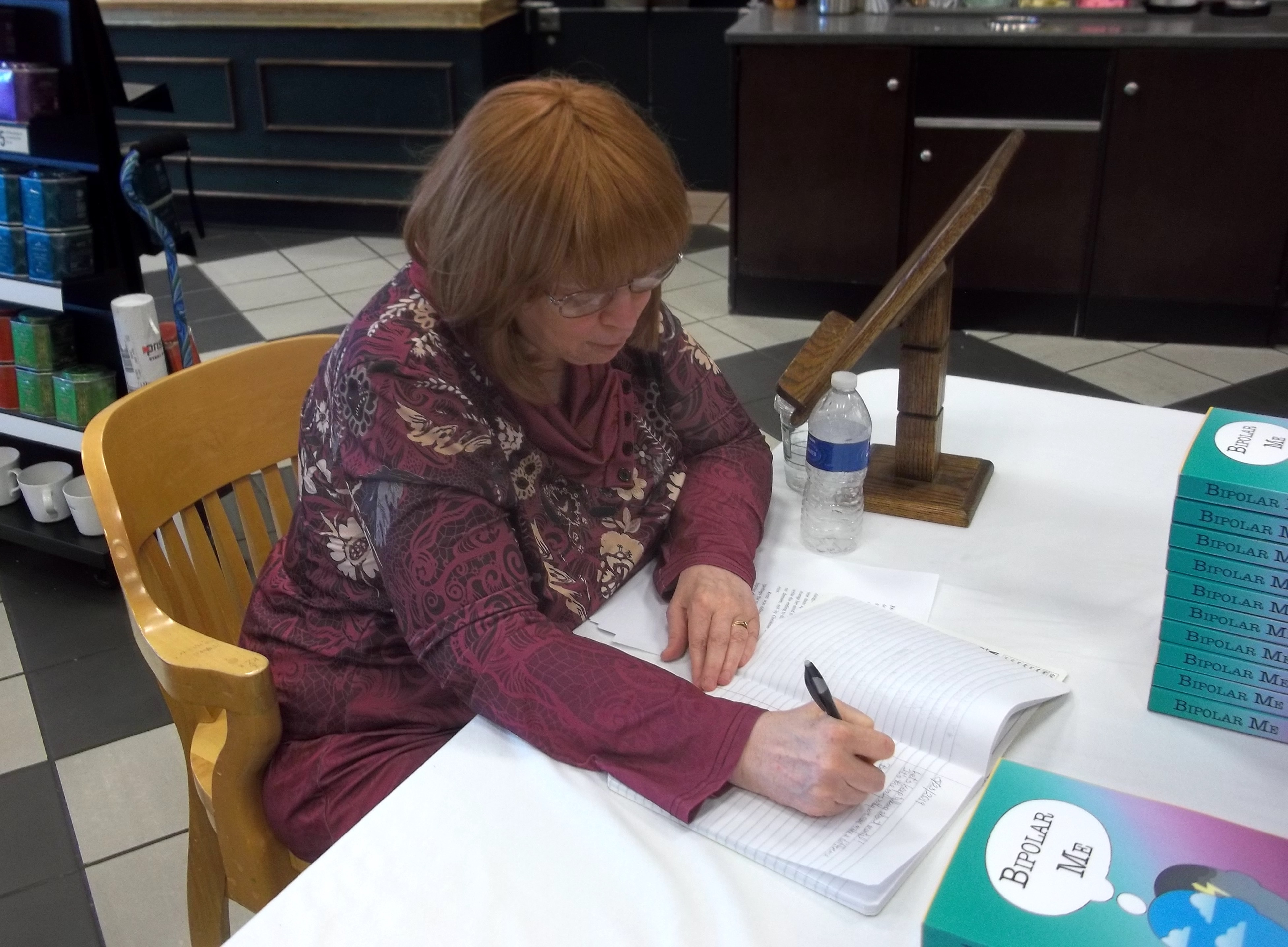
It’s tough enough for someone with bipolar or depression or anxiety to go outside, where it’s all people-y. It’s another level of achievement when such a person deliberately puts herself or himself out into the public eye.

But that’s just what I did this week. My publisher arranged for me to do a reading and signing of my book at a local branch of a national bookstore. And I agreed to do it. Thursday night was my debut.

Let me go back a few steps. I do have some experience speaking in public, so it wasn’t going to be a completely novel experience. Those occasions were, shall we say, a bit distant in time, mostly before my bipolar disorder reached its heights (or depths). In high school, I did debate and extemporaneous speaking. In grad school, I taught introductory English classes. During my somewhat-less-than-successful business years, I once addressed a power breakfast meeting. I even opened with a joke.

I was prepared to open with a joke (or at least a witticism) this time, too. But my plans soon flew out the window.

I had prepared – or over-prepared, probably – somewhat obsessively. I spent spoons like they were disposable plastic. I picked out an outfit and a back-up outfit, including earrings and back-up earrings. I did my hair. I agonized over which pieces from my book to read, then printed them out in huge type so I wouldn’t have to squint at them. I took an anti-anxiety pill and Immodium, just in case. I was fortunate that Thursday was my day off and also my husband’s, so he could be present as my emotional support animal, wearing one of my book t-shirts.

My expectations, such as they were, took a nose-dive when only two people showed up – both friends of mine, one of whom had already bought my book. It was time to rearrange my plans on the spot, not really one of my strong suits. Why had I knocked myself out making plans if the universe wasn’t going to cooperate with them? I had thought that at least half a dozen people would turn up. I was trying to keep my expectations reasonable, after all.

I’ll admit that when I saw such a small audience, I felt a wave of despair. In actuality, it proved good that they were both friends of mine, because they were a receptive audience who wished me well.

Given the meager audience, though, I abandoned my introduction (though I worked my joke in later). These people already knew me. I gave a brief synopsis of “What is bipolar disorder?” and plunged into my readings.

I had tried out one of my readings previously, when I was on a podcast for indie authors. Of course, I had no eye contact with my audience then and no real idea how my performance went over. On Thursday, I explained Spoon Theory, as it came up in one of the pieces I was to read. I had chosen two of my more light-hearted pieces, though on serious topics (psychotropics and side effects, and cognitive dissonance). Then I finished with a reading of a piece on why I write about bipolar disorder and why I put myself out there to the extent that I do in this blog and my book, and indeed my public appearance.

The big surprise of the evening came when I invited a Q&A session. My husband fed me questions to get things started and my friends also had queries. What I hadn’t been expecting, however, was that a few people in the bookstore cafe where this all occurred got sucked into the discussion and had questions of their own, though they had no idea that the event was scheduled at all. One worked at a local university and had heard his students talking about having bipolar disorder. Another was a woman studying psychology in order to become a counselor. I didn’t always have the answers, and I’m sure I bobbled some of the explanations, but I did my best to come up with reasonable answers about treatments and medications, self-care, and so on.

Then came the signing portion of the evening. I signed a book for one of my friends and the counselor-in-training asked me to sign her notebook with any little inspirational words I might have. (I winged it. I was tired by then and am not usually inclined to be inspirational.)

Then my husband and one of my friends and I went out for milkshakes, which I highly recommend as a way to decompress after such a fraught experience.

All things considered, I’m glad I took the risk and gave it the old college try, as it were. If nothing else, it was good practice for the next time I speak in public, perhaps when my second book comes out.

The reason that I write about bipolar disorder and my experiences with it is that I want to share what I’ve learned and lived. I think I did that Thursday, even if not to the extent that I had hoped. I don’t regret the anxiety and the preparation that went into it and, all things considered, count it as a win. When I think about the melt-downs I could have had – before, during, and after – I feel pride that I kept my depression and anxiety at bay for long enough to share information about bipolar and healing and mental health.

I think it was worth putting myself out there.


Helping Someone Else

My husband used to work in a community correctional facilityessentially a jail. The residents were considered nonviolent offenders technically on parole for mostly drug crimes, but things could still get interesting. Mostly he didn’t talk about his work because he would try to dismiss it from his mind every day as he went by a certain overpass on his way home from work.

One day, though, I was bitching in disbelief about something that had happened at my work – another editor had put his table of contents in random order instead of numerical. I was appalled by the stupidity of that.

There I was ranting about it. Then my husband said, “Boy, that’s tough. All I did today was break up a fight and spot a guy who might have a septic wound. But you – the table of contents out of numerical order? Wow!” That put me in my place.

My husband was someone who helped other people. For years after he left the job, people would come up to him when he was out and about, and reminisce with him. They’d tell him about how well they were doing, how they were clean and sober, how they had jobs, how they had improved their lives. They always said thank you to my husband.

This morning when I woke up and checked my email, I found something I wasn’t expecting. There, nestled in amongst the spam, was a response to a post that I wrote back in January, about passive suicidal ideation (https://wp.me/p4e9Hv-Me).

In the reply, the person told of having thought about suicide but not acting on it. The response ended, “I’ll follow your advice and seek professional help.”

It’s difficult to describe what I felt then. Mostly, it was gratitude that my writing had helped someone, combined with not a little surprise at receiving a response at all. Sometimes writing is like shouting down a well. You never really know if anyone even hears you or if you’ve made a difference. Most of the time when I write this blog, I have no idea how the posts will affect my readers, if at all. But this time I knew – at least if the person followed through – that I had actually helped someone.

When I started Bipolar Me, it was to share my experiences with bipolar disorder and my thoughts on mental illness and mental health. If my writing resonated with someone, good. But I wasn’t writing with the intention of being inspiring, or helping people solve problems, or being a “good example.” I’m not a professional and the kind of advice I give (when I do) is largely commonsense – don’t stop taking your meds, seek professional help, thank your caregivers, and so on.

I’m not going to break my arm patting myself on the back here. There are lots of people who do the work of caring for the desperate and hurting every day. I am privileged to know some of them and to have even been helped by some. There are people like Sarah Fader and Gabe Howard who are advocates and activists for the mentally ill, who go out on a limb to do something to help the whole mental health community.

But today, for just a moment, I felt that I had really touched someone, really helped. It was a good feeling.

So there it is. I started this blog for self-centered reasons, to chronicle my own struggles and occasional victories. If it helped anyone, fine. If not, I still had stories to share. But now I find that having helped someone else has made a difference – in the other person, in me, in the world. Now I believe that my blog and my book could do more of that.

Bipolar Moonshine

Honestly, the things they ask on Quora these days! Quora, for those of you not familiar with it, is a website that allows people to ask questions for “experts” to answer. Somehow, I have become one of the people that others come to with questions about bipolar disorder. (Also the Ivy League, but that’s another story.)

Some of the questions are serious, but others are less so. “If you could stay hypomanic all the time, why wouldn’t you?” “How can I get my bipolar dad to stay on his diabetes meds?” I actually had an answer for that: You can’t. And bipolar has nothing to do with it. 

I’ve answered a few of the questions if I had the time or if a good answer hadn’t already been given. Many of the answers are written by doctors, who can do a much better job than I.

Recently, however, I saw a question that I thought it wouldn’t take a medical degree to answer:

“Is bipolar disorder causally linked to lunar cycles?”

The argument was based on several points.

  • Sexual reproduction is always in response to lunar cycles.
  • This is based on gravity, illumination, and diurnal and lunar cycles/high tides.
  • Bipolar disorder is a disruption of sleep.
  • It first manifests at or near puberty, with the onset of hormonal cycles.
  • Something about teenagers having a different sleep cycle than adults, staying up later to reproduce while the parents sleep. (I can’t say I understood this part.)
  • During the full moon, hospitals and police report increases in both people out late at night and odd behaviors and emergencies.
  • Anecdotally, the writer noticed “elevated and depressed moods not necessarily linked to lunar cycles, but not necessarily independent of them either,” noting that “periods of mania occur during full and nearly full/new moon.”

The writer’s hypothesis, if I follow it correctly, is that bipolar disorder involves sleep-hormonal cycles related to the full moon, which evolved in the days before artificial lighting. This apparently gave a reproductive advantage of being awake at night because bipolar disrupts the sleep cycle. This is noted to be “an obvious evolutionary reproductive strategy.” There was more, but that was enough for me. (The writer admitted that statistics to prove any of this did not exist or had to be derived from “Bayesian statistical methods,” which one source I looked at called “a measure of the strength of your belief regarding the true situation.”)

So, where to start? First, if the writer thought he or she already knew the answer, why write in with the question? Obviously, to seek validation or to promote a theory (or to make me look like a fool).

I could answer each point individually. (I’m not a neurophysiologist either, but I do have some experience with rhetoric and logic. And bipolar.) But let’s just take a few.

Not all animals’ reproductive cycles are based on the moon, and neither are humans’. Women have menstrual cycles at all times of the month, and men don’t. (And what about bipolar men?)

Bipolar disorder can certainly cause a disruption of sleep, but is not caused by it. That is too simple an explanation for a complex disorder.

We’ll just skip that one about teenagers reproducing while parents sleep. Its connection with bipolar disorder is slim at best.

That one about the full moon is most likely anecdotal, as reported by police and emergency room workers, but no statistics (other than perhaps Bayesian ones) seem to bear this out. And the moon is full, nearly full, or new for more than half the month. Let’s also disregard the fact that bipolar cycles are seldom exactly a month in length. I had a depressive crisis that lasted several years.

Many causes have been theorized for bipolar disorder, from gut bacteria to early trauma to brain wiring. At the moment, as far as I know, the jury is still debating. Perhaps all of these are components of the cause, though I favor brain wiring as the principal cause. But given the actual science, I’m betting that the moon isn’t the answer.

I Hate My Job, But I Don’t Hate My Life

The other day I found myself thinking, “I hate my job. I hate my life.” But then I stopped. The truth was that I do hate my job, but I don’t hate my life.

There have been times when the two thoughts absolutely went together. I well remember getting up in the morning and thinking, “Now I have to go to the bad place where they make me unhappy.” Unfortunately, the thought would color my whole day. Instead of unwinding after a rotten day – or a whole series of them – I brooded about what came before and dreaded what would come the next day. I was caught in a loop of bad thoughts and they wouldn’t let me go, or enjoy, or relax. My life seemed to stretch out into an unending series of more of the same.

Of course, that was when I was deep in bipolar depression, improperly medicated, and unaware of self-care. Oh, the job was indeed pretty terrible. I was an editor, a writer, and a proofreader, tasks and occupations I normally enjoy. There’s something wonderful about taking something mediocre and making it good, or even taking something bad and making it better. Once or twice I even got compliments on the job I was doing.

But at that time, when I hated it, the job was a misery. A reorganization had put the editorial department under the marketing department, which had been true in fact for a long time but was now formally acknowledged, with a resulting new chain of command. Anything I wrote was essentially a puff piece for some advertiser. Three senior editors were fighting over my time and attention, each determined that I should work on their project first and foremost.

I wasn’t quite ready for a major breakdown, but I was close. I hated both my job and my life.

Now I have a tedious and basically unfulfilling job. I transcribe audios of boring business meetings and lawyer consultations, relieved only by the occasional podcast. On top of that, I’m a really crappy typist, so it takes me hours to do a job that others could zoom through. Add in foreign accents and mumblers, and you get a job that brings me no joy, but only a modest paycheck.

But for some reason it also suits me. I work four days a week, at home in my pajamas. No one is looking over my shoulder. If I make my deadlines (and I do), I can expect fairly steady work, except during the holiday season. I earn enough to supplement my social security without going over their limit on extra income.

I also have medications that stabilize me and a much better knowledge of self-care. Working at home for only one boss is part of that. So is taking meal breaks whenever I want them and spending that time with my husband. Eating nutritious meals. Letting myself say, “I hate it! I hate it!” after a particularly trying assignment. Reading a book before I go to bed. Snuggling with the kitties. Allowing all these things to seep beneath my skin and feed my soul.

I don’t belong to the regular-massage-and-decadent-chocolates school of self-care. Maybe I’m a simple soul, but I prefer the everyday comforts that make my life not a misery and help me appreciate what I can of my situation. Not that I’ve got anything against either massages or chocolate. But to me, they are special indulgences rather than a part of my daily self-care.

In the end, medication and self-care are what keep me going, hating my job, but not my life.

Stone Cold Depression

I saw an ad online recently for a crystal antidepressant necklace. It was basically a crystal point hung from a chain.  The crystal was pink in color, which meant it was either rose quartz or pretending to be.

When I looked at the website, there were other colors available, such as clear (quartz), turquoise (turquoise), purple (amethyst), and black (maybe onyx?). Of course, there was always the possibility that these were not naturally occurring colors and that every crystal was plain quartz died some other hue. The turquoise certainly looked dyed to enhance its turquoise-ness, and isn’t a crystal anyway. I also had my doubts about the black one.

In point of fact, I had my doubts about all of them. Not that they weren’t authentic crystals, but that they would work. I’ll be honest here. I don’t believe in crystals as channels of psychic power or healing or whatever. I think they’re beautiful and make great jewelry, though. I have quite a collection of necklaces and earrings made from semi-precious stones, some of which are crystals. I feel better when I wear them, but that’s because I actually have taken the time to accessorize before I go out.

I think that, if crystals have any effect at all, it is the placebo effect, which I’m not discounting. That at least is a real thing. But the ad for the depression crystals got me thinking. If the 12 or so widely varied stones that were featured in the ad are all good for depression, what’s the point? I thought at least specific crystals were supposed to be good for different things.

So I researched some of the advertised crystals to see what effects they were supposed to have and how they might relate to mental health. Here are some of the associations I found:

rose quartz – emotional healing, releasing toxic emotions

turquoise – spiritual expansion, a path to your vibrationally highest self

onyx – inner strength, balance, confidence, protection

amethyst – release of addiction, relaxing energy, sound sleep

I’ll admit right off that I don’t know what “a path to your vibrationally highest self” means, but then again, turquoise is not one of my favorite stones. I have worn rose quartz, amethyst, and occasionally onyx, but felt nothing in particular regarding my emotions, confidence, or sleep (though, to be fair, I never have worn amethysts to bed). Amethysts for relief of addictions most likely goes back to medieval days, when they were thought to counteract poisons.

Then I checked another site, which connected assorted crystals and stones specifically with mental health issues. Here the results were more specific and more focused. Rose quartz was again associated with emotional turmoil, which is pretty close to releasing toxic emotions. Blue lace agate, a very pretty stone, was associated with journaling, which was both different and interesting.

Even more interesting to me were the purported beneficial effects of amber, unakite, tiger’s eye, and smoky quartz. According to this website, amber, perhaps my favorite semiprecious gem (though not technically a crystal), is particularly effective for seasonal affective disorder (SAD). Unakite, a little-known stone that mixes gray-green and dusky pink colors, is said to be beneficial for anxiety and negative thoughts, both of which I, of course, have in abundance.

Smoky quartz appears to be the recommended crystal for depression and tiger eye for mood swings. Both should therefore help with my bipolar disorder. (I don’t remember whether smoky quartz was among the crystals and stones offered in the antidepression crystal ad, but according to this website, it should have been.) I used to wear a ring of tiger’s eye, but it did nothing to ward off bipolar.

I can’t see any scientific basis for crystals having any sort of effect on a person’s emotional states. But I suppose that if these stones bring you some solace or seem to encourage your healing, I shouldn’t put them (or you) down. I don’t happen to believe in their alleged powers myself, but I also know that affirmations, CBT, and positive thinking don’t work for me, as far as my mental health goes, while they do work for other people.

But I do think it is disingenuous at best and fraudulent at worst for that particular website to advertise that these varied stones and crystals all have antidepressant effects. Even those who believe in the power of crystals believe that different ones have different effects.

Personally, I think that a black crystal would do more to reinforce depression than to ward it off. I know someone will tell me if they think I’m wrong.


The Languages of Love and Bipolar Disorder

In 1995, Dr. Gary Chapman published his popular relationship book, The Five Love Languages. In it he proposed that there are different ways – or “languages”  – that people use to communicate their love. Problems happen when one partner doesn’t speak the same language as the other; for example, when one gives the other literal gifts while the other yearns for time together.

I’ve been thinking quite a bit about love and bipolar disorder lately and it occurred to me that the five love languages could be a helpful lens for looking at relationships. In particular, they might help a person realize what the other one needs when experiencing symptoms of the disorder.

Here are the five love languages and how they might be helpful if you are in a relationship with someone who has bipolar disorder.

Words of affirmation. I’m not talking here about the kinds of affirmation we are supposed to look in the mirror and give ourselves. I mean words of affirmation that come from outside, from another person, and are gifts of love. Everyone needs affirmations at times, but for people whose love language is words of affirmation, they can be positively soul-feeding.

For the bipolar person, these affirmations can be as simple as, “Thank you for coming out with me,” or “Congratulations on getting the bills paid,” or even, “I know you can do it,” or “I knew you could do it!” And for the bipolar person who struggles with self-esteem, imposter syndrome, or lack of motivation, these can be the words that keep us going.

Quality time. Quality time doesn’t have to mean an elaborate outing or a two-week vacation. It can be as simple as sitting on the sofa with your partner watching a movie, or cooking together. Especially when there’s something else you could be doing. Giving up that other activity to spend time with your loved one is another kind of love-gift.

Quality time – extended periods of togetherness – can be extra special to someone with bipolar who feels lonely, isolated, or unlovable. Just the idea that someone wants to spend time with you, even though you can barely stand to be with yourself, sends a powerful message.

Receiving gifts. There are people who value physical gifts and see in them the care and attention that another person spends selecting just the right thing. Diamond rings are unnecessary. In this language of love, a simple houseplant can even be preferable.

You probably shouldn’t expect a physical gift to “cheer up” a person with bipolar depression. As with any gift, the important thing is knowing what the person values and providing it to them. Comfort objects such as plush animals, mp3s of calming or favorite music, or a weighted blanket to ward off panic may be just the thing. Even a silly coffee mug with an appropriate saying can become a treasured item.

Acts of service. If the person you love values acts of service, then your way of speaking that love is accomplished when you do something for her or him. Doing the dishes or some other chore that usually falls to the loved one is one example.

For the bipolar person, acts of service that speak of love may be as simple as handling phone calls and visitors, or doing the shopping when he or she just can’t face the grocery store. “I’ll do it for you” is a powerful message that says, “I care about you and want to help ease your burdens.”

Physical touch. Strange as it may seem, some people never think of physical touch as a language of love unless they’re talking about sex. Of course, the physical and emotional intimacy of sex can speak love, but other kinds of touch do just as well for some people.

Bipolar people in the manic phase can have a high sex drive and appreciate some sexual attention even if you wouldn’t ordinarily want it at that time of day, for example.  But the bipolar person can crave touch without sex as well. Hugging and cuddling, sitting close with an arm around the shoulders, and even a touch on the shoulder as you leave a room can speak volumes.

The important part of this is to learn and know what your partner values – what language of love she or he speaks – and to give it to them. Mixed signals, speaking the language that you would want instead of the one that your partner does, will not be processed as love. Physical gifts to one who hears love in affirmations will miss the mark.

Obviously, the best thing to do is to ask your partner which “language” they speak. But she or he may not even realize that there are different languages or which one is theirs. Observation, attention, and even trial and error may be necessary to get the communication going. But if you want to speak love to a person with bipolar disorder, these are communication skills that can be vital.

What My Husband Has Learned From My Bipolar Disorder

First, let me say I’ve learned a lot from my husband and from my bipolar disorder. The two of us have been married for more than 35 years and I’ve been bipolar all that time. I’ve learned a lot from him about caregiving, steadfast love, and coping, among many other things.

But he’s also learned a few things from living with me and my disorder. I asked him to tell me about it, and here’s what he said he learned.

He can’t fix me or control my emotions. (Of course, the corollary to this is neither can I.) “It’s not necessarily my fault when she feels bad and it’s not my responsibility to make her feel better,” he says. This particular lesson caused both of us a lot of trouble early in our marriage. Dan would blame himself for my moods and become angry when he couldn’t do anything to make me feel better or even respond to his attempts. He was in there trying, but he had to learn to let go and help me find ways to work toward my own healing.

He knows my comfort items and my triggers. Over the years, Dan has learned that while he can’t make me better by himself, he can help me get the things that bring me comfort and avoid the things that trigger me. For example, he knows I find watching cooking shows calming. Him, not so much. But often he joins me on the sofa while I indulge. “Sometimes I’ll sit and be with her even if I’m not really interested in the cooking shows,” he says. “Just to be with her. I do it because I want to be with her.” Sometimes I do that with him too, when he watches shows about treasure hunting or weird science. Sometimes we even sit together and watch shows we both like, such as Forged in Fire.

He has also learned about things that trigger my anxiety, such as loud noises. “I have to be mindful if she’s in a place where loud noises affect her,” he says.  “If I do have to hammer or pound on something, I give a warning so that she’s not blindsided or startled by it.” “There’s going to be a crashing noise,” he says, or “Everything’s okay. I just dropped a pan.” He also lets me know where he’s going to be and how to get hold of him in case I panic badly.

He knows to ask, offer, or get out of the way. I can be needy at times, but don’t always know what it is I need. At times like that he’ll ask, “Do you need a hug? Do you need to eat?” Other times he’ll simply give me that hug or put on one of my comfort movies (The Mikado or The Pirates of Penzance usually draws me out of bed). If neither one of us can figure out what might help, he’ll simply let me alone until I feel better or until I think of something.

If I do ask for something I need he’ll say, “You can get that.” If he can’t do what I need, we’ll sometimes negotiate a partial solution. Or he’ll give me the tools to do it myself.

He knows how to help with self-care. Like so many people with bipolar disorder, I find that taking a shower, getting dressed, and going out requires quite a number of spoons, sometimes more than I have. Dan helps with that. For example, he’ll give me a clean towel and clean clothes, and remind me that I need that shower. Or he’ll encourage me to get out of the house by negotiating how many errands we’ll do on a given day or by including a stop at a bookstore or a favorite restaurant among them.

He knows that self-care is important for him too. Sometimes he’s the one who needs that hug or that alone time, and he asks for it. He knows that I have learned that he needs these things too and that I will ask him what he needs, or offer it, or say, “You can get that” to him. As the saying goes, you can’t pour from an empty vessel.

A lot of what we’ve both learned from my bipolar disorder are just the things that any partners need to learn: Tolerance. Give-and-take. Negotiation. Touching. Sharing. Civility. Support. We’ve both grown from the experience and that to me is very important. This marriage would never have worked if either one of us had stayed stuck in the way we were in the early days.

Ridding Your Life of Toxic People to Save Your Mental Health

It’s hard to cut toxic people from your life, even if the person is a gaslighter or other abuser. There’s always the temptation to give the person one more chance, believe his or her protestations of love or change, or to feel it is up to you to change the situation or the other person.

But sometimes it’s necessary to end the relationship.

A toxic person is like a psychic vampire who sucks all the confidence and energy and spirit from your life. He or she exhausts you emotionally and adds nothing to your life but annoyance, pain, and trouble.

Once or twice I’ve even been that toxic person when I was in the grips of the depressive phase of my bipolar disorder. Several people cut me out of their lives and I can’t say that they were wrong to do so. I gave nothing, only took. I was the psychic vampire. And I deeply regret that, even though my hurtful actions were manifestations of my disorder. It lasted so long, with no apparent signs of letting up, that it simply wasn’t worth it to them to continue to associate with me.

Once or twice I’ve been on the other side of the equation, though. I can think of two times in particular. One was when I got out of the relationship with the person who turned out to be gaslighting me, which I have written about before. I learned something from the experience (though I still maintain that the lesson wasn’t worth the price I paid).

What I discovered is that it is better to make the break definitive. If you’re going to cut a toxic person out of your life, do it cleanly. Don’t leave that door open for continued contact. In my case, I felt I owed the person some money and sent him a little every month. An acquaintance called me on this and pointed out that even if I did owe money (which he doubted), it was better just to send a single, final payment and end it there.

So that’s what I did. I scraped together some money, wrote a check, and released myself from the ties that still bound me.

It’s somehow different when the toxic person is a family member, though. I won’t write much about the actual situation because I want to leave the person their privacy. But it was a toxic relationship that sucked time and energy from me and also from another person that I loved. It was concern for this other person that led me eventually to make the break, though I was growing weary of dealing with the person’s dramas, helplessness, vindictiveness, and general mean-spirited relations with me and others in the family.

I haven’t looked back. Some people have judged me harshly for taking that step because the person was, after all, family. Many people believe that family is more important than anything. But I chose my own mental health and refused to keep forgiving the damage done to both me and others. It took a lot of years until I was able to make the break, but I am never tempted to go back on my decision.

It’s easy to say that one should cut toxic people from one’s life, but it’s often a very hard thing to do. You can end up questioning yourself and your own motives. You can be shamed by others outside of the situation. You may regret your decision and wish you could mend the relationship.

My experience has taught me that sometimes that just isn’t possible. If the person is unwilling to or incapable of seeing the harm he or she has done, it’s likely to be a mistake to let the person have another chance to inflict more damage.

I plan on reaching out one more time to a person that I have harmed. But if they don’t respond, I’ll understand. I own that I was toxic and it was perfectly understandable that they cut me loose. I’ll always have regret and shame for the way I was, and I won’t try to insert myself back into their lives. I just want it to end on a less bad note if that makes any sense.

But I note that the toxic people whom I have cut from my life show no such inclination. I have to believe that they still believe they did nothing wrong and that they have not become less toxic. I still must protect myself and my mental health by not letting them back into my life.

And if that includes family, so be it.

When You Don’t Want to Live, but You Don’t Want to Die

“I hope I don’t wake up tomorrow morning.”

That is the classic thought of someone suffering from passive suicidal ideation. It’s not really a desire to die by suicide. It’s just a way of expressing how much it hurts to be you.

It’s not active suicidal ideation, the kind where you make an actual plan to kill yourself, even if you never put it into practice. It’s passive, meaning that you’d like to be dead but don’t intend on doing anything about it. It’s like asking the universe to take over and do it for you.

I’ve certainly had passive suicidal thoughts. Once I was very stressed and depressed while coming home from a business conference. I clearly remember thinking, “Maybe the plane will go down and keep me from having to deal with all this.” I certainly had no plan to rush the cockpit with a box cutter or anything like that. I just wanted my pain to be over. I wanted the choice taken out of my hands.

Another time I was at a business meeting in a swanky hotel that had rooms surrounding the lobby on numerous floors. I remember being on the 16th floor, looking down at the atrium beneath with what felt like idle curiosity. Would it annoy the hotel more, I wondered, if I landed on the carpeted area, necessitating a thorough cleaning or total replacement? Or would they be more upset if I landed on the marble floor portion of the lobby, making a bigger mess and potentially chipping the surface? (And was it just a coincidence that business meetings made me contemplate my mortality or did they just come packed with a lot of stressful triggers?)

At neither time was I actively suicidal. I’ve been there once too, and this was completely different. When I was suicidal, I had actual plans and plenty of means to carry out any one of them. I’m not going to discuss what those plans were. (The difficulty of choosing among them may have been what kept me from actually doing it. By then my depression had lifted just enough for me to get help.)

It was easy enough later to make jokes about the passively suicidal occasions and most people took them as exactly that – jokes. It was even plausible that they were jokes. I used to talk about jumping out a window, adding that it wouldn’t work because I lived in a basement. It was only much later that I thought about it and realized that I needed help even on those occasions. After all, isn’t pain the source of much humor and the downfall of many comedians?

Passive suicidal ideation is asking yourself “what if?” What if my troubles were over? What if my pain was gone? What if all I had to do to accomplish this was to let that bus hit me instead of stepping out of the way?

The important thing to remember is that someone passively suicidal is in great psychological pain and wants not to feel that way anymore. In that respect, it’s similar to cutting or other self-harm. And like those acts, it doesn’t end the pain at all. It may be a temporary escape valve, but it’s not a solution.

Passive suicidal ideation is certainly a bad thing and an excellent reason to see your psychiatrist or therapist as soon as possible. If you hear a friend or loved one talking this way, encourage them as strongly as possible to seek help. Let a professional decide if the person has passive suicidal ideation or active suicidal ideation. It is entirely possible that passive suicidal ideation will lead to the more active kind and even to death if it is not dealt with.

No Resolutions – Just Memories and Hopes

I don’t make New Year’s resolutions. But since January is named after Janus, the two-faced god that can look both ways, I do look to the past and the future just to see what I can see.

Last year was a very mixed bag. It brought the heights of joy and the depths of depression, along with a little hypomania and dysthymia thrown in just because my brain does that.

The big negative this year was my husband’s heart attack in August and all the medical and financial repercussions that entailed. He’s back at work now, though he’s having difficulty managing the mental and physical stresses of it, so much so that he hasn’t made it to cardiac rehab in over a week. Rehab is not just a good thing physically; Dan said it made him feel energized, productive, and cheerful. I know, I know, exercise could do the same for me.

Still, there have been good things. My book, named after this blog, has now been published. This is a huge event in my life that lifted me temporarily out of depression and into (possibly) hypomania. And I have retired, meaning only that I will start collecting Social Security next year. It will not alter my blogging, writing, or other pursuits, since what I make from them won’t be over the “allowed-to-make-in-addition” line.

As for next year, I expect to see more of the same (minus, I hope, the heart attack). There will still be problems paying the bills, including the massive hospital one, but at least I will have a steady, fixed income. It will help me with my anxiety over potential financial collapse and my unreasonable fear of losing the house.

I’m also planning to get away for another long weekend at a bed-and-breakfast on a working farm. The last time we did it, it proved enormously soothing and relaxing. Another such mini-vacation would be ideal. We certainly won’t be able to take a full vacation, so I won’t even hope for that.

The other good news is that my second book, Bipolar Us, will be published. It may not be attended with the same level of hypomania that the first one was, but at the very least there will be real joy. Also in the coming year, I plan to finish my mystery novel and place it with an agent.

As far as my bipolar disorder, in the coming year, I will still have it. I expect that my meds will change not at all, or minimally since I’ve been relatively stable for so long. But I know it won’t go away just because I’ve crossed “publishing a book” off my bucket list. That’s not the way it works.

If this sounds like my 2019 will be more of the same, well, that’s because that is truly what I expect. Of course, my expectations will have no influence on the outcome. The year will be what it will be, as rife with unexpected events as this one was. My main hopes are that my husband’s health and my writing both improve.

I’ll try to remember the lessons learned from this year – that we are both strong and good things can happen to us. And I’ll try to plan for some positive accomplishments in 2019 and hope they’re within our reach. I won’t call them resolutions, though. Resolutions are so easily broken and I don’t like to think that my plans and hopes are.