Bipolar 2 From Inside and Out

Posts tagged ‘depression’

Inspiration and Mental Illness

high angle view of pencils on table

Photo by Pixabay on Pexels.com

I was manicky this week and it affected my blog writing. I had a post all ready to go this morning, but last night I thought about it and realized it was crap. It meandered, without focus. The ideas were confused. It sucked. So I got up this morning to write something different instead.

Many of you may recognize this aspect of mania or hypomania. You do something that you think is fantastic  while in the grip of mania and when you come down, you can’t see what you ever saw in it. Or you begin an ambitious project that you work on and work on but never can complete.

I was toying with the idea of “inspiration porn” – the sort of post or story or TV show that holds someone up as an ideal, usually because they’ve lost a bunch of weight and gotten themselves into shape, or have an illness or disability and managed to do – whatever – again. Think “The Biggest Loser.” Or amputees who’ve learned to eat with their feet. It’s put out there for entertainment and to make everyone feel good that whoever it is conquered whatever it was. It takes a regular person out of the context of their lives and reduces them to their condition. And the subtext is that if this brave person can become able to do or be whatever again, so can everyone else with the same problem.

It happened to a friend of mine who was at a gym on a treadmill. A woman came up to her and said how inspiring it was to see her working so hard to lose all that weight. “Excuse me?” was my friend’s reaction. She was doing it for herself, not for anyone else, and especially not to inspire some random stranger.

The thing is, there really isn’t any mental health inspiration porn. For one thing, it would make lousy TV. Oh, they’d get advertisers – all those purveyors of psychotropics that clog the airwaves. But who would watch a depressed person finally getting out of bed and taking a shower, unless she had a coach yelling at her?

Inspiration for those of us with mental health problems takes other forms. Celebrities who speak about their struggles with mental illness are one. They are inspiring because they break the taboo about talking about mental illness in public and because they have done so to help other people.

Then there are the superstars of mental health inspiration. Carrie Fisher, Glenn Close, and Jenny Lawson, to name a few. These are people who focus light on the difficulties and struggles of mental illness. Their communications don’t stop with the announcement that they have a condition and encouraging people to get treatment, though those are also good things. But the real inspirations are those who open their lives, take others with them through the journey of symptoms, treatments, relapses, small triumphs, and bigger successes. They speak and keep speaking and keep speaking their message. They don’t make the process sound easy, because it isn’t. And they speak with authenticity and authority because we know they’ve been there.

They do inspire us because they are honest and open, and they clearly care about helping others in the same proverbial boat.

We lost a true inspiration when we lost Mama Carrie. No one will ever really take her place. But you can tell that she was an inspiration by the many people whose life she touched and how they remember her. If someday they make a movie of her life, I hope it features not only her personal struggles, but all that she did for others. Her speaking and continuing to speak despite – or because – of her ongoing struggles.

We can carry on her work by doing the same, by shedding the stigma, by talking to others, even family and friends. Recently a friend “came out” to me that she takes an antidepressant and an anti-anxiety med (the same ones I take). I was proud of her, but I didn’t make a big deal of it. But I was impressed and pleased that she was able and willing to share even that much. She was saying that she was part of our tribe.

As Jenny Lawson reminds us, in this we are alone together. And that’s inspiring. 

Back to Work – Full Time

business clean computer connection

Photo by Ken Tomita on Pexels.com

As is true with many of us who can manage to work only part-time while dealing with bipolar disorder, I was always one paycheck away from financial disaster.

Then the checks stopped coming.

When my main source of work dried up, that financial disaster loomed closer. I knew that it was time to try to go back to regular work. Full-time. Outside in the world, if need be, rather than in my home office, in my jammies.

Looking for work was a job in itself (https://wp.me/p4e9wS-zY). It turns out I’m overqualified for many things and underqualified for others, sometimes both at once.

And the specter of bipolar reared its fearsome head. Even if I found full-time work, could I do it? Especially out there where it’s all people-y? It’s been years since I’ve worked in such an environment and my last few years at it did not go well, as I was beginning to slide into a major, long-lasting bipolar depressive episode.

Looking for work at home was not much better. Even telephone jobs (customer service or order handling, please, not sales) required some experience and my Girl Scout cookie days were back when we still thought it was safe to go door-to-door. When I responded to work-from-home jobs, many of them turned out to be Uber or Lyft, which is hardly the same as work-at-home, if you ask me.

I found a couple of small gigs to tide me over. Then I found one that was really promising.

Proofreader.

They warned me during the phone interview that I was vastly overqualified. I told them that this kind of job was exactly what I needed at this point in my life and please to keep me in mind if any of the other candidates washed out.

The job was with a transcription service, proofing scripts of meetings and reports that other people had typed up from audio files. But there wasn’t much of it, and it didn’t pay very well.

Then they asked me if I would move up to typing. And whether I would do it full-time.

Those were separate questions. I’m not a fast or good typist. I never took typing in high school (though I discovered that I needed it once I got into college). All these years I’ve been faking it, looking at the keyboard and using at most six or seven fingers to type with. But I said I’d try and I did. I’ve been sweating over these typing jobs and they take me lots longer than they do for other, ten-fingered, trained typists, but I’ve been hitting my deadlines.

Full-time was another issue. I said I’d try, with the understanding that I’d go back to part-time if I couldn’t handle it. It’s certainly been a challenge, forcing myself to spend six or more hours at the keyboard five days a week (and then using my days off to write blogs and work on my novel). It’s exhausting. But at least I’m still in my jammies and ready to go to bed afterward.

And I’ve learned a few things. One is “Never volunteer.” Often the company has extra work with even tighter deadlines that pay more per minute and are up for grabs. I made the mistake of grabbing a couple. It nearly did me in, combined with my regular work. (I did get an Amazon gift card for working on the Fourth of July.) Full-time work is hard enough. Full-time plus is a meat-grinder, or I should say a me-grinder.

So now for the big question – did I disclose my bipolar disorder?

I did not. As long as could do the work, it didn’t seem relevant. Work-at-home is not the sort of gig where they make accommodations or modifications for those with disabilities. And if I can keep up my stability and relative mental health, and get time off for doctor’s appointments, my mental status shouldn’t be relevant.

But I’m thinking I may have to cut back to four days a week. Five days is running me ragged. And then in December, when I retire, I can give it up altogether or work only a couple of days a week.

I will have a fixed income, which has both good and bad points, but at least it will lift from me the crushing anxiety of “Will we make the mortgage this month?” (I never was able to get disability.)

So, for now at least, and for the next few months, I will be working full- or almost full-time, if only my bipolar disorder will let me.

Wish me luck.

(Full disclosure: That photo is not an actual representation of my writing space. Mine is littered with legal pads, stuffed animals, Kleenex, and water bottles.)

Reaching Out and Reaching In

A lot has been said in recent days about reaching out when you’re in trouble psychologically. And that’s always a good idea. Reach out to your friends, your family, your therapist, your psychiatrist, your church or synagogue or temple.

hands people friends communication

Photo by Pixabay on Pexels.com  

Unfortunately, not everyone has those resources. And sometimes when you reach out to them, they do not reach back to you or even respond in hurtful ways.

Sometimes – many times – you’re just not able to reach out. That’s true of me, anyway. When major depression hits me like a truck, I get immobilized. Uncommunicative. Isolated. I usually have the wherewithal to get to my therapist, if my husband drives me, but not much more.

My family and friends can tell when I’m in trouble. And they do reach out, even when I don’t reach back.

My mother always knew when I hit a particularly bad spot because she could recognize it in my voice – it lacked animation, even if I was talking about something I loved. Not that I talked much or felt much. Depression can damp down all your feelings sometimes. You don’t cry, you don’t feel sad. You feel nothing. And it shows to someone who knows how to look and listen.

This is called “flat affect” by psychiatrists. The person’s face, voice, mannerisms do not reflect emotions, sometimes not even anxiety or despair. And sometimes people adopt a flat affect so as not to betray their inner turmoil. (It can still leak out around the eyes, even to relative strangers. And I don’t mean crying.)

My husband knows I’m depressed when I turn monosyllabic. Ordinarily, I enjoy talking to my husband about anything and nothing – things we’ve read or heard, what’s happening at work (his, mostly), funny things the cats did, and so forth. But when I stop responding and communicating, or respond only with “yeah,” “nah,” and “meh” sorts of answers, or don’t laugh or at least groan at his jokes, he knows I’m headed downward.

I stop communicating other ways, too. I don’t post on Facebook or only pass along the occasional pass-along. I skip commenting on posts regarding things I usually care about. I spend hours alone reading, if my sometimes-dubious powers of concentration let me. Or I sleep, and nap, then sleep some more. I certainly don’t leave the house or even make plans to go out. I don’t call friends. I isolate. I don’t reach out, like the memes say I’m supposed to.

I am fortunate to have friends that do reach out to me. John would lend me books, talk about them with me, and listen if I needed to vent. Peggy would call and invite me to visit, even when she knew I wasn’t leaving the house. Pete sometimes IM’s every day just to check in and JB assures me that when he IM’s and I don’t feel like chatting that’s still okay. Robbin calls me and tells me all about her life even when I can’t talk about mine, then says, “Let me know when you surface.” If she doesn’t hear from me for awhile, she calls again and reminds me that I can call her too. (She can also “read” my voice and knows when there’s some topic I’m avoiding.) My husband offers a hug or kisses me on the head. My mother prayed for me. I am fortunate indeed to have had people like these around me when I really need them.

Reaching out to others is good. So is reaching in to the suffering. Best is a combination of both. But that takes work and not everyone is able to do it.

If you can reach out, reach out.

If you can reach in, reach in.

If you’re lucky, you’ll meet in the middle, where hope lives.


Would You Try Electroshock?

Photo by Mike T

In the course of dealing with my bipolar disorder, I had a near brush with electroshock. I managed to avoid it, but I did give it serious thought.

Now 60 Minutes has come out with a piece called “Is Shock Therapy Making a Comeback?” You can see the segment here: 60 Minutes.

ECT(electroconvulsive therapy, the modern name for the procedure), which is often done on an outpatient basis, works by inducing a brief seizure in a patient. The seizure, which lasts about a minute, releases multiple neurotransmitters in the brain, all at once. The patient is required to have someone to transport them to and from the appointment. Treatments are typically applied one or two times per week for 6-8 weeks.

In a brief article excerpted from the news show segment, Dr. Charlie Welch, of McLean Psychiatric Hospital, explains how ECT differs from how it was performed in the past: “What’s different first of all is that it’s done under general anesthesia with a muscle relaxant. So when the treatment is done, the patient is sound asleep and completely relaxed.” Call it a kinder, gentler shock treatment.

That was the procedure that my psychiatrist offered me after he had spent a number of years trying me on various medications that either didn’t work, or helped only partially.

My immediate reaction was negative. I recall thinking, “Fuck, NO! Keep away from my brain, you Nazi sadist!” After I calmed down a bit, I did some research.

ECT, my sources said, was a long way from the cruel, stigmatizing procedure portrayed in One Flew Over the Cuckoo’s Nest. The Internet was little help, though. The opinions and experiences of people who had undergone electroshock ranged from “It was hideous” to “It was a miracle.”

Truthfully, I was appalled by the notion of electrical jolts surging through my brain. My precious brain, which had both sustained me and betrayed me throughout my life.

Then I thought some more. So ECT sometimes causes memory loss. I already had that, thanks to some of my meds. I would be altering my brain with electricity. But hadn’t I been altering it for years with chemicals – medications that no one seemed to know how they worked?

So I went back to my doctor and said I would at least talk to the doctor who would perform the procedure. And I lined up a journalist friend to write about my experiences if her editor approved. (Note: In the 60 Minutes piece, former Massachusetts First Lady Kitty Dukakis gave permission to have her treatment filmed and broadcast.)

My psychiatrist, however, had one more medication that he wanted me to try before we took that next step. And it worked. So much for electroshock.

Now as to that side effect of memory loss – Dr. Sarah Lisanby of the National Institute of Mental Health in Maryland has developed a new treatment that seems to avoid that particular consequence.

The procedure is called Magnetic Seizure Therapy (MST) and it uses magnets (duh!) to stimulate more precisely focused seizures than ECT does. These focused seizures seem to avoid the parts of the brain associated with memories. As Dr. Lisanby told the 60 Minutes reporters, “For some people, ECT may still be needed. But if Magnetic Seizure Therapy could be effective without the memory loss who wouldn’t want to try that first?”

Would I try MST if I relapsed into treatment-resistant depression? I would certainly consider it, if it were out of the testing stage by then. And I’d do that before I signed up for ECT. While I have memories I’d prefer to forget, with my luck, those would be the ones left unaffected.

The cynical side of me says that these seizure-causing therapies are becoming more popular because insurance companies like the notion of a short course of 6-8 weeks of treatment instead of years of talk-and-medication. (Although Kitty Dukakis said that she has done ECT for years now and expects to continue into the foreseeable future.)

But I could be wrong. It is possible that some kind of treatment could be short in length but longer-lasting in effectiveness. I’m not ruling it out. At this point I’m not ruling out anything that could aid in my progress and my healing.


Drug Therapy: The Short Form

From what I’ve read in Facebook support groups – and noticed from my own experience – the effects of antidepressants don’t always last as long as we might want.

My first psychotropic medication was, as nearly as I can remember, imipramine (Tofranil). At the time I was only diagnosed with unipolar depression, so it seemed like a good choice. Imipramine is what is called a “tricyclic” antidepressant because of its chemical structure. Many people complained of the side effects.

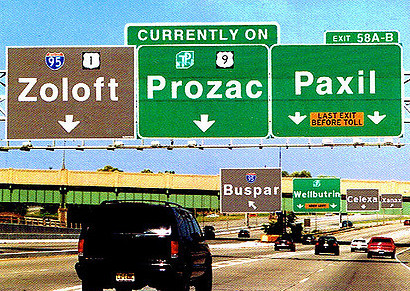
Tricyclics were about all the medical community had to offer until 1987, when Prozac hit the market, followed by its cousins Zoloft and Paxil. All of these were classified as SSRI drugs, ones that selectively acted on the neurochemical serotonin in the brain, rather than a wide variety of brain chemicals as the tricyclics had.

Since then we have listened to Prozac, talked back to Prozac, and been referred to as a Prozac Nation. Prozac has been hailed as a miracle drug, damned as a gateway to violence or suicide, and prescribed in phenomenal amounts.

And Prozac has helped me. After about six weeks on it, when the drug started to kick in, I was on a sailing trip. One of the crew said I was the passenger most at peace with myself that he knew. It was a revelation to me and a new way of thinking of myself.

Prozac changed my life – possibly saved it. And then, not so much. I moved on to other medications.

“Major Study Finds Antidepressants Work, But May Have Limitations,” by Brigit Katz, published on The Smithsonian.com, validates my perception.

Her article states, “A meta-analysis [or study of studies] of existing trials suggests that the drugs are mostly effective on a short-term basis for patients suffering from acute depression.” Katz’s article also cites articles in the New York Times and The Lancet that report similar findings.

The Lancet study “analyzed 522 double-blind studies that included 116,477 patients and 21 commonly prescribed antidepressants. The results of the study showed that all 21 of the antidepressants were more effective than placebos in reducing depressive symptoms during the first eight weeks of treatment.”

“The new analysis suggests, however, that the efficacy of the drugs may be limited,” Katz reports. “For one thing, the benefits applied in the short term, and only to patients who are suffering from acute major depression.” [emphasis added]

The Smithsonian.com article and the studies conclude that “while the new study suggests that antidepressants are more effective than a placebo, at least in some cases, media reports claiming [as an article in Newsweek did] that the research shows ‘antidepressants do work, and many more people should take them’ are not entirely accurate.”

(This hearkens back to a pet peeve of mine: that headline writers (who are almost never the authors of the articles) do a poor job of summarizing articles in favor of more definitive or appealing descriptions of the text. https://wp.me/p4e9Hv-Br)

At any rate, the meta-analysis bears out my experience. Although I was bipolar 2, my disorder first manifested as major depression. I got relief from Prozac, results that later diminished. Since my proper diagnosis I have found more relief from a combination of an SSRI, an anticonvulsant medication often used for bipolar disorder, and an atypical antipsychotic also useful for bipolar as well as schizophrenia. Even though I do not have seizures or schizophrenia, these medications work for me and have not worn off for several years now.

So, what’s the takeaway from all this? I think it is that, if your medication for bipolar or depression seems to be “wearing off,” your perception may indeed be valid. But that’s no reason to give up on psychotropics altogether. People and their disorders differ in ways we just don’t know. You can ask your doctor to try a different medication or combination of medications that may work better for you.

The benefits of medication for psychiatric disorders do not simply go away just because the effect of one does.

Read more: https://www.smithsonianmag.com/smart-news/major-study-finds-antidepressants-work-may-have-limitations-180968452/#vjLKOqe2JdKEWOe3.99

On Pain and/or Suffering

Recently, when I was reading Every Patient Tells a Story: Medical Mysteries and the Art of Diagnosis by Lisa Sanders, I came across this:

Eric Cassell, a physician who writes frequently about the moral dimensions of medicine, argues, in a now classic paper, that pain and suffering are very different. Pain, according to Cassell, is an affliction of the body. Suffering is an affliction of the self. Suffering, writes Cassell, is a specific state of distress that occurs when the intactness or integrity of the person is threatened or disrupted.

Later, when I was reading M Is for Malice, by Sue Grafton, I read this: “Pain was better than anxiety any day of the week and sweat was better than depression.”

The universe seemed to be telling me to focus my attention on pain and/or suffering.

Cassell (as quoted by Sanders), could have been (but probably wasn’t) talking about bipolar disorder when he defined suffering as “a specific state of distress that occurs when the intactness or integrity of the person is threatened or disrupted.” I certainly don’t feel intact or integrated while in the midst of a bipolar episode – either hypomanic or depressive. I suffer. My personhood is certainly threatened and disrupted.

It’s common to hear bipolar described this way: “I suffer from bipolar disorder.” I prefer to say “I live with bipolar disorder,” which I feel is more accurate. It’s always there, but I’m not always suffering. I live with it and it lives with me.

I think Cassell was wrong, though, about pain being a purely bodily sensation. I addressed the concept back in the early days of this blog. with a post called “Depression Hurts” (https://wp.me/p4e9Hv-6Z). In it I claimed that bipolar (or depression specifically) caused physical pain as well as emotional pain. I still maintain that one is as valid as the other and that they are virtually inseparable. The mind and the body not being entirely separate, or separable, you see. You get both for the price of one.

Grafton, on the other hand, through her character Kinsey Millhone, was talking about the physical act of running. We all know by now (or should) that exercise is recommended for those who have bipolar disorder or other mental/emotional conditions. But again, there is this idea that physical discomforts (pain and sweat) are better than emotional distress (anxiety and depression). She seems to be saying that pain is the antidote for suffering.

This can be dangerous territory. As someone who used to self-harm, I can easily see how one might think that pain is preferable to anxiety, or numbness, or dissociation – to suffering, that is. But in such cases, pain is really just another aspect of suffering, expressed in bodily terms. Again, the two are inextricably intertwined.

Personally, I would be delighted to avoid all four sensations – pain, anxiety, sweat, and depression. But I don’t think that’s possible, even with avoiding both exercise and self-harm. Sweat is the easiest to dispense with, thanks to modern toiletries, but there have been plenty of times when my anxiety has caused me to sweat. Think about being summoned to a tax audit, for instance, and you’ll see what I mean. Pain is unavoidable; no one goes through life without stepping on a nail or some such. Anxiety and depression occur at least occasionally in the neurotypical as well as the mentally disordered.

The human condition itself involves feeling both pain and suffering. Bipolar disorder involves both pain and suffering. Well, what do you know? We’re only human, after all.

Knitting Away Depression and Anxiety

Photo by Athena, Creative Commons

Last week I dissed a story that I read online about self-care for bipolar disorder, which consisted of praise for sleep, pets, and creativity, things which anyone with bipolar already knows are good for their mental health.

It was pointed out to me by someone who should know that I was wrong to make fun of the researchers, since they were students learning valuable lessons about how to conduct research studies in the first place. Which led me to believe that it was all the reporter’s fault for presenting their results as news.

Anyway, as an apology to researchers and grad students everywhere, I’m now going to praise a research study that would otherwise get a “well, duh” from me.

Huffington Post (UK) shared the good news:

Knitting could save the NHS [National Health Service] vital funds because it leads to a healthier population, reducing depression and anxiety, slowing the onset of dementia and distracting from chronic pain, a new report has found.

The study was primarily focused on the benefits of knitting for the aging, but since depression and anxiety were two of the conditions that it reportedly relieves, I thought it might be relevant to bipolar disorder too. Now someone can do a study to confirm or deny this idea.

The report added that knitting “is a sociable activity that helps overcome isolation and loneliness, too often a feature of old age,” and, I might note, of mental illness.

There are many, many articles that extol the benefits of creative pursuits for those with bipolar disorder and other mental illnesses. Although the notion of “basket-weaving” is outmoded and stigmatizing, other creative activities are commonly suggested as part of self-care. (I discussed this in a post called “Tools for Tackling Bipolar Disorder.”)

Coloring seems to be the most popular recent trend, but drawing, painting, collages, and all sorts of needlework are well thought of too. (I would certainly put crocheting in the same category as knitting.)

But then there’s the other side of bipolar – mania. I don’t know a lot about creativity and mania because I only get hypomania. But I do know that when I’m hypomanic I can get a lot of writing done. (Whether it’s good writing is another question.)

However, if you’ll forgive anecdotal evidence, I once knew a woman who did experience full-blown mania as part of her disorder and was not well controlled on medication. One year at Christmas she decided to make green velvet dresses for all three of her daughters.

As she spoke of her progress over the ensuing weeks, however, it was clear that the project was not going well. She kept rethinking – and redoing – all the sewing. She didn’t like the design, or she didn’t think they’d fit right, or she saw some other flaw. She never finished the dresses.

Other people may have better experiences with mania and creativity, of course. I hope you’ll share with me if you have.

The idea of creativity as a way to be sociable intrigues me. Sewing circles are a time-honored tradition among neurotypical people as well as those with mental disorders. (A friend of mine and her cronies had what they called the “Stitch and Bitch Club.”) Needlepoint, quilting, and indeed all of the fabric arts can be group activities.

For those who aren’t into those kinds of needle-centric activities, there are classes in scrapbooking, drawing, painting, ceramics, sculpture, or other creative art forms, often available through local adult education programs, museums, or shops that sell arts and crafts supplies. And of course, writers’ groups abound at bookstores and other venues (though presenting one’s own work at such a gathering may be too daunting for some with self-esteem issues).

I should probably get involved with a writer’s group myself. I’ve had to give up needlework because of my eyesight and shaking hands. But I’m all for doing something for my brain. Lord knows, it needs all the help it can get.


References:

http://www.huffingtonpost.co.uk/entry/knitting-linked-to-health-benefits-including-reducing-depression-and-slowing-dementia-report-reveals_uk_5aa63cb0e4b07047bec7feee?ncid=tweetlnkukhpmg00000001

knitforpeace.org.uk

“Tools for Tackling Bipolar Disorder” https://wp.me/p4e9Hv-uT


Why I Hate TV Drug Commercials

Just as a general rule, I dislike commercials for any drugs. They impede the doctor/patient relationship. (I’ve often considered saying to my doctor, “I’m supposed to ask you if Latuda, Humira, Prolia, Viberzi, Lunesta, Cialis, Trulia, Trintellix, Keytruda, and Boniva are right for me.”) TV – and to a lesser extent print – ads encourage people to act as unpaid drug reps. And they only advertise expensive drugs until they go generic, which is when they stop being expensive and the drug companies stop making so much money.

(If you want to read more on the issue, go to https://www.medicinenet.com/script/main/art.asp?articlekey=106198.)

But there are other things about TV drug ads that make me more than a little cranky. Like where are the ads for drugs to treat bipolar disorder?

Oh, there are ads for drugs to treat bipolar depression, as well as ones for treating non-bipolar depression. You’d think that with approximately 2.8 million people who have bipolar in the U.S. and Canada (http://www.pendulum.org/bpfacts.html), there would be a market for bipolar treatments.

Also, the ads for depression treatments don’t always get it right. A few of them say that depression is more than just sadness, or that it lasts for several weeks at least. One even says that depression is a “tangle” of symptoms, which is certainly true. (Although the tangle is shown graphically in primary red, yellow, and blue, which don’t really say “depression” to me.)

Most, however, treat depression simplistically, with hidden depression represented by a smiley face mask hiding a frowny face mask. (The colors in that ad are muted during the “before” scenes and more vibrant during the “after” scenes, which is an old advertising trick.)

The ads also make it look like the most important thing about depression is not spending time with your family or not enjoying it if you do. While that certainly is one symptom of depression, it is by-and-large irrelevant to people like me, who don’t have 2.1 school-age children to take on picnics. And it’s pretty much a guilt trip for people who do.

Then there’s how the people in the ads are represented. Oh, they almost always show one POC and one slightly older person (frolicking with the grandkids). But all of them are attractive. All of them are models. Are we supposed to identify with them? Or just expect to look like them when our depression lifts?

I wouldn’t be so annoyed by this issue if it weren’t that ads for other kinds of drugs – those for psoriasis and diabetes, for example – have actual people with the disorder in them. Testimonials from those who’ve been there, as it were. Even real-life cancer patients are now featured in ads for treatment centers.

What’s up with that, I wonder? Surely they don’t imagine that only pretty people get depression or bipolar. It can’t be that they can’t find any well-spoken, real-life people who can relate their own experiences. I for one would feel more reassured if I heard about a treatment from someone who’s lived with the disorder instead of from someone selected at a casting call. Are we all homely and illiterate? (I meet the qualification for literacy, at any rate.)

Instead of trying to convince us what medications our doctors might prescribe us, the airtime would be better spent on ads that educated the public on depression and bipolar disorder. But those would be PSAs, of course, appear only at 3:00 a.m., and not make anyone any money.

Update: I have finally seen an ad for a drug to treat bipolar 1 mania. Everything else I wrote here remains the same.


Books About Bipolar and Other Fun Topics

I love reading. Always have – except for the period when a major depressive episode stole it from me –https://wp.me/p4e9Hv-qp. I’m never more than two feet away from a book or, at this point in my life, an ereader. Reading is how I explore the world.

So naturally, in trying to better understand my disorder, I read about it. And because I’m interested in psychology in general, in addition to books about bipolar disorder, I read about other mental illnesses as well.

Let me share some of my reading with you.

For sheer delight as well as profound insights, try Jenny Lawson’s Furiously Happy: A Funny Book About Horrible Things. Amid the hilarious stories of life in her other-than-typical family are insights into depression and social anxiety, along with a manifesto of defiance – the will to be, well, furiously happy.

The other easily approachable book is Allie Brosh’s Hyperbole and a Half: Unfortunate Situations, Flawed Coping Mechanisms, Mayhem, and Other Things That Happened. What started as a humorous blog grew into a book (with quirky illustrations) featuring two chapters in particular, “Adventures in Depression” and “Depression Part Two,” which are about as good as writing about depression gets. A second book, Solutions and Other Problems, was scheduled but has been postponed indefinitely.

And while we’re on the subject of funny books about mental illness, there’s Surviving Mental Illness Through Humor, an anthology edited by Jessica Azar and Alyson Herzig.

Perhaps the best-known book in the field of bipolar disorder is An Unquiet Mind: A Memoir of Moods and Madness, by Kay Redfield Jamison. In it, Jamison deals openly and honestly with bipolar disorder, particularly with mania and psychosis, along the road to becoming a doctor herself. She has also written Robert Lowell, Setting the River on Fire: A Study of Genius, Mania, and Character, about the famous modern poet, but I haven’t read it yet, so I can’t comment.

Birth of a New Brain: Healing from Postpartum Bipolar Disorder, by Dyane Harwood, is another recent book that I haven’t read yet, either. But I know Harwood’s writing and expect it to be a stand-out, as well as the only book I know of on that particular topic.

Other books on bipolar disorder include Lost Marbles: Insights into My Life with Depression & Bipolar by Natasha Tracy.

For books about depression, the definitive work is The Noonday Demon: An Atlas of Depression, by Andrew Solomon. A thorough examination of depression, including the author’s own, it is practically a reference book on the topic, though much less dry than that makes it sound.

Darkness Visible: A Memoir of Madness, by William Styron, is another classic on depression that I really ought to read, but haven’t yet because I’m not that fond of Styron’s writing. (Sophie’s Choice is his best-known work.)

For mania, I recommend Just Like Someone Without Mental Illness Only More So: A Memoir, by Mark Vonnegut, M.D. The son of Kurt Vonnegut, Jr., the author deals less with his celebrity father, instead focusing on his saving-the-world-style mania during his pursuit of an M.D. degree.

Other books that I can recommend include:

  • My Lobotomy, by Howard Dully, a memoir of a boy who was lobotomized for no particular reason other than the fact that his stepmother hated him, and the difficulties he encountered in and out of institutions.
  • Ten Days in a Mad-House, by Nellie Bly, early undercover journalism at its finest. (I wrote about her experiences in one of my earlier posts: https://wp.me/p4e9Hv-hG.)
  •  Shrinks: The Untold Story of Psychiatry, by Jeffrey A. Lieberman, a history of the development of the field from the buried memories days to the biological understanding of today.
  • The Man With the Electrified Brain: Adventures in Madness, by Simon Winchester (who also wrote The Professor and the Madman, about the making of the Oxford English Dictionary). Despite the title, this is not about electroshock treatment, but rather dissociative states.
  • Rebooting My Brain: How a Freak Aneurysm Reframed My Life, by Maria Ross; and My Life Deleted: A Memoir, by Scott Bolzan. These books, about a cerebral accident and amnesia, respectively, don’t speak directly to bipolar disorder, but I found them interesting as accounts of rebuilding one’s life after a significant mental condition.

And for an opposing point of view, if you must, there’s Anatomy of an Epidemic: Magic Bullets, Psychiatric Drugs, and the Astonishing Rise of Mental Illness in America, by Robert Whitaker. Once you’ve read the title, you pretty much know how the book’s going to go; I don’t recommend this anti-psychiatry screed.

What books do you recommend? Which have helped you?

Using Facebook to Track Bipolar Depression

I never planned it this way, but I’ve just realized that I can track my moods (roughly) by looking back at my Facebook posts.

When I joined Facebook, I must have been in a hypomanic phase. Thanks to Facebooks “today’s memories” feature, I can see that I posted numerous things going on in my life and assorted weirdness I’d encountered, usually about language or science or feminism:

Plenty of food in the freezer. (Spare freezer outdoors.) Plenty of food in the fridge. (Spare fridge downstairs.) Plenty of seasoned firewood. Plenty of sweaters. Plenty of cat food. Plenty of cats. We’re ready.

Little to no snow here. But bring your brass monkeys inside tonight, folks!

Weird Non-Word of the Day:

bang (a fine word, except when it purportedly means the singular of bangs, the hairstyle)

I also posted an ongoing series of amusing or stupid headlines I saw on the Internet:

“Oh, Who the Hell Cares?” Headline of the Day:

Is 2014 the year of the biscuit?

Unless you’re a dog. Dogs care deeply about this.

Those were all from January 2014. And from 2013:

Just so you know – do not put a whole summer squash in the microwave. It will explode. This tip courtesy of someone who prefers his name not be mentioned. Thank you. You may now go back to whatever you were doing.

I was engaged. I was communicative. I was – dare I say it? – buoyant.

I was hypomanic, or at least on a level playing field.

This year I have taken two breaks from Facebook for my sanity’s sake, in reaction to all the negativity and bad news appearing there. When I do post, it’s always pass-along memes or cartoons. (I’m glad I’m still “alive” enough to find some things funny.) Occasionally I make comments or ask questions about my friends’ posts – but not damn often. I IM with one or two close friends, and that seems the most “productive” thing I do, some days. A series of days or months like that are a pretty clear indication that I’m on the downswing.

I understand that now Facebook’s memories feature will let you weed out bad memories, instead of reminding you of them and offering to repost them for all to see. (If only I could do the same for my brain!) The problem is, right now, you can only have them block references to certain people and certain dates.

Birthdays and holidays are tough for me, as I know they are for many of you, but, anymore at least, they are not so traumatic that I have to expunge them from my life. I can always choose not to repost them. Just as I can choose not to repost things I said that were about depressing topics – not getting a job, being angry about political bullshit, the death of a pet. The people I would block are already on my blocked list, or are ones I never “friended” in the first place.

Facebook also reminds me what I posted on my blogs in various years, and that gives me some idea of what I was thinking or feeling at the same time in various years. If I wanted or needed to, I could look through my Facebook memories and plot a graph of how my moods fluctuated from month to month, year to year. Yes, I know that there are software apps that will do this for you and that I could keep a mood journal or even a paper-and-pencil graph.

Instead I check my Facebook memories and re-repost things that I still think are funny.