Bipolar 2 From Inside and Out

Posts tagged ‘coping mechanisms’

Confessions of a Crazy Cat Lady

One can be a crazy cat lady without living alone in a cavernous house with a dozen or more cats. I should know. I am one, and I don’t.

First let’s start with definitions. I’m crazy. I think we all know that by now and I don’t mind saying so. (See “Yes, I Am Crazy. Thanks for Asking” http://wp.me/p4e9Hv-4h.) I’m also a cat lady. We had dogs growing up, but I never got very close with them. I did have a rabbit that I was awfully fond of, but this was in the days before lop-eared rabbits became house pets. She lived in a cage in the garage, or in the back yard when the weather was nice.

To me a crazy cat lady is someone who has eight or more cats, lives alone with them, usually in a large house, but one not quite big enough for all the inhabitants. Often you hear news stories about crazy cat ladies who die alone and are eaten by their cats, or crazy cat ladies whose pets are taken away from them because of inadequate care – especially sanitation.

I have a friend who was had more than eight cats at once, and is just as crazy as I am. She does not, however, believe that she is a crazy cat lady because another lady down the street has more cats. And truthfully, she doesn’t meet the other requirements of crazy-cat-lady-hood. She has a family, and keeps up with the care and feeding of her menagerie.

Do crazy cat ladies have an actual mental disorder? If so, do they all have the same kind? Maybe not. The crazy cat lady on The Simpsons (Eleanor Abernathy) is pretty clearly schizophrenic, though I doubt that many are in real life. Real-life cat ladies may demonstrate obsessive-compulsive tendencies, or their isolation may be due to depression. Or something else entirely.

Psychology Today tells us there is no real basis for the stereotype.

The stereotypic term “crazy cat lady” is used in a pejorative sense to classify an older, female animal hoarder and there is no research to support such correlation. Research on animal hoarding is lacking and there is not one plausible theory that suggests why older females tend to hoard animals more than men.

https://www.psychologytoday.com/blog/when-more-isnt-enough/201106/animal-hoarding-is-there-such-thing-the-crazy-cat-lady

Still, crazy cat lady behavior may be psychologically classified as a “hoarding disorder.” Mother Nature Network reports that the condition…

…is only now getting the recognition that will prove helpful to sufferers. Recent research has revealed abnormal brain activity in people with hoarding disorder. And both experts and hoarders hope and believe that the new DSM classification will help bring about better treatment.

Read more: http://www.mnn.com/health/fitness-well-being/stories/crazy-cat-ladies-to-get-a-new-clinical-definition#ixzz3nG9WWESM

I would make the case that crazy-cat-lady-hood is actually a defense against mental disorders. Carried to an extreme, perhaps, but beneficial nonetheless.

Caring for cats – even multiple ones – gives a person another living being to care about. Patients in geriatric facilities are often brought into contact with small domesticated farm animals or cats and dogs (therapy animals), which pretty clearly help them deal with isolation and depression.

For an isolated person, cats provide someone to talk to. Not that the cats necessarily listen or respond, of course, except in the most perverse ways possible. They are cats, after all.

I got my first cat when I was living alone and recovering from several years of psychological trauma. My future husband went with me to the shelter, but was studiously unhelpful in selecting a cat, thereby proving that he had some sense and a grasp of how important it was for me to find a kitty I could bond with.

“Which one should I get?” I asked.

“Gee,” he replied, “I dunno, honey. They all look like nice cats to me.” The one I chose was Bijou, a tortoiseshell.

We as a couple have since had up to five cats at one time, and through the years a total of well over a dozen.

When my bipolar disorder was at its worst, after I had suffered a major meltdown (nervous breakdown, decompensation, or whatever you call it), I was certainly crazy, but hardly a cat lady. I was unable to take care of my own daily needs, much less those of anyone else, human or feline. My husband, who was taking up enormous amounts of slack, took over pet care as well. Now that I’m back on a fairly even keel, I can do my part with feeding, litter box tending, grooming, and so forth.

Fortunately, even when I was immobilized, my cats, in addition to my husband, gave me emotional sustenance. The therapeutic effects of a purr, a gentle kneading, and a nice snuggle are not to be underestimated. The antics of a kitten may be exhausting to watch, but they provide more than a little distraction, if that’s what you need.

Do dogs have the same therapeutic effect? I don’t know. For some people I suppose they do, but I have never bonded with a dog as I have with my cats.

In psychological terms, my cats are “comfort objects,” like furry, living security blankets, or teddy bears that shit and meow. I hope never to be without a cat again. I need them for my mental health.
Social But Spoonless

In the past week I have been out of the house more and seen more people than I have in years. It’s almost like having a social life.

In the past week I have also slept more than I usually do in my sloth-like, torpid existence.

I think the two are not unrelated.

If you follow Spoon Theory (http://www.butyoudontlooksick.com/articles/written-by-christine/the-spoon-theory/) you know that each spoon represents an amount of coping that you can do.

Every day you get a certain number of spoons – not the same number every day.  You use them to perform everyday tasks that most people think nothing of – things like getting out of bed (some days you don’t even have that spoon), taking a shower (1/2 spoon for Janet’s patented “super-fast smelly-bits sink wash-up”), getting dressed, finding something to eat, fixing that something (keep a box of Cheerios by the bed in case you run out of spoons at this point), and all that is without even leaving the house. Some days that’s all the spoons you have and when you’ve used up your spoons, that’s it.

Other days you can manage to do all that and leave the house, go to work, run errands, and assorted other normal activities. But for those of us who have mental disorders, such days are few and far between.

You hear depressed people talk of not being able to get out of bed, and for the most part that’s caused by lack of spoons. I am usually notoriously low on spoons. My husband now understands Spoon Theory and we use it as common shorthand for “I’m too tired” or “That’s all I can handle right now.”

Dan, however, is an over-scheduler and I often have to rein him in by pointing out that his proposed slate of activities will not be possible because I, for one, will run out of spoons, and he may too.

The dry run for my recent spurt of socializing began last week. After I went for my final session with Dr R., I managed a trip to the bank, a trip to the place where I could pay my power bill, and since it was right next door, a stop at Kmart to buy underwear. It was a good thing that was a hypomanic day, but it floored me for the rest of that day and the next. And it started a cycle of bipolar up-and-down oscillations that were clearly related to spoon usage.

My spate of social endeavors started with a double-header. On Saturday I had lunch with a friend at a favorite restaurant I almost never get to go to. We talked about politics, social issues, and book proposals. Then I went home and had a little nap.

That evening Dan and I went to Monkey Bones for Zombie Dogz. I know that takes a little explaining. Monkey Bones is the tattoo studio where I got my semicolon tattoo (http://wp.me/p4e9Hv-9G). Zombie Dogz is a local food truck. (Also, it’s fun to say “We went to Monkey Bones for Zombie Dogz.”)

Notice that in a single day I had to get up, out of bed, and get dressed twice. That’s a lot of spoons. Sunday I was not able to get out of bed at all.

Monday did not involve socializing, but it was another hellacious spoon-eater. Dan and I spent the day scrounging for documents and information that the IRS wanted. It was taxing. (See what I did there?)

Tuesday was an extra-special social event, though it did not involve getting dressed and going out, or even interacting with other people. It was Jenny Lawson’s online book launch party. Better known as the Bloggess, Jenny has severe social anxiety. At this stage in my life, I certainly would not be able to dress up, mingle, and make polite conversation with both friends and complete strangers. The online party was a genius idea.

I sat at home in my pajamas with some red wine while the Bloggess read chapters from her new book, Furiously Happy. (You should get it, by the way. It’s about mental illness, but funny.) As low-key a social situation as that was, it still used up spoons because it was something I had never done before. Making sure I had the right URL, converting Central Time to Eastern, not being able to ask questions because I don’t Tweet, worrying that Dan was getting bored – not a lot a lot of spoons, but still some.

The effects were getting cumulative. Again I was unable to get out of bed the next day. In fact, Dan and I both slept away most of the daylight hours. For him it’s understandable because he works third shift, but I have no such excuse. Except that if you borrow from the next day’s spoons, or try to keep going without them, you will pay.

Thursday, I was determined, with or without spoons, I was going to meet a friend for coffee. I’ve seen her only once, briefly, in several years. In a way, it was a test of my ability to maintain anything approaching a real social life.

I put forth the extra effort because a mutual friend cut her ties with me because I canceled so often on social engagements. I suppose I really have nothing to prove to anyone but myself but it seems important that I do so. It’s not like coffee with a friend is an ordeal or anything. It’s just that I know I’ll be using a spoon for more than stirring my coffee.

And I hope I have enough spoons left over to work on my other blog.

The Quest for a Psychiatrist

I have been seeing Dr. R. for eight years. He helped me through my major meltdown and skillfully, gradually mixed the cocktail of medications that would get me and keep me functioning at an acceptable, livable level. He got me through my near-brush with ECT (although he also suggested it).

Dr. R. is moving to another state. He sent all his clients a letter listing half a dozen or so local psychiatrists he could recommend, though he didn’t know if they were accepting new patients or what insurance plans they took. This week was my last appointment with him.

I looked at the inch-thick file he was holding. “I was really messed up back then,” I said.

“Yep,” he replied.

I left with a hearty handshake, good luck wishes, a paper stating my diagnosis (bipolar disorder, anxiety disorder – I guess there was no insurance code for bipolar 2) and six months of refills on my prescriptions. That’s how long I have to find a new psychiatrist.

So where will my inch-thick file end up next? That’s a good question.

I’ve written before about finding a psychotherapist (http://wp.me/p4e9Hv-1m), but oh, I hate the process of finding and breaking in a new shrink.

At least this time I probably won’t have to go through the whole Reader’s Digest Condensed Version of my screwed-up life, since what I really need at this point is someone who will prescribe and monitor my meds, though it will also be nice to have someone standing by in case of another major meltdown, should I have one.

My first avenue of exploration is whether my primary care physician will prescribe my psychotropics, so I can continue with just a psychotherapist. Dr. R. says that most GPs would shy away from the somewhat lengthy list of meds, but every time I see Dr. S. I update him on what meds I am taking, and I always mention the psychotropics, which have mostly been the same for years.

I have an appointment to see Dr. S. next month and sent a query about the prescription issue (his office has a robust online presence), so with luck, I may have a solution before Halloween.

My next step would be to start with the list that Dr. R. provided. Only one of the offices is at all close to me and I’ll likely start there. Does the doctor accept new patients? Does the practice take my insurance? What’s the charge if they don’t?

I’ll also need to contact my insurance provider for a list of local psychiatrists who do take that insurance, but with that I’ll be flying blind. Dr. R.’s recommendations are people he knows, and knows are good.

I hope they’re as good as Dr. R.

When Anxiety Attacks

I was grocery shopping and when I came to the cereal aisle, I found myself light-headed and breathing raggedly.

My husband dropped a knife in the kitchen; I jumped and all my muscles tightened up.

We were driving down the highway, when suddenly I flung my arms out to the side and gasped loudly.

In none of these cases was anything actually wrong. (Although the incident in the car nearly caused an accident when my husband turned and yelled, “What? What?”)

My depression has always been accompanied by anxiety. That’s one of the reasons I was later given a diagnosis of bipolar disorder, type 2. It seems that, where other people get hypomania, I get anxiety. (There is a thorough explanation of bipolar disorder and anxiety (or “mixed states) at http://psycheducation.org/diagnosis/mixed-states/anxiety-and-bipolar-disorder/.)

I have had generalized anxiety, where I have no idea whether anything specific is actually wrong or doom is impending. I have had phobic-type anxiety, where I imagine that any bee in the neighborhood is going to choose to sting me and I freeze up. I have had anxiety reactions to loud noises or sudden movements, where I feel like I’m jumping out of my skin and actually do physically jump. And I’ve had irrational moments of anxiety, as when I can’t sleep because I don’t know where I put my passport. (Naturally, I have to get up and look for it.)

Now that I am relatively well controlled on medication, the various anxieties don’t plague me nearly as much. And I’ve developed coping mechanisms for a number of them. For example, when I get anxious in the car on the highway I no longer fling out my arms and gasp. My husband notices my tension and asks if anything would make me feel better. “Drive in the other lane,” I say, “and not next to the concrete divider.” I take an extra Ativan (which my doctor allows) before social events I can’t avoid. My husband warns me if he is going to hammer a nail in another room, or reassures me that the cat just knocked over a glass.

I still don’t know what was going on in the cereal aisle. I thought it might be the imposing wall of large, brightly colored boxes, visual noise that seemed to overwhelm me. My therapist at the time said that it was likely that I was just having a random anxiety attack and happened to be in the cereal aisle when it happened. After that I associated the two.

Now I’m not sure. I may have been right about the visual noise. Auditory noises certainly provoke anxiety in me, and I know that some people on the autism spectrum can be overwhelmed by visual stimuli. (I’ve never been diagnosed on the autism spectrum, but I do share certain traits with Aspies.)

I think the anxiety will always be with me, to some extent, just like the depression. My meds make them bearable and my ways of handling them improve. But I don’t think I’ll ever get used to the fact that there are bees, wasps, and ticks in the world, all of them with a thirst for my blood.

Music Charms the Troubled Mind

Once I knew a man whose wife was going to leave him. I knew he was in a lot of pain and despair about it, though he also turned into a huge asshole before everything was said and done. He was also suicidal for a time.

One day when I was trying to talk him through a bad patch, I asked whether he might turn to music to help him. “What?” he said. “Do you think I should listen to country music and cry in a beer?”

I wasn’t suggesting that at all. I just knew that he was a singer and songwriter of talented amateur status and was known for this in various circles. I honestly thought that music might help.

On the other hand, I always forget, when I am on the downswing, how much music can do for me. It soothes and heals, but it also lets me tap into the emotions that I have been suppressing.

Do I have the inexplicable blues that are part and parcel of my condition? There’s a song for that. Am I feeling unrequited love? Unrequited lust? There’s a song for those too. Is the world spinning too fast for me? Do I need to know that everything will be all right? Or do I just need to know that someone, somewhere and somewhen, has also felt this way? I can turn to music.

“Music, uniquely among the arts, is both completely abstract and profoundly emotional. It has no power to represent anything particular or external, but it has a unique power to express inner states or feelings. Music can pierce the heart directly; it needs no mediation.”
– Oliver Saks, Musicophilia

Saks also says, “The power of music, whether joyous or cathartic, must steal on one unawares, come spontaneously as a blessing or a grace.” There he and I part company.

Music can certainly steal on us unawares, whack us upside the head with a memory, a feeling, a piercing stab of emotional intensity, all the stronger for being unexpected.

But we can also choose to bring music into our lives when nothing else seems to touch us. We can tap into those memories and feelings – good or bad – and let the music wash over us as we listen and feel.

According to scientific experiments with fMRI, music uses more parts of the brain than almost any other activity. The neural connections fire all over the place – more so if one is playing an instrument, but even when just listening. The memory centers, artistic areas, language centers, emotional areas – even the motor complexes – are stimulated.

My problem is remembering all that music can do for me. When my emotions are dulled, flattened by the steamroller of depression, I sometimes forget that I can be any other way. The music I love is always there for me. I can bathe in it, wallow in it, be uplifted by it, float on it, join in with it, feel it emotionally and viscerally and intellectually all at once or one at a time. It can express the things that I just can’t.

When you’re depressed is a time for writing bad poetry. Or you can let good poets and songwriters take you with them as they explore the human condition in ways you’re not capable of. I think that’s why they do it – create their art. The really good ones anyway.

There’s also something to be said for music as distraction. A song from years ago – even a frivolous one – can take you away from your troubles, even if only for a moment. This is not the time for exploring new musical avenues. Remembering that things once were good can feed your sadness, your depression, but it can also give you perspective. If you took joy in this music once, there will come a time when you will again. And maybe that time is now.

Perhaps the most amazing power of music is to provoke catharsis. Certain songs leave me sobbing like a baby. They don’t even have to be sad songs, though many of them are. “The Mary Ellen Carter” by Stan Rogers is about as life-affirming as you can get, but it can still turns me into a weeping puddle. (https://www.youtube.com/watch?v=Fhop5VuLDIQ) His song “Lies” has nothing to do with my situation personally, but its evocative power touches me nonetheless. (https://www.youtube.com/watch?v=D79XOc1vKzQ) And almost no one I know can make it through Kathy Mar’s “Velveteen.” (http://www.last.fm/music/Kathy+Mar/_/Velveteen)

Afterwards, I feel drained and, if not exactly better, less emotionally constipated, I guess you’d say. Clearing away a bit of blockage can be cleansing. If music can do that – and it can – then I don’t care if its country with a beer, jazz with a glass of wine, or hip hop with an energy drink. Even easy listening with a glass of milk, if that’s your thing.

So thank God and Apple for iTunes. And here’s hoping that my Swiss cheese of a memory will give me a nudge in the right direction when I need it next time.

I Have This Friend . . .

To have a friend, be a friend.

That’s how the saying goes, and it goes double for friends with mental disorders.

But.

There are limits. Boundaries. You may call them self-serving or self-saving, but there they are.

When you are depressed, you neglect friends, and I have certainly done that. I permanently lost one friend over it. But another kept reaching out to me and I eventually responded. (We then had a good game of “I’m a bad friend.” “No, I’m a bad friend.” She thought she hadn’t reached out often enough. I was glad she put up with my silence as long as she did, until I was able to reach back.)

But I have this friend. We used to be tight. When we were both depressed, we shared our misery and so lessened it. But now that the Pit of Despair is no longer my permanent abode…I have to limit my contact.

Why? My social skills have never been terrific, but now I frequently find myself walking that invisible line between Bad Friend and burnout.

Why is it so hard to be a Good Friend?

First, there is the Disaster Report. Whenever I talk to her, I hear a litany of all that is going wrong in her life. Almost never anything else. I’m no fan of relentless positivity, but its opposite is sometimes hard to bear too, even though I’ve been guilty of the same.

Then there is the fact that any suggestions are pushed away, denied as impossible, dismissed as unworkable. Granted, we have completely different styles of coping, but I feel discounted, unheard. Eventually I gave up sharing anything but a few of my own tribulations, some awful jokes, and commiseration.

Then I get off the phone or off Facebook, usually after half an hour or so. That’s about my limit.

I still keep reaching out. I don’t want to be a Bad Friend. I know I can’t fix her, or even her day-to-day difficulties, the kind even non-depressed people have. But I sure wish there were a way I could help, short of climbing down into the Pit with her. I hope that listening, even half an hour at a time, does some good.

And when I talk to other friends of mine, I try to remember to ask how their day was and what’s new in their life and have they seen any good movies and what is a mutual friend doing. I try to listen if they have something to share, good or bad, and I try not to overwhelm them or play whose-life-sucks-the-most. I try to be a Not-Bad Friend, even if I do have to lean on my friends, at times pretty heavily.

And they do likewise, when they can.

In Defense of the Armadillo

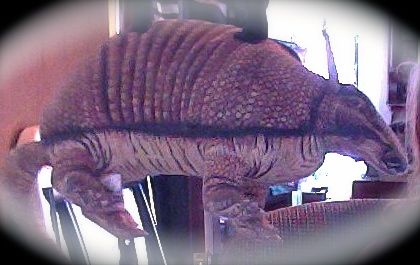
Let’s consider the armadillo. Better yet, let’s consider this brief video. Take note of the armadillo’s defense mechanisms, if you will.

I have always identified with the armadillo, for a variety of reasons. It is the symbol of Texas music, which I love. I have a purse shaped like an armadillo. I also have toy armadillos, crocheted armadillos, wooden, stone, cement, armadillo jewelry, you name it. My uncle and I have a catch-phrase: El armadillo amarillo de mi tía es sobre la mesa.

What does all this have to do with bipolar disorder? I’m glad you asked.

Most of all, I admire the armadillo for its defense mechanisms, which resemble some of mine. For those of you who skipped the video, here’s a recap.

The armadillo has armor (obviously). I have tried to construct a similar impervious shell. When I have been even partially successful, it has proved counterproductive. When you wall off feelings, you wall off the good ones too.

The armadillo rolls up in a tight ball. I isolate. This has also proved counterproductive. If sorrow shared is halved and joy shared is doubled, then isolation – well, you do the math.

The armadillo leaps vertically when threatened. My anxiety makes me jump and release fight-or-flight hormones. This defense is also counterproductive, both for the armadillo and for me. One of the armadillo’s main predators is the automobile; the armadillo jumps straight up to bumper height. I waste energy on panicky behaviors even when I’m not threatened.

The armadillo has a low body temperature and is therefore useful for research on leprosy. This is not a defense mechanism, but it is a Fun Fact to Know and Tell. I have never had leprosy.

All things considered, the armadillo is not a good role model for a person (me) with bipolar disorder. But I like them anyway. They remind me that I need to check whether my defenses are doing me harm rather than good.

Plus, with my armadillo handbag I get lots of practice in the social skill of making light conversation strangers – and even children!

Erma

Erma

The Lighter Side of Insomnia

I’ve had insomnia. Lots. January seems to be an especially bad time of year for me. A sleeping pill reduced the frequency, but nothing banishes it completely – the obsessive thoughts, the catastrophizing, the worrying, the worrying about how worried I am. We’ve all been there at 3:00 a.m., trying to will ourselves to sleep.

What could possibly be light-hearted about that?

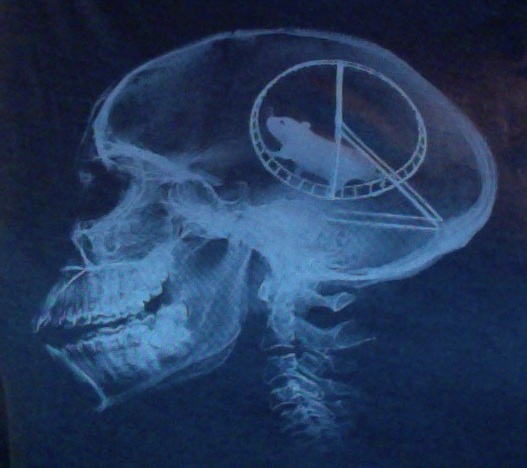
Just this: An actual x-ray of my insomniac self:

T-shirt by Headline Shirts. Photo by me.

Indeed, my friend Leslie and I, both afflicted with insomnia, recognized this as our mutual problem. We began to end our late-night commiseration with the sign-off, “Death to Hamsters!”

Our mutual friend, the incomparable, incorrigible Tom Smith, heard of this and ran with it. Here is the result, for your amusement.

Imagine, if you will, this performed as a sing-along with a hundred people joining in on the chorus. It may not put you to sleep, but at least it puts insomnia in some kind of loony perspective.

At least it does for me.

Notes:

No hamsters were harmed in the making of this blog post. A rubber duck may have been squeezed, but it had nothing to squawk about. So if you’re with PETA, chill already.

Lyrics to Hamster Brain available here: http://www.tomsmithonline.com/lyrics/hamster_brain.htm.

The Abilify Saga Continues

It turns out, Abilify works for me. Except now I have to work for Abilify. To afford it, I mean.

I now wake up around 7:30 or 8:00 instead of 10:00. I can concentrate long enough to read whole chapters of books, and am enjoying that immensely. I am able to get showered and dressed and go out to run a few errands. I can decide what to eat and even recognize when it’s time for me to eat.

And I can work. I have taken on a mega-project, which has required my attention up to eight hours a day, researching, writing, editing, and proofreading. I don’t know how well I’m doing (there are some differences of opinion about that), but I’m doing it, goddammit.

I may be pushing myself a little too hard, despite the new energy and focus. The other day I had to force myself, one pitiful step at a time, to address a dozen Christmas cards. “You have the list, you can put the addresses on the envelopes. You’ve got enough stamps, you can surely put them on the envelopes. (Don’t call me Shirley.) Better put return addresses on. You can do that much, then stop. You can slip the cards into the envelopes. How hard can that be? You had them printed with your names, so you don’t really have to sign them if you don’t want to and won’t have to fake your husband’s signature because he’s not here. That would be too much. Now lick the envelopes. All you have to do is stick out your tongue. Might as well take them to the mailbox. You need to get cat food out of the car anyway. Okay, now you can crash. Egg sauce, Ted.”

Many’s the year when all that was Just Too Much. According to the Mystic Law of Reciprocal Cards, we get about four nowadays, and are very grateful for those.

And grateful for the Abilify. Except it’s $800 a bottle, even for the tiny dose I’m taking. I got one free month and one discounted month ($650) from the manufacturer and have spent a lot of time since worrying and seeking solutions.

There will (we hope) be a generic in April. Yay.

I know someone who was taking it and has some left over.

I know someone in Canada.

Will my doctor prescribe a higher dosage so I can break them in half and stretch them (and the cost) out?

I may have at last solved the problem. After hours on the phone and hours more on hold, we finally have new insurance. It costs about as much per month as a bottle of Abilify, but the drug benefit kicks in before we’ve paid the deductible (which is way lower than previously). So our many, many other drugs will magically shrink to $15 per – or less with mail-away – and we’ll come out ahead. A little. Probably. If I can keep up the pace on work.

Plus, now we have dental, and oh lord do I need that. But that’s another story for another time.

Happy Humbug

It’s a truism that holidays are difficult, not to say hazardous, for those of us with mental disorders. But there are a variety of reasons and a variety of reactions and – dare I say it – a variety of coping mechanisms.

First, let me say, that despite the fact that I was already depressed or bipolar as a child, the holidays were marvelous. Our granny, maiden aunt, and uncle lived a few hours away and we spent Every Holiday there. (My uncle drank, but not when we were kids.)

On Thanksgiving, we’d arrive, the adults would eat themselves into a coma, and then nap while we kids were sent of to the movies.

Christmas was similar, except that we’d get up, open presents from our parents (and “Santa” for the biggies), pile into the car, and head to granny’s. The adults would eat themselves into a coma, and then nap while we kids were sent of to the movies. (I specifically remember The Sting and The Andromeda Strain, during which I saw my first picture of a naked male butt.)

There was no tension involved – no grand dining table, no fancy dress, no distant relatives, no formal manners. We’d simply fill a plate with home cooking, perch on a sofa (which was called the davenport) or chair, and chow down.

My birthday falls between Thanksgiving and Christmas, but poised well enough between the two that it was never combined with either one. Back then, birthdays were simple – cake and frosting from box mixes, four to six neighbor kids, presents (no gift bags), and maybe a couple of party games. (It was at someone else’s birthday party that I was traumatized during a game of Pin the Tail on the Donkey.)

How could anything in later life measure up to those?

Well, it couldn’t. My first Thanksgiving away from home was when I was at college, and we ate lasagna, not turkey. I believe it was the first time I had lasagna. Ever.

Since then all the holidays have gone downhill, or I have.

Any more, they’re a chore, a relentlass gray blob from November through January. (Halloween starts it off. I can’t get with that either.)

For years, I kept up some of the traditions for my parents’ sake. My mother in particular loved everything to do with Christmas – the Macy’s parade, the tree with my father’s favorite old smudge-faced angel on top, crocheted holiday sweaters and snowflakes and handmade ornaments from her foreign penpals and neighbors and church friends.

.muzz3

My first Christmas in my own apartment, I had a small fake tree. When I got married my husband and I tried to get into the spirit with surprise gifts and selecting and decorating my mother’s tree and inviting a divorced friend to dinner with us.

But I was sinking rapidly. At various places I worked, all the ladies sported store-bought Christmas sweaters and sweatshirts (Halloween ones, too) that I thought were just awful. But one year, in a desperate attempt to fit in, I bought holiday sweaters on sale in January to wear the next year. Of course, by then I had lost the job.

Dan and I continued the tradition of dining with our friend John, but our venue changed to Chinese restaurants, where we were kept company by Jews, pagans, atheists, and, no doubt, other depressives and bipolars.

One year Dan was visiting his mother and I was on my own. I tried. I really did. I trotted out a festive holiday sweater and little wrapped-present earrings, and went out to a buffet that offered turkey and beef and ham. But I sat by myself and listened surreptitiously to my iPod. And not holiday music, either. By then about all I could stand was the Christmas jazz from the Charlie Brown TV show.

This year, we ate out on Thanksgiving – but not at the swanky hotel buffet we sometimes took my mother to, or any of the other mega-buffets. We went to a diner that John used to love. I had pork chops and lemon pie. On Christmas I’m likely to be by myself again and may just get festive with a Stouffer’s mac-n-cheese.

Comfort food seems appropriate, and the cats like to lick the dish. Then for dessert – Zoloft and Ativan and Lamictal and Abilify and Ambien. Yum. Visions of psychotropics dance in my head.


P.S. I wrote about a Thanksgiving with John on my other blog. If you’d like to see it, go to http://janetcobur.wordpress.com/2014/07/25/thanksgiving-ratatouille-and-a-near-death-experience/

And if you’d like to see my rant about the “War on Christmas,” go to http://janetcobur.wordpress.com/2014/11/09/lets-call-a-truce-on-christmas/