Bipolar 2 From Inside and Out

Posts tagged ‘coping mechanisms’

The Abilify Saga Continues

It turns out, Abilify works for me. Except now I have to work for Abilify. To afford it, I mean.

I now wake up around 7:30 or 8:00 instead of 10:00. I can concentrate long enough to read whole chapters of books, and am enjoying that immensely. I am able to get showered and dressed and go out to run a few errands. I can decide what to eat and even recognize when it’s time for me to eat.

And I can work. I have taken on a mega-project, which has required my attention up to eight hours a day, researching, writing, editing, and proofreading. I don’t know how well I’m doing (there are some differences of opinion about that), but I’m doing it, goddammit.

I may be pushing myself a little too hard, despite the new energy and focus. The other day I had to force myself, one pitiful step at a time, to address a dozen Christmas cards. “You have the list, you can put the addresses on the envelopes. You’ve got enough stamps, you can surely put them on the envelopes. (Don’t call me Shirley.) Better put return addresses on. You can do that much, then stop. You can slip the cards into the envelopes. How hard can that be? You had them printed with your names, so you don’t really have to sign them if you don’t want to and won’t have to fake your husband’s signature because he’s not here. That would be too much. Now lick the envelopes. All you have to do is stick out your tongue. Might as well take them to the mailbox. You need to get cat food out of the car anyway. Okay, now you can crash. Egg sauce, Ted.”

Many’s the year when all that was Just Too Much. According to the Mystic Law of Reciprocal Cards, we get about four nowadays, and are very grateful for those.

And grateful for the Abilify. Except it’s $800 a bottle, even for the tiny dose I’m taking. I got one free month and one discounted month ($650) from the manufacturer and have spent a lot of time since worrying and seeking solutions.

There will (we hope) be a generic in April. Yay.

I know someone who was taking it and has some left over.

I know someone in Canada.

Will my doctor prescribe a higher dosage so I can break them in half and stretch them (and the cost) out?

I may have at last solved the problem. After hours on the phone and hours more on hold, we finally have new insurance. It costs about as much per month as a bottle of Abilify, but the drug benefit kicks in before we’ve paid the deductible (which is way lower than previously). So our many, many other drugs will magically shrink to $15 per – or less with mail-away – and we’ll come out ahead. A little. Probably. If I can keep up the pace on work.

Plus, now we have dental, and oh lord do I need that. But that’s another story for another time.

Happy Humbug

It’s a truism that holidays are difficult, not to say hazardous, for those of us with mental disorders. But there are a variety of reasons and a variety of reactions and – dare I say it – a variety of coping mechanisms.

First, let me say, that despite the fact that I was already depressed or bipolar as a child, the holidays were marvelous. Our granny, maiden aunt, and uncle lived a few hours away and we spent Every Holiday there. (My uncle drank, but not when we were kids.)

On Thanksgiving, we’d arrive, the adults would eat themselves into a coma, and then nap while we kids were sent of to the movies.

Christmas was similar, except that we’d get up, open presents from our parents (and “Santa” for the biggies), pile into the car, and head to granny’s. The adults would eat themselves into a coma, and then nap while we kids were sent of to the movies. (I specifically remember The Sting and The Andromeda Strain, during which I saw my first picture of a naked male butt.)

There was no tension involved – no grand dining table, no fancy dress, no distant relatives, no formal manners. We’d simply fill a plate with home cooking, perch on a sofa (which was called the davenport) or chair, and chow down.

My birthday falls between Thanksgiving and Christmas, but poised well enough between the two that it was never combined with either one. Back then, birthdays were simple – cake and frosting from box mixes, four to six neighbor kids, presents (no gift bags), and maybe a couple of party games. (It was at someone else’s birthday party that I was traumatized during a game of Pin the Tail on the Donkey.)

How could anything in later life measure up to those?

Well, it couldn’t. My first Thanksgiving away from home was when I was at college, and we ate lasagna, not turkey. I believe it was the first time I had lasagna. Ever.

Since then all the holidays have gone downhill, or I have.

Any more, they’re a chore, a relentlass gray blob from November through January. (Halloween starts it off. I can’t get with that either.)

For years, I kept up some of the traditions for my parents’ sake. My mother in particular loved everything to do with Christmas – the Macy’s parade, the tree with my father’s favorite old smudge-faced angel on top, crocheted holiday sweaters and snowflakes and handmade ornaments from her foreign penpals and neighbors and church friends.

.muzz3

My first Christmas in my own apartment, I had a small fake tree. When I got married my husband and I tried to get into the spirit with surprise gifts and selecting and decorating my mother’s tree and inviting a divorced friend to dinner with us.

But I was sinking rapidly. At various places I worked, all the ladies sported store-bought Christmas sweaters and sweatshirts (Halloween ones, too) that I thought were just awful. But one year, in a desperate attempt to fit in, I bought holiday sweaters on sale in January to wear the next year. Of course, by then I had lost the job.

Dan and I continued the tradition of dining with our friend John, but our venue changed to Chinese restaurants, where we were kept company by Jews, pagans, atheists, and, no doubt, other depressives and bipolars.

One year Dan was visiting his mother and I was on my own. I tried. I really did. I trotted out a festive holiday sweater and little wrapped-present earrings, and went out to a buffet that offered turkey and beef and ham. But I sat by myself and listened surreptitiously to my iPod. And not holiday music, either. By then about all I could stand was the Christmas jazz from the Charlie Brown TV show.

This year, we ate out on Thanksgiving – but not at the swanky hotel buffet we sometimes took my mother to, or any of the other mega-buffets. We went to a diner that John used to love. I had pork chops and lemon pie. On Christmas I’m likely to be by myself again and may just get festive with a Stouffer’s mac-n-cheese.

Comfort food seems appropriate, and the cats like to lick the dish. Then for dessert – Zoloft and Ativan and Lamictal and Abilify and Ambien. Yum. Visions of psychotropics dance in my head.


P.S. I wrote about a Thanksgiving with John on my other blog. If you’d like to see it, go to http://janetcobur.wordpress.com/2014/07/25/thanksgiving-ratatouille-and-a-near-death-experience/

And if you’d like to see my rant about the “War on Christmas,” go to http://janetcobur.wordpress.com/2014/11/09/lets-call-a-truce-on-christmas/


Cutters

If that title wasn’t enough of a trigger warning, well, here goes:

TRIGGER WARNING: Self-Harm

Recently a small discount store a couple of miles from my house was caught up in a furor because a “Princess Wand” toy they were selling (ominously named an “EvilStick”) would reveal a hidden image of a teenage girl cutting her arm with a knife. Here’s a link to a local news story about it, and the snopes.com report verifying it. If you want to, you can easily search out a copy of the image, but I don’t recommend it.

Self-Injury

http://www.snopes.com/photos/odd/evilstick.asp

The “toy” is in horrifically bad taste (so, for that matter, is the snopes article’s headline, “Wristcutters – A Toy Story”). But items that adults consider dreadful can attract kids (remember the Garbage Pail Kids trading cards?). The image of the teenage cutter looks like a macabre Halloween costume rather than anything realistic (I’ve seen it), but we don’t really know whether a mistake, an error in judgment, a misunderstanding, or a prank at the factory that went way over the line resulted in the image on the toy. I kind of hope so, because if it was intentional, that’s way worse.

But bad taste is the least of the problem. The toy and the reaction to it have introduced the subject of cutting to a wider audience, if they choose to look beyond the squick factor and think about what the image really means. Cutting is a reality that’s mostly hidden from view.

Of course, it’s not always cutting. Burning is popular too. But cutting is perhaps the most common name. There are websites devoted to it, some offering help, facts, and information on quitting (see below) – but others glorifying it as, I don’t know, a creative expression of teen angst or something.

The name does keep changing. The last I heard, the “approved” psychiatric term was “Non-Suicidal Self-Injury” (NSSI). Self-mutilation, deliberate self-harm, non-fatal self-harm, self-destructive acts, self-inflicted violence, parasuicide, and self-wounding are all names for the dangerous practice performed by desperate people. The subject still isn’t talked about much and carries a huge stigma. As if the mental and physical scars were not enough.

Some facts: Self-harm is not attempted suicide, though with some miscalculation it can lead to serious permanent injury or death. Most people associate it with teenage girls, but I’ve know at least one man in his 50s who cut himself fairly regularly. It is not a matter of attention-seeking, since most cutters hide their physical wounds.

As I understand it, the practice results from one of two phenomena: the build-up of painful pressure such as perfectionism, or a feeling of severe alienation to the point of numbness. Cutting is a coping mechanism, though a dangerous, dysfunctional, and unsuccessful one, to deal with pain.

In my case, it was probably the numbness. I was feeling a lot of psychological pain at the time (college age) and irrationally wondered if physical pain would lessen that, or increase it, or feel any different. Like I said, irrational. All this was before I was diagnosed bipolar, had a therapist, or was medicated.

I made a few small cuts on my wrist to watch the blood well up. (Ironically, they became mildly infected; I neglected to sterilize the knife.)

I wasn’t suicidal. They weren’t that kind of cuts. I do know the difference. (I didn’t realize that I could have damaged tendons or nerves in my hand or arm, perhaps permanently.) It was more like when you stand on a bridge or balcony and look over the edge. You walk away. But you know the bridge is always there.

All told, I cut myself maybe three or four times. The scars are very faint now, white against my pale inner wrist, almost invisible. The memories are vivid. A friend who’s a psychologist once asked me why I stopped. “Because I didn’t need to any more,” was the only answer I could give. I’ve only felt the urge once since, and it was easy enough to push aside. But I recognized it.

I hesitated to write and post this, though I knew I would have to sooner or later, if I meant this blog to share my experiences truthfully. One of my dearest friends once said that if he ever found out I was a cutter, I would never hear from him again. Except for his publicly mocking me for being so stupid.

Naturally, this sort of reaction, though common, is not helpful. I didn’t tell him (or practically anyone else). And I didn’t tell him that at least two other people he knew – one fairly intimately – were also cutters.

Anyway, Tom, if you’re reading this and still feel the same, I guess this is goodbye – just not the long goodbye. I would rather skip the public mocking, though. I’ll just assume you’ve done it while I wasn’t there, mm-kay?

Cutting isn’t going away if we ignore it. It won’t go away even if we do talk about it. (Or mock it, or gasp in horror.) But understanding self-injury is a big step.

If you’re a cutter, or know someone who is, here are some places you can go for information, hope, and help:

On the Inside

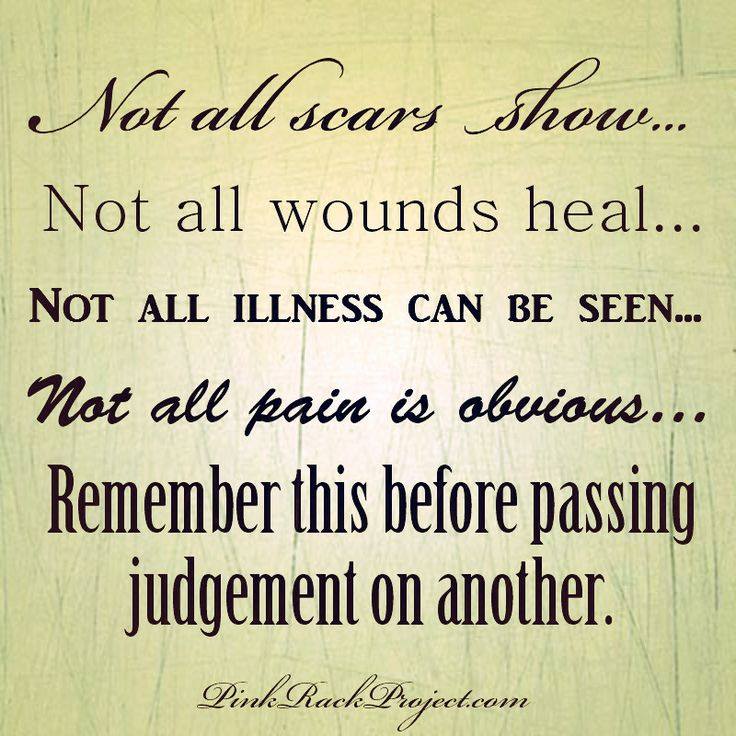
I saw this pass-along the other day and felt compelled to, well, pass it along.

wounds

It reminded me of a lot of things. Things I try not to remember.

Not all scars show. Some of mine do. The one where kids threw a rock at me, requiring seven stitches in my forehead. The ones where I cut myself. (I’ll write more about that later.)

Others don’t. I’ve often described my relationship with Rex as a train wreck. People wonder why I haven’t gotten over it, all these years later. It was the sort of train wreck in which you lose pieces of yourself, some of them irreplaceable. These scars aren’t the visible kind.

Not all wounds heal. Especially the wounds that happen when you’re too young to know how to treat them. Cutting words. Emotional bruises. Neglect. Loneliness. There are no bandages that can cover them, no ointments that can soothe them, no miracle cures.

Not all illness can be seen. If we’re high-functioning or have learned enough coping mechanisms, others may not notice. But bipolar disorder – and other mental illnesses – are, if not immediately visible, lurking just below the surface. And ready to break through at any time.

Not all pain is obvious. But it can leak out, especially around the eyes.

Remember this before passing judgment on another. But judgment-passing is practically an Olympic sport these days, along with shaming.

Scars. Wounds. Illness. Pain. These are things that those of us with mental disorders know all too well. What if our conditions are chemical imbalances in our brains? The consequences of having them, the misunderstandings they cause, the messages we receive, the behaviors we can’t understand or control or mimic, the friends we lose, the opportunities and joys we miss out on, are very real. And don’t let anyone tell you different.

Our disorders may be in our brains, but they’re not all in our heads.

But you knew that, didn’t you?

For Sharing

http://www.upworthy.com/these-9-college-students-want-to-tell-you-about-their-mental-illnesses?c=ufb1

Don’t give in to stigma. If you dig this video, share it so more people with mental illness can leave shame behind.

Can’t Write Today, So Here’s a Cat

maggie

I have been avoiding the Internet for days (and TV news and commentary as well) because I just can’t handle it right now. Actions, reactions, reactions to the reactions, et endless cetera. I’m depressed enough without all that.

There are plenty of thoughts I have on the Isla Vista shootings, and the media coverage of it, and mental health, and gun regulations. I’m sure most of them have already been said, and probably better than I could, and everything about the subject makes me angry, confused, outraged, despairing, hopeless, helpless, and majorly depressed.

Then there’s everything I’ve read lately about bodily autonomy and male privilege and the “war on women” (why does everything have to be a war?) and politics and climate change and all of those make me angry, confused, outraged, despairing, hopeless, helpless, and majorly depressed too.

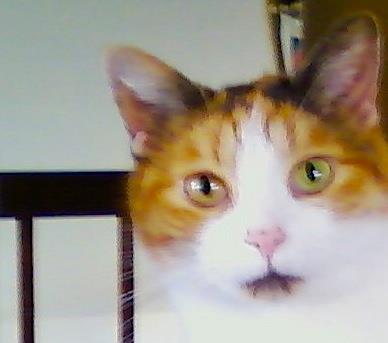
But it is TBT, so here is a picture of Maggie, a cat who saw the glowing design on Dan’s forehead that reads “Sucker.” He instantly scooped her up and brought her home. She was thereafter totally devoted to him. He could arouse her to a fever pitch of writhing and seduction with only the use of his voice. I mean, if they had been the same species, I wouldn’t have stood a chance.

Maybe next week I’ll have pulled myself together a bit and can write about something. For now, I’ll just say the best things that have happened to me today are a head-bonk, a nose-touch, and two nose-licks from Dushenka (Little Soul) with the Crazy Eyes.

Dushenkacu

Yours truly,

A Truly Crazy Crazy Cat Lady


Cookie Theory

Many of you are probably already familiar with Spoon Theory (and if you’re not, go here and read it: http://www.butyoudontlooksick.com/wpress/articles/written-by-christine/the-spoon-theory/).

In my previous post, I explained my Theory of Misery and Math. This week, inspired by something a friend posted, I will expound on Cookie Theory. Here’s the post:

argument

As I commented then, even an RSVP is optional. This is especially good advice if your FB friends post on controversial topics, as a number of mine do.

On to Cookie Theory. Just as I didn’t invent Spoon Theory, I can’t claim Cookie Theory as my own. My husband shared it with me, on the weekend over 30 years ago when we met.

I was having a difficult time (to say the least) with my boyfriend at the time, whom we’ll call Rex. Among the difficulties was that I was stranded, several hundred miles from home, with no money. I had to borrow money from every single person I knew there, including some, like my future husband, that I had just met, in order to get bus fare. And find someone who would take me to the bus station.

Dan, the aforementioned future husband, was the one who gave me a ride, and as I was waiting for the bus, he shared with me these words of wisdom:

Just because someone hands you shit cookies doesn’t mean you have to eat them.

The more I pondered this metaphor, the more I realized how insightful it was. Rex had generously supplied me with shit cookies over the year and a half I knew him. And I ate them. I was also supposed to pretend they were chocolate chip. And say yum, yum.

And I did.

The bus wasn’t the only thing that stopped for me that day. So did my willingness to eat the cookies.

The first step is training yourself to recognize the difference between shit cookies and chocolate chip. The second is saying no. (Like refusing an invitation to an argument. Just say no and walk away. Or catch a bus.)

I’m not claiming it’s easy. But when someone hands you a put-down, a micro-aggression, a lie, ask yourself, “Is this a chocolate chip cookie?” If not, don’t take it. Don’t eat it.

Then stay on that diet. It’s amazing how much weight it will take off you.

Misery and Math

One day, when I had too much time on my hands, I came up with a theory: The Mathematics of Misery.

Basically, there are two stages of misery – wallowing and getting over it.

In my theory, the wallowing stage is necessary. You need to feel the misery, own the feeling, and try to figure out what (if anything) caused it. If you omit this stage, you won’t learn whatever lesson there is.

Then you move on to the getting over it stage. Ideally, the getting over it should involve eliminating the cause of the misery. (Keeping in mind that there are laws against homicide and you’re probably at that awkward age when you can be tried as an adult. I know I am.)

Now, here comes the mathematics.

According to my theory, the proper proportion should be 20 percent wallowing and 80 percent getting over it. But for me, that’s an unreachable goal (especially before I was medicated). Thirty to 35 percent wallowing is more realistic. It’s when the scale tips over 50 percent wallowing that you definitely need to get help. Preferably professional help. And I’ve been way over that tipping point.

It’s like the stupid scale in the doctor’s office. I just keep trying to slide the weight closer to the getting over it end.

A Little Bit of This, A Little Bit of That

I’ve noticed that a lot of my friends who have psychiatric diagnoses display at least minor symptoms of other conditions as well. Depression with a side of Tourette’s. Bipolar with a soupçon of OCD. OCD with a smidge of anxiety disorder. PTSD with all of the above.

The symptoms of the secondary problem are usually not severe enough to warrant a second diagnosis and a separate treatment regimen. Most likely the add-ons are noticeable only to the person who has them, or possibly to very close friends (largely those who know about the main condition).

I don’t exclude myself. I have little rituals that help get me through the day, a certain order I do things in. I have a couple of words or phrases I mutter under my breath to keep me centered when I am stressed. (“Kittens” for mild stress and “jumping” for more than that. I suppose that if I ever get into kinky sex, I could use those as my “safe words.”)

Do these mini-disorders ever grow into major ones? I don’t know. They could be coping mechanisms or side effects of medication or fairly routine habits or personality traits.

Mostly I think one should ignore them – until or unless they start causing problems with one’s life. My husband, formerly a certified addiction counselor, says that’s how to tell when drinking or drugs have become a problem – when they start causing problems (in finances, work, relationships, legal matters, etc.)

For now, they’re  just little quirks – reminders that my brain has an alternative wiring scheme.

(See the disclaimer. These are my opinions only, not professional medical or psychiatric advice. YMMV.)

Those Who Will Not See

Yesterday I shared a post on Facebook that I thought was awesome. Here it is, so you can contemplate it too: http://momastery.com/blog/2014/01/30/share-schools/

The comments I got on it were things like “Wow! Brilliant!” and “This would have changed my life.”

A friend posted exactly the same essay, and here are some of the responses he got, interspersed with comments I made.

COMMENT: Wow, a math teacher that does not understand how game theory works. That is kind of sad.

COMMENT: It should be noted that the premiss [sic] of revenge is that 1+1=0.

 ME: Why are you debating game theory? This is about the human heart.

COMMENT: If she’s optimizing to prevent a low probability event, she’s making the same mistake add the TSA.

ME: Summarize in no more than three words what this essay is about. Kids. Loneliness. Ostracism. Help the hurting. Pay attention, gang. The point is zooming by somewhere overhead. The TSA is irrelevant to this.

COMMENT: I think that people who think that by mining a lot of data and then look for correlations they can detect who’s being abusive are…naive at best, dangerous at worst.

ME: I’ll take naive over uncaring any day. A teacher that cares is way more important than the TSA, NSA, and all those TLA* people. I’m leaving now before I say something that will get me banned. [The poster blocks or bans anyone who engages in ad hominem or other abusive attacks.]

COMMENT: This is a single teacher data mining, yes. The NSA at least has some experience in doing it correctly…

Of course, there were other people who responded to what the post was really about, but I was appalled at the number who skipped right past the topic in favor of showing off their erudition instead of compassion.

Admittedly, I’m a professional nitpicker, and I have sometimes been guilty of the same thing – ignoring the content of a post to go after incorrect usage of “literally,” for example. But my God, the relentless refusal to address the topic, even when it was pointed out repeatedly, and not just by me, that they were discussing Something Else Entirely. With rants so long they were essays themselves, and links to articles on the NSA and how to avoid being arrested. (The thread included comments on profiling as well.)

I have been a victim of bullying, etc. So have many of the people who commented when I shared the essay, and when they passed it along. So have many people who tried to get my friend’s comment thread back on topic.

And so, too, I suspect, were at least some of the people who nattered on about statistical analysis and all the other extraneous matters. I cannot imagine them going through school without getting taunted, threatened, or beaten up for being a “smarty-pants,” “brainiac,” or “know-it-all,” or some words less polite. And I suspect that those people are in MASSIVE denial, still trying to build themselves a shield of words and facts and statistics and analysis and theories and showy buzzwords.

I would tell them (if they would listen, which they likely wouldn’t) that this strategy Won’t Work. I know. I’ve tried it. Again and again. And yet again.

What is that definition of mental illness? Oh yes. Doing the same thing over and over and expecting different results.

So what’s the point? The topic, as it were? I may be crazy. But by that definition, so are they. And I’m getting treatment for it, not reinforcing myself with a feedback loop. Oops. Did I just get pedantic and jargon-y? I’ll stop now and apologize.

*TLA = Three-Letter Acronym