Bipolar 2 From Inside and Out

Posts tagged ‘my experiences’

A Letter From the Future to Bipolar Me

by sosiukin via adobestock.com

Dear Me:

You’re 13 years old now, and there are a few things you should know.

You have bipolar disorder. No one knows this, not even you. But a lot of people notice that you act “weird” at times. You have decided to embrace your weirdness, which is fine, but what you really need is psychological help. And medication.

Don’t pass up any chance to get that help. Your high school will recommend to your parents that you get counseling. When your parents leave the choice up to you, take it. It will not go on your permanent record, and you will still get into a college. A very good college, in fact.

I know that at times you sit alone and cry. Other times you laugh at things no one else finds funny. This is not just “weirdness.” This is a mood disorder, called bipolar disorder, type 2. Your mood swings will make it difficult for you to make and keep friends. Keep trying. The friends you will find are worth it and will stand by you when you really need them. You will not be alone in dealing with this.

Your choice to go to college out of state will be a good one. There you will have a variety of experiences that will make you grow in unexpected ways. Your mood disorder will go to college with you, though. Leaving Ohio will not mean you will leave bipolar disorder behind. You will still feel the mood swings, and most of them will be depression.

It’s a good idea to take that year off between freshman and sophomore year. I know it will feel scary, but at that point you will be in no shape to carry on with academics. Instead, you will get a job which, while not great, will introduce you to more new people and new ways of life. At least one of those people will stick with you till you are old and gray.

Returning to school will be a good decision. Your parents will support you in that decision. They won’t object to your year off, because they know you will go back. It still won’t be easy, but you will have a core group of friends that accept you, even though you are different from them.

Your bipolar disorder will follow you back to college. It will make you miss some opportunities and choose others that will not be good for your mental health. You will be unhappy most of the time, but you will find that music helps you through it.

Try not to self-harm. I know you will feel numb and want to feel something else, but cutting yourself is a bad decision and will not help. You will carry those scars forever.

When you meet Rex, though, you will be encountering a problem too big for you to handle, and the relationship will leave you scarred as well. It would be best if you were to steer clear of him altogether. But then again, you will find some true friends in his circle, and it would be a shame to miss them. Try your best to hold yourself together, remember what I said about self-harm, and don’t give up on who you are. You are not your disorder, and you will get through this, despite everything.

I know you never gave a thought to marrying, but you will meet a man and in a few years you will marry him. This, I assure you, is a good decision. He will stick by you no matter what and help you find help.

Going into the building that says “South Community Mental Health” will be a good decision. Whatever you will be feeling at this point – most likely misery – it’s not mentally healthy. This will be the place where you will start to climb out of the hole you have found yourself in.

At last, a doctor will tell you that you have bipolar disorder – most often depression, but also anxiety. He will work with you to find a combination of medications that will help you. When that happens, you will become reacquainted with your brain and relearn how to function in the world at large. Your brain will function in a new way, one with fewer out-of-control feelings. You will experience life more fully and be glad of your new outlook.

It won’t be quick, and it won’t be easy, but you will have therapists, and friends, and work, and love, all of which will help see you through. You will have bipolar disorder all your life, but it will not be your life, though it seems that way now.

Reach out for help whenever and wherever you find it. Cherish your friends. Keep trying, even when you want to give up. Better times are on the way.

I promise.

Love, me (older and maybe wiser)

Psychological Tactics of Abusers, Gaslighters, and Cults

Image by Vadim Gushva via adobestock.com

Once upon a time, I lived with a man who, I later realized, was a gaslighter. (This was in the time before gaslighting became trendy and well-known.) For a while after I left, I had no notion that I had any harsh feelings towards him. It was only later, after I had been away for a while, that I realized what my buried feelings were and what damage he had done. The experience was responsible for parts of who I am today, including my strength and resilience.

For a time, though, right after my deeper feelings began surfacing, I realized that I had been psychologically controlled. I began to read up on the phenomenon. Some of the subjects I devoured were accounts of and theory of domestic physical and psychological abuse, mind control, and cults. They fascinated me – how the human mind and spirit could be so affected by another person or persons that they acted in irrational ways, defended their abusers, changed their personalities, and gave up their lives, either figuratively or literally. I don’t mean to compare my experience to the suffering that the people I read about have gone through, or to the suffering that still exists. All that I knew was that I had been manipulated, and was desperate to find out how, if not why.

I started with the easiest subject to find information about – domestic abuse. I will say that my gaslighter never harmed me physically and only once said something that could be taken as a violent thought towards me. But I learned, particularly, about intermittent reinforcement. This happens when the abuser switches between telling the victim that he loves her and she is wonderful, and that she is stupid or ugly or otherwise worthy of abuse. These mixed signals keep the victim coming back, on the theory that sometimes the person is so nice and loving. “It must be that I make him mad without meaning to,” she thinks.  Thus, she is hooked and less likely to leave.

My gaslighter also used intermittent reinforcement and mixed signals to keep me hooked. I stayed much longer than was good for my mental health.

Learning about mind control – “brainwashing,” kidnapping, and so forth, gave me little insight into my own situation, except that some of the principles were to isolate the person being controlled, to control the environment such as when the person slept or ate, and to be that person’s only source of information or reality. I had been relatively isolated physically, had little control over schedules, and, while TV news was available, it was always filtered through the gaslighter’s sensibilities and opinions. Again, I am not comparing my suffering to that of other people. I don’t believe, really, that suffering can or should be compared.

Learning about cults took me even farther from my own experience, but I was fascinated by it nonetheless. I soaked up information about Jim Jones and Jonestown, Heaven’s Gate, Scientology, and others. Especially interesting to me were stories of people who had escaped from cults. (One of my Facebook friends escaped from a religious cult, which took advantage of her PTSD and bipolar disorder to ensnare her. She supports others who have been victimized by cults and spreads information on cults and the tactics they use.) All I can say is that leaders of cults are usually charismatic, often reject societal sexual norms, and mentally coerce their followers to isolate from family and to finance the cult leader’s lifestyle.

Gaslighting, which I have written about many times (https://wp.me/p4e9Hv-pm, https://wp.me/p4e9Hv-C2, https://wp.me/p4e9Hv-Ir, https://wp.me/p4e9Hv-Cu) most resembles domestic abuse, though usually without the physical violence. It uses the tactics of intermittent reinforcement, isolation, verbal abuse, cults, and mixed signals to convince the victim that her perceptions of reality are invalid – in extreme cases, that she is going insane.

All of these forms of abuse do harm to their victims, in varying degrees. I was lucky to be able to leave my gaslighter when and how I did, and I will forever be grateful to the people who have helped me heal from the experience.

If you are in any of these situations – domestic violence, emotional abuse such as gaslighting, or being victimized by a cult, the best advice is: Get out now. Leave while you still can, before something worse happens. And get help, both from your friends and family, if possible, and from a professional counselor who has experience with these issues. It could save your happiness, your sanity, or even your life.


Resources

https://www.goodreads.com/list/show/72664.Nonfiction_resources_on_abuse_and_domestic_violence

National Domestic Abuse Hotline https://www.thehotline.org/

https://nymag.com/strategist/article/best-books-on-cults-reviewed-by-experts.html

https://www.women.com/sophiematthews/lists/books-on-gaslighting-101718

A Sensory Self-Soothing Room

Photo from the author’s collection

Not long ago, I read in the Creativity in Therapy blog (http://creativityintherapy.com/2016/05/create-a-sensory-self-soothing-kit/) an article by Carolyn Mehlomakulu, art therapist, called “Create a Sensory Self-Soothing Kit.” The idea was that a box filled with items that engage your five senses is an excellent tool for being grounded when you need centering or self-care. The recommendations were for any five things that appeal to the senses of touch, sight, hearing, taste, and smell. I tried the exercise and came up with the following:

Touch – plush animal

Sight – amber necklace

Hearing – iPod playlist

Taste – caramel

Smell – Oolong tea

I never actually made myself such a self-comfort box, but I remember the exercise as a way to think about my senses and how nourishing them can nourish me.

Lately, though, I have acquired a room of my own and have been decorating it to suit myself. Recently, I realized that it has all the requisites of a comfort kit toolbox.

Touch – I have quite a collection of stuffed animals stashed around the room. A great many of them were gifts from my husband, who knows my history with stuffed animals (as we used to call them). Every Easter there was a new stuffed rabbit in our Easter baskets, along with the chocolate bunny and the jelly beans.

Perhaps the most important plushie in my room is named “Trauma Bunny.” My husband found her in the store he works at, squashed behind two huge bags of dog food in the pet aisle, rather than in toys where she belonged. Of course, he bought her and brought her home to me. Now she sits on my desk, guarding my headphones and cellphone, close enough for me to reach out and pat her on the head or fondle her ears.

Sight – I have furnished my room with many things I like to look at, from travel souvenirs to prints and paintings that have significance for me. Even the walls are a toasty rusty-brickish color that makes me feel warm just to look at. I also have a television, where I can watch shows that comfort me, such as ones on the Food Network. I have two windows, and the blinds are always up on at least one of them. The view isn’t terrific, but the sunshine is welcome.

Hearing – I do have iTunes on my computer, with more music than I could listen to in a week. Among the tunes are ones recorded by some of my singer/songwriter friends, as well as the well-known artists I like best, ones you don’t hear on the radio anymore. There is also instrumental music, from Vince Guaraldi to Béla Fleck, if I want something less distracting than voices and lyrics.

I also have a cat tree by the window, where my two cats love to sit or sleep. Both cats purr nicely and loudly. One of them even snores when she sleeps – daintily, but she definitely snores. (Of course, petting the cats also qualifies as touch, and watching them bathe themselves, which I find soothing, counts for sight as well.)

Taste – My husband keeps my room stocked with things he knows I like such as Cocoa Puffs. There’s always diet cola in the bottom drawer on the lefthand side of my desk. Right now there are honey-roasted peanuts in case I need a more proteinaceous snack.

I generally eat only one meal a day, and when I’m really depressed sometimes skip eating altogether. It’s good to know that there’s something here that is easy to access, requires no cooking, and meets some of my basic needs and likes.

Smell – Since I’ve transferred most of my library to an ereader, there are fewer books in my room, but most of the ones I still have are old and retain that almost-indefinable book smell – dust, paper, and some other distinctive aroma that I remember from trips to the used book store as a kid.

I also have a candle that smells like snickerdoodle cookies. I’ve never lit it, but sometimes I just pick it up for a deep sniff. Then there’s my tiny Mr. Coffee, which I use for tea, including oolong, herb tea, and possibly my favorite, the spicy smell of Constant Comment tea.

I practically live here, even though the house is fairly large and there are sensory delights in the other spaces as well. But what I have here, I recently realized, is a comfort box that’s just the size of a room.

Bipolar Conversation

This morning a podcast called Bi-Polar Girl was uploaded, and I was the interviewee. (You can find it on Apple, Amazon, and other podcast sources.) Here’s a look at what was like.

  • Prepping. Before we recorded the podcast, my anxiety kicked in, and I tried to overprepare. I bombarded the hosts with emails asking what I should be prepared to talk about or what questions they were going to ask me. Basically, they told me we were going to “wing it” and have me tell my story.
  • History. The thing we talked about most was when I started showing signs of bipolar and when I was diagnosed. I explained that I was showing signs of it as early as my high school years, how I decided to seek treatment after college, and how I was mistakenly diagnosed with major depression for years before receiving the proper diagnosis and medication.
  • Meds. We discussed medication in some detail – pill-shaming, how every person reacts to meds differently (so it’s useless to “recommend” a particular drug to friends or support group members). We talked about the side effects of various medications, including the fact that the most-feared one seems to be weight gain. One particular point of discussion was how many people are afraid that taking medications to treat their disorder will stunt their creativity or turn them into “zombies.” Snowflake (one of the hosts) and I agreed that our creativity and ability to work were actually improved while on medication, because it enabled us to focus and do more creative work.
  • Family. We also talked about the fact that I have no children and my reasons for that. (We also introduced some of our pets during the Zoom call, or they introduced themselves. Just try to keep an animal out of a Zoom call.) I shared that I felt it would be unfair to a child to have a nonfunctional mother, that I was afraid of going off antidepressants while pregnant, and postpartum depression afterward. Snowflake shared her story of medications, potential side effects, pregnancy, and postpartum depression.
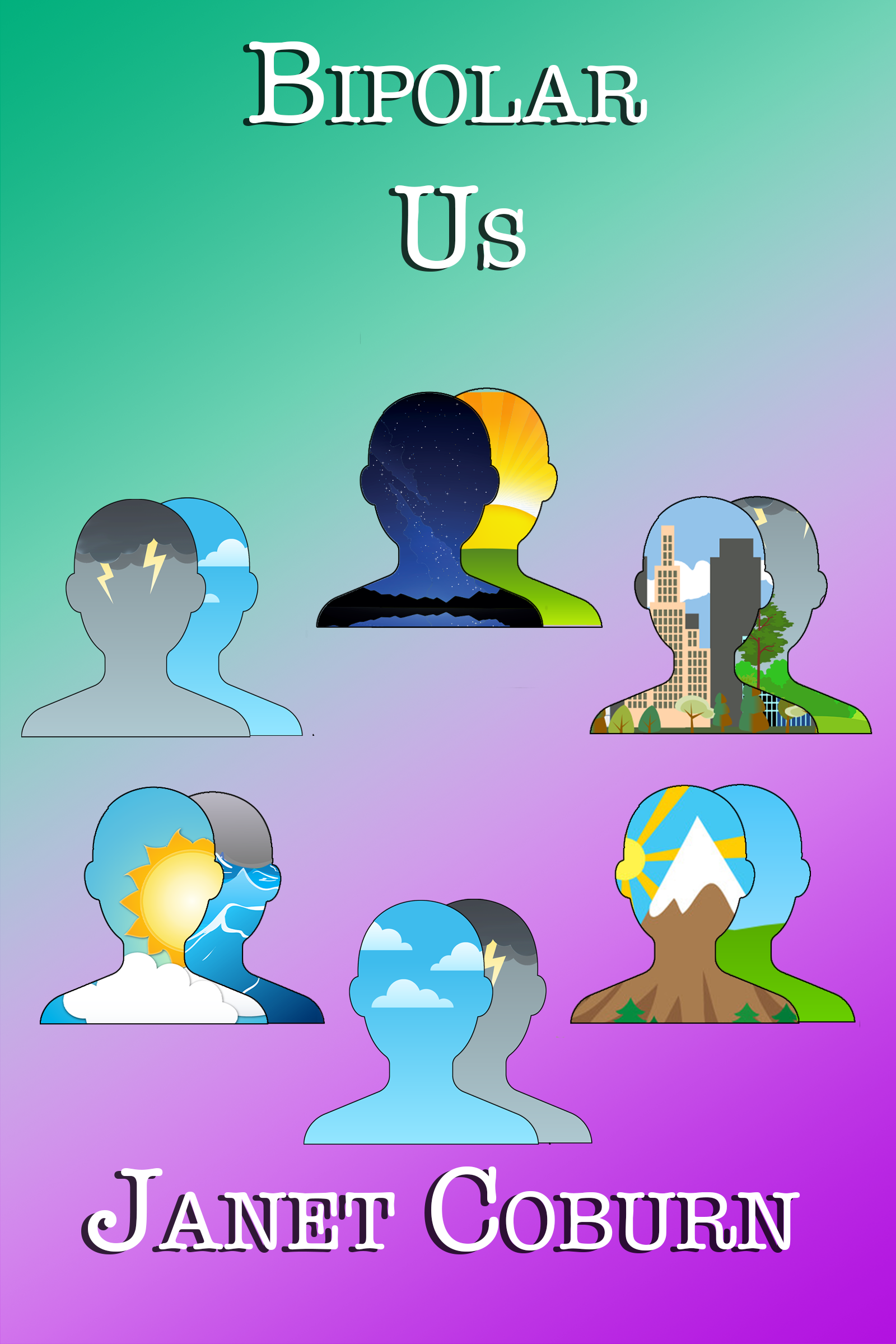
  • My publications. I talked about my blog and my books, Bipolar Me and Bipolar Us. In particular, we discussed gaslighting, which features in my second book, and how people with bipolar are more susceptible to it. Both Snowflake and I shared how we had encountered gaslighters in our own lives.
  • Groups. Chacoman, the other host, questioned me about whether I was involved in any local or regional support groups, and I had to admit that I’m not. Now, during the pandemic, group meetings are problematic at best, but I don’t react well to groups at any time, due to my anxiety (which is how my hypomania manifests). In my case, outreach is limited to my blogs and books, and membership in online support groups.
  • Miscellaneous. We got off topic a number of times. I don’t want to make it sound like the interview was all serious or grim. We also talked about our pets, positive relationships, college memories, and even politics.
  • Plans. I talked about how my next book will be a mystery, with a bipolar main character, and received positive feedback on the idea.

All in all, it was a good experience, worth overcoming my anxiety for. I had only participated in a podcast once before, a not-altogether-successful interview about my first book with an interviewer who had obviously not read it and was more interested in whether any of my family members were also creative. (It was supposed to be a podcast about first-time authors.)

This was not the same sort of thing at all. I told my story, as the hosts had recommended, and we had a genuine, far-ranging conversation about not just my own experiences with bipolar disorder, but with how others cope with it as well. Actually, I learned a lot about myself, from how much my anxiety – and especially social anxiety – still affect me, to how much my teen years illustrated my journey into depression.

So, here’s a big thank you to Snowflake and Chacoman for the opportunity to share with them and their audience. I would absolutely do it again. It helped me step out of my comfort zone and, I hope, will help the listeners as well. It’s a form of outreach that I had never considered, but one that I found valuable – and just plain fun!


The Demise of a Bipolar Support Group

By Artur / adobestock.com

Funny, but I thought support groups were supposed to be supportive. Recently, though, I ran into one that was anything but.

I won’t name the group, since some people may still get something out of it, but as far as I could see, it was a group of over 5,000 people out of control. Many posts were off-topic, sexually-oriented, political, and even abusive. Of course, many people never contributed at all, so I don’t know whether they approved, ignored, or simply watched from the sidelines.

I have my own opinions about bipolar support groups – they should be focused on bipolar disorder, its symptoms, treatments, and lifestyles. Within that large umbrella, there are lots of topics to be covered.

To me, it is legitimate to have “getting to know you” posts – Where are you from? What is your favorite comfort food? What kind of music do you like? Such posts and responses enable people to reach out and make connections, to realize that there are people in the world who experience life in the same way that they do – or in different, equally valid ways.

Similarly, it is understandable that people post about their symptoms – Do you ever wake up angry? Do you often get hypersexuality as a symptom? What do you do about it? Is there anything that alleviates your feelings of being alone? These posts encourage people to share commonalities and suggest ways to deal with them.

I can even see some good in comparing medications, though I don’t much like them. Has anyone tried Vraylar? Do you have much weight gain with Abilify? As far as I can see, the only answers to such questions are: Ask your physician or pharmacist. Medications affect everyone differently. Yes, I have, but your mileage may vary. The only truly useful things I can think of to say are: Don’t stop taking your medication without a doctor’s help, and If you get a rash, especially around your mouth and nose, see your doctor immediately. But if it gives comfort to know that someone else has the same reactions you do, that may indeed be helpful.

What this particular support group got into, however, was way off-topic remarks, sexual solicitations, stalker-like behavior, politics, name-calling, and general nastiness. It seemed like some of the participants went out of their way to be offensive. One poster asked, “Do you know what ‘tea-bagging’ is?” A few others got into a, shall we say, heated discussion about Black Lives Matter and Blue Lives Matter that involved calling each other not just racist, but “cunt” and “fucking POS.” Yet another complained about the cursing appearing in such posts and was met with a long list of responses, all of which said, “Fuck you.”

Part of the problem seemed to be inexperienced or overwhelmed moderators. They did not take down the most offensive posts. They did not try to steer the discussion in productive directions. Admittedly, moderating a support group is not an easy thing to do, and dealing with a group that experiences symptoms such as anger, despair, hypersexuality, sensitivity, and irrational thinking, as well as the normal responses of outrage, insult, offense, anger, retribution, and hurt, is that much more complicated.

Perhaps the majority of the 5,000 group members don’t mind such interactions, but there were more than a few who did, and said so. Some quit the group or went off to start their own. Others decided to stay around for a while to see if things got better.

I am torn. I hate the group the way some members are currently behaving. I hope that more administrators/moderators can get the group back on track to something that is truly a support group. But my time, attention, and patience are limited. Unless I see some changes – and soon – I’m outa there. I may not be missed, but neither will I miss them.

When My Carer Needs Care

By Farknot Architect / adobestock.com

My husband is the mainstay of my support system and, in large part, my caregiver. I cannot count the things he has done for me and does for me every day. We’ve been married for over 35 years and during that time he has helped me through daily life, major depression, anxiety attacks, loneliness, irrational thoughts, school, therapy. He makes sure I practice self-care and cares for me as needed.

Recently, though, he needed my help and care. The other day he experienced distressing eye-related symptoms – a large “floater” (dark spot) in his vision and unexpected flashes of light. What could I do about it? First, I answered his request to get a flashlight and look in his eye, but I saw nothing.

Next I arranged an appointment for him at our eye doctor. Dan used to be terrible at admitting when he needed medical treatment, but since a heart scare he’s been much more amenable to seeing a doctor. That particular evening, he was scared and cranky, and made up excuses. He left his phone in the car. That’s okay. I had mine right there. He didn’t know the number. That’s okay. I have it programmed into my phone. I waited on hold. “Forget it,” he said. “Never mind,” I replied. “I’ve got nothing else to do.” He said he didn’t see the floater any more. I pointed out that his eyes were closed. I got through to the doctor and made him an appointment for the next day.

Naturally, I drove him to the appointment, as they would have to dilate his eyes. Then, afterward, I drove him on several other errands (including an appointment with a different doctor) and made sure he ate lunch. I canceled one of the errands and put off others when I saw how tired and nervous he was getting. I took him home and tucked him in bed. (The floater turned out to be nothing truly alarming, just an effect of his aging eyes. He named it “Freddie the Free-Floater.”)

Dan has done almost exactly the same for me, many times. I could usually make my own appointments, but he encouraged me to do so. He has driven me to appointments countless times. He makes sure I eat. When I run out of spoons, he cancels or postpones errands, or even runs them for me. He reminds me when I need to have a lie-down or to sleep or to shower.

It was unusual for me to be the caregiver in this situation, and at times difficult, but I didn’t begrudge it. How could I possibly?

Of course, later in the day, I had a crisis and a mini-meltdown of my own, and there was Dan, ready to be with me, talk me through it, and make sure I didn’t skip a meal.

I know this is what marriage is supposed to be – partners helping each other through their individual and mutual times of difficulty. I also know that mental illness can put a terrible strain on a relationship. I admit that I am very needy at times, and was even more so at other times in my life.

But this time I got to be the strong one and take care of his needs before my own. And I was pleased and proud to be able to do that. Often there’s little enough that I can do for him, except offer him encouragement and remind him that I love him and appreciate him and all he does for me. If he asks for something he needs, I try to make sure he gets it (except for the $900 woodchipper, I mean). And I do what I can that benefits both of us – working to bring in money, paying the bills, doing computer research, handling phone calls, reminding him of appointments when I can – mostly stuff that involves computers and phones and recordkeeping and occasionally knowing where missing stuff is. And reassuring him when he gets trapped in the depression that he also suffers from that I love him and that he is strong and good and that he needs to take care of himself, and that if he can’t, I will try and do my best.

My Hypothetical Baby

By pololia / adobestock.com

Having bipolar disorder was one of the reasons I decided not to have children. Really, it was having major depression, which was what I was diagnosed with at the time.

I wasn’t so much concerned with passing my condition on to any potential offspring, since, at the time when I was contemplating motherhood, the genetic links were not yet that firmly established. Now that I know more about it, I think that might have been another deterrent. My parents had no idea what to do with me when bipolar symptoms started happening, and there’s no guarantee that I would have done any better. I’d like to think I would, but there’s no telling, really.

No, what I feared was having to go off my medication while pregnant (and breastfeeding, should it come to that). I was terrified of being unmedicated and I knew that psychotropic drugs were not good for pregnant women or their developing babies. Once I had discovered the benefits of Prozac and other mood-regulating meds, I knew I never wanted to be without them again. I never wanted to again fall into the pit that I had clawed my way out of. (In truth, that pit was waiting for me anyway, when I experienced a major depressive episode many years later.) 

Postpartum depression scared me too. I had heard the horror stories of women killing their children and/or themselves while suffering from the illness. I knew how out of control I could get with just plain ol’ garden-variety depression and anxiety. Adding postpartum hormones to the mix could be a really bad thing.

But the main reason that I decided my bipolar disorder made it unwise to have a child was that it would be unfair to the child. How to explain to a toddler that mama couldn’t get out of bed today or that she burst into tears for no apparent reason? How to explain weeks or months like that? How to deal with a child jazzed up on mama’s sudden hypomanic jag, who would then be let down when she crashed? How to soothe a child’s anxieties when mine were making me jump out of my skin? How to take care of a child’s essential needs, when I suck at taking care of my own?

Is that selfish? I know there are people who would say it is. That when the time came, I would suck it up and do the best I could. And I might. But would that “best I could” be good enough? I’ve heard it phrased that I was too involved with giving birth to myself – a relatively stable, reasonably happy, mostly functioning self – to give birth to someone else. And I think there’s some truth in that. It’s been a struggle, filled with despair, misery, hard work, setbacks, immobilization, dangerous thoughts, and living too much in my own head. To do the work of bringing myself to some baseline of functioning while trying to nurture and bring up another person daunts me.

I do understand that there are women with bipolar disorder and even postpartum depression who have children and that those children can be happy, healthy, and as well-adjusted as any modern child ever is. I don’t know how they do it, though. I was fortunate that I had a choice of whether or not to have children. I know that not all women do, and that many are delighted with their choice – whichever way they decide. I know that there are those who desperately want children and are unable to have them. I was fortunate that my husband didn’t push the issue, despite the fact that he would have welcomed a child.

I also had irrational thoughts about that potential child. I imagined that if the child were a boy (which run in my husband’s family), Dan (whose inner child is, shall we say, close to the surface) and the little boy would be natural allies and I the odd one out. He would be the fun dad and I the not-fun mama. And while that’s somewhat irrational, it also might be partly true. It took a long time for me to learn how to relax and have fun and share it with another person.

The one time I was open to having a child was when my father was dying a slow death. I thought that if he was going to see his grandchild, I’d better produce one promptly. Fortunately, it didn’t happen. I later realized that that was a really poor reason to bring a new life into the world.

What I’m saying is that the decision is not – was not – an easy one. Having a mental disorder makes it even more difficult.


Missing the Finer Things in Life

By GoodIdeas / adobestock.com

One of the ways I know when I’m slipping into bipolar depression is when I lose my sense of humor. Not even my husband’s awful jokes get a rise out of me. I also lose interest in many things that I ordinarily enjoy – reading, puzzles, and games, to name a few. The joys of life are few and far between.

Lately, I’ve noticed that I seem to be slipping again. I don’t feel overly depressed yet, but the signs are creeping up on me.

I think I first noticed it when it occurred to me that I had not done the New York Times crossword puzzle for at least a week. The Sunday Times puzzle is, or was, something I looked forward to every week. Now, I may not get around to playing it till mid-week or simply wait for next week’s, in hopes that I feel better. Most of my other entertainments have fallen by the wayside as well.

I know part of the problem is lack of spoons. I have been taking on extra work in my transcription job, simply to make extra money, which we do need. But it means I have given up almost all my days off and have had to get up very early to finish assignments. There’s little of me left over to do frivolous things, the things that bring joy.

On top of that, I have a house to furnish from top to bottom. I do not find shopping relaxing or enjoyable. In fact, I loathe it. Yet there I am, once or twice a week, at the vast home improvement store, picking out lighting or flooring or something else the contractor needs right away. It’s exhausting, not rewarding, and it eats into my spoons and my days off even more. It’s almost like having a second job, what with all the research, phone calls, appointments, choices, and decisions. Perhaps I’ll be able to rejoice in our new digs when it’s all done, but right now I can barely picture it.

The lockdown isn’t helping, either. One of the things I used to enjoy was going out to my favorite restaurants or discovering new ones. Now that is right out. I know some people are again indulging, but I’m not willing to risk my life for a cheeseburger and a brew or even tiramisu. My space and my life are constricted to a one-bedroom apartment, with a laundry/utility area substituting for my beloved study.

I do still have some comfort in my life, which is a mercy. When it all gets too much for me, I knock off for a while and watch some cooking shows on TV, which I find soothing, or read a chapter in a book before I fall asleep. At least I haven’t lost my ability to read, which I did once during a major depressive episode. And I’ve been able to maintain my blogs, which gives me satisfaction.

But as to joy, there is none. Life has become a tedious slog through one damn thing after another. One of the questions they always ask you during the depression screener at the doctor’s office is, “Do you no longer enjoy things you used to?” 

I’d say that’s true. Or at least I no longer have the wherewithal to do the things that I used to enjoy. Is it a marker of bipolar depression, or simply a reaction to all the things piling up on me right now? And which one causes the other?

On the surface, my retreat from joy is not excessively alarming. It has not yet reached the point of a major depressive episode. I can still do my work and my work on completing the house. What I can’t do is find a way to take mental time off – and I know that’s not good for my emotional stability.

I guess I’m just afraid that, in my life as it stands right now, there is no room left over for enjoyment. And that feels a lot like psychic numbness and depression. Perhaps when life settles down a little bit – if it ever does – I will get some of the enjoyment back. Perhaps it will become clear to me whether this exhaustion is circumstantial or anhedonia, a symptom.

Nevertheless, I plod onward, hoping for the day when satisfaction, relaxation, engagement – joy – will return. So far, it always has, though sometimes it seems forever before it does. That’s the nature of this illness and of recovery.


When You Face Too Many Options

Delphotostock/ from adobestock.com

It often seems that bipolar disorder and especially bipolar depression narrow your life down to the fewest possible choices. Try to take a shower or stay in bed. Eat a handful of cereal or skip eating. Cry or … cry. And that’s all true. These disorders are quite limiting.

However, it’s also true that sometimes we’re faced with too many choices. Right now I am in the process of having our house rebuilt after it was destroyed by a tornado. Every other day it seems the contractor has something new we have to pick out – paint colors, floor coverings, lighting fixtures, ceiling fans – even the color of the grout between the tiles in the kitchen, an aspect of decorating I didn’t know even existed. It’s overwhelming.

The worst was the paint colors. Sherwin Williams has a color palette about 100 pages thick, with seven different shades on every page. My husband and I have a hard time trying to pick a place to go for lunch, much less what color paint we’ll likely have to live with for the rest of our lives.

Needless to say, I dithered for a long time about the colors. The only reason that it didn’t totally immobilize me is that I employed the technique of weeding. Once I had decided on a color for each room (my husband left that largely up to me, except for his study), I began looking at the paint samples and not choosing what I liked, but pitching out what I hated. No beige anywhere. No teal, not even for the bathrooms. And so on. What was left was a much smaller assortment of choices, which hubby and I were able to process. He always liked the lightest version of a color and I the next darker, but we were never far apart.

We got through the process in just a couple of weeks, and with only one real regret (the green we chose was yellower than we really liked, but we’ll mitigate that by covering the walls with photos, posters, and art prints).

Exhaustion is another aid to making choices. I have some mobility issues and can’t walk for very long, especially on the concrete floors in home improvement warehouses. And I’ve always hated shopping, except on the internet. At some point in the process of looking and comparing, I just throw up my hands and say, “What the hell! That’ll do!” and arbitrarily pick one of the two light fixtures that have most attracted my attention. It’s not like my world will fall apart if I don’t get the one, exact light fixture that complements the room. I just need to be able to see. Then I go home, have some iced tea, and put my poor, tired feet up.

One of my therapists once taught me another technique for making decisions – flipping a coin. This sounds obvious, but it’s not. The simple act of coin-flipping can work in one of two ways. Either you can leave the choice in the hands of the coin (as it were), or the result of the flip can focus your mind on what it is you really want. Any number of times Dan and I have played, “Heads, lunch at Frisch’s; tails, Waffle House.” If it comes up tails, we often instantly realize that it was Frisch’s we were wanting all along.

Frankly, I don’t know whether it’s better to have a limited number of choices or a lot. Either way can be mind-numbing, a seemingly insoluble riddle that threatens to stymie you into making no choice at all. (Or, as the therapists tell us, “Not to decide is to decide not to.”) But it is possible to develop techniques that allow you to make those choices and continue with your life.

Of course, I know these are comparatively trivial decisions. I sure couldn’t have figured out “leave or stay” by flipping a coin, especially as seriously unmedicated and out of control as I was at the time. “Get a job or go back to college” was also an important one, but ultimately an easier one to make – I envisioned the situations and asked myself which I’d rather be doing, writing press releases or reading books. The choice was clear at that point. Both were major turning points in my life, but one was excruciating and the other just another choice. I attribute that in large part to the medication and therapy I’d had in between and the coping mechanisms that I had learned and practiced.


What’s the Difference Between Anxiety and Mania?

kues1 from adobestock.com

Ha!, you say. That’s an easy one. I know the answer to that. It’s like the difference between walking on pins and needles and walking on eggshells. For me, anxiety is the pins and needles, while mania is produces the eggshells. Pins and needles hurt more, but eggshells are easier to break. Anxiety causes me more pain, but mania has me treading carefully on a fragile edge.

Anxiety and Mania

I know more about anxiety than mania. My diagnosis is actually bipolar 2 with anxiety disorder. As such, I never really experience true mania. Hypomania is about as far as I get. And believe me, that’s enough. 

First, let’s start by admitting that anxiety and mania have a lot in common. At least they do in my life. Both of them make me frantic. Both of them make me obsessed with money. Both disrupt my eating habits. And both of them make me very very twitchy.

Frantic. Both anxiety and hypomania make me feel frantic, like there is something that I need to be doing to alleviate them. I know this isn’t true, that they are out of my control, but it feels that way. I get all revved up inside, a nagging, prickly feeling that jangles my nerves and irritates my brain. I try desperately to think what it might be that would calm the feeling, but there is nothing this side of an anti-anxiety pill, which might or might not help.

Obsessed with money. With anxiety, I obsess about the bills and how I am going to pay them. With mania, I obsess about what money I do have and how I can best spend it. Since this is, after all, hypomania, I tend not to go on wild spending sprees, but I have been known to buy myself or my husband presents, telling myself that the costs are comparatively reasonable and that at least I have limited myself to a non-extravagant amount. (Which may be the anxiety and the hypomania arguing with each other.) With anxiety, I try to anticipate all possible bills and juggle their amounts, due dates, and relative necessity (power cut off or trash removal cut off). I take on extra work, not because I think I have the wherewithal to do it, but because I want the extra money, no matter what it costs me in terms of physical and emotional energy.

Eating habits. Both anxiety and hypomania make me eat too much. With anxiety, no doubt I am trying to fill an existential hole or find something to distract me from my worries. With hypomania, I crave the relatively safe sensations of rum raisin ice cream; cinnamon Danish; or salted, buttery popcorn.

Twitchy. Both anxiety and hypomania can cause the shakes, tremors in my hands and arms and legs. Alas, not for me the euphoria of true mania, but the inherent sensation that I’m doing something wrong at some level. I can’t even enjoy hypomania without guilt.

There are differences, however.

Anxiety leaves me immobilized, in a way that hypomania just doesn’t. You’d think with all that nervous energy vibrating around my body and brain, I would hyper myself into a frenzy. Instead, all the jitters cancel each other out, leaving me with no place I can go to escape. My fears leave me paralyzed. The money worries leave me unable to decide what bill to pay first. I can’t decide whether it’s better to stay awake and try to read (if I have enough ability to concentrate), or take that anti-anxiety pill and try to rest, if not sleep.

Mania can make me productive, in a way that anxiety can’t. When I’m hypomanic, I can write, or at least put words on the screen. (Whether they’re any good or not is anybody’s guess.) But at least I have the illusion of motion, the impetus to create. That extra energy seems more focused, at least in comparison with anxiety. When I hit a hypomanic jag, I sometimes try to get ahead on my blogs, or at least jot down titles and ideas that I hope I can decipher and develop later.

Neither state of mind is preferable. Anxiety is the more painful and hypomania the more fragile. Anxiety is more familiar to me and hypomania more rare and even exciting. But I can’t choose. I can’t say that I like hypomania more than anxiety, although it does seem to have more benefits. But I know that it can be destructive and futile, promising things that it can’t fulfill.

Given the choice, I’d rather not walk on pins and needles or on eggshells. Level ground is fine with me.