Bipolar 2 From Inside and Out

Posts tagged ‘depression’

The Un-Merry-Go-Round

I submitted this for a mental health anthology and swore that if it wasn’t selected, I would post it here. It wasn’t. so here it is.


Back when I was diagnosed with depression (unipolar) and anxiety, I secretly envied the manic-depressives (as we called them then). At least if I had a manic phase, I thought, I could get something done.


Then I met Kate, who was bipolar – and not well controlled on medication, to say the least. My envy lasted through her ambitious plans to make identical green velvet Christmas dresses for her three daughters. And vanished when I saw her tear them apart, recut them, start over, change her mind multiple times. You can write the ending to this one. There were no dresses, not by Christmas and not ever.


Kate was riding the roller coaster – perhaps the most common metaphor for bipolar disorder – the peaks and troughs, swooping crashes, anticipatory climbs, stomach-clenching vertigo, and, for some, an abrupt stop at the end.


Type 2 bipolar is not like that. Type 2 is what my new psychiatrist diagnosed. Except I seldom got the hypomanic mini-jags of ambition and purpose. Instead, it came out sideways, as anxiety.


The challenge for both my doctor and me was finding the right mix of drugs to get me functional and keep me functional, at least at some sort of reasonable level.


While supposedly unipolar, I had been through most of the different sorts of antidepressants and anti-anxiety meds, including, of course, Prozac. When the increasing side effects of each outweighed the diminishing relief, I went through a lengthening list of tricyclics, SSRIs, and so forth. I learned not to ask, “How do they work?” I couldn’t get an answer. The more basic question was, “Do they work?”


I can’t remember all the combinations now. My memory has become Swiss cheese after the spectrum of chemicals I tried. (Actual conversation: “Doctor, I’ve been having some rather embarrassing memory lapses. I asked a friend how her father was doing, when he had been dead for three months.” “Yes, that medication will do that. Stop taking it.”) But in addition to (instead of?) the Prozac, I remember buspirone, Wellbutrin, imipramine. Desyrel, Lexapro? I think so. Effexor, Sinequan? Maybe. No MAOIs or lithium, though.


What I do remember all too well is when my brain broke. I don’t know what else to call it: nervous breakdown, decompensating, mental and emotional collapse. It wasn’t the first time this had happened, I later realized, but it was by far the most severe. That’s when I climbed on the merry-go-round.


It wasn’t a carousel. No painted ponies or dolphins or elephants or zebras with fantastical, bright bridles of flowers and whimsical saddles, steadily but gently leaping to the calliope music like the calming rhythm of waves.


This was a merry-go-round of the type that is no longer allowed on playgrounds because of the danger. A wooden platform, painted a color no longer identifiable, a metal pole speared through the center. Bent metal pipes dividing the surface into rough pie-wedges. No power to make it twirl but the force of children pushing and then jumping on, not to thrilling acceleration, but only to inevitable slowing. No lilting music; only creaks and rattles. No scents of popcorn and cotton candy; only playground dust and much-used sneakers.


The metaphoric merry-go-round would start rotating with each new pill or combo that promised (or at least proffered) “Better Living Through Chemistry.” I couldn’t handle the side effects of some – hideously vivid nightmares or the feeling of wanting to jump out of my skin. Others had side effects that I could live with, but little or no therapeutic effect. “There’s another drug I’d like to try” was the constant refrain.


The merry-go-round creaked on for years. Literally. With each new med, I had six weeks or so of slowly sliding back into the numbness and misery as my body sloughed off that chemical. Then six or so more weeks, waiting for the new one to work or not, prove tolerable or not, be any better than the last drug or not. Each new drug cycle amounted to a minimum of three months of hell. More, sometimes, as the doctor slowly, cautiously ramped up the dosage to gauge the effects, both intended and incidental. Lather, rinse, repeat.


Those years are mostly a blur to me now. I remember sleeping a lot. I remember sitting on the sofa watching “reality” shows so I could see people whose lives were train wrecks worse than mine. I recall not having the wherewithal to add water and nuke a cup of macaroni and cheese. Not bathing. Not feeding the pets. Not paying bills. Not reading. Not caring.


I know now how lucky I was to have a husband who lived the vow about “in sickness and in health” and took up the enormous quantity of slack required. He put up with a distant, unresponsive wife; frequent and apparently unprovoked bouts of sobbing; irrational panics; and all the other symptoms he knew by then he couldn’t fix. He didn’t know about the suicidal thoughts, or if he suspected, he never mentioned it. He often asked how he could help, but really, there was nothing else he could do.


Then came the day that my psychiatrist said we were just about out of options. He was thinking of recommending electroshock (or ECT, electroconvulsive therapy, its current version). As he talked about how it wasn’t like the bad old days and really showed quite good results in some people, his voice seemed to fade and I heard my inner voice screaming, “Fuck, NO! Keep away from my brain, you Nazi sadist!”


I had heard how in the 1950s electroshock was used as a way to punish or control unruly, uncooperative, nonconforming women. And of course everyone knew about the Cuckoo’s Nest. The Snake Pit. As far as I was concerned, electroshock was right up (or down) there with icepick lobotomy, the frighteningly efficient epitome of former psychiatric treatments.


Reeling, I made it to my car and immediately called a friend, a scientist, one of the most rational people I know, to talk me down. Her extremely sensible advice was to do some research. Research was something I knew about and remembered how to do.


I started digging. The Internet was little help. The opinions and experiences of people who had undergone electroshock ranged from “It was hideous” to “It was a miracle.” I kept looking and questioning and slogging through the research as well as the dense fog around me. I lost one friend, my long-time go-to guy for comparing our conditions and our meds, who said, “Do it immediately or I will kick your ass.” (Hint: Advice phrased as a threat of violence doesn’t help, or have the desired effect.)


So there I was, on a merry-go-round that had jolted to a sudden, sickening stop by the notion of electrical jolts surging through my brain. My precious brain, which had both sustained me and betrayed me throughout my life. The only part of my body I ever really loved.


What was I doing, considering altering that unique organ with electricity? But the brain in question kept pondering.


Electroshock caused memory lapses. I was already having those.


I would be allowing doctors to tinker with and alter the functioning – perhaps even the structure – of my brain. But really, hadn’t I been doing those very things with chemicals for years?


I went back to my psychiatrist, ready to tell him I was at least willing to talk to the doctor who did the shocking.


Then I got a surprise (at least as much as anything repeated for years can be a surprise). “There’s one more drug I’d like to try,” he said. “Lamictal. It’s an anti-seizure drug.”


“I don’t have seizures. How does it work?”


“We don’t really know.”


Oh, why the hell not try it? One more spin around the playground.


More misery. More weeks of weaning off and ramping up. More weeks of no change. The same-old same-old.


And then one day, something did change. It was such a clear sensation, physical as well as mental. I felt a sudden click in my head – an actual click, like someone throwing a switch located about two inches inside the back of my skull. I could hear my brain saying, “Oh, yeah. I remember this. This is how thinking and feeling are supposed to work.”


The click wasn’t a flick from a magic wand. I still had a long way to go, rebuilding the parts of me that I still could and still wanted to. Setbacks. More fiddling with the dosages. The creation of a crazy cocktail of drugs to keep the crazy at bay. But I was on my way back to functioning, with the help of anti-depressant, anti-anxiety, and anti-seizure drugs, plus a sleeping aid. And lots and lots of psychotherapy.


So what did I learn from this process? Not “There’s always hope.” I gave up hope lots of times, every time another med didn’t work. Not “Desperate times call for desperate measures.” I am infinitely glad I did not have electroshock. “It’s always darkest before the dawn”? Please. No truly depressed person believes that crap.


The lesson I took was “Stubbornness is a virtue.”  It saved our marriage countless times. It saved my father’s life for five times longer than the doctors gave him. And it saved my sanity.


“Stubbornness is a virtue” is different from “There’s always hope.” Even when you do give up hope, when you know it’s hopeless, when you realize the merry-go-round is grinding to its inevitable halt, you keep pushing it. Hopelessly, if you must, but stubbornly. As long as it takes.
On the Inside

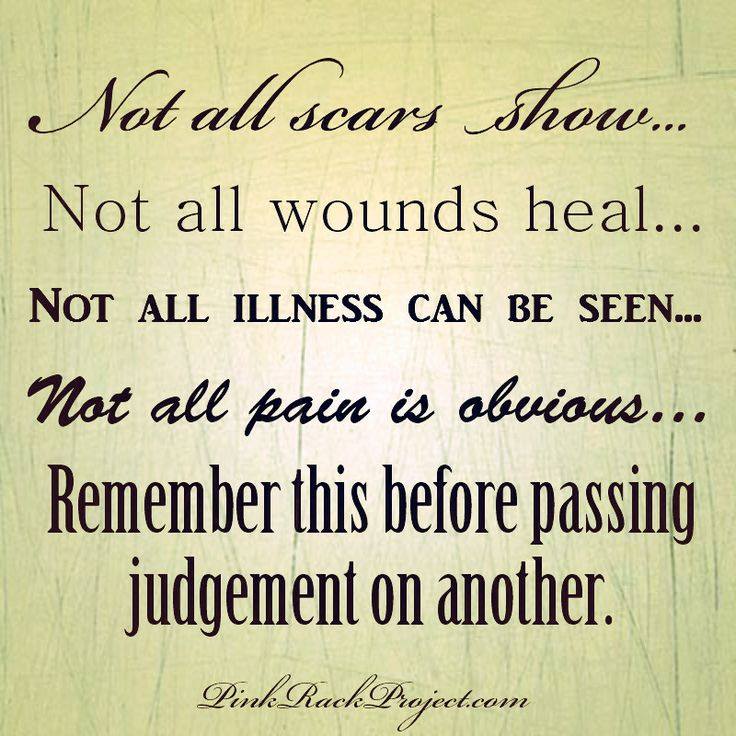
I saw this pass-along the other day and felt compelled to, well, pass it along.

wounds

It reminded me of a lot of things. Things I try not to remember.

Not all scars show. Some of mine do. The one where kids threw a rock at me, requiring seven stitches in my forehead. The ones where I cut myself. (I’ll write more about that later.)

Others don’t. I’ve often described my relationship with Rex as a train wreck. People wonder why I haven’t gotten over it, all these years later. It was the sort of train wreck in which you lose pieces of yourself, some of them irreplaceable. These scars aren’t the visible kind.

Not all wounds heal. Especially the wounds that happen when you’re too young to know how to treat them. Cutting words. Emotional bruises. Neglect. Loneliness. There are no bandages that can cover them, no ointments that can soothe them, no miracle cures.

Not all illness can be seen. If we’re high-functioning or have learned enough coping mechanisms, others may not notice. But bipolar disorder – and other mental illnesses – are, if not immediately visible, lurking just below the surface. And ready to break through at any time.

Not all pain is obvious. But it can leak out, especially around the eyes.

Remember this before passing judgment on another. But judgment-passing is practically an Olympic sport these days, along with shaming.

Scars. Wounds. Illness. Pain. These are things that those of us with mental disorders know all too well. What if our conditions are chemical imbalances in our brains? The consequences of having them, the misunderstandings they cause, the messages we receive, the behaviors we can’t understand or control or mimic, the friends we lose, the opportunities and joys we miss out on, are very real. And don’t let anyone tell you different.

Our disorders may be in our brains, but they’re not all in our heads.

But you knew that, didn’t you?

The Seven Wonders of the Bipolar World

I wonder if I can get out of bed today.

I wonder if a different drug would help.

I wonder what would happen if I told my friends and coworkers.

I wonder how long this mood swing will last.

I wonder if I have enough spoons for all I need to do today.

I wonder if people can tell that I have a mental disorder.

I wonder if this is the best I will ever get, for the rest of my life.

For Sharing

http://www.upworthy.com/these-9-college-students-want-to-tell-you-about-their-mental-illnesses?c=ufb1

Don’t give in to stigma. If you dig this video, share it so more people with mental illness can leave shame behind.

Can’t Write Today, So Here’s a Cat

maggie

I have been avoiding the Internet for days (and TV news and commentary as well) because I just can’t handle it right now. Actions, reactions, reactions to the reactions, et endless cetera. I’m depressed enough without all that.

There are plenty of thoughts I have on the Isla Vista shootings, and the media coverage of it, and mental health, and gun regulations. I’m sure most of them have already been said, and probably better than I could, and everything about the subject makes me angry, confused, outraged, despairing, hopeless, helpless, and majorly depressed.

Then there’s everything I’ve read lately about bodily autonomy and male privilege and the “war on women” (why does everything have to be a war?) and politics and climate change and all of those make me angry, confused, outraged, despairing, hopeless, helpless, and majorly depressed too.

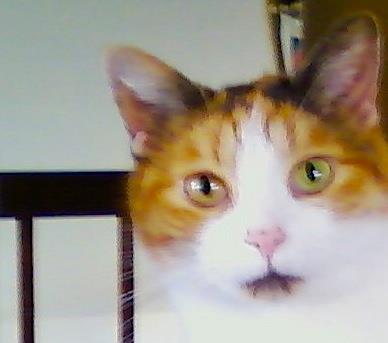
But it is TBT, so here is a picture of Maggie, a cat who saw the glowing design on Dan’s forehead that reads “Sucker.” He instantly scooped her up and brought her home. She was thereafter totally devoted to him. He could arouse her to a fever pitch of writhing and seduction with only the use of his voice. I mean, if they had been the same species, I wouldn’t have stood a chance.

Maybe next week I’ll have pulled myself together a bit and can write about something. For now, I’ll just say the best things that have happened to me today are a head-bonk, a nose-touch, and two nose-licks from Dushenka (Little Soul) with the Crazy Eyes.

Dushenkacu

Yours truly,

A Truly Crazy Crazy Cat Lady


My Brain, My Books

It used to be that I could never be found without a book within arm’s reach. I had a purse book, a nightstand book, a bathroom book, and a car book at the very least. (I kept them straight by having a different genre in each location.)

Now that I have a Nook e-reader, I have hundreds of books with me everywhere I go. But I’m doing a lot less reading.

I think it’s a function of my lack of concentration, but whether that’s the disorder or the meds, I couldn’t say.

I do know that when I was in the depths of my most recent breakdown, I barely read at all. I watched moronic reality shows like Trading Spouses, on the theory that these people’s lives were bigger train-wrecks than mine. And I watched cooking shows, because they were calming. (This was before cooking game shows really got going.)

During an earlier meltdown, I tried to watch sitcoms, but the relentlessly upbeat theme songs made me weep.

Now I have to hoard my concentration like I hoard my spoons. I am fortunate enough to be able to work freelance from home. But it’s the kind of work that sometimes has deadlines. On days when I can force myself to work, I can concentrate for about 2-1/2 to three hours at a spell. Some days I have to do two sessions like that with a nap in between, if a deadline is approaching too rapidly.

But when it comes to non-work activities, I can usually only concentrate for an hour at the most. Sometimes I try really hard so that I can watch a movie, but mostly I stick to half-hour or hour-long shows.

But reading takes concentration too, especially if the book has a plot (which I recommend) or is information-rich nonfiction. I do a lot of my reading in bed at night. (Yes, I know you’re not supposed to do that because it keeps you from falling asleep. But it’s a life-long habit.)

My mind flitters, the hamsters and sometimes the badgers stir, and I find myself several pages along with no idea what happened. At that point my need for distraction and my attention span collide and I have to find something moderately absorbing but short-term to do. It’s a good thing I have some games on my reader so I can play a hand of rummy or work a sudoku puzzle.

Reading has been one of the great joys of my life, since I was four, and it bothers me that I no longer have the ability to immerse myself in it the way I used to.

But, like so many other things, it’s something I’m having to learn to live with.

A Mother? Me?

Ah, the shrieks of laughter and squeals of delight from playful children! They cut through me like a light saber through Jell-O. I’m hyper-sensitive to loud or high-pitched noises.

A while back, one of my blogging buddies was speculating on whether she wanted to or ought to have a child, despite her disorder. I have no answer or even advice for her, but but here is what I think about motherhood and Bipolar Me.

When we got married, my husband really wanted to be a father some day. To tell the truth, I never gave it much thought really, since I had never expected to be married.

At that time in my life I was barely medicated and had a lot of meltdowns and breakdowns and up-and-down cycles (mostly down) ahead of me.

Looking back, I am glad that I never became a mother. The thought alone overwhelms me.

First of all, I would have been a really bad mother. It would have been unfair to a child to have a mother who would disappear into her room for days at a time, not communicate for weeks at a time, be depressed for months – or years – at a time. Not to mention not being able to enjoy anything. Put that person in charge of a live human child for 18+ years?

I know there must be people who do it, but I don’t even really understand how non-biploar people manage it.

Second – and this is the part that is going to sound selfish to those people she feel that childless-by-choice women are all selfish – but I needed all the resources I had to construct and reconstruct myself. As Gloria Steinem reportedly said, I didn’t give birth to a child because I was giving birth to myself. I still am, after my most recent and most monumental breakdown, still trying to salvage what I can of my psyche, seeing what pieces still fit, and learning to live with the things that are no longer present – or maybe never were.

And I had all kinds of irrational thoughts on the subject of motherhood. The one time I thought about motherhood, it was because my father was dying, and I wanted him to see his grandchild if there was going to be one.

Also, I was terrified of losing myself. My husband had some issues of his own and was, let’s say, way too close to his inner child. I thought he and a child would outnumber me and I would be the mean one, the killjoy, the Other.

As time went on, I grew less and less inclined to even be around babies or small children. And my husband would go into a funk if one of our friends had a baby. Eventually, he decided that if he wasn’t going to be a father, he could be a mentor, a helper, a healer, to other children and former children. Maybe even his inner child.

Now having a child is no longer even a possibility. And I’m good with that.


Misery and Math

One day, when I had too much time on my hands, I came up with a theory: The Mathematics of Misery.

Basically, there are two stages of misery – wallowing and getting over it.

In my theory, the wallowing stage is necessary. You need to feel the misery, own the feeling, and try to figure out what (if anything) caused it. If you omit this stage, you won’t learn whatever lesson there is.

Then you move on to the getting over it stage. Ideally, the getting over it should involve eliminating the cause of the misery. (Keeping in mind that there are laws against homicide and you’re probably at that awkward age when you can be tried as an adult. I know I am.)

Now, here comes the mathematics.

According to my theory, the proper proportion should be 20 percent wallowing and 80 percent getting over it. But for me, that’s an unreachable goal (especially before I was medicated). Thirty to 35 percent wallowing is more realistic. It’s when the scale tips over 50 percent wallowing that you definitely need to get help. Preferably professional help. And I’ve been way over that tipping point.

It’s like the stupid scale in the doctor’s office. I just keep trying to slide the weight closer to the getting over it end.

Posting Weakly

Today I don’t feel like writing at all. It’s been a tough week.

Although I usually try to say something about mental health in general, bipolar disorder specifically, something relevant that caught my eye in the news, or a piece of my past that might be interesting or informative, today I can’t.

I’m very depressed. Or feeling sorry for myself. Sometimes I can’t tell the difference.

There’s a convention in July that I would really, REALLY like to go to. I could see many friends, including one I haven’t seen in literally years and have been fearing I may not have the chance to again (maybe irrational thinking, maybe not). I would have intellectual stimulation, friend, parties, laughs, all sorts of fun available to me.

And I can’t go.

Some of the reasons are practical. We can’t afford it. My husband has to work. Driving that far and carrying luggage would trigger back pain and the walking required would rapidly exhaust me. If I went, I might well spend much of my time flat on my back in a hotel room, wiped out or communing with Vicodin.

The other reasons I can’t go have to do with my mental disorders. I barely leave the house as it is, except for doctor and therapist appointments. A day with a few simple errands uses up every spoon I have and sometimes the next day’s as well.

But mostly, it’s my over-sensitivity to the crowds and the noise. I can’t tolerate either one for more than a few minutes without a panic attack or a meltdown. Neither of which is pretty and neither of which would add to my enjoyment of the convention, or anyone else’s, for that matter.

I’m now thinking about all the things I can no longer do for physical or mental reasons. My therapist would tell me to look at how far I’ve come – all the things I can do now that I couldn’t do a few years ago, like write a blog and maintain a goal of posting weekly.

She’s right, of course, but for now I just need to go back to bed, and try again to accomplish something after a nap.

Risky Business

It’s always a risk when you admit publicly to having a mental disorder. But I am thinking of doing just that.

I have not had uniform success when I have revealed to others that I have bipolar disorder (or chronic depression, either). There have been a lot of “me too’s” and “so’s my brother/sister/mother/friend/etc.” and then we compare diagnoses and symptoms and meds and war stories and have a jolly time.

Other times, well… My mother hoped my problems would go away after I got a “good, steady job.” My father said he didn’t mind if I went to a therapist “as long as he didn’t have to go too.” My mother-in-law “doesn’t believe in mental illness.” My rotten-ex-boyfriend “jokingly” suggested that if we went to couples counseling, he and the therapist could agree that I was a danger to self and others and have me put away. (I knew that wasn’t true and told him so. We went. It didn’t help.)

Recently I have started two blogs, this one for mental health issues and a more general one called Et Cetera, etc. (which you’re welcome to visit if you like). I have linked Et Cetera to my Facebook account, but so far I haven’t linked this one.

Starting these blogs feels like a risk to me, especially since I’ve set WordPress to remind me to post at least once a week. Making a commitment that I will pull myself together four times a month (eight if you count the other blog) and write is something I’m not completely sure I can do. I have good days and bad days, and sometimes those bad days pile up in a bunch.

But I have also taken a bigger risk. Creative Nonfiction magazine requested submissions to be considered for its Mental Health Anthology. So I submitted one. If it gets chosen, I will be “coming out” as bipolar and a mental patient. When (if) that happens, I will likely do the “big reveal” on Facebook. A fair number of my close friends already know, but they constitute only a small segment of my FB friends.

(Creative Nonfiction accepts only manuscripts that have not been published elsewhere. If they don’t accept mine, you can bet it’s going up on this blog the next day.)

So, having thoroughly terrified myself, I will anxiously await the results. And in the meantime, I’ll try to keep up the regular blogging.

Wish me luck.