Bipolar 2 From Inside and Out

Posts tagged ‘depression’

Self-Care and Human Needs

Self-care is one of the hot topics these days in the world of bipolar disorder and the people who live with it. Self-care can be as basic as remembering to eat or as complicated as knowing and avoiding your triggers.

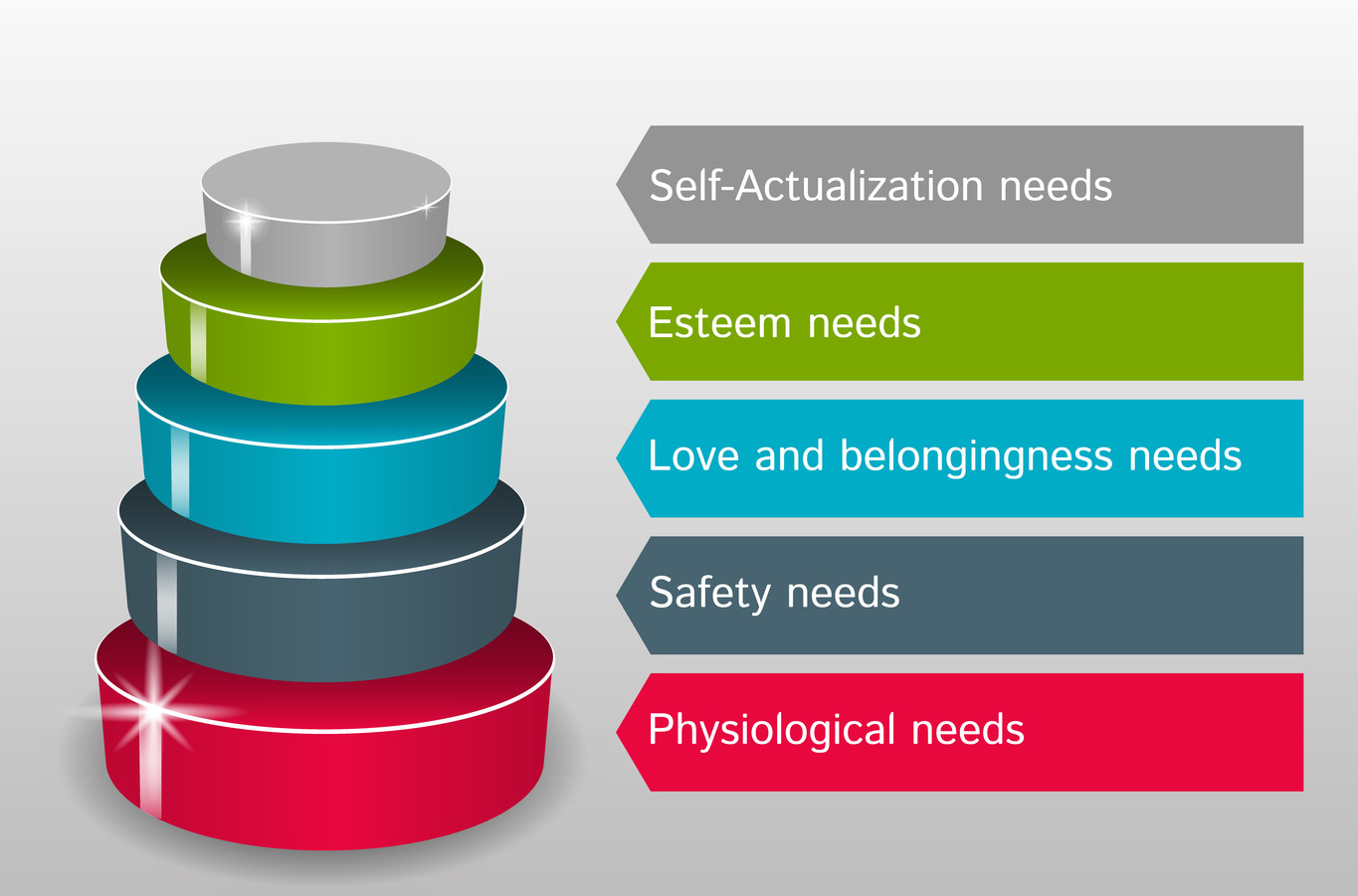
Back in 1943, psychologist Abraham Maslow created what he called a “hierarchy of needs” – a series of stages that human beings must go through on the way to the ultimate goal of “self-actualization.” With few changes, the concept, usually illustrated as a pyramid, has continued to influence the study of human motivation and developmental psychology.

So what does self-care have to do with the hierarchy of needs?

The most basic needs of human life form the base of the pyramid. These are called “physiological needs” and are essentially what a person needs to stay alive: air, water, food, shelter, sleep, clothing. Without meeting these needs, a person cannot move up to the next level of the hierarchy.

A large part of self-care is devoted to meeting these very basic, fundamental needs. Air is usually not a problem but shelter and clothing can be, for those bipolar persons who are homeless – and there are more than a few. Many of us are just one financial reverse – loss of income, insurance, options – from being homeless.

The most common advice for self-care is to pay attention to these base-level needs: Remember to eat. Stay hydrated. Get enough sleep. At times, it’s a real struggle just to meet these self-care needs. Add “get exercise” to the list and it can suddenly be overwhelming. People with bipolar or major depressive disorder often need help accomplishing them. That’s as high as we get on the pyramid.

The second step of the pyramid, which people need to work on after they’ve met the requirements of the first step is called “safety needs”: personal security, employment, resources, and health. Again, the needs on this step may seem insurmountable, and may – probably will – require help to achieve.

But they are self-care needs too. Current society may not view them as such, but that’s because they tend not to struggle with them, at least not on the level of a person with a mental disorder. Individuals can sometimes help meet these needs, but more often government, community, or charitable organizations provide necessary help. Talking about self-care at this second level may seem like pie-in-the-sky to those who have not yet conquered the first. But truly, taking care of these needs is a form of self-care, enabling one to maintain the gains represented by achieving those of the first level.

The third level of human needs – and self-care – is called “love and belonging”: friendship, intimacy, family, sense of connectedness. Again, this is not usually thought of as a part of self-care. But it certainly is. Many of us – I include myself – lose friends, become estranged from family, fail at intimate relationships. There are other places to look for ways to practice self-care on this level, however.

Therapy groups and self-help groups can lead you to people who share your problems and may be able to help you in achieving self-care. (My husband met one of his dearest friends, who provided support, listening, understanding, and companionship, at a self-help group meeting.) If in-person meetings are not possible, social media such as Facebook, Twitter, and WordPress provide opportunities to meet some social self-care needs through various groups and online communities.

The top two levels of the pyramid are not as easy to think of as self-care, and not as easy to tackle. Level four is esteem: respect, self-esteem, status, recognition, strength, freedom. And five is self-actualization: to become the most that one can be. Realistically, these are not strictly speaking things that can be accomplished through self-care. Even neurotypical people may never complete step four, and there is reason to think that few people ever reach self-actualization. These are goals to strive for, but not guarantees.

Wherever you may currently be on the pyramid, the important thing to remember is that self-care will help you reach the next step; that each follows the one before; and that your bipolar life will improve with every step you achieve.


Tracking Your Moods: Low-Tech, High-Tech, and In Between

Many therapists and people with bipolar disorder recommend journaling as a practice that allows you to track your moods and figure out what your triggers are. And many individuals do well with journaling.

I didn’t, however. I tried starting a journal of what I was doing and what I accomplished daily. It rapidly turned boring and whiny. My entries looked like this:

Accomplishments:

  1. Paid cell phone.
  2. Forced myself to finish work assignment.
  3. Finally got off that stupid level of that horrible Candy Crush.

Writing is what I do, but journaling, especially when depressed, was an unrelenting series of pitiful nothing. Instead, I started this blog (on 1/7/14). In my blog, I could write about anything. Still, it wasn’t much good as a way to track my daily moods.

Technology is starting to address that problem. Recently some inventions have come on the market that promise to help you track your moods not just daily, but hourly (or even more often). Most of these devices resemble what would happen if a Fitbit and a mood ring had a child.

Most of them claim to monitor your moods by tracking your heart rate and/or your breathing. (One notes that it tracks your steps too, so you don’t need an extra device to do that. Another promises to monitor galvanic skin response, pulse, and skin temperature, which sounds more like a lie detector than mood tracking.) Then you take that data and compare them with what you were doing at the time and voilà – a mood journal.

Of course, these devices make certain assumptions – for example, that when your heart rate is elevated, you are anxious or tense. Needless to say, there are plenty of other things that can raise your heart rate and breathing. Sex, for one. Or running. Neither one of which is necessarily a source of anxiety for everyone. There is, as far as I can see, no way for the device to tell when you are depressed. They appear to assume that everything except anxiety is normal.

Then there’s the fact that you still have to journal. The devices work on the theory that you can look for patterns in your breathing and respiration, then figure out what you were doing when that happened. Upgraded devices and apps are planned that will add calendar and location functions to make this easier. But if you’re in your house the whole time the moods are happening, it won’t tell you much.

(One brand of these devices is available only from an employer, health plan, or EAP, which, if you ask me, is pretty creepy. If there’s anyone I don’t want to have information about my moods, it’s my employer.)

My friend Mike came up with an in-between solution that uses both higher-tech and lower-tech approaches to monitoring his moods. Over a period of several months, Mike had been on four different drug regimens for depression. Not all of them worked, and he was unsure which did the most good.

His idea was to go to his social media and chat apps and take a look at when he was the most active, engaged, and responsive. Then he looked at what medication he was on at the time. He noticed, for example, that in the first few weeks of April, he was posting more about accomplishments and responding to others’ posts and chat messages. A quick check of his pharmacy records and he had a pretty good idea of which medications were working best. No journaling involved – the evidence of his increased energy was right there in front of him, already recorded. And no $150 expense for an emotional tracking device.

Maybe journaling is right for you. Maybe a wearable mood tracker is the thing that will help. But don’t overlook the tools you already have. Think about them in new ways and you may already have a handle on understanding your moods and meds.

Sources

https://www.l2inc.com/daily-insights/spire-wants-to-be-the-fitbit-for-your-emotions

https://www.entrepreneur.com/article/239743

http://nerdist.com/sentios-feel-wristband-fitbit-for-your-emotions/

Depression, Mania, and Mystery

Writing a book takes a certain amount of mental stability. Also, you have to be a little crazy.

Despite the fact that in the popular imagination, creativity is linked with insanity, having a mental disorder is not all that conducive to productive work, particularly to the sort of sustained, focused writing that a book requires.

Still, bipolar, OCD, schizophrenic, and other writers have managed to write books – and some very good and highly acclaimed ones.

I have taken on that venture myself. I am writing a book.

Now, settle down. I am not (yet) asking you to buy this book. It is still only a book in process. Nothing has been published. Maybe nothing ever will be. Nevertheless, I persist.

Actually, I have two books in the works. One is out of my hands now. It is languishing at a publishing company, where it has languished for a year, waiting for them to determine if their interest in it will lead to actual publication. That book is a memoir of sorts, based on these blog posts. Unless I want to start pimping it to agents and other publishing companies, there is nothing more to do with it right now.

In the meantime, my attention has turned to the other book. It is a mystery, and has nothing to do with bipolar disorder. Except that the writing of it has everything to do with bipolar disorder.

First depression. Depression is great for writing certain types of scenes – deaths and reactions to them, for example, which are good for mysteries. Depression, however, periodically leads to the “this book is shitty” phenomenon, which I understand is not exclusive to depressive writers.

When depression leads me into that trap, I stop writing. Instead, I do “research.” If I am not too depressed to read, I delve into books about the craft of writing – plotting, description, etc. Or I study the works of writers that do things exceedingly well – dialogue, word choice, narrative voice. I highlight examples of good technique. Then, at some point the depression lifts and I try to put what I have learned into my manuscript. Of course this means lots of rewriting and revising, which slows my progress, but, I hope, makes the manuscript better.

Then there’s mania. Or at least hypomania, in my case. It carried me through the first eight chapters of the mystery before the depression hit. If it’s a truism that depression lies (it is and it does), mania is a liar as well. Recently I was tootling along at about 500 words per day, and it occurred to me that, at that pace, I could reasonably expect to have a rough draft by July 4, ready to send to my beta readers.

This was mania talking. Lying, rather. In fact, there was no way I could maintain the pace, meager though it was, of 500 words per day and not a chance in hell that I could meet the self-imposed deadline.

What came next? More depression, of course. More research, this time into how various authors use dialogue tags. And a confusing attempt to improve the pacing by scrambling the order of the chapters.

Until writing mania sets in again, I plug away at scenes I know need to be written, even if I don’t know where they go, and keep my eyes and ears open for both the depressive lies and the manic ones. I have over 45,000 words written and refuse to abandon them now.

So I don’t know all that much about whether bipolar disorder is a help or a hindrance to creativity (I would suspect it is both), but I do know that it is possible to work around it.

Eventually, if I’m lucky and persistent, I’ll ask you to buy my books. Someday.

What I Learned About Ketamine and Depression

Trigger Warning – Meds

Note that I’m not a doctor or a pharmacist or any kind of medical personnel. Do not consider this post to be advice on what you should do. If the subject interests you, ask a licensed physician for more information.

What did I know about ketamine before I started doing some research?

Not much.

I knew that as a street and “club” drug it was known as “Special K.”

Then I heard that it was being used for treatment-resistant depression. Here’s what I found.

First, you can’t just go down to Brown Street and buy a few pills. That’s illegal. And what you get may include other substances that you didn’t intend to take.

So, you need a prescription for it. Once you get that prescription, usually after a consult with a psychiatrist, you need to find a treatment center that will administer the drug. Clinic operators may be anesthesiologists, as ketamine is primarily used as an anesthetic.

The treatment is delivered via IV or injections. No simple pills to take. It’s a course of treatments, each lasting 45 minutes to an hour, with a rest of an hour afterward. The treatment may be delivered for as many as six doses over the course of 12 days. (There may also be a nasal spray option, but the IV version seems more typical.)

You have to have someone who can drive you. The possible side effects include confusion and blurry vision. You can’t drive for 24 hours after the treatment, which basically means you can’t drive for two weeks, since the treatments are roughly every other day.

They don’t know how it works. I don’t find this surprising, since every time I’ve asked my psychiatrist how a medication works, I’ve been told, “They don’t really know, blah blah blah, neurotransmitters, blah blah blah, serotonin, blah blah blah.”

It’s expensive. The initial treatment may cost $500–$1,000, and a full course of treatments may cost as much as $3,800, which insurance won’t cover. These are estimated costs, based on treatment in various regions of the country. (The wholesale cost is approximately $.32 per dose, by the way.)

The results don’t last. They give relief for as little as a few hours to as much as nine months, after which a $600 booster shot is required.

You may still need regular antidepressants and psychotherapy. Ketamine may get you “over the hump” until your regular antidepressant kicks in, but is not a stand-alone treatment.

There are side effects. Confusion, hallucinations, and high blood pressure are among them, along with something called “lucid daydreaming.”

More research is needed. Duh.

The FDA has also approved trials of MDMA (Ecstasy) for treating PTSD. It is also being researched for effects on OCD, depression, and other conditions.

So, assuming that I could afford it, would I try ketamine? There’s not one easy answer to that.

Back in the days when my depression was drug-resistant, when I had spent years trying different combinations of psychotropics, when I was considering electroshock, I might well have seen ketamine as something to consider before I took that step. It should be noted that, at the time, my psychiatrist did not recommend or even mention it, so it might not have been appropriate for me whether I wanted to try it or not. And anyway, a combination of meds and therapy finally kicked in and made the subject moot.

Nowadays, I would not try ketamine (or MDMA, for that matter). My bipolar depression has moved from drug-resistant to drug-alleviated, at least for the most part. And that “most part” is enough for me. I have no need to be driven 45 minutes to the nearest clinic or to try to find a psychiatrist and anesthesiologist willing to go off-label. I am satisfied as I am.

As always, Your Mileage May Vary.

Sources

http://www.webmd.com/depression/news/20140923/ketamine-depression#1

http://www.ketaminetherapy.com/Depression.html

Intranasal Ketamine Infusion

https://psychcentral.com/blog/archives/2012/12/01/should-you-try-ketamine-for-depression/

https://en.wikipedia.org/wiki/Ketamine

http://www.webmd.com/depression/news/20161130/fda-ecstasy-ptsd-treatment#1

Why I Didn’t Get Depressed When I Got a F**k Off Letter

Brenda was a friend to my husband and me for many long years. We partied with her, and talked with her, and grieved with her and supported her when her marriage ended.

I became closer to her than Dan had, although he had met her first. Then we grew apart. Then I heard that she had given up on me. I wrote, asking for one more chance.

Recently, she sent me a three-page letter. When a mutual friend asked what it said, I replied, “Basically, ‘fuck off.'”

I’ve written before about the friends I’ve lost due to my bipolar disorder (http://wp.me/p4e9Hv-2W) – the pain and loss I sometimes still feel, my unsuccessful attempts to apologize or rebuild the relationships, the continuing rejection, the knowledge that those important people are gone from my life forever.

But this time, the rejection didn’t seem to bother me as much.

Why? I wondered.

I know that people sometimes do drift apart, and there was an element of that in the death of the relationship.

I knew that I had refused many invitations and stood her up many times. But apparently, when I did show up, I brought along an extra person, “my misery.” It seems like a trap: don’t accept an invitation, or be unwelcome when I do because of my constant companion, which I was unable to just leave at home. In those days, and sometimes still, the Black Dog was always with me. But Brenda saw it as something she couldn’t compete with, something that was always more important to me than she was.

In a sense that was true, though I didn’t see it as a competition. It wasn’t like I valued my disorder more than I valued her. Feeling miserable was important to me, in the sense that it seemed ever-present, but it was important to me in a bad way – the thing that dragged me down, the thing I fought against, the thing that did make my life a misery. But it was a misery I could not put down, much as I wanted to, even for people I cared about. At the depth of my depression, it was simply a part of me. I am sometimes amazed that I came through it with any friends left. But I have.

To be fair, Brenda also blamed her own misery after her divorce as a contributing factor to our parting. Then there would be four of us present – two people and two miseries – and evidently it was too much.

Most perplexing to me, though, was Brenda’s contention that her growing religious fervor and burgeoning political conservatism contributed to her decision to cut ties. I freely admit to being a liberal and to disliking organized religion, but I have friends who feel otherwise and yet remain my friends. There’s lots we agree to disagree on or simply choose not to talk about. Even my mother and I had profound differences but never gave up on each other.

According to Brenda, her religious and political leanings required “personal responsibility” – including responsibility for one’s moods. As she put it, despite her reactive depression, her happiness was a choice. One that she made and I didn’t.

She compared mental illness with high blood pressure and diabetes – conditions that one must take personal responsibility for treating and trying to control. The fact is, I was trying to control my disorder, with therapy, with medication, and once almost with electroshock. I know she knew this, as once we went to the same therapist.

And that’s why I said, “eh” when I got the letter. By Brenda’s own criteria I was doing my best. And that’s all anyone can do. I couldn’t go back and change my misery, or try harder to find relief. And I couldn’t simply choose to be happy, which I don’t believe is possible for most people like me. If you can manage it, more power to you, and to Brenda.

I think what bothered me most about the letter is that Brenda has a degree in psychology and is teaching psychology in college now. I wonder what her students are learning from her.


To Sleep or Not to Sleep – That Is the Question

According to WebMD (which I find a pretty reliable source), “An inability to sleep is one of the key signs of clinical depression. Another sign of clinical depression is sleeping too much or oversleeping.” http://www.webmd.com/depression/guide/depression-sleep-disorder#1

So, apparently, with either unipolar or bipolar depression, either way you’re screwed when it comes to sleeping.

Most of what I could find online about depression and sleep talked about depression and insomnia. WebMD says:

An inability to sleep, or insomnia, can be one of the signs of depression…. Lack of sleep alone cannot cause depression, but it does play a role. Lack of sleep caused by another medical illness or by personal problems can make depression worse. An inability to sleep that lasts over a long period of time is also an important clue that someone may be depressed. http://www.webmd.com/depression/sleep-depression#1

But, they add, “a small percentage of depressed people, approximately 15%, oversleep or sleep too much.”

I seem to be in the 15% that sleep too much. I usually wake up around 7:00 or 8:00, take my morning meds, and go back to sleep until 9:30 or 10:00. Sometimes I have a little nap in the afternoon. (For me, a “little nap” is about two hours.) I take my nighttime meds at 11:00 and am asleep by 12:00.

That’s a lot of sleeping.

Of course, those are just averages, just when I’m depressed, and just when I have no deadline-dependent work to do. Many days lately, I have been getting out of bed when I first wake up and skipping the afternoon nap. But then I go to bed even earlier, though I usually read for a couple of hours.

On the other hand, I’m subject to mixed states, when depression and anxiety coexist. When that happens, I want desperately to sleep, but can’t turn off my idiot bipolar brain. I’ll lie awake thinking about my writing, or my finances, or any damn thing. I’ll wake up at 5:00 and do the same. Those are often the days when I try to work in a nap.

Back to WebMD. They note:

Doctors may sometimes treat depression and insomnia by prescribing an SSRI along with a sedating antidepressant or with a hypnotic medication. However, hypnotic drugs usually should be taken for a short period of time. http://www.webmd.com/depression/sleep-depression#

Part of my nighttime meds are an anti-anxiety drug and a sleeping aid, plus an SSRI and an atypical. So, am I overmedicated?

It’s possible. But I trust my psychiatrist, and I’ve been on this regimen for a number of years now. My bipolar symptoms are now fairly well controlled, I’m able to work, and with the help of my husband, I manage to get through most days with level moods, only mild depression, and only occasional hypomania. I’ve been on other drugs and other combinations of drugs that did not work as well, or gave me horrible and vivid nightmares or other side effects.

I don’t want to hear opinions on the drugs I take from people who are not M.D.s and have never met me, or as Jenny Lawson said recently, “something that every person who deals with mental illness dreads…well-meaning advice from others.” Believe me, whatever it is, I’ve tried it. That’s not why I’m writing this.

What I do have to say: Whether you sleep too much or not enough, bipolar disorder may be the cause. There are treatments, some involving meds, and others not. Meditation, for example, helps many people sleep. (My mother used to sing herself to sleep with hymns when she had insomnia.) It’s a thing to discuss with your psychiatrist and/or your psychotherapist. He or she may be able to help. You don’t have to go through sleep disruptions without treatment. Even with all the problems that sleep causes me, I’ve got a system that works well enough for me.

And … now my insurance company thinks it knows better than my psychiatrist and only allows me a sleeping aid every other day. Apparently my choices are pay for it myself or take Benadryl. Again, I’m not asking for advice. Just restful, restorative sleep.

Don’t Tell Me Not to Feel the Way I Feel

“Don’t be sad/angry/upset.”

“Calm down.”

“Smile. It’ll make you feel better.”

“Stop getting all revved up.”

Never in the history of ever has any communication of this sort had the desired effect on a person – especially one with bipolar disorder.

When you offer this sort of “advice,” what you are basically doing is telling the person not to feel the way they feel. Not only is this useless, it’s insulting.

It’s useless because ordering someone to feel a certain way simply won’t work. Saying, “Be cheerful” will not make it so. Emotions aren’t like flipping a switch on command. Even for neurotypical people, emotions are complex interactions of chemicals in the brain. While some people claim – or may perhaps be able to – shift their emotional state at will (from angry to merely annoyed or to neutral), it isn’t easy or natural. There’s a reason that you feel the way you do.

For the person with bipolar disorder, it’s even more difficult – if not impossible – to shift moods at a whim, especially someone else’s. Bipolar is a mood disorder. It affects moods and emotions in a nonstandard, often unpredictable way. Telling someone to alter their own brain chemistry merely by thinking about it is ludicrous.

Even if the bipolar person’s moods or feelings seem exaggerated or uncalled-for to you, that person is having an experience no different than when you feel elated or despairing or fearful. The emotions may even be more profound, less susceptible to alteration by force of will.

But telling bipolar people not to feel the way they feel is not just pointless, it is insulting. You are denying their perception of reality, invalidating their experience, dismissing their concerns, minimizing their problems, discounting their feelings. In effect, you are saying, “I don’t feel the same way, so your feelings are wrong. Change them to match mine.”

Imagine that you have written something – a report, a poem, whatever – and feel good about it. You’ve made your point and done it well. You’ve captured reality as you see it and communicated it in a way you think is clear and effective. Then someone comes along and reads it and says, “This is crap.” They have denied what you feel and believe. And even if they’re right, even if it is crap, they have profoundly insulted you. And, of course, they may be wrong.

Diagnosed bipolar people already know that their emotions do not run the same as other people’s. There’s no need to remind them of that. And bipolar people are generally doing what they can to alleviate their symptoms, be it through therapy, medication, mindfulness, meditation, or whatever works best for them. When you discount their feelings you are discounting them as persons. That can be anywhere from annoying to soul-damaging.

Adam Savage, of Mythbusters fame, sometimes wears a t-shirt that says, “I Reject Your Reality and Substitute My Own.” He is (I hope) talking about substituting a provable, scientific reality for a mythical, uninformed one.

But to go around substituting your own emotional reality for other people’s – and trying to make them agree with you – does a disservice to the people you think you are trying to help.

So, what would be better than saying, “Don’t feel ________”?

How about, “I know you feel _________ and I can see why.”

Or “I can tell you’re feeling _______. How can I help you?”

In other words, start by acknowledging that the other person’s feelings are real. Then ask what the person needs. This lets the person know that you understand his or her feelings and that you would like to help in the way that the person thinks best.

If you know other things that have worked in the past, you could suggest them (after validating the feelings, of course). Would you like me to run a hot bath? Do you need a hug? Do you just need time alone? Do you want to talk about it? Maybe later?

It occurs to me that this is not really news to a bipolar person. The ones who need to read it are the ones who are doing the invalidating, not the ones who feel invalidated.

So, if you know someone like that – a friend or loved one, feel free to copy this post and give or send it to them, if you think it will help. I know it helped me when I figured out what was going on and what my husband and I could do about it.

The Tools for Tackling Bipolar Disorder

When you’re facing bipolar disorder – which is, when you have it, nearly every day – there are some things you can do to lessen its hold on you. But in order to do so, you’ve got to have the right tools. Try to collect as many as possible for best effect.

Shall we take a look at what they are?

The Usual Suspects

  • medication – to tame your symptoms, level your moods, get your brain back in gear, and/or regulate your energy
  • psychiatrist – to prescribe your medications (a primary care physician may also do this)
  • psychotherapist – to discuss with you the issues you haven’t resolved, the problems you still have, and the things the medication can’t do

Self-Care 

The two most important tools you need for self-care are sleep and food. Without either, the body can’t function properly, and if the body doesn’t function, the brain is less likely to function properly either.

Ideally, the food should be nutritious and eaten regularly, but let’s face it, that doesn’t always happen. But you’ve got to give your body something to run on. If there are carrot sticks there, eat them; if there is mac-n-cheese, eat that. If there’s Raisin Bran, well, it’s easy to eat and requires no preparation. Try for at least one substantial meal per day – two is better, if you can manage it.

(Of course, this advice doesn’t count if you have an eating disorder. In that case, see your doctor or psychotherapist or support group.)

Support

Find support where you can – a friend who’s willing to listen, a support group online or in real life. Try for a combination of these and don’t rely on any one of them for too much. Maybe you have a friend you can phone once a week; a support group that meets every two weeks; and an online group or two of people who really understand, with links to helpful articles and blogs. Before you know it, you’ve got a support system, especially if you count your therapist (which I do) or have a supportive family (which I don’t).

Spoon Theory

If you don’t know what this is, see https://butyoudontlooksick.com/articles/written-by-christine/the-spoon-theory/. Basically, Spoon Theory is a way to measure how much energy you have on any given day – and an understandable metaphor for explaining your symptoms to others, and a shorthand for other people who are also up on the theory. It can also help alleviate the guilt of not being able to do all the things you are “supposed” to do in a day. It’s not an excuse, but an explanation.

Distraction

Let’s face it, it’s all too easy to dwell on your symptoms and how miserable you are. And if you’re at the bottom of the depressive well and your meds haven’t kicked in yet, there may be nothing you can do about it.

But maybe there is. Do you know a person who tells good jokes – or really bad ones? Do you have music you used to play but have forgotten about? Do you know of a TV show that features people whose lives are an even worse train wreck than yours? Do you have a go-to movie that never gets old no matter how many times you see it? (Mine is The Mikado. )

Creativity

If that distraction involves creativity, so much the better. Coloring books and pages for adults have been the trend for a while now. (Some of them are really for adults.) Jenny Lawson draws and also puts together tiny little Ferris wheels. I know someone who can make little sculptures out of drink stirrers or paper clips. The point is, you don’t have to paint masterpieces. Just keeping your brain and your hands occupied is a good idea.

Comfort

Soft warm, fluffy things and smooth, silky things are soothing. They just are. Cats and dogs come instantly to mind (they also provide distraction). But I also have a collection of teddy bears and other plushies that I sometimes cuddle with. These are “comfort objects,” which is an actual psychological Thing. (I wrote about them once: http://wp.me/p4e9wS-k9.) I even took a plush bunny with me when I went to have a sleep study.

Stubbornness

This may be the most important tool of all. Be stubborn. Take those meds, even if you hate them. Eat that egg, even if you don’t feel like it. Go to that appointment, even if will take all your spoons for the day. Call that friend, even if you don’t think a joke will help. Post on your support group, even if you feel you are alone.

We can’t let bipolar disorder beat us. Not when we’ve got so much to beat it back with.

When Bipolar Disorder Wrecks Your Sex Life (NSFW)

I had a hot sex dream last night. That’s fortunate, as it’s the only hot sex likely for me these days. I have bipolar disorder 2 and tend toward the depressed.

I have only once experienced the hypomanic rush that leads one to the desire for uninhibited, crazy, insistent, steamy motel sex. So I can’t really tell you much about that, except to make sure it’s safe sex, even if it is spontaneous, wild, and compelling. Coping with the aftermath is also something I can’t help with.

So. Bipolar depression and sex. (I am writing from the point of view of a cis-gender heterosexual female, so YMMV.)

It will likely come as no surprise to you to learn that bipolar disorder has an effect on your sex life. And, aside from mania, that effect is to lessen or completely kill it. And there are varying levels: low libido, lack of desire, difficulty ejaculating, etc. The question is what to do about it. Here are some examples of advice:

[S]ex is a part of life and it’s a part you don’t want, or need, to hang up just because you have a mental illness…There are therapeutic techniques that can deal with hypersexuality or low sex drive, and, of course, there are always medical options as well.

http://www.healthyplace.com/blogs/breakingbipolar/2013/01/normal-sex-bipolar/

And this:

Getting bipolar disorder under control is the first step to improving your sex life. It’s easier to address these issues when your moods are stable. Many people with bipolar disorder have healthy relationships and satisfying sex lives. The key is working with your doctor to find the right treatment and talking with your partner about any sexual issues.

http://www.healthline.com/health/bipolar-disorder/sexual-health#outlook5

And that’s all well and wonderful, but how much does it actually help?

Not that I’m an expert, but here’s what I can say about the subject.

Realize that most of sex happens in the brain. The body goes along for the ride. If you’re bipolar, you’re already having trouble with your brain. It makes sense that you’d have trouble with sex too. Don’t beat yourself up. It can be a nuisance or a sorrow or a loss, but it doesn’t have to be a tragedy.

Decide how much sex you actually need in your life. Some people have naturally low sex drives and are quite satisfied with long gaps between sexual encounters or occasional masturbation. If this is the case for you, dandy. The real problem comes when you and your partner(s) have a mismatch in your sex drive. That’s where the talking comes in.

Ask for what you need and encourage your partner to do the same. And accept and/or give what you can. If you need a hug or a cuddle, ask for it. If your partner asks for one, give it. Don’t push for more right then. Even if you have no desire for “the act” yourself, you may be able to give your partner some of what she/he needs. Or vice versa. Of course, if you’re at the very depths, you may not even be able to ask for a hug. But if one is offered, don’t turn it down. Keeping that bond going may improve your connection when the depression has eased.

You can try different medications or see an endocrinologist, but don’t expect quick results. Or any, necessarily. The one drug that peps up your libido may also be the one that gives you side effects you can’t handle. And after years of trying different combinations of pills, you may decide, like I did, that having a reasonably functioning brain is more important to you than having regular sex. In other words, you may face a trade-off.

Listen to your body as well as your brain. I already know that my brain is not performing up to specs. Occasionally, when I’m reading a book or watching a movie or remembering a dream or thinking about an old friend, I feel something that reminds me of what it is to feel desire. If that happens, enjoy and encourage it. It’s a signal that you may not be totally numb from the neck down.

I could tell you that everything will be okay and you’ll soon be back to romping between the sheets with wild abandon. I haven’t seen statistics on it, but it seems unlikely. If you want to get your sex life started again, you’re going to have to work at it, just like you work at taming your bipolar disorder.


As a Muse, Depression Sucks

Pencil tied in a knot on a white backgroundRecently, someone commented that I didn’t write like I was depressed, even though I actually was at the time I wrote.

This week I am even more depressed, so I thought I’d give you a look inside my head as I try to write while depressed and/or anxious.

::typing:: “Donald Trump Is Not a Monster. He may be a liar, a bully, and a misogynist who is uninformed, egotistical, and thin-skinned, but he is not a monster. Monsters are mythical. They are what we invented to be The Other. To say a person – Timothy McVeigh, Ted Bundy, Donald Trump – is a monster is to say that they are Other: not human beings. In reality, they are all human beings, who may have done monstrous things. But they are motivated by the same things as all humans: greed, fear, hate, sex, fame…”

::thinking:: No. That stinks. Half the people who read my Et Cetera, etc. blog will hate me because I said Donald Trump is not a monster and the other half will hate me because I compared him to Timothy McVeigh and Ted Bundy. I’ll offend everyone at once. Maybe I could write “How to Offend Everyone at Once.” No, that’s a terrible idea. My goal is not to offend.

::still thinking:: Why am I so afraid of offending anyone? Is it because when I’m depressed, my self-esteem is super-low and I can’t afford to lose any more friends? Is it because I’m female and was raised to be a people-pleaser? Then why haven’t I pleased more people? Is it because I don’t want to be called a “special snowflake”?

::still thinking:: My knee hurts.

::still thinking:: Maybe I should write something about education. What, though? The education issue everyone is talking about is Betsy DeVos. I only know about her what others have written. Writing about her would be useless and boring. Crap. It’s already Friday and I don’t have anything. I’m not going to have a thing to post this week.

::still thinking:: What’s another go-to topic? Books. I just re-read The Handmaid’s Tale and that’s totally relevant.

::typing:: “The Handmaid’s Tale: A Tale for Our Times”

::thinking:: No.

::typing:: “Written Thirty Years Ago and Still Relevant”

::thinking:: No. Hardly anyone reads my book posts anyway. How can I have been doing this for three years and not have more followers? Is that why I write? Ego gratification. I’m a sad, sad person who needs external validation instead of interior satisfaction.

::still thinking:: My husband doesn’t even read my posts half the time, even if I mention him. Maybe I could write about bipolar disorder and sex. No, I’d have to do too much research and I’m running out of time. Besides, with my luck, my husband would read that one and not want our sex life all over the Internet.

::still thinking:: My knee still hurts. How long have I been sitting at this stupid computer?

::typing:: “I Hear Voices” – I’ve been meaning to write that one.

::thinking:: No. I don’t hear voices like psychotics hear voices. All I hear are Pete Seeger singing pizza commercials or a men’s chorus or an NPR broadcast that I can’t quite make out. That’s boring. My life is boring. Besides, I’d have to do too much research and I’m running out of time.

::still thinking:: I could look up some quotes about bipolar and say whether I agree with them or not. More research again. Besides, who cares whether I agree with them or not?

::still thinking:: Maybe I could re-post one of my old posts. Wouldn’t that be cheating? If I can’t some up with something by tomorrow, I may have to. But that’s like admitting failure. Like I can’t write. Maybe I can’t write anymore. Maybe I’ve already written everything I know.

::still thinking:: Maybe I could write about not writing. Too boring? Too meta? Don’t people hate stream-of-consciousness? Especially stream-of-depressed-consciousness. It’s so bloody depressing. I’m so bloody depressed.

::typing:: Recently, someone commented that I didn’t write like I was depressed, even though I actually was at the time I wrote…

::thinking:: Now how am I going to illustrate this?