Bipolar 2 From Inside and Out

Posts tagged ‘bipolar disorder’

Bipolar Me vs. DisneyWorld

Once a group of us were on a business trip to Anaheim. “If any of you want to take clients to Disneyland, I can get you tickets,” the boss said.

“I can’t even imagine myself wanting to do that,” I replied.

The others laughed, though I wasn’t trying to be funny. I get that a lot.

I have always had deeply mixed feelings about Walt Disney and his creations. How could I not? A place that bills itself as The Happiest Place on Earth vs. Bipolar 2 That Has Caused Depression Since Childhood. (To be fair, I used to like “Wonderful World of Color,” particularly the nature films, even when we had only a b&w TV. Gray Tinkerbelle is a metaphor for. . . well, something involving depression.)

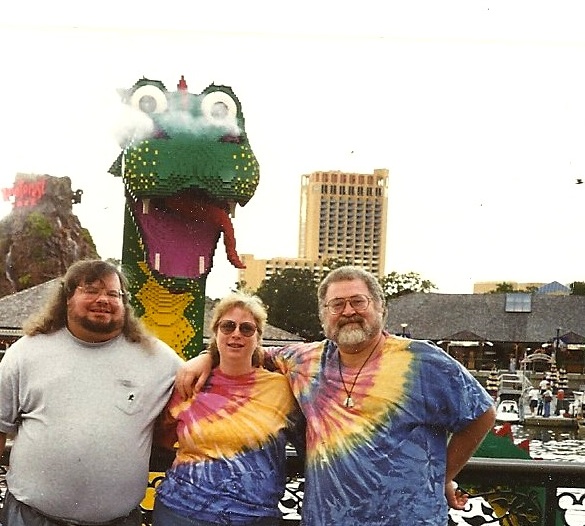
So what explains this picture of a dear friend, me, and my husband being photo-bombed by a Lego dragon?

smithdragon

The first thing you have to know about Tom (left) and Leslie (the photographer) is that their inner child is, let’s say, very close to the surface. They are DisneyWorld aficionados. And they know all (well, almost all) about my mental disorders.

We desperately needed a vacation, and they offered to be our guides for an adult-friendly, non-teacup visit. Also, it was the Millennium celebration and early in December, which promised no sweltering heat, interesting decorations (as much or as little as I could stand) and other spiffy stuff, including few children, who would not yet be on Christmas break. (Ah, the high-pitched shrieks of laughter from children meeting their cartoon heroes. It cuts right through me like a knife.)

Here’s what I learned.

• The restaurants there are incredible. Eat your way around Epcot.

• I dreaded the Tower of Terror because I thought my stomach would drop out. This proved not to be the problem; my inner ear objected, though. Our friends got me on it by telling me to repeat the mantra, “Disney will not kill me. They want more of my money later.” It was one of those things that I’m glad I did and now Will Never Do Again.

• The Explorer’s Club is extremely cool.

• There are lots of nifty tiny things that aren’t rides and attraction that you can try to spot – bits of the sidewalk that light up randomly like a surprise Dance Dance Revolution, Mouse ear shapes in unexpected places, such as the wing nuts on shelves in the many gift shops, and so on. This is where knowledgeable guides come in particularly handy.

• At night, you can see the stars from the top of that mining train-roller coaster thing, something I didn’t expect, given all the ambient light an amusement park puts out.

• Also, we all won giant purple-and-red plush armadillos at one of the games. That’s one thing my inner child can appreciate.

• STAY AWAY from the teacups and It’s a Small World. They will turn you into a whimpering, burbling puddle of regret and sugar-shock. When your mother asks later, just say, “Oh, yes. They were nice. You would have loved them.”

If you go with the right people, do not try to make it into the Bataan Fun March, and rest and eat or retreat to the hotel when you need a break, it’s survivable and even – dare I say? – enjoyable. Sufficiently medicated with Prozac and Ativan, I could handle it.

I’d have to give this round to Disney, but really it was all Tom and Leslie.

P.S. Also, the Food and Wine Festival is a great experience. I spent three months in Orlando and a co-worker got us tickets. Cute guys with devastating Australian accents chatting about Australian wine. What could possibly be more satisfactory?


Abilify: News or Not

I’ve been taking Abilify for several days now. Is it working? It’s hard to say.

I’m pleased to report that I haven’t had any side effects I can’t handle. In fact, I don’t know whether I’ve had any side effects at all. I’ve had a tiny bit of dizziness and some drowsiness. But I have those anyway, either from my other meds or from other physical conditions.

On the positive side, I’ve had a bit of an increase in energy and concentration – as you could probably tell from the fact that I’m blogging again. But is this attributable to the new drug, or is it just the usual up cycle of my own personal roller coaster?

It’s probably too soon to expect anything definitive. Like most psychotropics, it probably needs to build up in my system a bit. Or I may just be one of those people Abilify doesn’t affect, for good or ill.

I recently read an article in Discover magazine called “The Power of Single-Person Medical Expepriments.” The article discussed the fact that the usual clinical studies of new drugs and treatments – randomized, double-blinded, hundreds or thousands of participants (the “gold standard” of tests and trials) – give results that are only averages. The techniques will work for some people and not for others. Some experimental subjects will experience side effects to varying degrees. Or not.

The only way to see whether a given treatment works for an individual is for that person to try it. The odds may say it has a better-than-50% chance of working, but until the patient tries it, whether it will work for that one individual is basically a crap-shoot.

I think this may be particularly true of psychotropics. Every time I’ve asked how this or that med works, the answer has been, “We don’t really know.” Factor in the number of different meds I’m on, psychotropic and otherwise, and their potential for interactions with each other, and any new treatment’s effectiveness is likely a matter of trial and error.

I’ve certainly gone through a long, tedious, disappointing (or unpleasant) series of weaning off and ramping up different meds in hopes of mixing just the right cocktail for my particular brain.

I think that’s why they call it “practicing” medicine.

Dear Folks: Sorry I Haven’t Written Lately

This has been the longest trough I’ve had in a while, and I’ve been spending all my spoons on work, because the cats do insist on eating.

Tomorrow begins a new adventure: My psychiatrist has prescribed Abilify. The $800/month price tag seemed a tad bit high to me. We have insurance, but the benefits don’t really kick in until we meet the absurdly high deductible. A few months of Abilify would probably do it. (We couldn’t afford the gold plan. I think ours is aluminum, or maybe tin.)

The manufacturer does offer a free month’s trial and a discount card, so at least I can see if it works for me. If it does, I’ll figure out how to pay for more. (BTW, if your meds are way expensive, check out needymeds.org. They have a database of manufacturers, discounts, requirements, and contacts. My psychotherapist turned me to that.)

When Dr. R. prescribed Abilify, he told me that it could make me restless. “How will I know whether it’s the drug or my usual twitchiness?” I asked. “You’ll know,” he said. After reading the literature, I can see what he means.

So here I am with three work assignments (not particularly tight deadlines, though) and am about to start a drug that could feel either heaven-sent or hellish. Or just “meh,” I suppose, which would leave me exactly where I am now.

Wish me luck.

And tell me if you’ve had any experiences with Abilify. I know anecdotal evidence doesn’t mean squat to scientists, but I’m interested in hearing from people who have tried it, or seen how it worked (or didn’t) for a friend or relative.

Treading Water

I haven’t given up. Life is just overwhelming lately. And tomorrow I face a challenge that was a major contributor to my most recent breakdown. I keep on keepin’ on.

Going Public

I just posted this on my Facebook page. Now we wait and see what happens.

Along with the news of Robin Williams’s death have come discussions of mental illness and suicide. I’ve decided to go public with my own experience. I have bipolar disorder – type 2 (which means that I have lots of depression and anxiety, but very few manic phases). I’ve had this all my life, most likely, so whenever you met me, I had it.

Some of my friends already know and I’m sure others have guessed or suspected it. It is the result of a biochemical imbalance in my brain and is now treated with medication and therapy. I’m working on it.

Anyway, I ask for your understanding when I sometimes go hide under a rock for a while or say or do something odd or rude or unkind. My social skills have never been great, and having a disorder like this doesn’t improve them. I’m working on that too.

But you don’t have to do anything special or tiptoe around me. I’m still who I always was. I don’t freak out when people call me crazy or nuts or weird.

If you are interested, I blog about it: bipolarjan.wordpress.com (I also have a general purpose blog: janetcobur.wordpress.com.) Anyone is welcome to visit. I can also recommend other resources.

Here is the article about Robin Williams that noodged me into taking this step: http://www.slate.com/blogs/xx_factor/2014/08/12/robin_williams_and_mental_illness_when_depression_is_breaking_news.html

I Bet Robin Williams Knew He Was Loved. Unfortunately, Love Doesn’t Cure Mental Illness.
http://www.slate.com
It is jarring when a beloved celebrity dies of something you could possibly die of yourself—when all of a sudden everyone is talking about the illness you have, the one that they usually…

Read Your Way to Sanity

As reported in Smithsonian magazine, “Doctors are now prescribing books to patients with depression, hoping that reading will help them find connections.”

Here’s the link, but I’ll hit the high spots for you. http://www.smithsonianmag.com/smart-news/doctors-are-now-prescribing-books-to-treat-depression-180948211/?no-ist

First, let’s note that this is third-hand information – from the U.K. National Health Service to the Boston Globe to the Smithsonian. (Fourth-hand, if you count this blog.) Many of the details and even the explanation of the concept may have lost quite a bit in the transitions. But here are the basics:

 If your primary care physician diagnoses you with “mild to moderate” depression, one of her options is now to scribble a title on a prescription pad. You take the torn-off sheet not to the pharmacy but to your local library, where it can be exchanged for a copy of “Overcoming Depression,” “Mind Over Mood,” or “The Feeling Good Handbook.” And depression is only one of over a dozen conditions treated.

There are also books prescribed for other conditions including, I presume, bipolar disorder. And they sound a lot the old self-help books of the sorts we read in the 1970s, of the Women Who Are Ambivalent About Women Against Women Against Feminism sort (h/t The Bloggess for that awesome title).

Back then I was diagnosed with depression, and back then the Common Wisdom said, “Depression is anger turned inward.” Now that we know more about brain biochemistry, neurotransmitters, and such, advice from a book called “Mind Over Mood” is not likely to be all that much help. And God spare me from anything called “The Feeling Good Handbook.”

Of course the Brits’ prescriptions are not actual bibliotherapy, which is a real thing, defined by  The American Library Association thusly:

The use of books selected on the basis of content in a planned reading program designed to facilitate the recovery of patients suffering from mental illness or emotional disturbance. Ideally, the process occurs in three phases: personal identification of the reader with a particular character in the recommended work, resulting in psychological catharsis, which leads to rational insight concerning the relevance of the solution suggested in the text to the reader’s own experience. Assistance of a trained psychotherapist is advised.

This is a much better idea, but again, it’s advisable to check the publication dates on those books. The extremely popular book I Never Promised You a Rose Garden was written before anyone really knew about the genetic and biological components of schizophrenia.

I’m sure there is modern fiction that would be useful in bibliotherapy. Personally, I think that the Dementors in J.K. Rowling’s Harry Potter books provide as good a description of depression as I’ve ever heard:

[T]hey glory in decay and despair, they drain peace, hope, and happiness out of the air around them… Get too near a Dementor and every good feeling, every happy memory will be sucked out of you. … You will be left with nothing but the worst experiences of your life.

Rowling herself has spoken about the connection:

It was entirely conscious. And entirely from my own experience. Depression is the most unpleasant thing I have ever experienced. It is that absence of being able to envisage that you will ever be cheerful again. The absence of hope. That very deadened feeling, which is so very different from feeling sad. Sad hurts but it’s a healthy feeling. It’s a necessary thing to feel. Depression is very different. I think [dementors] are the scariest things I’ve written.

As for me, I find insight into mental disorders primarily in nonfiction – though not necessarily in books with a psychiatric or psychological perspective. The Noonday Demon: An Atlas of Depression by Andrew Solomon is, I think, essential for any collection. It combines the author’s own experiences with historical, cultural, philosophical, and other ways people have thought and written about depression.

Generally, though, I prefer memoirs of people who have lived through or with the conditions they write about. Although my diagnosis is bipolar disorder type II, I also read memoirs about people with other conditions. There are many similarities of experiences, symptoms, feelings, and other aspects that I find familiar or helpful.

Being an ardent bibliophile as well as a psychiatric patient, I believe in the potential of bibliotherapy. Being a former consumer of self-help books, I sincerely doubt that genre will do much good.

On Dithering

If dithering were a power source, I could light up Chicago. Good thing it burns nerve endings instead of fossil fuels.

The last couple of weeks have seen a lot of dithering and anxiety. I hardly ever get to enjoy the rush of hypomania – except for that one brief spell a few weeks ago – because it comes out sideways as anxiety.

I also have a third-degree black belt in catastrophizing.

Both have gotten a workout lately, since a cyst was discovered in my left breast. (I wrote flippantly about mammograms on my other blog, so irony gifted me with this.)

I checked my usual sources (Mayo Clinic website and a friend who is a biologist and had a lumpectomy), and the consensus was that I had only the remotest chance of the anomaly turning out to be anything really dire.

Do you think that stopped my dithering?

Hell no! Of course not!

What could have gone wrong?

They could have stuck a needle in my breast to aspirate fluid and get a sample for the lab. (A friend who should know tells me that some people do this kind of thing for fun. Somehow, it doesn’t appeal to me.)

If the results were worse, I could have been scheduled for a lumpectomy. There was extra anxiety on this one because my friend almost had a mastectomy instead of a lumpectomy when the surgeon started making the wrong incision. (An operating room tech noticed, saving the day and the breast.)

And of course, my anxiety told me that a mastectomy could be in my future (either on purpose or accidentally, I suppose). My mother had a mastectomy, which added extra oomph to the dithering.

A mastectomy would suck for oh so many reasons. Cancer, surgery, body image issues, obviously.

Also, I would keep falling over to the right. And before the operation I’d have to take my breast on a farewell tour for all its friends and admirers.

Maybe worst of all, I would have to put up with all the pinkness and positivity. Not to denigrate this strategy for those who find it helpful, but I am not that person. Anyone with my brain chemistry is not going to respond to slogans and cheerleading and daily affirmations. (Reminder – As always with my posts, YMMV.)

Barbara Ehrenreich has written about this phenomenon in Bright-Sided: How the Relentless Promotion of Positive Thinking Has Undermined America.  Apparently many breast cancer survivors feel they must get something positive from the experience – appreciating life and family more and so on.

We’ve come a long way from Betty Rollins’s First, You Cry. Now it seems like we’re never supposed to.

The anticlimactic but welcome result came today: Everything is OK. I just need to keep up with yearly mammograms.

And now I can move on to the next thing that needs dithering about – the work I wasn’t able to do while I was catastrophizing.

The Un-Merry-Go-Round

I submitted this for a mental health anthology and swore that if it wasn’t selected, I would post it here. It wasn’t. so here it is.


Back when I was diagnosed with depression (unipolar) and anxiety, I secretly envied the manic-depressives (as we called them then). At least if I had a manic phase, I thought, I could get something done.


Then I met Kate, who was bipolar – and not well controlled on medication, to say the least. My envy lasted through her ambitious plans to make identical green velvet Christmas dresses for her three daughters. And vanished when I saw her tear them apart, recut them, start over, change her mind multiple times. You can write the ending to this one. There were no dresses, not by Christmas and not ever.


Kate was riding the roller coaster – perhaps the most common metaphor for bipolar disorder – the peaks and troughs, swooping crashes, anticipatory climbs, stomach-clenching vertigo, and, for some, an abrupt stop at the end.


Type 2 bipolar is not like that. Type 2 is what my new psychiatrist diagnosed. Except I seldom got the hypomanic mini-jags of ambition and purpose. Instead, it came out sideways, as anxiety.


The challenge for both my doctor and me was finding the right mix of drugs to get me functional and keep me functional, at least at some sort of reasonable level.


While supposedly unipolar, I had been through most of the different sorts of antidepressants and anti-anxiety meds, including, of course, Prozac. When the increasing side effects of each outweighed the diminishing relief, I went through a lengthening list of tricyclics, SSRIs, and so forth. I learned not to ask, “How do they work?” I couldn’t get an answer. The more basic question was, “Do they work?”


I can’t remember all the combinations now. My memory has become Swiss cheese after the spectrum of chemicals I tried. (Actual conversation: “Doctor, I’ve been having some rather embarrassing memory lapses. I asked a friend how her father was doing, when he had been dead for three months.” “Yes, that medication will do that. Stop taking it.”) But in addition to (instead of?) the Prozac, I remember buspirone, Wellbutrin, imipramine. Desyrel, Lexapro? I think so. Effexor, Sinequan? Maybe. No MAOIs or lithium, though.


What I do remember all too well is when my brain broke. I don’t know what else to call it: nervous breakdown, decompensating, mental and emotional collapse. It wasn’t the first time this had happened, I later realized, but it was by far the most severe. That’s when I climbed on the merry-go-round.


It wasn’t a carousel. No painted ponies or dolphins or elephants or zebras with fantastical, bright bridles of flowers and whimsical saddles, steadily but gently leaping to the calliope music like the calming rhythm of waves.


This was a merry-go-round of the type that is no longer allowed on playgrounds because of the danger. A wooden platform, painted a color no longer identifiable, a metal pole speared through the center. Bent metal pipes dividing the surface into rough pie-wedges. No power to make it twirl but the force of children pushing and then jumping on, not to thrilling acceleration, but only to inevitable slowing. No lilting music; only creaks and rattles. No scents of popcorn and cotton candy; only playground dust and much-used sneakers.


The metaphoric merry-go-round would start rotating with each new pill or combo that promised (or at least proffered) “Better Living Through Chemistry.” I couldn’t handle the side effects of some – hideously vivid nightmares or the feeling of wanting to jump out of my skin. Others had side effects that I could live with, but little or no therapeutic effect. “There’s another drug I’d like to try” was the constant refrain.


The merry-go-round creaked on for years. Literally. With each new med, I had six weeks or so of slowly sliding back into the numbness and misery as my body sloughed off that chemical. Then six or so more weeks, waiting for the new one to work or not, prove tolerable or not, be any better than the last drug or not. Each new drug cycle amounted to a minimum of three months of hell. More, sometimes, as the doctor slowly, cautiously ramped up the dosage to gauge the effects, both intended and incidental. Lather, rinse, repeat.


Those years are mostly a blur to me now. I remember sleeping a lot. I remember sitting on the sofa watching “reality” shows so I could see people whose lives were train wrecks worse than mine. I recall not having the wherewithal to add water and nuke a cup of macaroni and cheese. Not bathing. Not feeding the pets. Not paying bills. Not reading. Not caring.


I know now how lucky I was to have a husband who lived the vow about “in sickness and in health” and took up the enormous quantity of slack required. He put up with a distant, unresponsive wife; frequent and apparently unprovoked bouts of sobbing; irrational panics; and all the other symptoms he knew by then he couldn’t fix. He didn’t know about the suicidal thoughts, or if he suspected, he never mentioned it. He often asked how he could help, but really, there was nothing else he could do.


Then came the day that my psychiatrist said we were just about out of options. He was thinking of recommending electroshock (or ECT, electroconvulsive therapy, its current version). As he talked about how it wasn’t like the bad old days and really showed quite good results in some people, his voice seemed to fade and I heard my inner voice screaming, “Fuck, NO! Keep away from my brain, you Nazi sadist!”


I had heard how in the 1950s electroshock was used as a way to punish or control unruly, uncooperative, nonconforming women. And of course everyone knew about the Cuckoo’s Nest. The Snake Pit. As far as I was concerned, electroshock was right up (or down) there with icepick lobotomy, the frighteningly efficient epitome of former psychiatric treatments.


Reeling, I made it to my car and immediately called a friend, a scientist, one of the most rational people I know, to talk me down. Her extremely sensible advice was to do some research. Research was something I knew about and remembered how to do.


I started digging. The Internet was little help. The opinions and experiences of people who had undergone electroshock ranged from “It was hideous” to “It was a miracle.” I kept looking and questioning and slogging through the research as well as the dense fog around me. I lost one friend, my long-time go-to guy for comparing our conditions and our meds, who said, “Do it immediately or I will kick your ass.” (Hint: Advice phrased as a threat of violence doesn’t help, or have the desired effect.)


So there I was, on a merry-go-round that had jolted to a sudden, sickening stop by the notion of electrical jolts surging through my brain. My precious brain, which had both sustained me and betrayed me throughout my life. The only part of my body I ever really loved.


What was I doing, considering altering that unique organ with electricity? But the brain in question kept pondering.


Electroshock caused memory lapses. I was already having those.


I would be allowing doctors to tinker with and alter the functioning – perhaps even the structure – of my brain. But really, hadn’t I been doing those very things with chemicals for years?


I went back to my psychiatrist, ready to tell him I was at least willing to talk to the doctor who did the shocking.


Then I got a surprise (at least as much as anything repeated for years can be a surprise). “There’s one more drug I’d like to try,” he said. “Lamictal. It’s an anti-seizure drug.”


“I don’t have seizures. How does it work?”


“We don’t really know.”


Oh, why the hell not try it? One more spin around the playground.


More misery. More weeks of weaning off and ramping up. More weeks of no change. The same-old same-old.


And then one day, something did change. It was such a clear sensation, physical as well as mental. I felt a sudden click in my head – an actual click, like someone throwing a switch located about two inches inside the back of my skull. I could hear my brain saying, “Oh, yeah. I remember this. This is how thinking and feeling are supposed to work.”


The click wasn’t a flick from a magic wand. I still had a long way to go, rebuilding the parts of me that I still could and still wanted to. Setbacks. More fiddling with the dosages. The creation of a crazy cocktail of drugs to keep the crazy at bay. But I was on my way back to functioning, with the help of anti-depressant, anti-anxiety, and anti-seizure drugs, plus a sleeping aid. And lots and lots of psychotherapy.


So what did I learn from this process? Not “There’s always hope.” I gave up hope lots of times, every time another med didn’t work. Not “Desperate times call for desperate measures.” I am infinitely glad I did not have electroshock. “It’s always darkest before the dawn”? Please. No truly depressed person believes that crap.


The lesson I took was “Stubbornness is a virtue.”  It saved our marriage countless times. It saved my father’s life for five times longer than the doctors gave him. And it saved my sanity.


“Stubbornness is a virtue” is different from “There’s always hope.” Even when you do give up hope, when you know it’s hopeless, when you realize the merry-go-round is grinding to its inevitable halt, you keep pushing it. Hopelessly, if you must, but stubbornly. As long as it takes.
On the Inside

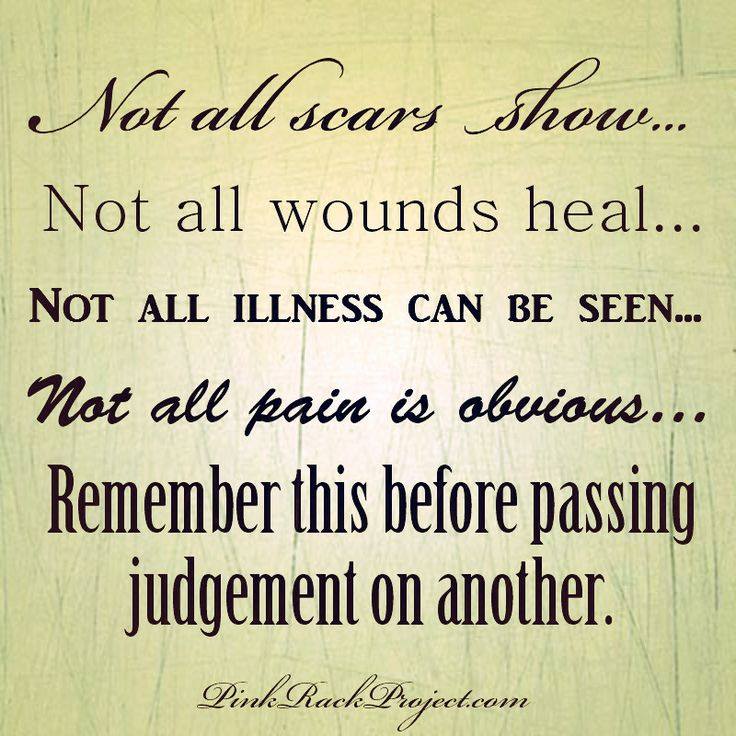
I saw this pass-along the other day and felt compelled to, well, pass it along.

wounds

It reminded me of a lot of things. Things I try not to remember.

Not all scars show. Some of mine do. The one where kids threw a rock at me, requiring seven stitches in my forehead. The ones where I cut myself. (I’ll write more about that later.)

Others don’t. I’ve often described my relationship with Rex as a train wreck. People wonder why I haven’t gotten over it, all these years later. It was the sort of train wreck in which you lose pieces of yourself, some of them irreplaceable. These scars aren’t the visible kind.

Not all wounds heal. Especially the wounds that happen when you’re too young to know how to treat them. Cutting words. Emotional bruises. Neglect. Loneliness. There are no bandages that can cover them, no ointments that can soothe them, no miracle cures.

Not all illness can be seen. If we’re high-functioning or have learned enough coping mechanisms, others may not notice. But bipolar disorder – and other mental illnesses – are, if not immediately visible, lurking just below the surface. And ready to break through at any time.

Not all pain is obvious. But it can leak out, especially around the eyes.

Remember this before passing judgment on another. But judgment-passing is practically an Olympic sport these days, along with shaming.

Scars. Wounds. Illness. Pain. These are things that those of us with mental disorders know all too well. What if our conditions are chemical imbalances in our brains? The consequences of having them, the misunderstandings they cause, the messages we receive, the behaviors we can’t understand or control or mimic, the friends we lose, the opportunities and joys we miss out on, are very real. And don’t let anyone tell you different.

Our disorders may be in our brains, but they’re not all in our heads.

But you knew that, didn’t you?

The Seven Wonders of the Bipolar World

I wonder if I can get out of bed today.

I wonder if a different drug would help.

I wonder what would happen if I told my friends and coworkers.

I wonder how long this mood swing will last.

I wonder if I have enough spoons for all I need to do today.

I wonder if people can tell that I have a mental disorder.

I wonder if this is the best I will ever get, for the rest of my life.