I’m too tired to make a real blog post, so I’ll just say: Abilify at last! Yay!
Co-pay: $25 YAY!!
I’m too tired to make a real blog post, so I’ll just say: Abilify at last! Yay!
Co-pay: $25 YAY!!
I’ve had insomnia. Lots. January seems to be an especially bad time of year for me. A sleeping pill reduced the frequency, but nothing banishes it completely – the obsessive thoughts, the catastrophizing, the worrying, the worrying about how worried I am. We’ve all been there at 3:00 a.m., trying to will ourselves to sleep.
What could possibly be light-hearted about that?
Just this: An actual x-ray of my insomniac self:
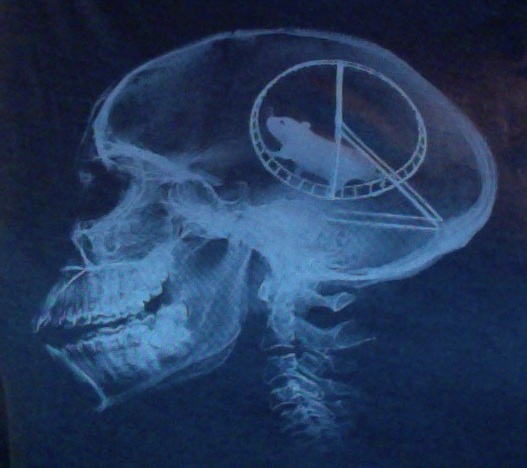
Indeed, my friend Leslie and I, both afflicted with insomnia, recognized this as our mutual problem. We began to end our late-night commiseration with the sign-off, “Death to Hamsters!”
Our mutual friend, the incomparable, incorrigible Tom Smith, heard of this and ran with it. Here is the result, for your amusement.
Imagine, if you will, this performed as a sing-along with a hundred people joining in on the chorus. It may not put you to sleep, but at least it puts insomnia in some kind of loony perspective.
At least it does for me.
Notes:
No hamsters were harmed in the making of this blog post. A rubber duck may have been squeezed, but it had nothing to squawk about. So if you’re with PETA, chill already.
Lyrics to Hamster Brain available here: http://www.tomsmithonline.com/lyrics/hamster_brain.htm.
Obviously, I’m not a man or a theoretical physicist or a character on The Big Bang Theory. But also, I can’t say, as he often does, “I’m not crazy. My mother had me tested.” I’d like to have that t-shirt, but it would be false advertising.
I am crazy and my childhood was entirely free of psychological testing.
It probably shouldn’t have been, because the crazy had taken full hold during my tender years. Crippling depression. Massive anxiety. But both my parents were ordinary folk from Kentucky transplanted to a bland Ohio suburb. They stayed true to their roots and never considered testing or counseling for me or my sister. According to their upbringing, having crazy relatives might be upsetting or embarrassing, but that’s just the way it was. You tried to shelter them from the outside world – and vice-versa – but you didn’t involve agencies or doctors or hospitals.
My crazy got too obvious to ignore when I was in junior high school. I developed a nervous tic – my head would jerk up and to the left uncontrollably. This was very distracting, not only to me, but to whoever was sitting behind me in class. It got me noticed.
It did not, however, get me to a psychologist or other mental health professional. I didn’t want to see one anyway, because I had the irrational notion that being “shrunk” would go on my permanent record and I would never get into a good college.
Instead, I was taken to our family doctor. He prescribed Valium, which did stop the twitching but did absolutely no good for my depression.
Later, during my college years – at a good school, I might add – I had another run-in with Valium. This time my symptom was pain like a railroad spike being driven into the side of my head. Naturally, I thought it was a brain tumor.
I went to the doctor, who said, “I can do any test you want, but I can tell just by looking at you what your problem is. Your jaw is crooked.” He diagnosed me with temporomandibular joint (TMJ) disorder, explained that tension made my muscles contract unevenly and cause excruciating pain in my temples. He sent me away with a prescription for Valium. Which helped with the stabbing pain, but again not with the depression. (Also, I was self-medicating with wine, which just made the crazy train run faster.)
It was not until years later, after college, that I got half a diagnosis – depression – and a non-Valium prescription – Prozac. And many years after that until I got the more accurate diagnosis (bipolar 2) and an appropriate regimen of drugs, which does include Ativan, but not prescribed alone or with wine.
And that’s another thing I don’t have in common with Sheldon Cooper. He’s not taken any psychotropics (or wine) and is happily stuck in his supposed non-craziness. I’ve accepted my craziness, gotten help for it, and am slowly rising, if not above it, at least to where I can peek over the top of it.
No one in my family understands me.
Actually, no one in my family understands my illness.
My mother-in-law doesn’t believe that mental illness exists. And in a way she has a point. If she hasn’t experienced something, for her it doesn’t exist. Most people are a bit like that sometimes, especially regarding mental disorders. There are only a few varieties of broken arms, and when you’ve got one, you know it. When you’re talking synapses and neurotransmitters, thoughts and feelings, it’s obvious why “invisible illnesses” aren’t obvious or well understood.
I didn’t understand my disorder at first, either. I remember driving past a building with a sign: South Community Mental Health. I didn’t know what I was feeling, but I was pretty sure it wasn’t mentally healthy. I went in and began the journey.
My family had the following reactions when I told them I was going into therapy and when I first started taking medication:
Dad: Just as long as I don’t have to go.
Mom: I’ve heard Prozac is a ticking time bomb.
Mom (later): I thought you would feel better after you found a good job.
Sister: Why should you spend $100 a month just to talk to someone? (The clinic was on a sliding scale, so I actually paid only $5 per visit.)
I understand some of those reactions. Dad had heard about how psychologists blame parents for messed-up kids and he wasn’t going to someone to be told he was crazy, and a bad parent besides. And his fear was not that unreasonable. Dysfunctional kids often do come from dysfunctional families. But underlying my disorder was brain chemistry. I never asked him to join the couch gang.
Mom watched Phil Donahue (for you youngsters, think Dr. Phil). And there was at first over-prescribing of Prozac and suicides once the patients gained enough energy. Plus she thought my depression and anxiety were reactive and would clear up when my living situation was more stable.
My sister, I don’t know. I don’t understand her either. I’m sure she has psychological problems too, of one sort or another. But I’ve been diagnosed, so I’m the crazy one.
My husband, who has a background in psychology, “got it” a little better once he stopped trying to “fix” me. But he never understood in a visceral way until he had his own first meltdown.
“You know how you’re feeling now?” I said. “Try feeling that way for a couple of years instead of a month.” Later he did. So at least he knew what half of bipolar was all about. He still hasn’t felt the rapid cycling or the constant roller coaster or the extreme physical and mental battering of going on and off medication after medication, hoping the next one will do more than make his hands shake worse or his memory turn into Swiss cheese.
Still, it’s better to be partly understood than completely dismissed, and to have a family that tries. And to have a family of choice that does understand, because a lot of them are in the same leaky, patched boat.
I could have done a lot worse.
It turns out, Abilify works for me. Except now I have to work for Abilify. To afford it, I mean.
I now wake up around 7:30 or 8:00 instead of 10:00. I can concentrate long enough to read whole chapters of books, and am enjoying that immensely. I am able to get showered and dressed and go out to run a few errands. I can decide what to eat and even recognize when it’s time for me to eat.
And I can work. I have taken on a mega-project, which has required my attention up to eight hours a day, researching, writing, editing, and proofreading. I don’t know how well I’m doing (there are some differences of opinion about that), but I’m doing it, goddammit.
I may be pushing myself a little too hard, despite the new energy and focus. The other day I had to force myself, one pitiful step at a time, to address a dozen Christmas cards. “You have the list, you can put the addresses on the envelopes. You’ve got enough stamps, you can surely put them on the envelopes. (Don’t call me Shirley.) Better put return addresses on. You can do that much, then stop. You can slip the cards into the envelopes. How hard can that be? You had them printed with your names, so you don’t really have to sign them if you don’t want to and won’t have to fake your husband’s signature because he’s not here. That would be too much. Now lick the envelopes. All you have to do is stick out your tongue. Might as well take them to the mailbox. You need to get cat food out of the car anyway. Okay, now you can crash. Egg sauce, Ted.”
Many’s the year when all that was Just Too Much. According to the Mystic Law of Reciprocal Cards, we get about four nowadays, and are very grateful for those.
And grateful for the Abilify. Except it’s $800 a bottle, even for the tiny dose I’m taking. I got one free month and one discounted month ($650) from the manufacturer and have spent a lot of time since worrying and seeking solutions.
There will (we hope) be a generic in April. Yay.
I know someone who was taking it and has some left over.
I know someone in Canada.
Will my doctor prescribe a higher dosage so I can break them in half and stretch them (and the cost) out?
I may have at last solved the problem. After hours on the phone and hours more on hold, we finally have new insurance. It costs about as much per month as a bottle of Abilify, but the drug benefit kicks in before we’ve paid the deductible (which is way lower than previously). So our many, many other drugs will magically shrink to $15 per – or less with mail-away – and we’ll come out ahead. A little. Probably. If I can keep up the pace on work.
Plus, now we have dental, and oh lord do I need that. But that’s another story for another time.
It’s a truism that holidays are difficult, not to say hazardous, for those of us with mental disorders. But there are a variety of reasons and a variety of reactions and – dare I say it – a variety of coping mechanisms.
First, let me say, that despite the fact that I was already depressed or bipolar as a child, the holidays were marvelous. Our granny, maiden aunt, and uncle lived a few hours away and we spent Every Holiday there. (My uncle drank, but not when we were kids.)
On Thanksgiving, we’d arrive, the adults would eat themselves into a coma, and then nap while we kids were sent of to the movies.
Christmas was similar, except that we’d get up, open presents from our parents (and “Santa” for the biggies), pile into the car, and head to granny’s. The adults would eat themselves into a coma, and then nap while we kids were sent of to the movies. (I specifically remember The Sting and The Andromeda Strain, during which I saw my first picture of a naked male butt.)
There was no tension involved – no grand dining table, no fancy dress, no distant relatives, no formal manners. We’d simply fill a plate with home cooking, perch on a sofa (which was called the davenport) or chair, and chow down.
My birthday falls between Thanksgiving and Christmas, but poised well enough between the two that it was never combined with either one. Back then, birthdays were simple – cake and frosting from box mixes, four to six neighbor kids, presents (no gift bags), and maybe a couple of party games. (It was at someone else’s birthday party that I was traumatized during a game of Pin the Tail on the Donkey.)
How could anything in later life measure up to those?
Well, it couldn’t. My first Thanksgiving away from home was when I was at college, and we ate lasagna, not turkey. I believe it was the first time I had lasagna. Ever.
Since then all the holidays have gone downhill, or I have.
Any more, they’re a chore, a relentlass gray blob from November through January. (Halloween starts it off. I can’t get with that either.)
For years, I kept up some of the traditions for my parents’ sake. My mother in particular loved everything to do with Christmas – the Macy’s parade, the tree with my father’s favorite old smudge-faced angel on top, crocheted holiday sweaters and snowflakes and handmade ornaments from her foreign penpals and neighbors and church friends.
.
My first Christmas in my own apartment, I had a small fake tree. When I got married my husband and I tried to get into the spirit with surprise gifts and selecting and decorating my mother’s tree and inviting a divorced friend to dinner with us.
But I was sinking rapidly. At various places I worked, all the ladies sported store-bought Christmas sweaters and sweatshirts (Halloween ones, too) that I thought were just awful. But one year, in a desperate attempt to fit in, I bought holiday sweaters on sale in January to wear the next year. Of course, by then I had lost the job.
Dan and I continued the tradition of dining with our friend John, but our venue changed to Chinese restaurants, where we were kept company by Jews, pagans, atheists, and, no doubt, other depressives and bipolars.
One year Dan was visiting his mother and I was on my own. I tried. I really did. I trotted out a festive holiday sweater and little wrapped-present earrings, and went out to a buffet that offered turkey and beef and ham. But I sat by myself and listened surreptitiously to my iPod. And not holiday music, either. By then about all I could stand was the Christmas jazz from the Charlie Brown TV show.
This year, we ate out on Thanksgiving – but not at the swanky hotel buffet we sometimes took my mother to, or any of the other mega-buffets. We went to a diner that John used to love. I had pork chops and lemon pie. On Christmas I’m likely to be by myself again and may just get festive with a Stouffer’s mac-n-cheese.
Comfort food seems appropriate, and the cats like to lick the dish. Then for dessert – Zoloft and Ativan and Lamictal and Abilify and Ambien. Yum. Visions of psychotropics dance in my head.
P.S. I wrote about a Thanksgiving with John on my other blog. If you’d like to see it, go to http://janetcobur.wordpress.com/2014/07/25/thanksgiving-ratatouille-and-a-near-death-experience/
And if you’d like to see my rant about the “War on Christmas,” go to http://janetcobur.wordpress.com/2014/11/09/lets-call-a-truce-on-christmas/
 Janet Coburn

 Bipolar Me
Recent Comments