Bipolar 2 From Inside and Out

Posts tagged ‘support systems’

Mr. Fix-It

Him: I just groomed the cat. I used a cat-a-comb.

Me: *total silence*

Him: Hey, honey! I just groomed the cat – with a cat-a-comb!

Me: *more silence*

I was depressed, and he was trying to cheer me up. Using exactly the same joke that had gotten no response only seconds before. I don’t know why he thought it would work better the second time.

Many men have the instinct that, when confronted with a problem, they will try to solve it. When something is broken, they will try to fix.

I wasn’t broken, exactly, but I was deep in the Pit of Despair, aka the lower mood swing of my bipolar disorder. At that stage I am immobilized, uncommunicative, and utterly humorless.

The fact that Dan had worked in hospitals and psychiatric facilities was actually a bad thing, despite what you might expect. He had run laughter therapy groups, he knew the jargon, and he sincerely wanted to be helpful.

But he didn’t know – viscerally – what depression was like. How it felt in your body and mind and soul, how it damped down your personality and blunted your reactions and removed your ability to view life as anything other than miserable. Certainly not funny.

Later Dan learned all this when he experienced his own bout of clinical depression and became another one of my Prozac pals. But until then, he would occasionally come shrinking at me, until I had to tell him to stop. I could accept a hug, but not a joke or a “remedy.”

But all that was early in our relationship and before I had begun to heal or even get proper treatment. And I literally would not have made it this far without Dan. I need him and likely always will.

When it’s Pit of Despair time again (which it sometimes still is), he checks on me to see if I need that hug, or some food, or a kind word, or just to be left alone. When I am better, he still does the cooking and shopping, and reminds me to eat regular meals and take showers and tells me I smell nice after I do. Sometimes he can coax me out of bed with a tape of The Mikado or out of the house with lunch at Frisch’s. If I’m too nervous to drive to my appointments, he takes me. When I’m together enough to work, he keeps the house quiet and fixes food when I need a break and validates me for being able to bring in money, even when it’s difficult.

But he can’t fix me. And now he knows that.
Not Waving but Drowning

Consider this a trigger warning. The third section is going to talk about some difficult stuff, although in mostly general terms.

Here’s a list of how I know how bad my mood disorder is at any given time. Being bipolar, I cycle in and out of these phases, along with periods of reasonably competent functioning and even, occasionally, contentment or even happiness.

There are basically three stages of increasing dysfunction.

Starting to Sink
My sense of humor takes a hike.
I need more alone time.
I take mega-naps.
I forget that music can help.
I snap at my husband.
Noises irritate me.
I can force myself to work.

Floundering
I don’t want to eat.
I turn off my phone.
I sleep up to 14 hours a day.
Attention span is one hour (or one average book chapter).
I can trick myself into working.

Going Under
Can’t sleep.
Can’t work.
Can’t read.
Attention span: 15 minutes max.
Thinking “Maybe the plane will crash and I won’t have to deal with this anymore.”
Regretting I flushed my stash of pills.
Urge to cut.

Fortunately, I am well-medicated enough that category 3 doesn’t happen nowadays, though I remember it clearly and am appalled. At that point, the only things I can do are keep seeing my doctors and taking my meds. And remember to thank my husband when I come out of it.

(The title of this post is from a poem by Stevie Smith. The last two lines are: I was much too far out all my life / And not waving but drowning.)

The Lighter Side of Insomnia

I’ve had insomnia. Lots. January seems to be an especially bad time of year for me. A sleeping pill reduced the frequency, but nothing banishes it completely – the obsessive thoughts, the catastrophizing, the worrying, the worrying about how worried I am. We’ve all been there at 3:00 a.m., trying to will ourselves to sleep.

What could possibly be light-hearted about that?

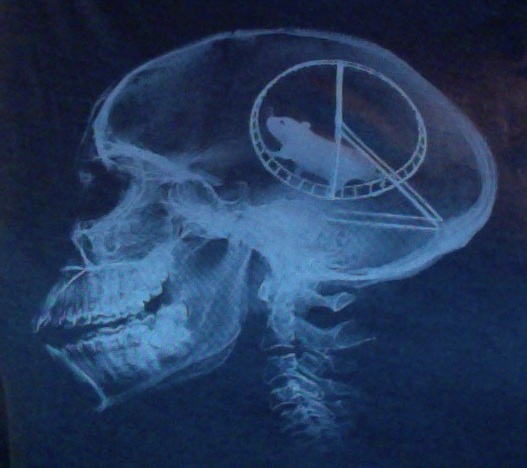
Just this: An actual x-ray of my insomniac self:

T-shirt by Headline Shirts. Photo by me.

Indeed, my friend Leslie and I, both afflicted with insomnia, recognized this as our mutual problem. We began to end our late-night commiseration with the sign-off, “Death to Hamsters!”

Our mutual friend, the incomparable, incorrigible Tom Smith, heard of this and ran with it. Here is the result, for your amusement.

Imagine, if you will, this performed as a sing-along with a hundred people joining in on the chorus. It may not put you to sleep, but at least it puts insomnia in some kind of loony perspective.

At least it does for me.

Notes:

No hamsters were harmed in the making of this blog post. A rubber duck may have been squeezed, but it had nothing to squawk about. So if you’re with PETA, chill already.

Lyrics to Hamster Brain available here: http://www.tomsmithonline.com/lyrics/hamster_brain.htm.

Family Matters

No one in my family understands me.

Actually, no one in my family understands my illness.

My mother-in-law doesn’t believe that mental illness exists. And in a way she has a point. If she hasn’t experienced something, for her it doesn’t exist. Most people are a bit like that sometimes, especially regarding mental disorders. There are only a few varieties of broken arms, and when you’ve got one, you know it. When you’re talking synapses and neurotransmitters, thoughts and feelings, it’s obvious why “invisible illnesses” aren’t obvious or well understood.

I didn’t understand my disorder at first, either. I remember driving past a building with a sign: South Community Mental Health. I didn’t know what I was feeling, but I was pretty sure it wasn’t mentally healthy. I went in and began the journey.

My family had the following reactions when I told them I was going into therapy and when I first started taking medication:

Dad: Just as long as I don’t have to go.

Mom: I’ve heard Prozac is a ticking time bomb.

Mom (later): I thought you would feel better after you found a good job.

Sister: Why should you spend $100 a month just to talk to someone? (The clinic was on a sliding scale, so I actually paid only $5 per visit.)

I understand some of those reactions. Dad had heard about how psychologists blame parents for messed-up kids and he wasn’t going to someone to be told he was crazy, and a bad parent besides. And his fear was not that unreasonable. Dysfunctional kids often do come from dysfunctional families. But underlying my disorder was brain chemistry. I never asked him to join the couch gang.

Mom watched Phil Donahue (for you youngsters, think Dr. Phil). And there was at first over-prescribing of Prozac and suicides once the patients gained enough energy. Plus she thought my depression and anxiety were reactive and would clear up when my living situation was more stable.

My sister, I don’t know. I don’t understand her either. I’m sure she has psychological problems too, of one sort or another. But I’ve been diagnosed, so I’m the crazy one.

My husband, who has a background in psychology, “got it” a little better once he stopped trying to “fix” me. But he never understood in a visceral way until he had his own first meltdown.

“You know how you’re feeling now?” I said. “Try feeling that way for a couple of years instead of a month.” Later he did. So at least he knew what half of bipolar was all about. He still hasn’t felt the rapid cycling or the constant roller coaster or the extreme physical and mental battering of going on and off medication after medication, hoping the next one will do more than make his hands shake worse or his memory turn into Swiss cheese.

Still, it’s better to be partly understood than completely dismissed, and to have a family that tries. And to have a family of choice that does understand, because a lot of them are in the same leaky, patched boat.

I could have done a lot worse.


Missing Friends

Last week I wrote about the controversial subject of self-harm. In my post, I said:

One of my dearest friends once said that if he ever found out I was a cutter, I would never hear from him again. Except for his publicly mocking me for being so stupid.

Naturally, this sort of reaction, though common, is not helpful. I didn’t tell him (or practically anyone else). And I didn’t tell him that at least two other people he knew – one fairly intimately – were also cutters.

Anyway, Tom, if you’re reading this and still feel the same, I guess this is goodbye – just not the long goodbye. I would rather skip the public mocking, though. I’ll just assume you’ve done it while I wasn’t there, mm-kay?

Finally, I got tired of wondering, withholding a part of my past from someone with whom I have practically no secrets, sometimes to the point of TMI.

So I called him and asked, “Are we OK?” At first he didn’t know what I meant, since he hadn’t read the post, but after a brief nudge I could tell he knew exactly what I was referring to.

Just as a (very rational) mutual friend had predicted, Tom chalked it up to the hyperbole of his callow youth and reassured me that we were fine.

Still.

I had lived with the fear of losing that important relationship (and being publicly mocked) for over 20 years. I had never dared mention it to any people in our circle either.

And, let’s face it, I have lost other friends and can attribute at least some of these losses to my bipolar disorder. It harms me, but it also harms those around me, and especially relationships.

I have shot my mouth off and driven away friends and colleagues with bitterness and sarcasm but without realizing how I sounded.

I have ratted out a friend to his therapist and his wife when he was suicidal, which he found unforgivable.

I have turned down invitations to go out or agreed to and then backed out one too many times. My friend gave up the effort since I wasn’t responding.

I have abused the hospitality of friends. When I was at my still functioning moderately well, I would visit and we would enjoy activities, food, conversation, and music. When I was near or at the depths, I would invite myself to visit and turn into an uncommunicative, disengaged, immobilized lump. I was a mooch and a leech, and a real downer generally. I didn’t like spending time with myself, so it’s no wonder they didn’t either.

And I miss every single one of them. I wish I hadn’t driven them away. I wish I could make things right again, now that I’m functioning at a higher level. But I can’t. And that hurts.

In some cases, I’ve tried – sent brief notes of apology. They have been acknowledged with cold politeness that does not invite more contact. I don’t know what else I can do.

Bipolar is a cyclical illness and, though I’m much improved, I can’t promise that I will never sink that low, be that inconsiderate, offend those I deeply care about again. And I can’t blame them for not wanting to deal with that. I don’t want to deal with it.

But I have no choice in the matter. And that hurts too.

Fortunately, there’s one friend I cannot lose, no matter what – my husband. He’s ridden the roller coaster with me, put up with the huge mood swings, ignored the irrational remarks, offered to help in any way, encouraged me to go out but understands when I can’t, and dispensed hugs on a regular basis. He respects alone time and is there when I need company or distraction. If things are really bad, he gets me to eat and helps me shower and takes care of the pets and picks up my refills and does whatever else needs doing.

He’s a man who takes “in sickness and in health” seriously. I wouldn’t have made it this far without him. And I won’t ever lose him, till death do us part.

Bipolar Me vs. DisneyWorld

Once a group of us were on a business trip to Anaheim. “If any of you want to take clients to Disneyland, I can get you tickets,” the boss said.

“I can’t even imagine myself wanting to do that,” I replied.

The others laughed, though I wasn’t trying to be funny. I get that a lot.

I have always had deeply mixed feelings about Walt Disney and his creations. How could I not? A place that bills itself as The Happiest Place on Earth vs. Bipolar 2 That Has Caused Depression Since Childhood. (To be fair, I used to like “Wonderful World of Color,” particularly the nature films, even when we had only a b&w TV. Gray Tinkerbelle is a metaphor for. . . well, something involving depression.)

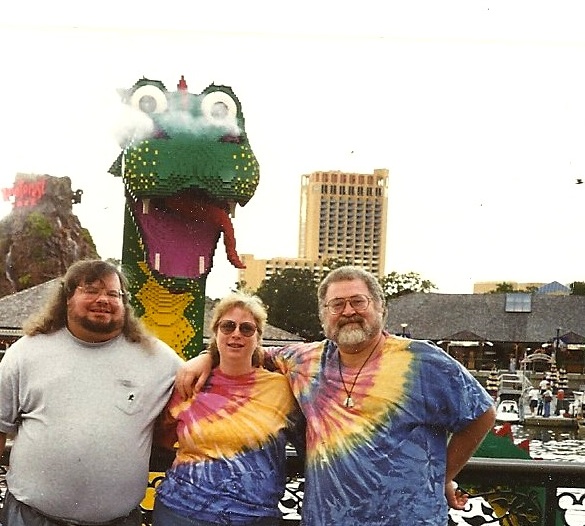
So what explains this picture of a dear friend, me, and my husband being photo-bombed by a Lego dragon?

smithdragon

The first thing you have to know about Tom (left) and Leslie (the photographer) is that their inner child is, let’s say, very close to the surface. They are DisneyWorld aficionados. And they know all (well, almost all) about my mental disorders.

We desperately needed a vacation, and they offered to be our guides for an adult-friendly, non-teacup visit. Also, it was the Millennium celebration and early in December, which promised no sweltering heat, interesting decorations (as much or as little as I could stand) and other spiffy stuff, including few children, who would not yet be on Christmas break. (Ah, the high-pitched shrieks of laughter from children meeting their cartoon heroes. It cuts right through me like a knife.)

Here’s what I learned.

• The restaurants there are incredible. Eat your way around Epcot.

• I dreaded the Tower of Terror because I thought my stomach would drop out. This proved not to be the problem; my inner ear objected, though. Our friends got me on it by telling me to repeat the mantra, “Disney will not kill me. They want more of my money later.” It was one of those things that I’m glad I did and now Will Never Do Again.

• The Explorer’s Club is extremely cool.

• There are lots of nifty tiny things that aren’t rides and attraction that you can try to spot – bits of the sidewalk that light up randomly like a surprise Dance Dance Revolution, Mouse ear shapes in unexpected places, such as the wing nuts on shelves in the many gift shops, and so on. This is where knowledgeable guides come in particularly handy.

• At night, you can see the stars from the top of that mining train-roller coaster thing, something I didn’t expect, given all the ambient light an amusement park puts out.

• Also, we all won giant purple-and-red plush armadillos at one of the games. That’s one thing my inner child can appreciate.

• STAY AWAY from the teacups and It’s a Small World. They will turn you into a whimpering, burbling puddle of regret and sugar-shock. When your mother asks later, just say, “Oh, yes. They were nice. You would have loved them.”

If you go with the right people, do not try to make it into the Bataan Fun March, and rest and eat or retreat to the hotel when you need a break, it’s survivable and even – dare I say? – enjoyable. Sufficiently medicated with Prozac and Ativan, I could handle it.

I’d have to give this round to Disney, but really it was all Tom and Leslie.

P.S. Also, the Food and Wine Festival is a great experience. I spent three months in Orlando and a co-worker got us tickets. Cute guys with devastating Australian accents chatting about Australian wine. What could possibly be more satisfactory?


For Sharing

http://www.upworthy.com/these-9-college-students-want-to-tell-you-about-their-mental-illnesses?c=ufb1

Don’t give in to stigma. If you dig this video, share it so more people with mental illness can leave shame behind.

Surviving High School (and Reunions)

I’ve only ever gone to one of my high school reunions – the 25th. Now the 40th is nearly here.

I was terrified then. This time is not as bad. I don’t have the energy or the attention span to get all worked up about it. Will I go? Probably not. It’s like the Tower of Terror at DisneyWorld – I did it once and I’m glad I did, but I have no desire to do it again.

My difficulties with the reunion even made the local paper. I went to a high school friend, Mary, for advice. She was quite helpful. She also, with my permission, wrote about my panic in her newspaper column.

Here’s what I told her: “Over the last quarter century I’ve confronted and dealt with a number of pieces of my past and tried to make my peace with them. High school, however, is not one of those things. I’m afraid I’ll have flashbacks.”

Mary did note that “Janet had more reason than most to be apprehensive. While I had been actively ignored, she had been, at times, actively picked on – one of those kids too brainy, too head-in-the-clouds, to comprehend how to navigate the social firmament.”

Pretty close. Except that I wouldn’t have called it “actively picked on.” High school was merely another part of the continuum of bullying and harassment that I experienced from childhood on. In high school no one threw literal rocks at me, but by then they didn’t have to. I was conditioned to cringe.

The head-in-the-clouds part was also not entirely accurate. As I walked through the halls between classes, my head was down and my nose was in a book. I was trying to perfect my “invisible” act and practice that advice that the bullied always get – “just ignore them.”

And I wouldn’t call the social milieu in high school “the firmament.” Just sayin’.

I did go to the reunion, though. I got my hair done for the event and told my stylist to make me look “successful and sane.” She replied, “Oh, no, here comes the wish list.” “At least I didn’t ask for young and thin,” I pointed out.

I went, taking along my husband and telling him not to leave my side. I’m sure the husband came as a surprise to most people there, proof that I had at least managed to navigate that particular social firmament. And if my hairstyle did proclaim some degree of sanity, that was likely a surprise as well.

I survived. My big insight: “Not everyone hated me.” I should have known that already, since I had friends like Mary and a few others I’m still in touch with. But old fears die hard.

Mary was much more philosophical: “In adolescence our images are refracted through so many distorted lights – the way we see ourselves, the way everyone else sees us, the way we fancy everyone else sees us. What mattered was that we could all talk face to face, as adults, as equals, as friends.”

She may have been right, though “Not everyone hated me” was, in its way, a major alteration in my outlook and pretty much as far as I’d gotten by then in my continuing struggle to come to grips with my life.

Things have changed a lot since then and so have I. Now I realize I have nothing to prove, and no need to try.

Cookie Theory

Many of you are probably already familiar with Spoon Theory (and if you’re not, go here and read it: http://www.butyoudontlooksick.com/wpress/articles/written-by-christine/the-spoon-theory/).

In my previous post, I explained my Theory of Misery and Math. This week, inspired by something a friend posted, I will expound on Cookie Theory. Here’s the post:

argument

As I commented then, even an RSVP is optional. This is especially good advice if your FB friends post on controversial topics, as a number of mine do.

On to Cookie Theory. Just as I didn’t invent Spoon Theory, I can’t claim Cookie Theory as my own. My husband shared it with me, on the weekend over 30 years ago when we met.

I was having a difficult time (to say the least) with my boyfriend at the time, whom we’ll call Rex. Among the difficulties was that I was stranded, several hundred miles from home, with no money. I had to borrow money from every single person I knew there, including some, like my future husband, that I had just met, in order to get bus fare. And find someone who would take me to the bus station.

Dan, the aforementioned future husband, was the one who gave me a ride, and as I was waiting for the bus, he shared with me these words of wisdom:

Just because someone hands you shit cookies doesn’t mean you have to eat them.

The more I pondered this metaphor, the more I realized how insightful it was. Rex had generously supplied me with shit cookies over the year and a half I knew him. And I ate them. I was also supposed to pretend they were chocolate chip. And say yum, yum.

And I did.

The bus wasn’t the only thing that stopped for me that day. So did my willingness to eat the cookies.

The first step is training yourself to recognize the difference between shit cookies and chocolate chip. The second is saying no. (Like refusing an invitation to an argument. Just say no and walk away. Or catch a bus.)

I’m not claiming it’s easy. But when someone hands you a put-down, a micro-aggression, a lie, ask yourself, “Is this a chocolate chip cookie?” If not, don’t take it. Don’t eat it.

Then stay on that diet. It’s amazing how much weight it will take off you.

Hired Help

Remember when you go to a therapist, you hire him or her. She/he works for you. And if it doesn’t work out you can fire your therapist.

I hate breaking in a new therapist. I hate having to do the little tap dance that is the Reader’s Digest Condensed version of my screwed-up life. But if I have to find a new therapist, I’ll keep reciting it until I find the right one.

Of course your choices may be limited by location, finances, or other factors (EAPs, for instance). You may not have that wide a range to choose from. But the better the “fit” between you and your therapist, the more likely you’ll make some progress.

When I need a new therapist (when mine has moved away, for instance) I go through a process.

Step One: I identify my current needs. Do I need counseling for grief? Mood disorders? Anxiety?

Step Two: I do research. Most therapists have websites and most of them list what they specialize in. Start making a list of those whose practices meet my needs.

Step 3: I make a list of my preferences. For me, this is easy. By now I know I need a therapist who is not Freudian or cognitive behavioralist or comes from any particular religious approach, but does deal with women’s issues and has a sense of humor.

Step 4: I make some calls. Is the therapist taking new patients? Is there a waiting list? Does he/she take my insurance? If not, is there a sliding fee scale based on need? Is long-term therapy possible, or is it 30 days max?

Step 5: I set up an “interview” appointment. I do the even-more-condensed version of my screwed-up life, ask a few questions and, if everything “feels” pretty good, make a follow-up appointment.

I know, that’s a lot of work. But in the long run, you can save yourself a lot of grief.

I’ve been to a couples counselor who absolutely shredded me, latching on to my husband’s difficulties with me and running with them. I felt she didn’t hear anything I said, or if she did, discounted it. I felt ganged up on. It was not pleasant. More important, it was not helpful.

(I’m not saying that she should have ignored my husband’s issues, which were important and valid. But I really needed to be navigating on a two-way street.)

Another therapist I went to decided that my problems stemmed from being an innocent led astray by an older man (ten years older) who got me into practices that went against my upbringing. Which is not the way it was at all. (It was the 70s. Some experimentation with sex and drugs for a woman in her 20s was not considered total depravity then.)

She also diagnosed me with PTSD because I said I had flashbacks and dreams about the bad parts.

In both of those cases, I got the hell out.

And that’s my point. I had a choice and I exercised it. I went looking for someone else who could help me with my problems. And I found a psychotherapist who could and has, plus a psychiatrist for my meds.

I’m not saying you should ditch your therapist when the process hits uncomfortable or even painful patches. It’s pretty much got to if it’s going to help.

But you made the choice of hiring this person. You also have the choice – and the right– to leave and go looking for someone else.


(Disclaimer again: I am not a medical or psychiatric professional and my comments are based on my own experience. YMMV.)