Bipolar 2 From Inside and Out

Posts tagged ‘support systems’

Am I Ready to Stop Therapy?

I got my first hint that I might be ready to stop therapy when I realized how little I was going. Over the years I have scaled down from weekly sessions to biweekly.

Then I noticed that, effectively, I’ve been going only once a month. I’ve been forgetting appointments, showing up on the wrong day, oversleeping, feeling poorly physically, or having too much freelance work to do.

Of course, those could be signs that I’m in denial, that I’m resisting therapy, that we’ve hit a bad patch of difficult issues and I just don’t want to deal with them.

But I don’t think that’s what’s happening. Here’s why.

I’m stabilized on my medications and they’re effective. When my psychiatrist moved away a few months ago, he left me with enough refills to last until this month and a list of other psychiatrists. My PCP agreed to prescribe my psychotropics if I lined up another psychiatrist for emergencies. I’ve done that, though I couldn’t get an appointment before March.

And that doesn’t alarm me. I don’t have the oh-my-god-what-if-my-brain-breaks-again panics. I don’t have the feeling that my brain is about to break again. I’ve thought about it, and I’m comfortable with letting my involvement with the psychiatric profession fade into the background of my life.

As long as I keep getting my meds.

I have more good days and I’m beginning to trust them. Oh, I still question whether I’m genuinely feeling good, happy, and productive or whether I’m merely riding the slight high of hypomania. But really? It doesn’t seem to matter very much. A few days ago I reflected on a string of particularly good days – when I accomplished things, enjoyed my hobbies, and generally felt content. And I simply allowed myself to bask in those feelings.

That’s not to say I don’t still have bad days. After a few days of hypomania, I hit the wall, look around for spoons and don’t find any, and require mega-naps to restore me. (I’m intensely grateful that I work at home and can do that. Most offices don’t appreciate finding an employee snoring underneath her desk. And my cat-filled bed is much more comfy-cozy.)

I still get low days too, but they are noticeably dysthymic rather than full-out, sobbing-for-no-reason, Pit-of-Despair-type lows that last seemingly forever. I know – really know, deep within me – that they will last a day or two at the most. And just that knowledge makes me feel a little bit better.

My creativity, concentration, and output are improving. I can work longer, read longer, write longer, take on new projects, think past today or even next week. I can trust my muse and my energy, if not immediately when I call on them, at least within a reasonable time.

I have trouble remembering how bad it used to be. Recently I’ve made connections with several on-line support groups for bipolar and mental health. I find I’m astonished at the crises, the outpourings of misery, the questioning of every feeling and circumstance, the desperate drama of even the most mundane interactions. They are overwhelming. But I realized that it’s been a long time since they’ve overwhelmed me. I recognize that I could some day be in that place again – that’s the nature of this disease. But I have a good support system that I trust to help me not fall too far without a net.

I don’t have much to talk about when I go to therapy. There are issues I need to work on – getting older, getting out of the house more, reclaiming my sexuality. But most of those I feel competent to work out on my own.  My sessions are mostly an update on what’s going on in my life at the moment, plus a recap of my recurring problems. But those problems are ones I’ve faced before and know how to cope with. I already have the tools I need and use them without needing a reminder.

So I’ve talked it over with my psychotherapist and I’m not completely quitting therapy, but I am cutting back officially to the once a month I seem to be going anyway. I know that if and when the bipolar starts giving me major trouble again, I can always call for an appointment or a telephone therapy session.

I’m not going to stop writing these posts. I still have a lot to say about where I’ve been, how I’ve got to where I am now, how things will go in the future, and all the many ways that mental illness affects society and vice versa.

You’re not getting rid of me that easily. I’m sticking around.
Dental Health and Mental Health

I still remember one of my earliest episodes of panic, which happened in a dentist’s waiting room. As I said in the uncomfortable chair, surrounded by Highlights for Children magazines that I had already read, I felt dread moving up my body from my toes. It crept up my legs into my hips and on into my abdomen. I was convinced that when the feeling of terror reached my heart, I would die. I was called into the doctor’s office before that happened.

This is a memory I have shared with only one other person before now. Just thinking about it still brings back a visceral body memory of fear.

It really bothers me that some people think that good teeth are a sign of moral superiority. Some other people, like me, are simply born with bad teeth, or at least weak, cavity-prone little tooth buds embedded in our infantile gums. Brush as diligently as we might, we are never going to have pristine white teeth like the people on TV.

While my dental phobia can possibly be attributed to the general pool of my anxiety triggers, there were also some outside factors that contributed to it.

My parents were never good role models for dental health, as my mother had gotten dentures at age 16 and my father chewed tobacco.

There were also bad experiences with blame-and-shame dentists and hygienists, one of whom scraped a bit of tartar off my teeth, stuck it in my face, and asked, “If I put that on a piece of bread, would you eat it?”

I used to loathe the public school practice of making us chew little purple tablets to see how clean our teeth really were. My teeth were – and still are – considerably crooked, so it was difficult for me to brush in a manner that wouldn’t leave glaring purple spots all over my mouth.

My teeth have only gotten crookeder, since my parents were not able to afford orthodontia for me. When and where they grew up, braces were a luxury for the well-to-do; rural children like they were simply did without. By the time my sister and I came along we lived in the suburbs, but braces had never become a priority for my parents compared, say, to eyeglasses, which were deemed essential.

My last and most recent experience with a dentist was a number of years ago. I don’t remember what prompted me to go, but I did tell the dentist about my phobia and he was very considerate. (I always look for a dentist whose advertising says, “We Cater to Cowards.”)

He did my exam and treatment in the kiddy room with the bright, nonthreatening murals of cowboys and western scenes on the walls. Just the x-rays and routine cleaning proved alarming enough to trigger one of my worst stress reactions – diarrhea. When it came time for the actual procedures the dentist brought in a traveling anesthesiologist so that I could be knocked out rather than conscious and terrified. My husband was there for driving, moral support, and decisions that needed to be made while I was out cold.

I have not been back to the dentist since. However, it’s becoming increasingly obvious that I need to. My teeth ache. My fillings have fallen out. One tooth is broken. Because of that, my teeth are moving in directions they were never supposed to. And that makes my dental bridge (acquired at the aforementioned last experience) fit poorly. I look like the stereotypical Willie Nelson fan. (I am a Willie Nelson fan, but I don’t care to reinforce the popular image.)

This week I was trying to convince myself to call a dentist just for a consultation. I still haven’t managed to do that. Just saying the word “dentist” gave me a spasm in my chest. Maybe I’ll be able to make the call during this coming week.

The only person in the world who is a worst dental-phobe than I am is my sister. She too had childhood dental issues. Once she even bit a dentist and he slapped her. Needless to say, that experience did not improve her attitude toward dental care.

She is also ultra sensitive to (or afraid of) pain and quite terrified of needles. Even as an adult, she has been known to scream so loudly and lengthily that she has cleared an entire dentist’s waiting room. (She then sent the dentist a Halloween card that screamed when you opened it.)

Still, I am a grown up. I need to do this. I cannot convincingly tell myself that waiting will improve the situation. I just have to pick a day for my appointment when my husband is available to take me and I have had my prescription for Ativan recently refilled. And some Immodium on hand.

Wish me luck.


ETA: I now have an appointment with a dentist for some serious work, and with a traveling anesthesiologist for IV sedation. I tried to get the doc to prescribe roofies, but some guys have no sense of humor…

Does “Natural” Treatment Work for Depression?

Not for everyone. Not all of the time.

Angel Chang recently posted on LittleThings.com “The 10 best natural ways to treat depression.” (See http://www.aol.com/article/2015/11/06/the-10-best-natural-ways-to-treat-depression/21260290/?ncid=txtlnkusaolp00001357) While she does acknowledge that “clinical depression is triggered from within, and very often need[s] medical attention” and “it’s imperative to consult your physician if you notice an abrupt change in your mood, feelings, or sense of well-being,” her article is about “easy” ways to treat depression yourself.

Unfortunately, her tips are not very helpful for me and many others who suffer from clinical bipolar or unipolar depression. Here’s how I respond to them.

Meditate. This is both nearly impossible when you have racing thoughts and a way to sink even lower if you can’t clear your mind of negative thoughts, which is one of the hallmarks of depression. And if you’re manic, even sitting still in one place for any length of time can be a challenge. After you’re stabilized on medication – go for it.

Eat Foods With Vitamin B. It may be true that vitamin B has been linked to neurotransmitters that we need more of, but preparing them is not realistic when I’m in the Pit of Despair. I try to imagine myself preparing a meal of fish, Swiss cheese, spinach, and eggs, and I just can’t. Or shopping for them, for that matter. I might be able to scramble an egg in the microwave, but that’s about it. (I wrote about food and depression recently: http://wp.me/p4e9Hv-db.) I do take a multivitamin along with my bedtime psychotropics, so I guess I can follow this advice a bit.

Set goals. Chang recommends starting with “small, daily goals.” When in full-blown depression, mine are about as small as you can get. Get out of bed. Make it through the day without crying. Take my meds. Poof! Out of spoons! The expert Chang quotes gives an example of a goal to work up to as washing the dishes every other day. To me, that implies a series of goals: Gather up dishes. Find soap. Fill sink. Wash a dish. Put in drainer. Repeat. My tip: Wash the spoons first!

Sleep on a schedule. Going to bed at the same time every night may be do-able, but getting up at the same time isn’t possible for me, which is one of the reasons I can’t hold a regular job. An alarm clock awakening me before my body is ready leaves me groggy and unfit to work. And there’s no guarantee that I’ll actually sleep during those scheduled hours, even with Ambien. Chang advises not taking naps, but I seldom make it through the day without one, even if I have slept eight (or nine or ten) hours. In fact, I love naps and consider them therapeutic, for me at least. Naps are my friends.

Get out of your rut. Structure is the only thing that keeps some of us going. And if we could find joy in a painting class, a museum, or making a new friend, as Chang suggests, we probably wouldn’t be depressed in the first place. J. K. Rowling described the Dementors in the Harry Potter books: “Get too near a Dementor and every good feeling, every happy memory will be sucked out of you. … You will be left with nothing but the worst experiences of your life.” She has stated that they are metaphors for depression. With every good feeling sucked out of you, you can’t see anything but the rut. I am told that for some people, Cognitive Behavioral Therapy (CBT) lessens the tendency to keep traveling in the rut. But “easy” and “natural”? I don’t know.

Talk. Chang is advocating talking with trusted loved ones, which is good as far as it goes. What it ignores is that friends and loved ones are not universally understanding of depression or supportive in dealing with it. She never suggests talking with a therapist or doctor. I don’t know why that’s less “natural” than talking with someone who has no training. Except you have to pay them (or your insurance does), but painting or language classes or art supplies aren’t free either.

Exercise. This is a classic antidote for depression, and I understand that it works for many people some of the time. But I would put this under the same heading as setting goals. I know it would be good for me, but motivation is hard to come by and immobilization thwarts me. But I wish I could take this advice. I looked into water aerobics, but there’s not a feasible program in my area.

Responsibilities. “Because you might feel down,” the article states, “you may also want to withdraw from your daily activities in life and your responsibilities at home or at work.” Yepper. “Try staying involved as much as possible in the causes you care deeply about, and take on new daily responsibilities. These can be as simple as volunteering at your local food pantry, or going back to work part-time.” Big nope. See getting out of your rut, above. For the clinically depressed, working even part-time is unimaginable, with responsibilities of the crushing sort.

Unwind and relax. If your depression comes with anxiety like mine, this idea is a non-starter. Unless you count drinking as relaxation, though it isn’t the best idea if you’re on meds.

Stay off caffeine. Okay, I can pretty much do this one, except for one cup of coffee or a caffeinated soda to get me started in the morning.

“Did you learn something new about how to naturally treat symptoms of depression?” the article ends. Not really. Well, except for the B vitamins. We’ve all heard these kinds of advice before. They’re good tips for situational or reactive depression, but largely not feasible for the chronically, clinically, biochemically depressed. In a way they add up to the much-hated “Just stop it. You must want to be depressed or else you’d be doing all these great things.”

But try them if you can, perhaps in addition to medical treatments. Maybe some of the ones that won’t work for me will for you. In the meantime, get help. See your therapist and/or psychiatrist. Keep taking those meds. Those may not be “easy, natural” ways to treat depression, but if they work, isn’t that the larger point?

P.S. Do NOT Google “CBT.” Spell out “Cognitive Behavioral Therapy.” Trust me on this one.

The Bloggess and Mental Health

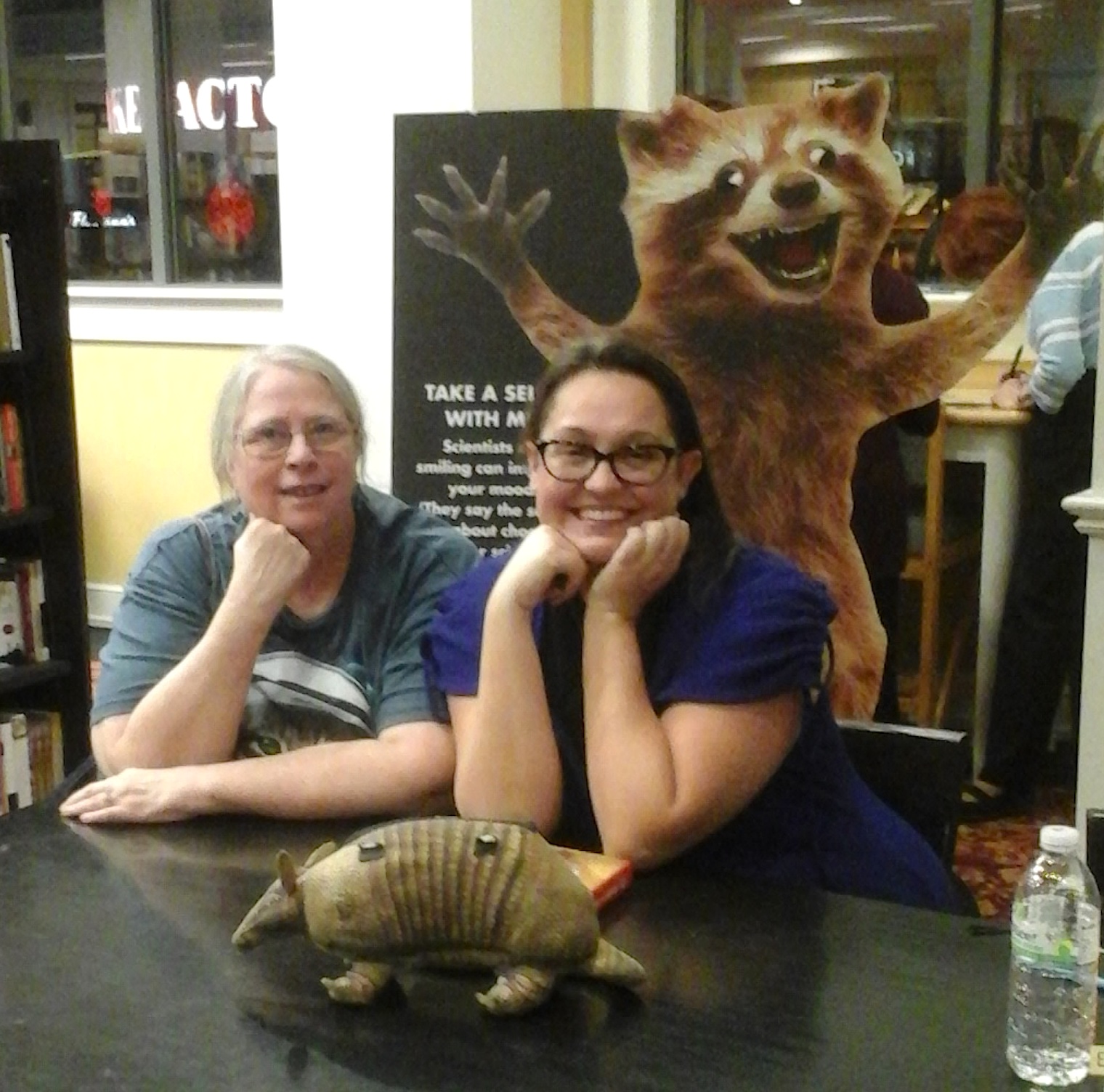
I met the Bloggess (aka Jenny Lawson) recently at a book signing for Furiously Happy, her second book. (Her first book was Let’s Pretend This Never Happened.)

Back row: Rory, the Furiously Happy Raccoon; middle row: me, Jenny Lawson; front row: Erma the Armadillo

Back row: Rory, the Furiously Happy Raccoon; middle row: me, Jenny Lawson; front row: Erma the Armadillo

The space at the bookstore was full to overflowing. (People had driven for as much as five hours to see her.) Jenny read two chapters of her new book to riotous laughter and applause. There was a brief Q&A session. (I figured she got the same questions all the time and wanted to ask her something that no one else had. I imagine that writers on tour need a little variety.So I asked: If you could be any animal, what would you be and why? Her answer: A tapeworm, because I could just not move and have people feed me.)

I joined the signing line (#17). She signed my copy of her book (“Our story is not over.”) and I showed her the semicolon tattoo that goes with that saying. She also signed my armadillo purse (Erma) and a piece of glass for my husband, who wants to put it over a picture of her or of a vagina; he hasn’t decided which. She laughed. He was one of the many that ask for perhaps her most famous – or at least most quoted – phrase, “Knock knock, motherfucker.” (It comes from her story about leaving a giant metal chicken on someone’s doorstep. There were also a lot of metal chickens she was asked to sign.) The bookstore personnel made sure that everyone knew it was okay to ask for that. In fact, they announced it just before the signings, reassuring the shy or inhibited.

The title of her new book, Furiously Happy, is Lawson’s way of telling depression to fuck off: If part of her life is misery and pain, she’s going to damn well make the most of the parts that aren’t. And while she’s at it, she’ll spread the word that mental illness is not a thing to be hidden or ashamed of.

This is not to say that her mental disorders are cured or that she no longer suffers from them. She was clearly anxious when reading aloud the two chapters, and visibly relieved when that part of the evening was done. Her strategy is to laugh at mental illness, joke about her meds, and speak bluntly to those in the audience who also suffer or have a person in their life who does.

Furious Happiness is a worthy goal, and her out-there enjoyment of life leads her into some of the hysterical situations she has written about in both books. These are the stories that make you say – only you, Jenny! Then she turns around and tells you that you are just like her in the ways that count.

The readers of her books and her blog – thebloggess.com – have formed an odd mutual support community. Although we may feel alone, Jenny rallies us to be alone together. Since one of the major difficulties with being a psychiatric patient is the feeling that no one else understands or experiences the same feelings, bringing people together in the virtual world or between the covers of a book is a valuable form of networking, especially for those who can’t network any other way.

Myself, I can’t manage the Furious Happiness. Too long dealing with the black dog and relatively little experience of even the mild highs of hypomania have left me depleted. Jenny will just have to do it for both of us. This is not to say I don’t love her or her work. I do, despite the blog post that I wrote, “Seven Reasons I Hate the Bloggess” (http://wp.me/p4e9wS-56). I can see myself in her and her in me, but for the moment I’m not able to follow her exuberant example. But she gives me hope. And I’m sure that’s one of her most important goals.

The Wrong Life

Nothing prepared me for this.

This is not the life my upbringing prepared me for. I don’t just mean the special guest speakers we had in home economics class who tried to introduce us to the subtleties of silver, china, and stemware. No, I was also misled by the books I read.

If Life Is a Bowl of Cherries, What Am I Doing in the Pits? and Please Don’t Eat the Daisies led me astray. Don’t get me wrong, I’m a total fan of Erma Bombeck’s writing style, but the quirky suburban life she loved and lamented was not what I got. Bombeck and Kerr both made light – and fortunes – of portraying the petty foibles and cute misunderstandings of women and their husbands, women and their children, women and their neighbors, women and other women.

Daily disasters with dishwashers, sticky-fingered children, and clueless husbands were an endless source of amazement and amusement for them. They soldiered on, supported by an innate buoyancy, faith in the divinity, and the occasional glass of wine.

My glasses of wine have been more than occasional. My disasters have not been humorous. I do not have children, and the cats are somewhat deficient in making adorable conversation in high-pitched, lisping voices. Sometimes all I can get out of them is “meh,” which is pretty much how I feel too.

As for the trappings of the genteel life, we eat off paper plates more often then not. I did once have a set of Limoges, but only because I was acting as a pawnbroker for a friend who needed ready cash. I fed one of the cats on the Limoges saucer, just to say that I had.

My parents used to say that their house was decorated in early married junk and I have followed in that fine tradition. Most of our furnishings are a demonstration of the maxim: If it’s not from Kmart or Goodwill you won’t find it here.

No one’s life prepares them for clinical depression, hypomania, bipolar disorder, or any other mental illnesses. I’ll wager that even psychologists’ kids don’t have a clue when they escalate from picking scabs to experimenting with lit cigarettes. Maybe their parents don’t either.

Either the mental disorder has been going on so long that you don’t know what it’s like without it, or it comes on so suddenly that you desperately hope that it goes away just as suddenly. Or it comes in a way that you can just convince yourself is no big deal. “I overspend? That’s just because I love shopping, not because I have mania or need to validate myself with expensive things.”

Perhaps people who grow up with a mentally disturbed loved one have a chance of understanding the underlying mechanisms. But with the number of families who don’t discuss the “elephant in the room,” or pass it off as, “Your sister is just high-strung” or say, “Uncle Ted is a little odd. Just ignore him,” not even that exposure may help.

How do young people learn about mental illness? Or even – gasp! – get help for one? If not at home, maybe at school? The National Association of Secondary School Principals cites the U.S. Surgeon General’s report saying that “one in five children and adolescents will face a significant mental health condition during their school years” and that the ratio of school counselors to students is 471:1. Add to that the fact that most school counselors have been shifted away from offering personal and emotional support to offering academics-only services. (http://www.nassp.org/Content.aspx?topic=57948)

Most of us struggle alone. Some never find a proper diagnosis and treatment. We have to be our own resources and our own advocates much of the time, even if our illnesses do not allow us to get out of bed. If we have one family member – or even a close friend – who understands, we are lucky beyond measure.

I wish that I had been even slightly prepared for the life I now lead, instead of the one I was “supposed” to have. No one can predict the future, but why can’t we at least have a bit of mental health education in school? I suppose that’s a lot to ask, when even sexuality education varies from the merely adequate to the appalling, when schools are barely able to stay abreast of the teach-to-the-test curriculum, and when Texas’s governor vetoes a bipartisan bill allocating resources for mental health, based on lobbying by Scientologists.

Do I sound bitter because I didn’t get to live the genteel suburban life? Probably. But there are aspects of that life that likely would have actively impeded my search for mental health. So I’ve had to do it on my own, or nearly so, at least until recently. A lot of us go DIY for mental health.

But a lot of us are accomplishing it. Living the life we have and not some fictitious pie-in-the-sky one. We may not have been prepared for it, but we muddle through anyway – and sometimes even realize that imperfect real life is better than a perfect lie.

The Quest for a Psychiatrist

I have been seeing Dr. R. for eight years. He helped me through my major meltdown and skillfully, gradually mixed the cocktail of medications that would get me and keep me functioning at an acceptable, livable level. He got me through my near-brush with ECT (although he also suggested it).

Dr. R. is moving to another state. He sent all his clients a letter listing half a dozen or so local psychiatrists he could recommend, though he didn’t know if they were accepting new patients or what insurance plans they took. This week was my last appointment with him.

I looked at the inch-thick file he was holding. “I was really messed up back then,” I said.

“Yep,” he replied.

I left with a hearty handshake, good luck wishes, a paper stating my diagnosis (bipolar disorder, anxiety disorder – I guess there was no insurance code for bipolar 2) and six months of refills on my prescriptions. That’s how long I have to find a new psychiatrist.

So where will my inch-thick file end up next? That’s a good question.

I’ve written before about finding a psychotherapist (http://wp.me/p4e9Hv-1m), but oh, I hate the process of finding and breaking in a new shrink.

At least this time I probably won’t have to go through the whole Reader’s Digest Condensed Version of my screwed-up life, since what I really need at this point is someone who will prescribe and monitor my meds, though it will also be nice to have someone standing by in case of another major meltdown, should I have one.

My first avenue of exploration is whether my primary care physician will prescribe my psychotropics, so I can continue with just a psychotherapist. Dr. R. says that most GPs would shy away from the somewhat lengthy list of meds, but every time I see Dr. S. I update him on what meds I am taking, and I always mention the psychotropics, which have mostly been the same for years.

I have an appointment to see Dr. S. next month and sent a query about the prescription issue (his office has a robust online presence), so with luck, I may have a solution before Halloween.

My next step would be to start with the list that Dr. R. provided. Only one of the offices is at all close to me and I’ll likely start there. Does the doctor accept new patients? Does the practice take my insurance? What’s the charge if they don’t?

I’ll also need to contact my insurance provider for a list of local psychiatrists who do take that insurance, but with that I’ll be flying blind. Dr. R.’s recommendations are people he knows, and knows are good.

I hope they’re as good as Dr. R.

Those Science Fiction Crazies

There has recently been a huge kerfuffle in the science fiction community regarding the Hugo Awards. You don’t really need to know much about it and probably don’t want to. Suffice it to say that two groups had it out over the past and future direction of science fiction and fantasy, and the meaning of the asterisk.

The awards have now been given, but still the blogosphere is full of recriminations, sour grapes, and schadenfreude.

What does this have to do with mental health? Aside from the fact that very smart people can behave like vicious toddlers, it’s interesting to note that the various sides in this dispute did not always, shall we say, acted rationally. You probably guessed that from the asterisks.

This phenomenon is not unique to the Hugo Awards. If you have never been to a science fiction convention, let me tell you about it.

Most of the people there will be very intelligent, obsessive about their particular fields of interest, lacking in social skills to various degrees, and will have a history of being outcast or bullied in their youth.

Does any of that sound familiar?

I’m not a psychologist (nor do I play one on TV), but I can’t help thinking that if you tested everyone at one of these events they would score higher than a random group of people on the autism spectrum. Simply put, the SF community appears to have more than its share of Aspies – and a fair sprinkling of bipolar, depressive, and OCD people.

When their oddities are carried to the extreme – and they often are – SF fandom can devolve into incivility that results in unconscionable threats and exceedingly ugly online behavior.

When you see these kinds of behavior, it is tempting to dismiss science fiction fans as being the caricatures that the media have instilled in us – clueless losers who live in their parents’ basements, show up at jury duty dressed in Star Trek uniforms, and insist that Harry should have ended up with Hermione.

Admittedly, to a certain extent that is true. If you look around at a convention you will almost certainly see a number of people who conform to that stereotype. I myself have a relative who could be Queen of the Get-a-Lifes.

What you may not see is that, despite the cluelessness, rudeness, sometimes elitist or misogynistic behavior, obsessiveness, and disregard for the feelings of others, the science fiction community is actually, at heart, a place where the non-typical person can find a group of like-minded individuals to talk with, obsess with, bond with, and occasionally practice social skills with. It fullfills a very real social and psychological need. Without the science fiction community, whether online or in “meatspace,” many of these people would have little or even no place to have much of a social life at all.

Certainly the stereotype is not true of all members of fandom. Most hold regular jobs in technical, creative, or other fields, have families and close relationships, and negotiate their way through modern society as well or poorly as anyone else. But there are consistencies in their background. Most are incessant readers and have been since childhood. Many have been the targets of cliques in school and the workplace. A number would be described by their neighbors as quiet loners (though this is not to imply that SF fandom harbors more spree killers  than any other group). They have odd senses of humor or in some cases none at all. In a very real sense, sf fandom is for them, as one song would have it, made up of “My Thousand Closest Friends.”

So if you happen to be in a hotel and find the meeting space is overflowing with people dressed as Klingons, robots, and giant furry animals, remember that they are mostly harmless and enjoying a moment of fitting in to a part of society that celebrates and honors their differences and shares their pride in their oddness. Where they can relax and be themselves, without worrying about seeming weird or threatening or being put down, avoided, or scorned. Think of it as a support group with parties, art shows, panel discussions, music, costumes, movies, and chocolate.

A lot of us with mental disorders are glad to know that such places exist. A lot of us wish we could find or make such places, too.

Music Charms the Troubled Mind

Once I knew a man whose wife was going to leave him. I knew he was in a lot of pain and despair about it, though he also turned into a huge asshole before everything was said and done. He was also suicidal for a time.

One day when I was trying to talk him through a bad patch, I asked whether he might turn to music to help him. “What?” he said. “Do you think I should listen to country music and cry in a beer?”

I wasn’t suggesting that at all. I just knew that he was a singer and songwriter of talented amateur status and was known for this in various circles. I honestly thought that music might help.

On the other hand, I always forget, when I am on the downswing, how much music can do for me. It soothes and heals, but it also lets me tap into the emotions that I have been suppressing.

Do I have the inexplicable blues that are part and parcel of my condition? There’s a song for that. Am I feeling unrequited love? Unrequited lust? There’s a song for those too. Is the world spinning too fast for me? Do I need to know that everything will be all right? Or do I just need to know that someone, somewhere and somewhen, has also felt this way? I can turn to music.

“Music, uniquely among the arts, is both completely abstract and profoundly emotional. It has no power to represent anything particular or external, but it has a unique power to express inner states or feelings. Music can pierce the heart directly; it needs no mediation.”
– Oliver Saks, Musicophilia

Saks also says, “The power of music, whether joyous or cathartic, must steal on one unawares, come spontaneously as a blessing or a grace.” There he and I part company.

Music can certainly steal on us unawares, whack us upside the head with a memory, a feeling, a piercing stab of emotional intensity, all the stronger for being unexpected.

But we can also choose to bring music into our lives when nothing else seems to touch us. We can tap into those memories and feelings – good or bad – and let the music wash over us as we listen and feel.

According to scientific experiments with fMRI, music uses more parts of the brain than almost any other activity. The neural connections fire all over the place – more so if one is playing an instrument, but even when just listening. The memory centers, artistic areas, language centers, emotional areas – even the motor complexes – are stimulated.

My problem is remembering all that music can do for me. When my emotions are dulled, flattened by the steamroller of depression, I sometimes forget that I can be any other way. The music I love is always there for me. I can bathe in it, wallow in it, be uplifted by it, float on it, join in with it, feel it emotionally and viscerally and intellectually all at once or one at a time. It can express the things that I just can’t.

When you’re depressed is a time for writing bad poetry. Or you can let good poets and songwriters take you with them as they explore the human condition in ways you’re not capable of. I think that’s why they do it – create their art. The really good ones anyway.

There’s also something to be said for music as distraction. A song from years ago – even a frivolous one – can take you away from your troubles, even if only for a moment. This is not the time for exploring new musical avenues. Remembering that things once were good can feed your sadness, your depression, but it can also give you perspective. If you took joy in this music once, there will come a time when you will again. And maybe that time is now.

Perhaps the most amazing power of music is to provoke catharsis. Certain songs leave me sobbing like a baby. They don’t even have to be sad songs, though many of them are. “The Mary Ellen Carter” by Stan Rogers is about as life-affirming as you can get, but it can still turns me into a weeping puddle. (https://www.youtube.com/watch?v=Fhop5VuLDIQ) His song “Lies” has nothing to do with my situation personally, but its evocative power touches me nonetheless. (https://www.youtube.com/watch?v=D79XOc1vKzQ) And almost no one I know can make it through Kathy Mar’s “Velveteen.” (http://www.last.fm/music/Kathy+Mar/_/Velveteen)

Afterwards, I feel drained and, if not exactly better, less emotionally constipated, I guess you’d say. Clearing away a bit of blockage can be cleansing. If music can do that – and it can – then I don’t care if its country with a beer, jazz with a glass of wine, or hip hop with an energy drink. Even easy listening with a glass of milk, if that’s your thing.

So thank God and Apple for iTunes. And here’s hoping that my Swiss cheese of a memory will give me a nudge in the right direction when I need it next time.

Me and My Brain: A Story of Love and Dysfunction

As they say, of all the things I’ve lost, I miss my mind the most. Or anyway, a properly functioning brain.

I love my brain, despite all the trouble it’s given me. For many years I thought it was the only measure of my worth, the only thing about me that made me special, the only thing that I could truly rely on.

I reveled in learning, in thinking, in reading, in questioning, in contemplating, in discovering. My body was not dependable; my brain was.

Little did I know the biochemical pitfalls that were waiting for me. Little did I know that my brain was ill. Disordered. Unbalanced. At the very least, uncooperative.

For instance, my brain decided other people were always pointing and laughing at me. Sometimes they were, of course, but that paranoia became my baseline assumption. (Shrinks call that “ideas of reference.” I just called it life.)

My brain played back for me every socially awkward or embarrassing thing I ever did, either randomly or at the worst possible moments.

My brain made me cry at the stupidest times – at an upbeat sitcom theme song, when someone mentioned foreign travel, when opening boxes from the garage, when thinking about my college years or birthday parties. Whenever I was confronted with how damaged I am.

My brain had irrational thoughts. Bad thoughts. Cutting. Worse. You know what I mean.

Eventually my brain refused to let me live any kind of a normal life – go out, talk to people, care for my house or my pets or myself, or even read, once the greatest joy of my life, the thing my brain and I best liked to do together.

But my brain also worked just well enough to send me looking for the help I needed. I’ve gotten back parts of who I was and what my mind was. And for that, I’m grateful. Even with it disorderly and uncooperative, it’s still the best part of me.

I Have This Friend . . .

To have a friend, be a friend.

That’s how the saying goes, and it goes double for friends with mental disorders.

But.

There are limits. Boundaries. You may call them self-serving or self-saving, but there they are.

When you are depressed, you neglect friends, and I have certainly done that. I permanently lost one friend over it. But another kept reaching out to me and I eventually responded. (We then had a good game of “I’m a bad friend.” “No, I’m a bad friend.” She thought she hadn’t reached out often enough. I was glad she put up with my silence as long as she did, until I was able to reach back.)

But I have this friend. We used to be tight. When we were both depressed, we shared our misery and so lessened it. But now that the Pit of Despair is no longer my permanent abode…I have to limit my contact.

Why? My social skills have never been terrific, but now I frequently find myself walking that invisible line between Bad Friend and burnout.

Why is it so hard to be a Good Friend?

First, there is the Disaster Report. Whenever I talk to her, I hear a litany of all that is going wrong in her life. Almost never anything else. I’m no fan of relentless positivity, but its opposite is sometimes hard to bear too, even though I’ve been guilty of the same.

Then there is the fact that any suggestions are pushed away, denied as impossible, dismissed as unworkable. Granted, we have completely different styles of coping, but I feel discounted, unheard. Eventually I gave up sharing anything but a few of my own tribulations, some awful jokes, and commiseration.

Then I get off the phone or off Facebook, usually after half an hour or so. That’s about my limit.

I still keep reaching out. I don’t want to be a Bad Friend. I know I can’t fix her, or even her day-to-day difficulties, the kind even non-depressed people have. But I sure wish there were a way I could help, short of climbing down into the Pit with her. I hope that listening, even half an hour at a time, does some good.

And when I talk to other friends of mine, I try to remember to ask how their day was and what’s new in their life and have they seen any good movies and what is a mutual friend doing. I try to listen if they have something to share, good or bad, and I try not to overwhelm them or play whose-life-sucks-the-most. I try to be a Not-Bad Friend, even if I do have to lean on my friends, at times pretty heavily.

And they do likewise, when they can.