Bipolar 2 From Inside and Out

Posts tagged ‘support systems’

Twelve-Step Groups for Bipolar?

Why are there no 12-Step groups for persons with bipolar disorder?

There are a number of support groups, both online and in local areas – and even a Facebook page called Bipolar Anonymous (https://www.facebook.com/bipolaranonymous38/) – though it’s not a 12-Step group and seems to consist mostly of posted memes of encouragement. They describe themselves as:

a group page for people who suffer from a Mental Illness, or are having a rough time of things, to seek out people with like problems, for support and a place to vent.

My short answer is that a 12-Step program would not work for bipolar disorder.

It’s not that people with bipolar don’t need AA. Some do. As James McManamy says at Health Central (https://www.healthcentral.com/article/bipolar-and-alcoholism-is-aa-the-only-game-in-town):

One-half of those with bipolar experience alcoholism at some stage in their lives, far more than the general population. Four in ten experience other substance use issues. This extra burden comes at a huge personal and family and social cost. As if bipolar weren’t bad enough, already.

However, at many 12-Step meetings, according to David Oliver (http://www.bipolarcentral.com/articles/articles-644-1-Ailcoholics-Anonymous-and-Bipolar-Disorder.html), alcoholism is the only condition discussed at meetings. Bipolar disorder is considered an “outside issue.” However, he also notes that for those with a dual diagnosis:

Part of the program of Alcoholics Anonymous is to get a “sponsor.” A sponsor is a person who will help the member through the 12 steps of the program, to help them stay sober, and to help them deal with the issues surrounding their alcoholism.

Hopefully, the member with bipolar disorder can find a sponsor who is sensitive to the fact that bipolar disorder is one of the issues that does, in fact, affect their sobriety.

Another facet of AA that can be applicable to those with bipolar disorder is Reinhold Niebuhr’s Serenity Prayer: God, grant me the serenity to accept the things I cannot change, Courage to change the things I can, And wisdom to know the difference.

But as to the 12 Steps themselves, only a few are likely to be helpful to bipolar sufferers, and several apply not at all. Let’s take a look at a few:

  • We admitted we were powerless over alcohol – that our lives had become unmanageable.
  • Came to believe that a Power greater than ourselves could restore us to sanity.

These, the first two steps, are problematic if you replace alcohol with bipolar. We are not powerless over bipolar. There are treatments, involving therapy and/or medication, that give us power to manage how bipolar affects us. And that Higher Power so essential to AA – often expressed as “God as we understand Him” – will not restore us to sanity, through prayer may help us get through the difficult times associated with the disorder. (https://wp.me/p4e9Hv-B6)

On the other hand, a few of the 12 Steps may be relevant:

  • Made a list of all persons we had harmed, and became willing to make amends to them all.
  • Made direct amends to such people wherever possible, except when to do so would injure them or others.

Few would deny that bipolar disorder has often been a factor that affected our relationships with others. We can certainly acknowledge that we have hurt others as well as ourselves while in the grip of mania and/or depression, and we can offer or try to make amends.

But, overall, it seems that 12-Step programs are not for us.

What is there to suggest instead? Here are two places to look:

  • Therapist-led support groups in your area
  • Depression and Bipolar Support Alliance (DBSA), which offers online and in-person peer support groups or chapters http://www.dbsalliance.org/site/PageServer?pagename=home

DBSA has a page that helps you locate support groups in your area. Unfortunately, there are none within a reasonable distance of where I live.

However, I could always start one. And so could you.

Also, I invite you to write any number of steps that would be appropriate for a support group along the AA model.

Gaslighting and Bipolar Disorder: A Follow-Up

Over a year ago, I wrote about gaslighting and bipolar disorder (https://wp.me/p4e9Hv-pm). In my post I said:

[W]hat does gaslighting have to do with bipolar disorder? Someone who is in the depressive phase of bipolar – especially one who is undiagnosed – is especially susceptible to gaslighting. The very nature of depression leaves a person wondering, “Am I insane?” To have another person reinforcing that only strengthens the idea.

Since then, gaslighting has become a hot topic, appearing all over the Web, so I thought I’d write about it again.

The essence of gaslighting is that someone denies your reality and substitutes his own. (Gaslighters are mostly – though not exclusively – men.)

What I believe is driving the interest in gaslighting is the “#MeToo” movement. Women everywhere are speaking up about incidents of sexual harassment, sexual abuse, sexual assault, and even rape that they had not spoken of before. Or that they had spoken of but not been believed.

In many of these cases, gaslighting was involved. The women say, “This happened.” The men say, “It was a joke/flirting/a compliment/not that big a deal/consensual.” Until now men have denied the women’s perception of abusive reality and substituted their own innocent explanation. And, for the most part, the men’s reality has been accepted. Again and again.

Some of the high and mighty have recently been brought low by revelations of misconduct. The more we hear, the more it seems that men who achieve prominence in any field see women and especially their bodies as just another perk – like a company car or a key to the executive washroom. An audience for a dick pic. A pussy to grab.

Those are the cases that make the news. But the problem goes all the way down to the least prestigious situations. Any male in a position of power over a woman has the opportunity to exploit that relationship. Many are decent men and don’t. But many – from your local McDonald’s manager to the city bus driver to the head janitor – do. That’s millions of men and millions of women, the gaslighters and the gaslit.

Again, why discuss this in a bipolar blog? Because the very nature of our disorder makes us a little unsure of reality anyway. Perhaps this is mania and my boss is complimenting me because I really am sexually appealing. Perhaps this is depression and I deserve the degrading thing that just happened to me. Perhaps this is somewhere in between and I can’t guess what’s what.

A person unsure of her emotions is more likely to take the “bait” that the gaslighter dangles. A person unsure of her reality is more likely to accept someone else’s definition of it.

The #MeToo movement is empowering. It allows women to bring into the light the shameful things that have been hidden away. And it gives the bipolar person a more objective standard against which to measure reality. “That happened to me too! I was right that it was inappropriate!” “I saw that happen to my friend. Next time I’ll be strong enough to speak up!” “I see what’s happening. I’ll teach my daughter not to put up with that behavior. And my son not to do it.”

And it says to the bipolar person, “You have an objective reality outside your moods. You can trust your perceptions on these matters. You too have a right to live without these insults, these aggressions, this gaslighting. You can trust your feelings when you perceive that someone has stepped over that line.”

We have bipolar disorder. We are not the disorder. And it does not rule every aspect of our lives. When we perceive a situation as unprofessional, harmful, insulting, degrading, we can say so – and deserve to be believed. Just because we have a mental disorder does not make us any less worthy of decent, respectful treatment by the men in our lives, whether they be boyfriends, husbands, fathers, employers, or supervisors.

We have enough problems in our lives. We shouldn’t have to deal with gaslighting too.


Surviving College While Bipolar

I had two goes at college, and they were very different from each other, based on the state of my bipolar disorder at the time.

The first time I went to college, for my undergraduate degree, I was undiagnosed and unmedicated – except for self-medication. I was away from home for the first time – that was my first goal when choosing a college, being after a “geographical cure.” I ended up in the Ivy League, a scholarship student and a fish out of water. And profoundly depressed.

I did manage to hit the ground hiking, as the university sponsored backpacking trips led by juniors and seniors for entering students. We used to joke that it was meant to lose a few along the way, but really it was for orientation. Campfire chats about college life and the like.

On that hike through the Adirondacks, I met Caren, Roberta, and Cyndi, who instantly became my best friends and were my support system throughout the five years I spent there.

Yes, five, though only four of them were really at the university. After my first year, I took a year off. My depression had gotten so bad that I was given to sitting on the floor in the hallway, staring at a poster for hours at a time instead of sleeping. During my year away, I worked a dreary but educational job as an evening shift cashier at a restaurant. When I returned, I had a new major and the same old depression.

Oh, I did have fits of hypomania. I joined a sorority during one, though I deactivated later in a depressive downturn. And I went through the ups and downs exacerbated by several failed romances, including one total trainwreck.

The only help I got, aside from the support of my friends, was one brief therapy group at the campus mental health center and a brief stay at the university clinic, because of some suicidal ideation that my friends recognized.

Needless to say, I came out in no better mental shape than I went in, but I did manage to snag a B.A. degree. Now I feel that I missed a lot of opportunities along the way. It was just another occasion when I felt that my lack of mental health got in the way of what could have been a more productive time, as a well as a happier one. When I left college I was still almost as ill-prepared to function as when I went in.

By the next time I gave college a try, I was, if not mentally healthy, at least mentally healthier. And being back in the town I had been so eager to leave, I had a larger support system, now including a therapist, parents, close friends, and a husband. This time I had help.

I was still a mess, but less of one. With my depression lifting, I was able to teach introductory courses and manage my own course load. I remember my first semester teaching as a blaze of hypomania as I adored the subject and thought I was sweeping all the students along with my enthusiasm. Then one of the students gave me a bad review and I plunged again, never to recover that soaring sensation. I plodded through the next three semesters of teaching.

This time I came out with an M.A. and better job prospects. The day after I graduated I was working as a temporary editorial assistant, a job I kept for 17 years, moving up to editor along the way.

What did my experiences with college teach me (aside from modern poetry and how to swallow aspirin without water)?

  1. Making it through college is possible when you’re unmedicated and have minimal support, but I don’t recommend it.
  2.  Even with diagnosis, medication, and support, it’s still not easy. You know how hard it is to get out of bed and take a shower some days? Now think about going to a class on top of that, where your work will be critiqued. Taking a year off was one of the best things I ever did.
  3. Being bipolar isn’t your only identity, though it looms large in your life. I was also a student, a teacher, a friend, a daughter, a wife, a poet, a cashier, and so many other things. I may not have enjoyed them as I should, gotten as much from them as I could, but they were as much a part of me as bipolar was.

I can’t see myself at this point going back to college and getting a Ph.D. Which is not to say I’ve never considered it. But I like to think that, were I to try, this time I would have a better chance of getting through, sanity intact, with something more to show for it than a piece of paper to hang on the wall. This time, I tell myself, I wouldn’t let Bipolar Me take the experience away from Me.

Self-Care and Human Needs

Self-care is one of the hot topics these days in the world of bipolar disorder and the people who live with it. Self-care can be as basic as remembering to eat or as complicated as knowing and avoiding your triggers.

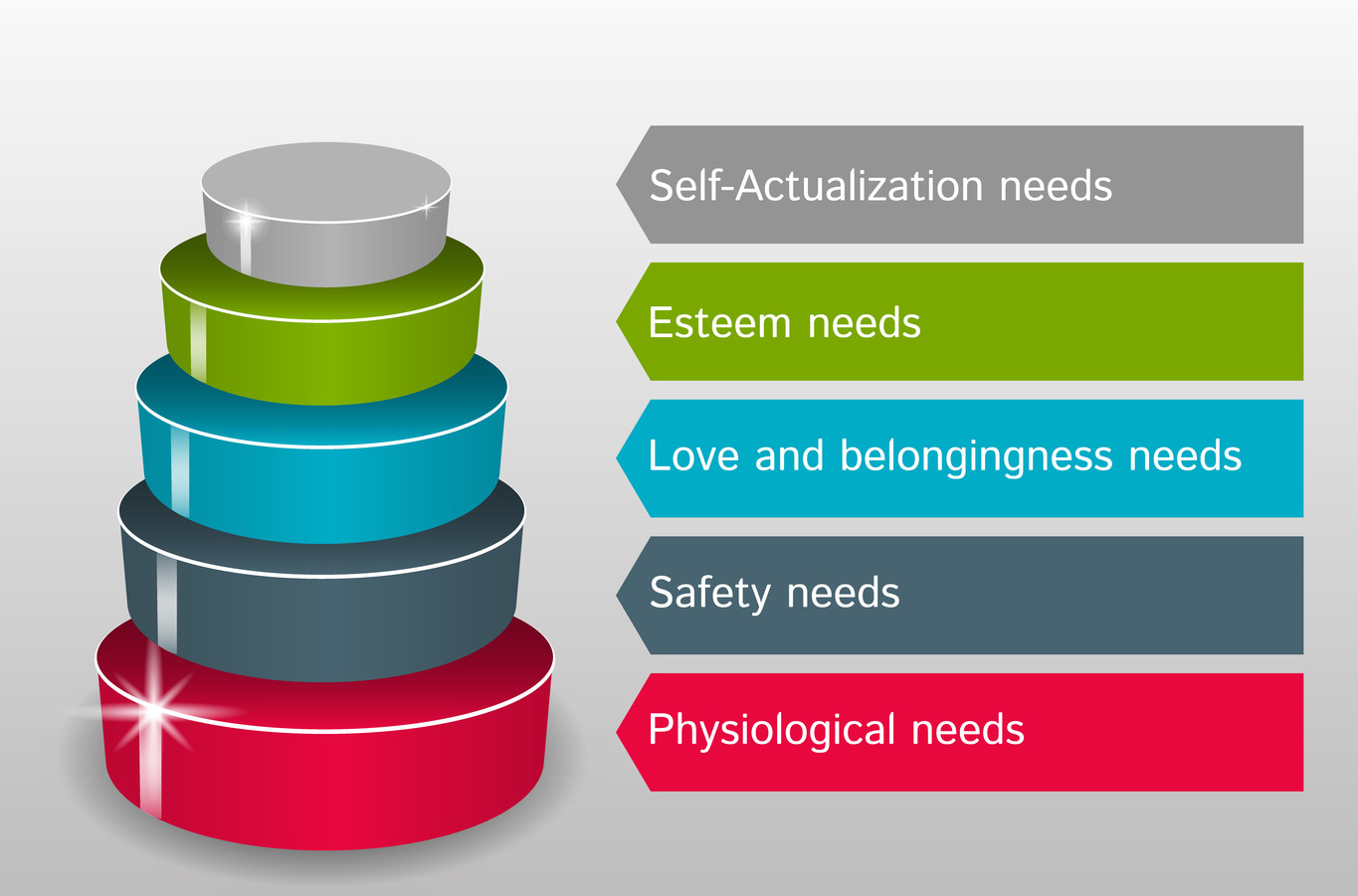
Back in 1943, psychologist Abraham Maslow created what he called a “hierarchy of needs” – a series of stages that human beings must go through on the way to the ultimate goal of “self-actualization.” With few changes, the concept, usually illustrated as a pyramid, has continued to influence the study of human motivation and developmental psychology.

So what does self-care have to do with the hierarchy of needs?

The most basic needs of human life form the base of the pyramid. These are called “physiological needs” and are essentially what a person needs to stay alive: air, water, food, shelter, sleep, clothing. Without meeting these needs, a person cannot move up to the next level of the hierarchy.

A large part of self-care is devoted to meeting these very basic, fundamental needs. Air is usually not a problem but shelter and clothing can be, for those bipolar persons who are homeless – and there are more than a few. Many of us are just one financial reverse – loss of income, insurance, options – from being homeless.

The most common advice for self-care is to pay attention to these base-level needs: Remember to eat. Stay hydrated. Get enough sleep. At times, it’s a real struggle just to meet these self-care needs. Add “get exercise” to the list and it can suddenly be overwhelming. People with bipolar or major depressive disorder often need help accomplishing them. That’s as high as we get on the pyramid.

The second step of the pyramid, which people need to work on after they’ve met the requirements of the first step is called “safety needs”: personal security, employment, resources, and health. Again, the needs on this step may seem insurmountable, and may – probably will – require help to achieve.

But they are self-care needs too. Current society may not view them as such, but that’s because they tend not to struggle with them, at least not on the level of a person with a mental disorder. Individuals can sometimes help meet these needs, but more often government, community, or charitable organizations provide necessary help. Talking about self-care at this second level may seem like pie-in-the-sky to those who have not yet conquered the first. But truly, taking care of these needs is a form of self-care, enabling one to maintain the gains represented by achieving those of the first level.

The third level of human needs – and self-care – is called “love and belonging”: friendship, intimacy, family, sense of connectedness. Again, this is not usually thought of as a part of self-care. But it certainly is. Many of us – I include myself – lose friends, become estranged from family, fail at intimate relationships. There are other places to look for ways to practice self-care on this level, however.

Therapy groups and self-help groups can lead you to people who share your problems and may be able to help you in achieving self-care. (My husband met one of his dearest friends, who provided support, listening, understanding, and companionship, at a self-help group meeting.) If in-person meetings are not possible, social media such as Facebook, Twitter, and WordPress provide opportunities to meet some social self-care needs through various groups and online communities.

The top two levels of the pyramid are not as easy to think of as self-care, and not as easy to tackle. Level four is esteem: respect, self-esteem, status, recognition, strength, freedom. And five is self-actualization: to become the most that one can be. Realistically, these are not strictly speaking things that can be accomplished through self-care. Even neurotypical people may never complete step four, and there is reason to think that few people ever reach self-actualization. These are goals to strive for, but not guarantees.

Wherever you may currently be on the pyramid, the important thing to remember is that self-care will help you reach the next step; that each follows the one before; and that your bipolar life will improve with every step you achieve.


Tracking Your Moods: Low-Tech, High-Tech, and In Between

Many therapists and people with bipolar disorder recommend journaling as a practice that allows you to track your moods and figure out what your triggers are. And many individuals do well with journaling.

I didn’t, however. I tried starting a journal of what I was doing and what I accomplished daily. It rapidly turned boring and whiny. My entries looked like this:

Accomplishments:

  1. Paid cell phone.
  2. Forced myself to finish work assignment.
  3. Finally got off that stupid level of that horrible Candy Crush.

Writing is what I do, but journaling, especially when depressed, was an unrelenting series of pitiful nothing. Instead, I started this blog (on 1/7/14). In my blog, I could write about anything. Still, it wasn’t much good as a way to track my daily moods.

Technology is starting to address that problem. Recently some inventions have come on the market that promise to help you track your moods not just daily, but hourly (or even more often). Most of these devices resemble what would happen if a Fitbit and a mood ring had a child.

Most of them claim to monitor your moods by tracking your heart rate and/or your breathing. (One notes that it tracks your steps too, so you don’t need an extra device to do that. Another promises to monitor galvanic skin response, pulse, and skin temperature, which sounds more like a lie detector than mood tracking.) Then you take that data and compare them with what you were doing at the time and voilà – a mood journal.

Of course, these devices make certain assumptions – for example, that when your heart rate is elevated, you are anxious or tense. Needless to say, there are plenty of other things that can raise your heart rate and breathing. Sex, for one. Or running. Neither one of which is necessarily a source of anxiety for everyone. There is, as far as I can see, no way for the device to tell when you are depressed. They appear to assume that everything except anxiety is normal.

Then there’s the fact that you still have to journal. The devices work on the theory that you can look for patterns in your breathing and respiration, then figure out what you were doing when that happened. Upgraded devices and apps are planned that will add calendar and location functions to make this easier. But if you’re in your house the whole time the moods are happening, it won’t tell you much.

(One brand of these devices is available only from an employer, health plan, or EAP, which, if you ask me, is pretty creepy. If there’s anyone I don’t want to have information about my moods, it’s my employer.)

My friend Mike came up with an in-between solution that uses both higher-tech and lower-tech approaches to monitoring his moods. Over a period of several months, Mike had been on four different drug regimens for depression. Not all of them worked, and he was unsure which did the most good.

His idea was to go to his social media and chat apps and take a look at when he was the most active, engaged, and responsive. Then he looked at what medication he was on at the time. He noticed, for example, that in the first few weeks of April, he was posting more about accomplishments and responding to others’ posts and chat messages. A quick check of his pharmacy records and he had a pretty good idea of which medications were working best. No journaling involved – the evidence of his increased energy was right there in front of him, already recorded. And no $150 expense for an emotional tracking device.

Maybe journaling is right for you. Maybe a wearable mood tracker is the thing that will help. But don’t overlook the tools you already have. Think about them in new ways and you may already have a handle on understanding your moods and meds.

Sources

https://www.l2inc.com/daily-insights/spire-wants-to-be-the-fitbit-for-your-emotions

https://www.entrepreneur.com/article/239743

http://nerdist.com/sentios-feel-wristband-fitbit-for-your-emotions/

Caregivers Need Care Too

While there are professional caregivers, family members often provide care and support for those with bipolar disorder and other mental illnesses.

My husband of 35 years is my caregiver. He does a spectacular job – making sure I have my meds, taking me to my appointments, running the errands that I have no spoons to do, keeping the house quiet when I need to sleep, making sure I eat at least one nutritious meal a day.

It’s a lot. And there are things I can give him in return. Things he needs.

Appreciation. When my father was dying of cancer, my mother was his primary caregiver. One day she came to me, wanting me to tell her that she was doing a good job. She knew that she was. She just needed to hear it from someone else, someone who could tell her that her excellent care had been noticed and appreciated.

Appreciation – validation – is the thing that caregivers need most, to replenish themselves, to allow them to keep doing the things that are so vital for their charges. And it’s the easiest to give. When you’re in the depths of depression, it may be difficult to remember to say “thank you,” but it means a lot to your caregiver.

Now I’m mostly out of my depression (usually), and I say “thank you” a dozen times a day. And he always responds, “You’re welcome, friend.”

Alone time. Primary caregiving can be a full-time job. I know that one thing I need in the process of healing is alone time. Dan needs it too. He needs time off, even if that’s just time to retreat to his study and watch a movie or go outside and dig in the garden. I can always reach him if I really need him – for example, if I have a panic attack – via cell phone if nothing else. But, as the saying goes, you can’t pour from an empty vessel. That’s part of the reason that he’s able to give me so much of what I need.

Couples time. This doesn’t necessarily mean sex. It means time spent together, doing something other than dealing with mood swings and trauma. It’s a little gift we give each other. Sometimes I sit through a movie I don’t really care for, just to give him the gift of snuggling on the couch. He got me color-and-bake ceramic mugs that are great for creativity and distraction. One rainy afternoon we sat together and each colored one side of the mugs.

Life stuff. Dan does most of the chores and tasks of daily living, but I do what I’m able to. I earn money. I pay bills online and do most of the other computing, except what he does for leisure. I help with cooking to the extent I can – sous-chefing, finding recipes, breading or mixing or inventing dressings and sauces, making grocery lists. He can ask me for help too.

Sharing my spoons. When I do find myself with a few spare spoons – a little extra energy occasionally – I try not to be selfish with it. When I have spoons to spend, I like to shower and dress and go out for lunch. But the other day, I showered and dressed and went for a walk in the woods with Dan, something he’s been longing for. My spoons ran out pretty rapidly, but he appreciated that I made the effort and shared one of his delights. It was another gift that cost no money.

In other words, when you have a caregiver, don’t think it’s all one way. Your caregiver needs care too. Small or large, what you are able to give will be appreciated.


The Tools for Tackling Bipolar Disorder

When you’re facing bipolar disorder – which is, when you have it, nearly every day – there are some things you can do to lessen its hold on you. But in order to do so, you’ve got to have the right tools. Try to collect as many as possible for best effect.

Shall we take a look at what they are?

The Usual Suspects

  • medication – to tame your symptoms, level your moods, get your brain back in gear, and/or regulate your energy
  • psychiatrist – to prescribe your medications (a primary care physician may also do this)
  • psychotherapist – to discuss with you the issues you haven’t resolved, the problems you still have, and the things the medication can’t do

Self-Care 

The two most important tools you need for self-care are sleep and food. Without either, the body can’t function properly, and if the body doesn’t function, the brain is less likely to function properly either.

Ideally, the food should be nutritious and eaten regularly, but let’s face it, that doesn’t always happen. But you’ve got to give your body something to run on. If there are carrot sticks there, eat them; if there is mac-n-cheese, eat that. If there’s Raisin Bran, well, it’s easy to eat and requires no preparation. Try for at least one substantial meal per day – two is better, if you can manage it.

(Of course, this advice doesn’t count if you have an eating disorder. In that case, see your doctor or psychotherapist or support group.)

Support

Find support where you can – a friend who’s willing to listen, a support group online or in real life. Try for a combination of these and don’t rely on any one of them for too much. Maybe you have a friend you can phone once a week; a support group that meets every two weeks; and an online group or two of people who really understand, with links to helpful articles and blogs. Before you know it, you’ve got a support system, especially if you count your therapist (which I do) or have a supportive family (which I don’t).

Spoon Theory

If you don’t know what this is, see https://butyoudontlooksick.com/articles/written-by-christine/the-spoon-theory/. Basically, Spoon Theory is a way to measure how much energy you have on any given day – and an understandable metaphor for explaining your symptoms to others, and a shorthand for other people who are also up on the theory. It can also help alleviate the guilt of not being able to do all the things you are “supposed” to do in a day. It’s not an excuse, but an explanation.

Distraction

Let’s face it, it’s all too easy to dwell on your symptoms and how miserable you are. And if you’re at the bottom of the depressive well and your meds haven’t kicked in yet, there may be nothing you can do about it.

But maybe there is. Do you know a person who tells good jokes – or really bad ones? Do you have music you used to play but have forgotten about? Do you know of a TV show that features people whose lives are an even worse train wreck than yours? Do you have a go-to movie that never gets old no matter how many times you see it? (Mine is The Mikado. )

Creativity

If that distraction involves creativity, so much the better. Coloring books and pages for adults have been the trend for a while now. (Some of them are really for adults.) Jenny Lawson draws and also puts together tiny little Ferris wheels. I know someone who can make little sculptures out of drink stirrers or paper clips. The point is, you don’t have to paint masterpieces. Just keeping your brain and your hands occupied is a good idea.

Comfort

Soft warm, fluffy things and smooth, silky things are soothing. They just are. Cats and dogs come instantly to mind (they also provide distraction). But I also have a collection of teddy bears and other plushies that I sometimes cuddle with. These are “comfort objects,” which is an actual psychological Thing. (I wrote about them once: http://wp.me/p4e9wS-k9.) I even took a plush bunny with me when I went to have a sleep study.

Stubbornness

This may be the most important tool of all. Be stubborn. Take those meds, even if you hate them. Eat that egg, even if you don’t feel like it. Go to that appointment, even if will take all your spoons for the day. Call that friend, even if you don’t think a joke will help. Post on your support group, even if you feel you are alone.

We can’t let bipolar disorder beat us. Not when we’ve got so much to beat it back with.

Five Things Psychotherapy Has Done for Me

Why pay $250 an hour just to talk to someone?

That was my sister’s reaction when I said I was going to start seeing a therapist. This is my answer.

Mental health symbolWell, Lucy, while a psychiatrist doesn’t cost 5 cents anymore, therapy can be had for a lot less than $250. There are community mental health centers with sliding fee scales – which is what I was going to then. There is insurance, for now at least. I’ve even known psychotherapists who would accept less than their usual fee for long-time patients in temporarily dire straits.

And I’m not paying to talk to just “someone.” A therapist usually has at least an M.A., and sometimes a Ph.D. Psychiatrists have an M.D. or D.O. They have years of training, more years of experience, and colleagues they can consult if your problem is particularly challenging or out of their area of expertise. You can also find peer counselors, religious counselors, and proponents of every variety of therapy or treatment you can name, from neuro-linguistic programming to electroconvulsive therapy.

Now, as I reflect on my clueless sister, I’ve started thinking about all the things that therapy has done for me.

Diagnosis. When I first started going, back in the 80s, I could only afford one of those community mental health centers with the sliding fee scale. (At the time, I paid $5 per session.) There I was diagnosed with depression. The primary treatment they offered was “talk therapy,” but I had years and years of mental difficulties to talk about. Later, when I was seeing a psychiatrist, I was re-diagnosed with bipolar 2 and anxiety disorder. Suddenly, my past became a lot clearer, even if my present was still messed up.

Medication. There has been a lot of it over the years. I started, as so many did, with Prozac, which had a noticeable effect on my depression. It was like the difference between watching a black-and-white TV that got only one channel that showed only tampon commercials, compared to a wide-screen color TV that got hundreds of cable channels. The meds I’m on right now keep me functional, at least enough to make a living and be creative.

Perspective. When I first started going to my current therapist, the word I used most often to describe myself was “pathetic.” I no longer call myself that. Dr. B. helped me view parts of my past in a different light and helped me develop techniques and strategies to deal with the problems I was facing at the time. Now she keeps me on track, reminding me that I have the tools to cope with many of my recurring problems. And she reminds me how far I’ve come since my “pathetic” days.

Couples counseling. When we married, I was still smack in the middle of clinical depression. (My husband had problems too, but I don’t want to talk about them here, except to say that a codependent and a depressive living together can never decide where to go for lunch. And that was the least of our difficulties.) Several times since then, we have had to turn to counselors to work on problems related to sex, money, and just plain living and communicating together.

Group therapy. Actually, though I’ve attended group therapy a few times, what I’ve learned from it is that it’s not for me. I do appreciate the fact that it’s there if I should need or want it, and that my therapist can recommend a group if she or he is going to be away for a while. Perhaps I just haven’t found the right group yet, although the support communities I’ve found online may serve part of the same purpose.

In short, therapy has given me my life, my sanity, my coping skills, my emotional strength, and my creativity back. And I can definitely say that professional therapy has been worth more than 5 cents, or whatever insights my sister could have offered.


Furry Friends and Helpers

I’m sure we’ve all seen memes that say the best therapist has four legs and fur. When I’ve been feeling cranky, I have occasionally written responses to the people who post them. They demean the very hard and real work that psychiatric and psychological professionals do. And after all, what do the memes really say? “Have a mental illness? Just get a dog.”

Still, there are circumstances in which an animal can help a person with a mental or emotional disorder. It’s not as simple as going to the pound and picking out a pup, though. For an animal to assist a psychiatric (or other) patient, there are a number of hoops for the person to jump through.

Most people nowadays are used to the presence – or at least the idea – of service animals such as seeing eye dogs. Less common are Therapy Animals, Emotional Support Animals (ESAs) and Psychiatric Service Animals (PSAs). But they all have parts to play in promoting and maintaining mental health in persons with bipolar and other emotional disorders.

Therapy animals are most often used with geriatric patients and children with emotional disturbances. In some nursing homes and convalescent centers you find programs that bring small animals to interact with the residents. Even farm animals – chickens, lambs, piglets – may spark memories that had been hidden away for years. The animals help residents get in touch with those memories and caregivers get in touch with residents. Libraries sometimes bring calm, well-behaved dogs in so that children can read to them. The soothing presence of a well-trained dog can help a child self-regulate her or his emotions – and get reading practice at the same time.

Emotional Support Animals are dogs or cats (or, less commonly, other animals such as miniature horses or guinea pigs) that live with and provide comfort to a person with a psychiatric disorder. Typically, in order for an emotional support animal to be allowed in rental housing, documentation such as a letter is required from a physician or mental health professional stating that the animal’s presence alleviates symptoms of a patient’s psychiatric condition – one that qualifies as a disability under the Americans with Disabilities Act (ADA).

Regulations covering comfort or emotional support animals apply mostly to residences and airlines, but not other places where service animals are allowed, such as stores, restaurants, and public buildings. There, health codes trump emotional support.

Some folks confuse Emotional Support Animals with Psychiatric Service Animals. They think that “training” a dog to offer a kiss on command, or jump in their lap, or be hugged is a task qualifying the animal as an official service animal. While these are indeed ways that an animal can calm a person in distress, service animals, including psychiatric service animals, must receive special training that teaches them how to alleviate the symptoms of an ADA-defined disability.

Legitimate tasks for PSDs (psychiatric service dogs) include counterbalance/bracing for a handler dizzy from medication, waking the handler at the sound of an alarm when the handler is heavily medicated and sleeps through alarms, doing room searches or turning on lights for persons with PTSD, blocking persons in dissociative episodes from wandering into danger (i.e., traffic), leading a disoriented handler to a designated person or place, and so on.

In The Possibility Dogs: What I Learned from Second-Chance Rescues About Service, Hope, and Healing, author Susannah Charleson recounts how rescue dogs – the unwanted, unlikely-to-be-adopted dogs that languish in shelters or are destroyed – have been matched with persons who need them.

One of the stories she tells involves training a dog to help a person with OCD. The dog was taught to identify when the handler had returned to the stove three times (to check the burners). Then the dog would interrupt the person, leaning against her leg to distract her. For a person who could approach a door but not go outside, the dog brought a leash to encourage leaving the house for a fun activity.

By the way, forget about cats as service animals. Just try training a cat to do anything it doesn’t want to do. (I know that cats have been trained to run obstacle courses for agility competitions, but that doesn’t really qualify as a service for an individual with a disability.) If you are able to register your cat as an Emotional Support Animal or get a medical/psychiatric recommendation, you may be able to have your cat live with you in a pet-free community, or have the fee for a pet waived. But that’s about it where cats are concerned.

So, animals can’t be actual therapists, but they can assist in treatment and life skills for people who need help with mental disorders. When I’m less cranky, I keep scrolling past the pet-as-therapist memes and feel grateful that my cats offer me emotional support, whether they’re trained to do so or not.


The 5 Stages of Depression

One of my depression triggers has been well and truly tripped and I am experiencing the long plunge downward. It’s been quite a while since this has happened, but oh, how well I remember it.cracked egg conceptual image for birth

In the classical Five Stages of Grieving, depression is the fourth, right before acceptance. For me, in the Five (or however many) stages of depression, the first stage is (duh) depression. I guess the next four would be immobility, numbness, despair, and Total Meltdown.

Right now I would have to say that I am somewhere between depression and immobility. I got out of bed for a few hours today, and I am writing this. I managed to get a big project done before this bout of depression hit, which was a Good Thing. I also now have a good supply of meds on hand, which is, I think, an Even Better Thing.

The Best Thing is that I have Dan, my husband. He just made sure I got a hot meal and is now giving me space and alone time, which is what I need more than attempts at engagement. And a cat just licked my face, which would be comforting if he hadn’t just been licking his butt.

As Jenny Lawson says, depression lies. Right now it’s telling me I’m useless, helpless, guilty, and ashamed. I hope that at least some of these are lies, though at the moment they’re what my brain is telling me is true. Then add in a large helping of catastrophizing, which at the moment is more likely to happen than not. I can’t see a way out.

Since I’ve been through this process before, I know the things that will help (at least a little) and those that won’t. I’ll try to keep my brain engaged enough to continue writing, and I’ll try to intersperse the doom and gloom with some ideas I made notes on before all this hit. I feel a responsibility to this blog and its readers to keep the thing going as best I can.

Based on my estimate, this episode is likely to last a minimum of two months. Maybe this time I can stop the slide before Total Meltdown. Wish me luck.