Bipolar 2 From Inside and Out

Posts tagged ‘public perception’

Diagnosis and Dickinson

The Brain — is wider than the Sky —
For — put them side by side —
The one the other will contain
With ease — and You — beside —

The Brain is deeper than the sea —
For — hold them — Blue to Blue —
The one the other will absorb —
As Sponges — Buckets — do —

The Brain is just the weight of God —
For — Heft them — Pound for Pound —
And they will differ — if they do —
As Syllable from Sound —
Emily Dickinson

I ran across this poem in a book called Shrinks: The Untold Story of Psychiatry (about which more some other time) and it made me think.

Dickinson was, by all accounts a recluse. She seldom went out and, when visitors came, she sometimes sat behind a screen while she talked to them. She never dared to submit her poems for publication. Less than a dozen were published in her lifetime, and those only because someone else submitted them without her knowledge. Her wealthy, loving family sheltered and nurtured her so that she never had to face the outside world.

Emily Dickinson had Social Anxiety Disorder.

And Abraham Lincoln suffered clinical depression. So did Charles Dickens.

Bipolar sufferers include Beethoven, Schumann, and Isaac Newton.

Charles Darwin, Michelangelo, and Nikola Tesla were all obsessive-compulsive.

Autism, dyslexia, and various learning disabilities affected Einstein, Galileo, Mozart, and even General Patton.

And Van Gogh! Let me tell you about Van Gogh. He had epilepsy. Or depression. Or psychotic attacks. Or bipolar disorder. Or possibly some combination thereof.

I call bullshit. I’m not saying none of those people had assorted mental disorders. My point is that we can’t tell from this distance in time.

In none of these cases, as far as I know, did any of the aforementioned people see a psychiatrist, psychoanalyst, psychotherapist, or even a phrenologist. None were diagnosed with any psychiatric condition, and no record of such a diagnosis has come down to us from any reliable source. Some even lived before psychiatry was invented.

People – mental health workers, but also art and literary critics, biographers, and the general public – have looked at these extraordinary people’s lives and work and decided that their behavior and their art look like those of a person who might be bipolar or obsessive-compulsive or psychotic. (They also like to retro-diagnose physical conditions there is no record of or only vague names for. King Tut, Henry VIII, and Napoleon are particularly good theoretical patients.)

Why the tendency to ascribe mental disorders to famous people? I can see two reasons, beyond the thrill of solving a mystery and feeling clever.

The first is the old saying about there being a thin line between madness and genius. These historical figures were geniuses, so they must have been mad. Or as we say now, suffering from mental disorders.

The other is the need for role models and inspiration. If Van Gogh could become one of the most famous artists ever (though not successful in his own lifetime), you too may rise above – even use – your disorder to accomplish greatness.

It’s possible, I guess, but it’s not likely. Certainly those with mental disorders can aspire to and achieve rich, full lives, satisfying relationships and jobs and artistic pursuits. These are the ordinary accomplishments of ordinary people, both with and without mental illness, and it’s a small miracle that people can achieve any one or more of these. Not everyone does – again with or without mental troubles or psychiatric diagnoses.

And for me, at least, it’s enough.

Can the spark of imaginative genius strike a person with a mental disorder? Of course. Can that person succeed and achieve lasting fame? Maybe, though the odds aren’t good. Is a person saying, “Look, I can be Van Gogh!” likely to fall short? Almost certainly. Can that failure to achieve greatness make a person feel worse about himself or herself instead of better? You tell me.

There’s nothing wrong with aiming high, and nothing that says a person with a psychiatric diagnosis can’t do just that. It’s a good idea for anyone. (As one of Lois McMaster Bujold’s characters says, “Aim high. You may still miss the target but at least you won’t shoot your foot off.”)

But pinning your hopes on a similarity with a non-psychiatric, perhaps non-existent, diagnosis of a genius may not be the best way to get there.

Better to look in these geniuses’ work for insights that can help you understand your own condition or pull you through tough times. Here’s another of Emily Dickinson’s poems that has always spoken to me about the experience of a depressive crisis and its aftermath.

After great pain, a formal feeling comes —
The Nerves sit ceremonious, like Tombs —
The stiff Heart questions ‘was it He, that bore,’
And ‘Yesterday, or Centuries before’?

The Feet, mechanical, go round —
A Wooden way
Of Ground, or Air, or Ought —
Regardless grown,
A Quartz contentment, like a stone —

This is the Hour of Lead —
Remembered, if outlived,
As Freezing persons, recollect the Snow —
First — Chill — then Stupor — then the letting go —

Was Emily herself depressed? We’ll never really know. And as long as we have her poems, I don’t really care.

Why Do They Do This? (And Why Do We Allow It?)

The big story last week for those of us with mental disorders was this one:

http://www.rawstory.com/rs/2015/02/truly-barbaric-florida-deputy-drags-mentally-ill-woman-through-courthouse-by-shackled-feet/#.VOyTNKh2Gbc.facebook

For those of you who haven’t read it or seen the video, here’s the gist. A woman, Ms. Rios, was declared mentally incompetent at a hearing for a minor offense and not allowed to say goodbye to her mother. She wanted to sit on a bench and cry for a bit. When she did not go promptly with the officer, he dragged her through the courthouse by her shackled feet. A video was taken on a cellphone camera by a lawyer who happened to be present, but had nothing to do with Ms. Rios’s case. If you watch the video clip you can see and hear her distress.

As the headline says, this was barbaric.

But there’s lots neither the headline nor the story says. I have questions.

What is the woman’s mental illness? Or why is she mentally incompetent? The stories vary, usually calling her “mentally ill,” which is shorter for the headline writers, but so far I have seen nothing more specific. One could get the impression that in the mind of the media – and therefore their readers – that the two terms mean the same thing. Was she medicated or unmedicated or off her prescribed meds? Does she have a developmental disability? An autism spectrum disorder? An emotional or behavioral disorder? We don’t know. But does the label make her automatically suspected of potential violence? The woman did not behave like an animal even when she was treated like one.

I think we all know people who have mental disorders but are still mentally competent to conduct their own affairs, up to and including court proceedings. In fact, I know you know one – me. But who among us, or among the sanest and most stable of the general public, wouldn’t have needed to sit on a bench and cry before going to wherever the officer thought we should go? Who wouldn’t yell and protest and try to hold on to a table if we were dragged anywhere by our shackled feet?

Why is the officer’s action called “barbaric”? I’m not saying it wasn’t barbaric. But how was it more barbaric than other things routinely done to the incarcerated mentally ill (or incompetent)? Could it be because the officer’s actions were caught on tape? How many everyday barbaric actions aren’t? And putting aside simple human compassion (which he did), didn’t the officer’s actions create a larger, potentially more dangerous disturbance?

Why did the other officers present do nothing? You can see them on the video. They are spectators. No one says, “Hey, do you have to do that?” or “Give her a minute to calm down” or “Here, let me take care of this” or “You know, there are other ways to handle this” or even “Are you sure you want to do that with the camera rolling?” Nothing. Nada. Zippety. Doo-dah.

Why weren’t the officers and other courthouse personnel trained to handle situations like that? They obviously happen occasionally. Officers are (supposedly) trained to handle situations involving violent felons (which Ms. Rios wasn’t), domestic violence, and how to restrain suspects properly. Some even get sensitivity training on race, sexual orientation, and ethnicity. Where’s the training for interacting with the mentally ill (or mentally incompetent)? For de-escalating a situation instead of throwing gas on the fire? How about anger management before incidents like this one instead of after? Shouldn’t every law enforcement official be able to control or channel his or her anger and not take it out on the public?

Why the hell aren’t police officers required to wear body cameras – and have someone whose job it is to, oh, I don’t know, review them occasionally? Certainly when there’s been a complaint, but spot checks might also do some good. Why are civilians subject to increasing surveillance, while law enforcement personnel – who are also civilians, by the way – perform their jobs with minimal oversight.

And why is the Golden Rule suspended when the “others” have a mental disturbance? I’d really like to know.

___________________________________

I am cross-posting a slightly altered version of this essay to Et Cetera, etc., my general purpose blog (janetcobur.wordpress.com).

Yes, I Am Crazy. Thanks for Asking.

I’ve been called a lot of things in my time, from schoolyard taunts (loony tunes, weirdo) to psychiatric labels (clinically depressed, bipolar 2). This used to bother me, but anymore, I don’t mind.

It’s not because of the old saying, “Sticks and sones can break my bones, but words will never hurt me. We all know that’s a damn filthy lie. I think it’s because I’ve developed a sense of humor about the “crazy” thing. If Al Yankovic can embrace “Weird,” I can embrace “squirrel-bait” or “wacko.” Even “bat-shit” or “bug-fuck” crazy don’t get me riled, though many find them offensive – and I can’t fault them for that. Everyone has a different level of tolerance and sense of what’s funny.

Take, for example, the time when my sister Kathy gave me a t-shirt that said, “Leave Me Alone. I’m Having a Crisis.” Her husband was dubious about the gift, thinking that I would be offended. I wasn’t. Kathy thought it was a hoot and so did I. (I just bought a t-short that says, “You Won’t Believe the Crazy Shit That Happens Next…” I’m going to wear it to my next psychotherapist appointment.)

I admit to being disconcerted when publicly confronted by a person who asks “Are you the one there’s something wrong with?” or “Do you have mental problems?” (In the first case, the elderly gentleman was thinking of my sister-in-law, who had MS, and in the second, the person recognized me from the psychiatrist’s waiting room.) But I’m not offended. Mostly I regret that I didn’t have snappy come-backs. (I thought of some great ones later.)

There are still some assumptions that do offend or at least irritate me. Here’s a link to an article that enumerates a few of the touchy subjects and unwelcome phrases.

10 Harmful Myths About People with Bipolar Disorder

That sums it up pretty well. I’m not going to walk into a fast food outlet and start shooting up the place. Mania is not fun. I’ve decided not to reproduce, but nobody can tell me that I shouldn’t.

Oh, and there’s one other thing. In the past, when I’ve mentioned my mood disorder to acquaintances or co-workers, they feel obliged to take my emotional temperature five times a day. “Are you okay? How are you feeling?” So I would add to the list: Not all people with bipolar disorder are rapid cycling.

So, am I crazy? Yes. But I don’t think that’s necessarily a bad thing. Most people use the word “crazy” to describe how they feel when they’re in love. And I’m good with that.

Why I’m Not Like Sheldon Cooper

Obviously, I’m not a man or a theoretical physicist or a character on The Big Bang Theory. But also, I can’t say, as he often does, “I’m not crazy. My mother had me tested.” I’d like to have that t-shirt, but it would be false advertising.

I am crazy and my childhood was entirely free of psychological testing.

It probably shouldn’t have been, because the crazy had taken full hold during my tender years. Crippling depression. Massive anxiety. But both my parents were ordinary folk from Kentucky transplanted to a bland Ohio suburb. They stayed true to their roots and never considered testing or counseling for me or my sister. According to their upbringing, having crazy relatives might be upsetting or embarrassing, but that’s just the way it was. You tried to shelter them from the outside world – and vice-versa – but you didn’t involve agencies or doctors or hospitals.

My crazy got too obvious to ignore when I was in junior high school. I developed a nervous tic – my head would jerk up and to the left uncontrollably. This was very distracting, not only to me, but to whoever was sitting behind me in class. It got me noticed.

It did not, however, get me to a psychologist or other mental health professional. I didn’t want to see one anyway, because I had the irrational notion that being “shrunk” would go on my permanent record and I would never get into a good college.

Instead, I was taken to our family doctor. He prescribed Valium, which did stop the twitching but did absolutely no good for my depression.

Later, during my college years – at a good school, I might add – I had another run-in with Valium. This time my symptom was pain like a railroad spike being driven into the side of my head. Naturally, I thought it was a brain tumor.

I went to the doctor, who said, “I can do any test you want, but I can tell just by looking at you what your problem is. Your jaw is crooked.” He diagnosed me with temporomandibular joint (TMJ) disorder, explained that tension made my muscles contract unevenly and cause excruciating pain in my temples. He sent me away with a prescription for Valium. Which helped with the stabbing pain, but again not with the depression. (Also, I was self-medicating with wine, which just made the crazy train run faster.)

It was not until years later, after college, that I got half a diagnosis – depression – and a non-Valium prescription – Prozac. And many years after that until I got the more accurate diagnosis (bipolar 2) and an appropriate regimen of drugs, which does include Ativan, but not prescribed alone or with wine.

And that’s another thing I don’t have in common with Sheldon Cooper. He’s not taken any psychotropics (or wine) and is happily stuck in his supposed non-craziness. I’ve accepted my craziness, gotten help for it, and am slowly rising, if not above it, at least to where I can peek over the top of it.

All in Our Heads

Well, mental disorders probably are mostly in our heads, or at least our brains (and genes), but I keep seeing news features that “offer hope” for new diagnostic tools and treatments that “may someday” alleviate the suffering.

Here’s an example from the University of Pennsylvania:

Many factors, both genetic and environmental, have been blamed for increasing the risk of a diagnosis of schizophrenia. Some, such as a family history of schizophrenia, are widely accepted. Others, such as infection with Toxoplasma gondii, a parasite transmitted by soil, undercooked meat and cat feces, are still viewed with skepticism. A new study used epidemiological modeling methods to determine the proportion of schizophrenia cases that may be attributable to T. gondii infection. The work suggests that about one-fifth of cases may involve the parasite.

Great. I am sure that schizophrenics will be comforted by the thought that their problems are caused by brain parasites and cat poop.

I noticed that the study showed that only 20 percent of schizophrenia “may” involve the parasite. What about the other 80 percent? Are those cases caused by some other parasite? And how will the parasites be detected? Blood test? Brain biopsy? Could be a world of horrors there for the already mentally unstable. And, perhaps most important, will real-world results back up the computer simulations?

Schizophrenia is far from the only illness being studied. Bipolar disorder and our old pal depression come in for their share of lab work too. USA Today recently reported on a procedure that might help with depression:

The treatment — transcranial magnetic stimulation — was approved by the Food and Drug Administration in 2008 for the treatment of patients with medication-resistant depression.

Magnets generate a directed, pulsed magnetic field — similar to an MRI in strength — to the prefrontal cortex, the front part of the brain behind the forehead. The magnetic fields induce small electrical currents, which encourage a mood-lifting chemical reaction in the brain.

The treatment is daily, for four to six weeks. If the patient improves enough, the treatment is then provided as a periodic booster.

Never mind that it’s entirely subjective when a patient has improved “enough” or even shows anything other than a placebo effect. And never mind the effects of having 42 MRI-strength treatments in a row.

Apparently scientists and insurance companies are battling it out on the money front (there’s a surprise).

Plus, as always, there are nay-sayers:

The National Institute of Mental Health describes the treatment as effective for some patients, but notes that studies of its efficacy have been “mixed.” The American Psychiatric Association’s guidelines for depression treatment states the procedure conveys “relatively small to moderate benefits.”

To the desperate, any potential “cure” or even palliative treatment eventually seems worth a try. I should know. I came that close (imagine several millimeters here) to having a go at electro-convulsive therapy (ECT). Formerly know as shock treatment.

The thing is, you only hear about theories that “might” be correct and treatments that “may” help. Studies are hardly ever published that say, “You know that treatment we said was going to relieve the suffering of millions? Turns out, not so much.” If the general public even gets to see the negative results, they may still cling to the hope offered by the earlier reports.

Just look at the anti-vaxxers. It has been repeatedly proved that childhood vaccines do not cause autism. The experiment that reported that finding was a fraud and the author (Andrew Wakefield) has been discredited – investigated and found guilty of “four counts of dishonesty and 12 involving the abuse of developmentally challenged children.” Basically, he’s been kicked out of medicine altogether and given the Lifetime Achievement in Quackery award by the Good Thinking Society. (I’m not making that up.)

And yet epidemics of measles and other deadly diseases continue to rise as parents yield to fear and refuse to have their children vaccinated.

I’m not trying to say that a parasite doesn’t cause some cases of schizophrenia or that magnetic therapy will never relieve anyone’s depression.

I’m just saying that if those theories are proved false, we’ll likely never hear about it from the popular press.


Cutters

If that title wasn’t enough of a trigger warning, well, here goes:

TRIGGER WARNING: Self-Harm

Recently a small discount store a couple of miles from my house was caught up in a furor because a “Princess Wand” toy they were selling (ominously named an “EvilStick”) would reveal a hidden image of a teenage girl cutting her arm with a knife. Here’s a link to a local news story about it, and the snopes.com report verifying it. If you want to, you can easily search out a copy of the image, but I don’t recommend it.

Self-Injury

http://www.snopes.com/photos/odd/evilstick.asp

The “toy” is in horrifically bad taste (so, for that matter, is the snopes article’s headline, “Wristcutters – A Toy Story”). But items that adults consider dreadful can attract kids (remember the Garbage Pail Kids trading cards?). The image of the teenage cutter looks like a macabre Halloween costume rather than anything realistic (I’ve seen it), but we don’t really know whether a mistake, an error in judgment, a misunderstanding, or a prank at the factory that went way over the line resulted in the image on the toy. I kind of hope so, because if it was intentional, that’s way worse.

But bad taste is the least of the problem. The toy and the reaction to it have introduced the subject of cutting to a wider audience, if they choose to look beyond the squick factor and think about what the image really means. Cutting is a reality that’s mostly hidden from view.

Of course, it’s not always cutting. Burning is popular too. But cutting is perhaps the most common name. There are websites devoted to it, some offering help, facts, and information on quitting (see below) – but others glorifying it as, I don’t know, a creative expression of teen angst or something.

The name does keep changing. The last I heard, the “approved” psychiatric term was “Non-Suicidal Self-Injury” (NSSI). Self-mutilation, deliberate self-harm, non-fatal self-harm, self-destructive acts, self-inflicted violence, parasuicide, and self-wounding are all names for the dangerous practice performed by desperate people. The subject still isn’t talked about much and carries a huge stigma. As if the mental and physical scars were not enough.

Some facts: Self-harm is not attempted suicide, though with some miscalculation it can lead to serious permanent injury or death. Most people associate it with teenage girls, but I’ve know at least one man in his 50s who cut himself fairly regularly. It is not a matter of attention-seeking, since most cutters hide their physical wounds.

As I understand it, the practice results from one of two phenomena: the build-up of painful pressure such as perfectionism, or a feeling of severe alienation to the point of numbness. Cutting is a coping mechanism, though a dangerous, dysfunctional, and unsuccessful one, to deal with pain.

In my case, it was probably the numbness. I was feeling a lot of psychological pain at the time (college age) and irrationally wondered if physical pain would lessen that, or increase it, or feel any different. Like I said, irrational. All this was before I was diagnosed bipolar, had a therapist, or was medicated.

I made a few small cuts on my wrist to watch the blood well up. (Ironically, they became mildly infected; I neglected to sterilize the knife.)

I wasn’t suicidal. They weren’t that kind of cuts. I do know the difference. (I didn’t realize that I could have damaged tendons or nerves in my hand or arm, perhaps permanently.) It was more like when you stand on a bridge or balcony and look over the edge. You walk away. But you know the bridge is always there.

All told, I cut myself maybe three or four times. The scars are very faint now, white against my pale inner wrist, almost invisible. The memories are vivid. A friend who’s a psychologist once asked me why I stopped. “Because I didn’t need to any more,” was the only answer I could give. I’ve only felt the urge once since, and it was easy enough to push aside. But I recognized it.

I hesitated to write and post this, though I knew I would have to sooner or later, if I meant this blog to share my experiences truthfully. One of my dearest friends once said that if he ever found out I was a cutter, I would never hear from him again. Except for his publicly mocking me for being so stupid.

Naturally, this sort of reaction, though common, is not helpful. I didn’t tell him (or practically anyone else). And I didn’t tell him that at least two other people he knew – one fairly intimately – were also cutters.

Anyway, Tom, if you’re reading this and still feel the same, I guess this is goodbye – just not the long goodbye. I would rather skip the public mocking, though. I’ll just assume you’ve done it while I wasn’t there, mm-kay?

Cutting isn’t going away if we ignore it. It won’t go away even if we do talk about it. (Or mock it, or gasp in horror.) But understanding self-injury is a big step.

If you’re a cutter, or know someone who is, here are some places you can go for information, hope, and help:

Suffering and Train Wrecks

What doesn’t kill you makes you stronger.

Right.

This is one of the world’s biggest falsehoods, right up there with “Sticks and stones may break my bones, but words will never hurt me.”

But it’s a platitude we hear all the time, particularly those of us with mental illnesses.

And it’s about time to call bs on the saying. Here’s why people say it:

Suffering hurts. It grinds you down. It makes you less able to function. It keeps you from being the person you want to be.

Except in literature. There, suffering ennobles one – makes one a finer person, a more worthy person, and, yes, stronger.

Once in a graduate-level literature class, I objected to this. I said the thing about suffering hurting and grinding you down.

I got called a sociologist, which apparently is a terrible insult in literary circles. But they were talking about literature and I was talking about real life, so maybe we both had a point.

But back to the saying. There are lots of things that don’t kill you, but also don’t make you stronger. Train wrecks, for example. If they don’t kill you, they can leave you on the brink of death or physically maimed or with PTSD. You may recover some, with help, but your back will still hurt and your leg won’t regrow and you can suffer from memories and dreams.

I’ve compared some relationships with train wrecks – probably most of us have. They simply cause you to suffer and the memories of them may always pain you like a damaged joint in bad weather. One can come through ordinary bad relationships and be stronger for it. But train wreck relationships, the toxic ones that erode your soul, do not ennoble or strengthen you.

Mental disorders can be like that. Yes, you may improve. Yes, you may become stronger in some ways. You may become more compassionate, more aware of others’ pain, better able to avoid situations that will cause you harm, capable of rebuilding a different life with the parts you want to keep. But it’s just as likely that when your brain breaks, it will never be good as new again. There will be cracks in your emotions or reasoning or moods that will be weaker, not stronger, and more likely to rupture again in the future.

We sufferers need strength, but it won’t come from platitudes and bumperstickers.

And you can’t explain this to people who haven’t been there.

Also, don’t get me started on that thing about God not giving you more than you can handle. We’ll be here all week.

As always, these are my experiences only. Your mileage may vary.

Going Public

I just posted this on my Facebook page. Now we wait and see what happens.

Along with the news of Robin Williams’s death have come discussions of mental illness and suicide. I’ve decided to go public with my own experience. I have bipolar disorder – type 2 (which means that I have lots of depression and anxiety, but very few manic phases). I’ve had this all my life, most likely, so whenever you met me, I had it.

Some of my friends already know and I’m sure others have guessed or suspected it. It is the result of a biochemical imbalance in my brain and is now treated with medication and therapy. I’m working on it.

Anyway, I ask for your understanding when I sometimes go hide under a rock for a while or say or do something odd or rude or unkind. My social skills have never been great, and having a disorder like this doesn’t improve them. I’m working on that too.

But you don’t have to do anything special or tiptoe around me. I’m still who I always was. I don’t freak out when people call me crazy or nuts or weird.

If you are interested, I blog about it: bipolarjan.wordpress.com (I also have a general purpose blog: janetcobur.wordpress.com.) Anyone is welcome to visit. I can also recommend other resources.

Here is the article about Robin Williams that noodged me into taking this step: http://www.slate.com/blogs/xx_factor/2014/08/12/robin_williams_and_mental_illness_when_depression_is_breaking_news.html

I Bet Robin Williams Knew He Was Loved. Unfortunately, Love Doesn’t Cure Mental Illness.
http://www.slate.com
It is jarring when a beloved celebrity dies of something you could possibly die of yourself—when all of a sudden everyone is talking about the illness you have, the one that they usually…

On the Inside

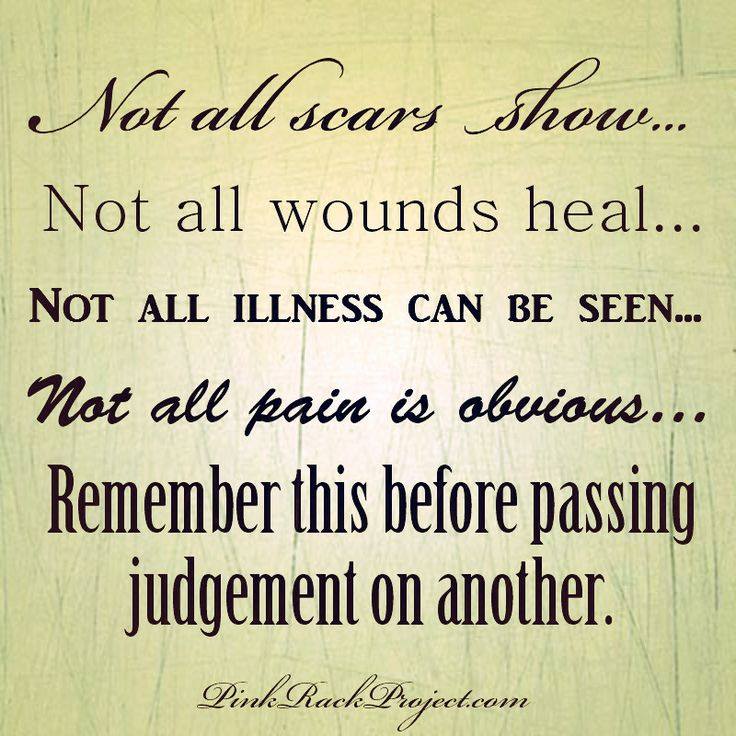
I saw this pass-along the other day and felt compelled to, well, pass it along.

wounds

It reminded me of a lot of things. Things I try not to remember.

Not all scars show. Some of mine do. The one where kids threw a rock at me, requiring seven stitches in my forehead. The ones where I cut myself. (I’ll write more about that later.)

Others don’t. I’ve often described my relationship with Rex as a train wreck. People wonder why I haven’t gotten over it, all these years later. It was the sort of train wreck in which you lose pieces of yourself, some of them irreplaceable. These scars aren’t the visible kind.

Not all wounds heal. Especially the wounds that happen when you’re too young to know how to treat them. Cutting words. Emotional bruises. Neglect. Loneliness. There are no bandages that can cover them, no ointments that can soothe them, no miracle cures.

Not all illness can be seen. If we’re high-functioning or have learned enough coping mechanisms, others may not notice. But bipolar disorder – and other mental illnesses – are, if not immediately visible, lurking just below the surface. And ready to break through at any time.

Not all pain is obvious. But it can leak out, especially around the eyes.

Remember this before passing judgment on another. But judgment-passing is practically an Olympic sport these days, along with shaming.

Scars. Wounds. Illness. Pain. These are things that those of us with mental disorders know all too well. What if our conditions are chemical imbalances in our brains? The consequences of having them, the misunderstandings they cause, the messages we receive, the behaviors we can’t understand or control or mimic, the friends we lose, the opportunities and joys we miss out on, are very real. And don’t let anyone tell you different.

Our disorders may be in our brains, but they’re not all in our heads.

But you knew that, didn’t you?

The Seven Wonders of the Bipolar World

I wonder if I can get out of bed today.

I wonder if a different drug would help.

I wonder what would happen if I told my friends and coworkers.

I wonder how long this mood swing will last.

I wonder if I have enough spoons for all I need to do today.

I wonder if people can tell that I have a mental disorder.

I wonder if this is the best I will ever get, for the rest of my life.