Bipolar 2 From Inside and Out

Posts tagged ‘public perception’

Cutters

If that title wasn’t enough of a trigger warning, well, here goes:

TRIGGER WARNING: Self-Harm

Recently a small discount store a couple of miles from my house was caught up in a furor because a “Princess Wand” toy they were selling (ominously named an “EvilStick”) would reveal a hidden image of a teenage girl cutting her arm with a knife. Here’s a link to a local news story about it, and the snopes.com report verifying it. If you want to, you can easily search out a copy of the image, but I don’t recommend it.

Self-Injury

http://www.snopes.com/photos/odd/evilstick.asp

The “toy” is in horrifically bad taste (so, for that matter, is the snopes article’s headline, “Wristcutters – A Toy Story”). But items that adults consider dreadful can attract kids (remember the Garbage Pail Kids trading cards?). The image of the teenage cutter looks like a macabre Halloween costume rather than anything realistic (I’ve seen it), but we don’t really know whether a mistake, an error in judgment, a misunderstanding, or a prank at the factory that went way over the line resulted in the image on the toy. I kind of hope so, because if it was intentional, that’s way worse.

But bad taste is the least of the problem. The toy and the reaction to it have introduced the subject of cutting to a wider audience, if they choose to look beyond the squick factor and think about what the image really means. Cutting is a reality that’s mostly hidden from view.

Of course, it’s not always cutting. Burning is popular too. But cutting is perhaps the most common name. There are websites devoted to it, some offering help, facts, and information on quitting (see below) – but others glorifying it as, I don’t know, a creative expression of teen angst or something.

The name does keep changing. The last I heard, the “approved” psychiatric term was “Non-Suicidal Self-Injury” (NSSI). Self-mutilation, deliberate self-harm, non-fatal self-harm, self-destructive acts, self-inflicted violence, parasuicide, and self-wounding are all names for the dangerous practice performed by desperate people. The subject still isn’t talked about much and carries a huge stigma. As if the mental and physical scars were not enough.

Some facts: Self-harm is not attempted suicide, though with some miscalculation it can lead to serious permanent injury or death. Most people associate it with teenage girls, but I’ve know at least one man in his 50s who cut himself fairly regularly. It is not a matter of attention-seeking, since most cutters hide their physical wounds.

As I understand it, the practice results from one of two phenomena: the build-up of painful pressure such as perfectionism, or a feeling of severe alienation to the point of numbness. Cutting is a coping mechanism, though a dangerous, dysfunctional, and unsuccessful one, to deal with pain.

In my case, it was probably the numbness. I was feeling a lot of psychological pain at the time (college age) and irrationally wondered if physical pain would lessen that, or increase it, or feel any different. Like I said, irrational. All this was before I was diagnosed bipolar, had a therapist, or was medicated.

I made a few small cuts on my wrist to watch the blood well up. (Ironically, they became mildly infected; I neglected to sterilize the knife.)

I wasn’t suicidal. They weren’t that kind of cuts. I do know the difference. (I didn’t realize that I could have damaged tendons or nerves in my hand or arm, perhaps permanently.) It was more like when you stand on a bridge or balcony and look over the edge. You walk away. But you know the bridge is always there.

All told, I cut myself maybe three or four times. The scars are very faint now, white against my pale inner wrist, almost invisible. The memories are vivid. A friend who’s a psychologist once asked me why I stopped. “Because I didn’t need to any more,” was the only answer I could give. I’ve only felt the urge once since, and it was easy enough to push aside. But I recognized it.

I hesitated to write and post this, though I knew I would have to sooner or later, if I meant this blog to share my experiences truthfully. One of my dearest friends once said that if he ever found out I was a cutter, I would never hear from him again. Except for his publicly mocking me for being so stupid.

Naturally, this sort of reaction, though common, is not helpful. I didn’t tell him (or practically anyone else). And I didn’t tell him that at least two other people he knew – one fairly intimately – were also cutters.

Anyway, Tom, if you’re reading this and still feel the same, I guess this is goodbye – just not the long goodbye. I would rather skip the public mocking, though. I’ll just assume you’ve done it while I wasn’t there, mm-kay?

Cutting isn’t going away if we ignore it. It won’t go away even if we do talk about it. (Or mock it, or gasp in horror.) But understanding self-injury is a big step.

If you’re a cutter, or know someone who is, here are some places you can go for information, hope, and help:

Suffering and Train Wrecks

What doesn’t kill you makes you stronger.

Right.

This is one of the world’s biggest falsehoods, right up there with “Sticks and stones may break my bones, but words will never hurt me.”

But it’s a platitude we hear all the time, particularly those of us with mental illnesses.

And it’s about time to call bs on the saying. Here’s why people say it:

Suffering hurts. It grinds you down. It makes you less able to function. It keeps you from being the person you want to be.

Except in literature. There, suffering ennobles one – makes one a finer person, a more worthy person, and, yes, stronger.

Once in a graduate-level literature class, I objected to this. I said the thing about suffering hurting and grinding you down.

I got called a sociologist, which apparently is a terrible insult in literary circles. But they were talking about literature and I was talking about real life, so maybe we both had a point.

But back to the saying. There are lots of things that don’t kill you, but also don’t make you stronger. Train wrecks, for example. If they don’t kill you, they can leave you on the brink of death or physically maimed or with PTSD. You may recover some, with help, but your back will still hurt and your leg won’t regrow and you can suffer from memories and dreams.

I’ve compared some relationships with train wrecks – probably most of us have. They simply cause you to suffer and the memories of them may always pain you like a damaged joint in bad weather. One can come through ordinary bad relationships and be stronger for it. But train wreck relationships, the toxic ones that erode your soul, do not ennoble or strengthen you.

Mental disorders can be like that. Yes, you may improve. Yes, you may become stronger in some ways. You may become more compassionate, more aware of others’ pain, better able to avoid situations that will cause you harm, capable of rebuilding a different life with the parts you want to keep. But it’s just as likely that when your brain breaks, it will never be good as new again. There will be cracks in your emotions or reasoning or moods that will be weaker, not stronger, and more likely to rupture again in the future.

We sufferers need strength, but it won’t come from platitudes and bumperstickers.

And you can’t explain this to people who haven’t been there.

Also, don’t get me started on that thing about God not giving you more than you can handle. We’ll be here all week.

As always, these are my experiences only. Your mileage may vary.

Going Public

I just posted this on my Facebook page. Now we wait and see what happens.

Along with the news of Robin Williams’s death have come discussions of mental illness and suicide. I’ve decided to go public with my own experience. I have bipolar disorder – type 2 (which means that I have lots of depression and anxiety, but very few manic phases). I’ve had this all my life, most likely, so whenever you met me, I had it.

Some of my friends already know and I’m sure others have guessed or suspected it. It is the result of a biochemical imbalance in my brain and is now treated with medication and therapy. I’m working on it.

Anyway, I ask for your understanding when I sometimes go hide under a rock for a while or say or do something odd or rude or unkind. My social skills have never been great, and having a disorder like this doesn’t improve them. I’m working on that too.

But you don’t have to do anything special or tiptoe around me. I’m still who I always was. I don’t freak out when people call me crazy or nuts or weird.

If you are interested, I blog about it: bipolarjan.wordpress.com (I also have a general purpose blog: janetcobur.wordpress.com.) Anyone is welcome to visit. I can also recommend other resources.

Here is the article about Robin Williams that noodged me into taking this step: http://www.slate.com/blogs/xx_factor/2014/08/12/robin_williams_and_mental_illness_when_depression_is_breaking_news.html

I Bet Robin Williams Knew He Was Loved. Unfortunately, Love Doesn’t Cure Mental Illness.
http://www.slate.com
It is jarring when a beloved celebrity dies of something you could possibly die of yourself—when all of a sudden everyone is talking about the illness you have, the one that they usually…

On the Inside

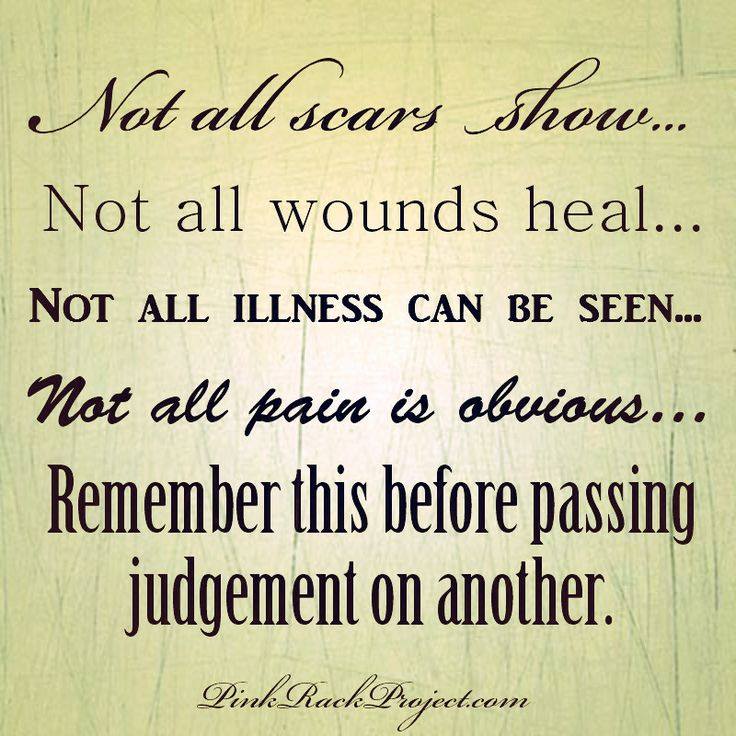
I saw this pass-along the other day and felt compelled to, well, pass it along.

wounds

It reminded me of a lot of things. Things I try not to remember.

Not all scars show. Some of mine do. The one where kids threw a rock at me, requiring seven stitches in my forehead. The ones where I cut myself. (I’ll write more about that later.)

Others don’t. I’ve often described my relationship with Rex as a train wreck. People wonder why I haven’t gotten over it, all these years later. It was the sort of train wreck in which you lose pieces of yourself, some of them irreplaceable. These scars aren’t the visible kind.

Not all wounds heal. Especially the wounds that happen when you’re too young to know how to treat them. Cutting words. Emotional bruises. Neglect. Loneliness. There are no bandages that can cover them, no ointments that can soothe them, no miracle cures.

Not all illness can be seen. If we’re high-functioning or have learned enough coping mechanisms, others may not notice. But bipolar disorder – and other mental illnesses – are, if not immediately visible, lurking just below the surface. And ready to break through at any time.

Not all pain is obvious. But it can leak out, especially around the eyes.

Remember this before passing judgment on another. But judgment-passing is practically an Olympic sport these days, along with shaming.

Scars. Wounds. Illness. Pain. These are things that those of us with mental disorders know all too well. What if our conditions are chemical imbalances in our brains? The consequences of having them, the misunderstandings they cause, the messages we receive, the behaviors we can’t understand or control or mimic, the friends we lose, the opportunities and joys we miss out on, are very real. And don’t let anyone tell you different.

Our disorders may be in our brains, but they’re not all in our heads.

But you knew that, didn’t you?

The Seven Wonders of the Bipolar World

I wonder if I can get out of bed today.

I wonder if a different drug would help.

I wonder what would happen if I told my friends and coworkers.

I wonder how long this mood swing will last.

I wonder if I have enough spoons for all I need to do today.

I wonder if people can tell that I have a mental disorder.

I wonder if this is the best I will ever get, for the rest of my life.

Mental Illness and Gun Violence

If you haven’t seen this article, I recommend you do so.

What Do We Actually Know About the Relationship Between Mental Illness and Mass Shootings?

There’s a lot more to be said on the subject, but this is a good jumping-off point.

We Don’t Do That Any More, Do We?

Here’s a story that caught my eye recently.

http://www.cnn.com/2014/03/08/us/mississippi-unmarked-graves/index.html?hpt=hp_bn1

It’s long, but worth reading. But for you busy people, I’ll summarize.

Two thousand unmarked graves were found on the grounds of an old hospital. Whose could they be? Civil war dead? Victims of an epidemic?

No. That section of the old hospital was an asylum, and the bodies were those of inmates. The insane. The developmentally delayed. The rebellious. Anyone the family wanted to hide and forget.

Of course, we don’t do that any more. No more locked, back wards. No more Snake Pits. No more Cuckoo’s Nests.

No, the asylums (pardon me, behavioral health residential facilities) have largely been closed and the inmates (pardon me, clients or residents or patients) released.

After their 30 days of insurance coverage run out.

To a group home that has a waiting list longer than the Mississippi.

To outpatient centers that hand out meds that may or may not have an effect or even be taken.

To the streets.

To a society that hates and fears them, lumps them all together as eyesores and NIMBYs, panhandlers, homeless and jobless, and spree killers.

Of course there are mentally ill people who are able to function in society on some level or another. They’re the ones who have likely never been in a locked ward. Those with understanding families, good insurance, nearby therapists, and a support system of friends. People who can hold a job. The ones who hardly ever shoot other people. People like me.

Still, the functional mental patients, your coworkers and neighbors and even family members are afraid to “come out” as needing help or getting help. They won’t even admit to taking Prozac, despite it’s being one of the most prescribed drugs in America.

Why is that? Because even if the asylums are gone, largely closed by lack of funding rather than obsolescence, the stigma remains. As a society, we have the impression that all people with mental disorders are psychotics or schizophrenics, lurking nearby just waiting for the chance to get their names in the papers and on TV.

We don’t lock up mental patients much any more. Now we’re humane. We give them apathy, invisibility, fear, and maybe a few drugs.

And the same old stigma.