Bipolar 2 From Inside and Out

Posts tagged ‘my experiences’

The Quest for a Psychiatrist

I have been seeing Dr. R. for eight years. He helped me through my major meltdown and skillfully, gradually mixed the cocktail of medications that would get me and keep me functioning at an acceptable, livable level. He got me through my near-brush with ECT (although he also suggested it).

Dr. R. is moving to another state. He sent all his clients a letter listing half a dozen or so local psychiatrists he could recommend, though he didn’t know if they were accepting new patients or what insurance plans they took. This week was my last appointment with him.

I looked at the inch-thick file he was holding. “I was really messed up back then,” I said.

“Yep,” he replied.

I left with a hearty handshake, good luck wishes, a paper stating my diagnosis (bipolar disorder, anxiety disorder – I guess there was no insurance code for bipolar 2) and six months of refills on my prescriptions. That’s how long I have to find a new psychiatrist.

So where will my inch-thick file end up next? That’s a good question.

I’ve written before about finding a psychotherapist (http://wp.me/p4e9Hv-1m), but oh, I hate the process of finding and breaking in a new shrink.

At least this time I probably won’t have to go through the whole Reader’s Digest Condensed Version of my screwed-up life, since what I really need at this point is someone who will prescribe and monitor my meds, though it will also be nice to have someone standing by in case of another major meltdown, should I have one.

My first avenue of exploration is whether my primary care physician will prescribe my psychotropics, so I can continue with just a psychotherapist. Dr. R. says that most GPs would shy away from the somewhat lengthy list of meds, but every time I see Dr. S. I update him on what meds I am taking, and I always mention the psychotropics, which have mostly been the same for years.

I have an appointment to see Dr. S. next month and sent a query about the prescription issue (his office has a robust online presence), so with luck, I may have a solution before Halloween.

My next step would be to start with the list that Dr. R. provided. Only one of the offices is at all close to me and I’ll likely start there. Does the doctor accept new patients? Does the practice take my insurance? What’s the charge if they don’t?

I’ll also need to contact my insurance provider for a list of local psychiatrists who do take that insurance, but with that I’ll be flying blind. Dr. R.’s recommendations are people he knows, and knows are good.

I hope they’re as good as Dr. R.

What Was I Thinking?

When I was a kid, I had irrational thoughts all the time. I think most kids do. They were harmless – even amusing.

It’s when you’re older that they become problems, or even dangers.

My younger self wouldn’t eat rhubarb because I knew that some part of the plant was poisonous and I didn’t want to take a chance. (I still don’t eat rhubarb. Any vegetable that needs that much sugar to make it palatable hardly seems worth it.) I suppose that could be considered an early OCD-type thought, since it was about potentially toxic food.

Another paranoid idea I had was that when someone threw a cigarette out of a car window, it could cause a major fireball explosion if it just happened to land underneath another car that just happened to have a leaking gas tank. I always looked around and braced for disaster when I saw someone fling a death-stick onto the road. It might as well have been dynamite, as far as I was concerned. (And I was very concerned.)

Yet another irrational fear (looking back, my irrational thoughts were almost all fears) was based on the fact that I had no idea how plumbing really worked. I was afraid that if I flushed the toilet right before I brushed my teeth, the waste water somehow flowed past the tap and could end up on my toothbrush.

(Another plumbing-related misconception dealt with sex (though not conception), but we won’t go into that now. Let’s just say that they never covered it in health class back then. For all I know, they still don’t. I had my mother buy me a copy of Everything You Always Wanted to Know About Sex But Were Afraid to Ask so I could find the answer.)

In my teen years, my irrational thoughts became more delusional, and more related to my by-then-shaky mental health. At some point it was recommended (I think by the high school, though I don’t remember the circumstances) that I should visit a counselor. And they were right. I certainly should have, although in retrospect, child psychiatry in those days was fairly primitive and I most likely wouldn’t have received a correct diagnosis or treatment. I don’t think bipolar type 2 even existed.

I’ll say this for my parents: They consulted me on whether I wanted to go or not, which was not what I would have expected. I declined.

My “reason”? I somehow thought that having such a thing on my permanent record would keep me from getting into a good – or perhaps any – college. (When I started applying, of course, no one even asked.)

And once I was in college and knew that my sanity was truly on shaky ground, my life goal was to graduate, and then work enough quarters (at pretty much anything) until I qualified for Social Security before I was put away. I was convinced that was likely to be my fate. I’m not sure why I thought that having Social Security would have helped.

None of those irrational fears were ever addressed in a timely manner. Except the sex one. Yay, me! for finding some accurate information on that one and Yay, Mom! for facilitating my enlightenment.

If you’ve noticed a trend of increasing irrationality and increasing potential for sabotaging my own life, you’re not wrong.

*** TRIGGER WARNING ***

The rest of this is tough stuff. You know what’s coming, so stop now if you’re not ready to hear about it.

When I had my major meltdown ten or so years ago, I had the worst irrational thought of all. My mother had just died, so my thought processes were pretty scrambled anyway.

Then my husband did something that I thought was unethical and likely illegal as well. Then he said he’d do it again. I managed to talk our way out of the first instance as a simple mistake, but his statement that he might do it again haunted me.

I catastrophized, of course. This time, however, the potential catastrophe loomed large and to me very real. If he did repeat his actions. there would be no possibility of smoothing things over. He would be culpable. And I would be in the position of needing to report it.

Then he would lose his job – at the very least – which was at the time loosely related to the legal system. They wouldn’t be able to overlook it.

I was unable to work at the time, trying to get disability, and we were barely staying afloat. Without his job, we would sink.

So I thought that, if he did it again, and I reported it, and he lost his job, the only thing left for me to do was kill myself.

Like I said, pretty irrational.

I had a plan, though. In fact, I had three or four different plans and I couldn’t decide among them. Indecision is part of what kept me alive.

As it turns out, my husband did not choose to repeat his actions, and I was spared the necessity of choosing among mine.

Soon thereafter, I got help. I never mentioned the suicidal thoughts till they were long gone, so I never even had to fear the dreaded lock-up that I had anticipated all those years before.

I kept one of the intended means of exit for a while, though. Just in case.

It was a major day in my healing when I finally let that go. That irrational thought had been dismissed and conquered.


When Anxiety Attacks

I was grocery shopping and when I came to the cereal aisle, I found myself light-headed and breathing raggedly.

My husband dropped a knife in the kitchen; I jumped and all my muscles tightened up.

We were driving down the highway, when suddenly I flung my arms out to the side and gasped loudly.

In none of these cases was anything actually wrong. (Although the incident in the car nearly caused an accident when my husband turned and yelled, “What? What?”)

My depression has always been accompanied by anxiety. That’s one of the reasons I was later given a diagnosis of bipolar disorder, type 2. It seems that, where other people get hypomania, I get anxiety. (There is a thorough explanation of bipolar disorder and anxiety (or “mixed states) at http://psycheducation.org/diagnosis/mixed-states/anxiety-and-bipolar-disorder/.)

I have had generalized anxiety, where I have no idea whether anything specific is actually wrong or doom is impending. I have had phobic-type anxiety, where I imagine that any bee in the neighborhood is going to choose to sting me and I freeze up. I have had anxiety reactions to loud noises or sudden movements, where I feel like I’m jumping out of my skin and actually do physically jump. And I’ve had irrational moments of anxiety, as when I can’t sleep because I don’t know where I put my passport. (Naturally, I have to get up and look for it.)

Now that I am relatively well controlled on medication, the various anxieties don’t plague me nearly as much. And I’ve developed coping mechanisms for a number of them. For example, when I get anxious in the car on the highway I no longer fling out my arms and gasp. My husband notices my tension and asks if anything would make me feel better. “Drive in the other lane,” I say, “and not next to the concrete divider.” I take an extra Ativan (which my doctor allows) before social events I can’t avoid. My husband warns me if he is going to hammer a nail in another room, or reassures me that the cat just knocked over a glass.

I still don’t know what was going on in the cereal aisle. I thought it might be the imposing wall of large, brightly colored boxes, visual noise that seemed to overwhelm me. My therapist at the time said that it was likely that I was just having a random anxiety attack and happened to be in the cereal aisle when it happened. After that I associated the two.

Now I’m not sure. I may have been right about the visual noise. Auditory noises certainly provoke anxiety in me, and I know that some people on the autism spectrum can be overwhelmed by visual stimuli. (I’ve never been diagnosed on the autism spectrum, but I do share certain traits with Aspies.)

I think the anxiety will always be with me, to some extent, just like the depression. My meds make them bearable and my ways of handling them improve. But I don’t think I’ll ever get used to the fact that there are bees, wasps, and ticks in the world, all of them with a thirst for my blood.

Those Science Fiction Crazies

There has recently been a huge kerfuffle in the science fiction community regarding the Hugo Awards. You don’t really need to know much about it and probably don’t want to. Suffice it to say that two groups had it out over the past and future direction of science fiction and fantasy, and the meaning of the asterisk.

The awards have now been given, but still the blogosphere is full of recriminations, sour grapes, and schadenfreude.

What does this have to do with mental health? Aside from the fact that very smart people can behave like vicious toddlers, it’s interesting to note that the various sides in this dispute did not always, shall we say, acted rationally. You probably guessed that from the asterisks.

This phenomenon is not unique to the Hugo Awards. If you have never been to a science fiction convention, let me tell you about it.

Most of the people there will be very intelligent, obsessive about their particular fields of interest, lacking in social skills to various degrees, and will have a history of being outcast or bullied in their youth.

Does any of that sound familiar?

I’m not a psychologist (nor do I play one on TV), but I can’t help thinking that if you tested everyone at one of these events they would score higher than a random group of people on the autism spectrum. Simply put, the SF community appears to have more than its share of Aspies – and a fair sprinkling of bipolar, depressive, and OCD people.

When their oddities are carried to the extreme – and they often are – SF fandom can devolve into incivility that results in unconscionable threats and exceedingly ugly online behavior.

When you see these kinds of behavior, it is tempting to dismiss science fiction fans as being the caricatures that the media have instilled in us – clueless losers who live in their parents’ basements, show up at jury duty dressed in Star Trek uniforms, and insist that Harry should have ended up with Hermione.

Admittedly, to a certain extent that is true. If you look around at a convention you will almost certainly see a number of people who conform to that stereotype. I myself have a relative who could be Queen of the Get-a-Lifes.

What you may not see is that, despite the cluelessness, rudeness, sometimes elitist or misogynistic behavior, obsessiveness, and disregard for the feelings of others, the science fiction community is actually, at heart, a place where the non-typical person can find a group of like-minded individuals to talk with, obsess with, bond with, and occasionally practice social skills with. It fullfills a very real social and psychological need. Without the science fiction community, whether online or in “meatspace,” many of these people would have little or even no place to have much of a social life at all.

Certainly the stereotype is not true of all members of fandom. Most hold regular jobs in technical, creative, or other fields, have families and close relationships, and negotiate their way through modern society as well or poorly as anyone else. But there are consistencies in their background. Most are incessant readers and have been since childhood. Many have been the targets of cliques in school and the workplace. A number would be described by their neighbors as quiet loners (though this is not to imply that SF fandom harbors more spree killers  than any other group). They have odd senses of humor or in some cases none at all. In a very real sense, sf fandom is for them, as one song would have it, made up of “My Thousand Closest Friends.”

So if you happen to be in a hotel and find the meeting space is overflowing with people dressed as Klingons, robots, and giant furry animals, remember that they are mostly harmless and enjoying a moment of fitting in to a part of society that celebrates and honors their differences and shares their pride in their oddness. Where they can relax and be themselves, without worrying about seeming weird or threatening or being put down, avoided, or scorned. Think of it as a support group with parties, art shows, panel discussions, music, costumes, movies, and chocolate.

A lot of us with mental disorders are glad to know that such places exist. A lot of us wish we could find or make such places, too.

A Tattoo Is for Life…

…this one, especially so.

As soon as I learned about the semicolon tattoo, I knew I had to get one – and not just because I’m a huge grammar nerd. Because I’m bipolar and want to spread the word about mental health issues.

In writing, the semicolon indicates a place where a writer could have finished a sentence, but instead chose to go on. This makes the semicolon an effective and beautiful symbol for suicide prevention efforts and those who struggle with mental disorders.

Every day we choose to get out of bed; choose to take our medications; choose to make and go to our therapist appointments; choose to live another day; and choose to go on with our story.

This is not something I invented. Here are the people behind it: http://www.projectsemicolon.com/. And here are some stories about the phenomenon that have been working their way through the media and around the internet.

http://www.upworthy.com/have-you-seen-anyone-with-a-semicolon-tattoo-heres-what-its-about?c=ufb1

9 beautiful semicolon tattoos our readers shared to destigmatize mental health challenges

Here is my story.

I am possibly the last person you would ever expect to get a tattoo. I am probably the last person I would ever expect to get a tattoo. I’m in my 50s, a former English teacher, married for over 30 years, fond of reading and word puzzles and cats.

Nevertheless, the professionals at Monkey Bones Tattoos in Beavercreek, OH, did not seem surprised when I showed up one day and presented my wrist.

The naked wrist.

The naked wrist.

When I explained what I wanted – to put down a deposit and book an appointment to get a semicolon tattoo – I learned that they had a cancellation and could ink me right away.

What the hell, I thought. Might as well. I had learned about the tattoos about a month before and had thought it over plenty. It was by no means a spur-of-the-moment (or drunken) impulse.

Mike Guidone showed me into his studio and explained the procedure.

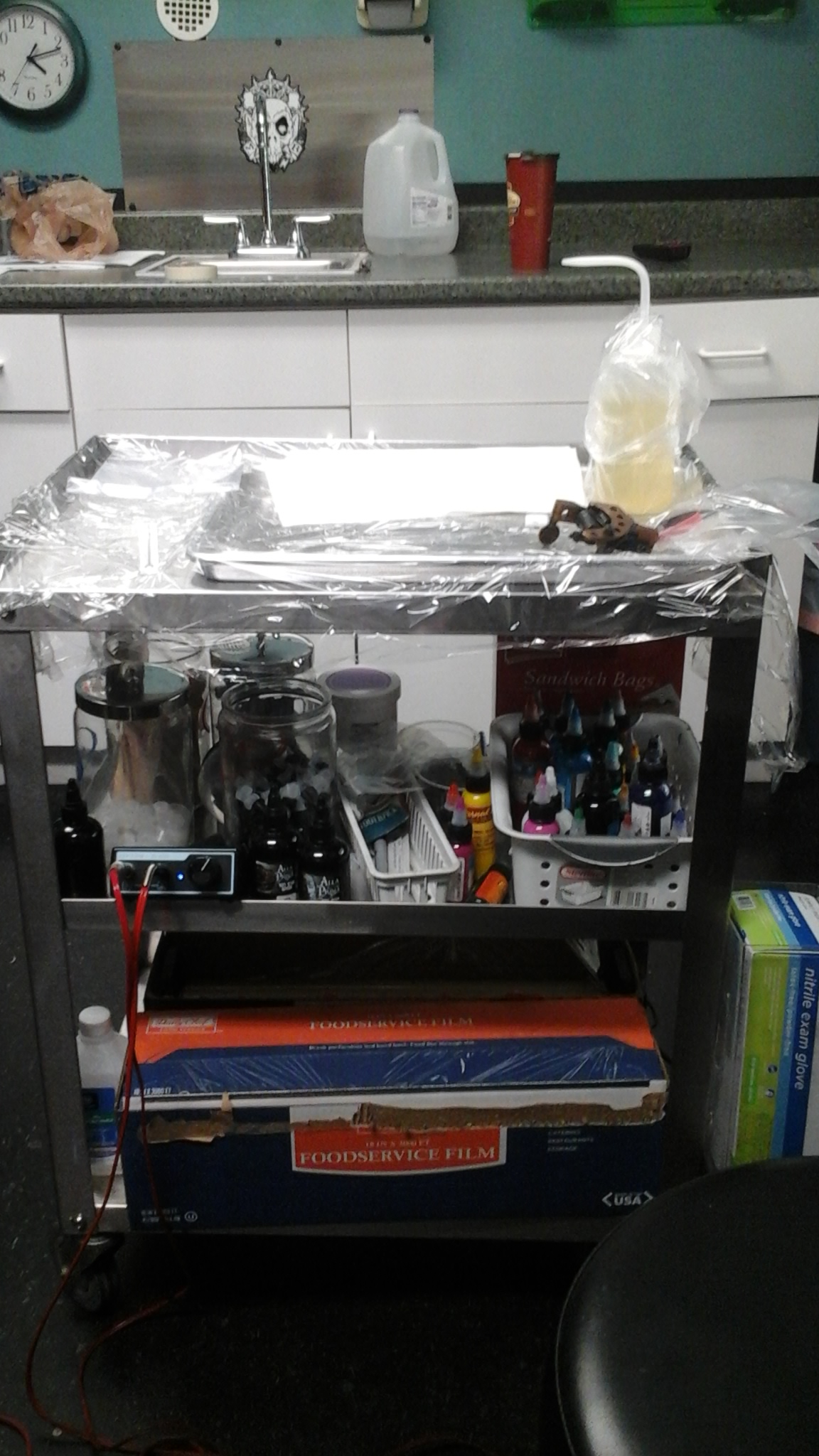
The tattoo artists work station.

The tattoo artist’s work station.

He presented me with stencils of three different sizes of semicolons. I chose the in-between one. My wrist is fairly small, so the big one would have looked out of place, but the small one wasn’t noticeable enough. The idea is for people to see it and ask, so you can share the meaning and talk to them about mental health and combatting the stigma.

I sat in the dentist-type chair, listened to a brief explanation, got answers to some questions, and was ready to start.

In progress.

Did it hurt? Not particularly. It was a feeling between a scratch and a sting, and took only about ten minutes. Some aftercare instructions and I was done.

finished1

Success!

Then I paid ($80, the shop minimum), tipped Mike, and was on my way. Now I care for the tattoo while it heals, anointing it with unscented lotion several times a day, avoiding sunlight or soaking, and trying my very best not to scratch or pick at it.

The results.

The results.

Am I happy with it? You bet!

And, like I said, it’s for life! My story isn’t finished yet.

Mini-Meltdowns and Many Meltdowns

When my brain broke back in 2001 or so, I thought it was the first time that had happened. Later, on reflection, it turned out that wasn’t so.

The 21st-century breakdown was certainly the most dramatic. Although I had just quit working in an office to start a freelance career, I found myself unable to work after a few months.

I had become unable to work in the office because of mounting difficulties that I now realize were warning signs of the impending breakdown: inability to concentrate, increased anxiety (the feeling that an angry badger was about to claw its way out of my stomach), lessened ability to interact with coworkers, sudden flares of temper, turning people away with unintendedly cutting remarks and sarcasm, isolating, inappropriate affect, catastrophizing – you name it, I had it.

What was causing all these symptoms? My bipolar disorder, obviously. But I’ve had that for years. What was pushing me over the edge this time? I had trouble at work. My boss left and, when I “came out” to my new boss as depressed (which is what I was diagnosed with at the time), she reacted with wariness and incomprehension. She gave me the first bad review I ever had at that job.

My mother’s health was deteriorating seriously, too, about then. I lost time at work taking her to various appointments and I had to have “the talk” with her about how much longer she could live alone. Eventually I took over her finances – and by then I was scarcely handling my own.

I experienced a lift when I quit my job and began freelancing. Hypomania? You bet! My new flexibility allowed me to take better care of my mother, and the assignments kept coming in.

Then everything came crashing down. I screwed up my finances and my mother’s. She began having worse falls and injuries, hospital stays and drug reactions, even hallucinations which scared the hell out of me. I emotionally judo-ed my sister to come up and help, then fought with and resented her, and had to take care of parts of her life as well.

Those and other difficulties on top of my mental disorder added up to a non-functioning me. I dumped all the chores and coping onto my husband, which was a rotten thing to do, fought with him, sobbed for no discernible reason, became unable to work, or care, or do much of anything except think up at least three different ways (and reasons) to kill myself. Fortunately, I was too immobilized to try any of them.

I’ve written before about the things that helped me get back to some kind of functioning – a proper diagnosis, the right meds, time without work (as we gutted our retirement savings), lots of psychotherapy, and my wonderful, patient, ever-helpful, devoted husband.

But now, looking back, I can see that it had happened before, though not so dramatically and completely. In childhood, in my teens, in college – at every stage of my life I had at least one breakdown, often triggered by the circumstances of my life, but fueled and stoked by my mental illness. In every one, my ability to function deteriorated a little more.

The first one that I remember clearly was when I was around 12. My best friend and I were in charge of a birthday party for her younger sister and some friends. This was the old-fashioned kind of party that everyone in the neighborhood had then: cake and ice cream, party games, presents, and not much else. It happened during pin-the-tail-on-the-donkey. I was blindfolded – literally – and my friend kicked me in the ass – again, literally. In front of all those younger children.

I ran home sobbing. And I curled up into a fetal ball and didn’t quit for at least three days. Non-functioning, non-responsive, non-everything. What finally brought me out of it was seeing my mother’s pain at this inexplicable (to her) meltdown.

I had a mini-meltdown in my freshman year of college, which involved sitting in my nightgown in the hallway, staring for hours at a richly detailed poster of a fantasy realm. (I managed to frighten an intruder by arising, ghost-like, in my pale yellow shroud as he entered the suite.)

This one was triggered by my realization that I had probably chosen the wrong major and that there were no job prospects ahead for me. (It turns out I was wrong about that. Maybe I should have stuck with it, but my next choice turned out pretty well.) I took a year off college and took a job as a cashier in a restaurant, where I spent a lot of time crying into the roller towel and being told I should smile more. This convinced me that going back to college, with a new major (and even fewer job prospects), was the right thing to do.

The next meltdown was major. I had finished college, endured a year-long train wreck of a relationship, and lost a job as an assistant restaurant manager (I hadn’t fully learned that lesson yet). I got unemployment, which meant I lay around the apartment for most of the week (except for making half-hearted attempts at job hunting).

One notable symptom of this breakdown was my near-complete immobility. One errand in a day – say, going to the post office for stamps – made it a productive one for me. I had maybe three of those a month, with one being the obligatory visit to the unemployment office – a supremely depressing place to be depressed.

I had some truly irrational thinking that time, too. I thought I could cheer myself up by watching light, fluffy sitcoms on TV. But as I lay there on the couch, I found myself crying with every upbeat, cheery theme song that came with them. Laverne and Shirley making their dreams come true. One Day at a Time, which advised me to get up on my feet because somewhere there was music playing. And, oh, Mary Tyler Moore. Love is all around, my ass.

After that, it was a long, slow slide to my major breakdown. It wasn’t unrelieved misery. I got married. I got a master’s degree and a job in publishing. We acquired a house and cats. We traveled. But the Big One was waiting for me.

Nowadays, I still have mini-meltdowns, but they usually last a maximum of three days, rather than weeks, months, or even years. They still tend to be triggered by stressful life events, especially financial ones. But when I get one, I know I’ll be coming out of it soon. And that’s a wonderful feeling buried in all the misery.



Music Charms the Troubled Mind

Once I knew a man whose wife was going to leave him. I knew he was in a lot of pain and despair about it, though he also turned into a huge asshole before everything was said and done. He was also suicidal for a time.

One day when I was trying to talk him through a bad patch, I asked whether he might turn to music to help him. “What?” he said. “Do you think I should listen to country music and cry in a beer?”

I wasn’t suggesting that at all. I just knew that he was a singer and songwriter of talented amateur status and was known for this in various circles. I honestly thought that music might help.

On the other hand, I always forget, when I am on the downswing, how much music can do for me. It soothes and heals, but it also lets me tap into the emotions that I have been suppressing.

Do I have the inexplicable blues that are part and parcel of my condition? There’s a song for that. Am I feeling unrequited love? Unrequited lust? There’s a song for those too. Is the world spinning too fast for me? Do I need to know that everything will be all right? Or do I just need to know that someone, somewhere and somewhen, has also felt this way? I can turn to music.

“Music, uniquely among the arts, is both completely abstract and profoundly emotional. It has no power to represent anything particular or external, but it has a unique power to express inner states or feelings. Music can pierce the heart directly; it needs no mediation.”
– Oliver Saks, Musicophilia

Saks also says, “The power of music, whether joyous or cathartic, must steal on one unawares, come spontaneously as a blessing or a grace.” There he and I part company.

Music can certainly steal on us unawares, whack us upside the head with a memory, a feeling, a piercing stab of emotional intensity, all the stronger for being unexpected.

But we can also choose to bring music into our lives when nothing else seems to touch us. We can tap into those memories and feelings – good or bad – and let the music wash over us as we listen and feel.

According to scientific experiments with fMRI, music uses more parts of the brain than almost any other activity. The neural connections fire all over the place – more so if one is playing an instrument, but even when just listening. The memory centers, artistic areas, language centers, emotional areas – even the motor complexes – are stimulated.

My problem is remembering all that music can do for me. When my emotions are dulled, flattened by the steamroller of depression, I sometimes forget that I can be any other way. The music I love is always there for me. I can bathe in it, wallow in it, be uplifted by it, float on it, join in with it, feel it emotionally and viscerally and intellectually all at once or one at a time. It can express the things that I just can’t.

When you’re depressed is a time for writing bad poetry. Or you can let good poets and songwriters take you with them as they explore the human condition in ways you’re not capable of. I think that’s why they do it – create their art. The really good ones anyway.

There’s also something to be said for music as distraction. A song from years ago – even a frivolous one – can take you away from your troubles, even if only for a moment. This is not the time for exploring new musical avenues. Remembering that things once were good can feed your sadness, your depression, but it can also give you perspective. If you took joy in this music once, there will come a time when you will again. And maybe that time is now.

Perhaps the most amazing power of music is to provoke catharsis. Certain songs leave me sobbing like a baby. They don’t even have to be sad songs, though many of them are. “The Mary Ellen Carter” by Stan Rogers is about as life-affirming as you can get, but it can still turns me into a weeping puddle. (https://www.youtube.com/watch?v=Fhop5VuLDIQ) His song “Lies” has nothing to do with my situation personally, but its evocative power touches me nonetheless. (https://www.youtube.com/watch?v=D79XOc1vKzQ) And almost no one I know can make it through Kathy Mar’s “Velveteen.” (http://www.last.fm/music/Kathy+Mar/_/Velveteen)

Afterwards, I feel drained and, if not exactly better, less emotionally constipated, I guess you’d say. Clearing away a bit of blockage can be cleansing. If music can do that – and it can – then I don’t care if its country with a beer, jazz with a glass of wine, or hip hop with an energy drink. Even easy listening with a glass of milk, if that’s your thing.

So thank God and Apple for iTunes. And here’s hoping that my Swiss cheese of a memory will give me a nudge in the right direction when I need it next time.

Sense of Self

The air is still and blankets all my sense.
I’m muffled, muzzled in the sheltering dark
But dare not hope for fire, with bright, intense,
loud flames that rend the silence with a spark.

I breathe or not. It’s sometimes hard to tell
When swathed in dimness. Stifling, musty scent
Fills up my nostrils and my brain as well –
Which cannot will the veil be shredded, rent

to save from suffocation. How shall I
Withstand this cycle till the day appears
And breezes blow the dust away from my
Stopped ears and eyes and lungs, plugged full with fears?

Pull off the cover and let free the soul.
Take broken breath and heal it into whole.

Me and My Brain: A Story of Love and Dysfunction

As they say, of all the things I’ve lost, I miss my mind the most. Or anyway, a properly functioning brain.

I love my brain, despite all the trouble it’s given me. For many years I thought it was the only measure of my worth, the only thing about me that made me special, the only thing that I could truly rely on.

I reveled in learning, in thinking, in reading, in questioning, in contemplating, in discovering. My body was not dependable; my brain was.

Little did I know the biochemical pitfalls that were waiting for me. Little did I know that my brain was ill. Disordered. Unbalanced. At the very least, uncooperative.

For instance, my brain decided other people were always pointing and laughing at me. Sometimes they were, of course, but that paranoia became my baseline assumption. (Shrinks call that “ideas of reference.” I just called it life.)

My brain played back for me every socially awkward or embarrassing thing I ever did, either randomly or at the worst possible moments.

My brain made me cry at the stupidest times – at an upbeat sitcom theme song, when someone mentioned foreign travel, when opening boxes from the garage, when thinking about my college years or birthday parties. Whenever I was confronted with how damaged I am.

My brain had irrational thoughts. Bad thoughts. Cutting. Worse. You know what I mean.

Eventually my brain refused to let me live any kind of a normal life – go out, talk to people, care for my house or my pets or myself, or even read, once the greatest joy of my life, the thing my brain and I best liked to do together.

But my brain also worked just well enough to send me looking for the help I needed. I’ve gotten back parts of who I was and what my mind was. And for that, I’m grateful. Even with it disorderly and uncooperative, it’s still the best part of me.

Crazy Pills

Once upon a time in the land of Jublia lived a kind and powerful queen named Lunesta. One day the dragon Cialis and the evil sorceress Humira attacked the castle, but Jublia was saved by Lunesta and her faithful dog Boniva.

And the peasants rejoiced.

Honestly! The names that pharmaceutical companies give their drugs these days! It’s bad enough that the drugs have a list of side effects longer than the symptoms they’re supposed to cure. Not to mention the drugs where the side effects are the same symptoms they are supposed to cure, or the ones where the side effects are considerably worse than the condition they’re being prescribed for.

My favorite has always been, may cause death (excuse me, “increases risk of death”). That has to be the ultimate side effect. You’ll be dead, but your toenails will look great for the funeral. Leave instructions that include sandals.

I made a list of all the drugs that I’ve been prescribed in my pursuit of something resembling sanity. It’s quite long. I’ve tried almost every class of drugs there is – tricyclics, atypical, SSRIs, anti-anxiety drugs, and hypnotics – in various combinations and assorted doses, and even for off-label uses. (TIL that Abilify can be classed as an “atypical atypical,” which makes me feel a certain kinship with it.)

The only ones I know I haven’t taken are lithium and the MAOI inhibitors. which is a good thing, because I do so like red wine and cheese.

Here’s the list, as nearly as I can remember:
Abilify
buproprion
Desyrel
Effexor
Inderal
Lamictal
Lexapro
desipramine
Prozac
Sinequan
Tofranil
Topamax
Wellbutrin
Zoloft
Ativan
BuSpar
Ambien
Valium

I may have missed a few, what with the brand names and generics, the decades over which all this occurred, the memory deficits, and the ones I took for only a month or two before the side effects became too heinous.

The side effects I’ve encountered along the way include:
dry mouth
memory loss
nightmares
agitation
lethargy
weight gain

Not all at the same time, of course, thank heavens. Right now I seem to have dry mouth, residual memory loss, and weight gain. Given the alternatives, I can live with these. More or less. (That is to say, I have to.) The memories, I understand, are not coming back. I just hope I don’t lose any more, especially ones of the hot-n-juicy variety.

The side effects I haven’t suffered include:
death (obviously)
fatal skin rash (Stevens-Johnson Syndrome, which I wrote bout a while back: https://bipolarjan.wordpress.com/2014/03/07/saving-face-or…-die-from-that/)
tardive dyskinesia

I hope the drug regimen has settled down for a while. I must admit that I don’t follow the instructions to the letter. They’re simply too overwhelming: Take this one on a full stomach, this on an empty stomach, another with milk or never with grapefruit juice; something else at bedtime or half an hour before bedtime, or with the noon meal. And don’t forget the non-psychotropics (cholesterol, blood pressure, etc.), or the vitamin, fiber, and calcium pills my GP prescribes or recommends. Well, and the OTC Benadryl, Tylenol, and Immodium, as needed.

(Yes, I did once look up all my meds in a drug interaction database. Every one interacts with every other one. Maybe that’s one reason mixing an effective cocktail has been such a crapshoot.)

I knew a woman who took so many different drugs for her variety of illnesses and conditions that she had a kitchen timer that she continually set and reset every time she had to take a dose of something. Her meds were more precise than mine, though. If she screwed it up, the consequences would be dire. Her side effects did include death.

The regimen I’ve settled on is this: one set of pills when I wake up (whenever that is) and one set at 11:00 p.m. I eat whenever I’m hungry, and I don’t like grapefruit juice anyway. Anything more complicated than that I can’t be sure of remembering. It’s still complex, what with the only-in-the-morning pills, the only-at-night pills, and the take-twice-a-day things.

I have little tricks to help me remember the routine – daytime-only pills in a plastic bag, nighttime-only on the lamp base, twice a day on the tea cart. Turn the vitamin bottle upside down after taking morning pills. I suppose I should get one of those daily pill caddy things, but they never seem to have enough, or big enough, compartments.

Is this routine crazy? You should see me without the pills.

Well, no, you shouldn’t.