Bipolar 2 From Inside and Out

Posts tagged ‘my experiences’

Reaching Out and Reaching In

A lot has been said in recent days about reaching out when you’re in trouble psychologically. And that’s always a good idea. Reach out to your friends, your family, your therapist, your psychiatrist, your church or synagogue or temple.

hands people friends communication

Photo by Pixabay on Pexels.com  

Unfortunately, not everyone has those resources. And sometimes when you reach out to them, they do not reach back to you or even respond in hurtful ways.

Sometimes – many times – you’re just not able to reach out. That’s true of me, anyway. When major depression hits me like a truck, I get immobilized. Uncommunicative. Isolated. I usually have the wherewithal to get to my therapist, if my husband drives me, but not much more.

My family and friends can tell when I’m in trouble. And they do reach out, even when I don’t reach back.

My mother always knew when I hit a particularly bad spot because she could recognize it in my voice – it lacked animation, even if I was talking about something I loved. Not that I talked much or felt much. Depression can damp down all your feelings sometimes. You don’t cry, you don’t feel sad. You feel nothing. And it shows to someone who knows how to look and listen.

This is called “flat affect” by psychiatrists. The person’s face, voice, mannerisms do not reflect emotions, sometimes not even anxiety or despair. And sometimes people adopt a flat affect so as not to betray their inner turmoil. (It can still leak out around the eyes, even to relative strangers. And I don’t mean crying.)

My husband knows I’m depressed when I turn monosyllabic. Ordinarily, I enjoy talking to my husband about anything and nothing – things we’ve read or heard, what’s happening at work (his, mostly), funny things the cats did, and so forth. But when I stop responding and communicating, or respond only with “yeah,” “nah,” and “meh” sorts of answers, or don’t laugh or at least groan at his jokes, he knows I’m headed downward.

I stop communicating other ways, too. I don’t post on Facebook or only pass along the occasional pass-along. I skip commenting on posts regarding things I usually care about. I spend hours alone reading, if my sometimes-dubious powers of concentration let me. Or I sleep, and nap, then sleep some more. I certainly don’t leave the house or even make plans to go out. I don’t call friends. I isolate. I don’t reach out, like the memes say I’m supposed to.

I am fortunate to have friends that do reach out to me. John would lend me books, talk about them with me, and listen if I needed to vent. Peggy would call and invite me to visit, even when she knew I wasn’t leaving the house. Pete sometimes IM’s every day just to check in and JB assures me that when he IM’s and I don’t feel like chatting that’s still okay. Robbin calls me and tells me all about her life even when I can’t talk about mine, then says, “Let me know when you surface.” If she doesn’t hear from me for awhile, she calls again and reminds me that I can call her too. (She can also “read” my voice and knows when there’s some topic I’m avoiding.) My husband offers a hug or kisses me on the head. My mother prayed for me. I am fortunate indeed to have had people like these around me when I really need them.

Reaching out to others is good. So is reaching in to the suffering. Best is a combination of both. But that takes work and not everyone is able to do it.

If you can reach out, reach out.

If you can reach in, reach in.

If you’re lucky, you’ll meet in the middle, where hope lives.

 

Would You Try Electroshock?

Photo by Mike T

In the course of dealing with my bipolar disorder, I had a near brush with electroshock. I managed to avoid it, but I did give it serious thought.

Now 60 Minutes has come out with a piece called “Is Shock Therapy Making a Comeback?” You can see the segment here: 60 Minutes.

ECT(electroconvulsive therapy, the modern name for the procedure), which is often done on an outpatient basis, works by inducing a brief seizure in a patient. The seizure, which lasts about a minute, releases multiple neurotransmitters in the brain, all at once. The patient is required to have someone to transport them to and from the appointment. Treatments are typically applied one or two times per week for 6-8 weeks.

In a brief article excerpted from the news show segment, Dr. Charlie Welch, of McLean Psychiatric Hospital, explains how ECT differs from how it was performed in the past: “What’s different first of all is that it’s done under general anesthesia with a muscle relaxant. So when the treatment is done, the patient is sound asleep and completely relaxed.” Call it a kinder, gentler shock treatment.

That was the procedure that my psychiatrist offered me after he had spent a number of years trying me on various medications that either didn’t work, or helped only partially.

My immediate reaction was negative. I recall thinking, “Fuck, NO! Keep away from my brain, you Nazi sadist!” After I calmed down a bit, I did some research.

ECT, my sources said, was a long way from the cruel, stigmatizing procedure portrayed in One Flew Over the Cuckoo’s Nest. The Internet was little help, though. The opinions and experiences of people who had undergone electroshock ranged from “It was hideous” to “It was a miracle.”

Truthfully, I was appalled by the notion of electrical jolts surging through my brain. My precious brain, which had both sustained me and betrayed me throughout my life.

Then I thought some more. So ECT sometimes causes memory loss. I already had that, thanks to some of my meds. I would be altering my brain with electricity. But hadn’t I been altering it for years with chemicals – medications that no one seemed to know how they worked?

So I went back to my doctor and said I would at least talk to the doctor who would perform the procedure. And I lined up a journalist friend to write about my experiences if her editor approved. (Note: In the 60 Minutes piece, former Massachusetts First Lady Kitty Dukakis gave permission to have her treatment filmed and broadcast.)

My psychiatrist, however, had one more medication that he wanted me to try before we took that next step. And it worked. So much for electroshock.

Now as to that side effect of memory loss – Dr. Sarah Lisanby of the National Institute of Mental Health in Maryland has developed a new treatment that seems to avoid that particular consequence.

The procedure is called Magnetic Seizure Therapy (MST) and it uses magnets (duh!) to stimulate more precisely focused seizures than ECT does. These focused seizures seem to avoid the parts of the brain associated with memories. As Dr. Lisanby told the 60 Minutes reporters, “For some people, ECT may still be needed. But if Magnetic Seizure Therapy could be effective without the memory loss who wouldn’t want to try that first?”

Would I try MST if I relapsed into treatment-resistant depression? I would certainly consider it, if it were out of the testing stage by then. And I’d do that before I signed up for ECT. While I have memories I’d prefer to forget, with my luck, those would be the ones left unaffected.

The cynical side of me says that these seizure-causing therapies are becoming more popular because insurance companies like the notion of a short course of 6-8 weeks of treatment instead of years of talk-and-medication. (Although Kitty Dukakis said that she has done ECT for years now and expects to continue into the foreseeable future.)

But I could be wrong. It is possible that some kind of treatment could be short in length but longer-lasting in effectiveness. I’m not ruling it out. At this point I’m not ruling out anything that could aid in my progress and my healing.


Bad Thoughts and Tattoos

Sometimes I have bad thoughts. We all do. I find that mine fall into three groups.

The first kind of bad thoughts are when I want to snap or snipe or snark at my husband, despite the fact that he is indispensable to me. He takes care of me, understands me, helps me, hugs me, feeds me in ways I can’t begin to describe.

When those bad thoughts arise, I have a brief internal chat with myself. (It looks like I’m thinking what to say because that’s exactly what I’m doing.) Then I choose not to say the nasty thing or I think of a less-nasty way of saying it. (I’ve written about the phenomenon before in “Managing My Anger” https://wp.me/p4e9Hv-kw.)

The skills involved are impulse control, the use of “I statements,” and the ability to rephrase. I try to say something that will get my point across without hurting or making things worse. These are techniques I have learned over the years, which makes me think they are things that can be developed with a little practice.

Learning to restrain myself has prevented many a fight. Some people find this style of communication inauthentic or wishy-washy – that I am tiptoeing around my husband instead of saying what I really think. All I can say to that is that it works for me and for our marriage.

The next kind of bad thought is the kind that comes with depression: I’m useless. I’m pathetic. I can’t do anything right. I’m worthless. Jenny Lawson (aka The Bloggess) talks about these thoughts in her book Furiously Happy, and she has one thing to say about them: Depression lies. These are the thoughts of a biochemically influenced brain that makes you miserable and sometimes wants to kill you, or at least kill your possibility of happiness.

Fortunately, my husband has read Jenny Lawson too. When I express these bad self-thoughts – and it’s best if you have a safe person to tell them to – he reminds me. He doesn’t try to deny the thoughts (You know you’re not worthless. You do lots of things right). He tells me, “That’s depression lying to you.” I used to get stuck in these cycles a lot before I was properly medicated and before I had his help and that of my therapist.

Then there are the really bad thoughts, those of self-harm or worse. Most of the time I don’t have these anymore, but when I do, there is one thing I can do. (Actually, there are more things I can do, but this is one that works for me.) I look at my tattoos.

The one on the right wrist is a symbol for bipolar disorder made up of punctuation : ) :  in the form of a smiley face/frowny face. This reminds me that my brain isn’t working right and is sometimes out to get me.

The other is on my left wrist, near my scars from self-harm. It is a semicolon. You may have heard about the Semicolon Project or seen the semicolon symbol on t-shirts or jewelry.

The semicolon is my favorite punctuation mark. It comes at the place in a sentence where a writer could choose to put a period and stop; instead, she continues the sentence. The semicolon says, “My story isn’t over,” something you’ll also see on t-shirts and such. (I’m thinking of making that sentence my third tattoo.)

Recently I had a bout of those really bad thoughts. But I looked at my tattoos and told myself, “My story isn’t over yet. I still have things I need to do.” One of them is to tell my story, in this blog and in a book I’m trying to write.

My tattoos helped me get over the bad thoughts. They have paid for themselves many times over. I never regret getting them. They may have saved my life.

Drug Therapy: The Short Form

From what I’ve read in Facebook support groups – and noticed from my own experience – the effects of antidepressants don’t always last as long as we might want.

My first psychotropic medication was, as nearly as I can remember, imipramine (Tofranil). At the time I was only diagnosed with unipolar depression, so it seemed like a good choice. Imipramine is what is called a “tricyclic” antidepressant because of its chemical structure. Many people complained of the side effects.

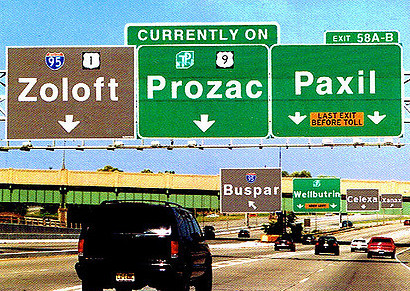
Tricyclics were about all the medical community had to offer until 1987, when Prozac hit the market, followed by its cousins Zoloft and Paxil. All of these were classified as SSRI drugs, ones that selectively acted on the neurochemical serotonin in the brain, rather than a wide variety of brain chemicals as the tricyclics had.

Since then we have listened to Prozac, talked back to Prozac, and been referred to as a Prozac Nation. Prozac has been hailed as a miracle drug, damned as a gateway to violence or suicide, and prescribed in phenomenal amounts.

And Prozac has helped me. After about six weeks on it, when the drug started to kick in, I was on a sailing trip. One of the crew said I was the passenger most at peace with myself that he knew. It was a revelation to me and a new way of thinking of myself.

Prozac changed my life – possibly saved it. And then, not so much. I moved on to other medications.

“Major Study Finds Antidepressants Work, But May Have Limitations,” by Brigit Katz, published on The Smithsonian.com, validates my perception.

Her article states, “A meta-analysis [or study of studies] of existing trials suggests that the drugs are mostly effective on a short-term basis for patients suffering from acute depression.” Katz’s article also cites articles in the New York Times and The Lancet that report similar findings.

The Lancet study “analyzed 522 double-blind studies that included 116,477 patients and 21 commonly prescribed antidepressants. The results of the study showed that all 21 of the antidepressants were more effective than placebos in reducing depressive symptoms during the first eight weeks of treatment.”

“The new analysis suggests, however, that the efficacy of the drugs may be limited,” Katz reports. “For one thing, the benefits applied in the short term, and only to patients who are suffering from acute major depression.” [emphasis added]

The Smithsonian.com article and the studies conclude that “while the new study suggests that antidepressants are more effective than a placebo, at least in some cases, media reports claiming [as an article in Newsweek did] that the research shows ‘antidepressants do work, and many more people should take them’ are not entirely accurate.”

(This hearkens back to a pet peeve of mine: that headline writers (who are almost never the authors of the articles) do a poor job of summarizing articles in favor of more definitive or appealing descriptions of the text. https://wp.me/p4e9Hv-Br)

At any rate, the meta-analysis bears out my experience. Although I was bipolar 2, my disorder first manifested as major depression. I got relief from Prozac, results that later diminished. Since my proper diagnosis I have found more relief from a combination of an SSRI, an anticonvulsant medication often used for bipolar disorder, and an atypical antipsychotic also useful for bipolar as well as schizophrenia. Even though I do not have seizures or schizophrenia, these medications work for me and have not worn off for several years now.

So, what’s the takeaway from all this? I think it is that, if your medication for bipolar or depression seems to be “wearing off,” your perception may indeed be valid. But that’s no reason to give up on psychotropics altogether. People and their disorders differ in ways we just don’t know. You can ask your doctor to try a different medication or combination of medications that may work better for you.

The benefits of medication for psychiatric disorders do not simply go away just because the effect of one does.

Read more: https://www.smithsonianmag.com/smart-news/major-study-finds-antidepressants-work-may-have-limitations-180968452/#vjLKOqe2JdKEWOe3.99

Bipolar Travel Tips

photo by Dan Reily

Last week I blogged about “Running Away From Home” (aka the geographical cure) https://wp.me/p4e9Hv-F9. This week I want to talk about actual travel – for business or pleasure. Travel was one of my greatest joys and one of the things I’ve missed most since bipolar stole so many parts of my life. I am delighted to be able to say that I am beginning to reclaim it.

I know that many people aren’t able to travel at all because of their bipolar disorder, but for those who can, here are some tips to make it easier.

The basic thing to remember while traveling is this: self-care. You may find it hard to do while on the road, but it is essential to keeping yourself functional. Just give yourself permission to do the things you have to do. And find ways to avoid the things that trigger you.

Business Travel

Business travel is the most difficult, and something I’m no longer able to do at all. Oh, I can drive an hour for a half-day training session, but I want to be back in my own house and bed when it’s over with. But the kind I used to do – four to seven days, with coworkers (sometimes in shared hotel rooms), and especially with booth duty – are simply beyond me. There’s no time or space for self-care.

If you must travel on business, however, I recommend bringing along a comfort object (https://wp.me/p4e9wS-k9) such as a small plush animal, a favorite pillow, or toiletries that have a soothing scent like lavender. Fuzzy slippers may have to do as a comfort object if you have to share a room. It’s also a good idea to bring along portable snacks such as nuts or raisins in your purse or briefcase, as regular meal schedules are often thrown off by meetings and other events.

“Me” time is hard to arrange, but do try. One trick that works for me is to find an unused function space and sit there with a pad of notepaper. Zone out. Then if anyone comes looking for you, claim you were just consolidating your notes.

Visiting Relatives

Avoiding arguments is one of the particular challenges of visiting relatives – particularly in-laws.

On one of the first visits I made to my in-laws’ house, I noticed that they shouted a lot. When that happened, I would go into the kitchen and make myself a cup of tea. That’s a strategy I have often used. It’s also a grounding method I can use when things are spinning out of control. When everything around me is chaos, the simple, familiar, soothing action of heating a pan of soup or a teakettle can bring me closer to stability. Whether I really want soup or tea is not the question.

My husband noticed that I kept skipping out to the kitchen and asked why I kept making tea. “Because you’re all shouting at each other,” I replied.

“No, we’re not,” he said.

“Listen to yourselves.”

Just then an argument broke out over where to go to get some sandwiches. “You take the 422 to Souderton, then turn…” “Nah, you follow Cowpath Road then cut over to the 309. That’s shorter.” “But there’s more stoplights!” With each comment, the volume grew. Dan and I went out and got the sandwiches and when we got back, the family members were still arguing about the best way to go. Dan had to admit that I had a point. He just couldn’t hear it until I shifted his perspective.

Another technique you may find helpful when hit with nosy questions from relatives is the “Boring Baroque Response,” described here – https://wp.me/p4e9wS-cY.

Leisure Travel

My friend Robbin says that when you travel, the only things you really need to have in your carry-on are your meds and some clean underwear. Anything else you can buy when you get there if your luggage doesn’t manage to arrive when you do. It’s also good to talk to your pharmacist beforehand and make sure you have enough meds for the scheduled length of the trip. (Do not do what I did and take your entire supply of meds and then leave them at the bed-and-breakfast.)

Once I went to DisneyWorld https://wp.me/p4e9Hv-2K. (Okay, twice, but the first time was epic.) Surviving it was an exercise in self-care. The things I learned there are applicable to almost any travel situation.

It helps if you go with a person or people who understand your disorder and your needs. When you’ve exhausted yourself, it’s good to have someone who can think of options – “Of course, we can go back to the hotel now, if you want, or we could sit in this café and have a cold beverage while you rest your feet for a while.”

The point is, you don’t have to go on what a friend calls the Bataan Fun March – you don’t have to ride every ride, see every scenic overlook, visit every church or castle. Give yourself permission to take a nap or read a book or lounge around the pool, if that’s what you need to do. (If you’re on a guided tour and want to skip an event, let the tour guide know, so the head count doesn’t come out wrong after an event or stop.)

Finances tend to prevent the kind of leisure travel I used to do, but at least now if I can ever afford it, I can also survive it.


Running Away From Home

photo by Karen Cox

When I was a teenager, I lived in Ohio, and all I wanted to do was leave. The suburb I lived in was homogenous and boring. The surrounding area had little to interest me. I was miserable. When it came time to select a college, the first thing I ruled out was anything in the state of Ohio.

It did not occur to me then that the reason I was miserable was not the state of Ohio, but bipolar disorder. And of course I took that with me to college.

When I returned to Ohio and began living in a suburb very near the one I grew up in, my friends were astonished. “I thought you hated Ohio,” they said. “I never expected you’d come back here to live.”

What I had been seeking was a “geographical cure” for a problem I didn’t know I had. I thought could outdistance it, outrun it, make a new life for myself somewhere better.

Believe me, it’s not possible; unless you are trying to leave an abusive relationship, moving somewhere else will do nothing for your underlying problem. Probably not even then.

The next time I had a chance to take the geographical cure – to move to Pennsylvania – I turned it down. I had by that time built up a support system in Ohio of family, friends, and doctors, and I couldn’t bear the thought of leaving them and trying to build a new support system in an unfamiliar place. (Eventually, my husband-to-be moved from Pennsylvania to Ohio, where we’ve lived ever since.)

But there are still times when I think about running away from this life. Often, I wish the Mothership would arrive and take me away to some interesting planet or galaxy.

But sometimes, when life just seems to be too much for me, I think of simplifying my life by starting over somewhere. It would be like being in the Witness Protection Plan, I always imagine. I’d live in a small, unimposing town somewhere. I would have a bookstore (maybe used books). I would live in a small apartment over the shop with one or two cats.

But alas, that wouldn’t work. Aside from the difficulties of moving, which I loathe, I would find myself in another place where I had no support system – no doctor to prescribe meds, no therapist to continue my progress with (I hate breaking in new doctors), no family or friends or husband. (I usually picture myself on my own, except for the cats.)

And life would be just as difficult, if on a smaller scale. I would still have days when I couldn’t get out of bed and open the store; weeks when I couldn’t bring myself to shower, driving away customers; times when the loneliness would become overwhelming. I would still have trouble with finances, health, isolation, shopping, business, et endless cetera. At least I would have a lot of books to read.

I would still have bipolar disorder. I might be able to replace some of what I would have to give up; it wouldn’t be easy or freeing. But sometimes I still like to imagine that it would be.

If my husband dies before I do, I may find myself in some form of such a solitary life and have to adjust to it, though I would most likely remain in my comfortable suburb, where I know a few people and have some great friends, and a psychiatrist and a therapist. I doubt I would again attempt a geographical cure unless forced by circumstances to relocate.

But I wouldn’t enjoy it, just as I wouldn’t really if I ran away from home now. The bipolar would just come with me, hopping into my suitcase before I even packed my underwear.

Do I Disclose or Don’t I?

As I’ve mentioned before (even on my other blog https://wp.me/p4e9wS-zY), I’m running low on money and clients in my freelancing business. Therefore, I’ve taken up searching job ads online for part-time, work-from-home gigs. (So far, Indeed is the only service that has presented me with reasonable options. I sometimes apply for as many as three a day.)

It’s filling out the applications that has me stumped. Oh, I’ve got a fine resume – one on Indeed and another file I can send to jobs not listed with Indeed. I can write a decent cover letter. If there are editing or writing tests, I can handle them too. I have way more education and experience than I need, but I explain in the cover letter that part-time, contract, or freelance work is what I really want at this time in my life.

Then come the other questions that many ask.

Am I a veteran? No.

Am I a U.S. citizen or do I have the necessary documents to work in the U.S.? Yes.

Is English my first language? Yes.

Am I male or female? Yes.

What race do I identify with? Yes.

(Those aren’t really yes/no questions and are usually marked as optional, but I answer them anyway.)

Then comes the real stumper. Am I disabled? Well, that depends.

Most of the application forms state that they abide by EEOC regulations. Some of them even have a handy list of what are considered disabling conditions – and bipolar is one.

So. Do I take them at their word and believe that they do abide by EEOC regulations, in which case I can reveal my bipolar condition without penalty. In fact, if the company is trying to prove to someone that they are abiding by those regulations, the answer is probably yes, I should.

But we all know that such questions, while well-meaning on the surface, may actually be used to screen out disabled candidates. So perhaps I should answer no.

The deal with the regulations is that employers must offer “reasonable accommodations” to let disabled employees do their jobs, unless the accommodations for that condition are not feasible because of expense or other reasons.

So, as a person with bipolar disorder, what actual accommodations would I need?

The main ones I would need are the ability to work remotely, from home, and to have flex time. Those cost an employer nothing, usually.

And those are precisely the kinds of jobs I am applying for – work-remotely jobs in which you can make your own hours, or at least partially.

So when it comes to “The Question,” I have been answering “yes.” For the purposes of work, I am at least partially disabled by my bipolar condition. I cannot work full time. I have trouble working in a bustling office with lots of people around. I need flex-time to work around my symptoms. (I can still meet deadlines, though.)

Funny, but the forms don’t have spaces or yes/no questions on those subjects.

I have considered the idea that I am doing this all wrong. That I should not disclose my bipolar disorder until I have the job (and for those who don’t ask the question, that’s what I’ll have to do). That after I have the job is when I should discuss accommodations.

But dammit, all evidence to the contrary, I am a cock-eyed optimist. Those EEOC rules are there for a reason and I am that reason. I know that when most employers think “disability,” they think “wheelchair” or “impaired hearing.” But there it is, listed right among the possible disabling conditions – bipolar.

So far I’ve gotten a few form rejection letters and mostly a resounding silence. And in the meantime I’ve been scrambling for other clients and other assignments.

But I hope the day will come when just one of my potential employers means what it says about disabilities.

Self-Care: Beyond Pets, Sleep, and Creativity?

New research from Western Sydney University has revealed that simple self-care strategies, such as spending time with animals and getting enough sleep, are helpful for people managing bipolar disorder symptoms. (https://medicalxpress.com/news/2018-02-pets-people-bipolar-disorder.html)

Sleep, pets, and photography – everything in one bundle

This is not exactly news, but the headline (“Sleep and time with pets help people living with bipolar disorder”) reflected my life so perfectly that I had to read on.

It turns out that the research involved only 80 subjects and was conducted by Edward Wynter, an honors student, who says he hopes “that knowledge of effective strategies can inspire proactive therapeutic engagement and empower people living with bipolar disorder to improve their health and wellbeing.”

And here’s the money quote:

This research reveals support for strategies already well known to professionals and people living with bipolar disorder, including those relating to quality and quantity of sleep, and drug and alcohol abstinence; but this study also highlights the effectiveness of several strategies yet to be explored such as spending time with pets and engaging in creative pursuits. (emphasis added)

Here’s some news, Mr. Wynter: Spending time with pets and engaging in creative pursuits are not “yet to be explored,” except perhaps by researchers. As he himself notes, professionals and people with bipolar disorder already know these concepts. I wonder what sort of grade this research gained him?

I’ve written about pets and creative pursuits myself. Service dogs for the mentally ill, for example (https://wp.me/p4e9Hv-nN):

Emotional Support Animals are dogs or cats (or, less commonly, other animals such as miniature horses or guinea pigs) that live with and provide comfort to a person with a psychiatric disorder, [t]ypically … one that qualifies as a disability under the Americans with Disabilities Act (ADA).

And even everyday pets can help (https://wp.me/p4e9Hv-jS). As I said of my very first cat: “We needed each other. I needed someone to care about, to focus my attention outward on. She needed someone to draw her out of her shell, to care for and about her.”

And regarding creativity (https://wp.me/p4e9Hv-uT):

Coloring books and pages for adults have been the trend for a while now. (Some of them are really for adults.) Jenny Lawson draws and also puts together tiny little Ferris wheels. I know someone who can make little sculptures out of drink stirrers or paper clips. The point is … [j]ust keeping your brain and your hands occupied is a good idea.

As for sleep, we all know that proper rest is a good thing, even if we’re not always able to achieve it. And I’ve written about that too (https://wp.me/p4e9Hv-vk):

Whether you sleep too much or not enough, bipolar disorder may be the cause. There are treatments, some involving meds, and others not. Meditation, for example, helps many people sleep … It’s a thing to discuss with your psychiatrist and/or your psychotherapist.

If I, a non-professional, already know about these aspects of treatment for bipolar that don’t involve therapy or medication (though I’m not knocking either one), why is research covering this old ground? Surely even lowly grad students can think of better, more productive topics than this.


Handling Hypomania and Shopping

I know it’s common when hypomania or mania hits for the bipolar person to go shopping.

The thing is, I hate shopping. Always have. Probably always will. I don’t like to shop for clothes or groceries or shoes. I don’t like to go out to stores.

Ah, but there’s always the Internet (I hear you say). You can shop without ever leaving your house, or for that matter your desk chair.

The problem is, I don’t have any money to spend on online shopping. And that’s one of the reasons I don’t have a credit card. It’s too easy to spend non-money.

What I do have are a debit card and a PayPal account. If there’s no more money on my debit card, too bad – I have to reload it (or more likely ask my husband to reload it). This requires taking money out of the bank account.

The PayPal account is where I usually get paid for the bit of writing and editing I do from home. I really should roll that money straight into the bank account.

But sometimes I don’t.

In fact, when the PayPal well is dry, it reverts to my backup payer – which is my bank account. It does this automatically. My husband never knows about it, since I’m the one who handles the online banking.

You see the problem here. I could shop to my heart’s content, and pay with PayPal/bank account as long as there was money available. Theoretically, I could bleed it dry.

Even with my meds working and all the progress I’ve made, I still get hypomania occasionally. I try to keep the shopping under control as well as I can.

There are several dresses in my closet that I never wear because I hardly ever go out, especially to places where a dress is necessary. I even have a party dress that I bought recently. It’s really becoming. But I never go to parties. I was just overwhelmed with the butterfly pattern and how cheap it was ($20).

But still, five dresses in two or three years isn’t bad, considering. (I once actually hyperventilated over a dress, and often do over amber jewelry.)

The real problems I have always had are books and music.

When I was still going out to malls and shopping centers and the like, the bookstores were always my downfall. My husband would take my arm and steer me past them, unless he was jonesing for a book too.

I’m trying to keep my online book-buying to a semi-reasonable level, too. I buy full-price books only when they’re absolutely essential – the last book Sue Grafton ever wrote, for example, which is not going to be discounted anytime soon.

For the rest of my ebook purchases, I subscribe to various newsletters that present me with cut-rate book choices every day. (Early Bird Books and Book Bub, for example). These books sell for $.99 (rarely), $1.99-$2.99 (usually), or $3.99 (occasionally). Once in a while I can even get a free classic – for instance, Tess of the D’Urbervilles or Ivanhoe (which I don’t recommend) or Journal of the Plague Year.

Back when I was going out, in the days when I did that, my other hypomanic shopping thrill was the used CD shop. I had a strategy for curbing my hypomania there, too, even though I didn’t know that hypomania was what I was feeling at the time. I would fill my little basket with everything that caught my eye.

Then I would weed. I made three piles – must haves, can pass on, and maybes. Then I would angst over the maybe pile, juggling price, artist, essential tunes, and the like until I had the piles down to something more manageable. Under budget or just a wee bit over. I can do the same with my online “cart.”

Again, this is a thing that could get me in trouble on the Internet, but since I have all those CDs and have loaded them all into iTunes, I seldom get the music shopping urge anymore.

So, yes, I do hypomanic shopping and no, I don’t let it break the bank. Just chip away at the edges.

Using Facebook to Track Bipolar Depression

I never planned it this way, but I’ve just realized that I can track my moods (roughly) by looking back at my Facebook posts.

When I joined Facebook, I must have been in a hypomanic phase. Thanks to Facebooks “today’s memories” feature, I can see that I posted numerous things going on in my life and assorted weirdness I’d encountered, usually about language or science or feminism:

Plenty of food in the freezer. (Spare freezer outdoors.) Plenty of food in the fridge. (Spare fridge downstairs.) Plenty of seasoned firewood. Plenty of sweaters. Plenty of cat food. Plenty of cats. We’re ready.

Little to no snow here. But bring your brass monkeys inside tonight, folks!

Weird Non-Word of the Day:

bang (a fine word, except when it purportedly means the singular of bangs, the hairstyle)

I also posted an ongoing series of amusing or stupid headlines I saw on the Internet:

“Oh, Who the Hell Cares?” Headline of the Day:

Is 2014 the year of the biscuit?

Unless you’re a dog. Dogs care deeply about this.

Those were all from January 2014. And from 2013:

Just so you know – do not put a whole summer squash in the microwave. It will explode. This tip courtesy of someone who prefers his name not be mentioned. Thank you. You may now go back to whatever you were doing.

I was engaged. I was communicative. I was – dare I say it? – buoyant.

I was hypomanic, or at least on a level playing field.

This year I have taken two breaks from Facebook for my sanity’s sake, in reaction to all the negativity and bad news appearing there. When I do post, it’s always pass-along memes or cartoons. (I’m glad I’m still “alive” enough to find some things funny.) Occasionally I make comments or ask questions about my friends’ posts – but not damn often. I IM with one or two close friends, and that seems the most “productive” thing I do, some days. A series of days or months like that are a pretty clear indication that I’m on the downswing.

I understand that now Facebook’s memories feature will let you weed out bad memories, instead of reminding you of them and offering to repost them for all to see. (If only I could do the same for my brain!) The problem is, right now, you can only have them block references to certain people and certain dates.

Birthdays and holidays are tough for me, as I know they are for many of you, but, anymore at least, they are not so traumatic that I have to expunge them from my life. I can always choose not to repost them. Just as I can choose not to repost things I said that were about depressing topics – not getting a job, being angry about political bullshit, the death of a pet. The people I would block are already on my blocked list, or are ones I never “friended” in the first place.

Facebook also reminds me what I posted on my blogs in various years, and that gives me some idea of what I was thinking or feeling at the same time in various years. If I wanted or needed to, I could look through my Facebook memories and plot a graph of how my moods fluctuated from month to month, year to year. Yes, I know that there are software apps that will do this for you and that I could keep a mood journal or even a paper-and-pencil graph.

Instead I check my Facebook memories and re-repost things that I still think are funny.