Bipolar 2 From Inside and Out

Posts tagged ‘my experiences’

The Stressor I Didn’t Realize I Had

You’ve seen those lists of life stressors, the ones where they assign you so many points for each stressful life event that occurred during the past year and use the total to calculate the likelihood of your becoming physically ill. Death of a spouse or child is at the top of the list, for 100 points. Marriage, divorce, taking out a mortgage (or losing your home), and even retirement are on the list.

The lists you find in various places differ in the details. Some list only ten major stressors, while others list 20 or more. (Nowhere in any of the lists does being diagnosed with, or living with, a serious mental illness appear. Apparently, only physical illnesses are considered stressful.)

I’ve managed to avoid a lot of the major stressors this year, though I can count retirement, my husband’s heart attack, and losing our home in my total. But there was one life event on one of the lists that I hadn’t even considered: changing one’s residence.

When I thought about it I could understand it, though. Moving is a major disruption of your life. It entails endless details, physical effort, and a need for psychological stamina. Packing up your life in boxes is itself a stressful process. (Hell, I get stressed just packing for a vacation.)

In the past month and a half, we’ve moved a total of four times, if you count the night we were evacuated from our tornado-damaged house to the Red Cross shelter. (Not that we did any packing for that. The rescue squad just yelled, “Grab your medications and come with us!”) We then moved to a hotel, then a pet-friendly hotel, and finally to a rental house where we can stay for up to a year while our house is rebuilt. (We had good insurance.)

It was the last move that was possibly most traumatic, though it was the one that brought us closest to a “normal” situation. A whole house. A full kitchen. A backyard. A mailing address. Like the hotels, it came with various rented amenities such as linens and dishes that made the transition easier, but it was still foreign to us.  We’ve been here for a couple of weeks now and are adjusting, but it’s undeniable that the whole process has stressed us very badly.

I know that we are fortunate in so many ways. The closest we came to true homelessness was the day spent in the Red Cross shelter. We both survived the tornado physically intact, and so did our cats. We know we still had a lot to be thankful for, and we were, and are.

The tornado was the really big stressor, but I only recently realized how much stress the constant moving added to the toll. As a person with bipolar disorder, I find all these moves jarring as well as stressful. I like to cocoon, rarely leaving the house. I want my comfort objects around me. The series of moves tapped into my fear of abandonment, my anxiety around packing, and my feeling of being overwhelmed by life. My husband, who is given to depression, feels the loss of all the things that embodied his memories very keenly. Our local paper observed that many of the tornado victims were suffering PTSD. I may be among them, as I have had tornado dreams and other sorts of upsetting ones.

Will we succumb to stress-induced physical illness? Who knows? Have we been suffering from the psychological effects of stress? Definitely. If you had asked me two months ago whether moving was a stressor, I would most likely have said yes.  But I had no idea of the reality. We had intended to stay in our home for the rest of our lives. When suddenly that became not an option, we came unmoored both physically and psychologically.

Stability has always been a problem for me, but now my husband and I have even less of it than usual. When we finally get a chance to settle in, take a deep breath and a day off, perhaps the stress will lift a little. But until then, we’ll keep slogging through it.


When Trauma and Mental Illness Happen Together

Couples who experience serious trauma may go through the experience together, but they do not always stay together afterward. The death of a loved one, infidelity, the onset of a disease – many things can test a couple’s ability to cope with the event and with each other.

Serious mental illness can also be a relationship killer. Dealing with symptoms, treatments, medications, setbacks, hospitalization, mood swings, and just generally going off the rails is more of a task than many couples can handle.

Combine serious trauma and serious mental illness, though, and what you’ve got is a recipe for a new level of disaster.

One of the potential pitfalls is two people who grieve in different manners or on different timescales. One partner may feel it necessary to process events aloud and at length, while the other may prefer to process feelings internally, without conversation. One person may take a year to get over a death, while the other is still grieving after three or more.

Then there’s couple who have different agendas when it comes to whatever is troubling them both. One may feel that moving on is the best response to a traumatic event, while the other person can’t let go of the past.

Many relationships crack and break apart under the strain. And those are just for couples who don’t have mental disorders.

Now take an example (not completely at random) of a couple who have lost their home in a natural disaster. He suffers from depression. She has bipolar disorder. He grieves the loss of their home and all their belongings to a point that she considers excessive. She kicks into hypomania and focuses on the small details of their situation. He thinks she doesn’t grieve. She thinks he needs to help her address the future.

It will be easier for this couple to stay on track and stay together if they can talk about what has happened and what is happening. That may well involve talking with other people – a trusted friend, a professional counselor, even each other. But it’s important that both people feel that they are being listened to and, more importantly, being heard. And that’s not always something that the other partner can provide.

If the couple can talk to each other, their communication skills will be severely tested. Depressed people and those with bipolar disorder both tend to isolate in times of stress. Processing feelings may not be either person’s greatest strength. And those different timescales and differing agendas are likely to throw up roadblocks should they try to talk about it all.

Being aware that trauma and mental illness both have detrimental effects on a relationship may help. Although even previously strong relationships can be stressed to the breaking point, stepping outside oneself to try to understand the other person can be enlightening. Feelings that seem callous or stubborn or flippant or shallow can just be different ways of dealing with trauma. Thinking the way you feel is the only way to feel will severely impede healing.

If it sounds like I am trying to remind myself of all these things, well, I am. We lost our home in a tornado, and my husband and I were dealing with mental difficulties before that happened. I feel that I must be on alert now for any signs that our relationship is cracking. But it’s not just my problem. The disaster, and the mental disorders, and the relationship are things that we share. They have led to a tangle of emotions and reactions that aren’t predictable or rational or even helpful.

We know the basic things we need to do – take our meds, practice self-care (and help each other do so as well), talk when necessary and be alone when that is what’s needed. We have to keep our eyes on what’s important: our mental health and getting through these difficult times intact both personally and as a couple. And we need to see the humor where there is any. But this isn’t the ordinary sort of disagreement that lasts a day or a week. It’s something we’ll be working on long-term.

Wish us luck.

Emotional and Mental Work

I am weary to my bones and to my soul. As the spoonies say, I’m so out of spoons I can’t eat soup.
Physically, I haven’t done that much to wear myself out. A little light housecleaning. Running some errands. Answering emails and making phone calls. No heavy lifting, unless you count the time I had to help my husband push the washer back into place.
No, the heavy lifting I have been doing is emotional and mental. Make no mistake, that is work and it is exhausting. I am responding to a physical and emotional crisis that happened almost exactly a month ago. After the disaster (a tornado destroyed our house), my husband has done almost all of the physical heavy lifting.
The mental work is stuff that I’m easily capable of doing on a good day: dealing with bureaucracy, organizing the trivia of paperwork and daily life, paying bills, etc. Now, however, there is so much of it to deal with that I am falling behind. I haven’t kept up with sorting our receipts. I haven’t returned the phone call about the hole the cable guy made in the wall. I haven’t even listened to the voice mail about it. I haven’t responded to a friend’s request to look over an official letter she is writing.
The emotional work is entirely different. My husband is dealing with issues of grief, loss, and anger regarding the loss of our house and our possessions. Somewhere inside, I must be having similar feelings, but his are closer to the surface and he is able to express them more.
And I am having some difficulty dealing with this. First of all, angry men distress me, even if I’m not the object of their anger. It’s a throwback to other times and other relationships, a button that was pushed and has stayed mostly stuck in that position. Dan is doing his best to accommodate this quirk, trying to keep his voice down and his conversation rational when we speak of it. But I hear him when he is alone in his study, bellowing or wailing in emotional pain about something I do not fully understand.
My husband and I are operating from different places, with differing agendas, regarding the loss of our house and belongings. He invests his memories and emotions in things much more than I do. I look at what can be replaced and he looks at the irreplaceable – artifacts from his trips to Africa and Israel, for example. Those can’t even have a price put on them and there is no way to replace them. His grandfather’s diamond ring could be physically replaced, but not the sentimental value he attaches to it.
I do understand this, though not at the gut level he does. I do (or did) have possessions that meant a lot to me – a guitar, paintings a friend did, some carvings in semi-precious stones, some photos, of course (though some are stored on my computer, which survived). And I think the salvage company did a poor job of inventorying what they had to throw away and keeping what was small but important, letting us participate in the process. But my anger doesn’t extend to revenge fantasies.
All these feelings, both expressed and unresolved, are sapping my strength and my energy. I have gone back to my therapist for reminders of my coping mechanisms and validation on what I have been able to do – and to have a safe space to vent when all of this does begin to spill over.
And now I have decided to go back to work, on a reduced schedule at least. I don’t know if this is a good idea or a bad one, but it seems a necessary one. Perhaps it will provide a missing piece of familiarity in my life, something to anchor me. Perhaps a different kind of work will distract me from what I have been dealing with.
I know there’s still a lot of emotional and mental labor to do, but with help from my husband and my therapist, I believe I will get through it, especially if I pay some attention to self-care: taking my meds regularly, sleeping and eating regularly, taking breaks when I need them, taking comfort in our cats, and trying to eat the elephant one bite at a time.
This is one of the biggest elephants I can remember, though.

When Will My Breakdown Happen?

For those of you who follow this blog, this is another chapter in the saga of our experience with the Memorial Day tornado, which destroyed our house. My husband, who lives with depression, and I have been coping very well so far.

I saw my psychiatrist on Saturday. During the session, I mentioned that I hadn’t had a breakdown yet, but that I knew it was coming. “I hope not,” he replied.

Frankly, I think he’s being unrealistic. I keep saying it will come when we are settled in a living space, which we now are (a rental house) and when I don’t have to deal with insurance, housing, furniture, landlords, finances, utilities, and the thousand-and-one things that I’ve been in charge of dealing with. (Dan has been in charge of the more physical stuff, like salvage at our dearly lamented former house. He’s better at that and I’m better at working the phones and the computer.)

I think my brain will want to decompress with a crying jag and a couple of days in bed, at the very least. I plan to start work again next Monday, so it will likely happen during this next week. I know you can’t schedule these things, but I hope that’s the way it works out.

Dan is already at the ragged edge. He went back to work a couple of weeks ago, though physical health problems interfered with that somewhat. On Saturday he slept the whole day, having worked all night without sleep, owing to our moving out of the hotel and into the house in just a couple of hours. His emotions are also closer to the surface, too. He’s expressed anger at the salvage people and a need to cry when he sees what’s left of the house and our belongings.

Much as I dislike having breakdowns, or mini-melt-downs, or whatever you call them, I think sometimes they are both necessary and inevitable. When a bipolar brain gets too clogged up with the effort of coping during especially trying circumstances, it seems only natural that when the stress lets up even a little, that brain will need to let out all the feelings that have been suppressed while dealing with the crisis.

Bottling up your feelings is generally not a good idea, but sometimes you just have to in order to keep going. But like a shaken bottle of soda, the pressure builds up and there has to be a way to release it. The metaphoric bottle may simply explode, spraying shrapnel and its contents over everyone and everything within reach. This is not pretty, but it is understandable.

Keeping your feelings suppressed too long – putting them in a box and sitting on the lid – is not healthy, either. If you don’t allow yourself to feel the emotions and deal with them, they may fester and spring out of the box at the most inopportune time. Or you may turn off your emotions entirely and not be able to feel anything – including relief and satisfaction, in addition to the distress, anger, and/or despair that are in that box. A lot of us, including me, have done this for years in the course of our disorder. Feeling nothing but numbness can seem appealing if the alternative is chaos and pain.

So, in a way, I am hoping that I do have a bit of a breakdown, in a safe space where I can rage, weep, isolate, and grieve what we have lost. I don’t think I’ll be quite whole again until I have gone through the emotions that I’ve been putting off.

This week I’ve made an appointment with my psychotherapist, whom I stopped seeing about a year ago. I hope that she will be able to help me process the process, as it were. I think it’s definitely time for a “check-up from the neck up.” Maybe in her office, I will find that safe space and begin to feel the feelings that I know are hiding somewhere deep inside me.


Disaster in Dreams

On May 27th, our house was destroyed by a tornado. I was on the second floor of the building at the time and the roof came off. I emerged without a scratch.

On June 12th, I had my first dream about the tornado.

Up until then, I had been coping with the disaster, putting one foot in front of the other, dealing with what must be dealt with, eating the elephant one bite at a time. Now, it appears, my disorder or my subconscious has caught up with me.

As is typical with dreams, there are both similarities and differences with real life. As for the similarities, the dream took place in a wooden building and I was on the second floor. I wasn’t wearing shoes at the time. (In the dream I was looking for a pair of boots that fit me. In real life, I was able to slip on a pair of shoes before the rescuers ordered me out.)

But there were significant differences. In the dream, I was not in my house but in a riding stable that shows up on occasion in my various dream landscapes. I was waiting for a horse to ride, which may have been related to my desire to escape.

In real life, I had little to no knowledge that the tornado was coming. I heard about it with no time to get downstairs to a safe place. I put a pillow over my head and hoped for the best. I was alone when the roof blew off.

In the dream, I knew that the tornado was coming. I could see it through a window or maybe through a skylight (which is what our great room became).

The biggest difference, though, is that in the dream I was terrified. I panicked. I screamed. There may have been someone there with me in the dream, but no one who could help me. In real life, I was alone, though rather calm, but as soon as he could, my husband came for me and then the rescue squad came for us both.

I’m not a Freudian when it comes to interpreting dreams and in this case, I didn’t have to be. It was frighteningly literal. Clearly, my conscious mind had fed my subconscious mind all the details it needed to recreate the event in a slightly altered but basically straightforward form.

I had been proud of myself for keepin’ on keepin’ on, doing the things that had to be done. But by the time the dream hit, the mundane details were 90 percent taken care of. We were in a residential hotel instead of a shelter. Our cats, who also survived (there was a part of the dream about missing cats), were with us. The insurance company and rental agents and salvage people were on the job and on the spot. My husband was keeping track of physical details while I worked the phones and the bureaucracy. A friend remarked how well I was handling it all, without having the breakdown everyone including me had expected.

Since that dream, I’ve been more troubled by phenomena like wind, thunder, and lightning. There is less coping to do to distract me and my disorder takes over. Even as I write this, there are high winds and I worry about the hotel’s roof blowing off. (We are on the top floor, which may have been a bad idea. They said it was the “quietest” floor.)

I’ve also had a bad-hotel-experience dream which was almost amusing in its details but seems to me to be a symptom of a deeper disquiet with our current living situation.

My husband and I are not on the same page with all this. His memories reside in things much more than mine do and I cannot be entirely sympathetic with his grief over the losses we suffered. To me, we rebuild and refurnish and salvage what we can and let go of the rest. He’s had his meltdowns too, though he remains solicitous of mine. As far as I know, his dreams are untroubled, though his daily life is, to the extent that he’s considering seeing a therapist. (A local college is offering free counseling to tornado victims – or survivors, however you prefer to think about it.)

I do not like the loss of my composure. I do not like the dreams or the fact that I am having them. I have expected them but was still not ready for them to come. I’m now having trouble getting to sleep at night.

I know this was inevitable but I do not like it. I’m lucky that it held off long enough for me to function effectively. I wonder how long it will be with me. Other traumas I have suffered have recurred in my dreams for literally decades. I hope this one is different.


My Emotional Support Animals

As I mentioned last week, my home was destroyed in the Memorial Day tornadoes. Although I was upstairs in bed when it hit and blew the roof off, I emerged physically without a scratch. The emotional effects have not begun to hit me yet, except for a feeling of numbness. Part of what’s keeping me together is my emotional support animals.

The first and most important is my husband. He earned this title when I had to go to the dentist a few years ago (which terrifies me). “Can I bring my emotional support animal?” I asked, gesturing toward Dan. It was meant as a joke, to lighten the mood, but he indeed came into the procedure room with me, sat in a chair in the corner, and placed his hand on my ankle, the only part of me he could reach. And it really did help, that physical contact that helped keep me grounded, and a sympathetic pat from time to time. 

He was much more than that to me this time around. Dan was at work when the tornado hit. I called him and told him the roof was gone. “I’ll be there,” he said. Although his work is only about three or four miles away, it took him an hour to reach me. He drove into our plat until he couldn’t drive anymore, blocked by downed power lines. Then he set off on foot.

It was midnight dark and all the landmarks were gone, as the many trees had fallen or been blown away. It took him an hour to navigate that last half mile. He crawled over huge tree trunks. He fell backward into a creek. He clawed his way up a muddy bank. He lost track of where he was in relation to the house. He had no flashlight. 

But he got to me and we huddled together amongst the dust, dirt, and insulation until the rescue people came. He looked after me at the shelter, made sure I ate and got a shower, and generally acted as my interface with the Red Cross and church volunteers until we left there for a hotel, where we stayed for almost a week.

Meanwhile, back at the house, our cats remained. Every day we had to go to the shell of our home, give Toby and Dushenka food and water, and make sure they were still okay. We couldn’t get them out of the house for days because there was no way to carry them through the obstacle course of trees, branches, utility cables, roofing, boards, and other debris.

Days later a path to the house was cleared and we were able to rescue them. The motel where we were living did not allow pets, but our vet agreed to board them as long as necessary and our insurance agreed to pay for it. They were treated for the difficulties they suffered from having tried to clean their fur when it was matted with insulation. We were their emotional support animals, visiting them and loving them, and playing with them, and making sure they got good care. They needed us and caring for them gave us something to focus on besides ourselves and the devastation in our lives.

Finally, we were moved to a hotel that was pet-friendly and our little family was reunited. It really is an emotional comfort to have our cats with us again, sleeping on the bed with us, exploring the room, and returning that little bit of peace and normality to us. It’s now less of just a hotel room and more of a temporary home.

In a way, taking care of the cats has provided emotional support for us as well. When we need comfort, there is someone there to respond with affection and trust. When we are lonely, there is another being there to pet and cuddle. When we get short-tempered, we can find solace and distraction in their purring.

Our cats aren’t trained service animals, of course. But they give us emotional support just the same, especially when our ability to support each other wears thin. We and our animals have been emotional supports for each other and helped us bear up under these difficult times so that we can be the emotional support animals when needed, too.


Anxiety Says No, but Mental Health Says, “Do It!”

It’s tough enough for someone with bipolar or depression or anxiety to go outside, where it’s all people-y. It’s another level of achievement when such a person deliberately puts herself or himself out into the public eye.

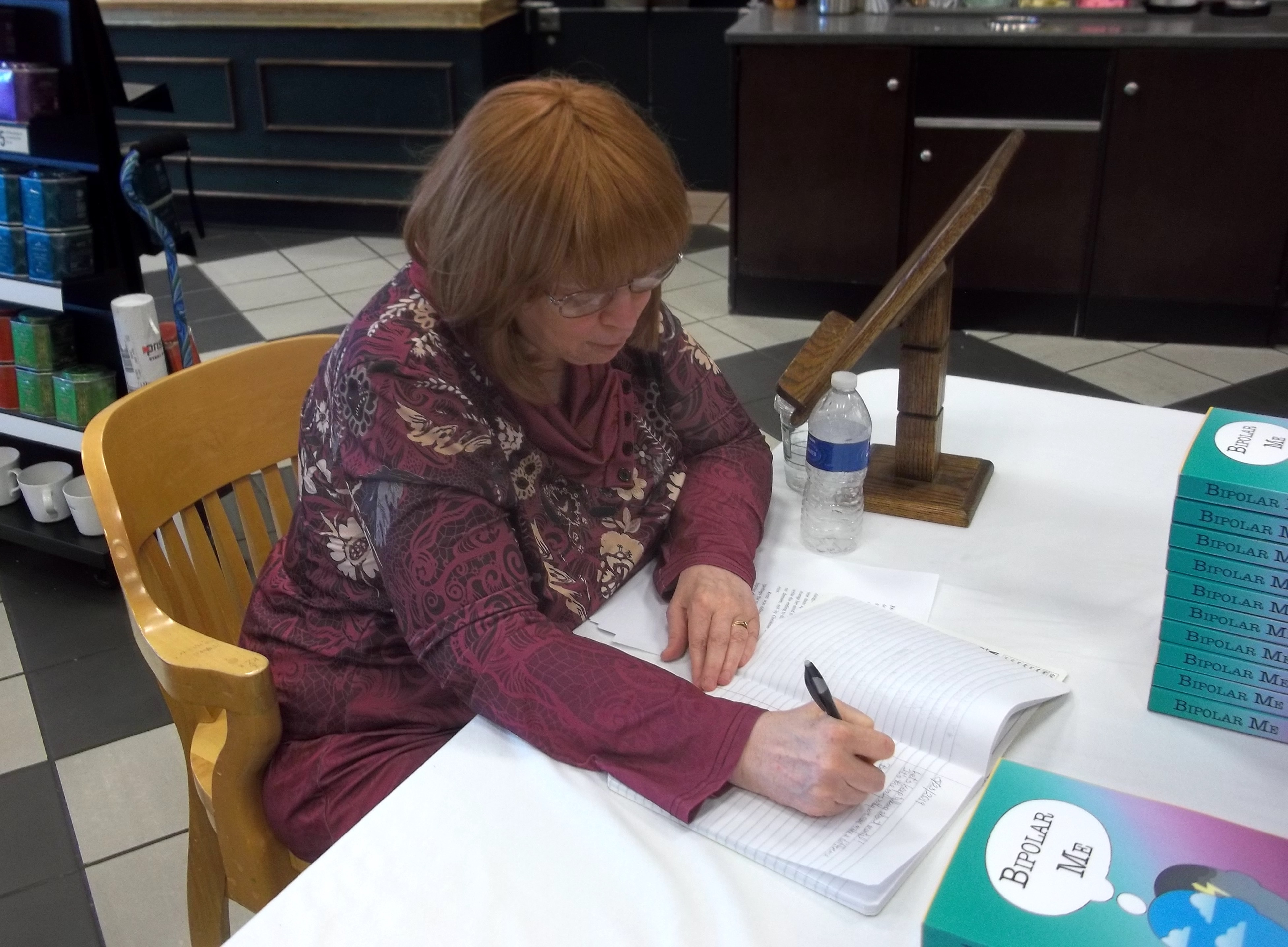
But that’s just what I did this week. My publisher arranged for me to do a reading and signing of my book at a local branch of a national bookstore. And I agreed to do it. Thursday night was my debut.

Let me go back a few steps. I do have some experience speaking in public, so it wasn’t going to be a completely novel experience. Those occasions were, shall we say, a bit distant in time, mostly before my bipolar disorder reached its heights (or depths). In high school, I did debate and extemporaneous speaking. In grad school, I taught introductory English classes. During my somewhat-less-than-successful business years, I once addressed a power breakfast meeting. I even opened with a joke.

I was prepared to open with a joke (or at least a witticism) this time, too. But my plans soon flew out the window.

I had prepared – or over-prepared, probably – somewhat obsessively. I spent spoons like they were disposable plastic. I picked out an outfit and a back-up outfit, including earrings and back-up earrings. I did my hair. I agonized over which pieces from my book to read, then printed them out in huge type so I wouldn’t have to squint at them. I took an anti-anxiety pill and Immodium, just in case. I was fortunate that Thursday was my day off and also my husband’s, so he could be present as my emotional support animal, wearing one of my book t-shirts.

My expectations, such as they were, took a nose-dive when only two people showed up – both friends of mine, one of whom had already bought my book. It was time to rearrange my plans on the spot, not really one of my strong suits. Why had I knocked myself out making plans if the universe wasn’t going to cooperate with them? I had thought that at least half a dozen people would turn up. I was trying to keep my expectations reasonable, after all.

I’ll admit that when I saw such a small audience, I felt a wave of despair. In actuality, it proved good that they were both friends of mine, because they were a receptive audience who wished me well.

Given the meager audience, though, I abandoned my introduction (though I worked my joke in later). These people already knew me. I gave a brief synopsis of “What is bipolar disorder?” and plunged into my readings.

I had tried out one of my readings previously, when I was on a podcast for indie authors. Of course, I had no eye contact with my audience then and no real idea how my performance went over. On Thursday, I explained Spoon Theory, as it came up in one of the pieces I was to read. I had chosen two of my more light-hearted pieces, though on serious topics (psychotropics and side effects, and cognitive dissonance). Then I finished with a reading of a piece on why I write about bipolar disorder and why I put myself out there to the extent that I do in this blog and my book, and indeed my public appearance.

The big surprise of the evening came when I invited a Q&A session. My husband fed me questions to get things started and my friends also had queries. What I hadn’t been expecting, however, was that a few people in the bookstore cafe where this all occurred got sucked into the discussion and had questions of their own, though they had no idea that the event was scheduled at all. One worked at a local university and had heard his students talking about having bipolar disorder. Another was a woman studying psychology in order to become a counselor. I didn’t always have the answers, and I’m sure I bobbled some of the explanations, but I did my best to come up with reasonable answers about treatments and medications, self-care, and so on.

Then came the signing portion of the evening. I signed a book for one of my friends and the counselor-in-training asked me to sign her notebook with any little inspirational words I might have. (I winged it. I was tired by then and am not usually inclined to be inspirational.)

Then my husband and one of my friends and I went out for milkshakes, which I highly recommend as a way to decompress after such a fraught experience.

All things considered, I’m glad I took the risk and gave it the old college try, as it were. If nothing else, it was good practice for the next time I speak in public, perhaps when my second book comes out.

The reason that I write about bipolar disorder and my experiences with it is that I want to share what I’ve learned and lived. I think I did that Thursday, even if not to the extent that I had hoped. I don’t regret the anxiety and the preparation that went into it and, all things considered, count it as a win. When I think about the melt-downs I could have had – before, during, and after – I feel pride that I kept my depression and anxiety at bay for long enough to share information about bipolar and healing and mental health.

I think it was worth putting myself out there.


Riding the Mania

This has been a couple of good weeks for me. Either that or I’ve been riding the wave of mania.

In the past, I’ve written about how fleeting the feeling of hypomania can be (https://wp.me/p4e9Hv-df). One pinprick and it bursts, leaving nothing but the air. Maybe that’s because I was hypomanic or rapid cycling at the time. Or maybe it was just a temporary feeling of joy that lasted only a few minutes and then retreated in the face of disappointment.

It’s difficult trusting your feelings when you have a mood disorder. I always have to ask myself, is this feeling a reaction to the real circumstances that surround me, or is it just a glitch that occurs between my synapses? It’s tiring questioning all your emotions all the time.

I’ve been stable for many months now. I’m not symptom-free. I still find it difficult to do daily tasks or leave the house, though lately, I have gotten up, groomed, dressed, and out of the house – including a record of three or four times in one week, rather than once or twice a month. But I have been feeling what feels like genuine happiness.  Contentment. Energy. Productivity. Engagement. Can I trust this?

Since over-thinking is one of my superpowers, let’s take a closer look. Do I have any of the symptoms of mania or hypomania to go with my lightened moods? Hypersexuality? No. Racing thoughts? No. Risk-taking behaviors? No.

But I have been overspending. Maybe. Our finances have improved of late, so there’s no real harm in buying a few things that I’ve been putting off. And my purchases have not been excessive – nothing over $30, and that was a birthday present for my husband. Still, I have been beset by the feeling, right before I hit checkout, “I shouldn’t be doing this,” or “I don’t really need that.” Again, my feelings are questionable. Maybe my purchases are influenced by hypomania and the stable part of my brain is warning me. On the other hand, the purchases may be modest and reasonable, and my questioning a holdover of “shoulds” and “shouldn’ts” from when our budget had no room at all for discretionary spending.

Then there’s my writing. I’ve written a couple of extra essays and guest blog posts in addition to my regular two blogs per week. I’m getting them done early, too. Once I even decided a post I was working on wasn’t very good, so I wrote a new one to take its place in a single day. I renamed and redesigned my other blog (newly christened “But I Digress…,” available at http://www.butidigress.blog). But is what I’m writing any good? It’s hard to tell. My stats on blog readership haven’t been as good as usual, but the editors were happy with the guest posts I wrote. The rewritten post was selected for special treatment on Medium.

It’s been observed that I could over-analyze a ham sandwich. But I am tired of examining every mood and emotion to be sure it isn’t pathological. Having unstable emotions is not a pleasant thing to live with, but neither is this level of self-doubt.

I saw my psychiatrist last weekend and he thought there were plenty of good things happening in my life – my published books (htpps:bit.ly/3xQk6Dj) and (https:bit.ly/3xNuFqA), the extra writing, an upcoming podcast (https://wp.me/p4e9Hv-Pi), a science fiction convention to attend – to explain my good mood. If he isn’t worried, why should I be?

All in all, I’m very tempted to say, “what the hell,” and ride this wave until or unless it crashes.

What Does “Normal” Mean?

When I was young, I wanted like anything to be normal. I didn’t know what normal meant, but I knew I wasn’t it.

I had a lot of the trappings of what passed for normal in that day and age: parents still married, one sister, suburban house in a town with good schools, church down the street, same-age children living within a block, working father, stay-at-home mom, abundant books and toys, and vacations to visit the relatives.

But I knew. There was something different about me. Everyone else knew it too. I wasn’t normal. I was too sensitive, whatever that meant. I was precocious. I didn’t fit in and I didn’t know how to.

As I reached my tween and teen years, I encountered a dilemma. I desperately wanted to be normal. Normal kids had friends, got to hang out with each other, laughed and smiled a lot, wore what was in fashion. They gave off an aura of being normal. I longed for that. I was in love with the idea of normalcy.

But every time I tried, I failed. I was always too weird, too emotional, too smart, too something.

So I began to hate the idea of normalcy. If I didn’t fit in, then by God, I would scorn the idea of fitting in. I would embrace non-normalcy. I would hang with the few other misfits I could find. I would eschew the latest fashions and trends. I didn’t rebel, exactly. I was too timid for that (yet another too).

And I blamed the suburb and the Midwestern state where I lived. Maybe this kind of normal was bland, spiritless, and hum-drum. Maybe I was right not to want to be of it.

So, of course, I tried the geographical cure, going away to college, where I thought the people would be more like me, where there would be enough diversity that I could find others like me and finally fit in. Be normal within a different definition of normal.

And it worked, at least partially. But by that time it was too late for me to ever be normal.

What happened was that bipolar disorder caught up with me. I had probably been struggling with it all the time I was a weird kid who didn’t fit in. Other kids threw rocks at me. My moods were extreme. I cried and laughed at things that were neither sad nor funny. Being betrayed by a friend sent me into a severe meltdown.

By the time I was in college, there was no doubt that I was struggling with a mood disorder, although we didn’t have that term for it at the time. At the time it seemed like major depression and for the most part, it was, or at least that was the only mood I could identify.

Years later, when I got a proper diagnosis and the right medication, it was easier to look back and see my bipolar tendencies slowly building over the years. But I’ll admit something – I still both love and hate the idea of normalcy. I still want to fit in and I’ve found a few groups where I seem to. But I also want to embrace my oddness, celebrate my differences, glory in my assorted varieties of geekiness.

I never want to go back to that lost, lonely, spinning-out-of-control kid who was always too much or not enough. My lifestyle helps since I don’t have to try to fit in at a nine-to-five office job. My husband helps, as I was at least normal enough to find one. And my writing helps, so I can work out some of my conflicting emotions and bipolar moods through this blog and other venues.

Here’s another reason to hope: Matt Norris, a blogger at The Thinking Orc, recently wrote:

Disapproving of people who aren’t “Normal” went from a virtue to vice within my lifetime. The shift in public morals changed the rules on what it took to be seen as a good person. It used to be about not doing anything weird, and looking down on anybody who did. Now it’s about not doing anything cruel, and looking down on anyone who does.

Besides, to quote songwriter Steve Goodman, “I may not be normal, but nobody is.” I know that now. So in that sense, I do at last fit in.

I Hate My Job, But I Don’t Hate My Life

The other day I found myself thinking, “I hate my job. I hate my life.” But then I stopped. The truth was that I do hate my job, but I don’t hate my life.

There have been times when the two thoughts absolutely went together. I well remember getting up in the morning and thinking, “Now I have to go to the bad place where they make me unhappy.” Unfortunately, the thought would color my whole day. Instead of unwinding after a rotten day – or a whole series of them – I brooded about what came before and dreaded what would come the next day. I was caught in a loop of bad thoughts and they wouldn’t let me go, or enjoy, or relax. My life seemed to stretch out into an unending series of more of the same.

Of course, that was when I was deep in bipolar depression, improperly medicated, and unaware of self-care. Oh, the job was indeed pretty terrible. I was an editor, a writer, and a proofreader, tasks and occupations I normally enjoy. There’s something wonderful about taking something mediocre and making it good, or even taking something bad and making it better. Once or twice I even got compliments on the job I was doing.

But at that time, when I hated it, the job was a misery. A reorganization had put the editorial department under the marketing department, which had been true in fact for a long time but was now formally acknowledged, with a resulting new chain of command. Anything I wrote was essentially a puff piece for some advertiser. Three senior editors were fighting over my time and attention, each determined that I should work on their project first and foremost.

I wasn’t quite ready for a major breakdown, but I was close. I hated both my job and my life.

Now I have a tedious and basically unfulfilling job. I transcribe audios of boring business meetings and lawyer consultations, relieved only by the occasional podcast. On top of that, I’m a really crappy typist, so it takes me hours to do a job that others could zoom through. Add in foreign accents and mumblers, and you get a job that brings me no joy, but only a modest paycheck.

But for some reason it also suits me. I work four days a week, at home in my pajamas. No one is looking over my shoulder. If I make my deadlines (and I do), I can expect fairly steady work, except during the holiday season. I earn enough to supplement my social security without going over their limit on extra income.

I also have medications that stabilize me and a much better knowledge of self-care. Working at home for only one boss is part of that. So is taking meal breaks whenever I want them and spending that time with my husband. Eating nutritious meals. Letting myself say, “I hate it! I hate it!” after a particularly trying assignment. Reading a book before I go to bed. Snuggling with the kitties. Allowing all these things to seep beneath my skin and feed my soul.

I don’t belong to the regular-massage-and-decadent-chocolates school of self-care. Maybe I’m a simple soul, but I prefer the everyday comforts that make my life not a misery and help me appreciate what I can of my situation. Not that I’ve got anything against either massages or chocolate. But to me, they are special indulgences rather than a part of my daily self-care.

In the end, medication and self-care are what keep me going, hating my job, but not my life.