Bipolar 2 From Inside and Out

Posts tagged ‘mental illness’

Cheerleading or Celebrating?

I was prejudiced. I admit it. When I was in high school, I believed that all cheerleaders fit the stereotype – “buoyant and busty and just plain dumb,” as the singing group Uncle Bonsai put it in “Cheerleaders on Drugs.”

I still don’t really understand cheerleading, especially on the scale of professional sports. But I know some good people who have participated in cheerleading and cheer coaching, so I’m willing to give them the benefit of the doubt.

But that’s not what I wanted to write about today. I want to discuss the kind of cheerleaders that offer support to those of us with bipolar disorder.

I suppose traditional-style cheerleaders are supposed to give encouragement before a thing is done. But I prefer ones who cheer after something, no matter how small, is accomplished.

That is to say, I prefer cheerleaders who say, “You did it!” to those who say, “You can do it!” (This is another YMMV post. This is just my own experience. Your mileage may vary.)

Cheerleaders-before-the-event are common in mental health circles. “Smile! You can do it!” “Do volunteer work! Give it a try!” “Get out there and meet new people! You’ll feel better!” “Get some fresh air and exercise! It’s easy!” But the fact is, no, I can’t always do it or give it a try. No, it’s not easy, and I don’t feel better.

It’s good to know that someone believes in you, but to me, cheerleaders set me up for failure. If I can’t manage to smile or exercise or whatever, I have disappointed not just myself, but the person who thought that I could do it, whatever “it” is. Remember the Little Engine That Could? It was thinking, “I think I can,” not “Someone else thinks I can.” What does that someone else really know about how severe my symptoms are today or whether my meds are having their desired effect or how many spoons I have?

I prefer cheerleaders-after-the-fact – those who join me in celebrating victories, no matter how small or insignificant they may seem to others. “Hurray! You paid a bill today!” “Congratulations! You phoned your mother!” “Good job! You took a shower!” “Go you! You put on pants three days this week!”

These are accomplishments – things you actually did, not things that you might or might not do. They’re tiny victories, maybe, and you don’t see memes that encourage you to do them. To neurotypical people, they wouldn’t be accomplishments at all, just normal functions of everyday living. It’s too easy to picture cheerleaders-before-the-fact saying these things half-heartedly or sarcastically. “Oh, great. You fed the dog. Woo-hoo.”

I don’t want cheerleaders so much as celebrators, people who can join me in acknowledging that it is a victory to write my blog post, or even to make notes for it. Or even, some days, to get out of bed.

I don’t expect someone to follow me around all day applauding every little thing I do. But on days when I feel useless and unproductive, like a failure or a slug, I do like having someone remind me that I do make progress, that my struggles have value, that – as a friend of mine said – not fucking things up worse is at least half a win.

I’ll take half a win when I can get it. And a pat on the back whether I smile and get out and make new friends, or simply make it to my doctor’s appointment.

That doesn’t make me a glass-half-full person. It just means I’m grateful that the glass isn’t completely empty.



Bipolar and Growing Older

I was a bipolar child. I was a bipolar college student. I was a bipolar adult. And now that I am about to be able to get the senior discount card, I am a bipolar – what? – mature adult.

First, let me say that aging sucks. Except that the alternative sucks more. The problem is, I can’t always tell whether anything that happens to me is due to my bipolar disorder or due to aging. I fear that, since my bipolar is fairly well in check at the moment, what are left of my problems may be due to something else.

My hands shake, for example. This has been true for years, though. The neurologist called it “essential tremor,” which I think means it just happens and they don’t know why. But some medications have made the tremor worse, and one of the medications I’m taking now could be increasing the shaking. And the shaking gets worse when I have anxiety. So I think we can chalk that one up to bipolar disorder, mostly.

I forget words. Sometimes, when I’m talking, I forget the word that comes next and have to pause or talk around it until it comes back to me. Sometimes my husband fills in the blank, which is helpful, but really annoying. For a writer, losing words is scary, but the memory difficulties seem to happen more when I talk than when I write.

I know I’ve had memory lapses before that can be attributed to my medication, and those memories are gone forever. I’ve written about that phenomenon: http://wp.me/p4e9Hv-6k. But these seem to be single words that escape me, and that I can usually get back within a few seconds. It doesn’t feel like anything I’ve had associated with bipolar, so I suppose this one is aging. If it’s the onset of Alzheimer’s, I’m going to be so pissed.

I isolate. This I’m pretty sure is bipolar in nature, since I’ve been doing it for years, especially when I’m depressed. I’m also reasonably sure that I am getting less isolated as my bipolar disorder has eased. I still don’t get out much, though I did go to a fabulous (and large) party last Sunday. But I am active on Facebook and Messenger, and I write these blogs, and I talk on the phone.

On the other hand, I seldom leave the house, and that I think is an effect of aging. I have mobility and balance problems because of a bad back and some nerve damage in one foot. But bipolar is involved, since weight gain from medications also affects my mobility, and an aversion to crowds and noise is likely associated with my anxiety.

Side effects of bipolar disorder and bipolar medications are to be expected. So, for that matter, are side effects of aging. Teasing out which is which may seem futile, and perhaps it is. I just want to know which I have some degree of control over and whether some, especially the cognitive symptoms, are likely to fade, stay the same, or get worse.

Self-Care and Human Needs

Self-care is one of the hot topics these days in the world of bipolar disorder and the people who live with it. Self-care can be as basic as remembering to eat or as complicated as knowing and avoiding your triggers.

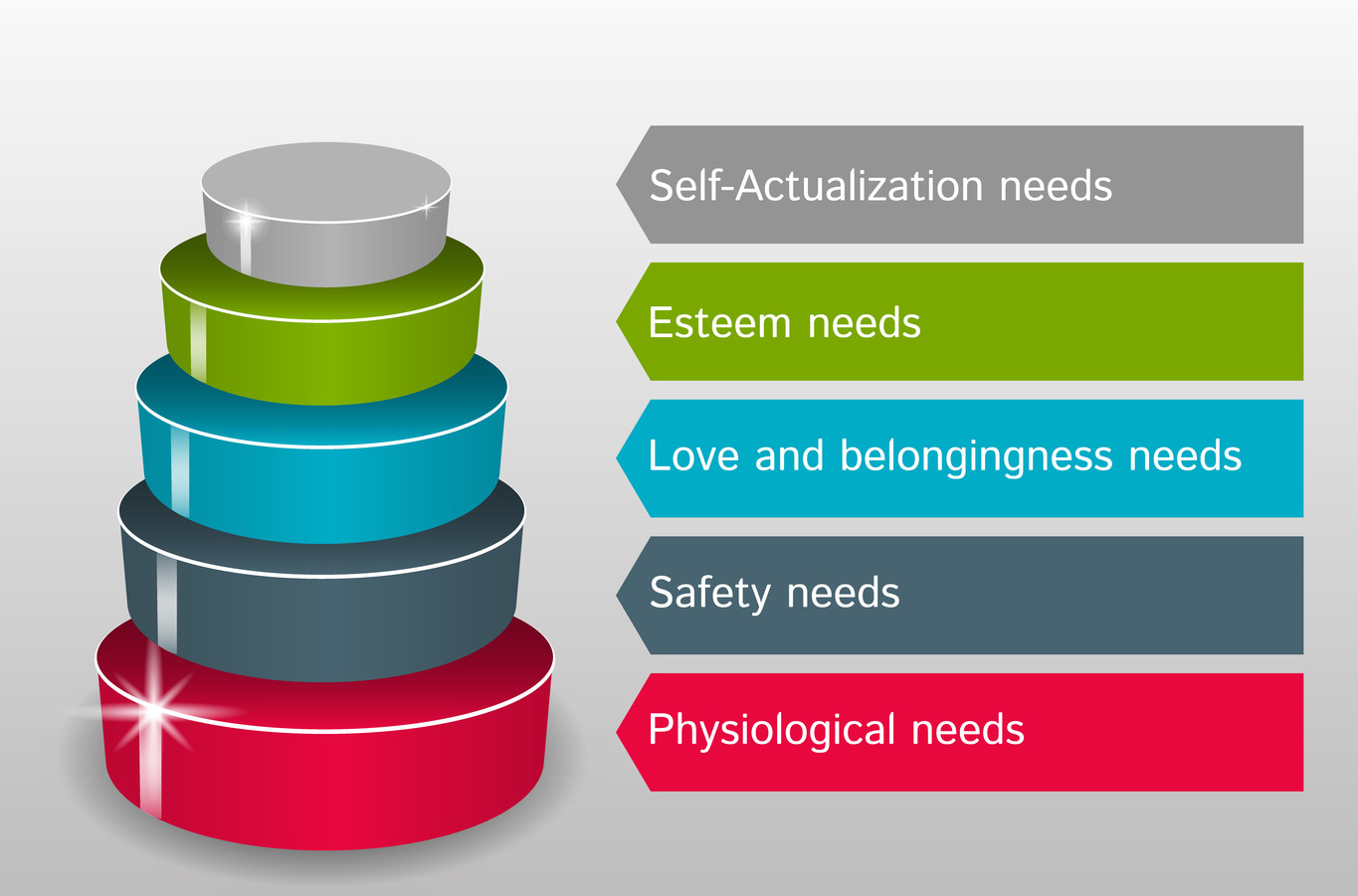
Back in 1943, psychologist Abraham Maslow created what he called a “hierarchy of needs” – a series of stages that human beings must go through on the way to the ultimate goal of “self-actualization.” With few changes, the concept, usually illustrated as a pyramid, has continued to influence the study of human motivation and developmental psychology.

So what does self-care have to do with the hierarchy of needs?

The most basic needs of human life form the base of the pyramid. These are called “physiological needs” and are essentially what a person needs to stay alive: air, water, food, shelter, sleep, clothing. Without meeting these needs, a person cannot move up to the next level of the hierarchy.

A large part of self-care is devoted to meeting these very basic, fundamental needs. Air is usually not a problem but shelter and clothing can be, for those bipolar persons who are homeless – and there are more than a few. Many of us are just one financial reverse – loss of income, insurance, options – from being homeless.

The most common advice for self-care is to pay attention to these base-level needs: Remember to eat. Stay hydrated. Get enough sleep. At times, it’s a real struggle just to meet these self-care needs. Add “get exercise” to the list and it can suddenly be overwhelming. People with bipolar or major depressive disorder often need help accomplishing them. That’s as high as we get on the pyramid.

The second step of the pyramid, which people need to work on after they’ve met the requirements of the first step is called “safety needs”: personal security, employment, resources, and health. Again, the needs on this step may seem insurmountable, and may – probably will – require help to achieve.

But they are self-care needs too. Current society may not view them as such, but that’s because they tend not to struggle with them, at least not on the level of a person with a mental disorder. Individuals can sometimes help meet these needs, but more often government, community, or charitable organizations provide necessary help. Talking about self-care at this second level may seem like pie-in-the-sky to those who have not yet conquered the first. But truly, taking care of these needs is a form of self-care, enabling one to maintain the gains represented by achieving those of the first level.

The third level of human needs – and self-care – is called “love and belonging”: friendship, intimacy, family, sense of connectedness. Again, this is not usually thought of as a part of self-care. But it certainly is. Many of us – I include myself – lose friends, become estranged from family, fail at intimate relationships. There are other places to look for ways to practice self-care on this level, however.

Therapy groups and self-help groups can lead you to people who share your problems and may be able to help you in achieving self-care. (My husband met one of his dearest friends, who provided support, listening, understanding, and companionship, at a self-help group meeting.) If in-person meetings are not possible, social media such as Facebook, Twitter, and WordPress provide opportunities to meet some social self-care needs through various groups and online communities.

The top two levels of the pyramid are not as easy to think of as self-care, and not as easy to tackle. Level four is esteem: respect, self-esteem, status, recognition, strength, freedom. And five is self-actualization: to become the most that one can be. Realistically, these are not strictly speaking things that can be accomplished through self-care. Even neurotypical people may never complete step four, and there is reason to think that few people ever reach self-actualization. These are goals to strive for, but not guarantees.

Wherever you may currently be on the pyramid, the important thing to remember is that self-care will help you reach the next step; that each follows the one before; and that your bipolar life will improve with every step you achieve.


Depression, Mania, and Mystery

Writing a book takes a certain amount of mental stability. Also, you have to be a little crazy.

Despite the fact that in the popular imagination, creativity is linked with insanity, having a mental disorder is not all that conducive to productive work, particularly to the sort of sustained, focused writing that a book requires.

Still, bipolar, OCD, schizophrenic, and other writers have managed to write books – and some very good and highly acclaimed ones.

I have taken on that venture myself. I am writing a book.

Now, settle down. I am not (yet) asking you to buy this book. It is still only a book in process. Nothing has been published. Maybe nothing ever will be. Nevertheless, I persist.

Actually, I have two books in the works. One is out of my hands now. It is languishing at a publishing company, where it has languished for a year, waiting for them to determine if their interest in it will lead to actual publication. That book is a memoir of sorts, based on these blog posts. Unless I want to start pimping it to agents and other publishing companies, there is nothing more to do with it right now.

In the meantime, my attention has turned to the other book. It is a mystery, and has nothing to do with bipolar disorder. Except that the writing of it has everything to do with bipolar disorder.

First depression. Depression is great for writing certain types of scenes – deaths and reactions to them, for example, which are good for mysteries. Depression, however, periodically leads to the “this book is shitty” phenomenon, which I understand is not exclusive to depressive writers.

When depression leads me into that trap, I stop writing. Instead, I do “research.” If I am not too depressed to read, I delve into books about the craft of writing – plotting, description, etc. Or I study the works of writers that do things exceedingly well – dialogue, word choice, narrative voice. I highlight examples of good technique. Then, at some point the depression lifts and I try to put what I have learned into my manuscript. Of course this means lots of rewriting and revising, which slows my progress, but, I hope, makes the manuscript better.

Then there’s mania. Or at least hypomania, in my case. It carried me through the first eight chapters of the mystery before the depression hit. If it’s a truism that depression lies (it is and it does), mania is a liar as well. Recently I was tootling along at about 500 words per day, and it occurred to me that, at that pace, I could reasonably expect to have a rough draft by July 4, ready to send to my beta readers.

This was mania talking. Lying, rather. In fact, there was no way I could maintain the pace, meager though it was, of 500 words per day and not a chance in hell that I could meet the self-imposed deadline.

What came next? More depression, of course. More research, this time into how various authors use dialogue tags. And a confusing attempt to improve the pacing by scrambling the order of the chapters.

Until writing mania sets in again, I plug away at scenes I know need to be written, even if I don’t know where they go, and keep my eyes and ears open for both the depressive lies and the manic ones. I have over 45,000 words written and refuse to abandon them now.

So I don’t know all that much about whether bipolar disorder is a help or a hindrance to creativity (I would suspect it is both), but I do know that it is possible to work around it.

Eventually, if I’m lucky and persistent, I’ll ask you to buy my books. Someday.

What I Learned About Ketamine and Depression

Trigger Warning – Meds

Note that I’m not a doctor or a pharmacist or any kind of medical personnel. Do not consider this post to be advice on what you should do. If the subject interests you, ask a licensed physician for more information.

What did I know about ketamine before I started doing some research?

Not much.

I knew that as a street and “club” drug it was known as “Special K.”

Then I heard that it was being used for treatment-resistant depression. Here’s what I found.

First, you can’t just go down to Brown Street and buy a few pills. That’s illegal. And what you get may include other substances that you didn’t intend to take.

So, you need a prescription for it. Once you get that prescription, usually after a consult with a psychiatrist, you need to find a treatment center that will administer the drug. Clinic operators may be anesthesiologists, as ketamine is primarily used as an anesthetic.

The treatment is delivered via IV or injections. No simple pills to take. It’s a course of treatments, each lasting 45 minutes to an hour, with a rest of an hour afterward. The treatment may be delivered for as many as six doses over the course of 12 days. (There may also be a nasal spray option, but the IV version seems more typical.)

You have to have someone who can drive you. The possible side effects include confusion and blurry vision. You can’t drive for 24 hours after the treatment, which basically means you can’t drive for two weeks, since the treatments are roughly every other day.

They don’t know how it works. I don’t find this surprising, since every time I’ve asked my psychiatrist how a medication works, I’ve been told, “They don’t really know, blah blah blah, neurotransmitters, blah blah blah, serotonin, blah blah blah.”

It’s expensive. The initial treatment may cost $500–$1,000, and a full course of treatments may cost as much as $3,800, which insurance won’t cover. These are estimated costs, based on treatment in various regions of the country. (The wholesale cost is approximately $.32 per dose, by the way.)

The results don’t last. They give relief for as little as a few hours to as much as nine months, after which a $600 booster shot is required.

You may still need regular antidepressants and psychotherapy. Ketamine may get you “over the hump” until your regular antidepressant kicks in, but is not a stand-alone treatment.

There are side effects. Confusion, hallucinations, and high blood pressure are among them, along with something called “lucid daydreaming.”

More research is needed. Duh.

The FDA has also approved trials of MDMA (Ecstasy) for treating PTSD. It is also being researched for effects on OCD, depression, and other conditions.

So, assuming that I could afford it, would I try ketamine? There’s not one easy answer to that.

Back in the days when my depression was drug-resistant, when I had spent years trying different combinations of psychotropics, when I was considering electroshock, I might well have seen ketamine as something to consider before I took that step. It should be noted that, at the time, my psychiatrist did not recommend or even mention it, so it might not have been appropriate for me whether I wanted to try it or not. And anyway, a combination of meds and therapy finally kicked in and made the subject moot.

Nowadays, I would not try ketamine (or MDMA, for that matter). My bipolar depression has moved from drug-resistant to drug-alleviated, at least for the most part. And that “most part” is enough for me. I have no need to be driven 45 minutes to the nearest clinic or to try to find a psychiatrist and anesthesiologist willing to go off-label. I am satisfied as I am.

As always, Your Mileage May Vary.

Sources

http://www.webmd.com/depression/news/20140923/ketamine-depression#1

http://www.ketaminetherapy.com/Depression.html

Intranasal Ketamine Infusion

https://psychcentral.com/blog/archives/2012/12/01/should-you-try-ketamine-for-depression/

https://en.wikipedia.org/wiki/Ketamine

http://www.webmd.com/depression/news/20161130/fda-ecstasy-ptsd-treatment#1

Why I Didn’t Get Depressed When I Got a F**k Off Letter

Brenda was a friend to my husband and me for many long years. We partied with her, and talked with her, and grieved with her and supported her when her marriage ended.

I became closer to her than Dan had, although he had met her first. Then we grew apart. Then I heard that she had given up on me. I wrote, asking for one more chance.

Recently, she sent me a three-page letter. When a mutual friend asked what it said, I replied, “Basically, ‘fuck off.'”

I’ve written before about the friends I’ve lost due to my bipolar disorder (http://wp.me/p4e9Hv-2W) – the pain and loss I sometimes still feel, my unsuccessful attempts to apologize or rebuild the relationships, the continuing rejection, the knowledge that those important people are gone from my life forever.

But this time, the rejection didn’t seem to bother me as much.

Why? I wondered.

I know that people sometimes do drift apart, and there was an element of that in the death of the relationship.

I knew that I had refused many invitations and stood her up many times. But apparently, when I did show up, I brought along an extra person, “my misery.” It seems like a trap: don’t accept an invitation, or be unwelcome when I do because of my constant companion, which I was unable to just leave at home. In those days, and sometimes still, the Black Dog was always with me. But Brenda saw it as something she couldn’t compete with, something that was always more important to me than she was.

In a sense that was true, though I didn’t see it as a competition. It wasn’t like I valued my disorder more than I valued her. Feeling miserable was important to me, in the sense that it seemed ever-present, but it was important to me in a bad way – the thing that dragged me down, the thing I fought against, the thing that did make my life a misery. But it was a misery I could not put down, much as I wanted to, even for people I cared about. At the depth of my depression, it was simply a part of me. I am sometimes amazed that I came through it with any friends left. But I have.

To be fair, Brenda also blamed her own misery after her divorce as a contributing factor to our parting. Then there would be four of us present – two people and two miseries – and evidently it was too much.

Most perplexing to me, though, was Brenda’s contention that her growing religious fervor and burgeoning political conservatism contributed to her decision to cut ties. I freely admit to being a liberal and to disliking organized religion, but I have friends who feel otherwise and yet remain my friends. There’s lots we agree to disagree on or simply choose not to talk about. Even my mother and I had profound differences but never gave up on each other.

According to Brenda, her religious and political leanings required “personal responsibility” – including responsibility for one’s moods. As she put it, despite her reactive depression, her happiness was a choice. One that she made and I didn’t.

She compared mental illness with high blood pressure and diabetes – conditions that one must take personal responsibility for treating and trying to control. The fact is, I was trying to control my disorder, with therapy, with medication, and once almost with electroshock. I know she knew this, as once we went to the same therapist.

And that’s why I said, “eh” when I got the letter. By Brenda’s own criteria I was doing my best. And that’s all anyone can do. I couldn’t go back and change my misery, or try harder to find relief. And I couldn’t simply choose to be happy, which I don’t believe is possible for most people like me. If you can manage it, more power to you, and to Brenda.

I think what bothered me most about the letter is that Brenda has a degree in psychology and is teaching psychology in college now. I wonder what her students are learning from her.


Caregivers Need Care Too

While there are professional caregivers, family members often provide care and support for those with bipolar disorder and other mental illnesses.

My husband of 35 years is my caregiver. He does a spectacular job – making sure I have my meds, taking me to my appointments, running the errands that I have no spoons to do, keeping the house quiet when I need to sleep, making sure I eat at least one nutritious meal a day.

It’s a lot. And there are things I can give him in return. Things he needs.

Appreciation. When my father was dying of cancer, my mother was his primary caregiver. One day she came to me, wanting me to tell her that she was doing a good job. She knew that she was. She just needed to hear it from someone else, someone who could tell her that her excellent care had been noticed and appreciated.

Appreciation – validation – is the thing that caregivers need most, to replenish themselves, to allow them to keep doing the things that are so vital for their charges. And it’s the easiest to give. When you’re in the depths of depression, it may be difficult to remember to say “thank you,” but it means a lot to your caregiver.

Now I’m mostly out of my depression (usually), and I say “thank you” a dozen times a day. And he always responds, “You’re welcome, friend.”

Alone time. Primary caregiving can be a full-time job. I know that one thing I need in the process of healing is alone time. Dan needs it too. He needs time off, even if that’s just time to retreat to his study and watch a movie or go outside and dig in the garden. I can always reach him if I really need him – for example, if I have a panic attack – via cell phone if nothing else. But, as the saying goes, you can’t pour from an empty vessel. That’s part of the reason that he’s able to give me so much of what I need.

Couples time. This doesn’t necessarily mean sex. It means time spent together, doing something other than dealing with mood swings and trauma. It’s a little gift we give each other. Sometimes I sit through a movie I don’t really care for, just to give him the gift of snuggling on the couch. He got me color-and-bake ceramic mugs that are great for creativity and distraction. One rainy afternoon we sat together and each colored one side of the mugs.

Life stuff. Dan does most of the chores and tasks of daily living, but I do what I’m able to. I earn money. I pay bills online and do most of the other computing, except what he does for leisure. I help with cooking to the extent I can – sous-chefing, finding recipes, breading or mixing or inventing dressings and sauces, making grocery lists. He can ask me for help too.

Sharing my spoons. When I do find myself with a few spare spoons – a little extra energy occasionally – I try not to be selfish with it. When I have spoons to spend, I like to shower and dress and go out for lunch. But the other day, I showered and dressed and went for a walk in the woods with Dan, something he’s been longing for. My spoons ran out pretty rapidly, but he appreciated that I made the effort and shared one of his delights. It was another gift that cost no money.

In other words, when you have a caregiver, don’t think it’s all one way. Your caregiver needs care too. Small or large, what you are able to give will be appreciated.


I Don’t Care If They Discover the Cause of Bipolar

Recently there have been several so-called “breakthroughs” in discovering the cause of bipolar disorder.

And I really don’t care.

Whatever they decide the cause is, I still have bipolar disorder. No matter if it’s toxoplasmosis, gut bacteria, or faulty synapses that are behind it, I still get to experience the lows and (sometimes) highs, the apathy and psychological pain, the weeping and despair, the irritability and touchiness, the anxiety and the gloom.

Knowing the cause will not alleviate my symptoms one bit.

I know that people believe that discovering the cause will bring us that much closer to a cure.

But will it really?

If the cause is genetic, how am I supposed to go back and change my genes? Or does anyone really believe that gene therapy will be available to the mentally ill when even hospital beds are denied them?

If the cause is viral, does that mean that a cure is right around the corner? We now know what virus causes AIDS – HIV was discovered in 1983 – but nearly 35 years later, a cure is still far away. Yes, there are treatments that improve health and extend life, but there are also treatments that alleviate some of the symptoms of bipolar disorder. Will any advances be orders of magnitude greater, or merely incremental? And how much money will be devoted to finding those treatments when Huntington’s disease, multiple sclerosis, and a host of other conditions are still without a cause, a cure, or sometimes even minimal treatments?

With most bipolar sufferers being treated (if at all) in community mental health centers, via EAPs, or through six-weeks-and-out insurance programs, what are the odds that any new breakthroughs and any new treatments that result will be available to the bipolar-on-the-street (or in the group home or even at home or at work)? Will someone really arrange MRIs or TMS or brain implants for the homeless?

With bipolar disorder once again considered a pre-existing condition and not given parity with physical ailments for insurance purposes, will any advances trickle down to us at all?

What do you want to bet that any breakthroughs regarding the causes of bipolar disorder will lead to more pharmaceutical research and yet another pill that costs more than the average person can pay or the average insurance will reimburse? And how long will that treatment take to get through the FDA pipeline to reach the people who need it?

Nor is knowing the cause of a disorder necessary to cure it. Isaac Semmelweis didn’t need to know the cause of childbed fever, a disease that killed thousands – perhaps millions – of new mothers. Germ theory wasn’t even developed until decades later by Lister and Pasteur. But Semmelweis knew that if only doctors washed their hands between conducting autopsies and putting their hands in pregnant women’s vaginas, the death rate would decrease.

So when I hear that there’s a new theory on the cause of bipolar disorder – and they seem to be coming with increasing frequency – I say, “Where’s the treatment? Where’s the cure? Who will be able to access it? Who will be able to afford it? When will it produce positive results for me and those like me?”

Get back to me when you’ve found something that will help. Until then, keep splicing your genes and culturing your bacteria and stimulating your synapses. I’m getting pretty good results with what you’ve already discovered. For now.

Don’t keep raising my hopes until you have something more than “mights” and “some days.”


Surprise!

Surprise parties are fun for everyone, right?

Wrong!

While many people enjoy the surprise element (probably the guests do more than the honoree), even neurotypical people can shy away from the practice. Coming home to a darkened house, only to be greeted by bright lights and loud noise, can be an alarming experience.

For a person with bipolar depression, autism spectrum disorder, PTSD, or other mental conditions, it can be a nightmare.

My husband once decided to throw me a small surprise party. We and another couple were cleaning up an old house while a few friends gathered back at home.

One of the people had actively discouraged Dan from having the party. Robert had experienced depression and Dissociative Identity Disorder (DID), and knew how difficult such an event would be for him. He also knew about my depression and some of the incidents associated with birthday parties in my mind.

For instance, when I was a young teen, my “best friend” and I were supervising a party of younger children. During the game of Pin-the-Tail-on-the-Donkey, while I was blindfolded, she kicked me in the ass. Literally. In front of all the kids.

It was the occasion of my first major meltdown. For years afterward, I would not even admit to having a birthday, much less let anyone celebrate it.

Robert had experienced similar traumas involving groups of children, humiliation, and abuse. He was not able to cope with surprise parties and thought I might freak out as well.

Fortunately, decades had gone by since my traumatic party experience. I had been diagnosed and properly medicated and counseled about my issues. Dan knew me well enough to realize that I could tolerate a small, low-key surprise party. And so I did.

Still, Robert was right to be concerned.

Common events at surprise parties are triggers for many people. My friend Joanie has panic attacks when there’s lightning. Would flash photography set her off? I don’t know, but I don’t want to be the one who finds out. If the party is held in a restaurant, a person who hates being singled out in a crowd of strangers may have problems. People hiding in one’s home could cause flashbacks of a home invasion. My startle reflex is hypersensitive and could easily be triggered by sudden, unexpected shouts of “Happy birthday!”

Even opening presents in front of others can be difficult if one is weak in social skills, appropriate facial expressions, or spontaneous conversation.

So how do you give a surprise party for someone with certain types of mental illness?

Don’t.

If you think you must, ask the person what kind of party he or she would prefer, and abide by those wishes. You can suggest a surprise party, with the time and place being the surprises, but again, abide by the person’s wishes.

Prepare a small, low-key surprise rather than a party. Give a present a day or two before the actual date. Pack a slice of cake in the person’s lunch. Or take the person out to lunch. (Warn the restaurant personnel not to march around singing and waving balloons, if you mention that it’s a birthday lunch at all.)

Do not have party games, unless they are non-threatening ones such as mad-libs or trivia. Forget ones involving physical contact like Twister or ones that involve sensory deprivation like Blind Man’s Bluff.

You may wish to avoid serving alcohol, especially if the honoree is on anti-anxiety medications. Booze-fueled parties tend to become loud and rowdy.

Make it short. Personally, spending an hour with a group of four or more, even if they are all my friends, is about all I can take. And then I want a lie-down afterward.

Personally, I could live my life happily without ever having another surprise party thrown for me (even though the one Dan threw would have to be called a success). Nor will I be upset if I never get invited to another surprise party. I’ll be too busy worrying what it might be doing to the honoree to enjoy myself.


Don’t Tell Me Not to Feel the Way I Feel

“Don’t be sad/angry/upset.”

“Calm down.”

“Smile. It’ll make you feel better.”

“Stop getting all revved up.”

Never in the history of ever has any communication of this sort had the desired effect on a person – especially one with bipolar disorder.

When you offer this sort of “advice,” what you are basically doing is telling the person not to feel the way they feel. Not only is this useless, it’s insulting.

It’s useless because ordering someone to feel a certain way simply won’t work. Saying, “Be cheerful” will not make it so. Emotions aren’t like flipping a switch on command. Even for neurotypical people, emotions are complex interactions of chemicals in the brain. While some people claim – or may perhaps be able to – shift their emotional state at will (from angry to merely annoyed or to neutral), it isn’t easy or natural. There’s a reason that you feel the way you do.

For the person with bipolar disorder, it’s even more difficult – if not impossible – to shift moods at a whim, especially someone else’s. Bipolar is a mood disorder. It affects moods and emotions in a nonstandard, often unpredictable way. Telling someone to alter their own brain chemistry merely by thinking about it is ludicrous.

Even if the bipolar person’s moods or feelings seem exaggerated or uncalled-for to you, that person is having an experience no different than when you feel elated or despairing or fearful. The emotions may even be more profound, less susceptible to alteration by force of will.

But telling bipolar people not to feel the way they feel is not just pointless, it is insulting. You are denying their perception of reality, invalidating their experience, dismissing their concerns, minimizing their problems, discounting their feelings. In effect, you are saying, “I don’t feel the same way, so your feelings are wrong. Change them to match mine.”

Imagine that you have written something – a report, a poem, whatever – and feel good about it. You’ve made your point and done it well. You’ve captured reality as you see it and communicated it in a way you think is clear and effective. Then someone comes along and reads it and says, “This is crap.” They have denied what you feel and believe. And even if they’re right, even if it is crap, they have profoundly insulted you. And, of course, they may be wrong.

Diagnosed bipolar people already know that their emotions do not run the same as other people’s. There’s no need to remind them of that. And bipolar people are generally doing what they can to alleviate their symptoms, be it through therapy, medication, mindfulness, meditation, or whatever works best for them. When you discount their feelings you are discounting them as persons. That can be anywhere from annoying to soul-damaging.

Adam Savage, of Mythbusters fame, sometimes wears a t-shirt that says, “I Reject Your Reality and Substitute My Own.” He is (I hope) talking about substituting a provable, scientific reality for a mythical, uninformed one.

But to go around substituting your own emotional reality for other people’s – and trying to make them agree with you – does a disservice to the people you think you are trying to help.

So, what would be better than saying, “Don’t feel ________”?

How about, “I know you feel _________ and I can see why.”

Or “I can tell you’re feeling _______. How can I help you?”

In other words, start by acknowledging that the other person’s feelings are real. Then ask what the person needs. This lets the person know that you understand his or her feelings and that you would like to help in the way that the person thinks best.

If you know other things that have worked in the past, you could suggest them (after validating the feelings, of course). Would you like me to run a hot bath? Do you need a hug? Do you just need time alone? Do you want to talk about it? Maybe later?

It occurs to me that this is not really news to a bipolar person. The ones who need to read it are the ones who are doing the invalidating, not the ones who feel invalidated.

So, if you know someone like that – a friend or loved one, feel free to copy this post and give or send it to them, if you think it will help. I know it helped me when I figured out what was going on and what my husband and I could do about it.