Bipolar 2 From Inside and Out

Posts tagged ‘mental illness’

Bipolar Travel Tips

photo by Dan Reily

Last week I blogged about “Running Away From Home” (aka the geographical cure) https://wp.me/p4e9Hv-F9. This week I want to talk about actual travel – for business or pleasure. Travel was one of my greatest joys and one of the things I’ve missed most since bipolar stole so many parts of my life. I am delighted to be able to say that I am beginning to reclaim it.

I know that many people aren’t able to travel at all because of their bipolar disorder, but for those who can, here are some tips to make it easier.

The basic thing to remember while traveling is this: self-care. You may find it hard to do while on the road, but it is essential to keeping yourself functional. Just give yourself permission to do the things you have to do. And find ways to avoid the things that trigger you.

Business Travel

Business travel is the most difficult, and something I’m no longer able to do at all. Oh, I can drive an hour for a half-day training session, but I want to be back in my own house and bed when it’s over with. But the kind I used to do – four to seven days, with coworkers (sometimes in shared hotel rooms), and especially with booth duty – are simply beyond me. There’s no time or space for self-care.

If you must travel on business, however, I recommend bringing along a comfort object (https://wp.me/p4e9wS-k9) such as a small plush animal, a favorite pillow, or toiletries that have a soothing scent like lavender. Fuzzy slippers may have to do as a comfort object if you have to share a room. It’s also a good idea to bring along portable snacks such as nuts or raisins in your purse or briefcase, as regular meal schedules are often thrown off by meetings and other events.

“Me” time is hard to arrange, but do try. One trick that works for me is to find an unused function space and sit there with a pad of notepaper. Zone out. Then if anyone comes looking for you, claim you were just consolidating your notes.

Visiting Relatives

Avoiding arguments is one of the particular challenges of visiting relatives – particularly in-laws.

On one of the first visits I made to my in-laws’ house, I noticed that they shouted a lot. When that happened, I would go into the kitchen and make myself a cup of tea. That’s a strategy I have often used. It’s also a grounding method I can use when things are spinning out of control. When everything around me is chaos, the simple, familiar, soothing action of heating a pan of soup or a teakettle can bring me closer to stability. Whether I really want soup or tea is not the question.

My husband noticed that I kept skipping out to the kitchen and asked why I kept making tea. “Because you’re all shouting at each other,” I replied.

“No, we’re not,” he said.

“Listen to yourselves.”

Just then an argument broke out over where to go to get some sandwiches. “You take the 422 to Souderton, then turn…” “Nah, you follow Cowpath Road then cut over to the 309. That’s shorter.” “But there’s more stoplights!” With each comment, the volume grew. Dan and I went out and got the sandwiches and when we got back, the family members were still arguing about the best way to go. Dan had to admit that I had a point. He just couldn’t hear it until I shifted his perspective.

Another technique you may find helpful when hit with nosy questions from relatives is the “Boring Baroque Response,” described here – https://wp.me/p4e9wS-cY.

Leisure Travel

My friend Robbin says that when you travel, the only things you really need to have in your carry-on are your meds and some clean underwear. Anything else you can buy when you get there if your luggage doesn’t manage to arrive when you do. It’s also good to talk to your pharmacist beforehand and make sure you have enough meds for the scheduled length of the trip. (Do not do what I did and take your entire supply of meds and then leave them at the bed-and-breakfast.)

Once I went to DisneyWorld https://wp.me/p4e9Hv-2K. (Okay, twice, but the first time was epic.) Surviving it was an exercise in self-care. The things I learned there are applicable to almost any travel situation.

It helps if you go with a person or people who understand your disorder and your needs. When you’ve exhausted yourself, it’s good to have someone who can think of options – “Of course, we can go back to the hotel now, if you want, or we could sit in this café and have a cold beverage while you rest your feet for a while.”

The point is, you don’t have to go on what a friend calls the Bataan Fun March – you don’t have to ride every ride, see every scenic overlook, visit every church or castle. Give yourself permission to take a nap or read a book or lounge around the pool, if that’s what you need to do. (If you’re on a guided tour and want to skip an event, let the tour guide know, so the head count doesn’t come out wrong after an event or stop.)

Finances tend to prevent the kind of leisure travel I used to do, but at least now if I can ever afford it, I can also survive it.

 

Running Away From Home

photo by Karen Cox

When I was a teenager, I lived in Ohio, and all I wanted to do was leave. The suburb I lived in was homogenous and boring. The surrounding area had little to interest me. I was miserable. When it came time to select a college, the first thing I ruled out was anything in the state of Ohio.

It did not occur to me then that the reason I was miserable was not the state of Ohio, but bipolar disorder. And of course I took that with me to college.

When I returned to Ohio and began living in a suburb very near the one I grew up in, my friends were astonished. “I thought you hated Ohio,” they said. “I never expected you’d come back here to live.”

What I had been seeking was a “geographical cure” for a problem I didn’t know I had. I thought could outdistance it, outrun it, make a new life for myself somewhere better.

Believe me, it’s not possible; unless you are trying to leave an abusive relationship, moving somewhere else will do nothing for your underlying problem. Probably not even then.

The next time I had a chance to take the geographical cure – to move to Pennsylvania – I turned it down. I had by that time built up a support system in Ohio of family, friends, and doctors, and I couldn’t bear the thought of leaving them and trying to build a new support system in an unfamiliar place. (Eventually, my husband-to-be moved from Pennsylvania to Ohio, where we’ve lived ever since.)

But there are still times when I think about running away from this life. Often, I wish the Mothership would arrive and take me away to some interesting planet or galaxy.

But sometimes, when life just seems to be too much for me, I think of simplifying my life by starting over somewhere. It would be like being in the Witness Protection Plan, I always imagine. I’d live in a small, unimposing town somewhere. I would have a bookstore (maybe used books). I would live in a small apartment over the shop with one or two cats.

But alas, that wouldn’t work. Aside from the difficulties of moving, which I loathe, I would find myself in another place where I had no support system – no doctor to prescribe meds, no therapist to continue my progress with (I hate breaking in new doctors), no family or friends or husband. (I usually picture myself on my own, except for the cats.)

And life would be just as difficult, if on a smaller scale. I would still have days when I couldn’t get out of bed and open the store; weeks when I couldn’t bring myself to shower, driving away customers; times when the loneliness would become overwhelming. I would still have trouble with finances, health, isolation, shopping, business, et endless cetera. At least I would have a lot of books to read.

I would still have bipolar disorder. I might be able to replace some of what I would have to give up; it wouldn’t be easy or freeing. But sometimes I still like to imagine that it would be.

If my husband dies before I do, I may find myself in some form of such a solitary life and have to adjust to it, though I would most likely remain in my comfortable suburb, where I know a few people and have some great friends, and a psychiatrist and a therapist. I doubt I would again attempt a geographical cure unless forced by circumstances to relocate.

But I wouldn’t enjoy it, just as I wouldn’t really if I ran away from home now. The bipolar would just come with me, hopping into my suitcase before I even packed my underwear.

On Pain and/or Suffering

Recently, when I was reading Every Patient Tells a Story: Medical Mysteries and the Art of Diagnosis by Lisa Sanders, I came across this:

Eric Cassell, a physician who writes frequently about the moral dimensions of medicine, argues, in a now classic paper, that pain and suffering are very different. Pain, according to Cassell, is an affliction of the body. Suffering is an affliction of the self. Suffering, writes Cassell, is a specific state of distress that occurs when the intactness or integrity of the person is threatened or disrupted.

Later, when I was reading M Is for Malice, by Sue Grafton, I read this: “Pain was better than anxiety any day of the week and sweat was better than depression.”

The universe seemed to be telling me to focus my attention on pain and/or suffering.

Cassell (as quoted by Sanders), could have been (but probably wasn’t) talking about bipolar disorder when he defined suffering as “a specific state of distress that occurs when the intactness or integrity of the person is threatened or disrupted.” I certainly don’t feel intact or integrated while in the midst of a bipolar episode – either hypomanic or depressive. I suffer. My personhood is certainly threatened and disrupted.

It’s common to hear bipolar described this way: “I suffer from bipolar disorder.” I prefer to say “I live with bipolar disorder,” which I feel is more accurate. It’s always there, but I’m not always suffering. I live with it and it lives with me.

I think Cassell was wrong, though, about pain being a purely bodily sensation. I addressed the concept back in the early days of this blog. with a post called “Depression Hurts” (https://wp.me/p4e9Hv-6Z). In it I claimed that bipolar (or depression specifically) caused physical pain as well as emotional pain. I still maintain that one is as valid as the other and that they are virtually inseparable. The mind and the body not being entirely separate, or separable, you see. You get both for the price of one.

Grafton, on the other hand, through her character Kinsey Millhone, was talking about the physical act of running. We all know by now (or should) that exercise is recommended for those who have bipolar disorder or other mental/emotional conditions. But again, there is this idea that physical discomforts (pain and sweat) are better than emotional distress (anxiety and depression). She seems to be saying that pain is the antidote for suffering.

This can be dangerous territory. As someone who used to self-harm, I can easily see how one might think that pain is preferable to anxiety, or numbness, or dissociation – to suffering, that is. But in such cases, pain is really just another aspect of suffering, expressed in bodily terms. Again, the two are inextricably intertwined.

Personally, I would be delighted to avoid all four sensations – pain, anxiety, sweat, and depression. But I don’t think that’s possible, even with avoiding both exercise and self-harm. Sweat is the easiest to dispense with, thanks to modern toiletries, but there have been plenty of times when my anxiety has caused me to sweat. Think about being summoned to a tax audit, for instance, and you’ll see what I mean. Pain is unavoidable; no one goes through life without stepping on a nail or some such. Anxiety and depression occur at least occasionally in the neurotypical as well as the mentally disordered.

The human condition itself involves feeling both pain and suffering. Bipolar disorder involves both pain and suffering. Well, what do you know? We’re only human, after all.

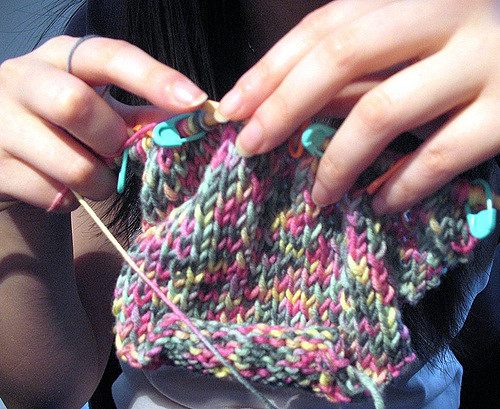
Knitting Away Depression and Anxiety

Photo by Athena, Creative Commons

Last week I dissed a story that I read online about self-care for bipolar disorder, which consisted of praise for sleep, pets, and creativity, things which anyone with bipolar already knows are good for their mental health.

It was pointed out to me by someone who should know that I was wrong to make fun of the researchers, since they were students learning valuable lessons about how to conduct research studies in the first place. Which led me to believe that it was all the reporter’s fault for presenting their results as news.

Anyway, as an apology to researchers and grad students everywhere, I’m now going to praise a research study that would otherwise get a “well, duh” from me.

Huffington Post (UK) shared the good news:

Knitting could save the NHS [National Health Service] vital funds because it leads to a healthier population, reducing depression and anxiety, slowing the onset of dementia and distracting from chronic pain, a new report has found.

The study was primarily focused on the benefits of knitting for the aging, but since depression and anxiety were two of the conditions that it reportedly relieves, I thought it might be relevant to bipolar disorder too. Now someone can do a study to confirm or deny this idea.

The report added that knitting “is a sociable activity that helps overcome isolation and loneliness, too often a feature of old age,” and, I might note, of mental illness.

There are many, many articles that extol the benefits of creative pursuits for those with bipolar disorder and other mental illnesses. Although the notion of “basket-weaving” is outmoded and stigmatizing, other creative activities are commonly suggested as part of self-care. (I discussed this in a post called “Tools for Tackling Bipolar Disorder.”)

Coloring seems to be the most popular recent trend, but drawing, painting, collages, and all sorts of needlework are well thought of too. (I would certainly put crocheting in the same category as knitting.)

But then there’s the other side of bipolar – mania. I don’t know a lot about creativity and mania because I only get hypomania. But I do know that when I’m hypomanic I can get a lot of writing done. (Whether it’s good writing is another question.)

However, if you’ll forgive anecdotal evidence, I once knew a woman who did experience full-blown mania as part of her disorder and was not well controlled on medication. One year at Christmas she decided to make green velvet dresses for all three of her daughters.

As she spoke of her progress over the ensuing weeks, however, it was clear that the project was not going well. She kept rethinking – and redoing – all the sewing. She didn’t like the design, or she didn’t think they’d fit right, or she saw some other flaw. She never finished the dresses.

Other people may have better experiences with mania and creativity, of course. I hope you’ll share with me if you have.

The idea of creativity as a way to be sociable intrigues me. Sewing circles are a time-honored tradition among neurotypical people as well as those with mental disorders. (A friend of mine and her cronies had what they called the “Stitch and Bitch Club.”) Needlepoint, quilting, and indeed all of the fabric arts can be group activities.

For those who aren’t into those kinds of needle-centric activities, there are classes in scrapbooking, drawing, painting, ceramics, sculpture, or other creative art forms, often available through local adult education programs, museums, or shops that sell arts and crafts supplies. And of course, writers’ groups abound at bookstores and other venues (though presenting one’s own work at such a gathering may be too daunting for some with self-esteem issues).

I should probably get involved with a writer’s group myself. I’ve had to give up needlework because of my eyesight and shaking hands. But I’m all for doing something for my brain. Lord knows, it needs all the help it can get.


References:

http://www.huffingtonpost.co.uk/entry/knitting-linked-to-health-benefits-including-reducing-depression-and-slowing-dementia-report-reveals_uk_5aa63cb0e4b07047bec7feee?ncid=tweetlnkukhpmg00000001

knitforpeace.org.uk

“Tools for Tackling Bipolar Disorder” https://wp.me/p4e9Hv-uT


Why I Hate TV Drug Commercials

Just as a general rule, I dislike commercials for any drugs. They impede the doctor/patient relationship. (I’ve often considered saying to my doctor, “I’m supposed to ask you if Latuda, Humira, Prolia, Viberzi, Lunesta, Cialis, Trulia, Trintellix, Keytruda, and Boniva are right for me.”) TV – and to a lesser extent print – ads encourage people to act as unpaid drug reps. And they only advertise expensive drugs until they go generic, which is when they stop being expensive and the drug companies stop making so much money.

(If you want to read more on the issue, go to https://www.medicinenet.com/script/main/art.asp?articlekey=106198.)

But there are other things about TV drug ads that make me more than a little cranky. Like where are the ads for drugs to treat bipolar disorder?

Oh, there are ads for drugs to treat bipolar depression, as well as ones for treating non-bipolar depression. You’d think that with approximately 2.8 million people who have bipolar in the U.S. and Canada (http://www.pendulum.org/bpfacts.html), there would be a market for bipolar treatments.

Also, the ads for depression treatments don’t always get it right. A few of them say that depression is more than just sadness, or that it lasts for several weeks at least. One even says that depression is a “tangle” of symptoms, which is certainly true. (Although the tangle is shown graphically in primary red, yellow, and blue, which don’t really say “depression” to me.)

Most, however, treat depression simplistically, with hidden depression represented by a smiley face mask hiding a frowny face mask. (The colors in that ad are muted during the “before” scenes and more vibrant during the “after” scenes, which is an old advertising trick.)

The ads also make it look like the most important thing about depression is not spending time with your family or not enjoying it if you do. While that certainly is one symptom of depression, it is by-and-large irrelevant to people like me, who don’t have 2.1 school-age children to take on picnics. And it’s pretty much a guilt trip for people who do.

Then there’s how the people in the ads are represented. Oh, they almost always show one POC and one slightly older person (frolicking with the grandkids). But all of them are attractive. All of them are models. Are we supposed to identify with them? Or just expect to look like them when our depression lifts?

I wouldn’t be so annoyed by this issue if it weren’t that ads for other kinds of drugs – those for psoriasis and diabetes, for example – have actual people with the disorder in them. Testimonials from those who’ve been there, as it were. Even real-life cancer patients are now featured in ads for treatment centers.

What’s up with that, I wonder? Surely they don’t imagine that only pretty people get depression or bipolar. It can’t be that they can’t find any well-spoken, real-life people who can relate their own experiences. I for one would feel more reassured if I heard about a treatment from someone who’s lived with the disorder instead of from someone selected at a casting call. Are we all homely and illiterate? (I meet the qualification for literacy, at any rate.)

Instead of trying to convince us what medications our doctors might prescribe us, the airtime would be better spent on ads that educated the public on depression and bipolar disorder. But those would be PSAs, of course, appear only at 3:00 a.m., and not make anyone any money.

Update: I have finally seen an ad for a drug to treat bipolar 1 mania. Everything else I wrote here remains the same.


“Lock Up the Crazies Before They Hurt Someone”

Mass shootings and the public reactions to them are pretty predictable among the mental illness community.

One thing you hear after every mass shooting – and after many smaller ones – is that the mentally ill should not have access to guns.

Fine. But I have bipolar disorder, as well as some guns that I inherited from my father. I occasionally go to a gun range and fire them, but not often since I’m not the gun aficionado my father was.

So what am I supposed to do? Sell the guns? Give them away? Turn them in to the police? My therapist? I was taught gun safety from a young age by two certified pistol and rifle instructors (my parents) long before I received my diagnosis.

The further you go into the debate about guns and the mentally ill, or about whether the mentally ill are a danger, the deeper you get into fundamental constitutional, legal, and medical issues, as well as considerations of simple practicality.

Some advocate locking up the mentally ill. This is irrational. What the proponents really mean is “Lock up the dangerous mentally ill before they become mass shooters.” And that is impossible.

First, there’s the matter of due process, which is as much a part of the Bill of Rights as the vaunted Second Amendment is. You can’t just lock people up without a trial or at least a hearing.

Second, there’s no way to determine whether a mentally ill person is likely to become a mass shooter or any other kind of danger. The only generally known predictor of violent behavior is past violent behavior. In fact, there’s no way to tell whether any given individual is going to become a mass shooter. That’s because it’s really hard to predict the future.

Third, there’s the consideration of medical decisions and the right to privacy. HIPPAA has gone a long way toward protecting the privacy of patients – including the mentally ill. At the moment, a mentally ill person can only be held for 72 hrs., and then only if the person goes to the hospital voluntarily or is determined to be a danger to self and others. That’s a high standard, and it should be.

Fourth, the mental health system is already understaffed, underfunded, and overwhelmed. There are long waiting lists for beds in hospitals and treatment facilities. Are we to build new asylums to accommodate all these supposedly dangerous persons? Train more counselors to treat them? Or just lock them up and get them out of sight, out of mind?

Fifth, the idea that mentally ill persons can be forced to accept treatment and take their medication as prescribed violates several basic rights. My mother, who was not mentally ill, hardly ever took her medications as prescribed. She would quit taking one after a few days “because it wasn’t helping” or “it caused sores in her mouth” – without telling her doctor. Should she have had a caregiver to monitor her compliance? Who would monitor all those potentially noncompliant mentally ill persons as they take their psychotropic drugs? I see, we’re back to putting them in asylums.

Besides, refusing treatment is a right that patients have – even mental patients. Physically ill patients, for example, can choose to forgo chemotherapy or dialysis or medications that cause side effects worse than the condition they’re prescribed for. And mental patients have the same right. They can stop taking a medication because they fear side effects like tardive dyskinesia or even weight gain, though we hope they consult their doctors first.

But forced treatment and forced medication, as some have suggested, brings us back to the question of who, how, and where. Asylums? Court-ordered treatment? Medications that must be taken in the presence of a doctor or a therapist (who is not qualified or licensed to dispense medication)?

Take all those arguments against forced treatment of the mentally ill and add the fact that the mentally ill are far more likely to be victims of violence than perpetrators of it, and where are we? Admittedly, the mental health “system” is broken, or at least badly fractured. But is the answer really to take away the civil rights of people who have broken no laws?

The press and the public are quick to focus on the mentally ill as the culprits in mass shootings. But even if they were correct, taking away fundamental rights would not only be no real solution, but would chip away at the rights of other disenfranchised or minority populations – the homeless, for example.

If there’s a solution to this problem, I don’t know it, but locking up the “crazies” isn’t it.


If you want to read more on both sides of the issue, see the L.A. Times article by Paloma Esquivel at http://www.latimes.com/local/la-me-adv-lauras-law-20140310-story.html.

Books About Bipolar and Other Fun Topics

I love reading. Always have – except for the period when a major depressive episode stole it from me –https://wp.me/p4e9Hv-qp. I’m never more than two feet away from a book or, at this point in my life, an ereader. Reading is how I explore the world.

So naturally, in trying to better understand my disorder, I read about it. And because I’m interested in psychology in general, in addition to books about bipolar disorder, I read about other mental illnesses as well.

Let me share some of my reading with you.

For sheer delight as well as profound insights, try Jenny Lawson’s Furiously Happy: A Funny Book About Horrible Things. Amid the hilarious stories of life in her other-than-typical family are insights into depression and social anxiety, along with a manifesto of defiance – the will to be, well, furiously happy.

The other easily approachable book is Allie Brosh’s Hyperbole and a Half: Unfortunate Situations, Flawed Coping Mechanisms, Mayhem, and Other Things That Happened. What started as a humorous blog grew into a book (with quirky illustrations) featuring two chapters in particular, “Adventures in Depression” and “Depression Part Two,” which are about as good as writing about depression gets. A second book, Solutions and Other Problems, was scheduled but has been postponed indefinitely.

And while we’re on the subject of funny books about mental illness, there’s Surviving Mental Illness Through Humor, an anthology edited by Jessica Azar and Alyson Herzig.

Perhaps the best-known book in the field of bipolar disorder is An Unquiet Mind: A Memoir of Moods and Madness, by Kay Redfield Jamison. In it, Jamison deals openly and honestly with bipolar disorder, particularly with mania and psychosis, along the road to becoming a doctor herself. She has also written Robert Lowell, Setting the River on Fire: A Study of Genius, Mania, and Character, about the famous modern poet, but I haven’t read it yet, so I can’t comment.

Birth of a New Brain: Healing from Postpartum Bipolar Disorder, by Dyane Harwood, is another recent book that I haven’t read yet, either. But I know Harwood’s writing and expect it to be a stand-out, as well as the only book I know of on that particular topic.

Other books on bipolar disorder include Lost Marbles: Insights into My Life with Depression & Bipolar by Natasha Tracy.

For books about depression, the definitive work is The Noonday Demon: An Atlas of Depression, by Andrew Solomon. A thorough examination of depression, including the author’s own, it is practically a reference book on the topic, though much less dry than that makes it sound.

Darkness Visible: A Memoir of Madness, by William Styron, is another classic on depression that I really ought to read, but haven’t yet because I’m not that fond of Styron’s writing. (Sophie’s Choice is his best-known work.)

For mania, I recommend Just Like Someone Without Mental Illness Only More So: A Memoir, by Mark Vonnegut, M.D. The son of Kurt Vonnegut, Jr., the author deals less with his celebrity father, instead focusing on his saving-the-world-style mania during his pursuit of an M.D. degree.

Other books that I can recommend include:

  • My Lobotomy, by Howard Dully, a memoir of a boy who was lobotomized for no particular reason other than the fact that his stepmother hated him, and the difficulties he encountered in and out of institutions.
  • Ten Days in a Mad-House, by Nellie Bly, early undercover journalism at its finest. (I wrote about her experiences in one of my earlier posts: https://wp.me/p4e9Hv-hG.)
  •  Shrinks: The Untold Story of Psychiatry, by Jeffrey A. Lieberman, a history of the development of the field from the buried memories days to the biological understanding of today.
  • The Man With the Electrified Brain: Adventures in Madness, by Simon Winchester (who also wrote The Professor and the Madman, about the making of the Oxford English Dictionary). Despite the title, this is not about electroshock treatment, but rather dissociative states.
  • Rebooting My Brain: How a Freak Aneurysm Reframed My Life, by Maria Ross; and My Life Deleted: A Memoir, by Scott Bolzan. These books, about a cerebral accident and amnesia, respectively, don’t speak directly to bipolar disorder, but I found them interesting as accounts of rebuilding one’s life after a significant mental condition.

And for an opposing point of view, if you must, there’s Anatomy of an Epidemic: Magic Bullets, Psychiatric Drugs, and the Astonishing Rise of Mental Illness in America, by Robert Whitaker. Once you’ve read the title, you pretty much know how the book’s going to go; I don’t recommend this anti-psychiatry screed.

What books do you recommend? Which have helped you?

Handling Hypomania and Shopping

I know it’s common when hypomania or mania hits for the bipolar person to go shopping.

The thing is, I hate shopping. Always have. Probably always will. I don’t like to shop for clothes or groceries or shoes. I don’t like to go out to stores.

Ah, but there’s always the Internet (I hear you say). You can shop without ever leaving your house, or for that matter your desk chair.

The problem is, I don’t have any money to spend on online shopping. And that’s one of the reasons I don’t have a credit card. It’s too easy to spend non-money.

What I do have are a debit card and a PayPal account. If there’s no more money on my debit card, too bad – I have to reload it (or more likely ask my husband to reload it). This requires taking money out of the bank account.

The PayPal account is where I usually get paid for the bit of writing and editing I do from home. I really should roll that money straight into the bank account.

But sometimes I don’t.

In fact, when the PayPal well is dry, it reverts to my backup payer – which is my bank account. It does this automatically. My husband never knows about it, since I’m the one who handles the online banking.

You see the problem here. I could shop to my heart’s content, and pay with PayPal/bank account as long as there was money available. Theoretically, I could bleed it dry.

Even with my meds working and all the progress I’ve made, I still get hypomania occasionally. I try to keep the shopping under control as well as I can.

There are several dresses in my closet that I never wear because I hardly ever go out, especially to places where a dress is necessary. I even have a party dress that I bought recently. It’s really becoming. But I never go to parties. I was just overwhelmed with the butterfly pattern and how cheap it was ($20).

But still, five dresses in two or three years isn’t bad, considering. (I once actually hyperventilated over a dress, and often do over amber jewelry.)

The real problems I have always had are books and music.

When I was still going out to malls and shopping centers and the like, the bookstores were always my downfall. My husband would take my arm and steer me past them, unless he was jonesing for a book too.

I’m trying to keep my online book-buying to a semi-reasonable level, too. I buy full-price books only when they’re absolutely essential – the last book Sue Grafton ever wrote, for example, which is not going to be discounted anytime soon.

For the rest of my ebook purchases, I subscribe to various newsletters that present me with cut-rate book choices every day. (Early Bird Books and Book Bub, for example). These books sell for $.99 (rarely), $1.99-$2.99 (usually), or $3.99 (occasionally). Once in a while I can even get a free classic – for instance, Tess of the D’Urbervilles or Ivanhoe (which I don’t recommend) or Journal of the Plague Year.

Back when I was going out, in the days when I did that, my other hypomanic shopping thrill was the used CD shop. I had a strategy for curbing my hypomania there, too, even though I didn’t know that hypomania was what I was feeling at the time. I would fill my little basket with everything that caught my eye.

Then I would weed. I made three piles – must haves, can pass on, and maybes. Then I would angst over the maybe pile, juggling price, artist, essential tunes, and the like until I had the piles down to something more manageable. Under budget or just a wee bit over. I can do the same with my online “cart.”

Again, this is a thing that could get me in trouble on the Internet, but since I have all those CDs and have loaded them all into iTunes, I seldom get the music shopping urge anymore.

So, yes, I do hypomanic shopping and no, I don’t let it break the bank. Just chip away at the edges.

Bipolar Me, Looking for Work

I have been very fortunate over the last few years in that I have been able to work and that, combined with my husband’s far-from-large – but steady – paycheck, we have been able to pay the bills. Now that seems to be changing.

After my last big emotional crash, I was unable to work at all, and after my husband’s major burnout, he was not able to work for a while. We ran through our IRAs and ended up in the situation where we are now.

I do writing, editing, and proofreading jobs from my home computer. It is really ideal, in that the projects usually come sporadically, with time in between them, so I seldom require more energy than I have available. I do not have to go out very much, or dress up very often and can work in my comfort zone, in my comfortable study, in my comfy pajamas. In these respects I am lucky or blessed, or however you wish to define it.

But clients have become a little thin on the ground lately. And I am afraid. I fear both a financial crash and an emotional one. The two are not unrelated. Finances and dealing with them were two of the largest triggers that started the major depression-plus-anxiety that swallowed me up for quite a few years.

Now I am feeling the pinch again. I felt it back in August, when my “proactive hypomania” helped me get through (https://wp.me/p4e9Hv-y4). But one can do that only so many times. Or at least I can’t summon the necessary mood at will. (Surprise, surprise.)

I have a writing project now, but it will run out in January. I have another client, but work from them is not as consistent as it used to be. We are already behind on some of our bills, including the mortgage.

So I am looking for more work, and it is scary.

The kind of work I’ve been doing is ideal, even when my symptoms increase. It lets me work around the deficits that bipolar heaps upon me. If I have a project due Monday, I can work during the weekend. If I have insomnia, I can work at night. If I am immobilized, I can usually schedule my deadlines so they don’t all hit at once.

I try to network, also at home from my computer, but that lets out job fairs and professional organizations and groups inhabited by people. I should put together a resume and sample packet and then try to figure out whom to send it to. Which is kind of like throwing spaghetti at the wall and seeing if any of it sticks. And the impressive kind of packet – slick, personalized, colorful, foil stamped, business-carded, sample-stuffed, stationeried – costs money to prepare, which of course is itself a problem since you have to spend it before you get results, if any.

So I have signed up with a number of sites that provide leads on jobs, and some of them don’t even want me to drive for Uber or move to Massachusetts.

Each time I apply, I ask myself, “Can I really do this job?”

Sometimes the answer is “Probably not, but I’m going to apply anyway.” Those are the 9-to-5 office jobs that would require me to upgrade my wardrobe just the teensiest little bit and try to keep the depressive phases under control if not totally under wraps. I have serious doubts about my ability to be “on” for eight hours a day, five days a week.

The Americans With Disabilities Act says that certain categories of people are entitled to “reasonable accommodations” in order to fulfill their job requirements. For someone like me, accommodations might include flextime, doing part of my work at home, time off for doctor appointments, and the like. If I got one of those jobs, I would have to reveal my mental disorder in order to receive accommodations, and I would have to decide whether to speak up about it before or after I got the job. Probably after.

The not-quite-as-frightening jobs are part-time ones, like working the circulation desk at the local library. They have their drawbacks too, including the same ones as full-time jobs, with less pay besides. Would it provide enough income to make a difference? Maybe not. Would I be able to do a part-time job and still squeeze in a little freelance work? I just don’t know. The idea is still daunting, to say the least.

(Another potential solution would be for my husband to get a better-paying job, but he is in the process of changing his meds, so that doesn’t seem likely either, at least for now.)

I know this seems like a better class of problem than many people with bipolar disorder have. Trying to keep up the mortgage payments is better than living under the Third St. bridge, fighting stray dogs for cold french fries. My husband’s job may be low-paying, but at least it’s steady and has a health insurance plan. I am truly grateful for these things.

And I am truly scared nonetheless. And tired. And sliding back down into depression.

Is My Pain as Real as Yours?

The other day I got a comment on a post I wrote a while back called “Who’s a Spoonie?” (https://wp.me/p4e9Hv-h6).

The commenter said that I was wrong to use the term “Spoonie” for those with mental illnesses. The kinds of disorders that merited the appellation “Spoonie” were only those that involved a “physical debilitating condition where pain and fatigue play major roles.” That I am not a Spoonie. That the language is not mine to use. That I am a part of the problem.

Let’s take a closer look at some of those assumptions.

Mental illness is not an invisible illness.

I wrote about that, in a post called “Is Bipolar Disorder an ‘Invisible Illness’?” (https://wp.me/p4e9Hv-gI). Disabled World (https://www.disabled-world.com/disability/types/invisible/) seems to think it is. Their definition specifically includes mental disorders:

These [mental] diseases can also be completely debilitating to the victim, and can make performing everyday tasks extremely difficult, if not impossible.

Bipolar disorder and depression are included in their partial list of “invisible illnesses.” And if you want to talk about “everyday tasks,” consider the number of bipolar and other sufferers who can’t get out of bed, can’t shower, can’t leave their homes, can’t work.

The condition must be physical.

To the best of our current knowledge, bipolar disorder and many other mental illnesses spring from glitches in the neurotransmitters in our brains. The brain, a physical organ. Neurotransmitters, a physical substance.

Pain and fatigue are required to play major roles.

Well, I’ve written about that too, in a post called “Depression Hurts” (https://wp.me/p4e9Hv-6Z).

My head and eyes hurt from all the crying spells. My back hurt from lying in bed all day. I had painful knotted muscles from the anxiety that went with the depression. I had intestinal cramps because my overactive nerves led to irritable bowel syndrome. I had headaches and eye strain from the over sensitivity to light and noise. And I had the general flu-like malaise that is practically the hallmark of depression. You know the one. Every bone and muscle aches, but you can’t think why.

Were these aches and pains psychogenic? Undoubtedly some of them were. But others, like the irritable bowel, were all too demonstrably physical phenomena.

Oh, and are they chronic? I’ve lived with them all for years. Not all at the same time, maybe, and not without times when the pain let up. But are all Spoonies required to be in constant pain and fatigue? Again, Disabled World says not.

The language is not mine to use. 

Sorry, but language doesn’t work that way. Once a word is released into the wild, it goes where it wills, acquiring new usages and new meaning. And “Spoonie” is certainly out in the wild. The essay that first defined it is all over the Internet. The suffix -holic has escaped from the word “alcoholic” and is now used for dissimilar ideas including “shopaholic” and “chocoholic.” Can we say, “No, you mustn’t do that. It must be reserved for alcohol addiction”? We might, but it’s not going to happen. Trust me on this. I have some training in linguistics.

I am part of the problem.

I suppose so, if you believe there’s actually a problem. In my post on Spoonies, I asked:

Isn’t that how Spoon language started – as a way to begin a conversation on what invisible illnesses are and how they affect our lives? Not a secret language that only those who know the password and handshake can use.

Obviously, opinions on the subject will vary, and mine is only one among many. I cordially dislike exclusionary language. Does anyone else want to weigh in?