Across the Spectra

Most often when “the spectrum” is mentioned, it’s the autism spectrum that springs to mind. There’s good reason for that. Autism affects varying people in varying ways and to various degrees.
But there are other conditions, disorders, and traits that vary across a spectrum as well: right brain/left brain, introvert/extrovert/, depressed/manic, and many others. The one I’m most familiar with, of course is the depressed/manic spectrum (or in my case depressed/hypomanic), but I’ve recently been reading about the other spectra I mentioned.
The first thing to know about spectra is that no one is fully at either end of the spectrum, or at least not all of the time. Think of a spectrum as the weight gauge on an old-fashioned scale at a doctor’s office. Most people’s weight tips the scale at somewhere other than the middle, and if they are all the way to one end or the other, the clinician moves the weight and starts over until the pointer rests in between the two extremes and the heavy weight falls somewhere between either end.
So, to use myself as an example (the one I’m most familiar with), when I am stable (properly medicated), I am close to the middle of the depressed/hypomanic spectrum, with the “weight” perhaps listing just a wee bit toward the depressed side. During depressive or hypomanic episodes, I slide toward one end or the other. No one is either all depressed or all hypomanic, though it feels like it at times, and people don’t stay at one end or the other all the time, except perhaps for the unmedicated person who has never had proper treatment and self-care.
Then consider the right-brain/left-brain scenario. When this theory was first proposed, it associated various traits with one or the other side of the brain. Type-A, energetic, risk-taking, mathematically oriented people were said to be left-brained, while shy, creative, language-loving, and risk-averse types were said to be “right-brained.”
This theory was extrapolated into the real world. Naturally, society at large was judged to be left-brained and that was deemed the better thing to be. These people got things done – businesspeople, politicians, scientists, and the like. Artists, writers, and other creative types were said to be right-brained, and not well adjusted to the left-brained society. There was even a book called Drawing on the Right Side of the Brain, which tried to harness that hemisphere in pursuit of artistic accomplishments and getting left-brained people in touch with their other “side” for a while.
Whenever I’ve taken one of those sided-ness tests, though, I almost always come out somewhere near the middle. What does this mean? I suppose either that my corpus callosum (which connects the two hemispheres) is particularly robust, or that I partake of both natures to some extent, more or less, and at different times. For example, I am mostly a stay-at-home reader and writer, but I am also a closet science geek, and like foreign travel, considered a risk-taking pursuit.
The same with introvert/extrovert (which seems to me to overlap considerably with right/left brainedness, and indeed with depressive/manic). I prefer to stay at home and pursue quiet activities like reading and writing, but I also enjoy going to science fiction conventions, which are known to be rather people-y. I can also tolerate moderate sized gatherings such as parties and book signings, as long as they aren’t filled with loud noise such as screaming children.
What I’m getting at here is that most scales are fairly useless and most people are somewhere in the middle of them, partake of both ends, and slide back and forth to some degree. I suppose there are people who are all one or the other, but I don’t know many and probably wouldn’t find them very interesting if there were.


 There’s nothing funny about bipolar disorder. In fact, one of the ways that I know I’m having a spell of bipolar depression is that my sense of humor flies out the window. Nothing brings a smile or a laugh – not my husband’s awful jokes. Not my friend Tom’s silly songs. Not a funny movie like Arsenic and Old Lace.
 I had a blog post all written and ready to go. It was about my fluctuating moods and my writing, and how they affected each other. Some of what I wrote is still true. The depression I suffered during my early years and the exceedingly depressive poetry I wrote during that time allowed me to learn something about how poetry works and something more about how depression works.

 Finding stability is difficult when you have bipolar disorder. The days seem to melt into one another, either life in dense fog or life on a tightrope. You can’t remember whether you’ve eaten that day or showered that week or when you need to pay that phone bill.

 Janet Coburn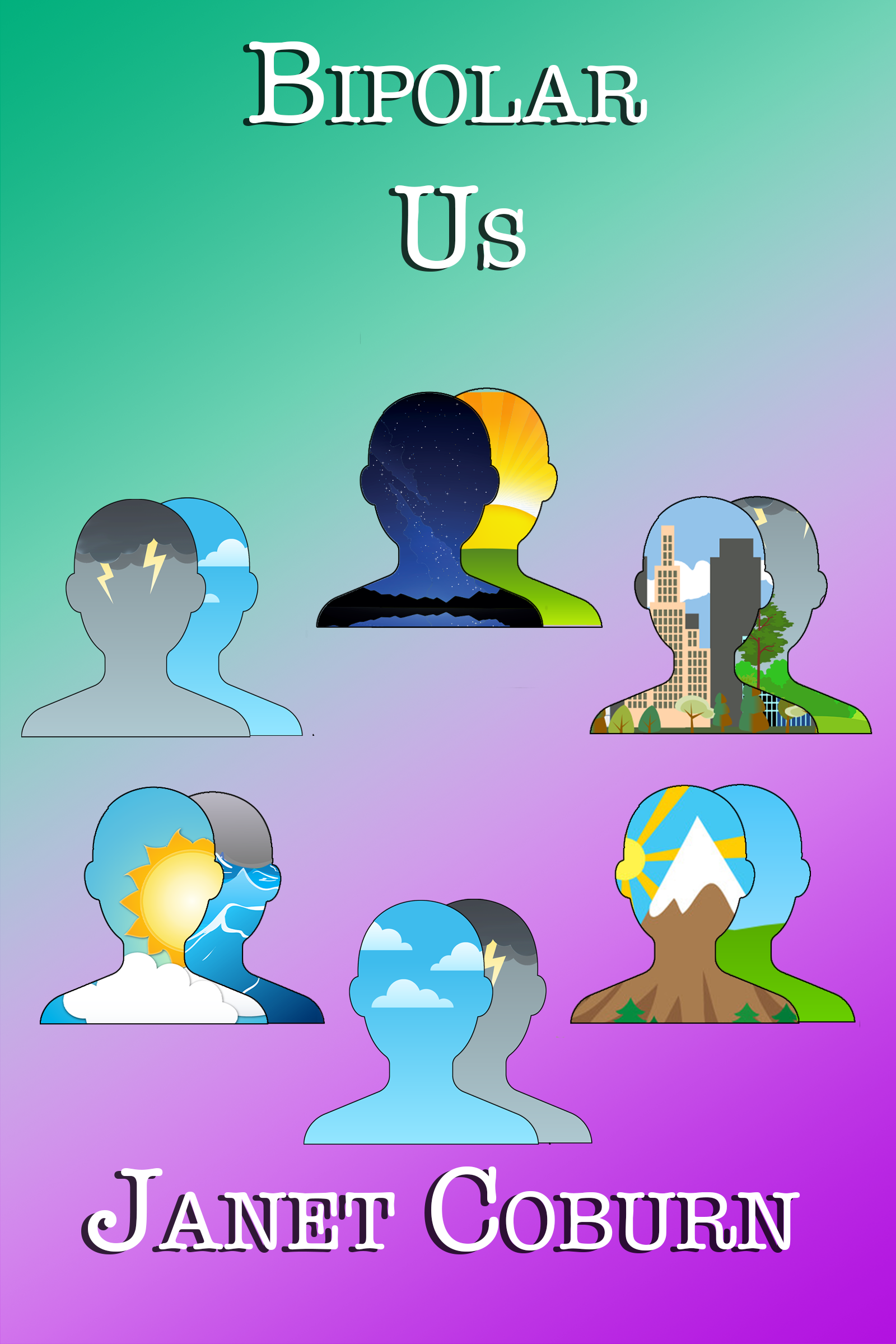

 Bipolar Me
Recent Comments