Bipolar 2 From Inside and Out

Posts tagged ‘mental health’

What Kids Should Learn About Mental Health

The stigma and the misinformation surrounding mental illness are staggering.

How many adults believe that depression is “just being sad”? That the weather can be “bipolar”? That you can call yourself OCD because you’re a little too organized? That suicide threats are never acted on? That mentally ill people are dangerous? That prayer, or sunshine, or positive thinking will cure all mental disorders?

We can’t do much about educating and informing the adult population that all those beliefs are false. But we can avoid raising another generation that buys in to these misconceptions – if we start now with mental health education in schools.

Whenever someone proposes this idea, there are common objections. You want kindergartners to learn about schizophrenia. You’ll have impressionable kids thinking they have every disorder you teach about. Discussing suicide will give teens ideas.

Again, those are misconceptions. Mental health education in schools could look like this:

In kindergarten and grades 1-2, part of the health curriculum should be a unit about understanding emotions and how to deal with them. This is already being done when teachers tell kids to “use your words” or “use your indoor voice.” But more could be done in the area of teaching children how they can keep from letting anger, sadness, frustration, and other emotions cause them difficulties. Yes, this may involve techniques that resemble meditation and yes, these may be controversial, but the outcomes will be beneficial.

I also think that young children ought to be taught about autism, though it’s not strictly speaking a mental illness. They will certainly meet autistic children in their classes at this age. Helping them understand the condition at their age level will, one can hope, lead to more inclusion and less bullying of kids who are “different.”

Older elementary children can learn about mental illness in their science or health classes. This should be a unit that covers the basic facts: that mental illness is like physical illness in some ways, that treatment is available, that mental or emotional disorders will affect one in four Americans in their lifetimes, and that mentally ill persons are not generally dangerous.

Middle schoolers can be taught some more specifics: the names and symptoms of some of the most common disorders, the kinds of treatments available, famous people who have succeeded in spite of mental disorders and ordinary people who live fulfilling lives despite them. Speakers from local mental health centers or the school guidance counselor would be helpful.

The topics of self-harm and suicide should be brought up at the middle school level. It is sad but true that children in the middle school age range are affected by both – if not directly, by knowing a classmate who is. And suicide is the third leading cause of death for children ages 10-14. Learning the facts may help students who need help find it before it is too late.

In high school, the focus can shift to human psychology; more detail about serious psychological conditions; and the possibility of careers in mental health treatment, nursing, or advocacy. Topics of self-harm and suicide should be covered in greater detail, with discussions of how suicide affects the families and loved ones of those who die by suicide, how to recognize possible signs that a person is thinking about suicide or self-harm, and what does and doesn’t work when a person shows those signs.

The details of mental health education in schools still need to be worked out. These suggestions come from my experience as a person with bipolar disorder, who began showing symptoms while I was a child. Organizations such as NAMI (National Alliance on Mental Illness) and NIMH (National Institute of Mental Health) provide resources that can help in understanding the need for mental health education among school-aged children.

Understanding mental health is as important for schoolchildren as understanding physical health. Why should one get all the attention and the other virtually none? Mental health education that begins early can help children and their families in ways that will resonate far into the future.

Most adults have little to no understanding of the realities of mental illness. It doesn’t have to be the same for the next generation.

When Your Therapist Tells You What to Do

The classic examples of non-directive therapists are Sigmund Freud and his disciples, who legendarily sat at the head of their couches and made comments like, “Hmm,” “Tell me about your dreams,” and “How do you feel about your mother?”

Freudian psychiatry is, thankfully, now out of vogue. But there are still therapists who believe that their job is to listen, not to instruct.

On the other hand, there are more directive therapists who assign homework. This can be anything from “Listen to this podcast on mindfulness” to “Write a letter to your ex telling him/her what you truly feel.” They probably won’t tell you to kick the bum to the curb, but if you decide to do so they’ll help you prepare for it.

But, although I am far from a Freudian and shy away from those who are (not many these days), I prefer non-directive therapists. I am not averse to doing a little homework or having a therapist ask me in a session to vocalize what I would like to tell a person or even to write a list of the coping mechanisms I’ve developed. My preferred dynamic, however, is to give-and-take with the therapist and then go home to contemplate what was said and how I feel about it.

I have had therapists who have given me homework and I can’t say they were wrong to do so. Sometimes writing something down or throwing teacups against the basement wall (or whatever helps you get your anger out) is a good thing.

My most recent therapist was a combination of the two. She mostly listened while I rambled on about what was happening in my life or what had happened in my past. Then she suggested ways that I could think about the events or pointed out coping mechanisms that I had developed or suggested ways I could put those coping mechanisms to use.

All in all, I felt that our sessions were mostly non-directive. She did suggest that I listen to a podcast on mindfulness, but she never quizzed me on whether I did and only listened when I told her what I got from it. She never told me that I should delve deeper into mindfulness or listen to more podcasts. She left that up to me, if I thought it might be helpful.

I understand that some therapists, particularly those that work in community mental health facilities, are required to file treatment plans and I can see where giving homework can flesh one out more than “talk about feelings.”

Perhaps there is something I’m missing. Perhaps at different stages of therapy, directive psychological interaction is more beneficial. Perhaps my particular problems lend themselves more to non-directive therapy. Perhaps I just have an aversion to being told what to do, especially where it concerns my memories and my feelings.

Of course, everyone has the option not to do the homework. This can be seen as resisting treatment, or disagreeing with the treatment approach, or simply lacking the wherewithal to carry it out. Sometimes it may be more helpful when the therapist sacrifices part of the session to doing the assignment there instead of leaving it to be done at home. In this case, the therapist is being really directive, though of course the client always has the choice not to do the assignment. It’s much harder, though, when the therapist is sitting there waiting for you to make a list of your dreams, your feelings, or your interactions with your mother, or to bash an empty chair with a pool noodle.

What it comes down to, basically, is therapeutic philosophy and therapeutic style. And a client is not bound to pursue whatever style of therapy that is favored. Although it is sometimes difficult to realize, a client has the option to request or to seek a therapist whose therapeutic style matches what the client feels is most helpful.

Remember, your therapist works for you, not the other way around. If you need a more or less directive therapist, it is your right to seek one out. Therapy has been known to stall and a different approach or philosophy may be just what you need.


Exhaustion as an Antidote for Panic

Wednesday afternoon my husband called his doctor complaining of chest pain and was instructed to go immediately to the ER. Actually, he had had the chest pain off and on for several days but he A) attributed it to Taco Bell, B) is good at denial, and C) is stubborn.

So off to the ER we went. We were tucked into Bay 22 and after a time, a nurse drew my husband’s blood. While we were waiting for results, we watched The Big Sleep on the room’s TV, possibly not the best choice at that particular time. We were there from 4:30 to 10:00, when they reported that Dan’s cardiac enzymes were a “little high.” I left shortly thereafter and Dan was admitted.

Although in the past ER visits with my parents caused massive anxiety which then caused a variety of physical symptoms, this time I did not panic. I was too exhausted. I even had a little trouble driving home. The streets in our plat seemed the wrong length or something and I wasn’t absolutely sure where to turn. When I got home I fed and watered the cats and then collapsed. Sleeping, not weeping.

The next morning I had to get up and finish a work project, then go to see Dan for a few hours, then back home to more work. Again, an early collapse. Still no panic.

Today (Friday) I am writing this post after finishing the work project and while waiting to hear that Dan’s angiogram is done so that I can go and see him. Again, I am not panicking. Numb, maybe, and tired, but not anxious.

I used to hate not knowing. Waiting for the proverbial other shoe to drop was torture. I am given to catastrophizing at the least provocation. But now, when there is an event that lends itself easily to catastrophizing I find I’m not. I have decided to postpone panicking until I truly have something to panic about.

At the moment Dan is fairly comfortable, in a very good hospital with attentive staff and even therapy dogs. There is nothing that I can do except visit him and call him.  I figure that when he calls with the results of the angio and info on whether they gave him a stent, I can panic then if required. Say, if he has to have bypass surgery.

But I’m disinclined to panic until or unless they tell me that’s the case.

And … I just got a phone call from his doctor. Dan had multiple artery blockages and required four stents, but no bypass surgery for now. I’m relieved, of course, but my main feeling is still one of exhaustion. Maybe I’ve been worrying in the back of my brain at a subconscious level and that has added to my exhaustion. Maybe when this is all over I’ll let loose and have a good cry, when he’s back home.

My friends have been sending me and him thoughts and prayers, hugs, light, and even good juju. They have also been reminding me to take care of myself, to remember to eat and sleep and I’ve been doing that at least on some kind of level. A bowl of cereal now, cheese sticks as a bedtime snack, a visit to the Waffle House when I’m too tired to make a meal. And eight hours of sleep a night. I can’t say the sleep has been dreamless or restful. I wake up still exhausted but at least my body is taken care of in a reasonable manner.

So there you have it. A potentially dire situation happened but I did not panic. Was it postponing the catastrophizing that helped? The exhaustion? I don’t know, but whatever coping mechanism it was, I’m glad it kicked in.

Dan has done so much for me through the years. I’m glad I will have an opportunity to pay him back even if only a fraction as much.

Inspiration and Mental Illness

high angle view of pencils on table

Photo by Pixabay on Pexels.com

I was manicky this week and it affected my blog writing. I had a post all ready to go this morning, but last night I thought about it and realized it was crap. It meandered, without focus. The ideas were confused. It sucked. So I got up this morning to write something different instead.

Many of you may recognize this aspect of mania or hypomania. You do something that you think is fantastic  while in the grip of mania and when you come down, you can’t see what you ever saw in it. Or you begin an ambitious project that you work on and work on but never can complete.

I was toying with the idea of “inspiration porn” – the sort of post or story or TV show that holds someone up as an ideal, usually because they’ve lost a bunch of weight and gotten themselves into shape, or have an illness or disability and managed to do – whatever – again. Think “The Biggest Loser.” Or amputees who’ve learned to eat with their feet. It’s put out there for entertainment and to make everyone feel good that whoever it is conquered whatever it was. It takes a regular person out of the context of their lives and reduces them to their condition. And the subtext is that if this brave person can become able to do or be whatever again, so can everyone else with the same problem.

It happened to a friend of mine who was at a gym on a treadmill. A woman came up to her and said how inspiring it was to see her working so hard to lose all that weight. “Excuse me?” was my friend’s reaction. She was doing it for herself, not for anyone else, and especially not to inspire some random stranger.

The thing is, there really isn’t any mental health inspiration porn. For one thing, it would make lousy TV. Oh, they’d get advertisers – all those purveyors of psychotropics that clog the airwaves. But who would watch a depressed person finally getting out of bed and taking a shower, unless she had a coach yelling at her?

Inspiration for those of us with mental health problems takes other forms. Celebrities who speak about their struggles with mental illness are one. They are inspiring because they break the taboo about talking about mental illness in public and because they have done so to help other people.

Then there are the superstars of mental health inspiration. Carrie Fisher, Glenn Close, and Jenny Lawson, to name a few. These are people who focus light on the difficulties and struggles of mental illness. Their communications don’t stop with the announcement that they have a condition and encouraging people to get treatment, though those are also good things. But the real inspirations are those who open their lives, take others with them through the journey of symptoms, treatments, relapses, small triumphs, and bigger successes. They speak and keep speaking and keep speaking their message. They don’t make the process sound easy, because it isn’t. And they speak with authenticity and authority because we know they’ve been there.

They do inspire us because they are honest and open, and they clearly care about helping others in the same proverbial boat.

We lost a true inspiration when we lost Mama Carrie. No one will ever really take her place. But you can tell that she was an inspiration by the many people whose life she touched and how they remember her. If someday they make a movie of her life, I hope it features not only her personal struggles, but all that she did for others. Her speaking and continuing to speak despite – or because – of her ongoing struggles.

We can carry on her work by doing the same, by shedding the stigma, by talking to others, even family and friends. Recently a friend “came out” to me that she takes an antidepressant and an anti-anxiety med (the same ones I take). I was proud of her, but I didn’t make a big deal of it. But I was impressed and pleased that she was able and willing to share even that much. She was saying that she was part of our tribe.

As Jenny Lawson reminds us, in this we are alone together. And that’s inspiring. 

Forgiving and Forgetting

man standing on riverbank

Photo by Pixabay on Pexels.com

Forgive and forget. That’s the saying.

To err is human; to forgive, divine. That’s another saying.

But what about when you can’t forget and can’t forgive? When you’re human, not divine?

Forgiveness is a tough subject for me, because there are things I can’t forget, despite the fact that either my bipolar disorder or my meds have made my memory spotty at best. But there are things I remember too well. And some of those I can’t forgive.

I can’t forgive the person who called my mother a murderer because she had her sick, ancient little dog euthanized. And then kept rubbing her face in it by saying she did not support my mother’s actions. This person caused my mother unnecessary pain when what she needed were understanding and comfort. By those criteria, I am a murderer too. A person that toxic is someone I don’t need in my life.

And maybe that’s wrong of me, but it was my decision.

Another person I can’t forget or forgive is my gaslighter, Rex, about whom I’ve written before (see https://wp.me/p4e9Hv-pm, https://wp.me/p4e9Hv-dR, https://wp.me/p4e9Hv-4t). In one of those posts I said, of forgiving and forgetting:

I can’t do either. The memories have faded over time and seldom give me flashbacks anymore. (The dreams still come.) As for forgiving? He’s never asked for it and never would. I’m sure he doesn’t think he did anything that needed forgiving….

That emotional abuse happened, and I can’t forget it. It was my first serious relationship and I left chunks of my soul and most of my barely existent self-esteem in that house on the hilltop. I had failed – at the relationship, at meeting my parents’ expectations, at so many things. I felt I was the one who needed forgiveness and spent much of the following years repeating incessantly, “I’m sorry.”

I once encountered a Christian who said that the essence of forgiveness was to “fore-give,” to give someone something before they ask for it, as in Jesus, fore-giving his life for His followers. Or giving a homeless person your coat before they ask for it.

I’ve since been told that that’s an inaccurate reading of the word “forgive.” But at the time it stuck with me and influenced my thinking. If that was forgiveness, I didn’t understand it and couldn’t accomplish it. Something to do with that “to forgive, divine” thing.

I couldn’t fore-give my mother’s pain. I surely wouldn’t have given it to her myself and I couldn’t fore-give that other person the right or the opportunity to do so.

I couldn’t fore-give Rex my pain. I gave him enough of my life – over a year – as well as some of my hopes and dreams and aspirations. And yes, at the time, my love.

I’ve thought about writing him a letter, the kind that therapists often suggest you write as an exercise in exploring your feelings, explaining what went on from my point of view. But I haven’t – not even the kind that you don’t mail.

It would be futile. I’ve written about the person and the pain here in these posts and it hasn’t done a thing toward making me forget or forgive. Far from forgetting, I sometimes need to remind myself of the pain – to affirm to myself that yes, it really was that awful and to warn myself never to get caught in a situation like that again.

I don’t go through my life holding grudges against everyone who has ever wronged me (or my mother). Everyday hurts – unless they come every day – are possible to let go of. I’ve mostly forgotten the kids who bullied me in school. And I’ve forgiven them. They were kids and didn’t know any better. I’ve forgiven friends who have cut me out of their lives because they couldn’t handle my bipolar symptoms. Sometimes I can’t handle the symptoms either. If I get fed up with my disorder, it’s easy to see how someone else could too.

I’m not going to give you any advice on forgiveness and whether you should forgive or not. The topic is too complex and I don’t know how or why you’ve been wronged.

All I’m going to say is to be a little easy on yourself if you find you can’t forgive what you can’t forget. Those sayings about forgiveness are guidelines, not laws, and your situation may not fit into those guidelines. Just know that I do understand.

Realistic Self-Care

woman in white long sleeved shirt holding white ceramic mug

I hate articles about self-care for mental illness such as the one I saw recently that said:

…[W]ays I practice self-care include swimming and Pilates, getting regular massages, spending time with friends and family, since staying connected is an essential part of emotional health at every age, watching TV, and seeing movies. I also love going for walks, especially near Santa Monica beach, and reading or listening to books.

If I could do all those things, I wouldn’t need self-care! When I’m depressed or anxious, I cannot make myself swim or exercise, or even get out of bed and shower at times, which lets out going to the movies and spending time with friends, too. I can maybe read a book or listen to a podcast if I’m not too twitchy and if my attention span and concentration will cooperate. And I can sit on the sofa and watch TV, but that feels like uselessness, not self-care.

Plus, guess what? A lot of those activities cost money.  Massages, movies, exercise classes (for which you need exercise clothes), and swimming (for which you need a swimsuit) would all require “shopping therapy,” which I loathe IRL and can’t afford online.

I personally would love a massage, but that’s not self-care for everyone. As Emily Roberts points out in “Self-Care for Mental Health: Find Ways That Work for You”:

The myth of a massage as an essential self-care activity – or anything that makes you more anxious – isn’t helpful for your mental health. I didn’t listen to my body the first time I booked a massage and guess what? It was so triggering to my body I couldn’t even finish it….I started to cry and couldn’t compose myself 10 minutes into the appointment. I was embarrassed and confused. I thought, “This stuff works for all the people in the magazines. What is wrong with me?”

I decided that booking an extra appointment with my therapist and having a date with my best friend was more helpful as self-care for my mental health than pushing myself to practice self-care in the way the media was telling me to.

One person’s mani-pedi can be another’s nightmare. I much prefer small ideas for self-care rather than big expeditions or splurges. For me, comfort food is one form of self-care. It has to be something I can make easily, though, like frozen mashed potatoes, mac-n-cheese, or French bread pizzas. (The microwave is my friend.)

Of course, these comforts require a little planning when I’m not overwhelmed to the point that I need self-care to restore me. I must think ahead, during those times when I’m able to go to the store, to bring home the foods that are easy to make yet soothing.

Another self-care technique I came across is definitely more my speed. Caiti Gearsbeck, in “Make Your Own Mental Health Self Care Kit” offers a simple, DIY alternative. She recommends filling a shoebox or other box with soothing things that appeal to all five senses, plus a few activities. Here are a few of her examples:

Sight: photos, cards, and letters

Smell: essential oils or candles

Taste: chocolate or tea

Sound: meditation CD or an mp3 player with a playlist

Touch: soft cloth or stuffed animal, stress ball or fidget cube

Activities: coloring books and pencils, a journal, a favorite movie

She adds: Whatever works for you!

For me, that box would contain photos, Irish Spring soap, oolong tea, an mp3 player, a stuffed animal (I have lots to choose from), and a CD of The Mikado. I’d need a cat in the box, too. But given the nature of cats, there would probably be one in there anyway, whether I wanted it or not. All of that is stuff I have around the house, unless I’m out of Irish Spring or oolong. Add a quiet room like the bedroom or my study and I’m all set. At least until I can afford a massage.

References

https://blogs.psychcentral.com/millennial/2017/10/make-your-own-mental-health-self-care-kit/

https://www.jwi.org/articles/mental-health-and-self-care

https://www.healthyplace.com/blogs/buildingselfesteem/2018/5/self-care-for-mental-health-find-ways-that-work-for-you

Reaching Out and Reaching In

A lot has been said in recent days about reaching out when you’re in trouble psychologically. And that’s always a good idea. Reach out to your friends, your family, your therapist, your psychiatrist, your church or synagogue or temple.

hands people friends communication

Photo by Pixabay on Pexels.com  

Unfortunately, not everyone has those resources. And sometimes when you reach out to them, they do not reach back to you or even respond in hurtful ways.

Sometimes – many times – you’re just not able to reach out. That’s true of me, anyway. When major depression hits me like a truck, I get immobilized. Uncommunicative. Isolated. I usually have the wherewithal to get to my therapist, if my husband drives me, but not much more.

My family and friends can tell when I’m in trouble. And they do reach out, even when I don’t reach back.

My mother always knew when I hit a particularly bad spot because she could recognize it in my voice – it lacked animation, even if I was talking about something I loved. Not that I talked much or felt much. Depression can damp down all your feelings sometimes. You don’t cry, you don’t feel sad. You feel nothing. And it shows to someone who knows how to look and listen.

This is called “flat affect” by psychiatrists. The person’s face, voice, mannerisms do not reflect emotions, sometimes not even anxiety or despair. And sometimes people adopt a flat affect so as not to betray their inner turmoil. (It can still leak out around the eyes, even to relative strangers. And I don’t mean crying.)

My husband knows I’m depressed when I turn monosyllabic. Ordinarily, I enjoy talking to my husband about anything and nothing – things we’ve read or heard, what’s happening at work (his, mostly), funny things the cats did, and so forth. But when I stop responding and communicating, or respond only with “yeah,” “nah,” and “meh” sorts of answers, or don’t laugh or at least groan at his jokes, he knows I’m headed downward.

I stop communicating other ways, too. I don’t post on Facebook or only pass along the occasional pass-along. I skip commenting on posts regarding things I usually care about. I spend hours alone reading, if my sometimes-dubious powers of concentration let me. Or I sleep, and nap, then sleep some more. I certainly don’t leave the house or even make plans to go out. I don’t call friends. I isolate. I don’t reach out, like the memes say I’m supposed to.

I am fortunate to have friends that do reach out to me. John would lend me books, talk about them with me, and listen if I needed to vent. Peggy would call and invite me to visit, even when she knew I wasn’t leaving the house. Pete sometimes IM’s every day just to check in and JB assures me that when he IM’s and I don’t feel like chatting that’s still okay. Robbin calls me and tells me all about her life even when I can’t talk about mine, then says, “Let me know when you surface.” If she doesn’t hear from me for awhile, she calls again and reminds me that I can call her too. (She can also “read” my voice and knows when there’s some topic I’m avoiding.) My husband offers a hug or kisses me on the head. My mother prayed for me. I am fortunate indeed to have had people like these around me when I really need them.

Reaching out to others is good. So is reaching in to the suffering. Best is a combination of both. But that takes work and not everyone is able to do it.

If you can reach out, reach out.

If you can reach in, reach in.

If you’re lucky, you’ll meet in the middle, where hope lives.


Would You Try Electroshock?

Photo by Mike T

In the course of dealing with my bipolar disorder, I had a near brush with electroshock. I managed to avoid it, but I did give it serious thought.

Now 60 Minutes has come out with a piece called “Is Shock Therapy Making a Comeback?” You can see the segment here: 60 Minutes.

ECT(electroconvulsive therapy, the modern name for the procedure), which is often done on an outpatient basis, works by inducing a brief seizure in a patient. The seizure, which lasts about a minute, releases multiple neurotransmitters in the brain, all at once. The patient is required to have someone to transport them to and from the appointment. Treatments are typically applied one or two times per week for 6-8 weeks.

In a brief article excerpted from the news show segment, Dr. Charlie Welch, of McLean Psychiatric Hospital, explains how ECT differs from how it was performed in the past: “What’s different first of all is that it’s done under general anesthesia with a muscle relaxant. So when the treatment is done, the patient is sound asleep and completely relaxed.” Call it a kinder, gentler shock treatment.

That was the procedure that my psychiatrist offered me after he had spent a number of years trying me on various medications that either didn’t work, or helped only partially.

My immediate reaction was negative. I recall thinking, “Fuck, NO! Keep away from my brain, you Nazi sadist!” After I calmed down a bit, I did some research.

ECT, my sources said, was a long way from the cruel, stigmatizing procedure portrayed in One Flew Over the Cuckoo’s Nest. The Internet was little help, though. The opinions and experiences of people who had undergone electroshock ranged from “It was hideous” to “It was a miracle.”

Truthfully, I was appalled by the notion of electrical jolts surging through my brain. My precious brain, which had both sustained me and betrayed me throughout my life.

Then I thought some more. So ECT sometimes causes memory loss. I already had that, thanks to some of my meds. I would be altering my brain with electricity. But hadn’t I been altering it for years with chemicals – medications that no one seemed to know how they worked?

So I went back to my doctor and said I would at least talk to the doctor who would perform the procedure. And I lined up a journalist friend to write about my experiences if her editor approved. (Note: In the 60 Minutes piece, former Massachusetts First Lady Kitty Dukakis gave permission to have her treatment filmed and broadcast.)

My psychiatrist, however, had one more medication that he wanted me to try before we took that next step. And it worked. So much for electroshock.

Now as to that side effect of memory loss – Dr. Sarah Lisanby of the National Institute of Mental Health in Maryland has developed a new treatment that seems to avoid that particular consequence.

The procedure is called Magnetic Seizure Therapy (MST) and it uses magnets (duh!) to stimulate more precisely focused seizures than ECT does. These focused seizures seem to avoid the parts of the brain associated with memories. As Dr. Lisanby told the 60 Minutes reporters, “For some people, ECT may still be needed. But if Magnetic Seizure Therapy could be effective without the memory loss who wouldn’t want to try that first?”

Would I try MST if I relapsed into treatment-resistant depression? I would certainly consider it, if it were out of the testing stage by then. And I’d do that before I signed up for ECT. While I have memories I’d prefer to forget, with my luck, those would be the ones left unaffected.

The cynical side of me says that these seizure-causing therapies are becoming more popular because insurance companies like the notion of a short course of 6-8 weeks of treatment instead of years of talk-and-medication. (Although Kitty Dukakis said that she has done ECT for years now and expects to continue into the foreseeable future.)

But I could be wrong. It is possible that some kind of treatment could be short in length but longer-lasting in effectiveness. I’m not ruling it out. At this point I’m not ruling out anything that could aid in my progress and my healing.


Drug Therapy: The Short Form

From what I’ve read in Facebook support groups – and noticed from my own experience – the effects of antidepressants don’t always last as long as we might want.

My first psychotropic medication was, as nearly as I can remember, imipramine (Tofranil). At the time I was only diagnosed with unipolar depression, so it seemed like a good choice. Imipramine is what is called a “tricyclic” antidepressant because of its chemical structure. Many people complained of the side effects.

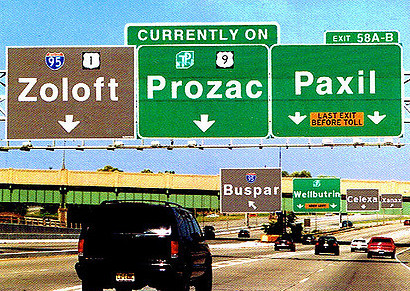
Tricyclics were about all the medical community had to offer until 1987, when Prozac hit the market, followed by its cousins Zoloft and Paxil. All of these were classified as SSRI drugs, ones that selectively acted on the neurochemical serotonin in the brain, rather than a wide variety of brain chemicals as the tricyclics had.

Since then we have listened to Prozac, talked back to Prozac, and been referred to as a Prozac Nation. Prozac has been hailed as a miracle drug, damned as a gateway to violence or suicide, and prescribed in phenomenal amounts.

And Prozac has helped me. After about six weeks on it, when the drug started to kick in, I was on a sailing trip. One of the crew said I was the passenger most at peace with myself that he knew. It was a revelation to me and a new way of thinking of myself.

Prozac changed my life – possibly saved it. And then, not so much. I moved on to other medications.

“Major Study Finds Antidepressants Work, But May Have Limitations,” by Brigit Katz, published on The Smithsonian.com, validates my perception.

Her article states, “A meta-analysis [or study of studies] of existing trials suggests that the drugs are mostly effective on a short-term basis for patients suffering from acute depression.” Katz’s article also cites articles in the New York Times and The Lancet that report similar findings.

The Lancet study “analyzed 522 double-blind studies that included 116,477 patients and 21 commonly prescribed antidepressants. The results of the study showed that all 21 of the antidepressants were more effective than placebos in reducing depressive symptoms during the first eight weeks of treatment.”

“The new analysis suggests, however, that the efficacy of the drugs may be limited,” Katz reports. “For one thing, the benefits applied in the short term, and only to patients who are suffering from acute major depression.” [emphasis added]

The Smithsonian.com article and the studies conclude that “while the new study suggests that antidepressants are more effective than a placebo, at least in some cases, media reports claiming [as an article in Newsweek did] that the research shows ‘antidepressants do work, and many more people should take them’ are not entirely accurate.”

(This hearkens back to a pet peeve of mine: that headline writers (who are almost never the authors of the articles) do a poor job of summarizing articles in favor of more definitive or appealing descriptions of the text. https://wp.me/p4e9Hv-Br)

At any rate, the meta-analysis bears out my experience. Although I was bipolar 2, my disorder first manifested as major depression. I got relief from Prozac, results that later diminished. Since my proper diagnosis I have found more relief from a combination of an SSRI, an anticonvulsant medication often used for bipolar disorder, and an atypical antipsychotic also useful for bipolar as well as schizophrenia. Even though I do not have seizures or schizophrenia, these medications work for me and have not worn off for several years now.

So, what’s the takeaway from all this? I think it is that, if your medication for bipolar or depression seems to be “wearing off,” your perception may indeed be valid. But that’s no reason to give up on psychotropics altogether. People and their disorders differ in ways we just don’t know. You can ask your doctor to try a different medication or combination of medications that may work better for you.

The benefits of medication for psychiatric disorders do not simply go away just because the effect of one does.

Read more: https://www.smithsonianmag.com/smart-news/major-study-finds-antidepressants-work-may-have-limitations-180968452/#vjLKOqe2JdKEWOe3.99

Mental Illness and Gun Violence

photo by Thomas Hawk

There’s been a lot of talk lately that not allowing the mentally ill to own guns would curb the trend of gun violence in the U.S. There are just a few things wrong with that theory.

Are background checks the answer? They aren’t. Such checks at certified gun dealers screen out only the very few who have been hospitalized for mental illness – involuntarily committed, that is, not just referred for a 72-hour hold for observation or self-referred. That’s only a very small portion of those with mental illnesses. Most people with mental disorders are never hospitalized and some never receive any diagnosis or treatment from a psychiatrist, psychologist, or another counselor, which means that background checks would never turn them up. And there are loopholes in many states’ versions of background checks that, for example, allow private sales of guns without them.

To take this to the next level of absurdity, it would be a severe breach of confidentiality if therapists had to report every client to a database somewhere, just in case, and would lead to fewer people being treated for mental health issues, for fear of being put on a registry that might be used for any purpose eventually, even employment. Gun owners don’t want to be on a nebulous registry “somewhere,” and neither do the mentally ill.

Can psychiatrists and other counselors report to the authorities clients they fear may become violent? Again, laws differ from state to state. Usually, the question comes up only when a client makes specific threats against a specific person or a government official. The therapist must make a judgment about whether the client is a danger to self and others, which could result in a 72-hour hold, and may of course be correct or incorrect. A client with generalized anger issues is probably not mandated to be reported.

And to whom and for what purpose would the person be reported? To the police, when no crime has been committed? Is a therapist’s report of a client’s report of feeling angry enough to shoot “someone” sufficient to justify a search warrant of the person’s house for a legally owned firearm?

Are mentally ill people more likely to be violent than other people? No. In fact, mentally ill people are much more likely to be the victims of violence than they are to be perpetrators. But no matter how many times we say that, few listen or believe it. Some mentally ill people turn violence – and guns –against themselves. Some are killed by police officers with no training in handling confrontations with differently abled people, including the mentally disordered.

Not only are mentally ill people more likely to be accused of violence, violent people are more likely to be accused of being mentally ill. That’s practically the first thing anyone says after a mass shooting – “Oh, he must be crazy” (or on psychotropic medications). Of course, with one in four adults being likely to experience some form of mental distress in their lifetimes, it is possible that a shooter is one of those people.

But newscasters and politicians and people on the street are, by and large, not psychiatrists or psychologists. They are no more able to diagnose mental illness than burger-flippers, dairy farmers, lawyers, or business executives. Not that that stops them. Mental diagnoses are flung about indiscriminately nowadays, from people who call themselves OCD because they straighten pictures to psychiatrists who claim to diagnose public figures without having spoken to them once, much less having developed a therapeutic relationship with them.

But can’t potential violence be predicted? No. It can’t. The prison system can’t do it, or there wouldn’t be so many parolees and probationers and those who have served their time who go right back to crime and violence. Mandatory sentencing laws and the political climate have reduced the problem in some areas, but there are still plenty of cases in which the system fails. At trials and parole hearings and sentencing hearings, there is always someone – doctor or lawyer or family member – to say that the offender will not offend again.

But the only known predictor of violence is past violence. That’s why some people think it’s more sensible to restrict the gun ownership rights of domestic abusers rather than someone mentally ill who has no record of violence.

Can’t mentally ill people who’ve proven to be violent be required not to own guns? Theoretically yes, but we know how well it works to tell people on probation who have no record of mental illness that they can’t own guns, drink liquor, or associate with known criminals. The probation system is too understaffed to enforce these requirements already. Who would be willing – or should have the responsibility – to check up on everyone, even the small proportion of the mentally ill who have been involuntarily committed or convicted and then released, and make sure they don’t acquire any guns? If the parole and probation people can’t handle the caseload they already have, why would we think that mental health professionals have any more time, capacity, training, or know-how to do it?

Would banning guns prevent gun violence by the mentally ill? In a word, no. There are already too many guns in circulation in this country for that to be possible, and those guns are too easy to get. And again, there would still be the problems of determining who is mentally ill, by whose definition, and how such a gun ban could be enforced.

So, I hear you asking, you’ve told us all the things that won’t work. Is there anything that will?

Not if you think that the problem of gun violence and the problem of treating the mentally ill overlap. Gun violence is one topic and the mental health system is another. There is a lot that can be said about fixing one or the other, but nothing that would solve both at once.

Not that a lot is being done now, unless you count blaming, finger-pointing, and spreading stigma.


For more discussion on the topic, see http://www.amhca.org/blogs/joel-miller/2017/10/03/gun-violence-and-mental-illnessmyths-and-evidence-based-facts from the American Mental Health Counselors Association.