Bipolar 2 From Inside and Out

Posts tagged ‘mental health’

The Hypomanic Blogger

When I thought I had unipolar depression, I used to wish I were bipolar, on the theory that I could get a lot more done. (I later found that not to be true, as I’m sure many of you can attest.)

I had a lot more experience with depression than with mania. My bipolar disorder is Type 2, which means I get hypomania instead of full-blown mania. And most of the time the hypomania comes out sideways as anxiety and/or irritability.

(Don’t ask me why I get the full-monty-style depression and only a smidge of hypomania. I don’t know. If my shrink does, he hasn’t told me.)

Looking back, I can remember only one hypomanic episode before my new diagnosis made me more aware of the possibility. I was working at writing and editing – the same things I do now, only then I could do it in an office full-time instead of at home and freelance. A woman came to me, asking about how she could become a writer for magazines.

I positively burbled and babbled. I gave her all sorts of advice on query letters and Writer’s Market and niche publications and getting bylines and clips. I told her about how I started, writing for I Love Cats magazine and editing my martial arts club’s journal, and working my way up. (Incidentally, I am, as far as I know, the only person ever to have articles published in both Black Belt and Catechist magazines.)

The woman went away inspired, she said, though I never heard how she made out.

Now I can more easily recognize hypomania when it hits. I still get the anxious and irritable sort, but now I get more of the buzzy kind. And even though it makes me twitchy, I can make use of it.

It was in a bout of hypomania that I decided to start this blog (and my other, general-purpose one – janetcobur.wordpress.com).
It’s hypomania that has kept me going for over a year so far. Though I can now, thanks to medication, force myself to work while in the dysthymic stage or the “meh” stage, if I hit a spell of hypomania, I can use it to write and edit. Right now I’m using a hypomanic swing to stockpile ideas and first drafts against the inevitable downswing.

Of course, the ramblings that go with hypomania are not worth posting (or submitting to a client) the way they hit the screen. When I’m less jazzed, but not in the Pit of Despair, I can re-read, edit, and improve. It’s a fine balance, a tightrope I’m learning to walk. And it takes both therapy and medication to maintain.

In essence, the not-properly-treated bipolar 2 made my work go downhill (even as I did), until I was unable to work at all. Now that my diagnosis and my meds are more on track, so am I. I may not be well, but I certainly am better. I can live with what I’ve got, and even re-learn how to use some of the abilities I lost in my most recent, largest, most devastating crash.

I wouldn’t recommend mania or even hypomania to anyone, but as long as I’ve got it, I might as well make it be good for something.
I Have This Friend . . .

To have a friend, be a friend.

That’s how the saying goes, and it goes double for friends with mental disorders.

But.

There are limits. Boundaries. You may call them self-serving or self-saving, but there they are.

When you are depressed, you neglect friends, and I have certainly done that. I permanently lost one friend over it. But another kept reaching out to me and I eventually responded. (We then had a good game of “I’m a bad friend.” “No, I’m a bad friend.” She thought she hadn’t reached out often enough. I was glad she put up with my silence as long as she did, until I was able to reach back.)

But I have this friend. We used to be tight. When we were both depressed, we shared our misery and so lessened it. But now that the Pit of Despair is no longer my permanent abode…I have to limit my contact.

Why? My social skills have never been terrific, but now I frequently find myself walking that invisible line between Bad Friend and burnout.

Why is it so hard to be a Good Friend?

First, there is the Disaster Report. Whenever I talk to her, I hear a litany of all that is going wrong in her life. Almost never anything else. I’m no fan of relentless positivity, but its opposite is sometimes hard to bear too, even though I’ve been guilty of the same.

Then there is the fact that any suggestions are pushed away, denied as impossible, dismissed as unworkable. Granted, we have completely different styles of coping, but I feel discounted, unheard. Eventually I gave up sharing anything but a few of my own tribulations, some awful jokes, and commiseration.

Then I get off the phone or off Facebook, usually after half an hour or so. That’s about my limit.

I still keep reaching out. I don’t want to be a Bad Friend. I know I can’t fix her, or even her day-to-day difficulties, the kind even non-depressed people have. But I sure wish there were a way I could help, short of climbing down into the Pit with her. I hope that listening, even half an hour at a time, does some good.

And when I talk to other friends of mine, I try to remember to ask how their day was and what’s new in their life and have they seen any good movies and what is a mutual friend doing. I try to listen if they have something to share, good or bad, and I try not to overwhelm them or play whose-life-sucks-the-most. I try to be a Not-Bad Friend, even if I do have to lean on my friends, at times pretty heavily.

And they do likewise, when they can.

Mr. Fix-It

Him: I just groomed the cat. I used a cat-a-comb.

Me: *total silence*

Him: Hey, honey! I just groomed the cat – with a cat-a-comb!

Me: *more silence*

I was depressed, and he was trying to cheer me up. Using exactly the same joke that had gotten no response only seconds before. I don’t know why he thought it would work better the second time.

Many men have the instinct that, when confronted with a problem, they will try to solve it. When something is broken, they will try to fix.

I wasn’t broken, exactly, but I was deep in the Pit of Despair, aka the lower mood swing of my bipolar disorder. At that stage I am immobilized, uncommunicative, and utterly humorless.

The fact that Dan had worked in hospitals and psychiatric facilities was actually a bad thing, despite what you might expect. He had run laughter therapy groups, he knew the jargon, and he sincerely wanted to be helpful.

But he didn’t know – viscerally – what depression was like. How it felt in your body and mind and soul, how it damped down your personality and blunted your reactions and removed your ability to view life as anything other than miserable. Certainly not funny.

Later Dan learned all this when he experienced his own bout of clinical depression and became another one of my Prozac pals. But until then, he would occasionally come shrinking at me, until I had to tell him to stop. I could accept a hug, but not a joke or a “remedy.”

But all that was early in our relationship and before I had begun to heal or even get proper treatment. And I literally would not have made it this far without Dan. I need him and likely always will.

When it’s Pit of Despair time again (which it sometimes still is), he checks on me to see if I need that hug, or some food, or a kind word, or just to be left alone. When I am better, he still does the cooking and shopping, and reminds me to eat regular meals and take showers and tells me I smell nice after I do. Sometimes he can coax me out of bed with a tape of The Mikado or out of the house with lunch at Frisch’s. If I’m too nervous to drive to my appointments, he takes me. When I’m together enough to work, he keeps the house quiet and fixes food when I need a break and validates me for being able to bring in money, even when it’s difficult.

But he can’t fix me. And now he knows that.

Mind Like a Steel Trap

Rusty. Unhinged. Not really good for trapping things.

Especially memories.

That’s not quite true. I have that uncanny ability that all depressed people seem to have to remember every stupid, clumsy, embarrassing thing I’ve ever done, as well as every trauma. It’s like a mental DVD that stores them up, then plays them at random moments. Or maybe not so random. Maybe just when I think I’m doing okay.

The memories can be as traumatic as the time other children threw rocks at me or as trivial as the time one person asked for a glass of water and I gave it to someone else.

Unfortunately, the recording feature only works for bad memories. A lot of the good ones are MIA. I don’t remember huge chunks of my childhood, except as stories that family members have told me. I don’t really know if the memories are mine or theirs. And I’m scared to compare notes.

My theory about these childhood memory deficits – and to tell the truth, all the way through my teens and early twenties – is that when you are profoundly depressed, memories don’t imprint the way they’re supposed to. Whatever synapses and neurochemicals are involved in memory are out of whack. I’m also afraid to do the simple Googling required to find out whether this is even a plausible theory. If it’s not, I don’t think I want to know. I have an explanation that makes sense to me, and the memories won’t come back if I learn my theory is wrong.

Later in life, medication has helped controlled the depression and, after it was diagnosed, the other effects of bipolar 2. But if I thought my memory was going to function properly, I was wrong. Some of the drugs left me with a memory like Swiss cheese.

My memory lapses seem more random now. Good things, bad things, neutral things, all disappear into the Pit of Unavailability. Sometimes they are embarrassing – I forgot a friend’s father had died and asked how he was. Other times they are more distressing – mere scraps left of trips I’ve taken. Sometimes they’re heart-searing – total nonrecall of a never-to-be-repeated sexual encounter.

Good and bad, gone.

(“Oh, yes,” said the doctor. “That drug will do that. You can stop taking it now.”)

I guess I’m lucky. If I’d had the electroshock, my memory would probably be as raggedy as old underwear. And about as useful.

Churchill’s Dog

Winston Churchill famously compared depression to a black dog. Here’s a video that takes that metaphor and runs with it.

Andrew Solomon, author of The Noonday Demon: An Atlas of Depression, says, “Depression minutes are like dog years, based on some artificial notion of time.” He goes on to describe how the simple act of getting out of bed and taking a shower can consume hours, leave you exhausted, or be simply impossible without help.

The Noonday Demon

There’s even a Black Dog Institute in Australia, which is a non-profit organization that provides information about depression, bipolar disorder, suicide, and other topics.

Home

There are other metaphors. J.K. Rowling, creator of Harry Potter, talked about depression and dementors. Here’s a link to a post I wrote about that.

Read Your Way to Sanity

The black dog is with me now.

Sensation in the Brain

I know there is no physical sensation in the brain. It cannot feel pain. It cannot feel touch. Even in a car accident when the brain sloshes from side to side and bashes against one side of the skull and then the other, the brain sustains injuries, but feels nothing.

That notwithstanding, twice in my life I have felt physical sensations in my brain – or at least what felt like them.

The first time was at the dentist. I am terribly phobic about dentists, so even for routine procedures I need anti-anxiety medication. This was not a routine procedure.

The dentist was very understanding. He put me in the children’s treatment room, which had brightly colored designs of cactus, coyotes, cowboys, all painted on the walls in comforting colors and playful attitudes.

He also brought in a traveling anesthesiologist so that I could be unconscious during the procedure instead of terrified. My husband was there with me, of course, both to drive me and to give me moral support. (It also turned out that he had to give permission for one of my teeth to be removed in the middle of the procedure while I was unconscious.)

While the anesthesiologist was putting me under, my husband and the dentist were casually chatting. My husband made a remark and the dentist said, “Oh, she can’t hear us now. She’s already pretty far under and won’t remember a thing.”

“I bet she will,” my husband replied. The bet involved giving me a word to try to remember when I awoke. They selected the word green.

“You mean like the color of my pants?” I said. They were actually more like olive drab.

“Yes,” the dentist replied. “Green – the color.”

Just for the hell of it, as I was sinking into unconsciousness, I silently repeated to myself the word green in a slow and steady manner: green green green – until the drugs took me under.

An unknown time later I awoke. The dentist asked me, “Is there something you were supposed to remember?” I shook my head groggily.

As soon as I did, I felt an odd sensation in the back of my brain. It was like a little bubble rising up through liquid. When the bubble reached the surface of whatever the liquid was, it burst and released the word green. “Green?” I said uncertainly.

“See?” said my husband. “I told you she would remember.”

The other sensation in my brain came about six weeks after beginning a new psychotropic medication. I had gone through a long, miserable time of trying drug after drug after drug – tapering off on one and ramping up on the next – all with no effect, except unpleasant ones.

Dr. R. was ready to recommend electroshock for me. And after such a long time – I think it may have been two years – of trying and failing with different medications, I was ready to take the plunge. I admitted as much in one of my sessions.

“There’s one more thing I’d like to try before we do that,” said Dr R. “Here is a prescription for lamictal”.

“Okay,” I said. “How does it work?”

“We don’t really know,” he replied. This was our standard conversation whenever he prescribed a new drug. I was used to it, but I always asked anyway.

So I tried it. And felt the usual nothing for almost six weeks. Then one day I was in my husband’s study and we were talking, when I felt it.

It was the physical sensation in the back of my brain of a light switch being flipped. I thought I heard an internal click. When that switch flipped, suddenly something in my brain changed. It remembered how to think and to feel and to not be miserable.

“Oh!” I said. “I remember this. This is the way my brain is supposed to work.” Since then it has kept working – not continuously in the proper manner – but often enough that I consider the drug a success.

I know that in both of those cases nothing happened in my brain that caused a physical sensation. Both times, my brain gave me a metaphor for what was happening. In the dentist’s office the metaphor was a bubble rising to the surface to explain coming out from under sedation – and a little bit of self-hypnosis.

In the case of the drug, the metaphor was the cliche of flipping on a light switch. This time something had changed in my brain, something biochemical. I should not have been able to feel it, but according to my brain, I did.

It seems I have a clever brain. It gave me ways to understand what was happening in terms I could relate to. The fact that I know the brain can have no physical sensations did not matter to my brain.

Human brains are amazing – and sometimes even in a good way.

The Creative Bipolar Brain

Sun or shade
feel or know
safe or strayed
stall or flow

Thought or whim
drought or rain
sink or swim
heart or brain

Stop or start
bound or free
light or dark
bipolar me

I have a lot of friends who are creative – writers, musicians, singers, woodworkers, knitters, and other craftspeople. I also have a lot of friends who have assorted mental or emotional disorders – depression, bipolar, PTSD, OCD, autism spectrum disorders, and probably many more that I don’t know about. In many cases, the two categories overlap.

Common wisdom holds that there is a link between creativity and madness. Look at Van Gogh, for example. People have spent years debating what specific disorder he may have had, but nearly everyone agrees that he had something. The question is, would he have been the great artist without the mental or emotional disorder? Or, perhaps, would he have been an even greater artist if his brain functioned in a more typical matter? Science so far has given us no answers.

Many creative people realize that their everyday functioning is impaired, but they are reluctant to seek treatment for it. They fear that tampering with their brain or thought processes will somehow inhibit their creativity – make them less than they were in some fundamental way. When you start tampering with brain chemistry, who knows what will happen?

It’s a valid concern.

Throughout my life, my brain has been all that I have, or nearly so. My intelligence and creativity were the things I was most proud of. How could I risk losing those simply because I was eternally miserable? The question seems absurd now.

Eventually I decided that I had plenty of brain cells to spare, and that if taking Prozac took away a few of them or lessened their ability, I could live with that. (Just in case, I took up pursuits that are supposed to strengthen the brain – math puzzles in addition to word puzzles, music in addition to writing. Not everything I tried was a success, but I hope they stretch my brain muscles.)

My experience with that first psychotropic med convinced me that Better Living Through Chemistry is not just a chemical company’s slogan. It turns out that – surprise, surprise – thinking more clearly and feeling more well-adjusted actually empower one’s creativity. My output changed from poems full of young adult angst to creative nonfiction, personal essays, and the occasional short story. I now make my living doing freelance writing and editing – an unstructured process that I couldn’t have made a go of before having my mood disorder treated. The ability to concentrate – to focus – is what enables me to sustain a creative effort.

So to all those people out there who wonder if they are sabotaging themselves and their creative impulses by seeking treatment, I say go for it! You have nothing to lose but your immobility. You have everything to gain – the ability to create, to express yourself and do it clearly, and the possibility to create something truly wonderful.

Sylvia Plath was a poetic genius. But she could have given so much more of her talent and vision to the world if she had not killed herself. Perhaps her poetry, had she been treated for her mood disorder, would not have been as searing and powerful. The point is, we will never know. Would she have become more ordinary, or more extraordinary? Dying young obviates the answer.

I believe – for me – that psychological treatment, appropriate medication, and more stable moods have expanded my creative process. And I try to prove it every week when I post in this and my other blog. Whether I succeed is for you to determine.

Have I lost a step? Maybe. But two forward and one back beats the hell out of one forward and two back.

Not Waving but Drowning

Consider this a trigger warning. The third section is going to talk about some difficult stuff, although in mostly general terms.

Here’s a list of how I know how bad my mood disorder is at any given time. Being bipolar, I cycle in and out of these phases, along with periods of reasonably competent functioning and even, occasionally, contentment or even happiness.

There are basically three stages of increasing dysfunction.

Starting to Sink
My sense of humor takes a hike.
I need more alone time.
I take mega-naps.
I forget that music can help.
I snap at my husband.
Noises irritate me.
I can force myself to work.

Floundering
I don’t want to eat.
I turn off my phone.
I sleep up to 14 hours a day.
Attention span is one hour (or one average book chapter).
I can trick myself into working.

Going Under
Can’t sleep.
Can’t work.
Can’t read.
Attention span: 15 minutes max.
Thinking “Maybe the plane will crash and I won’t have to deal with this anymore.”
Regretting I flushed my stash of pills.
Urge to cut.

Fortunately, I am well-medicated enough that category 3 doesn’t happen nowadays, though I remember it clearly and am appalled. At that point, the only things I can do are keep seeing my doctors and taking my meds. And remember to thank my husband when I come out of it.

(The title of this post is from a poem by Stevie Smith. The last two lines are: I was much too far out all my life / And not waving but drowning.)

In Defense of the Armadillo

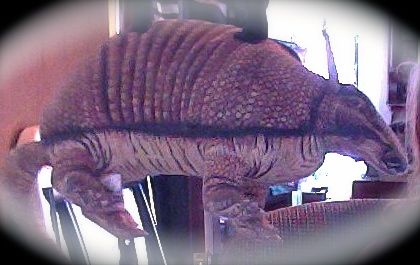
Let’s consider the armadillo. Better yet, let’s consider this brief video. Take note of the armadillo’s defense mechanisms, if you will.

I have always identified with the armadillo, for a variety of reasons. It is the symbol of Texas music, which I love. I have a purse shaped like an armadillo. I also have toy armadillos, crocheted armadillos, wooden, stone, cement, armadillo jewelry, you name it. My uncle and I have a catch-phrase: El armadillo amarillo de mi tía es sobre la mesa.

What does all this have to do with bipolar disorder? I’m glad you asked.

Most of all, I admire the armadillo for its defense mechanisms, which resemble some of mine. For those of you who skipped the video, here’s a recap.

The armadillo has armor (obviously). I have tried to construct a similar impervious shell. When I have been even partially successful, it has proved counterproductive. When you wall off feelings, you wall off the good ones too.

The armadillo rolls up in a tight ball. I isolate. This has also proved counterproductive. If sorrow shared is halved and joy shared is doubled, then isolation – well, you do the math.

The armadillo leaps vertically when threatened. My anxiety makes me jump and release fight-or-flight hormones. This defense is also counterproductive, both for the armadillo and for me. One of the armadillo’s main predators is the automobile; the armadillo jumps straight up to bumper height. I waste energy on panicky behaviors even when I’m not threatened.

The armadillo has a low body temperature and is therefore useful for research on leprosy. This is not a defense mechanism, but it is a Fun Fact to Know and Tell. I have never had leprosy.

All things considered, the armadillo is not a good role model for a person (me) with bipolar disorder. But I like them anyway. They remind me that I need to check whether my defenses are doing me harm rather than good.

Plus, with my armadillo handbag I get lots of practice in the social skill of making light conversation strangers – and even children!

Erma

Erma

The Lighter Side of Insomnia

I’ve had insomnia. Lots. January seems to be an especially bad time of year for me. A sleeping pill reduced the frequency, but nothing banishes it completely – the obsessive thoughts, the catastrophizing, the worrying, the worrying about how worried I am. We’ve all been there at 3:00 a.m., trying to will ourselves to sleep.

What could possibly be light-hearted about that?

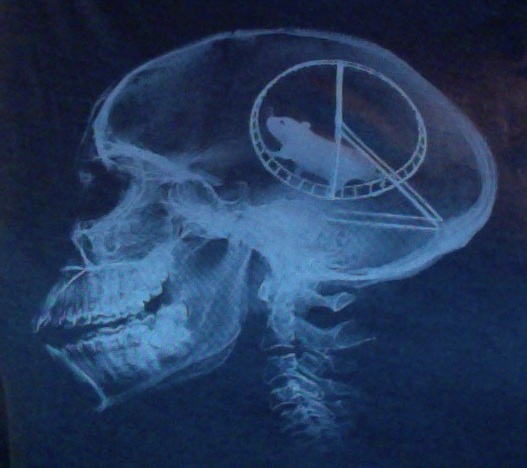
Just this: An actual x-ray of my insomniac self:

T-shirt by Headline Shirts. Photo by me.

Indeed, my friend Leslie and I, both afflicted with insomnia, recognized this as our mutual problem. We began to end our late-night commiseration with the sign-off, “Death to Hamsters!”

Our mutual friend, the incomparable, incorrigible Tom Smith, heard of this and ran with it. Here is the result, for your amusement.

Imagine, if you will, this performed as a sing-along with a hundred people joining in on the chorus. It may not put you to sleep, but at least it puts insomnia in some kind of loony perspective.

At least it does for me.

Notes:

No hamsters were harmed in the making of this blog post. A rubber duck may have been squeezed, but it had nothing to squawk about. So if you’re with PETA, chill already.

Lyrics to Hamster Brain available here: http://www.tomsmithonline.com/lyrics/hamster_brain.htm.