Bipolar 2 From Inside and Out

Posts tagged ‘mental health’

The Teen in my Head

There is someone else living inside my brain.

I don’t have Dissociative Identity Disorder (DID, formerly called Multiple Personalities). I just have another me who pipes up from time to time. And, man, can she be annoying!

She’s 14 years old, and she doesn’t have a name. I don’t know when I acquired her, but I do know when she acts up.

She’s the one who frets when a friend doesn’t answer my IM. When he does, she squees, “He noticed me! He noticed me!” She’s the one who wants to buy ridiculous, useless – but amusing – things. She makes me eat that extra chocolate cookie, then frets about getting fat and pimply. She’s the one who is hooked on all the stupid clicky Internet games.

I’ve heard the theory that everyone has a mental age that they get stuck at. No matter how old they get, they always picture themselves at that age. Mine is somewhere between 28 and 34. So how did I end up with a 14-year-old?

My theory about her existence is that she is there to try to do what I never did when I was 14 – all the regular teen-age angst and frivolous stuff: mad crushes and pouting, self-obsession and discovering her sexuality, in-jokes with BFFs and trying out fingernail polish.

When I was actually 14, I did none of that. I was in a prolonged downward mood swing, made worse by puberty and the horrors of junior high school. I wrote depressing poetry and read French existentialists. If they had had hipsters back then, I suppose I would have been one.

When I feel her popping up in the back of my skull, most of the time I have to put her in a box and sit on the lid. It’s scary to let her take over. She’s rapid-cycling, impulsive, and worst of all, unmedicated. (I don’t know why my meds don’t affect her, but there you are, they don’t.)

Once in a while I let her out of the box. I let her enjoy some mad crushes (as long as she doesn’t do anything about them). I let her buy things that cost $20 or less. I let her talk me into fake fingernails (once!). I let her have some of the fun that I never had at that age.

The thing is, I don’t know if this is just a me thing, a female thing, or a bipolar thing.

I know I’m not completely alone in having a teen ride-along. I do know a man with DID who has an alter that is a teen girl. I could tell when she was out because she giggles a lot and buys junk food. A friend of mine who has suffered from depression also has a 14-year-old in her head. She has given her teen a name – Innie Me. Hers behaves a lot like mine.

I also don’t know whether having a teen living in my head is a good thing or a bad thing. It could be good, because it does give me access to the feelings and experiences I never had as an actual teen. My teen is better than I am at having fun.

On the other hand, I know it would be a bad thing if I let her have her way all the time. She needs that box and I need to sit on the lid. The trick is knowing when and how and for how long to let her out.

On an episode of Scrubs, one character remarks that no matter how old a woman gets, she always has an insecure 14-year-old inside her. I suppose that men have similar phenomena. Most people are said to have an inner child (although I think they are usually younger than 14). I think my husband’s inner child is usually about seven.

Certainly my teen is insecure. There’s no question about that. But she’s also enthusiastic, engaged, and energetic, as well as moody, dramatic, and confused. I think she may be related to the hypomanic part of myself, although I’m also sure some of my fits of apparently reasonless weeping have been her acting up.

My therapist knows about my 14-year-old. We have discussed her and her behavior and her moods several times. Dr. B. has never expressed surprise or shock or puzzlement at the idea. She does think it’s good that I’m learning to sit on the box lid when I need to. We’ve talked less about when it’s a good time to let her out. That’s something I still need to work on.

I guess I’ll have to learn to live with my 14-year-old, because I don’t think she’s going away anytime soon. And I don’t think I really want her to.



Bipolar Basics for the Newly Diagnosed

If you have recently been diagnosed as bipolar, there are a few basics you should know. You’ll likely find them out on your own, but it might take a while.

So, here are some tips.

    1. Being bipolar isn’t necessarily a tragedy. It’s a chronic illness. At times it’s better, at others, worse. It’s not a death sentence and it’s treatable. You can still live a reasonably full and satisfying life.
    2. You need help. To live with bipolar disorder, you need a support system. Unfortunately, your friends and family may not be all that supportive. Fortunately, there are online support groups. But the most important parts of your support system, at least at first, are your psychiatrist and your psychotherapist. I recommend having one of each – psychiatrist for medication, therapist for talk or cognitive behavioral therapy, or whatever works for you.
    3. You will most likely need medication. And the odds are good that you will need it for the rest of your life. Don’t panic. After all, diabetics need insulin, usually for life. You may hate taking pills, you may hate the idea that you are dependent on them, you may hate the fact that they remind you of your brain’s difficulty functioning. But realize that meds will make your brain’s functioning less difficult. They are worth the hassle.
    4. Everyone is different. Everyone’s symptoms are slightly different. Everyone’s medications are slightly different. Everyone’s reactions to their medications are slightly different. A support group can help you with general information, but they cannot tell you what is ultimately best for you. Your particular symptoms and your unique version of bipolar disorder may well require different medications, in different amounts, than your friends. And you may have different reactions to them. Some pills have no effect at all on one person and are life-savers for another.
    5. Getting better takes time. Once you have your diagnosis and your medication, don’t expect to feel better quickly. Most medications for bipolar disorder take a while to build up in the body. Six weeks is not unheard of. Then your doctor may assess how well the medication is working, and change the dose or even the medication itself. Then you may go through another six weeks of waiting for the new dose or drug to take effect. Each case of bipolar disorder requires a medication regimen tailored specifically to the individual, and that often takes some doing.
    6. There are several different types of bipolar disorder. The two main types are called type 1 and type 2. Type 1 is the classical bipolar disorder, which used to be called manic-depressive illness. Type 2, a more recently identified version of the disorder, often manifests as mostly depression, possibly with hypomania, a less severe version of the ups that accompany bipolar 1. Other forms of bipolar disorder are rapid cycling, in which one’s mood states alter quickly, even within a few hours. Another version of bipolar disorder is called mixed states. Mixed states occur when a person experiences both extremes of emotion at the same time – for instance, depression and irritability, or fatigue despite racing thoughts.
    7. The odds are that you already know someone with bipolar disorder, or at least some kind of mood disorder. One in four Americans will have a psychiatric or emotional illness at some time during their lives. Because we don’t talk about it, though, no one may ever know. Especially when the disorder is treated properly, a person with bipolar illness can maintain function in society and choose whether or not to share the diagnosis with friends and coworkers. Many people choose not to because of the stigma surrounding mental illness. It’s a valid choice, but it cuts the bipolar person off from possible support and understanding from others who may share the disorder.
    8. Relationships can be difficult but not impossible. Relationships are difficult for everyone. People with bipolar disorder have relationships that are difficult too. The disorder may make the relationships even more difficult, especially when the family member or loved one or even close friend does not understand the symptoms, the medication, the mood swings, the anxiety or fatigue, or all the other facets of bipolar. The best cure for this is education. However, it may not be possible for a relationship to survive bipolar disorder, just as a relationship may not survive trauma, grief, addiction, infertility, incompatibility, meddling relatives, infidelity, parenting, or a host of other conditions. It may be better to look at all the circumstances surrounding a troubled relationship rather than automatically blaming bipolar disorder for difficulties.
    9. Learn all you can. Because bipolar disorder is so little understood by the public, because it manifests differently in nearly every case, because a person can be actively suffering or in remission, because a person may have any of the different types of bipolar disorder, because everyone is different – the need to educate yourself and probably those around you is essential. The more you know, the less you’ll panic when a symptom you haven’t experienced before suddenly hits. Rely on reputable sources. Medical, psychiatric, or psychological websites are usually the best. Support groups can offer much information, but the people in a support group may not be any more well-informed than you are. And there are lots of people selling “miracle cures” that can lure a person away from needed medication and other services.
    10. Keep trying. It’s hard. It’s frustrating. It’s difficult. It’s painful. It’s confusing. But bipolar disorder is something you can live with, and even something you can rise above. The secret is to keep trying. Keep seeking out therapy and friends who support you. Keep taking your medication, even if you don’t want to. (Stopping your medication without advice from your doctor can be dangerous, so don’t try that.) Be stubborn. When you feel like giving up, tell yourself that maybe things will get a little better in the morning. Hang in there. You may not realize it, but there are people who need you in the world, who need you to be functioning and happy, who need you to keep fighting the disorder.

Do you have any other tips for the newly diagnosed? Please share them in the Comments section.

Am I Ready to Stop Therapy?

I got my first hint that I might be ready to stop therapy when I realized how little I was going. Over the years I have scaled down from weekly sessions to biweekly.

Then I noticed that, effectively, I’ve been going only once a month. I’ve been forgetting appointments, showing up on the wrong day, oversleeping, feeling poorly physically, or having too much freelance work to do.

Of course, those could be signs that I’m in denial, that I’m resisting therapy, that we’ve hit a bad patch of difficult issues and I just don’t want to deal with them.

But I don’t think that’s what’s happening. Here’s why.

I’m stabilized on my medications and they’re effective. When my psychiatrist moved away a few months ago, he left me with enough refills to last until this month and a list of other psychiatrists. My PCP agreed to prescribe my psychotropics if I lined up another psychiatrist for emergencies. I’ve done that, though I couldn’t get an appointment before March.

And that doesn’t alarm me. I don’t have the oh-my-god-what-if-my-brain-breaks-again panics. I don’t have the feeling that my brain is about to break again. I’ve thought about it, and I’m comfortable with letting my involvement with the psychiatric profession fade into the background of my life.

As long as I keep getting my meds.

I have more good days and I’m beginning to trust them. Oh, I still question whether I’m genuinely feeling good, happy, and productive or whether I’m merely riding the slight high of hypomania. But really? It doesn’t seem to matter very much. A few days ago I reflected on a string of particularly good days – when I accomplished things, enjoyed my hobbies, and generally felt content. And I simply allowed myself to bask in those feelings.

That’s not to say I don’t still have bad days. After a few days of hypomania, I hit the wall, look around for spoons and don’t find any, and require mega-naps to restore me. (I’m intensely grateful that I work at home and can do that. Most offices don’t appreciate finding an employee snoring underneath her desk. And my cat-filled bed is much more comfy-cozy.)

I still get low days too, but they are noticeably dysthymic rather than full-out, sobbing-for-no-reason, Pit-of-Despair-type lows that last seemingly forever. I know – really know, deep within me – that they will last a day or two at the most. And just that knowledge makes me feel a little bit better.

My creativity, concentration, and output are improving. I can work longer, read longer, write longer, take on new projects, think past today or even next week. I can trust my muse and my energy, if not immediately when I call on them, at least within a reasonable time.

I have trouble remembering how bad it used to be. Recently I’ve made connections with several on-line support groups for bipolar and mental health. I find I’m astonished at the crises, the outpourings of misery, the questioning of every feeling and circumstance, the desperate drama of even the most mundane interactions. They are overwhelming. But I realized that it’s been a long time since they’ve overwhelmed me. I recognize that I could some day be in that place again – that’s the nature of this disease. But I have a good support system that I trust to help me not fall too far without a net.

I don’t have much to talk about when I go to therapy. There are issues I need to work on – getting older, getting out of the house more, reclaiming my sexuality. But most of those I feel competent to work out on my own.  My sessions are mostly an update on what’s going on in my life at the moment, plus a recap of my recurring problems. But those problems are ones I’ve faced before and know how to cope with. I already have the tools I need and use them without needing a reminder.

So I’ve talked it over with my psychotherapist and I’m not completely quitting therapy, but I am cutting back officially to the once a month I seem to be going anyway. I know that if and when the bipolar starts giving me major trouble again, I can always call for an appointment or a telephone therapy session.

I’m not going to stop writing these posts. I still have a lot to say about where I’ve been, how I’ve got to where I am now, how things will go in the future, and all the many ways that mental illness affects society and vice versa.

You’re not getting rid of me that easily. I’m sticking around.

Self-Harm Revisited

If that title isn’t enough of a TRIGGER WARNING for you, I don’t know what is.

Not long ago I saw on the web a video with the title “Is scratching self-harm?” Well, of course it is, I thought. The video agreed with me.

It seems like the low end of the spectrum, not as extreme as as what most people think of as self-harm, but a form of it nonetheless. Scratching, pinching, hair pulling, and the like are probably considered subclinical next to cutting and burning. But they are still problems. They can escalate into worse self-harm.

In another article (http://www.upworthy.com/this-researcher-who-studies-self-injury-explains-why-people-do-it-and-why-he-did-it?c=ufb1) I saw this definition for self-harm:

“Self-injury is intentional damage to body tissue (that doesn’t include body modifications like piercings, tattoos, and scarification) without suicidal intent.”

So, yes, scratching is self-harm. It is intentional. It is damage to body tissue. and it does not indicate suicidal intent.

Scratching sounds so minor. We scratch ourselves all the time when we have an itch or an insect bite. We scratch ourselves accidentally on protruding nails. Occasionally we draw blood. We wash it off, slap on a band-aid, and that’s that.

But when scratching escalates to self-harm, it can indeed be serious. For one thing, scratches have a tendency to become infected, infection of the sort can lead to further tissue damage – and if untreated, to more serious complications.

There is also the potential for further harm because the scratching will scab over. Then the desire to scratch off the scabs kicks in. When this happens, the scratches never heal. And yes, that’s both a fact and a metaphor.

My own experience with scratching came when I was working at a job that required me to monitor burglar alarms. The alarms tended to go off – whether there was a burglary or not – during thunderstorms. When a storm hit, a dozen or more alarms could go off simultaneously, or at least in rapid succession. I had to call the owners of the businesses, or emergency services as required.

One night during a particularly bad storm, I missed one of the alarms. I did not call the owners until I looked back at the record. When I called, it was 45 minutes since the alarm. I knew I had made a mistake, and a bad one. The owners of the business would not be happy. My boss would not be happy. I was not happy.

I sat alone by the monitors and imagined the trouble I was in. I started scratching my right arm – long slow strokes from nearly the wrist to nearly the elbow. Repetitively. Obsessively. Painfully. I believe I was punishing myself for making a bad mistake. Perhaps there was some thought that if I inflicted the pain, I would escape further consequences of my mistake.

Of course that makes no sense. It’s an example of the irrational thinking that goes with self-harm.

I don’t cut anymore, as I discussed in a previous post (http://wp.me/s4e9Hv-cutters). I also don’t scratch the way I did that night. I still have a tendency to pick scabs. Occasionally if I have an insect bite, I will scratch it to blood and then pick the scabs on that. I try not to. My husband helps me by reminding me not to pick at scabs or to put band-aids on them. I try to rub instead of scratch, or use lotion.

Jenny Lawson (aka the Bloggess) has admitted in her most recent book, Furiously Happy, that she scratches past the point of bleeding and pulls her hair enough to create bald spots. It’s clear that she considers this self-harm. Her husband tries to help her with it too.

But self-harm is basically a private thing – something we do and hide from the world. Some people are able to hide it even from their most intimate family and loved ones. I know I wore long sleeves to cover the dreadful scratch on my right arm. It healed from a scratch to a pink scar and then to a white scar. Now I can’t even see it anymore through the freckles.

But I don’t need the visible reminder. I remember how it felt to do it, how it felt after I did it, and how I felt as I watch the scars slowly fade. its nothing I’m proud of, except for the fact that I survived it and no longer do it.

As most cutters and other people who self-harm do, I feel shame in recalling the act, and almost never speak of it. The reason I’m sharing the story in such a public forum is to let people know that not all self-harm consists of big dramatic gestures. It can start with a tiny scratch. But it is not something to be ignored. We need to talk about self-harm, educate about it, bring it out in the open, and let others know that it doesn’t have to continue.

And that it can start with something as small as a scratch.

My New Mental Health Tattoo

Once again I have gotten a tattoo, supporting the cause of mental health.

A few months ago, I became a part of what’s called the semicolon project and wrote about it in this post: http://wp.me/p4e9Hv-9G. For those of you who aren’t up on the terminology, a semicolon tattoo represents mental health awareness, especially erasing the stigma, and suicide prevention.

The semicolon was chosen as the symbol because in writing, a semicolon indicates a place where a writer could have completed – or stopped – a sentence, but chose to go on. The semicolon says, in effect, “My story isn’t over.” The idea is to have the tattoo someplace visible – in my case, on my left wrist – and use it as a conversation starter.

Most people will assume that since I am a huge grammar nerd, my semicolon tattoo is some weird manifestation of love for punctuation. Then I can tell them that it’s a whole lot more. You can find out more about the semicolon project at http://www.projectsemicolon.org/.

My new tattoo represents bipolar disorder. Again it’s made up of punctuation: two colons and a paren. These symbols, unlike the semicolon, have no special meaning in writing and are never seen together in that order. Instead they make up a double emoticon: looked at one way, the colon and paren make up a smiley face. Looked at the other way, a frowny face.

New mental health tattoo

New mental health tattoo

This symbolism is easier for anyone seeing the tattoo to grasp. In a way, it’s a minimalist version of the comedy and tragedy masks you often see in theaters.

Again, it’s a conversation starter. Bipolar disorder is not well understood by the general public. This is particularly true of bipolar disorder type 2 – the kind I have – which many people have never even heard of.

Since I have gone public with having a mental illness, it seems only appropriate to introduce people to the disorder in a way that’s creative, nonthreatening, and understandable.  It’s a lot less abrupt than blurting out, “Hey, I have a mental illness!” Even my mother-in-law recognizes that these tattoos are not just a whim, but for a good cause.

The second tattoo is on my right wrist, so no matter which hand I extend, I can open up new understanding about a very real problem that many people live with daily.

A number of articles have come out lately questioning whether a person who gets a tattoo will regret it when they grow older. I think I can say with complete confidence that I will never regret these tattoos. They say something about who I am, something that will not change as I grow older. The disorder will always be with me and so will these symbols. For the rest of my life I can use them to educate, identify with other bipolar people, and remind myself that wrists are not for cutting.

I will say, however, that whoever thinks of these things had better put the brakes on new mental health-related tattoo designs – especially those made of punctuation – or I will soon become the illustrated editor/blogger. At the moment I have no plans for any further ink. My friends, however, tell me that tattoos are addictive. So we’ll see.

A few notes, since everyone asks: These simple tattoos take 10 minutes or less to apply. They hurt a little bit, but not much – a stinging sensation. They may fade a bit at first and need a touch-up. Because they are so quick and simple, you will not pay a lot to have them done. After you get the tattoo you have to take care of it while it heals, moisturizing it regularly for the first 3-6 weeks or so.

If you decide to get a tattoo, check out the studio before you have it done. It should be a professional operation, with high standards of cleanliness and concern for health. Tattoo artists should wear surgical gloves and change them frequently. There may be a consent form to fill out, indicating that you know what you are getting into, and even indicating whether you have various medical conditions or allergies, or have drunk alcohol within the previous eight hours. A reputable tattoo studio will not work on a drunken client.

Do you have a tattoo related to mental health? I’d love to hear about it. But don’t tell me if it’s more punctuation. I only have two wrists.

The Bloggess and Mental Health

I met the Bloggess (aka Jenny Lawson) recently at a book signing for Furiously Happy, her second book. (Her first book was Let’s Pretend This Never Happened.)

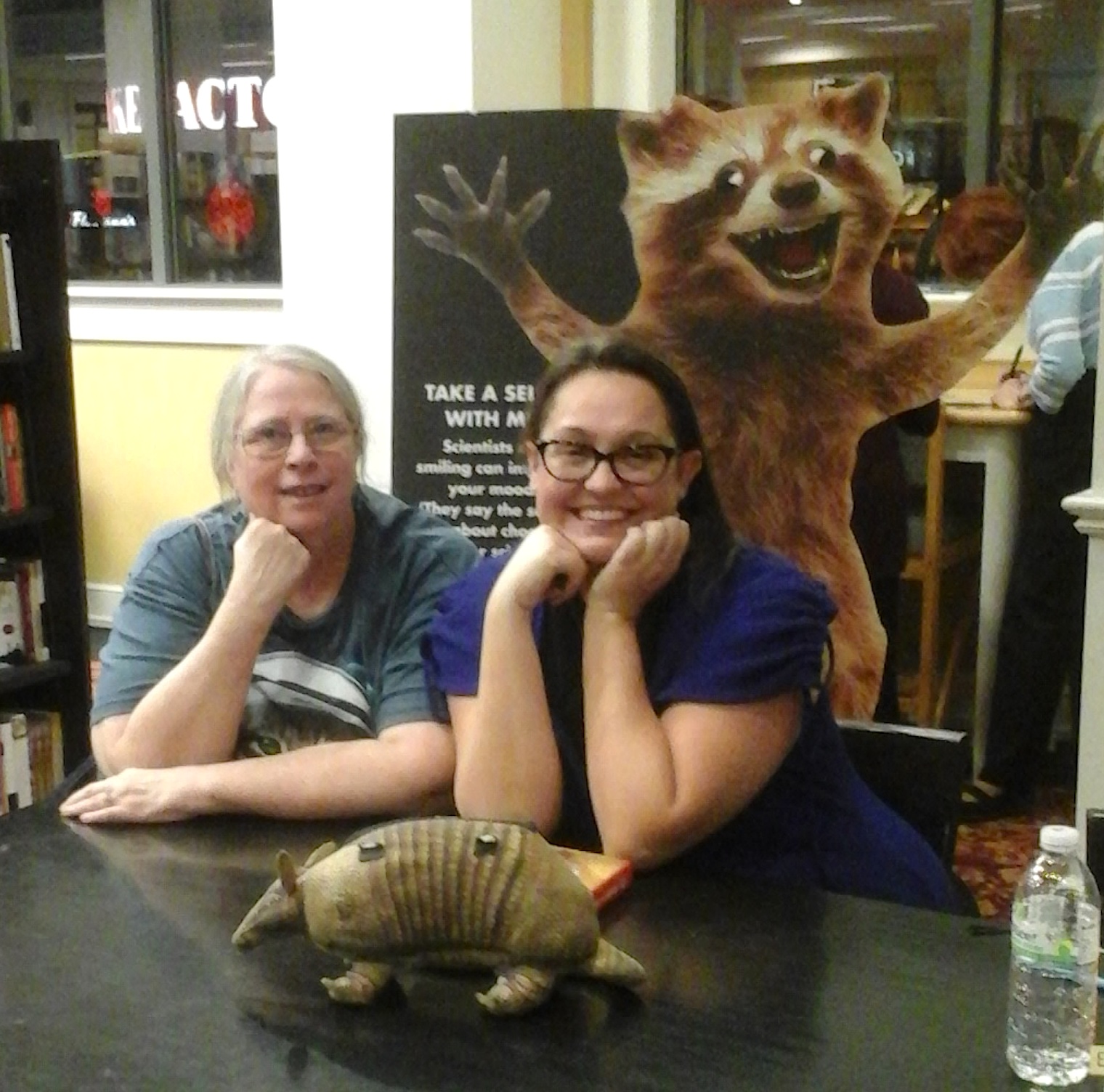
Back row: Rory, the Furiously Happy Raccoon; middle row: me, Jenny Lawson; front row: Erma the Armadillo

Back row: Rory, the Furiously Happy Raccoon; middle row: me, Jenny Lawson; front row: Erma the Armadillo

The space at the bookstore was full to overflowing. (People had driven for as much as five hours to see her.) Jenny read two chapters of her new book to riotous laughter and applause. There was a brief Q&A session. (I figured she got the same questions all the time and wanted to ask her something that no one else had. I imagine that writers on tour need a little variety.So I asked: If you could be any animal, what would you be and why? Her answer: A tapeworm, because I could just not move and have people feed me.)

I joined the signing line (#17). She signed my copy of her book (“Our story is not over.”) and I showed her the semicolon tattoo that goes with that saying. She also signed my armadillo purse (Erma) and a piece of glass for my husband, who wants to put it over a picture of her or of a vagina; he hasn’t decided which. She laughed. He was one of the many that ask for perhaps her most famous – or at least most quoted – phrase, “Knock knock, motherfucker.” (It comes from her story about leaving a giant metal chicken on someone’s doorstep. There were also a lot of metal chickens she was asked to sign.) The bookstore personnel made sure that everyone knew it was okay to ask for that. In fact, they announced it just before the signings, reassuring the shy or inhibited.

The title of her new book, Furiously Happy, is Lawson’s way of telling depression to fuck off: If part of her life is misery and pain, she’s going to damn well make the most of the parts that aren’t. And while she’s at it, she’ll spread the word that mental illness is not a thing to be hidden or ashamed of.

This is not to say that her mental disorders are cured or that she no longer suffers from them. She was clearly anxious when reading aloud the two chapters, and visibly relieved when that part of the evening was done. Her strategy is to laugh at mental illness, joke about her meds, and speak bluntly to those in the audience who also suffer or have a person in their life who does.

Furious Happiness is a worthy goal, and her out-there enjoyment of life leads her into some of the hysterical situations she has written about in both books. These are the stories that make you say – only you, Jenny! Then she turns around and tells you that you are just like her in the ways that count.

The readers of her books and her blog – thebloggess.com – have formed an odd mutual support community. Although we may feel alone, Jenny rallies us to be alone together. Since one of the major difficulties with being a psychiatric patient is the feeling that no one else understands or experiences the same feelings, bringing people together in the virtual world or between the covers of a book is a valuable form of networking, especially for those who can’t network any other way.

Myself, I can’t manage the Furious Happiness. Too long dealing with the black dog and relatively little experience of even the mild highs of hypomania have left me depleted. Jenny will just have to do it for both of us. This is not to say I don’t love her or her work. I do, despite the blog post that I wrote, “Seven Reasons I Hate the Bloggess” (http://wp.me/p4e9wS-56). I can see myself in her and her in me, but for the moment I’m not able to follow her exuberant example. But she gives me hope. And I’m sure that’s one of her most important goals.

The Wrong Life

Nothing prepared me for this.

This is not the life my upbringing prepared me for. I don’t just mean the special guest speakers we had in home economics class who tried to introduce us to the subtleties of silver, china, and stemware. No, I was also misled by the books I read.

If Life Is a Bowl of Cherries, What Am I Doing in the Pits? and Please Don’t Eat the Daisies led me astray. Don’t get me wrong, I’m a total fan of Erma Bombeck’s writing style, but the quirky suburban life she loved and lamented was not what I got. Bombeck and Kerr both made light – and fortunes – of portraying the petty foibles and cute misunderstandings of women and their husbands, women and their children, women and their neighbors, women and other women.

Daily disasters with dishwashers, sticky-fingered children, and clueless husbands were an endless source of amazement and amusement for them. They soldiered on, supported by an innate buoyancy, faith in the divinity, and the occasional glass of wine.

My glasses of wine have been more than occasional. My disasters have not been humorous. I do not have children, and the cats are somewhat deficient in making adorable conversation in high-pitched, lisping voices. Sometimes all I can get out of them is “meh,” which is pretty much how I feel too.

As for the trappings of the genteel life, we eat off paper plates more often then not. I did once have a set of Limoges, but only because I was acting as a pawnbroker for a friend who needed ready cash. I fed one of the cats on the Limoges saucer, just to say that I had.

My parents used to say that their house was decorated in early married junk and I have followed in that fine tradition. Most of our furnishings are a demonstration of the maxim: If it’s not from Kmart or Goodwill you won’t find it here.

No one’s life prepares them for clinical depression, hypomania, bipolar disorder, or any other mental illnesses. I’ll wager that even psychologists’ kids don’t have a clue when they escalate from picking scabs to experimenting with lit cigarettes. Maybe their parents don’t either.

Either the mental disorder has been going on so long that you don’t know what it’s like without it, or it comes on so suddenly that you desperately hope that it goes away just as suddenly. Or it comes in a way that you can just convince yourself is no big deal. “I overspend? That’s just because I love shopping, not because I have mania or need to validate myself with expensive things.”

Perhaps people who grow up with a mentally disturbed loved one have a chance of understanding the underlying mechanisms. But with the number of families who don’t discuss the “elephant in the room,” or pass it off as, “Your sister is just high-strung” or say, “Uncle Ted is a little odd. Just ignore him,” not even that exposure may help.

How do young people learn about mental illness? Or even – gasp! – get help for one? If not at home, maybe at school? The National Association of Secondary School Principals cites the U.S. Surgeon General’s report saying that “one in five children and adolescents will face a significant mental health condition during their school years” and that the ratio of school counselors to students is 471:1. Add to that the fact that most school counselors have been shifted away from offering personal and emotional support to offering academics-only services. (http://www.nassp.org/Content.aspx?topic=57948)

Most of us struggle alone. Some never find a proper diagnosis and treatment. We have to be our own resources and our own advocates much of the time, even if our illnesses do not allow us to get out of bed. If we have one family member – or even a close friend – who understands, we are lucky beyond measure.

I wish that I had been even slightly prepared for the life I now lead, instead of the one I was “supposed” to have. No one can predict the future, but why can’t we at least have a bit of mental health education in school? I suppose that’s a lot to ask, when even sexuality education varies from the merely adequate to the appalling, when schools are barely able to stay abreast of the teach-to-the-test curriculum, and when Texas’s governor vetoes a bipartisan bill allocating resources for mental health, based on lobbying by Scientologists.

Do I sound bitter because I didn’t get to live the genteel suburban life? Probably. But there are aspects of that life that likely would have actively impeded my search for mental health. So I’ve had to do it on my own, or nearly so, at least until recently. A lot of us go DIY for mental health.

But a lot of us are accomplishing it. Living the life we have and not some fictitious pie-in-the-sky one. We may not have been prepared for it, but we muddle through anyway – and sometimes even realize that imperfect real life is better than a perfect lie.

Confessions of a Crazy Cat Lady

One can be a crazy cat lady without living alone in a cavernous house with a dozen or more cats. I should know. I am one, and I don’t.

First let’s start with definitions. I’m crazy. I think we all know that by now and I don’t mind saying so. (See “Yes, I Am Crazy. Thanks for Asking” http://wp.me/p4e9Hv-4h.) I’m also a cat lady. We had dogs growing up, but I never got very close with them. I did have a rabbit that I was awfully fond of, but this was in the days before lop-eared rabbits became house pets. She lived in a cage in the garage, or in the back yard when the weather was nice.

To me a crazy cat lady is someone who has eight or more cats, lives alone with them, usually in a large house, but one not quite big enough for all the inhabitants. Often you hear news stories about crazy cat ladies who die alone and are eaten by their cats, or crazy cat ladies whose pets are taken away from them because of inadequate care – especially sanitation.

I have a friend who was had more than eight cats at once, and is just as crazy as I am. She does not, however, believe that she is a crazy cat lady because another lady down the street has more cats. And truthfully, she doesn’t meet the other requirements of crazy-cat-lady-hood. She has a family, and keeps up with the care and feeding of her menagerie.

Do crazy cat ladies have an actual mental disorder? If so, do they all have the same kind? Maybe not. The crazy cat lady on The Simpsons (Eleanor Abernathy) is pretty clearly schizophrenic, though I doubt that many are in real life. Real-life cat ladies may demonstrate obsessive-compulsive tendencies, or their isolation may be due to depression. Or something else entirely.

Psychology Today tells us there is no real basis for the stereotype.

The stereotypic term “crazy cat lady” is used in a pejorative sense to classify an older, female animal hoarder and there is no research to support such correlation. Research on animal hoarding is lacking and there is not one plausible theory that suggests why older females tend to hoard animals more than men.

https://www.psychologytoday.com/blog/when-more-isnt-enough/201106/animal-hoarding-is-there-such-thing-the-crazy-cat-lady

Still, crazy cat lady behavior may be psychologically classified as a “hoarding disorder.” Mother Nature Network reports that the condition…

…is only now getting the recognition that will prove helpful to sufferers. Recent research has revealed abnormal brain activity in people with hoarding disorder. And both experts and hoarders hope and believe that the new DSM classification will help bring about better treatment.

Read more: http://www.mnn.com/health/fitness-well-being/stories/crazy-cat-ladies-to-get-a-new-clinical-definition#ixzz3nG9WWESM

I would make the case that crazy-cat-lady-hood is actually a defense against mental disorders. Carried to an extreme, perhaps, but beneficial nonetheless.

Caring for cats – even multiple ones – gives a person another living being to care about. Patients in geriatric facilities are often brought into contact with small domesticated farm animals or cats and dogs (therapy animals), which pretty clearly help them deal with isolation and depression.

For an isolated person, cats provide someone to talk to. Not that the cats necessarily listen or respond, of course, except in the most perverse ways possible. They are cats, after all.

I got my first cat when I was living alone and recovering from several years of psychological trauma. My future husband went with me to the shelter, but was studiously unhelpful in selecting a cat, thereby proving that he had some sense and a grasp of how important it was for me to find a kitty I could bond with.

“Which one should I get?” I asked.

“Gee,” he replied, “I dunno, honey. They all look like nice cats to me.” The one I chose was Bijou, a tortoiseshell.

We as a couple have since had up to five cats at one time, and through the years a total of well over a dozen.

When my bipolar disorder was at its worst, after I had suffered a major meltdown (nervous breakdown, decompensation, or whatever you call it), I was certainly crazy, but hardly a cat lady. I was unable to take care of my own daily needs, much less those of anyone else, human or feline. My husband, who was taking up enormous amounts of slack, took over pet care as well. Now that I’m back on a fairly even keel, I can do my part with feeding, litter box tending, grooming, and so forth.

Fortunately, even when I was immobilized, my cats, in addition to my husband, gave me emotional sustenance. The therapeutic effects of a purr, a gentle kneading, and a nice snuggle are not to be underestimated. The antics of a kitten may be exhausting to watch, but they provide more than a little distraction, if that’s what you need.

Do dogs have the same therapeutic effect? I don’t know. For some people I suppose they do, but I have never bonded with a dog as I have with my cats.

In psychological terms, my cats are “comfort objects,” like furry, living security blankets, or teddy bears that shit and meow. I hope never to be without a cat again. I need them for my mental health.

The Quest for a Psychiatrist

I have been seeing Dr. R. for eight years. He helped me through my major meltdown and skillfully, gradually mixed the cocktail of medications that would get me and keep me functioning at an acceptable, livable level. He got me through my near-brush with ECT (although he also suggested it).

Dr. R. is moving to another state. He sent all his clients a letter listing half a dozen or so local psychiatrists he could recommend, though he didn’t know if they were accepting new patients or what insurance plans they took. This week was my last appointment with him.

I looked at the inch-thick file he was holding. “I was really messed up back then,” I said.

“Yep,” he replied.

I left with a hearty handshake, good luck wishes, a paper stating my diagnosis (bipolar disorder, anxiety disorder – I guess there was no insurance code for bipolar 2) and six months of refills on my prescriptions. That’s how long I have to find a new psychiatrist.

So where will my inch-thick file end up next? That’s a good question.

I’ve written before about finding a psychotherapist (http://wp.me/p4e9Hv-1m), but oh, I hate the process of finding and breaking in a new shrink.

At least this time I probably won’t have to go through the whole Reader’s Digest Condensed Version of my screwed-up life, since what I really need at this point is someone who will prescribe and monitor my meds, though it will also be nice to have someone standing by in case of another major meltdown, should I have one.

My first avenue of exploration is whether my primary care physician will prescribe my psychotropics, so I can continue with just a psychotherapist. Dr. R. says that most GPs would shy away from the somewhat lengthy list of meds, but every time I see Dr. S. I update him on what meds I am taking, and I always mention the psychotropics, which have mostly been the same for years.

I have an appointment to see Dr. S. next month and sent a query about the prescription issue (his office has a robust online presence), so with luck, I may have a solution before Halloween.

My next step would be to start with the list that Dr. R. provided. Only one of the offices is at all close to me and I’ll likely start there. Does the doctor accept new patients? Does the practice take my insurance? What’s the charge if they don’t?

I’ll also need to contact my insurance provider for a list of local psychiatrists who do take that insurance, but with that I’ll be flying blind. Dr. R.’s recommendations are people he knows, and knows are good.

I hope they’re as good as Dr. R.

A Tattoo Is for Life…

…this one, especially so.

As soon as I learned about the semicolon tattoo, I knew I had to get one – and not just because I’m a huge grammar nerd. Because I’m bipolar and want to spread the word about mental health issues.

In writing, the semicolon indicates a place where a writer could have finished a sentence, but instead chose to go on. This makes the semicolon an effective and beautiful symbol for suicide prevention efforts and those who struggle with mental disorders.

Every day we choose to get out of bed; choose to take our medications; choose to make and go to our therapist appointments; choose to live another day; and choose to go on with our story.

This is not something I invented. Here are the people behind it: http://www.projectsemicolon.com/. And here are some stories about the phenomenon that have been working their way through the media and around the internet.

http://www.upworthy.com/have-you-seen-anyone-with-a-semicolon-tattoo-heres-what-its-about?c=ufb1

9 beautiful semicolon tattoos our readers shared to destigmatize mental health challenges

Here is my story.

I am possibly the last person you would ever expect to get a tattoo. I am probably the last person I would ever expect to get a tattoo. I’m in my 50s, a former English teacher, married for over 30 years, fond of reading and word puzzles and cats.

Nevertheless, the professionals at Monkey Bones Tattoos in Beavercreek, OH, did not seem surprised when I showed up one day and presented my wrist.

The naked wrist.

The naked wrist.

When I explained what I wanted – to put down a deposit and book an appointment to get a semicolon tattoo – I learned that they had a cancellation and could ink me right away.

What the hell, I thought. Might as well. I had learned about the tattoos about a month before and had thought it over plenty. It was by no means a spur-of-the-moment (or drunken) impulse.

Mike Guidone showed me into his studio and explained the procedure.

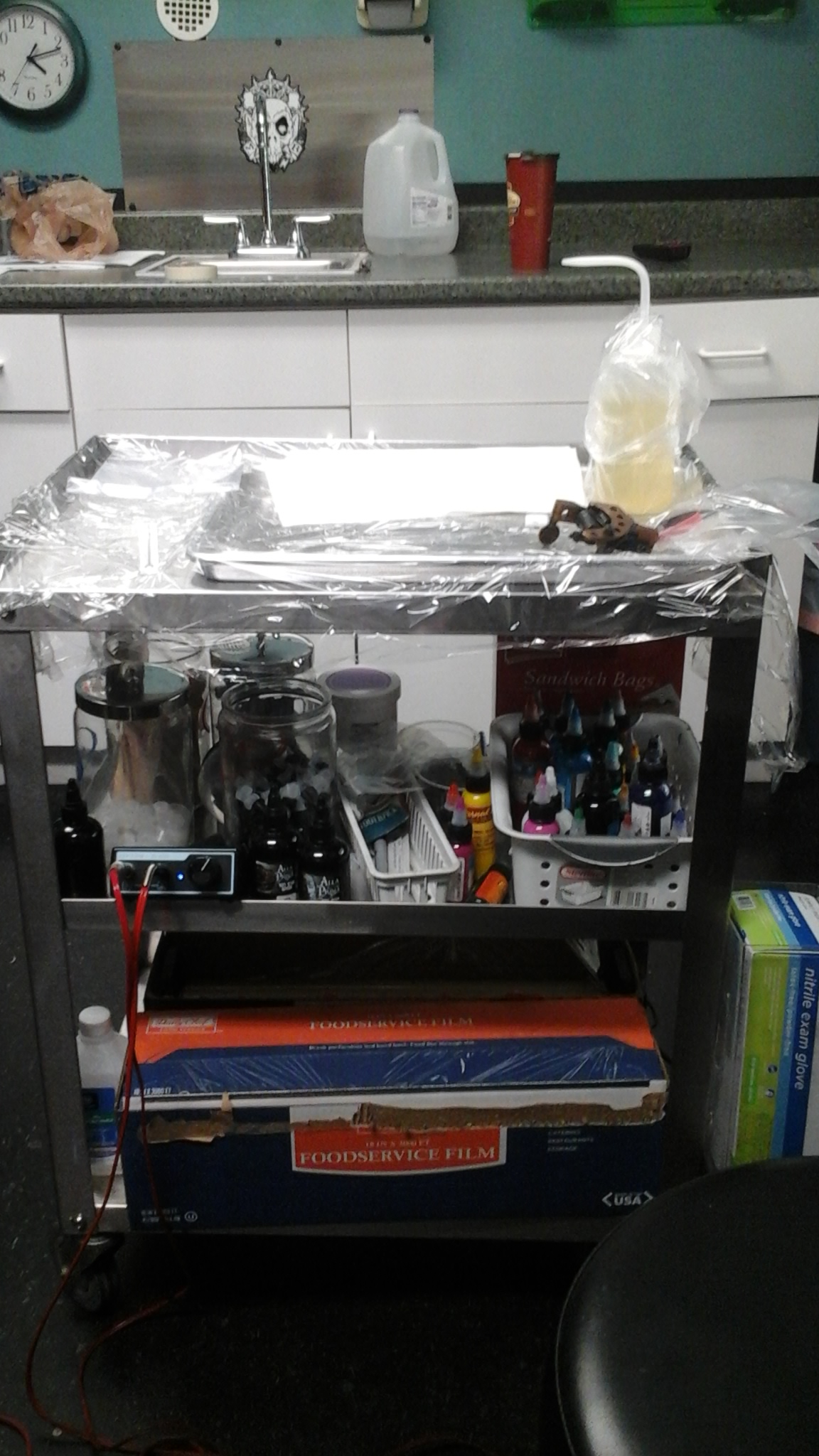
The tattoo artists work station.

The tattoo artist’s work station.

He presented me with stencils of three different sizes of semicolons. I chose the in-between one. My wrist is fairly small, so the big one would have looked out of place, but the small one wasn’t noticeable enough. The idea is for people to see it and ask, so you can share the meaning and talk to them about mental health and combatting the stigma.

I sat in the dentist-type chair, listened to a brief explanation, got answers to some questions, and was ready to start.

In progress.

Did it hurt? Not particularly. It was a feeling between a scratch and a sting, and took only about ten minutes. Some aftercare instructions and I was done.

finished1

Success!

Then I paid ($80, the shop minimum), tipped Mike, and was on my way. Now I care for the tattoo while it heals, anointing it with unscented lotion several times a day, avoiding sunlight or soaking, and trying my very best not to scratch or pick at it.

The results.

The results.

Am I happy with it? You bet!

And, like I said, it’s for life! My story isn’t finished yet.