Bipolar 2 From Inside and Out

Posts tagged ‘hypomania’

Bipolar Basics for the Newly Diagnosed

If you have recently been diagnosed as bipolar, there are a few basics you should know. You’ll likely find them out on your own, but it might take a while.

So, here are some tips.

    1. Being bipolar isn’t necessarily a tragedy. It’s a chronic illness. At times it’s better, at others, worse. It’s not a death sentence and it’s treatable. You can still live a reasonably full and satisfying life.
    2. You need help. To live with bipolar disorder, you need a support system. Unfortunately, your friends and family may not be all that supportive. Fortunately, there are online support groups. But the most important parts of your support system, at least at first, are your psychiatrist and your psychotherapist. I recommend having one of each – psychiatrist for medication, therapist for talk or cognitive behavioral therapy, or whatever works for you.
    3. You will most likely need medication. And the odds are good that you will need it for the rest of your life. Don’t panic. After all, diabetics need insulin, usually for life. You may hate taking pills, you may hate the idea that you are dependent on them, you may hate the fact that they remind you of your brain’s difficulty functioning. But realize that meds will make your brain’s functioning less difficult. They are worth the hassle.
    4. Everyone is different. Everyone’s symptoms are slightly different. Everyone’s medications are slightly different. Everyone’s reactions to their medications are slightly different. A support group can help you with general information, but they cannot tell you what is ultimately best for you. Your particular symptoms and your unique version of bipolar disorder may well require different medications, in different amounts, than your friends. And you may have different reactions to them. Some pills have no effect at all on one person and are life-savers for another.
    5. Getting better takes time. Once you have your diagnosis and your medication, don’t expect to feel better quickly. Most medications for bipolar disorder take a while to build up in the body. Six weeks is not unheard of. Then your doctor may assess how well the medication is working, and change the dose or even the medication itself. Then you may go through another six weeks of waiting for the new dose or drug to take effect. Each case of bipolar disorder requires a medication regimen tailored specifically to the individual, and that often takes some doing.
    6. There are several different types of bipolar disorder. The two main types are called type 1 and type 2. Type 1 is the classical bipolar disorder, which used to be called manic-depressive illness. Type 2, a more recently identified version of the disorder, often manifests as mostly depression, possibly with hypomania, a less severe version of the ups that accompany bipolar 1. Other forms of bipolar disorder are rapid cycling, in which one’s mood states alter quickly, even within a few hours. Another version of bipolar disorder is called mixed states. Mixed states occur when a person experiences both extremes of emotion at the same time – for instance, depression and irritability, or fatigue despite racing thoughts.
    7. The odds are that you already know someone with bipolar disorder, or at least some kind of mood disorder. One in four Americans will have a psychiatric or emotional illness at some time during their lives. Because we don’t talk about it, though, no one may ever know. Especially when the disorder is treated properly, a person with bipolar illness can maintain function in society and choose whether or not to share the diagnosis with friends and coworkers. Many people choose not to because of the stigma surrounding mental illness. It’s a valid choice, but it cuts the bipolar person off from possible support and understanding from others who may share the disorder.
    8. Relationships can be difficult but not impossible. Relationships are difficult for everyone. People with bipolar disorder have relationships that are difficult too. The disorder may make the relationships even more difficult, especially when the family member or loved one or even close friend does not understand the symptoms, the medication, the mood swings, the anxiety or fatigue, or all the other facets of bipolar. The best cure for this is education. However, it may not be possible for a relationship to survive bipolar disorder, just as a relationship may not survive trauma, grief, addiction, infertility, incompatibility, meddling relatives, infidelity, parenting, or a host of other conditions. It may be better to look at all the circumstances surrounding a troubled relationship rather than automatically blaming bipolar disorder for difficulties.
    9. Learn all you can. Because bipolar disorder is so little understood by the public, because it manifests differently in nearly every case, because a person can be actively suffering or in remission, because a person may have any of the different types of bipolar disorder, because everyone is different – the need to educate yourself and probably those around you is essential. The more you know, the less you’ll panic when a symptom you haven’t experienced before suddenly hits. Rely on reputable sources. Medical, psychiatric, or psychological websites are usually the best. Support groups can offer much information, but the people in a support group may not be any more well-informed than you are. And there are lots of people selling “miracle cures” that can lure a person away from needed medication and other services.
    10. Keep trying. It’s hard. It’s frustrating. It’s difficult. It’s painful. It’s confusing. But bipolar disorder is something you can live with, and even something you can rise above. The secret is to keep trying. Keep seeking out therapy and friends who support you. Keep taking your medication, even if you don’t want to. (Stopping your medication without advice from your doctor can be dangerous, so don’t try that.) Be stubborn. When you feel like giving up, tell yourself that maybe things will get a little better in the morning. Hang in there. You may not realize it, but there are people who need you in the world, who need you to be functioning and happy, who need you to keep fighting the disorder.

Do you have any other tips for the newly diagnosed? Please share them in the Comments section.

Am I Ready to Stop Therapy?

I got my first hint that I might be ready to stop therapy when I realized how little I was going. Over the years I have scaled down from weekly sessions to biweekly.

Then I noticed that, effectively, I’ve been going only once a month. I’ve been forgetting appointments, showing up on the wrong day, oversleeping, feeling poorly physically, or having too much freelance work to do.

Of course, those could be signs that I’m in denial, that I’m resisting therapy, that we’ve hit a bad patch of difficult issues and I just don’t want to deal with them.

But I don’t think that’s what’s happening. Here’s why.

I’m stabilized on my medications and they’re effective. When my psychiatrist moved away a few months ago, he left me with enough refills to last until this month and a list of other psychiatrists. My PCP agreed to prescribe my psychotropics if I lined up another psychiatrist for emergencies. I’ve done that, though I couldn’t get an appointment before March.

And that doesn’t alarm me. I don’t have the oh-my-god-what-if-my-brain-breaks-again panics. I don’t have the feeling that my brain is about to break again. I’ve thought about it, and I’m comfortable with letting my involvement with the psychiatric profession fade into the background of my life.

As long as I keep getting my meds.

I have more good days and I’m beginning to trust them. Oh, I still question whether I’m genuinely feeling good, happy, and productive or whether I’m merely riding the slight high of hypomania. But really? It doesn’t seem to matter very much. A few days ago I reflected on a string of particularly good days – when I accomplished things, enjoyed my hobbies, and generally felt content. And I simply allowed myself to bask in those feelings.

That’s not to say I don’t still have bad days. After a few days of hypomania, I hit the wall, look around for spoons and don’t find any, and require mega-naps to restore me. (I’m intensely grateful that I work at home and can do that. Most offices don’t appreciate finding an employee snoring underneath her desk. And my cat-filled bed is much more comfy-cozy.)

I still get low days too, but they are noticeably dysthymic rather than full-out, sobbing-for-no-reason, Pit-of-Despair-type lows that last seemingly forever. I know – really know, deep within me – that they will last a day or two at the most. And just that knowledge makes me feel a little bit better.

My creativity, concentration, and output are improving. I can work longer, read longer, write longer, take on new projects, think past today or even next week. I can trust my muse and my energy, if not immediately when I call on them, at least within a reasonable time.

I have trouble remembering how bad it used to be. Recently I’ve made connections with several on-line support groups for bipolar and mental health. I find I’m astonished at the crises, the outpourings of misery, the questioning of every feeling and circumstance, the desperate drama of even the most mundane interactions. They are overwhelming. But I realized that it’s been a long time since they’ve overwhelmed me. I recognize that I could some day be in that place again – that’s the nature of this disease. But I have a good support system that I trust to help me not fall too far without a net.

I don’t have much to talk about when I go to therapy. There are issues I need to work on – getting older, getting out of the house more, reclaiming my sexuality. But most of those I feel competent to work out on my own.  My sessions are mostly an update on what’s going on in my life at the moment, plus a recap of my recurring problems. But those problems are ones I’ve faced before and know how to cope with. I already have the tools I need and use them without needing a reminder.

So I’ve talked it over with my psychotherapist and I’m not completely quitting therapy, but I am cutting back officially to the once a month I seem to be going anyway. I know that if and when the bipolar starts giving me major trouble again, I can always call for an appointment or a telephone therapy session.

I’m not going to stop writing these posts. I still have a lot to say about where I’ve been, how I’ve got to where I am now, how things will go in the future, and all the many ways that mental illness affects society and vice versa.

You’re not getting rid of me that easily. I’m sticking around.

My New Mental Health Tattoo

Once again I have gotten a tattoo, supporting the cause of mental health.

A few months ago, I became a part of what’s called the semicolon project and wrote about it in this post: http://wp.me/p4e9Hv-9G. For those of you who aren’t up on the terminology, a semicolon tattoo represents mental health awareness, especially erasing the stigma, and suicide prevention.

The semicolon was chosen as the symbol because in writing, a semicolon indicates a place where a writer could have completed – or stopped – a sentence, but chose to go on. The semicolon says, in effect, “My story isn’t over.” The idea is to have the tattoo someplace visible – in my case, on my left wrist – and use it as a conversation starter.

Most people will assume that since I am a huge grammar nerd, my semicolon tattoo is some weird manifestation of love for punctuation. Then I can tell them that it’s a whole lot more. You can find out more about the semicolon project at http://www.projectsemicolon.org/.

My new tattoo represents bipolar disorder. Again it’s made up of punctuation: two colons and a paren. These symbols, unlike the semicolon, have no special meaning in writing and are never seen together in that order. Instead they make up a double emoticon: looked at one way, the colon and paren make up a smiley face. Looked at the other way, a frowny face.

New mental health tattoo

New mental health tattoo

This symbolism is easier for anyone seeing the tattoo to grasp. In a way, it’s a minimalist version of the comedy and tragedy masks you often see in theaters.

Again, it’s a conversation starter. Bipolar disorder is not well understood by the general public. This is particularly true of bipolar disorder type 2 – the kind I have – which many people have never even heard of.

Since I have gone public with having a mental illness, it seems only appropriate to introduce people to the disorder in a way that’s creative, nonthreatening, and understandable.  It’s a lot less abrupt than blurting out, “Hey, I have a mental illness!” Even my mother-in-law recognizes that these tattoos are not just a whim, but for a good cause.

The second tattoo is on my right wrist, so no matter which hand I extend, I can open up new understanding about a very real problem that many people live with daily.

A number of articles have come out lately questioning whether a person who gets a tattoo will regret it when they grow older. I think I can say with complete confidence that I will never regret these tattoos. They say something about who I am, something that will not change as I grow older. The disorder will always be with me and so will these symbols. For the rest of my life I can use them to educate, identify with other bipolar people, and remind myself that wrists are not for cutting.

I will say, however, that whoever thinks of these things had better put the brakes on new mental health-related tattoo designs – especially those made of punctuation – or I will soon become the illustrated editor/blogger. At the moment I have no plans for any further ink. My friends, however, tell me that tattoos are addictive. So we’ll see.

A few notes, since everyone asks: These simple tattoos take 10 minutes or less to apply. They hurt a little bit, but not much – a stinging sensation. They may fade a bit at first and need a touch-up. Because they are so quick and simple, you will not pay a lot to have them done. After you get the tattoo you have to take care of it while it heals, moisturizing it regularly for the first 3-6 weeks or so.

If you decide to get a tattoo, check out the studio before you have it done. It should be a professional operation, with high standards of cleanliness and concern for health. Tattoo artists should wear surgical gloves and change them frequently. There may be a consent form to fill out, indicating that you know what you are getting into, and even indicating whether you have various medical conditions or allergies, or have drunk alcohol within the previous eight hours. A reputable tattoo studio will not work on a drunken client.

Do you have a tattoo related to mental health? I’d love to hear about it. But don’t tell me if it’s more punctuation. I only have two wrists.

The Bloggess and Mental Health

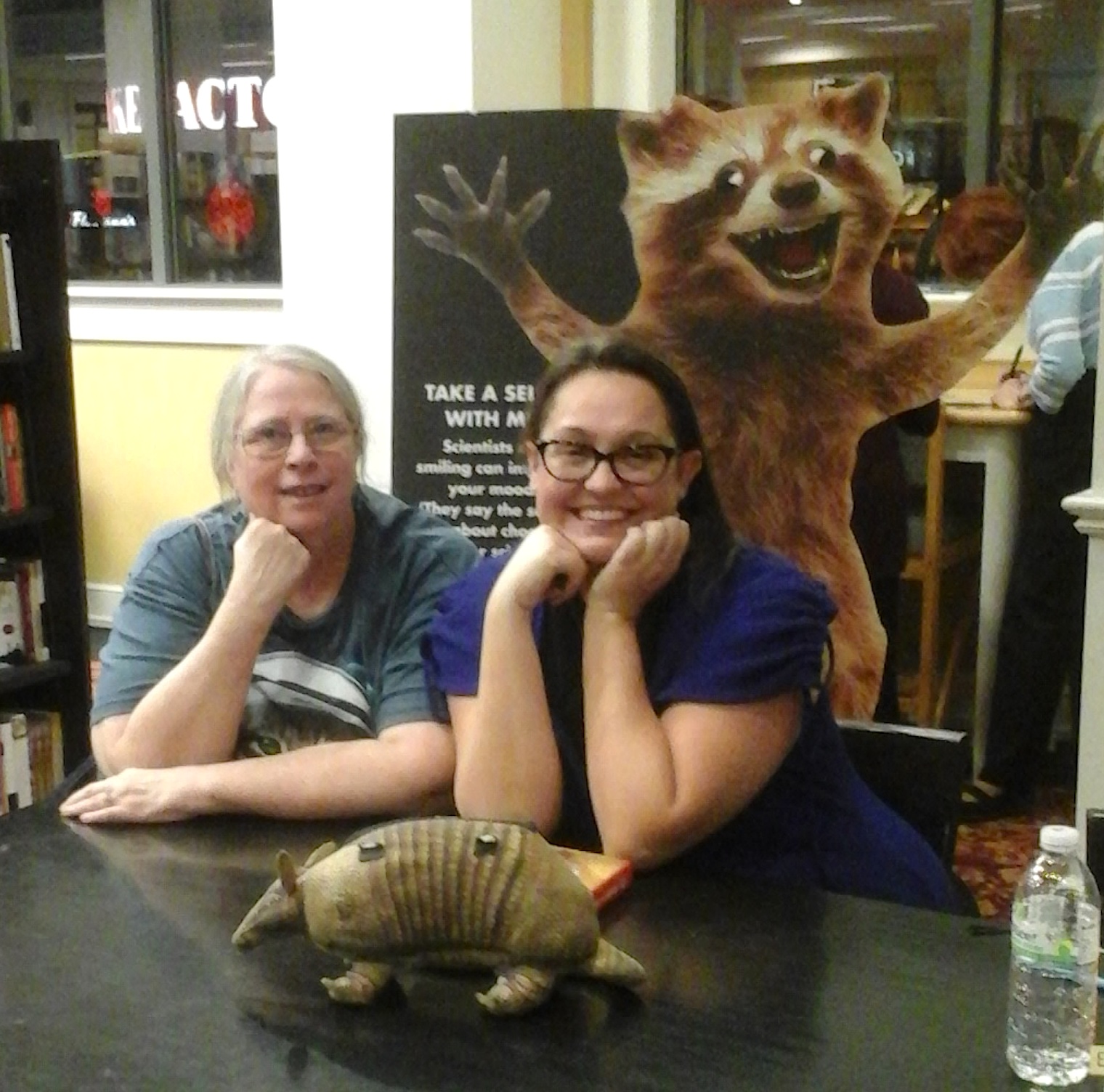
I met the Bloggess (aka Jenny Lawson) recently at a book signing for Furiously Happy, her second book. (Her first book was Let’s Pretend This Never Happened.)

Back row: Rory, the Furiously Happy Raccoon; middle row: me, Jenny Lawson; front row: Erma the Armadillo

Back row: Rory, the Furiously Happy Raccoon; middle row: me, Jenny Lawson; front row: Erma the Armadillo

The space at the bookstore was full to overflowing. (People had driven for as much as five hours to see her.) Jenny read two chapters of her new book to riotous laughter and applause. There was a brief Q&A session. (I figured she got the same questions all the time and wanted to ask her something that no one else had. I imagine that writers on tour need a little variety.So I asked: If you could be any animal, what would you be and why? Her answer: A tapeworm, because I could just not move and have people feed me.)

I joined the signing line (#17). She signed my copy of her book (“Our story is not over.”) and I showed her the semicolon tattoo that goes with that saying. She also signed my armadillo purse (Erma) and a piece of glass for my husband, who wants to put it over a picture of her or of a vagina; he hasn’t decided which. She laughed. He was one of the many that ask for perhaps her most famous – or at least most quoted – phrase, “Knock knock, motherfucker.” (It comes from her story about leaving a giant metal chicken on someone’s doorstep. There were also a lot of metal chickens she was asked to sign.) The bookstore personnel made sure that everyone knew it was okay to ask for that. In fact, they announced it just before the signings, reassuring the shy or inhibited.

The title of her new book, Furiously Happy, is Lawson’s way of telling depression to fuck off: If part of her life is misery and pain, she’s going to damn well make the most of the parts that aren’t. And while she’s at it, she’ll spread the word that mental illness is not a thing to be hidden or ashamed of.

This is not to say that her mental disorders are cured or that she no longer suffers from them. She was clearly anxious when reading aloud the two chapters, and visibly relieved when that part of the evening was done. Her strategy is to laugh at mental illness, joke about her meds, and speak bluntly to those in the audience who also suffer or have a person in their life who does.

Furious Happiness is a worthy goal, and her out-there enjoyment of life leads her into some of the hysterical situations she has written about in both books. These are the stories that make you say – only you, Jenny! Then she turns around and tells you that you are just like her in the ways that count.

The readers of her books and her blog – thebloggess.com – have formed an odd mutual support community. Although we may feel alone, Jenny rallies us to be alone together. Since one of the major difficulties with being a psychiatric patient is the feeling that no one else understands or experiences the same feelings, bringing people together in the virtual world or between the covers of a book is a valuable form of networking, especially for those who can’t network any other way.

Myself, I can’t manage the Furious Happiness. Too long dealing with the black dog and relatively little experience of even the mild highs of hypomania have left me depleted. Jenny will just have to do it for both of us. This is not to say I don’t love her or her work. I do, despite the blog post that I wrote, “Seven Reasons I Hate the Bloggess” (http://wp.me/p4e9wS-56). I can see myself in her and her in me, but for the moment I’m not able to follow her exuberant example. But she gives me hope. And I’m sure that’s one of her most important goals.

Social But Spoonless

In the past week I have been out of the house more and seen more people than I have in years. It’s almost like having a social life.

In the past week I have also slept more than I usually do in my sloth-like, torpid existence.

I think the two are not unrelated.

If you follow Spoon Theory (http://www.butyoudontlooksick.com/articles/written-by-christine/the-spoon-theory/) you know that each spoon represents an amount of coping that you can do.

Every day you get a certain number of spoons – not the same number every day.  You use them to perform everyday tasks that most people think nothing of – things like getting out of bed (some days you don’t even have that spoon), taking a shower (1/2 spoon for Janet’s patented “super-fast smelly-bits sink wash-up”), getting dressed, finding something to eat, fixing that something (keep a box of Cheerios by the bed in case you run out of spoons at this point), and all that is without even leaving the house. Some days that’s all the spoons you have and when you’ve used up your spoons, that’s it.

Other days you can manage to do all that and leave the house, go to work, run errands, and assorted other normal activities. But for those of us who have mental disorders, such days are few and far between.

You hear depressed people talk of not being able to get out of bed, and for the most part that’s caused by lack of spoons. I am usually notoriously low on spoons. My husband now understands Spoon Theory and we use it as common shorthand for “I’m too tired” or “That’s all I can handle right now.”

Dan, however, is an over-scheduler and I often have to rein him in by pointing out that his proposed slate of activities will not be possible because I, for one, will run out of spoons, and he may too.

The dry run for my recent spurt of socializing began last week. After I went for my final session with Dr R., I managed a trip to the bank, a trip to the place where I could pay my power bill, and since it was right next door, a stop at Kmart to buy underwear. It was a good thing that was a hypomanic day, but it floored me for the rest of that day and the next. And it started a cycle of bipolar up-and-down oscillations that were clearly related to spoon usage.

My spate of social endeavors started with a double-header. On Saturday I had lunch with a friend at a favorite restaurant I almost never get to go to. We talked about politics, social issues, and book proposals. Then I went home and had a little nap.

That evening Dan and I went to Monkey Bones for Zombie Dogz. I know that takes a little explaining. Monkey Bones is the tattoo studio where I got my semicolon tattoo (http://wp.me/p4e9Hv-9G). Zombie Dogz is a local food truck. (Also, it’s fun to say “We went to Monkey Bones for Zombie Dogz.”)

Notice that in a single day I had to get up, out of bed, and get dressed twice. That’s a lot of spoons. Sunday I was not able to get out of bed at all.

Monday did not involve socializing, but it was another hellacious spoon-eater. Dan and I spent the day scrounging for documents and information that the IRS wanted. It was taxing. (See what I did there?)

Tuesday was an extra-special social event, though it did not involve getting dressed and going out, or even interacting with other people. It was Jenny Lawson’s online book launch party. Better known as the Bloggess, Jenny has severe social anxiety. At this stage in my life, I certainly would not be able to dress up, mingle, and make polite conversation with both friends and complete strangers. The online party was a genius idea.

I sat at home in my pajamas with some red wine while the Bloggess read chapters from her new book, Furiously Happy. (You should get it, by the way. It’s about mental illness, but funny.) As low-key a social situation as that was, it still used up spoons because it was something I had never done before. Making sure I had the right URL, converting Central Time to Eastern, not being able to ask questions because I don’t Tweet, worrying that Dan was getting bored – not a lot a lot of spoons, but still some.

The effects were getting cumulative. Again I was unable to get out of bed the next day. In fact, Dan and I both slept away most of the daylight hours. For him it’s understandable because he works third shift, but I have no such excuse. Except that if you borrow from the next day’s spoons, or try to keep going without them, you will pay.

Thursday, I was determined, with or without spoons, I was going to meet a friend for coffee. I’ve seen her only once, briefly, in several years. In a way, it was a test of my ability to maintain anything approaching a real social life.

I put forth the extra effort because a mutual friend cut her ties with me because I canceled so often on social engagements. I suppose I really have nothing to prove to anyone but myself but it seems important that I do so. It’s not like coffee with a friend is an ordeal or anything. It’s just that I know I’ll be using a spoon for more than stirring my coffee.

And I hope I have enough spoons left over to work on my other blog.

When Anxiety Attacks

I was grocery shopping and when I came to the cereal aisle, I found myself light-headed and breathing raggedly.

My husband dropped a knife in the kitchen; I jumped and all my muscles tightened up.

We were driving down the highway, when suddenly I flung my arms out to the side and gasped loudly.

In none of these cases was anything actually wrong. (Although the incident in the car nearly caused an accident when my husband turned and yelled, “What? What?”)

My depression has always been accompanied by anxiety. That’s one of the reasons I was later given a diagnosis of bipolar disorder, type 2. It seems that, where other people get hypomania, I get anxiety. (There is a thorough explanation of bipolar disorder and anxiety (or “mixed states) at http://psycheducation.org/diagnosis/mixed-states/anxiety-and-bipolar-disorder/.)

I have had generalized anxiety, where I have no idea whether anything specific is actually wrong or doom is impending. I have had phobic-type anxiety, where I imagine that any bee in the neighborhood is going to choose to sting me and I freeze up. I have had anxiety reactions to loud noises or sudden movements, where I feel like I’m jumping out of my skin and actually do physically jump. And I’ve had irrational moments of anxiety, as when I can’t sleep because I don’t know where I put my passport. (Naturally, I have to get up and look for it.)

Now that I am relatively well controlled on medication, the various anxieties don’t plague me nearly as much. And I’ve developed coping mechanisms for a number of them. For example, when I get anxious in the car on the highway I no longer fling out my arms and gasp. My husband notices my tension and asks if anything would make me feel better. “Drive in the other lane,” I say, “and not next to the concrete divider.” I take an extra Ativan (which my doctor allows) before social events I can’t avoid. My husband warns me if he is going to hammer a nail in another room, or reassures me that the cat just knocked over a glass.

I still don’t know what was going on in the cereal aisle. I thought it might be the imposing wall of large, brightly colored boxes, visual noise that seemed to overwhelm me. My therapist at the time said that it was likely that I was just having a random anxiety attack and happened to be in the cereal aisle when it happened. After that I associated the two.

Now I’m not sure. I may have been right about the visual noise. Auditory noises certainly provoke anxiety in me, and I know that some people on the autism spectrum can be overwhelmed by visual stimuli. (I’ve never been diagnosed on the autism spectrum, but I do share certain traits with Aspies.)

I think the anxiety will always be with me, to some extent, just like the depression. My meds make them bearable and my ways of handling them improve. But I don’t think I’ll ever get used to the fact that there are bees, wasps, and ticks in the world, all of them with a thirst for my blood.

Mini-Meltdowns and Many Meltdowns

When my brain broke back in 2001 or so, I thought it was the first time that had happened. Later, on reflection, it turned out that wasn’t so.

The 21st-century breakdown was certainly the most dramatic. Although I had just quit working in an office to start a freelance career, I found myself unable to work after a few months.

I had become unable to work in the office because of mounting difficulties that I now realize were warning signs of the impending breakdown: inability to concentrate, increased anxiety (the feeling that an angry badger was about to claw its way out of my stomach), lessened ability to interact with coworkers, sudden flares of temper, turning people away with unintendedly cutting remarks and sarcasm, isolating, inappropriate affect, catastrophizing – you name it, I had it.

What was causing all these symptoms? My bipolar disorder, obviously. But I’ve had that for years. What was pushing me over the edge this time? I had trouble at work. My boss left and, when I “came out” to my new boss as depressed (which is what I was diagnosed with at the time), she reacted with wariness and incomprehension. She gave me the first bad review I ever had at that job.

My mother’s health was deteriorating seriously, too, about then. I lost time at work taking her to various appointments and I had to have “the talk” with her about how much longer she could live alone. Eventually I took over her finances – and by then I was scarcely handling my own.

I experienced a lift when I quit my job and began freelancing. Hypomania? You bet! My new flexibility allowed me to take better care of my mother, and the assignments kept coming in.

Then everything came crashing down. I screwed up my finances and my mother’s. She began having worse falls and injuries, hospital stays and drug reactions, even hallucinations which scared the hell out of me. I emotionally judo-ed my sister to come up and help, then fought with and resented her, and had to take care of parts of her life as well.

Those and other difficulties on top of my mental disorder added up to a non-functioning me. I dumped all the chores and coping onto my husband, which was a rotten thing to do, fought with him, sobbed for no discernible reason, became unable to work, or care, or do much of anything except think up at least three different ways (and reasons) to kill myself. Fortunately, I was too immobilized to try any of them.

I’ve written before about the things that helped me get back to some kind of functioning – a proper diagnosis, the right meds, time without work (as we gutted our retirement savings), lots of psychotherapy, and my wonderful, patient, ever-helpful, devoted husband.

But now, looking back, I can see that it had happened before, though not so dramatically and completely. In childhood, in my teens, in college – at every stage of my life I had at least one breakdown, often triggered by the circumstances of my life, but fueled and stoked by my mental illness. In every one, my ability to function deteriorated a little more.

The first one that I remember clearly was when I was around 12. My best friend and I were in charge of a birthday party for her younger sister and some friends. This was the old-fashioned kind of party that everyone in the neighborhood had then: cake and ice cream, party games, presents, and not much else. It happened during pin-the-tail-on-the-donkey. I was blindfolded – literally – and my friend kicked me in the ass – again, literally. In front of all those younger children.

I ran home sobbing. And I curled up into a fetal ball and didn’t quit for at least three days. Non-functioning, non-responsive, non-everything. What finally brought me out of it was seeing my mother’s pain at this inexplicable (to her) meltdown.

I had a mini-meltdown in my freshman year of college, which involved sitting in my nightgown in the hallway, staring for hours at a richly detailed poster of a fantasy realm. (I managed to frighten an intruder by arising, ghost-like, in my pale yellow shroud as he entered the suite.)

This one was triggered by my realization that I had probably chosen the wrong major and that there were no job prospects ahead for me. (It turns out I was wrong about that. Maybe I should have stuck with it, but my next choice turned out pretty well.) I took a year off college and took a job as a cashier in a restaurant, where I spent a lot of time crying into the roller towel and being told I should smile more. This convinced me that going back to college, with a new major (and even fewer job prospects), was the right thing to do.

The next meltdown was major. I had finished college, endured a year-long train wreck of a relationship, and lost a job as an assistant restaurant manager (I hadn’t fully learned that lesson yet). I got unemployment, which meant I lay around the apartment for most of the week (except for making half-hearted attempts at job hunting).

One notable symptom of this breakdown was my near-complete immobility. One errand in a day – say, going to the post office for stamps – made it a productive one for me. I had maybe three of those a month, with one being the obligatory visit to the unemployment office – a supremely depressing place to be depressed.

I had some truly irrational thinking that time, too. I thought I could cheer myself up by watching light, fluffy sitcoms on TV. But as I lay there on the couch, I found myself crying with every upbeat, cheery theme song that came with them. Laverne and Shirley making their dreams come true. One Day at a Time, which advised me to get up on my feet because somewhere there was music playing. And, oh, Mary Tyler Moore. Love is all around, my ass.

After that, it was a long, slow slide to my major breakdown. It wasn’t unrelieved misery. I got married. I got a master’s degree and a job in publishing. We acquired a house and cats. We traveled. But the Big One was waiting for me.

Nowadays, I still have mini-meltdowns, but they usually last a maximum of three days, rather than weeks, months, or even years. They still tend to be triggered by stressful life events, especially financial ones. But when I get one, I know I’ll be coming out of it soon. And that’s a wonderful feeling buried in all the misery.


Abilify: The Next Chapter

I’ve been taking Abilify as an add-on to my other psychotropics for about six months now, and I have some pieces of good news to share.

Good news #1: The generic (aripiprazole) is now available! There was a slight delay between the time the FDA gave approval for the generic (April) and the time it went on sale. But now it has arrived in drugstores. (I understand that the same company makes both the brand name and the generic, which strikes me as goofy, but then what do I know about drug marketing?)

Good news #2: Between my insurance and my pharmacy, I now have to pay only $15/month for the generic. The brand-name Abilify was $800 without insurance and $125 with. My insurance is not cheap, though it is still less than the cost of brand-name Abilify. When you add in all my other prescriptions and doctor visits and tests and such – plus all my husband’s drugs and other medical expenses, the insurance suddenly doesn’t seem so pricey. (I got this insurance through the Affordable Care Act, and I hope the Supreme Court doesn’t screw it up for me.)

Good news #3: Despite my tiny dosage (2 mg.) I have noticed significant effects. After six months on the drug, I have more energy, better focus and concentration, and fewer down/useless days (unless I overdo and run out of spoons). (See http://www.butyoudontlooksick.com/articles/written-by-christine/the-spoon-theory/ if you don’t know what I mean by that.)

I’ve been doing major housecleaning/sorting, going out – actually outside the house – to run errands other than my shrink appointments, and I even went to a party – a reunion of people I used to work with. I wore my new skirt, navigated the social milieu successfully, and stayed an hour and a half. (The next day was one of my no-spoons days, though.)

This is only the third time in my life that I’ve noticed a significant effect from taking a new prescription. The first was Prozac (fluoxetine), which felt like looking at a color television after years of black-and-white. With static. Showing only commercials. The second was Lamictal (lamotrigine), which felt like a switch flipping and turning on my ability to think rationally. And now there’s Abilify.

Whatever side effects I may have, I’m willing to live with. (Unless I get the tardive dyskinesia. That would be a deal-breaker.) This feels like real living and I’m happy about it. I don’t think this is hypomania, either. I think I’m supposed to feel this way. I’m going to run with it.

Of course this isn’t the end of bipolar disorder for me, or the end of this blog. I still have plenty to say about my experiences with bipolar depression, mental health in general, and particularly mental health in the media and society.

Sorry if I sound sappy, but it’s good to be alive and functioning!

The Hypomanic Blogger

When I thought I had unipolar depression, I used to wish I were bipolar, on the theory that I could get a lot more done. (I later found that not to be true, as I’m sure many of you can attest.)

I had a lot more experience with depression than with mania. My bipolar disorder is Type 2, which means I get hypomania instead of full-blown mania. And most of the time the hypomania comes out sideways as anxiety and/or irritability.

(Don’t ask me why I get the full-monty-style depression and only a smidge of hypomania. I don’t know. If my shrink does, he hasn’t told me.)

Looking back, I can remember only one hypomanic episode before my new diagnosis made me more aware of the possibility. I was working at writing and editing – the same things I do now, only then I could do it in an office full-time instead of at home and freelance. A woman came to me, asking about how she could become a writer for magazines.

I positively burbled and babbled. I gave her all sorts of advice on query letters and Writer’s Market and niche publications and getting bylines and clips. I told her about how I started, writing for I Love Cats magazine and editing my martial arts club’s journal, and working my way up. (Incidentally, I am, as far as I know, the only person ever to have articles published in both Black Belt and Catechist magazines.)

The woman went away inspired, she said, though I never heard how she made out.

Now I can more easily recognize hypomania when it hits. I still get the anxious and irritable sort, but now I get more of the buzzy kind. And even though it makes me twitchy, I can make use of it.

It was in a bout of hypomania that I decided to start this blog (and my other, general-purpose one – janetcobur.wordpress.com).
It’s hypomania that has kept me going for over a year so far. Though I can now, thanks to medication, force myself to work while in the dysthymic stage or the “meh” stage, if I hit a spell of hypomania, I can use it to write and edit. Right now I’m using a hypomanic swing to stockpile ideas and first drafts against the inevitable downswing.

Of course, the ramblings that go with hypomania are not worth posting (or submitting to a client) the way they hit the screen. When I’m less jazzed, but not in the Pit of Despair, I can re-read, edit, and improve. It’s a fine balance, a tightrope I’m learning to walk. And it takes both therapy and medication to maintain.

In essence, the not-properly-treated bipolar 2 made my work go downhill (even as I did), until I was unable to work at all. Now that my diagnosis and my meds are more on track, so am I. I may not be well, but I certainly am better. I can live with what I’ve got, and even re-learn how to use some of the abilities I lost in my most recent, largest, most devastating crash.

I wouldn’t recommend mania or even hypomania to anyone, but as long as I’ve got it, I might as well make it be good for something.

Maybe Another Manic Monday

The great Abilify experiment continues. I’m still roller-coastering, which is “normal” for me, but I really can’t tell whether the drug is affecting the ups and downs.

The highs and lows do seem to be higher and lower (respectively). I am dubious about this being a Good Thing. For several days I was so thoroughly depressed that I was ready to call Dr. R. and tell him I need to stop taking the drug. Then I leveled out to my usual place on the continuum – functioning, but not spectacularly well or consistently.

Now I think I’m starting to get manicky. One way I can tell is that I actually had fun, laughing and playing with my husband the other night and exulting in getting an old friend to walk straight into an awful joke. (Me: Have you heard the new Ebola joke going around. Him: No, what is it? Me: Eh, you probably won’t get it. Him: No, c’mon, try me. Me: That WAS the joke. Him (in evident pain): Oh! Oh! Oh! Oh! Oh! Oh!)

But the real clue that the upswing may be swinging more than it should. I’m thinking about starting more blogs.

I already have two – this one and a general purpose blog called Et Cetera, etc. (janetcobur.wordpress.com, if you’re interested). For over six months I met my goal of posting something in both of them once a week.

Then the big low hit me. But I’m back on track now, after several weeks’ absence.

The thing is, I have ideas for two other blogs. I just don’t know if I could handle them.

One would be Cats, Etc. – stories and anecdotes about life with cats, cat care and health, and so forth. We have three cats right now (Louise, Garcia, and Dushenka), plus many former fur-family members, so there would be no shortage of material.

The other idea is Books, Etc. I’m an avid reader, and though the bipolar has sapped my concentration so much that it varies between 20 minutes to two hours at a time, I’m starting to see some progress. And I find myself wanting to write about what I’m reading – maybe book reviews, maybe lists or quotations, maybe even some lit crit (my original background).

But could I maintain them? And not have them drain off the limited energy that I should use to do the freelance work that pays the bills.

I think it is a sign that I’m still fairly well anchored that I haven’t rushed off and started them already. But the yearning to do more reading and writing keeps getting stronger. Maybe I could keep my current two at once a week, and do the others on alternate weeks. But that would still mean three blog posts per week, plus the freelance. Frankly, I don’t know if I could handle it. I keep asking myself, should I try? Or should I wait to see if my moods level out on the Abilify and it becomes clear whether they are Good or Bad Ideas, or even possible.

Words – both reading and writing them – have sustained me for most of my life. It was a sign of my most profound depression when I found myself unable to maintain enough focus to read. Now that I can again read and write to some extent, do I dare to push myself, push the boundaries? Can I? Should I?

Good thing I see my psychotherapist today.