Bipolar 2 From Inside and Out

Posts tagged ‘husband’

Sensation in the Brain

I know there is no physical sensation in the brain. It cannot feel pain. It cannot feel touch. Even in a car accident when the brain sloshes from side to side and bashes against one side of the skull and then the other, the brain sustains injuries, but feels nothing.

That notwithstanding, twice in my life I have felt physical sensations in my brain – or at least what felt like them.

The first time was at the dentist. I am terribly phobic about dentists, so even for routine procedures I need anti-anxiety medication. This was not a routine procedure.

The dentist was very understanding. He put me in the children’s treatment room, which had brightly colored designs of cactus, coyotes, cowboys, all painted on the walls in comforting colors and playful attitudes.

He also brought in a traveling anesthesiologist so that I could be unconscious during the procedure instead of terrified. My husband was there with me, of course, both to drive me and to give me moral support. (It also turned out that he had to give permission for one of my teeth to be removed in the middle of the procedure while I was unconscious.)

While the anesthesiologist was putting me under, my husband and the dentist were casually chatting. My husband made a remark and the dentist said, “Oh, she can’t hear us now. She’s already pretty far under and won’t remember a thing.”

“I bet she will,” my husband replied. The bet involved giving me a word to try to remember when I awoke. They selected the word green.

“You mean like the color of my pants?” I said. They were actually more like olive drab.

“Yes,” the dentist replied. “Green – the color.”

Just for the hell of it, as I was sinking into unconsciousness, I silently repeated to myself the word green in a slow and steady manner: green green green – until the drugs took me under.

An unknown time later I awoke. The dentist asked me, “Is there something you were supposed to remember?” I shook my head groggily.

As soon as I did, I felt an odd sensation in the back of my brain. It was like a little bubble rising up through liquid. When the bubble reached the surface of whatever the liquid was, it burst and released the word green. “Green?” I said uncertainly.

“See?” said my husband. “I told you she would remember.”

The other sensation in my brain came about six weeks after beginning a new psychotropic medication. I had gone through a long, miserable time of trying drug after drug after drug – tapering off on one and ramping up on the next – all with no effect, except unpleasant ones.

Dr. R. was ready to recommend electroshock for me. And after such a long time – I think it may have been two years – of trying and failing with different medications, I was ready to take the plunge. I admitted as much in one of my sessions.

“There’s one more thing I’d like to try before we do that,” said Dr R. “Here is a prescription for lamictal”.

“Okay,” I said. “How does it work?”

“We don’t really know,” he replied. This was our standard conversation whenever he prescribed a new drug. I was used to it, but I always asked anyway.

So I tried it. And felt the usual nothing for almost six weeks. Then one day I was in my husband’s study and we were talking, when I felt it.

It was the physical sensation in the back of my brain of a light switch being flipped. I thought I heard an internal click. When that switch flipped, suddenly something in my brain changed. It remembered how to think and to feel and to not be miserable.

“Oh!” I said. “I remember this. This is the way my brain is supposed to work.” Since then it has kept working – not continuously in the proper manner – but often enough that I consider the drug a success.

I know that in both of those cases nothing happened in my brain that caused a physical sensation. Both times, my brain gave me a metaphor for what was happening. In the dentist’s office the metaphor was a bubble rising to the surface to explain coming out from under sedation – and a little bit of self-hypnosis.

In the case of the drug, the metaphor was the cliche of flipping on a light switch. This time something had changed in my brain, something biochemical. I should not have been able to feel it, but according to my brain, I did.

It seems I have a clever brain. It gave me ways to understand what was happening in terms I could relate to. The fact that I know the brain can have no physical sensations did not matter to my brain.

Human brains are amazing – and sometimes even in a good way.
Not Waving but Drowning

Consider this a trigger warning. The third section is going to talk about some difficult stuff, although in mostly general terms.

Here’s a list of how I know how bad my mood disorder is at any given time. Being bipolar, I cycle in and out of these phases, along with periods of reasonably competent functioning and even, occasionally, contentment or even happiness.

There are basically three stages of increasing dysfunction.

Starting to Sink
My sense of humor takes a hike.
I need more alone time.
I take mega-naps.
I forget that music can help.
I snap at my husband.
Noises irritate me.
I can force myself to work.

Floundering
I don’t want to eat.
I turn off my phone.
I sleep up to 14 hours a day.
Attention span is one hour (or one average book chapter).
I can trick myself into working.

Going Under
Can’t sleep.
Can’t work.
Can’t read.
Attention span: 15 minutes max.
Thinking “Maybe the plane will crash and I won’t have to deal with this anymore.”
Regretting I flushed my stash of pills.
Urge to cut.

Fortunately, I am well-medicated enough that category 3 doesn’t happen nowadays, though I remember it clearly and am appalled. At that point, the only things I can do are keep seeing my doctors and taking my meds. And remember to thank my husband when I come out of it.

(The title of this post is from a poem by Stevie Smith. The last two lines are: I was much too far out all my life / And not waving but drowning.)

The Universe vs. Me

I set out Friday to drive from Ohio to Michigan – about a 3-4 hour drive, depending on traffic.

Five miles out, the Saturn stopped working. Called husband and AAA. Towed to local mechanic. Probably bad clutch.

So we switched my luggage to my husband’s Blazer. About 30-40 miles away from home, car stopped working. Called cell phone emergency road service. Towed to nearest garage. No idea what’s wrong with it, or if the random mechanic is any good.

So my husband picked me up and put my luggage in the back of his ’84 pickup. Halfway home, the radiator blew. I had a meltdown. Called AAA. Towed home. Had pizza delivered.

That’s it on the vehicles. Not even a bicycle left.

Also, there is No Money, except maybe enough to pay the mortgage and health insurance for February.

I have my Abilify, but it hasn’t kicked in yet.

A couple of friends suggested that this was the universe’s way of telling me not to go to Michigan, thereby avoiding something even more heinous that would happen there.

My questions regarding this theory are:

Did the universe really want us both stranded at home, with no way to get to the store or pharmacy, or for that matter, to the other cars?

Did the universe really want Dan to miss more work and lose more pay, especially since he lost nearly a month’s pay going to stay with his mother while she recovered from surgery?

Did the universe really want us to invest yet more money in the cars, when we just bought two of them new wheel bearings?

My answer: No.

The universe is not conspiring against us. This is not divine retribution for a life of sin. This is not bad karma because I was a cannibalistic serial killer in a past life. This was not caused by some higher power that knew I shouldn’t go to Michigan because the place where I was going to stay would spontaneously burst into flames in the middle of the night.

But sometimes it sure feels like it.

I believe there is no larger “because.” Just the fact that we have crappy vehicles and can’t afford the upkeep.

I have no idea what to do, except go to bed, finish having my meltdown, and stay there till the Abilify revs up.

Family Matters

No one in my family understands me.

Actually, no one in my family understands my illness.

My mother-in-law doesn’t believe that mental illness exists. And in a way she has a point. If she hasn’t experienced something, for her it doesn’t exist. Most people are a bit like that sometimes, especially regarding mental disorders. There are only a few varieties of broken arms, and when you’ve got one, you know it. When you’re talking synapses and neurotransmitters, thoughts and feelings, it’s obvious why “invisible illnesses” aren’t obvious or well understood.

I didn’t understand my disorder at first, either. I remember driving past a building with a sign: South Community Mental Health. I didn’t know what I was feeling, but I was pretty sure it wasn’t mentally healthy. I went in and began the journey.

My family had the following reactions when I told them I was going into therapy and when I first started taking medication:

Dad: Just as long as I don’t have to go.

Mom: I’ve heard Prozac is a ticking time bomb.

Mom (later): I thought you would feel better after you found a good job.

Sister: Why should you spend $100 a month just to talk to someone? (The clinic was on a sliding scale, so I actually paid only $5 per visit.)

I understand some of those reactions. Dad had heard about how psychologists blame parents for messed-up kids and he wasn’t going to someone to be told he was crazy, and a bad parent besides. And his fear was not that unreasonable. Dysfunctional kids often do come from dysfunctional families. But underlying my disorder was brain chemistry. I never asked him to join the couch gang.

Mom watched Phil Donahue (for you youngsters, think Dr. Phil). And there was at first over-prescribing of Prozac and suicides once the patients gained enough energy. Plus she thought my depression and anxiety were reactive and would clear up when my living situation was more stable.

My sister, I don’t know. I don’t understand her either. I’m sure she has psychological problems too, of one sort or another. But I’ve been diagnosed, so I’m the crazy one.

My husband, who has a background in psychology, “got it” a little better once he stopped trying to “fix” me. But he never understood in a visceral way until he had his own first meltdown.

“You know how you’re feeling now?” I said. “Try feeling that way for a couple of years instead of a month.” Later he did. So at least he knew what half of bipolar was all about. He still hasn’t felt the rapid cycling or the constant roller coaster or the extreme physical and mental battering of going on and off medication after medication, hoping the next one will do more than make his hands shake worse or his memory turn into Swiss cheese.

Still, it’s better to be partly understood than completely dismissed, and to have a family that tries. And to have a family of choice that does understand, because a lot of them are in the same leaky, patched boat.

I could have done a lot worse.


Missing Friends

Last week I wrote about the controversial subject of self-harm. In my post, I said:

One of my dearest friends once said that if he ever found out I was a cutter, I would never hear from him again. Except for his publicly mocking me for being so stupid.

Naturally, this sort of reaction, though common, is not helpful. I didn’t tell him (or practically anyone else). And I didn’t tell him that at least two other people he knew – one fairly intimately – were also cutters.

Anyway, Tom, if you’re reading this and still feel the same, I guess this is goodbye – just not the long goodbye. I would rather skip the public mocking, though. I’ll just assume you’ve done it while I wasn’t there, mm-kay?

Finally, I got tired of wondering, withholding a part of my past from someone with whom I have practically no secrets, sometimes to the point of TMI.

So I called him and asked, “Are we OK?” At first he didn’t know what I meant, since he hadn’t read the post, but after a brief nudge I could tell he knew exactly what I was referring to.

Just as a (very rational) mutual friend had predicted, Tom chalked it up to the hyperbole of his callow youth and reassured me that we were fine.

Still.

I had lived with the fear of losing that important relationship (and being publicly mocked) for over 20 years. I had never dared mention it to any people in our circle either.

And, let’s face it, I have lost other friends and can attribute at least some of these losses to my bipolar disorder. It harms me, but it also harms those around me, and especially relationships.

I have shot my mouth off and driven away friends and colleagues with bitterness and sarcasm but without realizing how I sounded.

I have ratted out a friend to his therapist and his wife when he was suicidal, which he found unforgivable.

I have turned down invitations to go out or agreed to and then backed out one too many times. My friend gave up the effort since I wasn’t responding.

I have abused the hospitality of friends. When I was at my still functioning moderately well, I would visit and we would enjoy activities, food, conversation, and music. When I was near or at the depths, I would invite myself to visit and turn into an uncommunicative, disengaged, immobilized lump. I was a mooch and a leech, and a real downer generally. I didn’t like spending time with myself, so it’s no wonder they didn’t either.

And I miss every single one of them. I wish I hadn’t driven them away. I wish I could make things right again, now that I’m functioning at a higher level. But I can’t. And that hurts.

In some cases, I’ve tried – sent brief notes of apology. They have been acknowledged with cold politeness that does not invite more contact. I don’t know what else I can do.

Bipolar is a cyclical illness and, though I’m much improved, I can’t promise that I will never sink that low, be that inconsiderate, offend those I deeply care about again. And I can’t blame them for not wanting to deal with that. I don’t want to deal with it.

But I have no choice in the matter. And that hurts too.

Fortunately, there’s one friend I cannot lose, no matter what – my husband. He’s ridden the roller coaster with me, put up with the huge mood swings, ignored the irrational remarks, offered to help in any way, encouraged me to go out but understands when I can’t, and dispensed hugs on a regular basis. He respects alone time and is there when I need company or distraction. If things are really bad, he gets me to eat and helps me shower and takes care of the pets and picks up my refills and does whatever else needs doing.

He’s a man who takes “in sickness and in health” seriously. I wouldn’t have made it this far without him. And I won’t ever lose him, till death do us part.

Bipolar Me vs. DisneyWorld

Once a group of us were on a business trip to Anaheim. “If any of you want to take clients to Disneyland, I can get you tickets,” the boss said.

“I can’t even imagine myself wanting to do that,” I replied.

The others laughed, though I wasn’t trying to be funny. I get that a lot.

I have always had deeply mixed feelings about Walt Disney and his creations. How could I not? A place that bills itself as The Happiest Place on Earth vs. Bipolar 2 That Has Caused Depression Since Childhood. (To be fair, I used to like “Wonderful World of Color,” particularly the nature films, even when we had only a b&w TV. Gray Tinkerbelle is a metaphor for. . . well, something involving depression.)

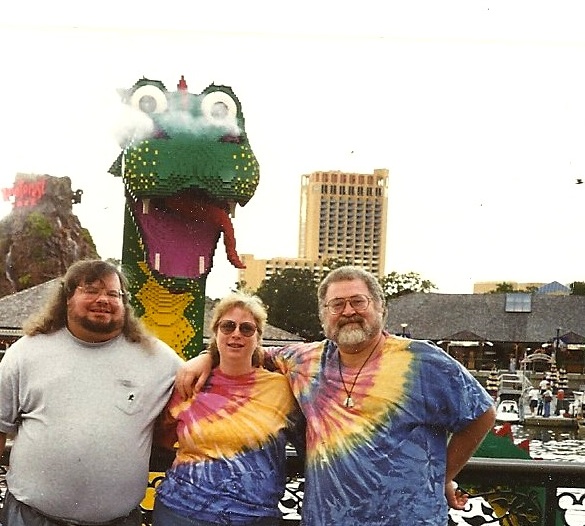
So what explains this picture of a dear friend, me, and my husband being photo-bombed by a Lego dragon?

smithdragon

The first thing you have to know about Tom (left) and Leslie (the photographer) is that their inner child is, let’s say, very close to the surface. They are DisneyWorld aficionados. And they know all (well, almost all) about my mental disorders.

We desperately needed a vacation, and they offered to be our guides for an adult-friendly, non-teacup visit. Also, it was the Millennium celebration and early in December, which promised no sweltering heat, interesting decorations (as much or as little as I could stand) and other spiffy stuff, including few children, who would not yet be on Christmas break. (Ah, the high-pitched shrieks of laughter from children meeting their cartoon heroes. It cuts right through me like a knife.)

Here’s what I learned.

• The restaurants there are incredible. Eat your way around Epcot.

• I dreaded the Tower of Terror because I thought my stomach would drop out. This proved not to be the problem; my inner ear objected, though. Our friends got me on it by telling me to repeat the mantra, “Disney will not kill me. They want more of my money later.” It was one of those things that I’m glad I did and now Will Never Do Again.

• The Explorer’s Club is extremely cool.

• There are lots of nifty tiny things that aren’t rides and attraction that you can try to spot – bits of the sidewalk that light up randomly like a surprise Dance Dance Revolution, Mouse ear shapes in unexpected places, such as the wing nuts on shelves in the many gift shops, and so on. This is where knowledgeable guides come in particularly handy.

• At night, you can see the stars from the top of that mining train-roller coaster thing, something I didn’t expect, given all the ambient light an amusement park puts out.

• Also, we all won giant purple-and-red plush armadillos at one of the games. That’s one thing my inner child can appreciate.

• STAY AWAY from the teacups and It’s a Small World. They will turn you into a whimpering, burbling puddle of regret and sugar-shock. When your mother asks later, just say, “Oh, yes. They were nice. You would have loved them.”

If you go with the right people, do not try to make it into the Bataan Fun March, and rest and eat or retreat to the hotel when you need a break, it’s survivable and even – dare I say? – enjoyable. Sufficiently medicated with Prozac and Ativan, I could handle it.

I’d have to give this round to Disney, but really it was all Tom and Leslie.

P.S. Also, the Food and Wine Festival is a great experience. I spent three months in Orlando and a co-worker got us tickets. Cute guys with devastating Australian accents chatting about Australian wine. What could possibly be more satisfactory?


Ack! Ack!

Oh noes! Another business meeting/training session/lunch!

On Wednesday – not much time to get ready.

Panic? Check.

Hair appointment? Check.

Therapist appointment? Check.

Everything else? Not check.

Will I ever be able to do this again without freaking out? Guess that’s a question for my therapist.

Bonus Material (Actual Conversation)

Me (distraught): I have to find something to wear!

Husband (helpful): What about that white thing you wore last time?

Me (gently): It’s June, and that was a turtleneck with long sleeves.

Husband (no particular tone of voice): Oh.

(I didn’t bother explaining that it was actually off-white and I couldn’t wear the same thing to two of these events in a row. The seasonal thing was a big enough information bite.)

A Grain of Salt

This week has been pretty bad. I tried to poke my nose out from under the rock where I’ve been hiding from the world.

Bad idea. I was instantly overwhelmed by the crazy-stupid-crazy of various sorts that has been sucking up all the oxygen lately. Read James Thurber’s story “The Box.” I was safe in the box and then I tried to come out.

Mistake. The sheer volume of malignant idiocy in the world seemed to have increased exponentially in the intervening week. I tried to stay away from it, refused to dip my smallest nerveless toe into Facebook threads on topics I have strong opinions about. A friend called to see whether I was okay, and I had a mini-meltdown.

I really thought my brain was going to break again.

It wasn’t just the relentless assault from the outside, though that was more than plenty.

I also had internal stress. My work. My difficulty forcing myself to do it. My exhaustion once I had done it. My total lack of spoons, even plastic ones.

The friend who called suggested a day off, comfort food, a book, cats. All good suggestions, and I tried them all.

The problem was, when I shut off all that other noise, memories began haunting me. Ones from years ago that I’ve never been able to suppress completely. From a time in my life when my psychiatric problems were undiagnosed and untreated, my body began to be plagued with conditions I still live with, my self-esteem was nonexistent, and my soul was being sucked dry by a person who might have helped, but made all of those things worse.

Today is still rough, but I had one good memory return. My husband bought a watermelon and I sprinkled a piece with salt.

This was a thing that my family used to do in the summertime – sit at the backyard picnic table and eat watermelon lightly sprinkled with salt. (And of course compete to spit seeds the farthest.)

The combination of salt and sweet is a trend among foodies these days, with the new sensation, salted caramel. Believe me, we were not foodies. Served with the watermelon were home-made popsicles made from Kool-Aid in Tupperware molds.

But for me, watermelon with just a touch of salt was one of the hallmarks of summer that I have not experienced in years. It was right up there with going barefoot and climbing trees.

My husband tried the melon with salt, but it didn’t do the same for him. It’s not one of his childhood pleasures, and he hates to add salt to anything, even popcorn. But at least he tried it, and listened to my story.

Mostly when a memory leaps suddenly into my mind, it’s the haunting kind. But every once in a while, I get salted watermelon. And I am grateful.

Surviving High School (and Reunions)

I’ve only ever gone to one of my high school reunions – the 25th. Now the 40th is nearly here.

I was terrified then. This time is not as bad. I don’t have the energy or the attention span to get all worked up about it. Will I go? Probably not. It’s like the Tower of Terror at DisneyWorld – I did it once and I’m glad I did, but I have no desire to do it again.

My difficulties with the reunion even made the local paper. I went to a high school friend, Mary, for advice. She was quite helpful. She also, with my permission, wrote about my panic in her newspaper column.

Here’s what I told her: “Over the last quarter century I’ve confronted and dealt with a number of pieces of my past and tried to make my peace with them. High school, however, is not one of those things. I’m afraid I’ll have flashbacks.”

Mary did note that “Janet had more reason than most to be apprehensive. While I had been actively ignored, she had been, at times, actively picked on – one of those kids too brainy, too head-in-the-clouds, to comprehend how to navigate the social firmament.”

Pretty close. Except that I wouldn’t have called it “actively picked on.” High school was merely another part of the continuum of bullying and harassment that I experienced from childhood on. In high school no one threw literal rocks at me, but by then they didn’t have to. I was conditioned to cringe.

The head-in-the-clouds part was also not entirely accurate. As I walked through the halls between classes, my head was down and my nose was in a book. I was trying to perfect my “invisible” act and practice that advice that the bullied always get – “just ignore them.”

And I wouldn’t call the social milieu in high school “the firmament.” Just sayin’.

I did go to the reunion, though. I got my hair done for the event and told my stylist to make me look “successful and sane.” She replied, “Oh, no, here comes the wish list.” “At least I didn’t ask for young and thin,” I pointed out.

I went, taking along my husband and telling him not to leave my side. I’m sure the husband came as a surprise to most people there, proof that I had at least managed to navigate that particular social firmament. And if my hairstyle did proclaim some degree of sanity, that was likely a surprise as well.

I survived. My big insight: “Not everyone hated me.” I should have known that already, since I had friends like Mary and a few others I’m still in touch with. But old fears die hard.

Mary was much more philosophical: “In adolescence our images are refracted through so many distorted lights – the way we see ourselves, the way everyone else sees us, the way we fancy everyone else sees us. What mattered was that we could all talk face to face, as adults, as equals, as friends.”

She may have been right, though “Not everyone hated me” was, in its way, a major alteration in my outlook and pretty much as far as I’d gotten by then in my continuing struggle to come to grips with my life.

Things have changed a lot since then and so have I. Now I realize I have nothing to prove, and no need to try.

A Mother? Me?

Ah, the shrieks of laughter and squeals of delight from playful children! They cut through me like a light saber through Jell-O. I’m hyper-sensitive to loud or high-pitched noises.

A while back, one of my blogging buddies was speculating on whether she wanted to or ought to have a child, despite her disorder. I have no answer or even advice for her, but but here is what I think about motherhood and Bipolar Me.

When we got married, my husband really wanted to be a father some day. To tell the truth, I never gave it much thought really, since I had never expected to be married.

At that time in my life I was barely medicated and had a lot of meltdowns and breakdowns and up-and-down cycles (mostly down) ahead of me.

Looking back, I am glad that I never became a mother. The thought alone overwhelms me.

First of all, I would have been a really bad mother. It would have been unfair to a child to have a mother who would disappear into her room for days at a time, not communicate for weeks at a time, be depressed for months – or years – at a time. Not to mention not being able to enjoy anything. Put that person in charge of a live human child for 18+ years?

I know there must be people who do it, but I don’t even really understand how non-biploar people manage it.

Second – and this is the part that is going to sound selfish to those people she feel that childless-by-choice women are all selfish – but I needed all the resources I had to construct and reconstruct myself. As Gloria Steinem reportedly said, I didn’t give birth to a child because I was giving birth to myself. I still am, after my most recent and most monumental breakdown, still trying to salvage what I can of my psyche, seeing what pieces still fit, and learning to live with the things that are no longer present – or maybe never were.

And I had all kinds of irrational thoughts on the subject of motherhood. The one time I thought about motherhood, it was because my father was dying, and I wanted him to see his grandchild if there was going to be one.

Also, I was terrified of losing myself. My husband had some issues of his own and was, let’s say, way too close to his inner child. I thought he and a child would outnumber me and I would be the mean one, the killjoy, the Other.

As time went on, I grew less and less inclined to even be around babies or small children. And my husband would go into a funk if one of our friends had a baby. Eventually, he decided that if he wasn’t going to be a father, he could be a mentor, a helper, a healer, to other children and former children. Maybe even his inner child.

Now having a child is no longer even a possibility. And I’m good with that.