Bipolar 2 From Inside and Out

Posts tagged ‘emotions’

Finding Intimacy

What do you think of when you hear the word “intimacy”? Sex, right?

That’s a part of intimacy, but it appears nowhere in the American Psychological Association’s definition. There, it says, intimacy is “an interpersonal state of extreme emotional closeness such that each party’s personal space can be entered by any of the other parties without causing discomfort to that person. Intimacy characterizes close, familiar, and usually affectionate or loving personal relationships and requires the parties to have a detailed knowledge or deep understanding of each other.”

Let’s take a look at that definition. “Extreme emotional closeness” is pretty understandable. But note the word “extreme.” It implies that intimacy is more than ordinary closeness. We have friends whom we are close to, but not intimately close to. They may be friends we can talk to about our troubles, share our stories with, be close to, but still not share that extreme emotional closeness. You’re not necessarily intimate with a best friend, though of course it’s possible.

The next part of the definition is more troubling to some. That part about “personal space” being entered by “any of the other parties.” It implies that there can be intimacy among more than two parties. To some people, that sounds like cheating or polyamory. But that’s when intimacy implies only sex.

Personally, I have a number of intimate friends, both male and female. That’s not to say that I’m promiscuous, bisexual, polygamous, or polyandrous. What I mean is that, as the APA definition states, we “have a detailed knowledge or deep understanding of each other.”

What does it take to get that detailed knowledge and deep understanding?

What are the qualities that foster intimacy?

Time. I’d say that, for non-sexual intimacy anyway, time is required. I can’t say how long that is exactly, but I do know that it isn’t instantaneous. You may feel an instant connection with someone you meet, but that’s not intimacy. I felt an instant connection with someone I helped through a public breakdown, but our intimacy had to grow over the years. Now I do count him as an intimate friend.

Sharing. You don’t have to share everything, but some sharing is essential. It may be seemingly superficial things like a love of country songs or a television show, but that’s only part of it. The intimacy kind of sharing involves actual sharing of thoughts, ideas, and experiences. You don’t have to agree on everything, though there are usually some non-negotiables. But for intimacy, you shouldn’t be afraid or embarrassed to share the truths about and inside you.

Laughter. Nothing bonds two (or more) people like laughter. Intimacy can be enhanced by laughing at the same things. A good belly laugh, the kind where you can’t stop and can’t breathe, is what I’m talking about. Or the snickers that you both have to suppress because you know you’re in a place where you can’t express it until you’re alone.

Help. For true intimacy, this is probably the most important quality of all. Someone you feel intimacy with is someone you can turn to when you’re at your lowest. Someone who understands or even if they don’t, will hold you closely in their heart or spirit. Physical help or financial help is good, but it isn’t required.

For those of us with SMI, it can be hard to feel intimacy. We may even fear intimacy because we’ve been betrayed by someone we’ve felt intimacy for. It’s difficult—or sometimes impossible—to get past that, but if you can, and you can open yourself to that extreme emotional closeness once again, intimacy with someone new is possible. Looking for someone to share intimacy with may not work. Sometimes intimacy has to find you.

Be open to it if it does.

The King Baby and the Narcissist

Almost everyone knows a grown-up in their life who has to be right all the time, has to be catered to, and blames everyone else for failures or unpleasant events.

That person is a King Baby. (Not to be sexist. There is also a Queen Baby.) It’s someone who never grew up, at least not emotionally. King Baby expects everyone to love him, take care of him, and solve all his problems for him.

Reference.com says that a King Baby: “is typically selfish, rejects criticism, complains, is obsessed with money and belongings and doesn’t feel like rules should apply to him. In short, he is someone who refuses to mature.” Tom Cunningham wrote the book (well, the 28-page pamphlet) on King Baby Syndrome in 1986. It’s still available from Hazelden, which is good because King Babies haven’t gone away, nor are they likely to.

King Babies view the world as their plaything and other people as someone whose only function is to meet their needs. Physically they are adults, but emotionally they are still infants. Typical King Baby remarks are, “That’s not fair,” “This is what I want,” “That’s not how I do it,” “Do this for me,” and “I’m the best at everything.”

Needless to say, King Babies are very trying to be around.

I learned about King Baby syndrome from my husband. Not that he has King Baby syndrome. But he used to work as a counselor with various therapy groups. One thing he told me was that when someone was trying to pull King Baby shit, one of the others might call him on it by saying, “Wah!”

King Baby goes by other names as well. Probably best known is Peter Pan, from an 80s pop psych book, The Peter Pan Syndrome. Years before that hit the bookshelves, though, writer Aldous Huxley produced a novel called Island, which talks about “dangerous delinquents” and “power-loving troublemakers” who are “Peter Pans.” In addition, he said, they are “boys who can’t read, won’t learn, don’t get on with anyone, and finally turn to the more violent forms of delinquency.” Huxley cited Adolf Hitler as an example.

King Baby syndrome is not an actual psychological diagnosis. It is not covered in the DSM. But the DSM does include Narcissistic Personality Disorder, which sounds remarkably like a King Baby:

  • exaggeration of accomplishments
  • saying they have done things they haven’t really done
  • acting or feeling more important than others
  • believing they are special and unique
  • having a need to be admired all the time
  • expecting to be treated differently, with more status than others
  • exploiting others to get what they want or need
  • pretending concern towards others or lacking empathy
  • being jealous and competitive with others
  • thinking that others are jealous of them
  • acting arrogant and superior

Narcissistic Personality Disorder is, of course, an official diagnosis in the DSM. King Baby is only someone you perceive as narcissistic but who hasn’t gone through the process that leads to a diagnosis. I’d hesitate to call someone a narcissist who hasn’t even talked to a psychologist or psychiatrist. But I have no problem labeling someone a King Baby.

So what do you do with a King Baby? My advice is to avoid them if possible. You can, like the people in my husband’s therapy groups, call the person out for their behavior, though it’s not likely to do any good. Often it’s best just to cut the King Baby out of your life. If you do, though, expect anger, blaming, and recriminations.

If you do have to live with a King Baby, perhaps the best thing you can do is to recognize the behavior when you see it happening and not fall into the trap of trying to meet the King Baby’s every need. This won’t make any difference in the King Baby’s behavior, of course. You’ll have to deal with pouting, sulking, poor-me talk, and even retaliation.

Because just as vampires never grow older, King Babies never grow up. They can’t and they won’t.

Stuffing Your Feelings in a Box

Cardboard box with the zipper isolated on white backgroundWe all know it’s a bad idea to stuff your feelings, especially if you then pile food or alcohol on top of them.

The thing is, sometimes you need to suppress a feeling, for just a little while, in order to get through a difficult situation. When that happens, I put my feelings in a box.

Here’s an example. My father was dying, and had only days to live. We all knew it. My mother, who didn’t drive, asked me to take her shopping for something to wear at his funeral. “Do you mind if I don’t wear black?” she asked. “If you don’t mind that I do,” I replied.

It was my first encounter with a close family death, and I had to get through this awful, wrenching shopping trip. I had to keep my composure so that my mother could keep her composure. I had to steer her away from a flowered dress, which would have been fine for church, to a navy suit and a lighter blue top, which would be suitable for a funeral but not so somber that she couldn’t wear it for anything else. All while my father lay in the hospital, dying painfully of bone cancer.

My feelings were complicated and I absolutely could not afford to feel them at that time. I had to stuff them in a box and close the lid on them until my mother’s needs had been met. Then I could let them out, in a time and place where it was safe to, in the presence of a person I could trust with those feelings.

When such circumstances arise – and they will, in one form or another – I recommend using a box, one in which the feelings will be out of sight for a while. A box is small; only a few feelings will fit in it. If you think the feelings are going to leak out, you can sit on the lid. Then, when it has served its purpose, you can rip the box open (or gently lift the lid) and feel the feelings. Cry. Rage. Grieve. That’s the important part.

You have to experience the grief or fear or even the crushing weight of guilt in order to come through it and heal.

But why put feelings in a box instead of something stronger? Who wants to feel those negative emotions anyway? Aren’t we better off without them? Shouldn’t you just build a wall around them to keep them from breaking out?

We’ve all tried it. It works for a while. But a couple of consequences go with the practice. First, all of your feelings get trapped behind that wall – the good as well as the bad. When you find yourself disconnected from all your feelings, life is a gray blur. In your depression or anxiety or fear or rage, you may not have had many good feelings. But when you build that wall, you cut off even the possibility of having them.

Second, you’re only postponing the pain. The wall will leak sometimes; your unpleasant feelings will come out some way – in your dreams, around your eyes, in sudden spurts, or trickling back into your everyday life. Worse, the wall may shatter – fail altogether, releasing all those feelings in an unstoppable torrent, only stronger and more concentrated from having been confined. They overwhelm both you and anyone in the vicinity. It’s not pretty. And it’s destructive – to you, your mental health, your healing, your employment, your relationships – to every aspect of your life.

If feelings are behind a wall, you may be able to tell yourself they don’t exist. But if you stuff them in a handy box, you can choose the time and place to open it – and yourself – back up.

Dear Bipolar Disorder

Dear Bipolar Disorder,

We’ve had a relationship for decades now, though it’s one I never chose. To tell the truth, I can’t even remember when we met. Gradually, you just moved in. So I guess we’re stuck as roommates for the rest of my life. You can’t break your lease and I can’t move out. That being said, there are some things I need to talk to you about. We’ve never been friends. We never will be. I have some issues with you; there are compromises we need to make.

I’ll take my meds faithfully if you back off when I do. By that I mean no major depressions of longer than a week and no panic attacks while I’m trying to sleep.

I’ll pay for those meds, as long as you settle down enough to let me keep working and earning money and paying for meds. Just leave me enough concentration to do that and to read, and I’ll be satisfied.

I won’t go to Chuck E. Cheese or Cici’s Pizza or shopping at a mall anytime after Thanksgiving if you will let me go out at other times to other places without getting your figurative undies in a bundle.

I will try to minimize the stress in my life (see above) if you will cut out the physical symptoms when there is stress anyway. You know the ones I’m talking about. Ick. Just ick. I hate cleaning up after you.

And can we talk about spoons? I know you only give me a limited number per day, but it would sure help if I knew what that number was. Is there any way you can be more consistent? If I have to borrow spoons from the next day or force myself to attend to some vital call or lengthy errand despite not having spoons, I promise to spend the next day in bed, just to satisfy you.

Please, if you can, give me some non-anxiety-laden hypomania so that I can go out and enjoy things with my husband and friends. If you agree to this, I will occasionally let you buy things off the Internet, for $20 or less.

And while we’re on the subject of enjoyment, I would appreciate it if you would give me back my libido. So would my husband. I know you don’t take orders from him, but it would be esteemed a favor.

Don’t even talk to me about hurting myself. I won’t listen. No matter how loud you get.

Don’t get between me and my friends. You’ve done that too often already and I just can’t put up with it anymore.

No more screwing with my memories. I’ve already lost enough. You can keep the ones of everything stupid I’ve ever done, but I will not watch when you push play on my internal video playback.

Now that I’ve finally got some self-esteem back, you just keep your claws off it. I need it and you don’t.

No dogs allowed. Especially large Black Dogs.

Oh, and tell your buddy Depression to leave my husband alone.

No love,

Me

Can I Choose My Emotional Reactions?

Back before he started on his path to learning how to live with me, my husband used to refuse to say he was sorry if he hurt my feelings. “I didn’t mean to,” he would say.

“If you stepped on my toe without meaning to, you’d say you were sorry,” I replied.

“Yes, but if I stepped on your toe, I’d know I hurt you.”

“I tell you that you hurt my feelings. That’s how you know you did.”

“I can’t control your reactions. I say something and you react with hurt.”

“I can’t choose my reactions when you step on my toe. It hurts and I say ouch. It’s the same when you hurt my feelings.”

We’d go around like this for a while.

Later, he came around to the idea that I couldn’t control my reactions. There were things that he couldn’t see inside me, from my emotional triggers to my bipolar disorder. At last, he admitted that I couldn’t control my reactions and learned to apologize even for things he didn’t mean to do.

Later still, he claimed that maybe I couldn’t control my emotional reactions, but that I had control over what I did about them. I maintained that I couldn’t necessarily do that. My feelings were hurt and I cried. I could choose whether or not to leave the room or stop speaking to him, but the tears were not optional. They were not something I could choose or control. Believe me, I’ve tried.

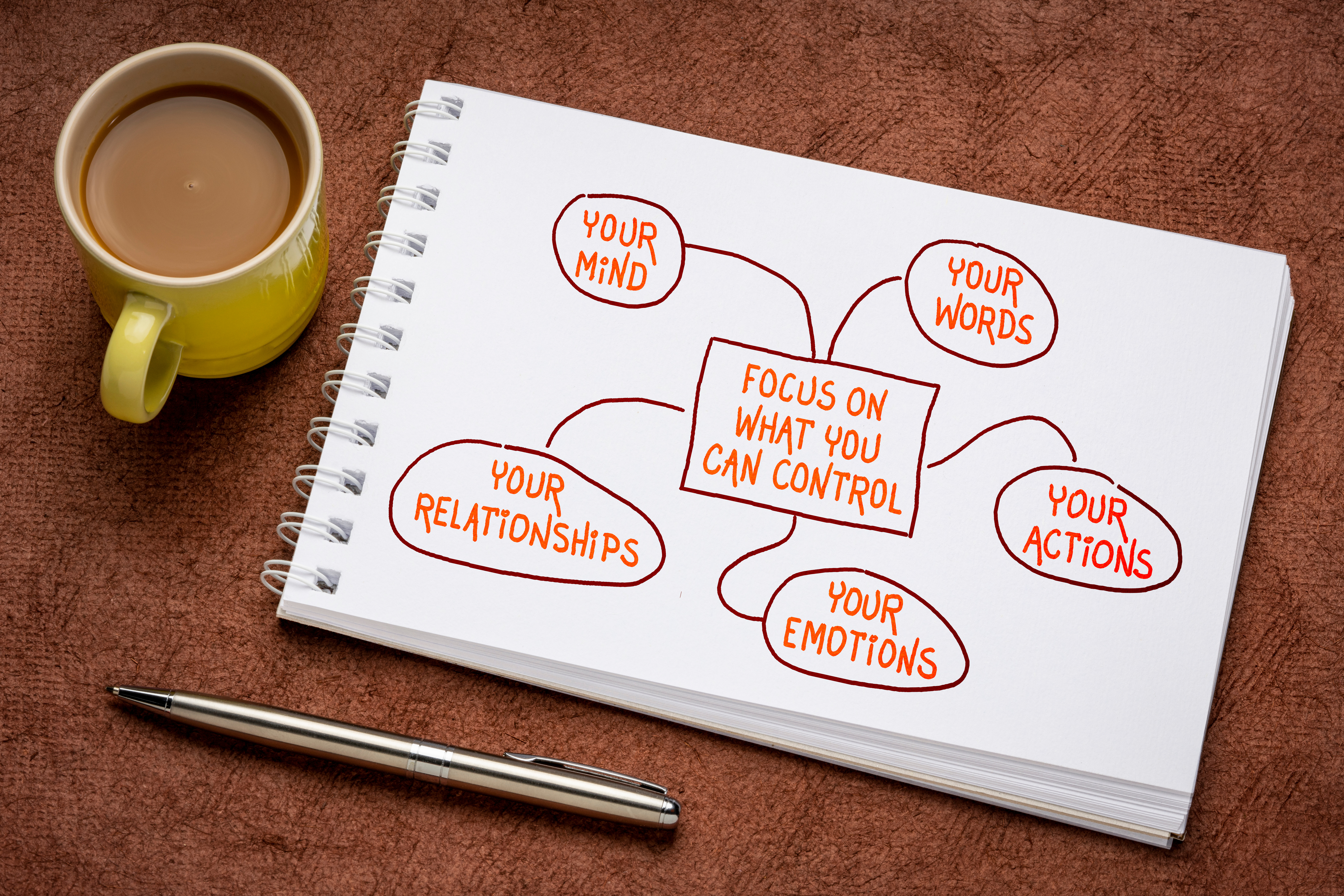
Our admittedly small example has larger implications. There seems to be a lot of things we’re supposed to be able to control. In the illustration above, your mind, your relationships, your emotions, your actions, and your words are said to be things you can control.

I would disagree with some of that. As my experience with my husband showed, I couldn’t control my emotions – I didn’t choose them. I can’t control my relationships. There’s another person involved, with a lack of control over their emotions as well.

And my mind. When you live with serious mental illness (SMI), you’re acutely aware that, a lot of the time, you can’t control your mind. From overthinking at one end of the continuum to psychosis at the other, the mentally ill mind does what it will. Personal choice can’t control it. We’re not able to reach inside and change our brain chemicals or the past traumas that influence our minds and our choices. Sometimes medication and therapy can’t control the mind either.

There are also a lot of memes – and people’s opinions and statements – saying that we can control whether we are happy or not. “Choose happiness.” “The only difference between a good day and a bad day is your attitude.”

I’m not even sure that’s true for people who don’t have SMI. Emotions aren’t something that can easily be switched on and switched off. Before I was correctly diagnosed and properly treated, I simply had to go through a spell of depression and wait for it to pass. It’s still largely true for me, except that now I know that the depression will pass, and a lot sooner than it used to.

I don’t think that it’s a good idea to deny your emotions, either. If you feel hurt or sad, let yourself feel that feeling and work through it. It may be trying to tell you something – that you’re angry for a reason, for example, and need to address that reason. Or if you’re sad, recognize that there’s something making you sad and stay with that sadness for a while. Forcing yourself to behave cheerfully denies the reality of your emotions and merely puts a mask on them. And that’s not healthy. Sooner or later, those feelings will leak out from behind the mask or shatter it.

I’ve always been a great believer in choice. But there are things I don’t think a person can or should have to choose. Emotions and our reactions to them are not within our control. Our actions are – leave an abusive relationship, seek help for mental illness, take medication every day, and so much more.

But not everything about us is subject to choice, and I think it’s better to recognize that than to deny it.

(And for those of you who are curious about it, my husband and I have chosen to work on our individual and mutual problems and have accomplished 40 years of struggle and working together to control what we can accept and what we can’t. We choose that struggle and that work every day.)

Keep This Blog Alive!

Choose an amount

¤2.50
¤5.00
¤10.00

Or enter a custom amount

¤

Your contribution is appreciated.

Donate

Bipolar Disorder Has Turned Me Into a Pouty Child

I am blessed with many friends, online and off, who are as dear to me as anyone can be. We have laughed together, cried together, eaten together, danced together, sung together, joked together, mourned together, and loved together.

Now that I’m back in my cycles of depression and hypomania, hurtling around like a marble in a shoebox, I haven’t heard from any of them.

A lot of the contact I have with friends is on Facebook, and I have almost entirely stopped posting or replying, or otherwise interacting there. No one seems to have noticed. At least no one has called or IMed to check on me.

Am I ghosting them? No, because I don’t want the relationships to end. In fact I very much want them to continue. My scattered moods, primarily depression, have sapped my ability to reach out. It may be that they assume since I post my blogs every Sunday, I am all right.

I desperately want someone to reach out to me. This is selfish and childish and unworthy. If I want human contact, I should be able to reach out and initiate it myself. But I haven’t been able to. Between the exhaustion of depression and the exhaustion of hypomania, it’s difficult to make any kind of effort.

The memes say that if you have a depressed friend, reach out to them, even when they can’t reach back. And there have been times when my excellent friends did that, back when I had been in the Pit of Despair. And they kept reaching, even when I didn’t respond.

I guess I miss those days – not the Pit of Despair – but the little parachutes of care that rained down and demanded nothing. The phone calls “just to check in” or to distract, the invitations that I was never going to be able to make myself go to or reciprocate, the awful jokes that I might not even be able to laugh at.

I understand that everyone is fighting their own battles these days, with isolation, anxiety, panic, and other reactions to the pandemic, the lockdowns, the vaccines, the separated families. Mental health struggles, especially including depression and anxiety, are spreading to people who have never experienced them before. A lot of people are suffering, and a lot of people don’t know what, if anything, they can do about it. People have had to resort to Zoom weddings and funerals and outside-the-window visits to relatives in nursing homes.

Part of the problem, I suspect, is that I have been so relatively stable and functional for so long now. I made it through a tornado and a year of home dislocation and all the associated disruptions and bureaucracy without having one of my famous meltdowns. So, now, when even I have not been expecting or experiencing any psychological trauma to speak of, it’s easy to understand that no one else has seen it or noticed.

Then there’s my husband. He is my rock, my caregiver, my “emotional support animal.” Ordinarily, he takes up most of the slack in making me feel seen and heard and cared for. But unfortunately, he is having depression and anxiety of his own right now. He has recently had health problems, has changed jobs, and has physically strenuous activities he must complete, within a deadline. Of course, he is reacting with depression and anxiety of his own. And when both of us are depressed and anxious at the same time, it’s not pretty. We don’t have enough psychic stamina to help ourselves, much less each other.

So, I understand why it isn’t happening. But I miss the check-ins I’m not getting. The calls that don’t come. The personal long-distance reach-in. The wave from outside the window.

I’m not quite to the point of, “Nobody likes me. Everybody hates me. I guess I’ll go eat some worms.” But close.

Hypomania and Exhaustion

I’ve done so much. I should feel exhausted. I do feel exhausted. Why do I keep doing so much?

The answer, of course is hypomania, or maybe a mixed state.

I had been thoroughly depressed over my writing, as I sent out query after query to agents, and getting back rejections or the horrifying limbo of “no response means no.” I kept doing this for nearly four months, until I had apparently run out of agents to query. (I know that can’t be literally true. There are thousands of agents in New York alone, but I had been through all the usual lists and gone pretty far down the Google pages.) Yet I trudged along, depressed but pushing myself. Get the queries done. Get my work done. Get these blogs done. Go to bed. The same the next day. Call it functioning depression. I was still in motion, doing what I told myself had to be done, but enjoying none of it (or anything else).

Then I got an invitation to try out for some work-for-hire (which is sort of like ghostwriting, only different). Instantly, preparing submissions (three of them!) for this gig consumed me. And I kept on with the queries, the work, and the blogs. But I was tipping over into hypomania.

I wrote the submissions insanely quickly, when I knew I should have taken the time to analyze them, polish them, try a couple of different drafts. But no. I found myself pushed to get them done and get them out there. Or rather, I pushed myself to do it.

My submissions were rejected, but this time instead of slipping back into a funk of depression, I wrote a nice note saying that if another opportunity like this came up to please consider letting me apply again. They responded to the note, seeming astonished that I had sent it, and complimenting me on my attitude. Nothing like a pat on the head to keep the juices flowing.

It was at about that point that hypomania truly hit. I focused everything on my writing. I reworked the first three chapters that I had been submitting to agents and submitted them to still more. I started taking on extra work assignments. I took only brief breaks to eat a bowl of soup, then plunged back into it again. I had trouble getting to sleep and trouble sleeping, even though I was so exhausted that I turned in early each night. And I woke early, ready to keep on keeping on.

Then the miracle happened. I got a positive response from an agent. They wanted to see more of my work. I tweaked the newly revised first three chapters and sent them in. Now I’m waiting, nearly bouncing out of my chair, for them to respond. I just know that they will want to see the whole novel and become my agents. I do know that the deal is a long way away from being sealed, but hope after so long of slogging through my depression, hypomania has taken control.

I am (sort of) still contemplating my WIP (work in progress, a sequel to the novel that might now become real), thinking I need to rethink it entirely or try a different plot altogether. I am still taking on extra work, though it exhausts me. During my brief breaks from work, I scour the internet for presents for my husband’s birthday, and spend more than I had intended for more presents than I had planned.

And I am writing this blog post the day before I need to post it, rather than the three to four days I usually allow myself to write it. And I still need to polish the post for my other blog. And pay bills. And find a place for us to get a health check that’s required by my husband’s employer. (I have already set up appointments for our vaccine shots.)

I think it is most likely that if the agent rejects my work after all this, I will once again sink into depression – the I’m not worthy anything, I’m a fool to have put this much energy into it, I should just give up kind. Cutting back my activity to the bare minimum – work and blogs. Sleeping more, enjoying it less. Enjoying everything less. My old familiar functioning depression that is only possible because of the meds I take that don’t allow me to swing too far down.

I know people who, when you try to tell them about hypomania, tell you to enjoy it while you have it. They don’t know how wrong they are.

Laughing Out Loud

There’s nothing funny about bipolar disorder. In fact, one of the ways that I know I’m having a spell of bipolar depression is that my sense of humor flies out the window. Nothing brings a smile or a laugh – not my husband’s awful jokes. Not my friend Tom’s silly songs. Not a funny movie like Arsenic and Old Lace.

I have been in a spell of depression for a little while now. As I mentioned last week, part of it may be reactive depression. But here’s the thing. Reactive depression feels the same as bipolar depression. You have the same sense of misery, loneliness, helplessness, hopelessness, anomie. But you know what caused it and that it will end pretty soon, relatively, unless you tip over into a true depressive episode, which can last a lot longer than that.

But yesterday I laughed. And that was a good thing. It didn’t pull me completely out of my depression, but it let me know that escape was possible, and maybe even starting.

It happened like this:

My husband and I were sitting on the couch, watching TV. I was not enjoying it. Then a commercial came on about “man-boosting” pills that increase testosterone. It promised everything: strength, leanness, stamina, and outstanding performance in the bedroom.

Dan turned to me and said, “Hey, honey. Maybe I should try some of that. Improve my performance in bed-woo-woo-woo!

I turned and looked him straight in the eyes. I said, in a solemn, deadpan voice, without a trace of a snicker: Woo. Woo. I never got to the third Woo because we both dissolved in giggles. And it felt good – not only that I could laugh, but that I could make him laugh. Just thinking about it made us laugh all over again.

Today I am back to feeling overwhelmed, if a little less miserable, but still functioning on some kind of level. I don’t think my depression is over with. But for just a moment, I saw a ray of hope. Yes, it was over something stupid. Yes, I delivered the line with a flat affect. No, I didn’t know it was going to be that funny. I even thought Dan might be offended that I was making fun of him. But the important thing is that we both laughed. 

What I’m saying is that laughter, by itself, is not a cure for depression, however much the memes and the positive thinkers tell you that it is. But if laughter happens to you, it at least reminds you that the depression will end sometime – maybe quicker than you think. The giggles are building blocks that will help you climb up out of your hole, or at least see that there is a way out.

That’s a lot of philosophizing about two words (or syllables, really), and I’m not sure the magic would happen again if either one of us said Woo. But I am taking the memory of that moment with me, for whatever strength it can give me and whatever amusement will stay with me when this depression ends.

How Depression Sneaks Up

I had a blog post all written and ready to go. It was about my fluctuating moods and my writing, and how they affected each other. Some of what I wrote is still true. The depression I suffered during my early years and the exceedingly depressive poetry I wrote during that time allowed me to learn something about how poetry works and something more about how depression works.

I wrote about how hypomania affects my writing, and that is still true. Hypomania pushes me to do my writing, even when I don’t feel like it. In fact, at times it pushes me into doing more writing than I can probably handle. Case in point: This week I wrote three samples for a work-for-hire outfit when I should have been writing or at least outlining my WIP (Work In Progress), a sequel to the mystery I have already written and have been sending around to agents.

And last night, that’s where I hit the wall. I figured out that I have sent out about 180 or so query letters and gotten only the most minimal results – rejections that said I had an interesting premise that was not right for them. Most, though, have received plain rejections or the dreaded “no response means no.” I am now second-guessing myself and everything about the manuscript.

Last night, the depression caved in on me. I spent the night in bed, not sleeping except for nightmares, and not wanting to get up in the morning.

Because my identity is invested in being a writer, though, I did get up (late), sent a few more queries, and got to work on rewriting my blog posts, which I had determined were wretched. In the blog post that I abandoned, I had pontificated about how keeping a schedule kept me going with all the writing projects and various other work I do. 

I had also crowed about my relative stability and how that was helping me keep that schedule, which was supposed to be keeping depression at bay. I found out that I lied. The fact that I have maintained functionality for some time did absolutely nothing to prevent the depression that hit me.

Admittedly, this is probably a reactive depression, with my lack of success being the trigger. The thing is, it’s awfully difficult to tell apart from endogenous depression. In fact, I have known the first to melt into the second. At first you have a clear cause that would depress anyone, then you find it clinging to you long after what would seem to be reasonable. (This is subjective, of course. What is the “right” length of time to be depressed over 180 rejections?)

What’s left? Self-care, of course. Trying to sleep if I can, and squeezing in a nap if possible. Eat something, even if it’s only some guacamole and chips or a bowl of soup. Take my meds religiously. Try to cling to that schedule even when I don’t want to.

But the truth is, I’m running out of agents to submit to. I’m running out of energy to try. And I’m running out of the frame of mind to keep me functional. I’ll be okay, I know, but it may be a long, hard climb. 

My Triggers

By shane / adobe stock.com

Bipolar disorder is a funny thing. It can come on with no warning. One moment you’re fine, and the next you’re in the infinite doldrums or jagging on a spike of enthusiasm. Most of the time, it’s like that. The moods come on unexpectedly and stay as long as they want.

Sometimes, however, there are things in your life that seem to trigger a bout of depression or mania.  This isn’t quite the same as what’s commonly called a trigger. In the usual sense, a trigger is something in your past, like a traumatic memory, that comes bursting through when you read, see, or otherwise encounter a reminder of that memory. Suddenly, you are thrown back into the situation that triggered you, reliving the trauma, feeling as if you were still there, re-experiencing it. Triggers are most commonly associated with PTSD (or Post Traumatic Stress Disorder). Many people associate PTSD and its flashbacks with veterans and war, but other traumas, such as rape, assault, and natural disasters can also cause PTSD.

Trigger warnings are controversial. Some people need a warning that the content – especially books, blog posts, or films – may trigger a suppressed or otherwise traumatic memory and leave the person caught up in the sensations during a public moment, such as in a classroom. Obviously, people with traumatic memories would prefer to avoid this, so a trigger warning is placed at the beginning of a story, novel, or even a song that deals with rape, domestic abuse, or other traumas, especially ones depicted in a particularly graphic manner.

To other people, reacting to a trigger is an admission of fragility, at best, or at worst, an excuse for avoiding content that most people can easily handle. This is part of the mindset that leads to calling the severely traumatized “snowflakes” for their perceived inability to deal with stimuli that “normal” people take for granted. They do not understand the power of traumatic memories or the power they have over people who have been through trauma. They consider such people weak. They consider themselves strong, even if – or especially if – they have been through traumas themselves.

In general, my life has been less traumatic than some, more traumatic than others. There are memories that invade my dreams, situations that cause me panic, and stimuli that rev me up. I am not in control of these stimuli, or what they do to me.

Most of the stimuli trigger depression in me, as my bipolar disorder is heavily weighted towards depression. (In fact, I was diagnosed with unipolar depression before a psychiatrist finally recognized my condition as bipolar 2 with anxiety.) When I encounter one of these “personal” triggers, I am panicked, unable to communicate, and immobilized, or nearly so, and must rely on the help of others, especially my husband, to get me through. There’s no telling how long that depression will last.

Primary among my triggers is what I call “the rotten ex-boyfriend who almost ruined my life.” It was a toxic, gaslighting relationship that left my soul sucked dry and my emotions shattered. Fortunately, I do not often encounter anything that reminds me of those days. A friend I met during that time, in fact, has helped me heal both then and for many years thereafter.

Still, I have dreams – ones where I am traveling to the man’s house, ones where I am in the house but he is not present, and ones in which he is. I wake feeling vaguely seasick and nervous. The feeling persists like a hangover through most of the next day. It interferes with my ability to do work and to interact with people. My reactions used to be much worse, with specific words even able to throw me into panic and depression.

Another thing that triggers me is disastrous financial matters, or at least ones that I perceive that way. IRS dealings are by far the worst. A letter with that return address throws me into a panic. Once I even collapsed on the street after an IRS engagement and was unable to get up without assistance. Overdue bills and dealing with personal finances are triggers, exacerbated by the fact that I pay most of the bills, despite the fact that I make less than half the money. This is one of my contributions to the household since there are many things I am unable to do. Such situations leave me with my head in my hands, shaking and catastrophizing, unable to do what must be done until I calm down. (My husband is by now adept at helping me do this.)

And I have one of the more “traditional” trauma triggers – a natural disaster. A year and a half ago, our house was destroyed by a tornado. At the time it hit, I was upstairs in the bedroom. I remember the roof coming off. I remember putting a pillow over my head and hoping for the best. For many months I suppressed the trauma. But now it has come out. When the wind blows very hard or the rain blows sideways, I panic. Despite the fact that upstairs is the very place I shouldn’t go, that’s where I end up – in bed with a pillow over my head. (I also avoid movies like Twister. I’m not even sure I should try The Wizard of Oz.)

As for hypomanic triggers, I have few. Most of my hypomanic flights are unexpected, lifting me up with no warning. Although they can be exhilarating, they are also dangerous. One of the hazards is unwise spending, which of course can lead to the aforementioned financial depression triggers.

One trigger that takes me as near as I ever get to hypomanic sexuality, though, is a sensory, rather than a situational, trigger. For some reason, the smell of Irish Spring soap brings up the heat in me. I distinctly remember the first occasion on which I noticed this. A coworker walked past me and I smelled the distinctive scent. It started my juices flowing. Later, we became lovers. My reaction to Irish Spring is less extreme these days, but it still triggers a memory of the feeling. I seldom encounter the scent anymore, as my husband prefers Zest.

At any rate, it is my experience that triggers can arise from sensory memories, from dreams, from upsetting situations. I have few triggers related to textual representations, though I am not immune to those in films (I left the movie “What Dreams May Come” before it was over and waited in the lobby until it was over).

What I can say is that people’s triggers do not make them “snowflakes.” Triggers elicit visceral reactions that are no less real for not being visible to outsiders. While I don’t advise purging any possible triggering material from, say, academic curricula, I do think a trigger warning on syllabi or blog posts is only polite, and possibly psychologically necessary.