Bipolar 2 From Inside and Out

Posts tagged ‘depression’

My New Mental Health Tattoo

Once again I have gotten a tattoo, supporting the cause of mental health.

A few months ago, I became a part of what’s called the semicolon project and wrote about it in this post: http://wp.me/p4e9Hv-9G. For those of you who aren’t up on the terminology, a semicolon tattoo represents mental health awareness, especially erasing the stigma, and suicide prevention.

The semicolon was chosen as the symbol because in writing, a semicolon indicates a place where a writer could have completed – or stopped – a sentence, but chose to go on. The semicolon says, in effect, “My story isn’t over.” The idea is to have the tattoo someplace visible – in my case, on my left wrist – and use it as a conversation starter.

Most people will assume that since I am a huge grammar nerd, my semicolon tattoo is some weird manifestation of love for punctuation. Then I can tell them that it’s a whole lot more. You can find out more about the semicolon project at http://www.projectsemicolon.org/.

My new tattoo represents bipolar disorder. Again it’s made up of punctuation: two colons and a paren. These symbols, unlike the semicolon, have no special meaning in writing and are never seen together in that order. Instead they make up a double emoticon: looked at one way, the colon and paren make up a smiley face. Looked at the other way, a frowny face.

New mental health tattoo

New mental health tattoo

This symbolism is easier for anyone seeing the tattoo to grasp. In a way, it’s a minimalist version of the comedy and tragedy masks you often see in theaters.

Again, it’s a conversation starter. Bipolar disorder is not well understood by the general public. This is particularly true of bipolar disorder type 2 – the kind I have – which many people have never even heard of.

Since I have gone public with having a mental illness, it seems only appropriate to introduce people to the disorder in a way that’s creative, nonthreatening, and understandable.  It’s a lot less abrupt than blurting out, “Hey, I have a mental illness!” Even my mother-in-law recognizes that these tattoos are not just a whim, but for a good cause.

The second tattoo is on my right wrist, so no matter which hand I extend, I can open up new understanding about a very real problem that many people live with daily.

A number of articles have come out lately questioning whether a person who gets a tattoo will regret it when they grow older. I think I can say with complete confidence that I will never regret these tattoos. They say something about who I am, something that will not change as I grow older. The disorder will always be with me and so will these symbols. For the rest of my life I can use them to educate, identify with other bipolar people, and remind myself that wrists are not for cutting.

I will say, however, that whoever thinks of these things had better put the brakes on new mental health-related tattoo designs – especially those made of punctuation – or I will soon become the illustrated editor/blogger. At the moment I have no plans for any further ink. My friends, however, tell me that tattoos are addictive. So we’ll see.

A few notes, since everyone asks: These simple tattoos take 10 minutes or less to apply. They hurt a little bit, but not much – a stinging sensation. They may fade a bit at first and need a touch-up. Because they are so quick and simple, you will not pay a lot to have them done. After you get the tattoo you have to take care of it while it heals, moisturizing it regularly for the first 3-6 weeks or so.

If you decide to get a tattoo, check out the studio before you have it done. It should be a professional operation, with high standards of cleanliness and concern for health. Tattoo artists should wear surgical gloves and change them frequently. There may be a consent form to fill out, indicating that you know what you are getting into, and even indicating whether you have various medical conditions or allergies, or have drunk alcohol within the previous eight hours. A reputable tattoo studio will not work on a drunken client.

Do you have a tattoo related to mental health? I’d love to hear about it. But don’t tell me if it’s more punctuation. I only have two wrists.

The Spike

It was The Year of Living With Rex, and for me that meant dangerously. I was undiagnosed and unmedicated, except for wine. I had already been through an episode of cutting. I was clueless and stubborn, isolated and emotionally abused. Tired to my soul and trying to claw my way through my last year of college and a relationship that has affected me to this day.

Then the pain started. Without warning, I would feel a railroad spike being driven through my right temple. It was blinding, all-consuming, and lasted for as much as 30 minutes straight, sometimes. If I was lucky, it was only a few seconds, but I was seldom lucky.

I didn’t know anything that would make it better. All I could do was lie down and weep until it went away.

As this continued, the fear grew in me that I had something dire, like a brain tumor. In addition to my major depressive episode, I was living with massive anxiety.

I don’t know how I made it through my senior year. I don’t know how I made it through the train wreck I was living.

But here’s how I made it through the railroad spike.

Actually, it was kind of amusing, if you weren’t me and it wasn’t happening to you. I went to a doctor, a neurologist, who took one look at me and said,”I can give you any test you want, but I’ll tell you what it is right now. Your jaw is crooked.”

It was Temporomandibular Joint (TMJ) syndrome. And this was before it got trendy and over-diagnosed, the way way gluten sensitivity is now.

My jaw was indeed as crooked as could be. When the doctor put his fingertips on my jaw and asked me to open my mouth, we could both feel it slipping sideways. I’ve been told it feels like my jaw is going to fall off in the doctor’s hands. It made clicking and cracking noises that I had somehow never noticed, and occasionally seemed to get stuck briefly.

How did this explain the railroad spike? When I was anxious, my jaw muscles would clench – and since my jaw was crooked, they would tighten up unevenly. Causing much pain.

“What can you do for it?” I asked.

“We could break your jaw and put it back together, but there’s no guarantee that would work,” he said. (This was in the ’70s. I believe treatments have improved since then.)

While I contemplated whether I really wanted to have a surgically broken jaw (I did not), he gave me a prescription to calm my anxiety so the muscles wouldn’t tighten up and trigger the pain spasms.

Good ol’ Valium.

Now I was officially medicated with benzos and self-medicated with wine. It did take down the anxiety, but plunged me even further into the depression. And I was still living with academic pressure, isolation, no psychiatric diagnosis. And Rex.

I finished up the year, grabbed my diploma, and lit out for my home state as fast as I possibly could. Rex threatened to send the police after me if I took my things while he wasn’t home to supervise and prevent theft of any of his goods. Fine, I thought. Just let him try. I was across two state lines before he got home from work. No, geographic cures don’t work, but sometimes retreating to a safer place can help.

So, all in all, a truly rotten experience. But did I have a psychiatric problem? After all, a crooked jaw is a decidedly, visibly, diagnosably physical ailment.

Of course I did. The crooked jaw was just one component of my condition. The anxiety was another –  a big, huge, whopping one. After all, I’d had a crooked jaw my entire life, and it never sent me railroad spikes until that year. And the depression made it all harder to see and to get away from.

If you ever needed proof the mind and the body are so intertwined that you can hardly tell one from the other, there it is. Physical problem + psychological problem = pain, of both sorts. Good luck trying to sort the two out. And medicating one without making the other worse.

Things That Work – Sometimes

Right now I am in the middle of a fairly deep depression. It has gone on for days, which is unusual now that I am more or less stabilized on medication. But there is no let-up in sight.

This time is one of those I-have-nothing-to-look-forward-to moments; plus the holidays; plus the need-to-see-my-therapist thing; plus the have-an-appointment-with-new psychiatrist-but-it’s-not-till-March thing; plus the whole no-spoons-to-get-out-but-really-need to-get-out-of-the-house feeling; plus the various catastrophizing-about-finances-and-the-IRS problem; plus the there’s-something-I-really-want-to-happen-but-if-it does-it-won’t-be-soon-and-may-not-happen-at-all.

Let’s see. Is there anything else?

Oh, probably, but that will do for starters. Of course to a lot of people, those would be everyday annoyances and I would be having your standard pity party. But for a bipolar person, with my brain chemistry, it’s an invitation to a deep, dark pit.

So what are the things that help pull me through, or out, or up? And what are the things I can do while I just ride it out?

Well, there’s music. I’ve written about that before (http://wp.me/p4e9Hv-42). There are two long-form musical bits that have been known to lure me out: The Mikado and The Pirates of Penzance. Occasionally when I haven’t gotten out of bed in a while, my husband will put on a DVD of one or the other and wait for me to appear in the door of his study. There is usually beer or snacks, and I can sing along (badly but loudly) to my heart’s content. Heart’s content – now there’s a good thing. Going to see live productions of Gilbert & Sullivan was an activity my sorority used to do, and one of my best memories of otherwise-difficult sorority life. (I mean, really, can you picture me in a sorority?)

Then there are distractions. These don’t actually improve my mood, but they can help me avoid dwelling on the above list of what’s-wrongs. If I have the concentration needed to read, that’s my go-to choice. (I’ve also written about “comfort reading”: http://wp.me/p4e9wS-3n.) I usually try to keep one fiction and one nonfiction going, so I can switch back and forth.

Sometimes, though, I don’t have the concentration to make it through a chapter. Then it’s time to try TV. Something familiar, non-challenging, not too fast-paced. Cooking shows work, or something like Pawn Stars. True crime or true medicine. Shows where I already know the characters and the back-stories: Castle, Bones.

When I don’t even have enough concentration for that, I go for stupid clicky games. One round of Candy Crush Soda Saga is about as mindless as you can get and still be breathing. Even playing out all five lives takes about 15 minutes. Or I can turn off my brain entirely, play obsessively, and get lost for hours of not-worrying about anything more important than making six-letter words in AlphaBetty.

Occasionally I can do light-as-popcorn forms of social interaction. Phone calls with a depressed friend or one who always has a silly joke ready or one who reads the same sorts of things that I do. Instant messaging. Facebook.

Sometimes, though not often in this state, I can force myself to work a little. Or work on my blogs. It’s difficult and not really satisfying and sometimes even painful, but if I can do it, it’s probably the best thing for me. Accomplishing something – anything – helps build a step out of the pit.

As for the usual advice – rest, exercise, nutrition, meditation – I usually can’t manage those. Except for sleeping. I’m a world-class napper. Also a world-class insomniac. Don’t ask me how I manage that. It’s a gift. I have a new exercise regimen that involves walking up and down the stairs more times than I really have to. My husband makes sure I eat at least one good meal a day. For meditation I pet a cat.

Then I wait.

I know that this will not last for weeks or months or years the way it used to. I’m just going to be miserable until I’m not anymore.

The Depression Diet

It seems that Target (and other stores) can now send, well, targeted ads based on previous purchases. The example usually given is that someone who buys a home pregnancy test will start receiving coupons and discount offers on diapers and strollers.

I maintain that one way to spot depressives is through their grocery-buying habits. Just as psychologists say that odds are that the last three people in any long line are likely to be clinically depressed, I say that someone who purchases an entire chocolate chip cheesecake and a bottle of Jose Cuervo is going to be in the back of that check-out line too.

Which brings me to my point. There are certain foods that depressed people tend to eat. These foods don’t cure depression, of course, but they do seem to provide some comfort.

The first category of depression food is, of course, comfort food. We all have our own definitions of comfort food, but a lot of them seem to be high-carb, high-fat, no-nutrition sorts of food. They bring back memories of childhood, maternal nurturing, and a simpler time when calories didn’t count. Some of my comfort foods include club sandwiches, grilled cheese sandwiches with tomato soup, mashed potatoes, and macaroni and cheese.

My husband knows enough to make me comfort food when I’m stressed out. He does add tuna fish and peas to the mac and cheese to make it somewhat more nutritious. He knows my needs and does well at meeting them, though his grilled cheese will never rival my mother’s. He does pretty well on the tomato soup.

The next category of depression food is weird food. I suppose this category includes the chocolate chip cheesecake and tequila. One of my depressed friends introduced me to her particular specialty: wavy potato chips dipped in cream cheese with an M&M stuck on top. My husband starts to worry about me if I ask him to pick these up for me at the store. But it does contain all four food groups: salty, sticky, sweet, and crunchy.

When I was a kid, my favorite was a block of cream cheese with that odd, unnaturally orange French dressing poured over it, mashed with a fork, and with pickle relish if I we had any. This was my own chip dip creation. It resembled my friend’s in the cream cheese and wavy chips department, but French dressing is no substitute for M&Ms. Let’s just say my tastes have grown. (Not necessarily up.)

Another category of depression food is useless food. These are edibles that one can make with very little effort, as even small efforts can be overwhelming at this point in depression. Frozen dinners are good for this. I recommend Marie Callender pot pies if you go this route, because they have both a top and bottom crust and so feel more like a meal. Foods that come in small cups with pop-open tops are good too: Beefaroni, mac and cheese, soups.

Sometimes, however, the depression is so severe that even these simple efforts are beyond you. For those occasions, there are truly useless foods. It’s a mistake to call them meals at all. Here I’m talking peanut butter straight out of the jar (spoon optional), and dry cereal straight out of the box. During my worst days I used to keep a box of Cocoa Puffs by my bedside, just in case. As I slowly improved, I replaced that with a box of Life cereal. (The name was a coincidence, I assure you.)

I know that eating a well-balanced, nutritious diet is one of the most common suggestions for keeping depression at bay (along with exercise, sleep, and all that other good advice). I also remember that when a person is talking about suicide, one of the questions you’re supposed to ask is, “When’s the last time you ate?” Supposedly it’s harder to take your own life if you’ve recently done something as life-affirming as eating. (I don’t know if that’s actually true, but I did try it once and the person is still alive, so maybe.)

I also know that sometimes irrational thinking extends to food choices as well. I worry about my husband when he starts eating peanut butter sandwiches dipped in cold chunky soup (still in the can). I’ve been told that’s a guy thing, not a depressive thing, but still sometimes I wonder. Even at my most depressed, I’ve never been tempted to do that. Ew. Just ew.

The Bloggess and Mental Health

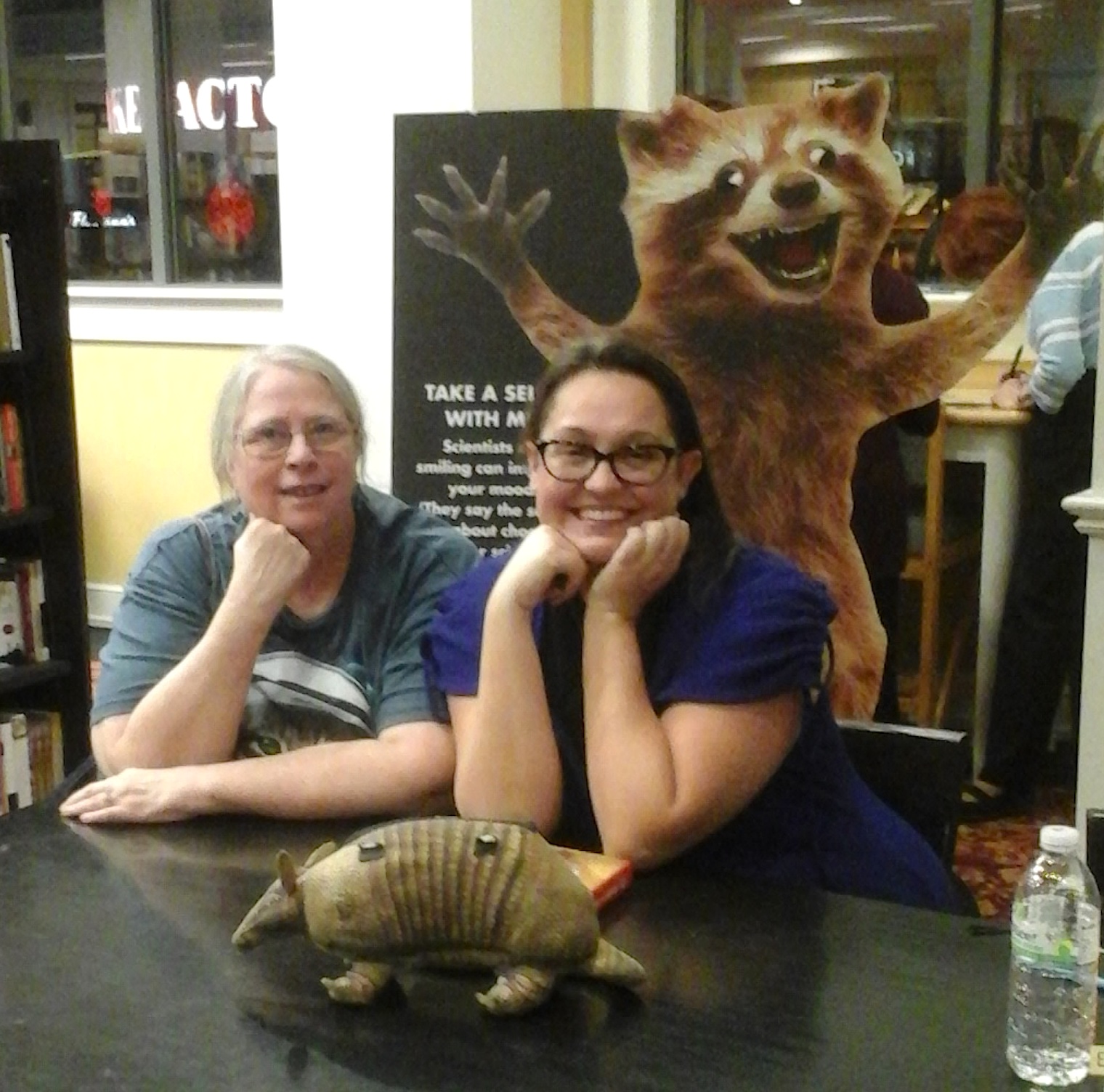
I met the Bloggess (aka Jenny Lawson) recently at a book signing for Furiously Happy, her second book. (Her first book was Let’s Pretend This Never Happened.)

Back row: Rory, the Furiously Happy Raccoon; middle row: me, Jenny Lawson; front row: Erma the Armadillo

Back row: Rory, the Furiously Happy Raccoon; middle row: me, Jenny Lawson; front row: Erma the Armadillo

The space at the bookstore was full to overflowing. (People had driven for as much as five hours to see her.) Jenny read two chapters of her new book to riotous laughter and applause. There was a brief Q&A session. (I figured she got the same questions all the time and wanted to ask her something that no one else had. I imagine that writers on tour need a little variety.So I asked: If you could be any animal, what would you be and why? Her answer: A tapeworm, because I could just not move and have people feed me.)

I joined the signing line (#17). She signed my copy of her book (“Our story is not over.”) and I showed her the semicolon tattoo that goes with that saying. She also signed my armadillo purse (Erma) and a piece of glass for my husband, who wants to put it over a picture of her or of a vagina; he hasn’t decided which. She laughed. He was one of the many that ask for perhaps her most famous – or at least most quoted – phrase, “Knock knock, motherfucker.” (It comes from her story about leaving a giant metal chicken on someone’s doorstep. There were also a lot of metal chickens she was asked to sign.) The bookstore personnel made sure that everyone knew it was okay to ask for that. In fact, they announced it just before the signings, reassuring the shy or inhibited.

The title of her new book, Furiously Happy, is Lawson’s way of telling depression to fuck off: If part of her life is misery and pain, she’s going to damn well make the most of the parts that aren’t. And while she’s at it, she’ll spread the word that mental illness is not a thing to be hidden or ashamed of.

This is not to say that her mental disorders are cured or that she no longer suffers from them. She was clearly anxious when reading aloud the two chapters, and visibly relieved when that part of the evening was done. Her strategy is to laugh at mental illness, joke about her meds, and speak bluntly to those in the audience who also suffer or have a person in their life who does.

Furious Happiness is a worthy goal, and her out-there enjoyment of life leads her into some of the hysterical situations she has written about in both books. These are the stories that make you say – only you, Jenny! Then she turns around and tells you that you are just like her in the ways that count.

The readers of her books and her blog – thebloggess.com – have formed an odd mutual support community. Although we may feel alone, Jenny rallies us to be alone together. Since one of the major difficulties with being a psychiatric patient is the feeling that no one else understands or experiences the same feelings, bringing people together in the virtual world or between the covers of a book is a valuable form of networking, especially for those who can’t network any other way.

Myself, I can’t manage the Furious Happiness. Too long dealing with the black dog and relatively little experience of even the mild highs of hypomania have left me depleted. Jenny will just have to do it for both of us. This is not to say I don’t love her or her work. I do, despite the blog post that I wrote, “Seven Reasons I Hate the Bloggess” (http://wp.me/p4e9wS-56). I can see myself in her and her in me, but for the moment I’m not able to follow her exuberant example. But she gives me hope. And I’m sure that’s one of her most important goals.

The Wrong Life

Nothing prepared me for this.

This is not the life my upbringing prepared me for. I don’t just mean the special guest speakers we had in home economics class who tried to introduce us to the subtleties of silver, china, and stemware. No, I was also misled by the books I read.

If Life Is a Bowl of Cherries, What Am I Doing in the Pits? and Please Don’t Eat the Daisies led me astray. Don’t get me wrong, I’m a total fan of Erma Bombeck’s writing style, but the quirky suburban life she loved and lamented was not what I got. Bombeck and Kerr both made light – and fortunes – of portraying the petty foibles and cute misunderstandings of women and their husbands, women and their children, women and their neighbors, women and other women.

Daily disasters with dishwashers, sticky-fingered children, and clueless husbands were an endless source of amazement and amusement for them. They soldiered on, supported by an innate buoyancy, faith in the divinity, and the occasional glass of wine.

My glasses of wine have been more than occasional. My disasters have not been humorous. I do not have children, and the cats are somewhat deficient in making adorable conversation in high-pitched, lisping voices. Sometimes all I can get out of them is “meh,” which is pretty much how I feel too.

As for the trappings of the genteel life, we eat off paper plates more often then not. I did once have a set of Limoges, but only because I was acting as a pawnbroker for a friend who needed ready cash. I fed one of the cats on the Limoges saucer, just to say that I had.

My parents used to say that their house was decorated in early married junk and I have followed in that fine tradition. Most of our furnishings are a demonstration of the maxim: If it’s not from Kmart or Goodwill you won’t find it here.

No one’s life prepares them for clinical depression, hypomania, bipolar disorder, or any other mental illnesses. I’ll wager that even psychologists’ kids don’t have a clue when they escalate from picking scabs to experimenting with lit cigarettes. Maybe their parents don’t either.

Either the mental disorder has been going on so long that you don’t know what it’s like without it, or it comes on so suddenly that you desperately hope that it goes away just as suddenly. Or it comes in a way that you can just convince yourself is no big deal. “I overspend? That’s just because I love shopping, not because I have mania or need to validate myself with expensive things.”

Perhaps people who grow up with a mentally disturbed loved one have a chance of understanding the underlying mechanisms. But with the number of families who don’t discuss the “elephant in the room,” or pass it off as, “Your sister is just high-strung” or say, “Uncle Ted is a little odd. Just ignore him,” not even that exposure may help.

How do young people learn about mental illness? Or even – gasp! – get help for one? If not at home, maybe at school? The National Association of Secondary School Principals cites the U.S. Surgeon General’s report saying that “one in five children and adolescents will face a significant mental health condition during their school years” and that the ratio of school counselors to students is 471:1. Add to that the fact that most school counselors have been shifted away from offering personal and emotional support to offering academics-only services. (http://www.nassp.org/Content.aspx?topic=57948)

Most of us struggle alone. Some never find a proper diagnosis and treatment. We have to be our own resources and our own advocates much of the time, even if our illnesses do not allow us to get out of bed. If we have one family member – or even a close friend – who understands, we are lucky beyond measure.

I wish that I had been even slightly prepared for the life I now lead, instead of the one I was “supposed” to have. No one can predict the future, but why can’t we at least have a bit of mental health education in school? I suppose that’s a lot to ask, when even sexuality education varies from the merely adequate to the appalling, when schools are barely able to stay abreast of the teach-to-the-test curriculum, and when Texas’s governor vetoes a bipartisan bill allocating resources for mental health, based on lobbying by Scientologists.

Do I sound bitter because I didn’t get to live the genteel suburban life? Probably. But there are aspects of that life that likely would have actively impeded my search for mental health. So I’ve had to do it on my own, or nearly so, at least until recently. A lot of us go DIY for mental health.

But a lot of us are accomplishing it. Living the life we have and not some fictitious pie-in-the-sky one. We may not have been prepared for it, but we muddle through anyway – and sometimes even realize that imperfect real life is better than a perfect lie.

More “News” About Mental Health

Next in my ongoing series (see: https://bipolarjan.wordpress.com/2015/07/05/new-hope-for-mental-illness/) of posts about news stories that bear on mental health, and what they may or may not mean:

Depression Damages Parts of the Brain, Research Concludes, July 2, 2015, by Sasha Petrova (http://www.iflscience.com/health-and-medicine/depression-damages-parts-brain-research-concludes_

“Brain damage is caused by persistent depression rather than being a predisposing factor for it, researchers have finally concluded after decades of unconfirmed hypothesising,” the article begins.

“A study published in Molecular Psychiatry … has proved once and for all that recurrent depression shrinks the hippocampus – an area of the brain responsible for forming new memories – leading to a loss of emotional and behavioural function.”

The article also claims that “the effects of depression on the brain are reversible with the right treatment for the individual,” though what those treatments might be is not explained.

The take-away: Depression damages the brain, not the other way around. What this means for patients is not yet known.

Link Found Between Gut Bacteria and Depression, July 28, 2015, by Caroline Reid (http://www.iflscience.com/plants-and-animals/link-found-between-gut-bacteria-and-depression)

Well, if it’s not the hippocampus, it might be your guts. According to this article, “Scientists have shown for the first time that there is a way to model how the gut bacteria in a mouse can have an active role in causing anxiety and depressive-like behaviors….

“[T]he lead author of the study… concluded that stress shortly after birth in mice, alongside the microbiome associated with stress, can lead to depression later in life.”

The take-away: More help for depressed mice. As the study author says, “It would be interesting to see if this relationship also effects humans. ….We need to obtain some human data to be able to say with confidence that bacteria are really inducing anxiety or depression…. However, so far, the data is missing.” In other words, more theory, more mice, no help for patients.

Mad Cow Disease Protein May Play a Role in Depression, by Justine Alford

(http://www.iflscience.com/brain/mad-cow-disease-protein-may-play-role-depression)

“In all likelihood, there is no single cause, but one of the leading ideas is that it results from an imbalance of chemicals in the brain, namely the ‘happy’ hormone serotonin and the ‘pleasure’ hormone dopamine.” Hard to argue with that. But here’s the meat of the article: “[S]cientists may have just discovered another contributing factor – abnormal bundles of proteins called prions.” Prions are also the culprit in mad cow disease. After some theorizing and mouse research, “the researchers propose a possible mechanism for the involvement of prion proteins in depression.”

The take-away: Interesting to scientists, but no help yet for depression sufferers. Plus, the article is a bit too technical for the lay audience – and all theory, except perhaps for the mice.

Picky Eaters May Be More Likely to Develop Anxiety and Depression, by Hannah Keyser (http://mentalfloss.com/article/67034/picky-eaters-may-be-more-likely-develop-anxiety-and-depression)

This sums it up nicely: “The study... found that picky eaters are more likely to develop anxiety, depression, and ADHD in later years….While moderate cases were associated with symptoms of separation anxiety and ADHD, severe picky eaters were more likely to have an actual diagnosis of depression or social anxiety in later years. But the scientists stressed that this is a case of correlation, not causation.”
The take-away: So, no news here. Correlation does not equal causation means this may be a coincidence, or anxiety and depression may cause picky eating, or some other factor may cause them both. Note the “May Be” in the article title – it often signals a result of little or no value.

A Urine Test Could Distinguish Between Bipolar Disorder and Depression, August 8, 2015, by Stephen Luntz (http://www.iflscience.com/brain/urine-test-distinguish-forms-depression)

“An easy and reliable method of distinguishing bipolar disorder from major depressive disorder could save tens of thousands of lives, and transform millions more. Now researchers at Chongqing Medical University, China, claim to have found just that in a study based on biomarkers in urine.” According to the study, the presence of six metabolites in urine was 90 percent reliable in diagnosing the two conditions, which are notoriously difficult to tell apart. “Studies have found that as many as 39% of patients diagnosed with MDD have unrecognized bipolar.”

The take-away: More research needed, but this could be big. Pee on a stick and find out whether you’re bipolar, instead of relying on the DSM. (Full disclosure: I was diagnosed with major depression for decades before my bipolar 2 diagnosis.)

The Startup That Wants to Cure Social Anxiety, by Robinson Meyer (http://www.theatlantic.com/health/archive/2015/05/the-startup-that-wants-to-end-social-anxiety/392900/?utm_campaignFacebook_lookalike2%25_8%2F3_Atlantic_desktop)

This is, if not new, at least a little different: Cognitive Behavioral Therapy (CBT) delivered on the web. The article claims that “[R]esearch conducted over the past half-decade shows that CBT delivered via a website can be just as effective as CBT delivered through an in-person therapist.” The service, called “Joyable,” can be accessed for $99 per month or $239 for three months, which includes a coach. The company says that the online treatment “reduces the stigma around seeking out therapy.”

The take-away: Yeah. We’ll see. And lose the name “Joyable,” for heaven’s sake. (Full disclosure: I’ve never been a fan of CBT.)

An infographic with references and everything.
The take-away: The infographic talks about physical ailments, but many of us can testify that a purring cat on one’s lap, or even by one’s side, can calm the distressed mind as well. Completely scientific, if you count anecdotal evidence.
Cats and Mental Health, Mental Health Foundation

Seriously, though, survey says, “Half of those people [more than 600 individuals surveyed in 2011] described themselves as having a mental health problem. The results highlighted some of the benefits of feline ownership:

  • 87% of cat owners feel that the animals have a positive impact on their wellbeing
  • 76% find that coping with everyday life is easier thanks to the animals
  • Stroking a cat is a calming and helpful activity.”

The article also refutes the myth about “crazy cat ladies” and self-harm.

My take-away: Pet therapy is a recognized technique that provides benefits to shut-ins, geriatric and psychiatric patients, those with ADD and autism, and even prisoners. My four cats increase the effects of Zoloft, Ativan, Lamictal, and Abilify. Be sure to have your pet spayed or neutered.


A Tattoo Is for Life…

…this one, especially so.

As soon as I learned about the semicolon tattoo, I knew I had to get one – and not just because I’m a huge grammar nerd. Because I’m bipolar and want to spread the word about mental health issues.

In writing, the semicolon indicates a place where a writer could have finished a sentence, but instead chose to go on. This makes the semicolon an effective and beautiful symbol for suicide prevention efforts and those who struggle with mental disorders.

Every day we choose to get out of bed; choose to take our medications; choose to make and go to our therapist appointments; choose to live another day; and choose to go on with our story.

This is not something I invented. Here are the people behind it: http://www.projectsemicolon.com/. And here are some stories about the phenomenon that have been working their way through the media and around the internet.

http://www.upworthy.com/have-you-seen-anyone-with-a-semicolon-tattoo-heres-what-its-about?c=ufb1

http://www.upworthy.com/9-beautiful-semicolon-tattoos-our-readers-shared-to-destigmatize-mental-health-challenges?c=ufb1

Here is my story.

I am possibly the last person you would ever expect to get a tattoo. I am probably the last person I would ever expect to get a tattoo. I’m in my 50s, a former English teacher, married for over 30 years, fond of reading and word puzzles and cats.

Nevertheless, the professionals at Monkey Bones Tattoos in Beavercreek, OH, did not seem surprised when I showed up one day and presented my wrist.

The naked wrist.

The naked wrist.

When I explained what I wanted – to put down a deposit and book an appointment to get a semicolon tattoo – I learned that they had a cancellation and could ink me right away.

What the hell, I thought. Might as well. I had learned about the tattoos about a month before and had thought it over plenty. It was by no means a spur-of-the-moment (or drunken) impulse.

Mike Guidone showed me into his studio and explained the procedure.

The tattoo artists work station.

The tattoo artist’s work station.

He presented me with stencils of three different sizes of semicolons. I chose the in-between one. My wrist is fairly small, so the big one would have looked out of place, but the small one wasn’t noticeable enough. The idea is for people to see it and ask, so you can share the meaning and talk to them about mental health and combatting the stigma.

I sat in the dentist-type chair, listened to a brief explanation, got answers to some questions, and was ready to start.

In progress.

Did it hurt? Not particularly. It was a feeling between a scratch and a sting, and took only about ten minutes. Some aftercare instructions and I was done.

finished1

Success!

Then I paid ($80, the shop minimum), tipped Mike, and was on my way. Now I care for the tattoo while it heals, anointing it with unscented lotion several times a day, avoiding sunlight or soaking, and trying my very best not to scratch or pick at it.

The results.

The results.

Am I happy with it? You bet!

And, like I said, it’s for life! My story isn’t finished yet.

Mini-Meltdowns and Many Meltdowns

When my brain broke back in 2001 or so, I thought it was the first time that had happened. Later, on reflection, it turned out that wasn’t so.

The 21st-century breakdown was certainly the most dramatic. Although I had just quit working in an office to start a freelance career, I found myself unable to work after a few months.

I had become unable to work in the office because of mounting difficulties that I now realize were warning signs of the impending breakdown: inability to concentrate, increased anxiety (the feeling that an angry badger was about to claw its way out of my stomach), lessened ability to interact with coworkers, sudden flares of temper, turning people away with unintendedly cutting remarks and sarcasm, isolating, inappropriate affect, catastrophizing – you name it, I had it.

What was causing all these symptoms? My bipolar disorder, obviously. But I’ve had that for years. What was pushing me over the edge this time? I had trouble at work. My boss left and, when I “came out” to my new boss as depressed (which is what I was diagnosed with at the time), she reacted with wariness and incomprehension. She gave me the first bad review I ever had at that job.

My mother’s health was deteriorating seriously, too, about then. I lost time at work taking her to various appointments and I had to have “the talk” with her about how much longer she could live alone. Eventually I took over her finances – and by then I was scarcely handling my own.

I experienced a lift when I quit my job and began freelancing. Hypomania? You bet! My new flexibility allowed me to take better care of my mother, and the assignments kept coming in.

Then everything came crashing down. I screwed up my finances and my mother’s. She began having worse falls and injuries, hospital stays and drug reactions, even hallucinations which scared the hell out of me. I emotionally judo-ed my sister to come up and help, then fought with and resented her, and had to take care of parts of her life as well.

Those and other difficulties on top of my mental disorder added up to a non-functioning me. I dumped all the chores and coping onto my husband, which was a rotten thing to do, fought with him, sobbed for no discernible reason, became unable to work, or care, or do much of anything except think up at least three different ways (and reasons) to kill myself. Fortunately, I was too immobilized to try any of them.

I’ve written before about the things that helped me get back to some kind of functioning – a proper diagnosis, the right meds, time without work (as we gutted our retirement savings), lots of psychotherapy, and my wonderful, patient, ever-helpful, devoted husband.

But now, looking back, I can see that it had happened before, though not so dramatically and completely. In childhood, in my teens, in college – at every stage of my life I had at least one breakdown, often triggered by the circumstances of my life, but fueled and stoked by my mental illness. In every one, my ability to function deteriorated a little more.

The first one that I remember clearly was when I was around 12. My best friend and I were in charge of a birthday party for her younger sister and some friends. This was the old-fashioned kind of party that everyone in the neighborhood had then: cake and ice cream, party games, presents, and not much else. It happened during pin-the-tail-on-the-donkey. I was blindfolded – literally – and my friend kicked me in the ass – again, literally. In front of all those younger children.

I ran home sobbing. And I curled up into a fetal ball and didn’t quit for at least three days. Non-functioning, non-responsive, non-everything. What finally brought me out of it was seeing my mother’s pain at this inexplicable (to her) meltdown.

I had a mini-meltdown in my freshman year of college, which involved sitting in my nightgown in the hallway, staring for hours at a richly detailed poster of a fantasy realm. (I managed to frighten an intruder by arising, ghost-like, in my pale yellow shroud as he entered the suite.)

This one was triggered by my realization that I had probably chosen the wrong major and that there were no job prospects ahead for me. (It turns out I was wrong about that. Maybe I should have stuck with it, but my next choice turned out pretty well.) I took a year off college and took a job as a cashier in a restaurant, where I spent a lot of time crying into the roller towel and being told I should smile more. This convinced me that going back to college, with a new major (and even fewer job prospects), was the right thing to do.

The next meltdown was major. I had finished college, endured a year-long train wreck of a relationship, and lost a job as an assistant restaurant manager (I hadn’t fully learned that lesson yet). I got unemployment, which meant I lay around the apartment for most of the week (except for making half-hearted attempts at job hunting).

One notable symptom of this breakdown was my near-complete immobility. One errand in a day – say, going to the post office for stamps – made it a productive one for me. I had maybe three of those a month, with one being the obligatory visit to the unemployment office – a supremely depressing place to be depressed.

I had some truly irrational thinking that time, too. I thought I could cheer myself up by watching light, fluffy sitcoms on TV. But as I lay there on the couch, I found myself crying with every upbeat, cheery theme song that came with them. Laverne and Shirley making their dreams come true. One Day at a Time, which advised me to get up on my feet because somewhere there was music playing. And, oh, Mary Tyler Moore. Love is all around, my ass.

After that, it was a long, slow slide to my major breakdown. It wasn’t unrelieved misery. I got married. I got a master’s degree and a job in publishing. We acquired a house and cats. We traveled. But the Big One was waiting for me.

Nowadays, I still have mini-meltdowns, but they usually last a maximum of three days, rather than weeks, months, or even years. They still tend to be triggered by stressful life events, especially financial ones. But when I get one, I know I’ll be coming out of it soon. And that’s a wonderful feeling buried in all the misery.


Music Charms the Troubled Mind

Once I knew a man whose wife was going to leave him. I knew he was in a lot of pain and despair about it, though he also turned into a huge asshole before everything was said and done. He was also suicidal for a time.

One day when I was trying to talk him through a bad patch, I asked whether he might turn to music to help him. “What?” he said. “Do you think I should listen to country music and cry in a beer?”

I wasn’t suggesting that at all. I just knew that he was a singer and songwriter of talented amateur status and was known for this in various circles. I honestly thought that music might help.

On the other hand, I always forget, when I am on the downswing, how much music can do for me. It soothes and heals, but it also lets me tap into the emotions that I have been suppressing.

Do I have the inexplicable blues that are part and parcel of my condition? There’s a song for that. Am I feeling unrequited love? Unrequited lust? There’s a song for those too. Is the world spinning too fast for me? Do I need to know that everything will be all right? Or do I just need to know that someone, somewhere and somewhen, has also felt this way? I can turn to music.

“Music, uniquely among the arts, is both completely abstract and profoundly emotional. It has no power to represent anything particular or external, but it has a unique power to express inner states or feelings. Music can pierce the heart directly; it needs no mediation.”
– Oliver Saks, Musicophilia

Saks also says, “The power of music, whether joyous or cathartic, must steal on one unawares, come spontaneously as a blessing or a grace.” There he and I part company.

Music can certainly steal on us unawares, whack us upside the head with a memory, a feeling, a piercing stab of emotional intensity, all the stronger for being unexpected.

But we can also choose to bring music into our lives when nothing else seems to touch us. We can tap into those memories and feelings – good or bad – and let the music wash over us as we listen and feel.

According to scientific experiments with fMRI, music uses more parts of the brain than almost any other activity. The neural connections fire all over the place – more so if one is playing an instrument, but even when just listening. The memory centers, artistic areas, language centers, emotional areas – even the motor complexes – are stimulated.

My problem is remembering all that music can do for me. When my emotions are dulled, flattened by the steamroller of depression, I sometimes forget that I can be any other way. The music I love is always there for me. I can bathe in it, wallow in it, be uplifted by it, float on it, join in with it, feel it emotionally and viscerally and intellectually all at once or one at a time. It can express the things that I just can’t.

When you’re depressed is a time for writing bad poetry. Or you can let good poets and songwriters take you with them as they explore the human condition in ways you’re not capable of. I think that’s why they do it – create their art. The really good ones anyway.

There’s also something to be said for music as distraction. A song from years ago – even a frivolous one – can take you away from your troubles, even if only for a moment. This is not the time for exploring new musical avenues. Remembering that things once were good can feed your sadness, your depression, but it can also give you perspective. If you took joy in this music once, there will come a time when you will again. And maybe that time is now.

Perhaps the most amazing power of music is to provoke catharsis. Certain songs leave me sobbing like a baby. They don’t even have to be sad songs, though many of them are. “The Mary Ellen Carter” by Stan Rogers is about as life-affirming as you can get, but it can still turns me into a weeping puddle. (https://www.youtube.com/watch?v=Fhop5VuLDIQ) His song “Lies” has nothing to do with my situation personally, but its evocative power touches me nonetheless. (https://www.youtube.com/watch?v=D79XOc1vKzQ) And almost no one I know can make it through Kathy Mar’s “Velveteen.” (http://www.last.fm/music/Kathy+Mar/_/Velveteen)

Afterwards, I feel drained and, if not exactly better, less emotionally constipated, I guess you’d say. Clearing away a bit of blockage can be cleansing. If music can do that – and it can – then I don’t care if its country with a beer, jazz with a glass of wine, or hip hop with an energy drink. Even easy listening with a glass of milk, if that’s your thing.

So thank God and Apple for iTunes. And here’s hoping that my Swiss cheese of a memory will give me a nudge in the right direction when I need it next time.