Bipolar 2 From Inside and Out

Posts tagged ‘blogging’

The Pluses and Minuses of Highs and Lows

Low polygonal shape mountain background with clouds.

Bipolar disorder comes with highs and lows – mania and depression, for those who still call it manic-depressive illness. Bipolar 2 comes with plenty of depression (trust me on this), but mania that doesn’t reach the heights of regular mania. Hence the term “hypomania” – low mania. Like “hypoglycemia” – low blood sugar. (Actually, low blood sugar can affect the bipolar person’s – or anyone’s – moods, but that’s a story for another time.)

So. Mania. Mania comes with pluses – exuberance, euphoria, ambition, confidence, and other good feelings. It also comes with minuses – risk-taking behaviors that can ruin relationships, careers, finances, lives.

Hypomania, however, is usually not so extreme. Sometimes you don’t even realize that you have hypomania at all, because it comes out sideways, as anxiety. This is what happened to me, and is the reason it took me so long to get the proper diagnosis of bipolar type 2.

Recently I have been exploring the realm of hypomania, and I’m here to report that, similar to regular mania, hypomania has its attractions and its drawbacks. And they are intertwined.

On the plus side, I have more energy – more spoons to spend. I can go longer between naps. I have now gotten out of bed, dressed, and out of the house for three days in a row. I can concentrate longer on the books I’m reading and spend more time with my husband and do some actual paying work.

On the minus side, I pay for that energy. It’s like borrowing spoons – you can’t keep doing it. Sooner or later the spoons have to be replaced. Right before my most recent spurt of energy, I had a need for a nap that turned into a mega-nap – almost six hours. I woke up just in time to get ready for bed. Then I slept at least ten hours more – maybe 12. It’s impossible to schedule these things, but I have left tomorrow open just in case my body and brain decide that’s payback day for the three days of activity.

Another plus is that my creative juices are flowing. I’m working ahead on blog posts because I know at the end of the month I have a huge commitment that will keep me from writing something for that Sunday. I’ve also taken steps to spiff up my posts with visuals. And I’ve been thinking that I ought to write some fiction.

However, there’s a however. The last time I had a creative spurt I almost talked myself into starting two new blogs, for a total of four. I have plenty on my plate already, what with these blogs and paying work and trying to find an agent for my book and getting ready for a writer’s conference. This is no time to start a big new project that could easily devour my time and my ability to do the things I already need and want to do. But I do now have a computer file set aside for notes and ideas that flit through my busy brain. Call that file “Later.”

And let’s not forget anxiety. It’s hard to find the pluses there, except that anxiety, if properly harnessed, helps me prepare. I suppose it sounds better if I call it anticipation instead of anxiety. Anticipating my upcoming dental work spurred me into putting together the financing for it. Anticipating the writers’ workshop allows me to prep for all the details – wardrobe, business cards, directions, strategies to cope with exhaustion – that would make my nerves fray even more at the last minute.

I assume I needn’t discuss the minuses of anxiety. Let’s just say that for me, they include regrettable and appalling physical symptoms that no one wants to hear about.

Any way you look at it, the dental procedures are going to be a low and the workshop a high. I can already predict some of the difficulties that will accompany the workshop boost. It’s harder to think of pluses related to the dental work. Except that I really need it done, and with luck it will (eventually) improve my looks, my breath, my health, my pain level, and my self-esteem. At least that’s what I’m telling myself now.

Bipolar disorder is often compared to a seesaw (or teeter-totter, if you prefer) or a swing set or a roller coaster – for some reason, usually as a form of amusement that involves ups and downs. The amusement is debatable and fleeting. But the ups and downs are with us always. Better to learn to ride this beast rather than let it ride us.

Beware the Mental Health Meme

This post was specially written for BlogHer’s Social Media and Blogging section, but I thought it worth sharing here too. (Credit for the photo goes to my husband, Dan Reily.)


Slide1

Most Internet memes are harmless, or even amusing. They proclaim that someone has a wonderful granddaughter or that kittens are cute.

But some memes that travel the world sow unhelpful or even hurtful ideas as they go. The one above appears mild and even inspiring, but to a person with mental illness, it says a lot more than appears on the surface.

The meme that started me on this train of thought was one that invited people to embrace the crazy or enjoy the madness or some such. As a person with mental illness – bipolar disorder – I found the message troubling. The comments were even more so. One said that manic-depressives could at least enjoy the mania.

Admittedly, mania comes with feelings of soaring confidence and a whirlwind of creativity. Mania can also prompt risky behaviors – reckless driving, shoplifting, unsafe or extramarital sex – that can lead to a lifetime of problems, including failed relationships, arrest records, serious debt, and worse. Those are surely the opposite of enjoyable.

But I didn’t know if I was alone in these feelings, so I asked other bipolar bloggers how they react to popular memes. Here’s what they had to say.

Nondescript inspirational memes (of the sort that proclaim daylight follows darkness) seem relatively harmless. Reactions went from “meh” to “a waste of time.” Bipolar blogger Brad Shreve (insightsbipolarbear.com) likens them to affirmations. His research showed that evidence from reputable studies confirms that affirmations mitigate stress. Nevertheless, “I find most of them trite and condescending,” he says. “They just aren’t my thing. I choose meditation.”

Amy Balot, who blogs at madwomanacrossthewater.net, dislikes the sort of memes that tout positivity. “I do have a big problem with the way a lot of ‘motivational’ images seem to imply that all you need to do is think positive thoughts and your life will be hunky-dory,” she says. “It seems to be blaming people for things like depression or anxiety.”

Supposedly positive memes raise the hackles on a number of the bloggers. Dyane Leshin-Harwood, blogger at proudlybipolar.wordpress.com and author of the upcoming memoir Birth of a New Brain, says they range from “cool and empowering” to “[make] me feel guilty that my life isn’t as good as it could

be! It seems like it would bring anyone with bipolar depression down even
further.”

It does that to me as well.

Many such memes also promote a “bootstrap” approach to mental illness – which Jim Buchanan, who blogs at mythoughts62.wordpress.com, finds “irritating”: “I feel that this sort of thinking is harmful and it essentially blames the person reading it for their problems by implying that they ‘don’t want to allow themselves’ what is needed for a good life.”

Shreve adds, “Usually these entail [the idea that] the individual can change by doing one thing – [changing] our attitude. As if we could just snap out of depression, mania and more, if we would just put [our] mind to it. I find these guilty of mental health shaming.”

And as for the “find-your-sanity-in nature” meme that began this article? Amy Balot doesn’t care for that type. “I don’t dispute that spending time with animals or outdoors can be great and even therapeutic; but I do dispute the implication that these things are a replacement for therapy or better than therapy,” she says. “It minimizes the struggles of the mentally ill and says they’d be ok if they just took their dogs for more walks in the woods. Not all problems are solved by a little sunshine and fresh air.”

Memes intended to be humorous are a gray area, since humor is so subjective. Personally, I don’t mind being called “crazy,” but many bipolar people do. Using “crazy,” “insane,” or any of the many synonyms – “weird,” “eccentric,” “not normal” – can make people with mental disorders feel as if the meme speaks directly to them, even if that wasn’t intended.

But some people with mental disorders enjoy a gentle poke of fun at themselves. Shreve agrees: “These can be touchy because they could hurt or offend someone who is going through a difficult time, but they help me.” (Here’s one of his favorites: http://www.someecards.com/usercards/viewcard/326b0799dbae216dbe3bf6069e297ea48d).

I must admit that I can sometimes see humor in our situations. I’ve written pieces called “The Lighter Side of Insomnia” and “Confessions of a Crazy Cat Lady.” It’s not a matter of malice being intended; I don’t think people who pass along memes that we consider hurtful are “out to get” those with mental disorders. But that’s the problem: They don’t think before they click “Share.”

So I’m asking: Please think first. One of four Americans will have a mental or mood disorder at some time during their lives. You wouldn’t make fun of someone with a physical illness. Ask yourself: Would this meme still be amusing or inspiring or helpful if you substituted fibromyalgia or diabetes or paraplegia for “mental illness”?

If not, think again.

Am I Ready to Stop Therapy?

I got my first hint that I might be ready to stop therapy when I realized how little I was going. Over the years I have scaled down from weekly sessions to biweekly.

Then I noticed that, effectively, I’ve been going only once a month. I’ve been forgetting appointments, showing up on the wrong day, oversleeping, feeling poorly physically, or having too much freelance work to do.

Of course, those could be signs that I’m in denial, that I’m resisting therapy, that we’ve hit a bad patch of difficult issues and I just don’t want to deal with them.

But I don’t think that’s what’s happening. Here’s why.

I’m stabilized on my medications and they’re effective. When my psychiatrist moved away a few months ago, he left me with enough refills to last until this month and a list of other psychiatrists. My PCP agreed to prescribe my psychotropics if I lined up another psychiatrist for emergencies. I’ve done that, though I couldn’t get an appointment before March.

And that doesn’t alarm me. I don’t have the oh-my-god-what-if-my-brain-breaks-again panics. I don’t have the feeling that my brain is about to break again. I’ve thought about it, and I’m comfortable with letting my involvement with the psychiatric profession fade into the background of my life.

As long as I keep getting my meds.

I have more good days and I’m beginning to trust them. Oh, I still question whether I’m genuinely feeling good, happy, and productive or whether I’m merely riding the slight high of hypomania. But really? It doesn’t seem to matter very much. A few days ago I reflected on a string of particularly good days – when I accomplished things, enjoyed my hobbies, and generally felt content. And I simply allowed myself to bask in those feelings.

That’s not to say I don’t still have bad days. After a few days of hypomania, I hit the wall, look around for spoons and don’t find any, and require mega-naps to restore me. (I’m intensely grateful that I work at home and can do that. Most offices don’t appreciate finding an employee snoring underneath her desk. And my cat-filled bed is much more comfy-cozy.)

I still get low days too, but they are noticeably dysthymic rather than full-out, sobbing-for-no-reason, Pit-of-Despair-type lows that last seemingly forever. I know – really know, deep within me – that they will last a day or two at the most. And just that knowledge makes me feel a little bit better.

My creativity, concentration, and output are improving. I can work longer, read longer, write longer, take on new projects, think past today or even next week. I can trust my muse and my energy, if not immediately when I call on them, at least within a reasonable time.

I have trouble remembering how bad it used to be. Recently I’ve made connections with several on-line support groups for bipolar and mental health. I find I’m astonished at the crises, the outpourings of misery, the questioning of every feeling and circumstance, the desperate drama of even the most mundane interactions. They are overwhelming. But I realized that it’s been a long time since they’ve overwhelmed me. I recognize that I could some day be in that place again – that’s the nature of this disease. But I have a good support system that I trust to help me not fall too far without a net.

I don’t have much to talk about when I go to therapy. There are issues I need to work on – getting older, getting out of the house more, reclaiming my sexuality. But most of those I feel competent to work out on my own.  My sessions are mostly an update on what’s going on in my life at the moment, plus a recap of my recurring problems. But those problems are ones I’ve faced before and know how to cope with. I already have the tools I need and use them without needing a reminder.

So I’ve talked it over with my psychotherapist and I’m not completely quitting therapy, but I am cutting back officially to the once a month I seem to be going anyway. I know that if and when the bipolar starts giving me major trouble again, I can always call for an appointment or a telephone therapy session.

I’m not going to stop writing these posts. I still have a lot to say about where I’ve been, how I’ve got to where I am now, how things will go in the future, and all the many ways that mental illness affects society and vice versa.

You’re not getting rid of me that easily. I’m sticking around.

We Are Not Amused

In the last few days the bipolar blogosphere has been in an uproar about a post from OpinionatedMan. In it he said,“I get amused by people who claim to be bi polar.” [sic]
Naturally, some people were upset.

It is hurtful to think that someone is amused by our illness. We do not have it in order to be entertainment for others. We do not expect a mild chuckle or a small, wry grin when we reveal that we have a psychiatric illness. We do not find the symptoms, the therapy, the medication, the limitations – the bipolar life – amusing. Not to ourselves and certainly not for the amusement of others.

It is also offensive that he spoke of people who “claim” to have bipolar disorder. There is some debate about whether he meant “claim” in the sense of “say they have but not necessarily truthfully” or in the sense of “own the reality of and identify with,” and, to be fair, since the post was intended as poetry, it could be both.

Although “bipolar” is popular shorthand for someone who has ordinary mood swings, making free with the term “bipolar” is like comparing someone who’s in a bad mood with someone who is clinically depressed. We wouldn’t claim it (in either sense) if it weren’t so.

That’s enough to be upset about, but I think the rest of the post was troubling as well. OM portrayed himself as “multipolar,” implying that his multipolar life is a source of his depth of feeling and writing prowess.

The author thereby denigrates others who struggle with bipolar disorder yet try to create meaning. Many of us write, blog, draw, sculpt, or otherwise avail ourselves of creative outlets. For OM to think that his supposed extreme affliction makes him more creative, a better wordsmith, a creator of higher art than anyone with ordinary bipolar disorder is insulting.

Saying that his condition is multipolar as opposed to bipolar gets us into a game of “Whose life sucks the most?” (The loser is also the winner.) We are to think that no one has suffered as he does, and that no one is a comparable artist. It’s a version of the humble-brag – I’m worse off than you and I’m also better than you.

Of course the author has the right to believe as he does and to say what he does. I would not have him stop writing. But those of us who felt his words as wounds are entitled to speak up as well. Though he has a much larger platform than most of us, his words are not automatically more powerful than ours.

This is my opinion. Others differ. Here’s the link (http://aopinionatedman.com/2015/12/02/journal-entry-4/) so you can read and decide for yourself how you feel about it. He has apologized and claimed he meant no harm, and has been bashed and trolled, which is not my intention. Think of this as literary criticism from a former English teacher. As always, YMMV.

The Bloggess and Mental Health

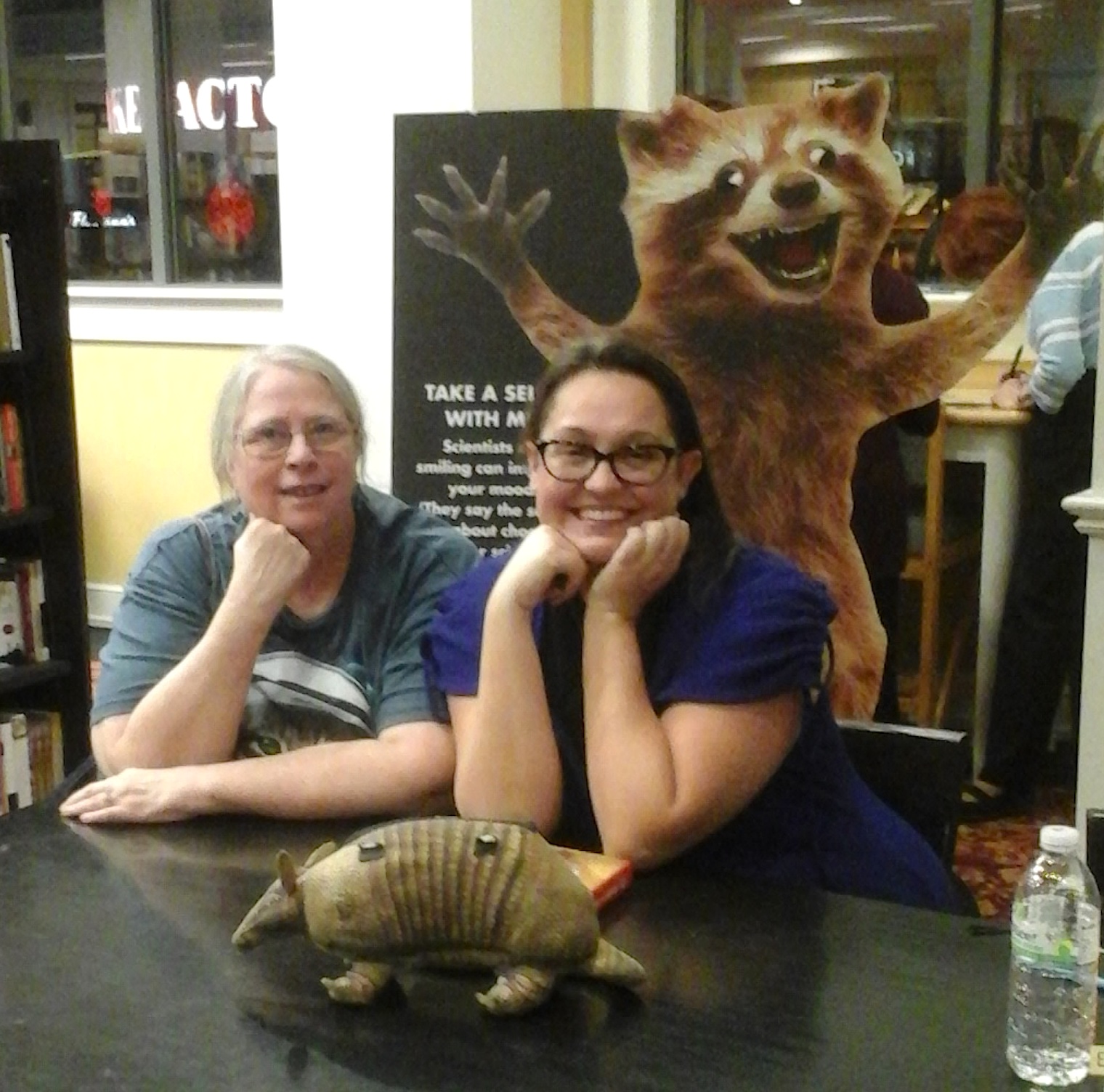
I met the Bloggess (aka Jenny Lawson) recently at a book signing for Furiously Happy, her second book. (Her first book was Let’s Pretend This Never Happened.)

Back row: Rory, the Furiously Happy Raccoon; middle row: me, Jenny Lawson; front row: Erma the Armadillo

Back row: Rory, the Furiously Happy Raccoon; middle row: me, Jenny Lawson; front row: Erma the Armadillo

The space at the bookstore was full to overflowing. (People had driven for as much as five hours to see her.) Jenny read two chapters of her new book to riotous laughter and applause. There was a brief Q&A session. (I figured she got the same questions all the time and wanted to ask her something that no one else had. I imagine that writers on tour need a little variety.So I asked: If you could be any animal, what would you be and why? Her answer: A tapeworm, because I could just not move and have people feed me.)

I joined the signing line (#17). She signed my copy of her book (“Our story is not over.”) and I showed her the semicolon tattoo that goes with that saying. She also signed my armadillo purse (Erma) and a piece of glass for my husband, who wants to put it over a picture of her or of a vagina; he hasn’t decided which. She laughed. He was one of the many that ask for perhaps her most famous – or at least most quoted – phrase, “Knock knock, motherfucker.” (It comes from her story about leaving a giant metal chicken on someone’s doorstep. There were also a lot of metal chickens she was asked to sign.) The bookstore personnel made sure that everyone knew it was okay to ask for that. In fact, they announced it just before the signings, reassuring the shy or inhibited.

The title of her new book, Furiously Happy, is Lawson’s way of telling depression to fuck off: If part of her life is misery and pain, she’s going to damn well make the most of the parts that aren’t. And while she’s at it, she’ll spread the word that mental illness is not a thing to be hidden or ashamed of.

This is not to say that her mental disorders are cured or that she no longer suffers from them. She was clearly anxious when reading aloud the two chapters, and visibly relieved when that part of the evening was done. Her strategy is to laugh at mental illness, joke about her meds, and speak bluntly to those in the audience who also suffer or have a person in their life who does.

Furious Happiness is a worthy goal, and her out-there enjoyment of life leads her into some of the hysterical situations she has written about in both books. These are the stories that make you say – only you, Jenny! Then she turns around and tells you that you are just like her in the ways that count.

The readers of her books and her blog – thebloggess.com – have formed an odd mutual support community. Although we may feel alone, Jenny rallies us to be alone together. Since one of the major difficulties with being a psychiatric patient is the feeling that no one else understands or experiences the same feelings, bringing people together in the virtual world or between the covers of a book is a valuable form of networking, especially for those who can’t network any other way.

Myself, I can’t manage the Furious Happiness. Too long dealing with the black dog and relatively little experience of even the mild highs of hypomania have left me depleted. Jenny will just have to do it for both of us. This is not to say I don’t love her or her work. I do, despite the blog post that I wrote, “Seven Reasons I Hate the Bloggess” (http://wp.me/p4e9wS-56). I can see myself in her and her in me, but for the moment I’m not able to follow her exuberant example. But she gives me hope. And I’m sure that’s one of her most important goals.

A Response to the Dalai Lama

This Friday, my Facebook newsfeed included a quotation from the Dalai Lama.

Depression seems to be related to fear, anger and frustration. When you’re in a bad mood, even if you meet with your friends, you don’t take pleasure in their company. But when you’re in a good mood, even if things go wrong, you can cope with them without difficulty. This is why putting yourself in a good mood, making a point of developing a sense of loving kindness gives you greater inner strength.

While I respect and admire the Dalai Lama, on this subject he is wrong.

I wrote a blog post to tell him and his followers so. I posted it on Blogher.com. (Blogher is a site for women bloggers that sometimes syndicates content. It is more general than what I usually post here, so I wrote something special for them.)

As I researched, trying to find when and where the Dalai Lama said this (I couldn’t), I discovered several articles about research into depression and Buddhist principles and techniques.

One was an article by Kathy Gilsinan at The Atlantic
(http://www.theatlantic.com/health/archive/2015/07/dalai-lama-neuroscience-compassion/397706/). It talked about “high-amplitude gamma-oscillations in the brain, which are indicative of plasticity.” What that is or has to do with depression, I don’t know. It sounds like “handwavium” to me.

One that made more sense was this, from Jeanie Lerche Davis at
WebMD: http://www.theatlantic.com/health/archive/2015/07/dalai-lama-neuroscience-compassion. (The feature was reviewed by Louise Chang, MD.)

While meditation can help many who are depressed, it’s not a sure-fire cure, [Charles W.] Raison [psychiatry professor and co-director of Emory’s Collaborative for Contemplative Studies] tells WebMD. “In fact, many people with mood disorders find they can’t do meditation when they’re depressed.” Their thoughts are too overwhelming. They are anxious, nervous, and can’t sit – and likely they need antidepressants, he says.

That’s more like it.

In my response to the Dalai Lama, I said,

Real, clinical depression is not about being in a “bad mood.” It’s true that a truly depressed person does not find pleasure even in ordinarily pleasurable things, such as meeting with friends. But we cannot simply put ourselves in a good mood.

That’s the hell of depression. We want to enjoy the good times. We want to put ourselves into a place of inner strength. But we can’t. Not without help.

In fact, your advice is hurtful to depressed people. Too many times we have been told, “Cheer up.” “Smile! You’ll feel better.” “Think about someone else for a change.” “What do you have to feel bad about?”

Don’t you think we would if we could?

Remarks like these remind us that we have an illness and we cannot cure ourselves by willpower alone – no more than a person with hepatitis or tuberculosis or even schizophrenia can. We need help, and most of us need medication.

You do a disservice to people with depression when you tell them to put themselves in a good mood. You, an enlightened spiritual leader, may be able to do it, but we can’t.

Certainly we can benefit from practicing loving kindness and developing inner strength.

But without treatment for depression, how many of us can do that?

It angers me when people say that depression – or any mental disorder – is something people can or should be able to cure with an attitude adjustment. I’ve heard it too many times from people in my life, and I’m sure you have too.

What’s really disappointing is that someone like the Dalai Lama, with his legion of followers and enormous credibility, is perpetuating this old way of thinking.

This lie.

Haiku Cycle

Break time here at the
synaptic schoolyard. You can
ride the swings all day.

Day lights sights you see,
saw before and that may be
In sight tomorrow.

Tomorrow times out
Wheels round and ticks away the
Body clock of mind.

Mind and brain play tag
I’m it as ducks and geese still
Wait while we circle.

Circle back and start
again, or stop before my
feelings crack and break.

Note: Poetry is something I used to do, years ago. After my Great Meltdown, my therapist suggested that I view it as an opportunity to rebuild myself, discarding things that were no longer useful and reclaiming things I want in my life.

So I decided to try poetry again. I used to write mostly free verse, but I decided to start with more structured forms because of needing some structure in my life now.

I have started with a cycle of haikus. They do not have to be read in order. Picture them as a ring. Pick any one as the starting point.

If you like this, and as inspiration strikes, I may attempt some more poetry for this blog. Is there a sonnet in our future? Dare I say it – a villanelle? Someday a sestina? We’ll see.

The Hypomanic Blogger

When I thought I had unipolar depression, I used to wish I were bipolar, on the theory that I could get a lot more done. (I later found that not to be true, as I’m sure many of you can attest.)

I had a lot more experience with depression than with mania. My bipolar disorder is Type 2, which means I get hypomania instead of full-blown mania. And most of the time the hypomania comes out sideways as anxiety and/or irritability.

(Don’t ask me why I get the full-monty-style depression and only a smidge of hypomania. I don’t know. If my shrink does, he hasn’t told me.)

Looking back, I can remember only one hypomanic episode before my new diagnosis made me more aware of the possibility. I was working at writing and editing – the same things I do now, only then I could do it in an office full-time instead of at home and freelance. A woman came to me, asking about how she could become a writer for magazines.

I positively burbled and babbled. I gave her all sorts of advice on query letters and Writer’s Market and niche publications and getting bylines and clips. I told her about how I started, writing for I Love Cats magazine and editing my martial arts club’s journal, and working my way up. (Incidentally, I am, as far as I know, the only person ever to have articles published in both Black Belt and Catechist magazines.)

The woman went away inspired, she said, though I never heard how she made out.

Now I can more easily recognize hypomania when it hits. I still get the anxious and irritable sort, but now I get more of the buzzy kind. And even though it makes me twitchy, I can make use of it.

It was in a bout of hypomania that I decided to start this blog (and my other, general-purpose one – janetcobur.wordpress.com).
It’s hypomania that has kept me going for over a year so far. Though I can now, thanks to medication, force myself to work while in the dysthymic stage or the “meh” stage, if I hit a spell of hypomania, I can use it to write and edit. Right now I’m using a hypomanic swing to stockpile ideas and first drafts against the inevitable downswing.

Of course, the ramblings that go with hypomania are not worth posting (or submitting to a client) the way they hit the screen. When I’m less jazzed, but not in the Pit of Despair, I can re-read, edit, and improve. It’s a fine balance, a tightrope I’m learning to walk. And it takes both therapy and medication to maintain.

In essence, the not-properly-treated bipolar 2 made my work go downhill (even as I did), until I was unable to work at all. Now that my diagnosis and my meds are more on track, so am I. I may not be well, but I certainly am better. I can live with what I’ve got, and even re-learn how to use some of the abilities I lost in my most recent, largest, most devastating crash.

I wouldn’t recommend mania or even hypomania to anyone, but as long as I’ve got it, I might as well make it be good for something.

The Creative Bipolar Brain

Sun or shade
feel or know
safe or strayed
stall or flow

Thought or whim
drought or rain
sink or swim
heart or brain

Stop or start
bound or free
light or dark
bipolar me

I have a lot of friends who are creative – writers, musicians, singers, woodworkers, knitters, and other craftspeople. I also have a lot of friends who have assorted mental or emotional disorders – depression, bipolar, PTSD, OCD, autism spectrum disorders, and probably many more that I don’t know about. In many cases, the two categories overlap.

Common wisdom holds that there is a link between creativity and madness. Look at Van Gogh, for example. People have spent years debating what specific disorder he may have had, but nearly everyone agrees that he had something. The question is, would he have been the great artist without the mental or emotional disorder? Or, perhaps, would he have been an even greater artist if his brain functioned in a more typical matter? Science so far has given us no answers.

Many creative people realize that their everyday functioning is impaired, but they are reluctant to seek treatment for it. They fear that tampering with their brain or thought processes will somehow inhibit their creativity – make them less than they were in some fundamental way. When you start tampering with brain chemistry, who knows what will happen?

It’s a valid concern.

Throughout my life, my brain has been all that I have, or nearly so. My intelligence and creativity were the things I was most proud of. How could I risk losing those simply because I was eternally miserable? The question seems absurd now.

Eventually I decided that I had plenty of brain cells to spare, and that if taking Prozac took away a few of them or lessened their ability, I could live with that. (Just in case, I took up pursuits that are supposed to strengthen the brain – math puzzles in addition to word puzzles, music in addition to writing. Not everything I tried was a success, but I hope they stretch my brain muscles.)

My experience with that first psychotropic med convinced me that Better Living Through Chemistry is not just a chemical company’s slogan. It turns out that – surprise, surprise – thinking more clearly and feeling more well-adjusted actually empower one’s creativity. My output changed from poems full of young adult angst to creative nonfiction, personal essays, and the occasional short story. I now make my living doing freelance writing and editing – an unstructured process that I couldn’t have made a go of before having my mood disorder treated. The ability to concentrate – to focus – is what enables me to sustain a creative effort.

So to all those people out there who wonder if they are sabotaging themselves and their creative impulses by seeking treatment, I say go for it! You have nothing to lose but your immobility. You have everything to gain – the ability to create, to express yourself and do it clearly, and the possibility to create something truly wonderful.

Sylvia Plath was a poetic genius. But she could have given so much more of her talent and vision to the world if she had not killed herself. Perhaps her poetry, had she been treated for her mood disorder, would not have been as searing and powerful. The point is, we will never know. Would she have become more ordinary, or more extraordinary? Dying young obviates the answer.

I believe – for me – that psychological treatment, appropriate medication, and more stable moods have expanded my creative process. And I try to prove it every week when I post in this and my other blog. Whether I succeed is for you to determine.

Have I lost a step? Maybe. But two forward and one back beats the hell out of one forward and two back.

Maybe Another Manic Monday

The great Abilify experiment continues. I’m still roller-coastering, which is “normal” for me, but I really can’t tell whether the drug is affecting the ups and downs.

The highs and lows do seem to be higher and lower (respectively). I am dubious about this being a Good Thing. For several days I was so thoroughly depressed that I was ready to call Dr. R. and tell him I need to stop taking the drug. Then I leveled out to my usual place on the continuum – functioning, but not spectacularly well or consistently.

Now I think I’m starting to get manicky. One way I can tell is that I actually had fun, laughing and playing with my husband the other night and exulting in getting an old friend to walk straight into an awful joke. (Me: Have you heard the new Ebola joke going around. Him: No, what is it? Me: Eh, you probably won’t get it. Him: No, c’mon, try me. Me: That WAS the joke. Him (in evident pain): Oh! Oh! Oh! Oh! Oh! Oh!)

But the real clue that the upswing may be swinging more than it should. I’m thinking about starting more blogs.

I already have two – this one and a general purpose blog called Et Cetera, etc. (janetcobur.wordpress.com, if you’re interested). For over six months I met my goal of posting something in both of them once a week.

Then the big low hit me. But I’m back on track now, after several weeks’ absence.

The thing is, I have ideas for two other blogs. I just don’t know if I could handle them.

One would be Cats, Etc. – stories and anecdotes about life with cats, cat care and health, and so forth. We have three cats right now (Louise, Garcia, and Dushenka), plus many former fur-family members, so there would be no shortage of material.

The other idea is Books, Etc. I’m an avid reader, and though the bipolar has sapped my concentration so much that it varies between 20 minutes to two hours at a time, I’m starting to see some progress. And I find myself wanting to write about what I’m reading – maybe book reviews, maybe lists or quotations, maybe even some lit crit (my original background).

But could I maintain them? And not have them drain off the limited energy that I should use to do the freelance work that pays the bills.

I think it is a sign that I’m still fairly well anchored that I haven’t rushed off and started them already. But the yearning to do more reading and writing keeps getting stronger. Maybe I could keep my current two at once a week, and do the others on alternate weeks. But that would still mean three blog posts per week, plus the freelance. Frankly, I don’t know if I could handle it. I keep asking myself, should I try? Or should I wait to see if my moods level out on the Abilify and it becomes clear whether they are Good or Bad Ideas, or even possible.

Words – both reading and writing them – have sustained me for most of my life. It was a sign of my most profound depression when I found myself unable to maintain enough focus to read. Now that I can again read and write to some extent, do I dare to push myself, push the boundaries? Can I? Should I?

Good thing I see my psychotherapist today.