Bipolar 2 From Inside and Out

Posts tagged ‘bipolar disorder’

Stress Plus

Mental stress plus physical stress = Stress Plus.

The mind and the body are part of the same system. What affects the one affects the other as well. When the body is stressed, the mind suffers. When the mind is stressed, the body suffers.

When both are stressed, you get Stress Plus.

Here’s how it works for people with mental disorders. You feel depressed or immobilized and you don’t get up and move around. Your body responds by becoming lethargic and flabby. Your mind responds to that by becoming discouraged and self-blaming. What you have there is a feedback loop.

My body and brain have been going different directions of late. My mood disorder has lessened and my brain doesn’t seem to be trying to kill me at the moment. This is good.

However, my body is experiencing all kinds of unpleasant disorders and sensations. Some – the thinning hair, the jowls, the weakened eyesight – are simply functions of aging. This does not make them any easier to deal with. They are wrapped up in my self-confidence, my sexuality, my identity, how others perceive me, and how congruent my self-image is with reality.

Stress symptoms have affected me at least since junior high. I developed a tic in which my chin would jerk up and to the left, making it hard for me (or anyone sitting behind me) to study. My doctor put me on Valium, which stopped the tic, but did no good, I’m sure, for my then-undiagnosed bipolar disorder.

Other physical ailments and disorders are the result of specific events or diseases. I have a bad back, which required two operations, the second because I irrationally thought it would be a good idea to ride an Arabian horse bareback. The experience has left me with nerve damage in my left toes – idiopathic radiculopathy, they call it – and an unsteady gait that sometimes necessitates the use of a cane for balance. It does not make me look or feel any younger.

Also, my hands shake. My neurologist called this an “essential tremor,” which means it’s caused by nothing in particular. He noticed that I often sit with my hands folded in my lap to call less attention to it. Between this and my balance issues, sometimes I stagger and shake like an old street rummy. A friend, God bless him, once told me I had a long way to go before looking like a street rummy. It was nice to hear, no matter what my brain tells me.

When my brain was acting up the worst, it also gave me the worst physical symptoms. My reflexes were hypersensitive and that included the reflex that empties my bowels. Just imagine the literal shitstorm I created in the bathroom of a bookstore one day. Then imagine how much of my self-esteem got flushed along with the rolls of toilet paper I used to try to clean it up. Imagine the humiliation of telling a store clerk, “Someone’s been very sick in the bathroom and you probably need to send a janitor.” I’m sure she knew it was me, because of how embarrassed and sickly I must have looked, but we both pretended that I was simply informing them that an accident had occurred.

Needless to say, all these conditions make me not want to go out amongst people, which adds to the isolation that my bipolar disorder already exacerbates. And when I don’t get out, my body doesn’t get moving, and I become even more immobilized – both physically and mentally.

Like I said, Stress Plus – a vicious circle.

Social But Spoonless

In the past week I have been out of the house more and seen more people than I have in years. It’s almost like having a social life.

In the past week I have also slept more than I usually do in my sloth-like, torpid existence.

I think the two are not unrelated.

If you follow Spoon Theory (http://www.butyoudontlooksick.com/articles/written-by-christine/the-spoon-theory/) you know that each spoon represents an amount of coping that you can do.

Every day you get a certain number of spoons – not the same number every day.  You use them to perform everyday tasks that most people think nothing of – things like getting out of bed (some days you don’t even have that spoon), taking a shower (1/2 spoon for Janet’s patented “super-fast smelly-bits sink wash-up”), getting dressed, finding something to eat, fixing that something (keep a box of Cheerios by the bed in case you run out of spoons at this point), and all that is without even leaving the house. Some days that’s all the spoons you have and when you’ve used up your spoons, that’s it.

Other days you can manage to do all that and leave the house, go to work, run errands, and assorted other normal activities. But for those of us who have mental disorders, such days are few and far between.

You hear depressed people talk of not being able to get out of bed, and for the most part that’s caused by lack of spoons. I am usually notoriously low on spoons. My husband now understands Spoon Theory and we use it as common shorthand for “I’m too tired” or “That’s all I can handle right now.”

Dan, however, is an over-scheduler and I often have to rein him in by pointing out that his proposed slate of activities will not be possible because I, for one, will run out of spoons, and he may too.

The dry run for my recent spurt of socializing began last week. After I went for my final session with Dr R., I managed a trip to the bank, a trip to the place where I could pay my power bill, and since it was right next door, a stop at Kmart to buy underwear. It was a good thing that was a hypomanic day, but it floored me for the rest of that day and the next. And it started a cycle of bipolar up-and-down oscillations that were clearly related to spoon usage.

My spate of social endeavors started with a double-header. On Saturday I had lunch with a friend at a favorite restaurant I almost never get to go to. We talked about politics, social issues, and book proposals. Then I went home and had a little nap.

That evening Dan and I went to Monkey Bones for Zombie Dogz. I know that takes a little explaining. Monkey Bones is the tattoo studio where I got my semicolon tattoo (http://wp.me/p4e9Hv-9G). Zombie Dogz is a local food truck. (Also, it’s fun to say “We went to Monkey Bones for Zombie Dogz.”)

Notice that in a single day I had to get up, out of bed, and get dressed twice. That’s a lot of spoons. Sunday I was not able to get out of bed at all.

Monday did not involve socializing, but it was another hellacious spoon-eater. Dan and I spent the day scrounging for documents and information that the IRS wanted. It was taxing. (See what I did there?)

Tuesday was an extra-special social event, though it did not involve getting dressed and going out, or even interacting with other people. It was Jenny Lawson’s online book launch party. Better known as the Bloggess, Jenny has severe social anxiety. At this stage in my life, I certainly would not be able to dress up, mingle, and make polite conversation with both friends and complete strangers. The online party was a genius idea.

I sat at home in my pajamas with some red wine while the Bloggess read chapters from her new book, Furiously Happy. (You should get it, by the way. It’s about mental illness, but funny.) As low-key a social situation as that was, it still used up spoons because it was something I had never done before. Making sure I had the right URL, converting Central Time to Eastern, not being able to ask questions because I don’t Tweet, worrying that Dan was getting bored – not a lot a lot of spoons, but still some.

The effects were getting cumulative. Again I was unable to get out of bed the next day. In fact, Dan and I both slept away most of the daylight hours. For him it’s understandable because he works third shift, but I have no such excuse. Except that if you borrow from the next day’s spoons, or try to keep going without them, you will pay.

Thursday, I was determined, with or without spoons, I was going to meet a friend for coffee. I’ve seen her only once, briefly, in several years. In a way, it was a test of my ability to maintain anything approaching a real social life.

I put forth the extra effort because a mutual friend cut her ties with me because I canceled so often on social engagements. I suppose I really have nothing to prove to anyone but myself but it seems important that I do so. It’s not like coffee with a friend is an ordeal or anything. It’s just that I know I’ll be using a spoon for more than stirring my coffee.

And I hope I have enough spoons left over to work on my other blog.

More “News” About Mental Health

Next in my ongoing series (see: https://bipolarjan.wordpress.com/2015/07/05/new-hope-for-mental-illness/) of posts about news stories that bear on mental health, and what they may or may not mean:

Depression Damages Parts of the Brain, Research Concludes, July 2, 2015, by Sasha Petrova (http://www.iflscience.com/health-and-medicine/depression-damages-parts-brain-research-concludes_

“Brain damage is caused by persistent depression rather than being a predisposing factor for it, researchers have finally concluded after decades of unconfirmed hypothesising,” the article begins.

“A study published in Molecular Psychiatry … has proved once and for all that recurrent depression shrinks the hippocampus – an area of the brain responsible for forming new memories – leading to a loss of emotional and behavioural function.”

The article also claims that “the effects of depression on the brain are reversible with the right treatment for the individual,” though what those treatments might be is not explained.

The take-away: Depression damages the brain, not the other way around. What this means for patients is not yet known.

Link Found Between Gut Bacteria and Depression, July 28, 2015, by Caroline Reid (http://www.iflscience.com/plants-and-animals/link-found-between-gut-bacteria-and-depression)

Well, if it’s not the hippocampus, it might be your guts. According to this article, “Scientists have shown for the first time that there is a way to model how the gut bacteria in a mouse can have an active role in causing anxiety and depressive-like behaviors….

“[T]he lead author of the study… concluded that stress shortly after birth in mice, alongside the microbiome associated with stress, can lead to depression later in life.”

The take-away: More help for depressed mice. As the study author says, “It would be interesting to see if this relationship also effects humans. ….We need to obtain some human data to be able to say with confidence that bacteria are really inducing anxiety or depression…. However, so far, the data is missing.” In other words, more theory, more mice, no help for patients.

Mad Cow Disease Protein May Play a Role in Depression, by Justine Alford

(http://www.iflscience.com/brain/mad-cow-disease-protein-may-play-role-depression)

“In all likelihood, there is no single cause, but one of the leading ideas is that it results from an imbalance of chemicals in the brain, namely the ‘happy’ hormone serotonin and the ‘pleasure’ hormone dopamine.” Hard to argue with that. But here’s the meat of the article: “[S]cientists may have just discovered another contributing factor – abnormal bundles of proteins called prions.” Prions are also the culprit in mad cow disease. After some theorizing and mouse research, “the researchers propose a possible mechanism for the involvement of prion proteins in depression.”

The take-away: Interesting to scientists, but no help yet for depression sufferers. Plus, the article is a bit too technical for the lay audience – and all theory, except perhaps for the mice.

Picky Eaters May Be More Likely to Develop Anxiety and Depression, by Hannah Keyser (http://mentalfloss.com/article/67034/picky-eaters-may-be-more-likely-develop-anxiety-and-depression)

This sums it up nicely: “The study... found that picky eaters are more likely to develop anxiety, depression, and ADHD in later years….While moderate cases were associated with symptoms of separation anxiety and ADHD, severe picky eaters were more likely to have an actual diagnosis of depression or social anxiety in later years. But the scientists stressed that this is a case of correlation, not causation.”
The take-away: So, no news here. Correlation does not equal causation means this may be a coincidence, or anxiety and depression may cause picky eating, or some other factor may cause them both. Note the “May Be” in the article title – it often signals a result of little or no value.

A Urine Test Could Distinguish Between Bipolar Disorder and Depression, August 8, 2015, by Stephen Luntz (http://www.iflscience.com/brain/urine-test-distinguish-forms-depression)

“An easy and reliable method of distinguishing bipolar disorder from major depressive disorder could save tens of thousands of lives, and transform millions more. Now researchers at Chongqing Medical University, China, claim to have found just that in a study based on biomarkers in urine.” According to the study, the presence of six metabolites in urine was 90 percent reliable in diagnosing the two conditions, which are notoriously difficult to tell apart. “Studies have found that as many as 39% of patients diagnosed with MDD have unrecognized bipolar.”

The take-away: More research needed, but this could be big. Pee on a stick and find out whether you’re bipolar, instead of relying on the DSM. (Full disclosure: I was diagnosed with major depression for decades before my bipolar 2 diagnosis.)

The Startup That Wants to Cure Social Anxiety, by Robinson Meyer (http://www.theatlantic.com/health/archive/2015/05/the-startup-that-wants-to-end-social-anxiety/392900/?utm_campaignFacebook_lookalike2%25_8%2F3_Atlantic_desktop)

This is, if not new, at least a little different: Cognitive Behavioral Therapy (CBT) delivered on the web. The article claims that “[R]esearch conducted over the past half-decade shows that CBT delivered via a website can be just as effective as CBT delivered through an in-person therapist.” The service, called “Joyable,” can be accessed for $99 per month or $239 for three months, which includes a coach. The company says that the online treatment “reduces the stigma around seeking out therapy.”

The take-away: Yeah. We’ll see. And lose the name “Joyable,” for heaven’s sake. (Full disclosure: I’ve never been a fan of CBT.)

An infographic with references and everything.
The take-away: The infographic talks about physical ailments, but many of us can testify that a purring cat on one’s lap, or even by one’s side, can calm the distressed mind as well. Completely scientific, if you count anecdotal evidence.
Cats and Mental Health, Mental Health Foundation

Seriously, though, survey says, “Half of those people [more than 600 individuals surveyed in 2011] described themselves as having a mental health problem. The results highlighted some of the benefits of feline ownership:

  • 87% of cat owners feel that the animals have a positive impact on their wellbeing
  • 76% find that coping with everyday life is easier thanks to the animals
  • Stroking a cat is a calming and helpful activity.”

The article also refutes the myth about “crazy cat ladies” and self-harm.

My take-away: Pet therapy is a recognized technique that provides benefits to shut-ins, geriatric and psychiatric patients, those with ADD and autism, and even prisoners. My four cats increase the effects of Zoloft, Ativan, Lamictal, and Abilify. Be sure to have your pet spayed or neutered.


A Tattoo Is for Life…

…this one, especially so.

As soon as I learned about the semicolon tattoo, I knew I had to get one – and not just because I’m a huge grammar nerd. Because I’m bipolar and want to spread the word about mental health issues.

In writing, the semicolon indicates a place where a writer could have finished a sentence, but instead chose to go on. This makes the semicolon an effective and beautiful symbol for suicide prevention efforts and those who struggle with mental disorders.

Every day we choose to get out of bed; choose to take our medications; choose to make and go to our therapist appointments; choose to live another day; and choose to go on with our story.

This is not something I invented. Here are the people behind it: http://www.projectsemicolon.com/. And here are some stories about the phenomenon that have been working their way through the media and around the internet.

http://www.upworthy.com/have-you-seen-anyone-with-a-semicolon-tattoo-heres-what-its-about?c=ufb1

9 beautiful semicolon tattoos our readers shared to destigmatize mental health challenges

Here is my story.

I am possibly the last person you would ever expect to get a tattoo. I am probably the last person I would ever expect to get a tattoo. I’m in my 50s, a former English teacher, married for over 30 years, fond of reading and word puzzles and cats.

Nevertheless, the professionals at Monkey Bones Tattoos in Beavercreek, OH, did not seem surprised when I showed up one day and presented my wrist.

The naked wrist.

The naked wrist.

When I explained what I wanted – to put down a deposit and book an appointment to get a semicolon tattoo – I learned that they had a cancellation and could ink me right away.

What the hell, I thought. Might as well. I had learned about the tattoos about a month before and had thought it over plenty. It was by no means a spur-of-the-moment (or drunken) impulse.

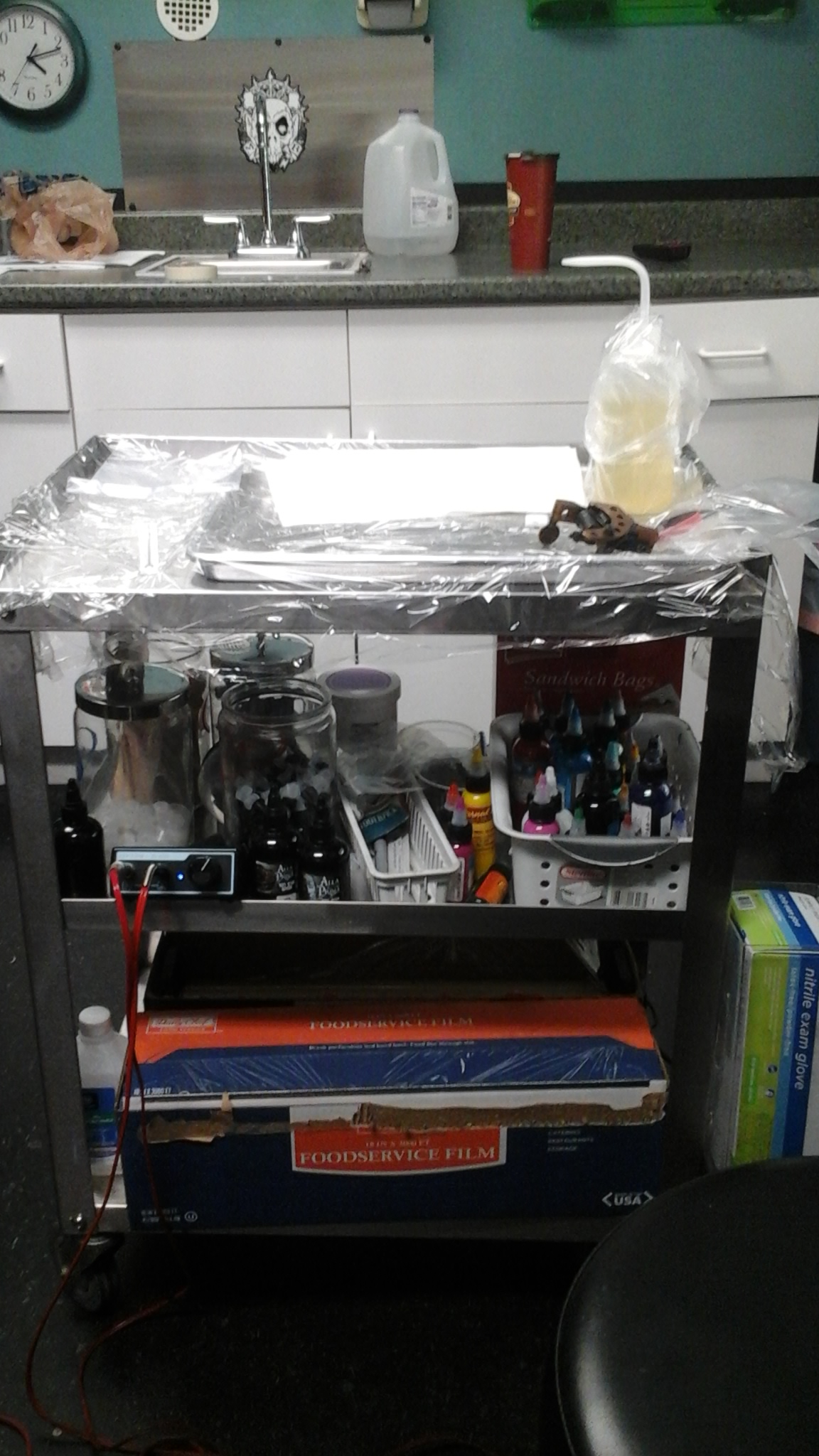
Mike Guidone showed me into his studio and explained the procedure.

The tattoo artists work station.

The tattoo artist’s work station.

He presented me with stencils of three different sizes of semicolons. I chose the in-between one. My wrist is fairly small, so the big one would have looked out of place, but the small one wasn’t noticeable enough. The idea is for people to see it and ask, so you can share the meaning and talk to them about mental health and combatting the stigma.

I sat in the dentist-type chair, listened to a brief explanation, got answers to some questions, and was ready to start.

In progress.

Did it hurt? Not particularly. It was a feeling between a scratch and a sting, and took only about ten minutes. Some aftercare instructions and I was done.

finished1

Success!

Then I paid ($80, the shop minimum), tipped Mike, and was on my way. Now I care for the tattoo while it heals, anointing it with unscented lotion several times a day, avoiding sunlight or soaking, and trying my very best not to scratch or pick at it.

The results.

The results.

Am I happy with it? You bet!

And, like I said, it’s for life! My story isn’t finished yet.

Mini-Meltdowns and Many Meltdowns

When my brain broke back in 2001 or so, I thought it was the first time that had happened. Later, on reflection, it turned out that wasn’t so.

The 21st-century breakdown was certainly the most dramatic. Although I had just quit working in an office to start a freelance career, I found myself unable to work after a few months.

I had become unable to work in the office because of mounting difficulties that I now realize were warning signs of the impending breakdown: inability to concentrate, increased anxiety (the feeling that an angry badger was about to claw its way out of my stomach), lessened ability to interact with coworkers, sudden flares of temper, turning people away with unintendedly cutting remarks and sarcasm, isolating, inappropriate affect, catastrophizing – you name it, I had it.

What was causing all these symptoms? My bipolar disorder, obviously. But I’ve had that for years. What was pushing me over the edge this time? I had trouble at work. My boss left and, when I “came out” to my new boss as depressed (which is what I was diagnosed with at the time), she reacted with wariness and incomprehension. She gave me the first bad review I ever had at that job.

My mother’s health was deteriorating seriously, too, about then. I lost time at work taking her to various appointments and I had to have “the talk” with her about how much longer she could live alone. Eventually I took over her finances – and by then I was scarcely handling my own.

I experienced a lift when I quit my job and began freelancing. Hypomania? You bet! My new flexibility allowed me to take better care of my mother, and the assignments kept coming in.

Then everything came crashing down. I screwed up my finances and my mother’s. She began having worse falls and injuries, hospital stays and drug reactions, even hallucinations which scared the hell out of me. I emotionally judo-ed my sister to come up and help, then fought with and resented her, and had to take care of parts of her life as well.

Those and other difficulties on top of my mental disorder added up to a non-functioning me. I dumped all the chores and coping onto my husband, which was a rotten thing to do, fought with him, sobbed for no discernible reason, became unable to work, or care, or do much of anything except think up at least three different ways (and reasons) to kill myself. Fortunately, I was too immobilized to try any of them.

I’ve written before about the things that helped me get back to some kind of functioning – a proper diagnosis, the right meds, time without work (as we gutted our retirement savings), lots of psychotherapy, and my wonderful, patient, ever-helpful, devoted husband.

But now, looking back, I can see that it had happened before, though not so dramatically and completely. In childhood, in my teens, in college – at every stage of my life I had at least one breakdown, often triggered by the circumstances of my life, but fueled and stoked by my mental illness. In every one, my ability to function deteriorated a little more.

The first one that I remember clearly was when I was around 12. My best friend and I were in charge of a birthday party for her younger sister and some friends. This was the old-fashioned kind of party that everyone in the neighborhood had then: cake and ice cream, party games, presents, and not much else. It happened during pin-the-tail-on-the-donkey. I was blindfolded – literally – and my friend kicked me in the ass – again, literally. In front of all those younger children.

I ran home sobbing. And I curled up into a fetal ball and didn’t quit for at least three days. Non-functioning, non-responsive, non-everything. What finally brought me out of it was seeing my mother’s pain at this inexplicable (to her) meltdown.

I had a mini-meltdown in my freshman year of college, which involved sitting in my nightgown in the hallway, staring for hours at a richly detailed poster of a fantasy realm. (I managed to frighten an intruder by arising, ghost-like, in my pale yellow shroud as he entered the suite.)

This one was triggered by my realization that I had probably chosen the wrong major and that there were no job prospects ahead for me. (It turns out I was wrong about that. Maybe I should have stuck with it, but my next choice turned out pretty well.) I took a year off college and took a job as a cashier in a restaurant, where I spent a lot of time crying into the roller towel and being told I should smile more. This convinced me that going back to college, with a new major (and even fewer job prospects), was the right thing to do.

The next meltdown was major. I had finished college, endured a year-long train wreck of a relationship, and lost a job as an assistant restaurant manager (I hadn’t fully learned that lesson yet). I got unemployment, which meant I lay around the apartment for most of the week (except for making half-hearted attempts at job hunting).

One notable symptom of this breakdown was my near-complete immobility. One errand in a day – say, going to the post office for stamps – made it a productive one for me. I had maybe three of those a month, with one being the obligatory visit to the unemployment office – a supremely depressing place to be depressed.

I had some truly irrational thinking that time, too. I thought I could cheer myself up by watching light, fluffy sitcoms on TV. But as I lay there on the couch, I found myself crying with every upbeat, cheery theme song that came with them. Laverne and Shirley making their dreams come true. One Day at a Time, which advised me to get up on my feet because somewhere there was music playing. And, oh, Mary Tyler Moore. Love is all around, my ass.

After that, it was a long, slow slide to my major breakdown. It wasn’t unrelieved misery. I got married. I got a master’s degree and a job in publishing. We acquired a house and cats. We traveled. But the Big One was waiting for me.

Nowadays, I still have mini-meltdowns, but they usually last a maximum of three days, rather than weeks, months, or even years. They still tend to be triggered by stressful life events, especially financial ones. But when I get one, I know I’ll be coming out of it soon. And that’s a wonderful feeling buried in all the misery.


Sense of Self

The air is still and blankets all my sense.
I’m muffled, muzzled in the sheltering dark
But dare not hope for fire, with bright, intense,
loud flames that rend the silence with a spark.

I breathe or not. It’s sometimes hard to tell
When swathed in dimness. Stifling, musty scent
Fills up my nostrils and my brain as well –
Which cannot will the veil be shredded, rent

to save from suffocation. How shall I
Withstand this cycle till the day appears
And breezes blow the dust away from my
Stopped ears and eyes and lungs, plugged full with fears?

Pull off the cover and let free the soul.
Take broken breath and heal it into whole.

Abilify: The Next Chapter

I’ve been taking Abilify as an add-on to my other psychotropics for about six months now, and I have some pieces of good news to share.

Good news #1: The generic (aripiprazole) is now available! There was a slight delay between the time the FDA gave approval for the generic (April) and the time it went on sale. But now it has arrived in drugstores. (I understand that the same company makes both the brand name and the generic, which strikes me as goofy, but then what do I know about drug marketing?)

Good news #2: Between my insurance and my pharmacy, I now have to pay only $15/month for the generic. The brand-name Abilify was $800 without insurance and $125 with. My insurance is not cheap, though it is still less than the cost of brand-name Abilify. When you add in all my other prescriptions and doctor visits and tests and such – plus all my husband’s drugs and other medical expenses, the insurance suddenly doesn’t seem so pricey. (I got this insurance through the Affordable Care Act, and I hope the Supreme Court doesn’t screw it up for me.)

Good news #3: Despite my tiny dosage (2 mg.) I have noticed significant effects. After six months on the drug, I have more energy, better focus and concentration, and fewer down/useless days (unless I overdo and run out of spoons). (See http://www.butyoudontlooksick.com/articles/written-by-christine/the-spoon-theory/ if you don’t know what I mean by that.)

I’ve been doing major housecleaning/sorting, going out – actually outside the house – to run errands other than my shrink appointments, and I even went to a party – a reunion of people I used to work with. I wore my new skirt, navigated the social milieu successfully, and stayed an hour and a half. (The next day was one of my no-spoons days, though.)

This is only the third time in my life that I’ve noticed a significant effect from taking a new prescription. The first was Prozac (fluoxetine), which felt like looking at a color television after years of black-and-white. With static. Showing only commercials. The second was Lamictal (lamotrigine), which felt like a switch flipping and turning on my ability to think rationally. And now there’s Abilify.

Whatever side effects I may have, I’m willing to live with. (Unless I get the tardive dyskinesia. That would be a deal-breaker.) This feels like real living and I’m happy about it. I don’t think this is hypomania, either. I think I’m supposed to feel this way. I’m going to run with it.

Of course this isn’t the end of bipolar disorder for me, or the end of this blog. I still have plenty to say about my experiences with bipolar depression, mental health in general, and particularly mental health in the media and society.

Sorry if I sound sappy, but it’s good to be alive and functioning!

Me and My Brain: A Story of Love and Dysfunction

As they say, of all the things I’ve lost, I miss my mind the most. Or anyway, a properly functioning brain.

I love my brain, despite all the trouble it’s given me. For many years I thought it was the only measure of my worth, the only thing about me that made me special, the only thing that I could truly rely on.

I reveled in learning, in thinking, in reading, in questioning, in contemplating, in discovering. My body was not dependable; my brain was.

Little did I know the biochemical pitfalls that were waiting for me. Little did I know that my brain was ill. Disordered. Unbalanced. At the very least, uncooperative.

For instance, my brain decided other people were always pointing and laughing at me. Sometimes they were, of course, but that paranoia became my baseline assumption. (Shrinks call that “ideas of reference.” I just called it life.)

My brain played back for me every socially awkward or embarrassing thing I ever did, either randomly or at the worst possible moments.

My brain made me cry at the stupidest times – at an upbeat sitcom theme song, when someone mentioned foreign travel, when opening boxes from the garage, when thinking about my college years or birthday parties. Whenever I was confronted with how damaged I am.

My brain had irrational thoughts. Bad thoughts. Cutting. Worse. You know what I mean.

Eventually my brain refused to let me live any kind of a normal life – go out, talk to people, care for my house or my pets or myself, or even read, once the greatest joy of my life, the thing my brain and I best liked to do together.

But my brain also worked just well enough to send me looking for the help I needed. I’ve gotten back parts of who I was and what my mind was. And for that, I’m grateful. Even with it disorderly and uncooperative, it’s still the best part of me.

Crazy Pills

Once upon a time in the land of Jublia lived a kind and powerful queen named Lunesta. One day the dragon Cialis and the evil sorceress Humira attacked the castle, but Jublia was saved by Lunesta and her faithful dog Boniva.

And the peasants rejoiced.

Honestly! The names that pharmaceutical companies give their drugs these days! It’s bad enough that the drugs have a list of side effects longer than the symptoms they’re supposed to cure. Not to mention the drugs where the side effects are the same symptoms they are supposed to cure, or the ones where the side effects are considerably worse than the condition they’re being prescribed for.

My favorite has always been, may cause death (excuse me, “increases risk of death”). That has to be the ultimate side effect. You’ll be dead, but your toenails will look great for the funeral. Leave instructions that include sandals.

I made a list of all the drugs that I’ve been prescribed in my pursuit of something resembling sanity. It’s quite long. I’ve tried almost every class of drugs there is – tricyclics, atypical, SSRIs, anti-anxiety drugs, and hypnotics – in various combinations and assorted doses, and even for off-label uses. (TIL that Abilify can be classed as an “atypical atypical,” which makes me feel a certain kinship with it.)

The only ones I know I haven’t taken are lithium and the MAOI inhibitors. which is a good thing, because I do so like red wine and cheese.

Here’s the list, as nearly as I can remember:
Abilify
buproprion
Desyrel
Effexor
Inderal
Lamictal
Lexapro
desipramine
Prozac
Sinequan
Tofranil
Topamax
Wellbutrin
Zoloft
Ativan
BuSpar
Ambien
Valium

I may have missed a few, what with the brand names and generics, the decades over which all this occurred, the memory deficits, and the ones I took for only a month or two before the side effects became too heinous.

The side effects I’ve encountered along the way include:
dry mouth
memory loss
nightmares
agitation
lethargy
weight gain

Not all at the same time, of course, thank heavens. Right now I seem to have dry mouth, residual memory loss, and weight gain. Given the alternatives, I can live with these. More or less. (That is to say, I have to.) The memories, I understand, are not coming back. I just hope I don’t lose any more, especially ones of the hot-n-juicy variety.

The side effects I haven’t suffered include:
death (obviously)
fatal skin rash (Stevens-Johnson Syndrome, which I wrote bout a while back: https://bipolarjan.wordpress.com/2014/03/07/saving-face-or…-die-from-that/)
tardive dyskinesia

I hope the drug regimen has settled down for a while. I must admit that I don’t follow the instructions to the letter. They’re simply too overwhelming: Take this one on a full stomach, this on an empty stomach, another with milk or never with grapefruit juice; something else at bedtime or half an hour before bedtime, or with the noon meal. And don’t forget the non-psychotropics (cholesterol, blood pressure, etc.), or the vitamin, fiber, and calcium pills my GP prescribes or recommends. Well, and the OTC Benadryl, Tylenol, and Immodium, as needed.

(Yes, I did once look up all my meds in a drug interaction database. Every one interacts with every other one. Maybe that’s one reason mixing an effective cocktail has been such a crapshoot.)

I knew a woman who took so many different drugs for her variety of illnesses and conditions that she had a kitchen timer that she continually set and reset every time she had to take a dose of something. Her meds were more precise than mine, though. If she screwed it up, the consequences would be dire. Her side effects did include death.

The regimen I’ve settled on is this: one set of pills when I wake up (whenever that is) and one set at 11:00 p.m. I eat whenever I’m hungry, and I don’t like grapefruit juice anyway. Anything more complicated than that I can’t be sure of remembering. It’s still complex, what with the only-in-the-morning pills, the only-at-night pills, and the take-twice-a-day things.

I have little tricks to help me remember the routine – daytime-only pills in a plastic bag, nighttime-only on the lamp base, twice a day on the tea cart. Turn the vitamin bottle upside down after taking morning pills. I suppose I should get one of those daily pill caddy things, but they never seem to have enough, or big enough, compartments.

Is this routine crazy? You should see me without the pills.

Well, no, you shouldn’t.

Haiku Cycle

Break time here at the
synaptic schoolyard. You can
ride the swings all day.

Day lights sights you see,
saw before and that may be
In sight tomorrow.

Tomorrow times out
Wheels round and ticks away the
Body clock of mind.

Mind and brain play tag
I’m it as ducks and geese still
Wait while we circle.

Circle back and start
again, or stop before my
feelings crack and break.

Note: Poetry is something I used to do, years ago. After my Great Meltdown, my therapist suggested that I view it as an opportunity to rebuild myself, discarding things that were no longer useful and reclaiming things I want in my life.

So I decided to try poetry again. I used to write mostly free verse, but I decided to start with more structured forms because of needing some structure in my life now.

I have started with a cycle of haikus. They do not have to be read in order. Picture them as a ring. Pick any one as the starting point.

If you like this, and as inspiration strikes, I may attempt some more poetry for this blog. Is there a sonnet in our future? Dare I say it – a villanelle? Someday a sestina? We’ll see.