Bipolar 2 From Inside and Out

Posts tagged ‘being overwhelmed’

Things That Work – Sometimes

Right now I am in the middle of a fairly deep depression. It has gone on for days, which is unusual now that I am more or less stabilized on medication. But there is no let-up in sight.

This time is one of those I-have-nothing-to-look-forward-to moments; plus the holidays; plus the need-to-see-my-therapist thing; plus the have-an-appointment-with-new psychiatrist-but-it’s-not-till-March thing; plus the whole no-spoons-to-get-out-but-really-need to-get-out-of-the-house feeling; plus the various catastrophizing-about-finances-and-the-IRS problem; plus the there’s-something-I-really-want-to-happen-but-if-it does-it-won’t-be-soon-and-may-not-happen-at-all.

Let’s see. Is there anything else?

Oh, probably, but that will do for starters. Of course to a lot of people, those would be everyday annoyances and I would be having your standard pity party. But for a bipolar person, with my brain chemistry, it’s an invitation to a deep, dark pit.

So what are the things that help pull me through, or out, or up? And what are the things I can do while I just ride it out?

Well, there’s music. I’ve written about that before (http://wp.me/p4e9Hv-42). There are two long-form musical bits that have been known to lure me out: The Mikado and The Pirates of Penzance. Occasionally when I haven’t gotten out of bed in a while, my husband will put on a DVD of one or the other and wait for me to appear in the door of his study. There is usually beer or snacks, and I can sing along (badly but loudly) to my heart’s content. Heart’s content – now there’s a good thing. Going to see live productions of Gilbert & Sullivan was an activity my sorority used to do, and one of my best memories of otherwise-difficult sorority life. (I mean, really, can you picture me in a sorority?)

Then there are distractions. These don’t actually improve my mood, but they can help me avoid dwelling on the above list of what’s-wrongs. If I have the concentration needed to read, that’s my go-to choice. (I’ve also written about “comfort reading”: http://wp.me/p4e9wS-3n.) I usually try to keep one fiction and one nonfiction going, so I can switch back and forth.

Sometimes, though, I don’t have the concentration to make it through a chapter. Then it’s time to try TV. Something familiar, non-challenging, not too fast-paced. Cooking shows work, or something like Pawn Stars. True crime or true medicine. Shows where I already know the characters and the back-stories: Castle, Bones.

When I don’t even have enough concentration for that, I go for stupid clicky games. One round of Candy Crush Soda Saga is about as mindless as you can get and still be breathing. Even playing out all five lives takes about 15 minutes. Or I can turn off my brain entirely, play obsessively, and get lost for hours of not-worrying about anything more important than making six-letter words in AlphaBetty.

Occasionally I can do light-as-popcorn forms of social interaction. Phone calls with a depressed friend or one who always has a silly joke ready or one who reads the same sorts of things that I do. Instant messaging. Facebook.

Sometimes, though not often in this state, I can force myself to work a little. Or work on my blogs. It’s difficult and not really satisfying and sometimes even painful, but if I can do it, it’s probably the best thing for me. Accomplishing something – anything – helps build a step out of the pit.

As for the usual advice – rest, exercise, nutrition, meditation – I usually can’t manage those. Except for sleeping. I’m a world-class napper. Also a world-class insomniac. Don’t ask me how I manage that. It’s a gift. I have a new exercise regimen that involves walking up and down the stairs more times than I really have to. My husband makes sure I eat at least one good meal a day. For meditation I pet a cat.

Then I wait.

I know that this will not last for weeks or months or years the way it used to. I’m just going to be miserable until I’m not anymore.

The Bloggess and Mental Health

I met the Bloggess (aka Jenny Lawson) recently at a book signing for Furiously Happy, her second book. (Her first book was Let’s Pretend This Never Happened.)

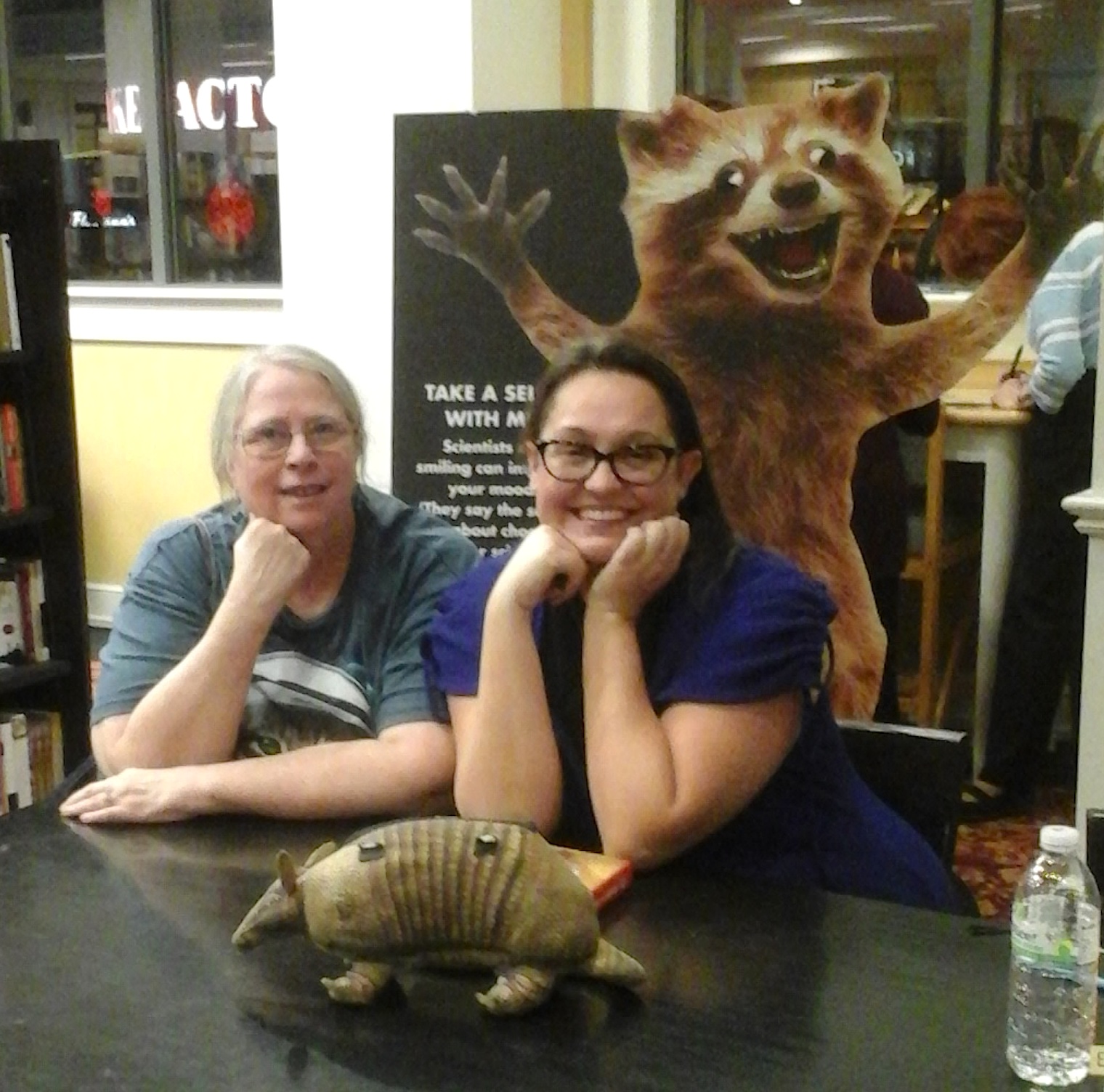
Back row: Rory, the Furiously Happy Raccoon; middle row: me, Jenny Lawson; front row: Erma the Armadillo

Back row: Rory, the Furiously Happy Raccoon; middle row: me, Jenny Lawson; front row: Erma the Armadillo

The space at the bookstore was full to overflowing. (People had driven for as much as five hours to see her.) Jenny read two chapters of her new book to riotous laughter and applause. There was a brief Q&A session. (I figured she got the same questions all the time and wanted to ask her something that no one else had. I imagine that writers on tour need a little variety.So I asked: If you could be any animal, what would you be and why? Her answer: A tapeworm, because I could just not move and have people feed me.)

I joined the signing line (#17). She signed my copy of her book (“Our story is not over.”) and I showed her the semicolon tattoo that goes with that saying. She also signed my armadillo purse (Erma) and a piece of glass for my husband, who wants to put it over a picture of her or of a vagina; he hasn’t decided which. She laughed. He was one of the many that ask for perhaps her most famous – or at least most quoted – phrase, “Knock knock, motherfucker.” (It comes from her story about leaving a giant metal chicken on someone’s doorstep. There were also a lot of metal chickens she was asked to sign.) The bookstore personnel made sure that everyone knew it was okay to ask for that. In fact, they announced it just before the signings, reassuring the shy or inhibited.

The title of her new book, Furiously Happy, is Lawson’s way of telling depression to fuck off: If part of her life is misery and pain, she’s going to damn well make the most of the parts that aren’t. And while she’s at it, she’ll spread the word that mental illness is not a thing to be hidden or ashamed of.

This is not to say that her mental disorders are cured or that she no longer suffers from them. She was clearly anxious when reading aloud the two chapters, and visibly relieved when that part of the evening was done. Her strategy is to laugh at mental illness, joke about her meds, and speak bluntly to those in the audience who also suffer or have a person in their life who does.

Furious Happiness is a worthy goal, and her out-there enjoyment of life leads her into some of the hysterical situations she has written about in both books. These are the stories that make you say – only you, Jenny! Then she turns around and tells you that you are just like her in the ways that count.

The readers of her books and her blog – thebloggess.com – have formed an odd mutual support community. Although we may feel alone, Jenny rallies us to be alone together. Since one of the major difficulties with being a psychiatric patient is the feeling that no one else understands or experiences the same feelings, bringing people together in the virtual world or between the covers of a book is a valuable form of networking, especially for those who can’t network any other way.

Myself, I can’t manage the Furious Happiness. Too long dealing with the black dog and relatively little experience of even the mild highs of hypomania have left me depleted. Jenny will just have to do it for both of us. This is not to say I don’t love her or her work. I do, despite the blog post that I wrote, “Seven Reasons I Hate the Bloggess” (http://wp.me/p4e9wS-56). I can see myself in her and her in me, but for the moment I’m not able to follow her exuberant example. But she gives me hope. And I’m sure that’s one of her most important goals.

The Wrong Life

Nothing prepared me for this.

This is not the life my upbringing prepared me for. I don’t just mean the special guest speakers we had in home economics class who tried to introduce us to the subtleties of silver, china, and stemware. No, I was also misled by the books I read.

If Life Is a Bowl of Cherries, What Am I Doing in the Pits? and Please Don’t Eat the Daisies led me astray. Don’t get me wrong, I’m a total fan of Erma Bombeck’s writing style, but the quirky suburban life she loved and lamented was not what I got. Bombeck and Kerr both made light – and fortunes – of portraying the petty foibles and cute misunderstandings of women and their husbands, women and their children, women and their neighbors, women and other women.

Daily disasters with dishwashers, sticky-fingered children, and clueless husbands were an endless source of amazement and amusement for them. They soldiered on, supported by an innate buoyancy, faith in the divinity, and the occasional glass of wine.

My glasses of wine have been more than occasional. My disasters have not been humorous. I do not have children, and the cats are somewhat deficient in making adorable conversation in high-pitched, lisping voices. Sometimes all I can get out of them is “meh,” which is pretty much how I feel too.

As for the trappings of the genteel life, we eat off paper plates more often then not. I did once have a set of Limoges, but only because I was acting as a pawnbroker for a friend who needed ready cash. I fed one of the cats on the Limoges saucer, just to say that I had.

My parents used to say that their house was decorated in early married junk and I have followed in that fine tradition. Most of our furnishings are a demonstration of the maxim: If it’s not from Kmart or Goodwill you won’t find it here.

No one’s life prepares them for clinical depression, hypomania, bipolar disorder, or any other mental illnesses. I’ll wager that even psychologists’ kids don’t have a clue when they escalate from picking scabs to experimenting with lit cigarettes. Maybe their parents don’t either.

Either the mental disorder has been going on so long that you don’t know what it’s like without it, or it comes on so suddenly that you desperately hope that it goes away just as suddenly. Or it comes in a way that you can just convince yourself is no big deal. “I overspend? That’s just because I love shopping, not because I have mania or need to validate myself with expensive things.”

Perhaps people who grow up with a mentally disturbed loved one have a chance of understanding the underlying mechanisms. But with the number of families who don’t discuss the “elephant in the room,” or pass it off as, “Your sister is just high-strung” or say, “Uncle Ted is a little odd. Just ignore him,” not even that exposure may help.

How do young people learn about mental illness? Or even – gasp! – get help for one? If not at home, maybe at school? The National Association of Secondary School Principals cites the U.S. Surgeon General’s report saying that “one in five children and adolescents will face a significant mental health condition during their school years” and that the ratio of school counselors to students is 471:1. Add to that the fact that most school counselors have been shifted away from offering personal and emotional support to offering academics-only services. (http://www.nassp.org/Content.aspx?topic=57948)

Most of us struggle alone. Some never find a proper diagnosis and treatment. We have to be our own resources and our own advocates much of the time, even if our illnesses do not allow us to get out of bed. If we have one family member – or even a close friend – who understands, we are lucky beyond measure.

I wish that I had been even slightly prepared for the life I now lead, instead of the one I was “supposed” to have. No one can predict the future, but why can’t we at least have a bit of mental health education in school? I suppose that’s a lot to ask, when even sexuality education varies from the merely adequate to the appalling, when schools are barely able to stay abreast of the teach-to-the-test curriculum, and when Texas’s governor vetoes a bipartisan bill allocating resources for mental health, based on lobbying by Scientologists.

Do I sound bitter because I didn’t get to live the genteel suburban life? Probably. But there are aspects of that life that likely would have actively impeded my search for mental health. So I’ve had to do it on my own, or nearly so, at least until recently. A lot of us go DIY for mental health.

But a lot of us are accomplishing it. Living the life we have and not some fictitious pie-in-the-sky one. We may not have been prepared for it, but we muddle through anyway – and sometimes even realize that imperfect real life is better than a perfect lie.

Social But Spoonless

In the past week I have been out of the house more and seen more people than I have in years. It’s almost like having a social life.

In the past week I have also slept more than I usually do in my sloth-like, torpid existence.

I think the two are not unrelated.

If you follow Spoon Theory (http://www.butyoudontlooksick.com/articles/written-by-christine/the-spoon-theory/) you know that each spoon represents an amount of coping that you can do.

Every day you get a certain number of spoons – not the same number every day.  You use them to perform everyday tasks that most people think nothing of – things like getting out of bed (some days you don’t even have that spoon), taking a shower (1/2 spoon for Janet’s patented “super-fast smelly-bits sink wash-up”), getting dressed, finding something to eat, fixing that something (keep a box of Cheerios by the bed in case you run out of spoons at this point), and all that is without even leaving the house. Some days that’s all the spoons you have and when you’ve used up your spoons, that’s it.

Other days you can manage to do all that and leave the house, go to work, run errands, and assorted other normal activities. But for those of us who have mental disorders, such days are few and far between.

You hear depressed people talk of not being able to get out of bed, and for the most part that’s caused by lack of spoons. I am usually notoriously low on spoons. My husband now understands Spoon Theory and we use it as common shorthand for “I’m too tired” or “That’s all I can handle right now.”

Dan, however, is an over-scheduler and I often have to rein him in by pointing out that his proposed slate of activities will not be possible because I, for one, will run out of spoons, and he may too.

The dry run for my recent spurt of socializing began last week. After I went for my final session with Dr R., I managed a trip to the bank, a trip to the place where I could pay my power bill, and since it was right next door, a stop at Kmart to buy underwear. It was a good thing that was a hypomanic day, but it floored me for the rest of that day and the next. And it started a cycle of bipolar up-and-down oscillations that were clearly related to spoon usage.

My spate of social endeavors started with a double-header. On Saturday I had lunch with a friend at a favorite restaurant I almost never get to go to. We talked about politics, social issues, and book proposals. Then I went home and had a little nap.

That evening Dan and I went to Monkey Bones for Zombie Dogz. I know that takes a little explaining. Monkey Bones is the tattoo studio where I got my semicolon tattoo (http://wp.me/p4e9Hv-9G). Zombie Dogz is a local food truck. (Also, it’s fun to say “We went to Monkey Bones for Zombie Dogz.”)

Notice that in a single day I had to get up, out of bed, and get dressed twice. That’s a lot of spoons. Sunday I was not able to get out of bed at all.

Monday did not involve socializing, but it was another hellacious spoon-eater. Dan and I spent the day scrounging for documents and information that the IRS wanted. It was taxing. (See what I did there?)

Tuesday was an extra-special social event, though it did not involve getting dressed and going out, or even interacting with other people. It was Jenny Lawson’s online book launch party. Better known as the Bloggess, Jenny has severe social anxiety. At this stage in my life, I certainly would not be able to dress up, mingle, and make polite conversation with both friends and complete strangers. The online party was a genius idea.

I sat at home in my pajamas with some red wine while the Bloggess read chapters from her new book, Furiously Happy. (You should get it, by the way. It’s about mental illness, but funny.) As low-key a social situation as that was, it still used up spoons because it was something I had never done before. Making sure I had the right URL, converting Central Time to Eastern, not being able to ask questions because I don’t Tweet, worrying that Dan was getting bored – not a lot a lot of spoons, but still some.

The effects were getting cumulative. Again I was unable to get out of bed the next day. In fact, Dan and I both slept away most of the daylight hours. For him it’s understandable because he works third shift, but I have no such excuse. Except that if you borrow from the next day’s spoons, or try to keep going without them, you will pay.

Thursday, I was determined, with or without spoons, I was going to meet a friend for coffee. I’ve seen her only once, briefly, in several years. In a way, it was a test of my ability to maintain anything approaching a real social life.

I put forth the extra effort because a mutual friend cut her ties with me because I canceled so often on social engagements. I suppose I really have nothing to prove to anyone but myself but it seems important that I do so. It’s not like coffee with a friend is an ordeal or anything. It’s just that I know I’ll be using a spoon for more than stirring my coffee.

And I hope I have enough spoons left over to work on my other blog.

When Anxiety Attacks

I was grocery shopping and when I came to the cereal aisle, I found myself light-headed and breathing raggedly.

My husband dropped a knife in the kitchen; I jumped and all my muscles tightened up.

We were driving down the highway, when suddenly I flung my arms out to the side and gasped loudly.

In none of these cases was anything actually wrong. (Although the incident in the car nearly caused an accident when my husband turned and yelled, “What? What?”)

My depression has always been accompanied by anxiety. That’s one of the reasons I was later given a diagnosis of bipolar disorder, type 2. It seems that, where other people get hypomania, I get anxiety. (There is a thorough explanation of bipolar disorder and anxiety (or “mixed states) at http://psycheducation.org/diagnosis/mixed-states/anxiety-and-bipolar-disorder/.)

I have had generalized anxiety, where I have no idea whether anything specific is actually wrong or doom is impending. I have had phobic-type anxiety, where I imagine that any bee in the neighborhood is going to choose to sting me and I freeze up. I have had anxiety reactions to loud noises or sudden movements, where I feel like I’m jumping out of my skin and actually do physically jump. And I’ve had irrational moments of anxiety, as when I can’t sleep because I don’t know where I put my passport. (Naturally, I have to get up and look for it.)

Now that I am relatively well controlled on medication, the various anxieties don’t plague me nearly as much. And I’ve developed coping mechanisms for a number of them. For example, when I get anxious in the car on the highway I no longer fling out my arms and gasp. My husband notices my tension and asks if anything would make me feel better. “Drive in the other lane,” I say, “and not next to the concrete divider.” I take an extra Ativan (which my doctor allows) before social events I can’t avoid. My husband warns me if he is going to hammer a nail in another room, or reassures me that the cat just knocked over a glass.

I still don’t know what was going on in the cereal aisle. I thought it might be the imposing wall of large, brightly colored boxes, visual noise that seemed to overwhelm me. My therapist at the time said that it was likely that I was just having a random anxiety attack and happened to be in the cereal aisle when it happened. After that I associated the two.

Now I’m not sure. I may have been right about the visual noise. Auditory noises certainly provoke anxiety in me, and I know that some people on the autism spectrum can be overwhelmed by visual stimuli. (I’ve never been diagnosed on the autism spectrum, but I do share certain traits with Aspies.)

I think the anxiety will always be with me, to some extent, just like the depression. My meds make them bearable and my ways of handling them improve. But I don’t think I’ll ever get used to the fact that there are bees, wasps, and ticks in the world, all of them with a thirst for my blood.

Mini-Meltdowns and Many Meltdowns

When my brain broke back in 2001 or so, I thought it was the first time that had happened. Later, on reflection, it turned out that wasn’t so.

The 21st-century breakdown was certainly the most dramatic. Although I had just quit working in an office to start a freelance career, I found myself unable to work after a few months.

I had become unable to work in the office because of mounting difficulties that I now realize were warning signs of the impending breakdown: inability to concentrate, increased anxiety (the feeling that an angry badger was about to claw its way out of my stomach), lessened ability to interact with coworkers, sudden flares of temper, turning people away with unintendedly cutting remarks and sarcasm, isolating, inappropriate affect, catastrophizing – you name it, I had it.

What was causing all these symptoms? My bipolar disorder, obviously. But I’ve had that for years. What was pushing me over the edge this time? I had trouble at work. My boss left and, when I “came out” to my new boss as depressed (which is what I was diagnosed with at the time), she reacted with wariness and incomprehension. She gave me the first bad review I ever had at that job.

My mother’s health was deteriorating seriously, too, about then. I lost time at work taking her to various appointments and I had to have “the talk” with her about how much longer she could live alone. Eventually I took over her finances – and by then I was scarcely handling my own.

I experienced a lift when I quit my job and began freelancing. Hypomania? You bet! My new flexibility allowed me to take better care of my mother, and the assignments kept coming in.

Then everything came crashing down. I screwed up my finances and my mother’s. She began having worse falls and injuries, hospital stays and drug reactions, even hallucinations which scared the hell out of me. I emotionally judo-ed my sister to come up and help, then fought with and resented her, and had to take care of parts of her life as well.

Those and other difficulties on top of my mental disorder added up to a non-functioning me. I dumped all the chores and coping onto my husband, which was a rotten thing to do, fought with him, sobbed for no discernible reason, became unable to work, or care, or do much of anything except think up at least three different ways (and reasons) to kill myself. Fortunately, I was too immobilized to try any of them.

I’ve written before about the things that helped me get back to some kind of functioning – a proper diagnosis, the right meds, time without work (as we gutted our retirement savings), lots of psychotherapy, and my wonderful, patient, ever-helpful, devoted husband.

But now, looking back, I can see that it had happened before, though not so dramatically and completely. In childhood, in my teens, in college – at every stage of my life I had at least one breakdown, often triggered by the circumstances of my life, but fueled and stoked by my mental illness. In every one, my ability to function deteriorated a little more.

The first one that I remember clearly was when I was around 12. My best friend and I were in charge of a birthday party for her younger sister and some friends. This was the old-fashioned kind of party that everyone in the neighborhood had then: cake and ice cream, party games, presents, and not much else. It happened during pin-the-tail-on-the-donkey. I was blindfolded – literally – and my friend kicked me in the ass – again, literally. In front of all those younger children.

I ran home sobbing. And I curled up into a fetal ball and didn’t quit for at least three days. Non-functioning, non-responsive, non-everything. What finally brought me out of it was seeing my mother’s pain at this inexplicable (to her) meltdown.

I had a mini-meltdown in my freshman year of college, which involved sitting in my nightgown in the hallway, staring for hours at a richly detailed poster of a fantasy realm. (I managed to frighten an intruder by arising, ghost-like, in my pale yellow shroud as he entered the suite.)

This one was triggered by my realization that I had probably chosen the wrong major and that there were no job prospects ahead for me. (It turns out I was wrong about that. Maybe I should have stuck with it, but my next choice turned out pretty well.) I took a year off college and took a job as a cashier in a restaurant, where I spent a lot of time crying into the roller towel and being told I should smile more. This convinced me that going back to college, with a new major (and even fewer job prospects), was the right thing to do.

The next meltdown was major. I had finished college, endured a year-long train wreck of a relationship, and lost a job as an assistant restaurant manager (I hadn’t fully learned that lesson yet). I got unemployment, which meant I lay around the apartment for most of the week (except for making half-hearted attempts at job hunting).

One notable symptom of this breakdown was my near-complete immobility. One errand in a day – say, going to the post office for stamps – made it a productive one for me. I had maybe three of those a month, with one being the obligatory visit to the unemployment office – a supremely depressing place to be depressed.

I had some truly irrational thinking that time, too. I thought I could cheer myself up by watching light, fluffy sitcoms on TV. But as I lay there on the couch, I found myself crying with every upbeat, cheery theme song that came with them. Laverne and Shirley making their dreams come true. One Day at a Time, which advised me to get up on my feet because somewhere there was music playing. And, oh, Mary Tyler Moore. Love is all around, my ass.

After that, it was a long, slow slide to my major breakdown. It wasn’t unrelieved misery. I got married. I got a master’s degree and a job in publishing. We acquired a house and cats. We traveled. But the Big One was waiting for me.

Nowadays, I still have mini-meltdowns, but they usually last a maximum of three days, rather than weeks, months, or even years. They still tend to be triggered by stressful life events, especially financial ones. But when I get one, I know I’ll be coming out of it soon. And that’s a wonderful feeling buried in all the misery.


Music Charms the Troubled Mind

Once I knew a man whose wife was going to leave him. I knew he was in a lot of pain and despair about it, though he also turned into a huge asshole before everything was said and done. He was also suicidal for a time.

One day when I was trying to talk him through a bad patch, I asked whether he might turn to music to help him. “What?” he said. “Do you think I should listen to country music and cry in a beer?”

I wasn’t suggesting that at all. I just knew that he was a singer and songwriter of talented amateur status and was known for this in various circles. I honestly thought that music might help.

On the other hand, I always forget, when I am on the downswing, how much music can do for me. It soothes and heals, but it also lets me tap into the emotions that I have been suppressing.

Do I have the inexplicable blues that are part and parcel of my condition? There’s a song for that. Am I feeling unrequited love? Unrequited lust? There’s a song for those too. Is the world spinning too fast for me? Do I need to know that everything will be all right? Or do I just need to know that someone, somewhere and somewhen, has also felt this way? I can turn to music.

“Music, uniquely among the arts, is both completely abstract and profoundly emotional. It has no power to represent anything particular or external, but it has a unique power to express inner states or feelings. Music can pierce the heart directly; it needs no mediation.”
– Oliver Saks, Musicophilia

Saks also says, “The power of music, whether joyous or cathartic, must steal on one unawares, come spontaneously as a blessing or a grace.” There he and I part company.

Music can certainly steal on us unawares, whack us upside the head with a memory, a feeling, a piercing stab of emotional intensity, all the stronger for being unexpected.

But we can also choose to bring music into our lives when nothing else seems to touch us. We can tap into those memories and feelings – good or bad – and let the music wash over us as we listen and feel.

According to scientific experiments with fMRI, music uses more parts of the brain than almost any other activity. The neural connections fire all over the place – more so if one is playing an instrument, but even when just listening. The memory centers, artistic areas, language centers, emotional areas – even the motor complexes – are stimulated.

My problem is remembering all that music can do for me. When my emotions are dulled, flattened by the steamroller of depression, I sometimes forget that I can be any other way. The music I love is always there for me. I can bathe in it, wallow in it, be uplifted by it, float on it, join in with it, feel it emotionally and viscerally and intellectually all at once or one at a time. It can express the things that I just can’t.

When you’re depressed is a time for writing bad poetry. Or you can let good poets and songwriters take you with them as they explore the human condition in ways you’re not capable of. I think that’s why they do it – create their art. The really good ones anyway.

There’s also something to be said for music as distraction. A song from years ago – even a frivolous one – can take you away from your troubles, even if only for a moment. This is not the time for exploring new musical avenues. Remembering that things once were good can feed your sadness, your depression, but it can also give you perspective. If you took joy in this music once, there will come a time when you will again. And maybe that time is now.

Perhaps the most amazing power of music is to provoke catharsis. Certain songs leave me sobbing like a baby. They don’t even have to be sad songs, though many of them are. “The Mary Ellen Carter” by Stan Rogers is about as life-affirming as you can get, but it can still turns me into a weeping puddle. (https://www.youtube.com/watch?v=Fhop5VuLDIQ) His song “Lies” has nothing to do with my situation personally, but its evocative power touches me nonetheless. (https://www.youtube.com/watch?v=D79XOc1vKzQ) And almost no one I know can make it through Kathy Mar’s “Velveteen.” (http://www.last.fm/music/Kathy+Mar/_/Velveteen)

Afterwards, I feel drained and, if not exactly better, less emotionally constipated, I guess you’d say. Clearing away a bit of blockage can be cleansing. If music can do that – and it can – then I don’t care if its country with a beer, jazz with a glass of wine, or hip hop with an energy drink. Even easy listening with a glass of milk, if that’s your thing.

So thank God and Apple for iTunes. And here’s hoping that my Swiss cheese of a memory will give me a nudge in the right direction when I need it next time.

A Response to the Dalai Lama

This Friday, my Facebook newsfeed included a quotation from the Dalai Lama.

Depression seems to be related to fear, anger and frustration. When you’re in a bad mood, even if you meet with your friends, you don’t take pleasure in their company. But when you’re in a good mood, even if things go wrong, you can cope with them without difficulty. This is why putting yourself in a good mood, making a point of developing a sense of loving kindness gives you greater inner strength.

While I respect and admire the Dalai Lama, on this subject he is wrong.

I wrote a blog post to tell him and his followers so. I posted it on Blogher.com. (Blogher is a site for women bloggers that sometimes syndicates content. It is more general than what I usually post here, so I wrote something special for them.)

As I researched, trying to find when and where the Dalai Lama said this (I couldn’t), I discovered several articles about research into depression and Buddhist principles and techniques.

One was an article by Kathy Gilsinan at The Atlantic
(http://www.theatlantic.com/health/archive/2015/07/dalai-lama-neuroscience-compassion/397706/). It talked about “high-amplitude gamma-oscillations in the brain, which are indicative of plasticity.” What that is or has to do with depression, I don’t know. It sounds like “handwavium” to me.

One that made more sense was this, from Jeanie Lerche Davis at
WebMD: http://www.theatlantic.com/health/archive/2015/07/dalai-lama-neuroscience-compassion. (The feature was reviewed by Louise Chang, MD.)

While meditation can help many who are depressed, it’s not a sure-fire cure, [Charles W.] Raison [psychiatry professor and co-director of Emory’s Collaborative for Contemplative Studies] tells WebMD. “In fact, many people with mood disorders find they can’t do meditation when they’re depressed.” Their thoughts are too overwhelming. They are anxious, nervous, and can’t sit – and likely they need antidepressants, he says.

That’s more like it.

In my response to the Dalai Lama, I said,

Real, clinical depression is not about being in a “bad mood.” It’s true that a truly depressed person does not find pleasure even in ordinarily pleasurable things, such as meeting with friends. But we cannot simply put ourselves in a good mood.

That’s the hell of depression. We want to enjoy the good times. We want to put ourselves into a place of inner strength. But we can’t. Not without help.

In fact, your advice is hurtful to depressed people. Too many times we have been told, “Cheer up.” “Smile! You’ll feel better.” “Think about someone else for a change.” “What do you have to feel bad about?”

Don’t you think we would if we could?

Remarks like these remind us that we have an illness and we cannot cure ourselves by willpower alone – no more than a person with hepatitis or tuberculosis or even schizophrenia can. We need help, and most of us need medication.

You do a disservice to people with depression when you tell them to put themselves in a good mood. You, an enlightened spiritual leader, may be able to do it, but we can’t.

Certainly we can benefit from practicing loving kindness and developing inner strength.

But without treatment for depression, how many of us can do that?

It angers me when people say that depression – or any mental disorder – is something people can or should be able to cure with an attitude adjustment. I’ve heard it too many times from people in my life, and I’m sure you have too.

What’s really disappointing is that someone like the Dalai Lama, with his legion of followers and enormous credibility, is perpetuating this old way of thinking.

This lie.

Sense of Self

The air is still and blankets all my sense.
I’m muffled, muzzled in the sheltering dark
But dare not hope for fire, with bright, intense,
loud flames that rend the silence with a spark.

I breathe or not. It’s sometimes hard to tell
When swathed in dimness. Stifling, musty scent
Fills up my nostrils and my brain as well –
Which cannot will the veil be shredded, rent

to save from suffocation. How shall I
Withstand this cycle till the day appears
And breezes blow the dust away from my
Stopped ears and eyes and lungs, plugged full with fears?

Pull off the cover and let free the soul.
Take broken breath and heal it into whole.

I Have This Friend . . .

To have a friend, be a friend.

That’s how the saying goes, and it goes double for friends with mental disorders.

But.

There are limits. Boundaries. You may call them self-serving or self-saving, but there they are.

When you are depressed, you neglect friends, and I have certainly done that. I permanently lost one friend over it. But another kept reaching out to me and I eventually responded. (We then had a good game of “I’m a bad friend.” “No, I’m a bad friend.” She thought she hadn’t reached out often enough. I was glad she put up with my silence as long as she did, until I was able to reach back.)

But I have this friend. We used to be tight. When we were both depressed, we shared our misery and so lessened it. But now that the Pit of Despair is no longer my permanent abode…I have to limit my contact.

Why? My social skills have never been terrific, but now I frequently find myself walking that invisible line between Bad Friend and burnout.

Why is it so hard to be a Good Friend?

First, there is the Disaster Report. Whenever I talk to her, I hear a litany of all that is going wrong in her life. Almost never anything else. I’m no fan of relentless positivity, but its opposite is sometimes hard to bear too, even though I’ve been guilty of the same.

Then there is the fact that any suggestions are pushed away, denied as impossible, dismissed as unworkable. Granted, we have completely different styles of coping, but I feel discounted, unheard. Eventually I gave up sharing anything but a few of my own tribulations, some awful jokes, and commiseration.

Then I get off the phone or off Facebook, usually after half an hour or so. That’s about my limit.

I still keep reaching out. I don’t want to be a Bad Friend. I know I can’t fix her, or even her day-to-day difficulties, the kind even non-depressed people have. But I sure wish there were a way I could help, short of climbing down into the Pit with her. I hope that listening, even half an hour at a time, does some good.

And when I talk to other friends of mine, I try to remember to ask how their day was and what’s new in their life and have they seen any good movies and what is a mutual friend doing. I try to listen if they have something to share, good or bad, and I try not to overwhelm them or play whose-life-sucks-the-most. I try to be a Not-Bad Friend, even if I do have to lean on my friends, at times pretty heavily.

And they do likewise, when they can.