Bipolar 2 From Inside and Out

The Journey to Proper Meds

By areeya_ann / adobestock.com

This week when I went to my four-times-a-year med check, I told my psychiatrist that I thought I needed a change in medication. The previous time I saw him I had expressed concerns over assorted Life Stuff that was making me extremely anxious. Given what was going on in my life at the time, the anxiety was understandable.

Since then my anxiety has lessened somewhat, now coming out mostly as irritability and difficulty sleeping. And my depression now makes me feel like I have a low-grade fever – logy, listless, exhausted (which is not helped by the sleep problems) – plus the usual depressive numbness, lack of holiday cheer, and all the rest.

My psychiatrist listened to my symptoms, then discussed my meds with me. There were only two, both mood levelers, that he would recommend increasing. I chose the one that had had the most dramatic effect on me when I started taking it. So he increased the dosage from 200 mg. to 300 mg. We’ll see how that works out. I’m to call him before my next med check if I need to.

I’m used to changes in medications. It took a long, trying – even painful – time for my previous psychiatrist and me to work out the cocktail of drugs that would alleviate my seemingly treatment-resistant bipolar disorder. We tried various antidepressants, anti-anxiety agents, anti-seizure meds, antipsychotics, mood levelers, and I-don’t-remember-what-else. At last, when we were about to give up and try ECT, one of the drugs worked. It took some more tinkering before we got the dosages right, but for years now, I’ve been on basically the same “cocktail” of drugs.

Psychiatric Times, in an article on switching antidepressant medications (most of the literature seems to focus on antidepressants), reports that approximately half of all patients fail to achieve an adequate response from their first antidepressant medication trial. High treatment failure rates make it critical for prescribers to know how to safely and effectively switch antidepressants to ensure patient-treatment targets are met.” Other publications put the figure at nine percent, one-third or two-thirds. Whichever is correct, it’s a substantial number.

One method of switching medication is simply called “the switch.” The patient goes off one drug and onto the other. But there are problems with that, including drug interactions between the old medication and the new one.

The technique most recommended is the one that my previous psychiatrist used with me, which is known as “cross-tapering” – tapering down on the first drug and then ramping up on the second. A “wash-out period” when no drug is given allows time for the first med to clear the body before the second is given. This is promoted as the safest method.

I can testify that it is also the slowest and most miserable. Going off one drug, being basically unmedicated while you wait for the second drug to ramp up, and then possibly going through the whole process again when the second drug doesn’t work either (or has side effects you can’t tolerate) is brutal. I went through the process more than once, and it was hell. Basically, it took me back to full-strength depression during the wash-out period and minimal to no effect as the new drug being tried ramped up.

However, eventually, we found a drug that made a huge difference and that, in conjunction with my other medications, allowed me to function almost normally. Close enough for jazz, as they say. The recent adjustment in dosage does not appear to be having much of an effect yet, but I didn’t expect it to. Pretty soon, relatively, I’ll know. And if it doesn’t help – or if it induces side effects – I still have my psychiatrist’s phone number.

References

https://www.psychiatrictimes.com/view/strategies-and-solutions-switching-antidepressant-medications 

https://www.uptodate.com/contents/switching-antidepressant-medications-in-adults

https://www.healthline.com/health/mdd/switching-antidepressants

by Chinnapong / adobestock.com

I missed out on the heyday of the ADA. People didn’t become as conscious of accommodating people with disabilities until much later. And even then, the most common accommodation was wheelchair ramps. But there are some workplace adjustments or accommodations I wish I had available to me, back when I worked in an office.

According to the Americans with Disabilities Act (ADA), persons with disabilities are entitled to accommodations to make it possible for them to work. Most of us think about certain kinds of lighting, closed captions, or specialized chairs. But what about when you have an invisible disability?

The ADA definition of a disability is one that impairs an individual’s ability to – among other “major life activities” – learn, read, concentrate, think, communicate, and work. Certainly, a number of psychological or psychiatric conditions qualify as producing trouble in these areas. In my case, my bipolar disorder made it difficult to do many of those in your standard office work environment.

But would the ADA have made accommodations available to me? The ADA does include some mental illnesses in its list of disabilities. Examples of mental disabilities commonly considered under the ADA are:

  • Major depressive disorder
  • Bipolar disorder
  • Post-traumatic stress disorder
  • Obsessive-compulsive disorder
  • Schizophrenia

Examples of accommodations or work adjustments for those with psychological disabilities include, among others:

  • Flexible Workplace – Telecommuting and/or working from home.
  • Scheduling – Part-time work hours, job sharing, adjustments in the start or end of work hours, compensation time and/or “make up” of missed time.
  • Leave – Sick leave for reasons related to mental health, flexible use of vacation time, additional unpaid or administrative leave for treatment or recovery, leaves of absence and/or use of occasional leave (a few hours at a time) for therapy and other related appointments.
  • Breaks – Breaks according to individual needs rather than a fixed schedule, more frequent breaks and/or greater flexibility in scheduling breaks, provision of backup coverage during breaks, and telephone breaks during work hours to call professionals and others needed for support.

Of course, in order to receive accommodations or adjustments, it’s necessary to reveal to someone – at least your boss or maybe the HR department – that you have a psychological or psychiatric disorder.

My own experience of needing accommodations at work was not great. In the job I held the longest, I only mentioned my depression (as it was then diagnosed), to my immediate supervisor. He was sympathetic, but the work environment was not exactly conducive to my needs.

One of the things that I could have used in dealing with the anxiety that went along with my depression was privacy. At first, that was not even possible, since my entire department was located in a cube farm, where no one had any real privacy. Even the fact that I was an editor and needed to concentrate on my work did not win me a private space.

Later, when we moved to an office that had actual offices, I snagged one with a door. The only problem was that I was not allowed to close the door, or at least looked askance at when I did.

An ideal situation for me (aside from being allowed to close my door) would have been permission to work from home. There was one person at this office who had this privilege, but it was never considered for me. Admittedly, this was very much pre-pandemic, but most of my work was done on a computer, and I had one at home that was compatible with the office computers. It wouldn’t even have been necessary for the company to supply me with one.

Another accommodation that would have helped lots would have been a hotel room to myself at business conventions, which would have allowed me time and space to decompress after a long day of being “on,” meeting and greeting, and being sociable and respectable. Unfortunately, that was a privilege reserved for the men. (As I understood it, the salesmen were booked into double rooms as well, but winked at when they rebooked them into singles.) This may have nominally been due to my sex rather than my mental condition, but not having a solitary retreat from the clamor of a convention definitely had a deleterious effect.

After 17 years at that job, I was let go, most likely because I was considered “unreliable.” At the next office where I landed, I had a boss who understood bipolar disorder (as I was then diagnosed) and who was satisfied with my work.  Never a bad evaluation – until that boss left. “I’m going to miss you,” I said. “I know you will,” she replied.

I realized what she meant when I revealed to my new boss that  I had bipolar disorder. “What does that mean?” she asked. Taken aback, the only reply I could think of was, “Sometimes I have good days and sometimes I have bad days.”  It wasn’t a great description of my condition and set me up for problems. After one year of my mother’s health and my psychiatrist appointments requiring me to miss work, and my missing work in winter owing to living at the bottom of a snowy, icy hill, I received my first bad evaluation. Nothing about my performance had actually changed since my work with the first boss. I could have easily worked from home and occasionally was permitted to, but my work was dubbed sub-par once I did.

(Not that it’s a big thing, but I would also have appreciated being able to take a “brain break” such as doing a crossword puzzle, instead of a cigarette break, since I don’t smoke. And not being asked work questions when I was on the toilet.)

After that, I went freelance, worked at home nearly all the time, and was only required to attend a meeting at an office once or twice a year. I have worked that way since and it suits me. It’s only now that I’ve become my own boss that I’ve been able to get what I really need when it comes to work.


References

https://www.eeoc.gov/statutes/americans-disabilities-act-amendments-act-2008#:~:text=The%20Act%20emphasizes%20that%20the,shall%20not%20require%20extensive%20analysis.

https://www.sfglife.com/blog/top-10-causes-disabilities-us-and-why-you-need-disability-insurance/

https://adata.org/factsheet/health

https://www.dol.gov/agencies/odep/program-areas/mental-health/maximizing-productivity-accommodations-for-employees-with-psychiatric-disabilities

https://www.shrm.org/resourcesandtools/tools-and-samples/hr-qa/pages/cms_011495.aspx

https://www.ada.gov/pubs/adastatute08.htm#12102

photo from the author’s collection

 As a child and as a teenager, I was a Girl Scout. We hiked. We camped. We did all sorts of nature-related crafts. We ate wild plants. Well into my 20s, I was an outdoorsy-type person, hiking on the Appalachian Trail, walking to all my classes through the leafy green environs of my college campus, even trudging contentedly through the copious snowfall. One year I lived in a log cabin on a hilltop so far from civilization that you had to go to town to pick up your mail.

All the while, I had bipolar disorder, and it was relentless, I experienced the inevitable mood swings, the crashing lows, the tempestuous highs, the confusing mixed states. 

Now, everywhere you turn, there are articles and memes touting how time spent in nature is good for various psychiatric conditions. When you look more closely, though, the studies often refer to simply alleviating bad moods or improving cardiovascular health. Very few of them seem to apply to actual mental illnesses. Perhaps this is to be expected, since improvements in emotions or mental health are largely self-reported or tracked by means of a survey. It’s hard to quantify mental health. But let’s take a look at some of the studies anyway.

Harvard Men’s Health Watch published an article called “Sour Mood Getting You Down? Get Back to Nature.” The subtitle on the piece read, “Research suggests that mood disorders can be lifted by spending more time outdoors.” Then the article went on to suggest that “ecotherapy” shows “a strong connection between time spent in nature and reduced stress, anxiety, and depression.” 

The subtitle suggests that the outdoors has an effect on alleviating mood disorders. The body of the article, though, stresses alleviating unpleasant moods in general, not primarily what psychiatrists would class as mood disorders. The article cited a 2014 study saying that “people who had recently experienced stressful life events like a serious illness, death of a loved one, or unemployment had the greatest mental boost from a group nature outing.” Stressful and sad events, certainly, but not mood disorders such as PTSD, clinical depression, or bipolar disorder.

The article also cites a report published online March 27, 2017, by Scientific Reports, which suggests that “listening to natural sounds caused the listeners’ brain connectivity to reflect an outward-directed focus of attention, a process that occurs during wakeful rest periods like daydreaming. Listening to artificial sounds created an inward-directed focus, which occurs during states of anxiety, post-traumatic stress disorder, and depression.” It does mention psychiatric disorders, but it says only that inward-directed focus occurs during these states, not that inward-directed focus causes them.

Greater Good published an article that claims, among other things, that “scientists are beginning to find evidence that being in nature has a profound impact on our brains and our behavior, helping us to reduce anxiety, brooding, and stress, and increase our attention capacity, creativity, and our ability to connect with other people.” Again, this says nothing about actual psychiatric disorders.

The article also cited a Japanese study: “Results showed that those who walked in forests had significantly lower heart rates and higher heart rate variability (indicating more relaxation and less stress), and reported better moods and less anxiety, than those who walked in urban settings.” The researchers concluded that there’s something about being in nature that had a beneficial effect on stress reduction, above and beyond what exercise alone might have produced.

This, of course, does not apply to those in urban settings who do not have much access to forests or sometimes even parks. And the abstract of the Japanese study says, “Despite increasing attention toward forest therapy as an alternative medicine, very little evidence continues to be available on its therapeutic effects. Therefore, this study was focused on elucidating the health benefits of forest walking on cardiovascular reactivity.” It doesn’t really deliver what the headline offers: “How nature makes you kinder, happier, more creative.” Good heart health is, of course, a good thing, but to extrapolate that to mental health benefits is quite a stretch.

The UK’s Mind.org does offer a link between ecotherapy and mental health in one instance, at least: “Being outside in natural light can … be helpful if you experience seasonal affective disorder (SAD), a type of depression that affects people during particular seasons or times of year.” This article also acknowledges that there are “other options for treatment and support – different things work for different people….You might do an ecotherapy programme on its own, or alongside other treatments such as talking therapies, arts and creative therapies and/or medication. Some ecotherapy sessions follow a set structure, and incorporate types of talking therapy, such as cognitive behavioural therapy (CBT). People in the group may or may not have experience of mental health problems, but the main focus is usually working together on the shared activity.” This at least sounds both more scientific and more likely to produce results.

If a walk in a natural setting does you good and alleviates your symptoms of mental illness, then by all means, make it part of your routine (or do it as often as you can manage). My bipolar depressions, however, are so debilitating that I am unable to plan, much less embark on, a walk in nature, even as far as the mailbox. Bringing nature indoors is, of course, an alternative. But the little plant pictured here, which needs two ounces of water once a month, is all I can really handle.

Resources

https://www.health.harvard.edu/mind-and-mood/sour-mood-getting-you-down-get-back-to-nature

https://greatergood.berkeley.edu/article/item/how_nature_makes_you_kinder_happier_more_creative

https://www.hindawi.com/journals/ecam/2014/834360/

https://www.mind.org.uk/information-support/tips-for-everyday-living/nature-and-mental-health/how-nature-benefits-mental-health/

by sosiukin via adobestock.com

Dear Me:

You’re 13 years old now, and there are a few things you should know.

You have bipolar disorder. No one knows this, not even you. But a lot of people notice that you act “weird” at times. You have decided to embrace your weirdness, which is fine, but what you really need is psychological help. And medication.

Don’t pass up any chance to get that help. Your high school will recommend to your parents that you get counseling. When your parents leave the choice up to you, take it. It will not go on your permanent record, and you will still get into a college. A very good college, in fact.

I know that at times you sit alone and cry. Other times you laugh at things no one else finds funny. This is not just “weirdness.” This is a mood disorder, called bipolar disorder, type 2. Your mood swings will make it difficult for you to make and keep friends. Keep trying. The friends you will find are worth it and will stand by you when you really need them. You will not be alone in dealing with this.

Your choice to go to college out of state will be a good one. There you will have a variety of experiences that will make you grow in unexpected ways. Your mood disorder will go to college with you, though. Leaving Ohio will not mean you will leave bipolar disorder behind. You will still feel the mood swings, and most of them will be depression.

It’s a good idea to take that year off between freshman and sophomore year. I know it will feel scary, but at that point you will be in no shape to carry on with academics. Instead, you will get a job which, while not great, will introduce you to more new people and new ways of life. At least one of those people will stick with you till you are old and gray.

Returning to school will be a good decision. Your parents will support you in that decision. They won’t object to your year off, because they know you will go back. It still won’t be easy, but you will have a core group of friends that accept you, even though you are different from them.

Your bipolar disorder will follow you back to college. It will make you miss some opportunities and choose others that will not be good for your mental health. You will be unhappy most of the time, but you will find that music helps you through it.

Try not to self-harm. I know you will feel numb and want to feel something else, but cutting yourself is a bad decision and will not help. You will carry those scars forever.

When you meet Rex, though, you will be encountering a problem too big for you to handle, and the relationship will leave you scarred as well. It would be best if you were to steer clear of him altogether. But then again, you will find some true friends in his circle, and it would be a shame to miss them. Try your best to hold yourself together, remember what I said about self-harm, and don’t give up on who you are. You are not your disorder, and you will get through this, despite everything.

I know you never gave a thought to marrying, but you will meet a man and in a few years you will marry him. This, I assure you, is a good decision. He will stick by you no matter what and help you find help.

Going into the building that says “South Community Mental Health” will be a good decision. Whatever you will be feeling at this point – most likely misery – it’s not mentally healthy. This will be the place where you will start to climb out of the hole you have found yourself in.

At last, a doctor will tell you that you have bipolar disorder – most often depression, but also anxiety. He will work with you to find a combination of medications that will help you. When that happens, you will become reacquainted with your brain and relearn how to function in the world at large. Your brain will function in a new way, one with fewer out-of-control feelings. You will experience life more fully and be glad of your new outlook.

It won’t be quick, and it won’t be easy, but you will have therapists, and friends, and work, and love, all of which will help see you through. You will have bipolar disorder all your life, but it will not be your life, though it seems that way now.

Reach out for help whenever and wherever you find it. Cherish your friends. Keep trying, even when you want to give up. Better times are on the way.

I promise.

Love, me (older and maybe wiser)

Image by Vadim Gushva via adobestock.com

Once upon a time, I lived with a man who, I later realized, was a gaslighter. (This was in the time before gaslighting became trendy and well-known.) For a while after I left, I had no notion that I had any harsh feelings towards him. It was only later, after I had been away for a while, that I realized what my buried feelings were and what damage he had done. The experience was responsible for parts of who I am today, including my strength and resilience.

For a time, though, right after my deeper feelings began surfacing, I realized that I had been psychologically controlled. I began to read up on the phenomenon. Some of the subjects I devoured were accounts of and theory of domestic physical and psychological abuse, mind control, and cults. They fascinated me – how the human mind and spirit could be so affected by another person or persons that they acted in irrational ways, defended their abusers, changed their personalities, and gave up their lives, either figuratively or literally. I don’t mean to compare my experience to the suffering that the people I read about have gone through, or to the suffering that still exists. All that I knew was that I had been manipulated, and was desperate to find out how, if not why.

I started with the easiest subject to find information about – domestic abuse. I will say that my gaslighter never harmed me physically and only once said something that could be taken as a violent thought towards me. But I learned, particularly, about intermittent reinforcement. This happens when the abuser switches between telling the victim that he loves her and she is wonderful, and that she is stupid or ugly or otherwise worthy of abuse. These mixed signals keep the victim coming back, on the theory that sometimes the person is so nice and loving. “It must be that I make him mad without meaning to,” she thinks.  Thus, she is hooked and less likely to leave.

My gaslighter also used intermittent reinforcement and mixed signals to keep me hooked. I stayed much longer than was good for my mental health.

Learning about mind control – “brainwashing,” kidnapping, and so forth, gave me little insight into my own situation, except that some of the principles were to isolate the person being controlled, to control the environment such as when the person slept or ate, and to be that person’s only source of information or reality. I had been relatively isolated physically, had little control over schedules, and, while TV news was available, it was always filtered through the gaslighter’s sensibilities and opinions. Again, I am not comparing my suffering to that of other people. I don’t believe, really, that suffering can or should be compared.

Learning about cults took me even farther from my own experience, but I was fascinated by it nonetheless. I soaked up information about Jim Jones and Jonestown, Heaven’s Gate, Scientology, and others. Especially interesting to me were stories of people who had escaped from cults. (One of my Facebook friends escaped from a religious cult, which took advantage of her PTSD and bipolar disorder to ensnare her. She supports others who have been victimized by cults and spreads information on cults and the tactics they use.) All I can say is that leaders of cults are usually charismatic, often reject societal sexual norms, and mentally coerce their followers to isolate from family and to finance the cult leader’s lifestyle.

Gaslighting, which I have written about many times (https://wp.me/p4e9Hv-pm, https://wp.me/p4e9Hv-C2, https://wp.me/p4e9Hv-Ir, https://wp.me/p4e9Hv-Cu) most resembles domestic abuse, though usually without the physical violence. It uses the tactics of intermittent reinforcement, isolation, verbal abuse, cults, and mixed signals to convince the victim that her perceptions of reality are invalid – in extreme cases, that she is going insane.

All of these forms of abuse do harm to their victims, in varying degrees. I was lucky to be able to leave my gaslighter when and how I did, and I will forever be grateful to the people who have helped me heal from the experience.

If you are in any of these situations – domestic violence, emotional abuse such as gaslighting, or being victimized by a cult, the best advice is: Get out now. Leave while you still can, before something worse happens. And get help, both from your friends and family, if possible, and from a professional counselor who has experience with these issues. It could save your happiness, your sanity, or even your life.


Resources

https://www.goodreads.com/list/show/72664.Nonfiction_resources_on_abuse_and_domestic_violence

National Domestic Abuse Hotline https://www.thehotline.org/

https://nymag.com/strategist/article/best-books-on-cults-reviewed-by-experts.html

https://www.women.com/sophiematthews/lists/books-on-gaslighting-101718

A Sensory Self-Soothing Room

Photo from the author’s collection

Not long ago, I read in the Creativity in Therapy blog (http://creativityintherapy.com/2016/05/create-a-sensory-self-soothing-kit/) an article by Carolyn Mehlomakulu, art therapist, called “Create a Sensory Self-Soothing Kit.” The idea was that a box filled with items that engage your five senses is an excellent tool for being grounded when you need centering or self-care. The recommendations were for any five things that appeal to the senses of touch, sight, hearing, taste, and smell. I tried the exercise and came up with the following:

Touch – plush animal

Sight – amber necklace

Hearing – iPod playlist

Taste – caramel

Smell – Oolong tea

I never actually made myself such a self-comfort box, but I remember the exercise as a way to think about my senses and how nourishing them can nourish me.

Lately, though, I have acquired a room of my own and have been decorating it to suit myself. Recently, I realized that it has all the requisites of a comfort kit toolbox.

Touch – I have quite a collection of stuffed animals stashed around the room. A great many of them were gifts from my husband, who knows my history with stuffed animals (as we used to call them). Every Easter there was a new stuffed rabbit in our Easter baskets, along with the chocolate bunny and the jelly beans.

Perhaps the most important plushie in my room is named “Trauma Bunny.” My husband found her in the store he works at, squashed behind two huge bags of dog food in the pet aisle, rather than in toys where she belonged. Of course, he bought her and brought her home to me. Now she sits on my desk, guarding my headphones and cellphone, close enough for me to reach out and pat her on the head or fondle her ears.

Sight – I have furnished my room with many things I like to look at, from travel souvenirs to prints and paintings that have significance for me. Even the walls are a toasty rusty-brickish color that makes me feel warm just to look at. I also have a television, where I can watch shows that comfort me, such as ones on the Food Network. I have two windows, and the blinds are always up on at least one of them. The view isn’t terrific, but the sunshine is welcome.

Hearing – I do have iTunes on my computer, with more music than I could listen to in a week. Among the tunes are ones recorded by some of my singer/songwriter friends, as well as the well-known artists I like best, ones you don’t hear on the radio anymore. There is also instrumental music, from Vince Guaraldi to Béla Fleck, if I want something less distracting than voices and lyrics.

I also have a cat tree by the window, where my two cats love to sit or sleep. Both cats purr nicely and loudly. One of them even snores when she sleeps – daintily, but she definitely snores. (Of course, petting the cats also qualifies as touch, and watching them bathe themselves, which I find soothing, counts for sight as well.)

Taste – My husband keeps my room stocked with things he knows I like such as Cocoa Puffs. There’s always diet cola in the bottom drawer on the lefthand side of my desk. Right now there are honey-roasted peanuts in case I need a more proteinaceous snack.

I generally eat only one meal a day, and when I’m really depressed sometimes skip eating altogether. It’s good to know that there’s something here that is easy to access, requires no cooking, and meets some of my basic needs and likes.

Smell – Since I’ve transferred most of my library to an ereader, there are fewer books in my room, but most of the ones I still have are old and retain that almost-indefinable book smell – dust, paper, and some other distinctive aroma that I remember from trips to the used book store as a kid.

I also have a candle that smells like snickerdoodle cookies. I’ve never lit it, but sometimes I just pick it up for a deep sniff. Then there’s my tiny Mr. Coffee, which I use for tea, including oolong, herb tea, and possibly my favorite, the spicy smell of Constant Comment tea.

I practically live here, even though the house is fairly large and there are sensory delights in the other spaces as well. But what I have here, I recently realized, is a comfort box that’s just the size of a room.

Image from foxyburrow/adobestock.com

Recently, I had a chance to sit down with Harvard professor Dr. Michael Rich (M.D.), founder and leader of The Center of Media and Child Health. In addition to his comments on that topic, Dr. Rich had a lot to say about social media and mental health in general.

What are some of the problems you see for patients with psychological problems in their use of social media?

I take care of a fair number of patients and one of the things that’s hardest for them is to come clean to those who want to help and nurture them. I think first of all that for people who are both struggling with psychological or psychiatric issues – and for all of us – the hardest but most important thing to do, particularly with social media, is to be real, be authentic.

I think that the biggest problem with social media is how we are using it. Essentially most of us use social media to market ourselves to the world. We go to it in hopes that it will build community, we’ll make connections with people. What ends up happening is those who are most vulnerable or folks with varieties of anxiety – most prominently social anxiety – feel anxious in an in-person social situation. They go to social media to take baby steps to try to connect with people. But because we are using it as a marketing tool to the world, what they see appears to be that everyone else is happier, more successful, and “better” than they are. They go to it feeling insecure and they come out of it feeling even worse in many cases.

What really builds relationships and connections is us showing each other our vulnerabilities, showing each other the ways in which we need someone else, not the ways in which we are a prize for someone else.

Image courtesy Dr. Michael Rich

You use the term “problematic interactive media use.” Can you tell us what you mean by that?

Part of why we call it problematic interactive media use is it’s not an addiction. It is more akin to binge eating disorder, in the sense that it’s overuse of a necessary resource in the 21st century. The online space, the interactive media space, is necessary to function at school, at work, etc. Problematic interactive media use is continued overuse despite negative outcomes and it is driven by underlying conditions, including anxiety, especially social anxiety, but also depression.

We don’t see the technology as being the problem, so calling it internet addiction or gaming disorder or smartphone disorder or smartphone addiction points to the technology as having done something to us. It is actually our behavior that is the issue – how do we behave with these technologies, not how have these technologies harmed us in some way.

What do you think about the online therapists that have become so popular since the pandemic?

I think that there are many, many ways to use telehealth that can be very effective, but I think that it is much more effective and much more efficient in terms of progress made when it is with someone you have already met face-to-face in real life, as opposed to someone you are meeting for the first time online. First of all, you get a lot more visual and audio cues.

The other thing, quite honestly – I hate to say it, but there are people who exploit that need, who present themselves as doctors. It’s problematic because obviously someone is not only exploiting it for their own advancement, but they are generating false hope in people. I think it is unethical and profoundly unfair to someone who is seeking any sign that there is a way out of the dark space for them.

I think that what’s really important here is to use the same level of vetting of your caregivers as you would someone you’re seeing in real life. Talk to them and see if you can trust this person enough – whether you feel heard, whether you feel connected, whether you feel that they really care, rather than just going through the motions.

Any final thoughts?

I think we lost a lot when “friend” became a verb. We friend people willy-nilly, but they’re not the kind of friends that you can cry to in the middle of the night or who you could reach out to for a shoulder to lay your head on. I think that we, in our quest for and achievement of near-infinite connectivity, have lost our connectedness in a deep and meaningful way. 

I think that, quite honestly, if we can learn from the authentic behavior of folks who are sharing a vulnerability like bipolar disorder or virtually anything – attention deficit hyperactivity disorder, physical disabilities, cognitive disabilities – if we can actually be honest and true and let people know our limitations, that people will step in and complement us. They will complete us. I think that that is what true friendship or true relationships are. 


Interview with Dr. Michael Rich, November 5, 2020


Bipolar Conversation

This morning a podcast called Bi-Polar Girl was uploaded, and I was the interviewee. (You can find it on Apple, Amazon, and other podcast sources.) Here’s a look at what was like.

  • Prepping. Before we recorded the podcast, my anxiety kicked in, and I tried to overprepare. I bombarded the hosts with emails asking what I should be prepared to talk about or what questions they were going to ask me. Basically, they told me we were going to “wing it” and have me tell my story.
  • History. The thing we talked about most was when I started showing signs of bipolar and when I was diagnosed. I explained that I was showing signs of it as early as my high school years, how I decided to seek treatment after college, and how I was mistakenly diagnosed with major depression for years before receiving the proper diagnosis and medication.
  • Meds. We discussed medication in some detail – pill-shaming, how every person reacts to meds differently (so it’s useless to “recommend” a particular drug to friends or support group members). We talked about the side effects of various medications, including the fact that the most-feared one seems to be weight gain. One particular point of discussion was how many people are afraid that taking medications to treat their disorder will stunt their creativity or turn them into “zombies.” Snowflake (one of the hosts) and I agreed that our creativity and ability to work were actually improved while on medication, because it enabled us to focus and do more creative work.
  • Family. We also talked about the fact that I have no children and my reasons for that. (We also introduced some of our pets during the Zoom call, or they introduced themselves. Just try to keep an animal out of a Zoom call.) I shared that I felt it would be unfair to a child to have a nonfunctional mother, that I was afraid of going off antidepressants while pregnant, and postpartum depression afterward. Snowflake shared her story of medications, potential side effects, pregnancy, and postpartum depression.
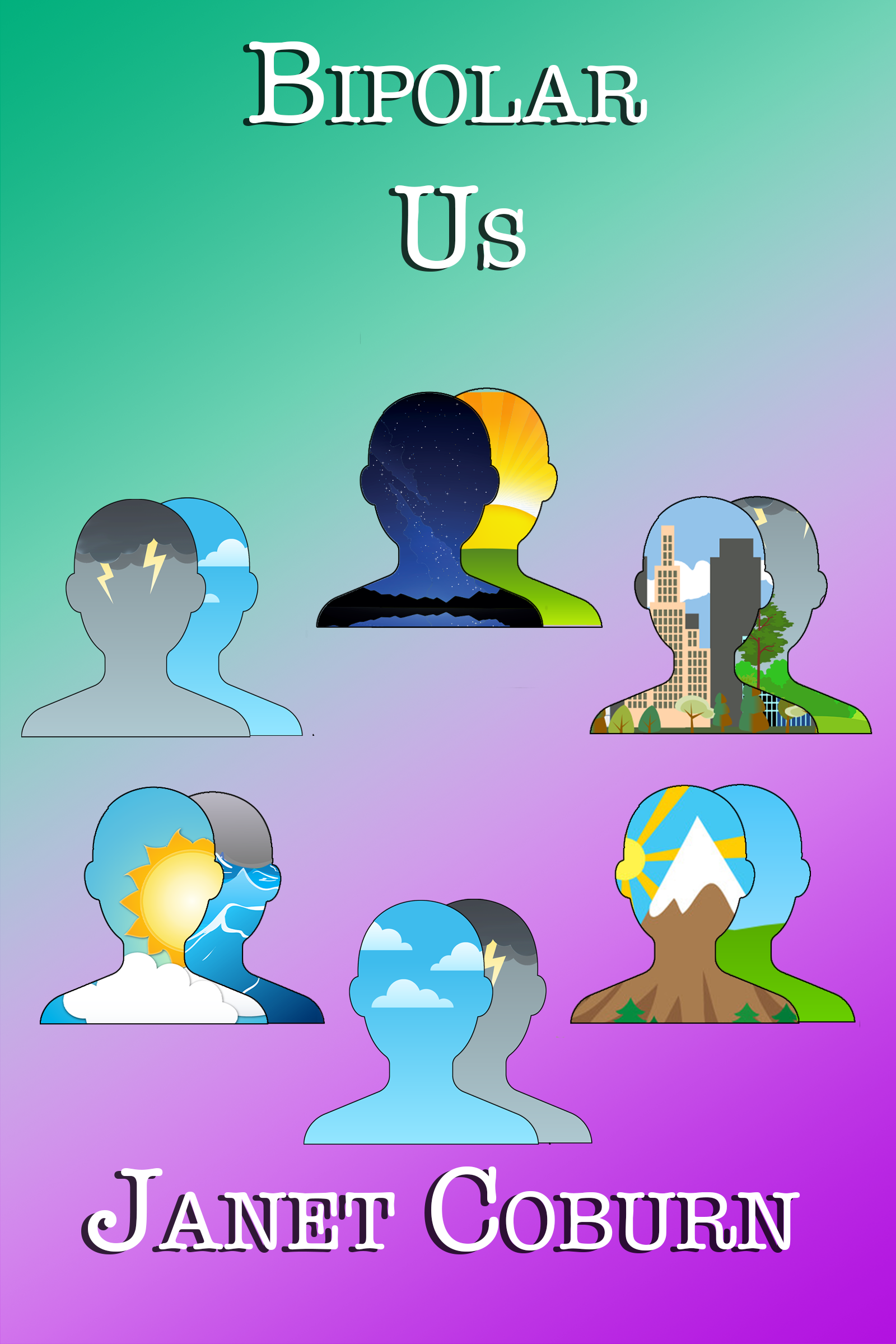
  • My publications. I talked about my blog and my books, Bipolar Me and Bipolar Us. In particular, we discussed gaslighting, which features in my second book, and how people with bipolar are more susceptible to it. Both Snowflake and I shared how we had encountered gaslighters in our own lives.
  • Groups. Chacoman, the other host, questioned me about whether I was involved in any local or regional support groups, and I had to admit that I’m not. Now, during the pandemic, group meetings are problematic at best, but I don’t react well to groups at any time, due to my anxiety (which is how my hypomania manifests). In my case, outreach is limited to my blogs and books, and membership in online support groups.
  • Miscellaneous. We got off topic a number of times. I don’t want to make it sound like the interview was all serious or grim. We also talked about our pets, positive relationships, college memories, and even politics.
  • Plans. I talked about how my next book will be a mystery, with a bipolar main character, and received positive feedback on the idea.

All in all, it was a good experience, worth overcoming my anxiety for. I had only participated in a podcast once before, a not-altogether-successful interview about my first book with an interviewer who had obviously not read it and was more interested in whether any of my family members were also creative. (It was supposed to be a podcast about first-time authors.)

This was not the same sort of thing at all. I told my story, as the hosts had recommended, and we had a genuine, far-ranging conversation about not just my own experiences with bipolar disorder, but with how others cope with it as well. Actually, I learned a lot about myself, from how much my anxiety – and especially social anxiety – still affect me, to how much my teen years illustrated my journey into depression.

So, here’s a big thank you to Snowflake and Chacoman for the opportunity to share with them and their audience. I would absolutely do it again. It helped me step out of my comfort zone and, I hope, will help the listeners as well. It’s a form of outreach that I had never considered, but one that I found valuable – and just plain fun!


Reminder: Podcast

Tomorrow evening from 7:00 – 8:00 p.m. EST, I will be the guest on the Bi-Polar Girl podcast. You can listen in on Apple, Amazon, or wherever you get your podcasts.

If you want to join in, the podcast will also be a Zoom call. Ask me questions! Give your reactions! Become a part of the event!

Here’s the info:

https://us02web.zoom.us/j/4429894773?pwd=dFlrcGVDNWduN1U1Ly8ydVhMN1lyUT09

Meeting ID: 442 989 4773
Passcode: 894298

Mental Health Privilege

Vectorarte / Adobestock.com

These days we hear a lot about privilege – class privilege, white privilege, first-world privilege, male privilege, and, I’m sure, many more. The idea is that people who have privilege don’t have problems that other people deal with every day and. In fact, they don’t usually realize that they have this privilege and benefit from it.

I know that I am privileged in many ways. I am white and heterosexual. I have a house, a husband, and work I can do. I have an Ivy League education and grew up in the suburbs, the child of loving parents who never divorced.

But what I don’t have is mental health privilege. I have bipolar disorder.

When a person has mental health privilege, they don’t have to take multiple medications just to keep their brain functioning in something like a normal manner. You won’t get pill-shamed for the meds you take or have random people suggest your problems will all be solved with prayer, yoga, apple cider vinegar, or acupuncture.

(I do recognize that there are many people who take meds for a variety of disorders, including life-threatening ones. I don’t mean to discount their struggles. Physical health privilege and ableist privilege also exist.)

When you have mental health privilege, you don’t have to question whether or when you should inform a boss, a potential employer, or a friend or romantic partner that you have a mental disorder. You don’t have to fear that that one fact will make it more unlikely that you can achieve a stable work situation (or any work situation) or a stable relationship.

When you have mental health privilege, you don’t have to try to find a therapist who specializes in your problem and can actually help you. You don’t have to repeat your whole psychiatric history every time your therapist gets another job, causing you to start all over with a new therapist. You also don’t have to ask your primary care physician, who may or may not know much about psychotropic meds, to prescribe for you until you find a psychiatrist or when one isn’t even available to you.

When you have mental health privilege, you don’t worry that people will avoid you because you act “peculiar,” miss appointments and dates, or can’t handle crowds or even family gatherings. 

When you have mental health privilege, you don’t have to fear that you may have to stay for a while in a mental ward or have treatments like ECT.

When you have mental health privilege, you won’t get shot by a police officer just because you have a meltdown or a really bad day or a psychotic break.

Of course, the privileges I do have protect me some. Realistically, there is less chance that I will be killed by a police officer than would a person of color. In fact, my race and income make it easier for me to access mental health care.

The Journal of Psychosocial Nursing and Mental Health Services, in its July 3, 2017 editorial, makes clear that mental health privilege affects not only people who have mental disorders, but also the people who care for them.  The piece, written by Mona Shattell, PhD, RN, FAAN and Paula J. Brown, MBA, points out, “More than 70% of all health care providers in the United States are White (U.S. Census Bureau, 2017), and many, if not most, have unconscious (or conscious) biases (Institute of Medicine, 2003).” Their level of privilege may interfere with their treatment of their clients. The authors of the editorial encourage those with privilege to use it to help others.

Racial privilege is particularly problematic when considering mental health providers and their clients. NAMI Illinois “reported studies found that ‘black professionals make up only 2.6% of mental health clinicians in the United States, which is low considering that approximately 20% of black Americans seek mental health specialty treatment within a 12-month period.'” “While access to culturally diverse providers is low, the cost of mental health treatment remains high,” they add, “which serves as an additional impediment to bridging the gap between the onset of symptoms and accessing professional care.”

Education about mental health privilege may or may not help. Many people pooh-pooh the idea of any kind of privilege and bridle at the idea that they themselves have privilege by virtue of their health, sex, economic status, or other attributes. Some people’s eyes can be opened. (My husband didn’t recognize male privilege until I pointed out that no one suggested he change his name when we married or that we were “shacked up” because he didn’t.)

It’s understandable in a way.  People have a hard time envisioning that they themselves might ever be mentally ill or poor or homeless or denied work or discriminated against in any number of ways.

But with mental health privilege, it’s even more difficult to get people to understand. Until a close friend or family member faces mental or emotional difficulties – suffers from PTSD, experiences major depression, develops schizophrenia – people will not usually have the opportunity to realize the mental health privilege they have. And they may not even then.

As with any kind of privilege or stigma, if there is to be any improvement, people need to be educated. It’s not easy to open their eyes. But doing so can make a difference in the lives of people who do not share that privilege.

Bipolar Me

Bipolar 2 From Inside and Out

Skip to content ↓