Let’s Laugh About Ourselves, When We Can
Not everyone will consider this funny, but I think it’s a riot.
http://www.theonion.com/article/depression-symptom-checklist-speaking-area-man-no–51251
Not everyone will consider this funny, but I think it’s a riot.
http://www.theonion.com/article/depression-symptom-checklist-speaking-area-man-no–51251
…this one, especially so.
As soon as I learned about the semicolon tattoo, I knew I had to get one – and not just because I’m a huge grammar nerd. Because I’m bipolar and want to spread the word about mental health issues.
In writing, the semicolon indicates a place where a writer could have finished a sentence, but instead chose to go on. This makes the semicolon an effective and beautiful symbol for suicide prevention efforts and those who struggle with mental disorders.
Every day we choose to get out of bed; choose to take our medications; choose to make and go to our therapist appointments; choose to live another day; and choose to go on with our story.
This is not something I invented. Here are the people behind it: http://www.projectsemicolon.com/. And here are some stories about the phenomenon that have been working their way through the media and around the internet.
http://www.upworthy.com/have-you-seen-anyone-with-a-semicolon-tattoo-heres-what-its-about?c=ufb1
9 beautiful semicolon tattoos our readers shared to destigmatize mental health challenges
Here is my story.
I am possibly the last person you would ever expect to get a tattoo. I am probably the last person I would ever expect to get a tattoo. I’m in my 50s, a former English teacher, married for over 30 years, fond of reading and word puzzles and cats.
Nevertheless, the professionals at Monkey Bones Tattoos in Beavercreek, OH, did not seem surprised when I showed up one day and presented my wrist.

The naked wrist.
When I explained what I wanted – to put down a deposit and book an appointment to get a semicolon tattoo – I learned that they had a cancellation and could ink me right away.
What the hell, I thought. Might as well. I had learned about the tattoos about a month before and had thought it over plenty. It was by no means a spur-of-the-moment (or drunken) impulse.
Mike Guidone showed me into his studio and explained the procedure.
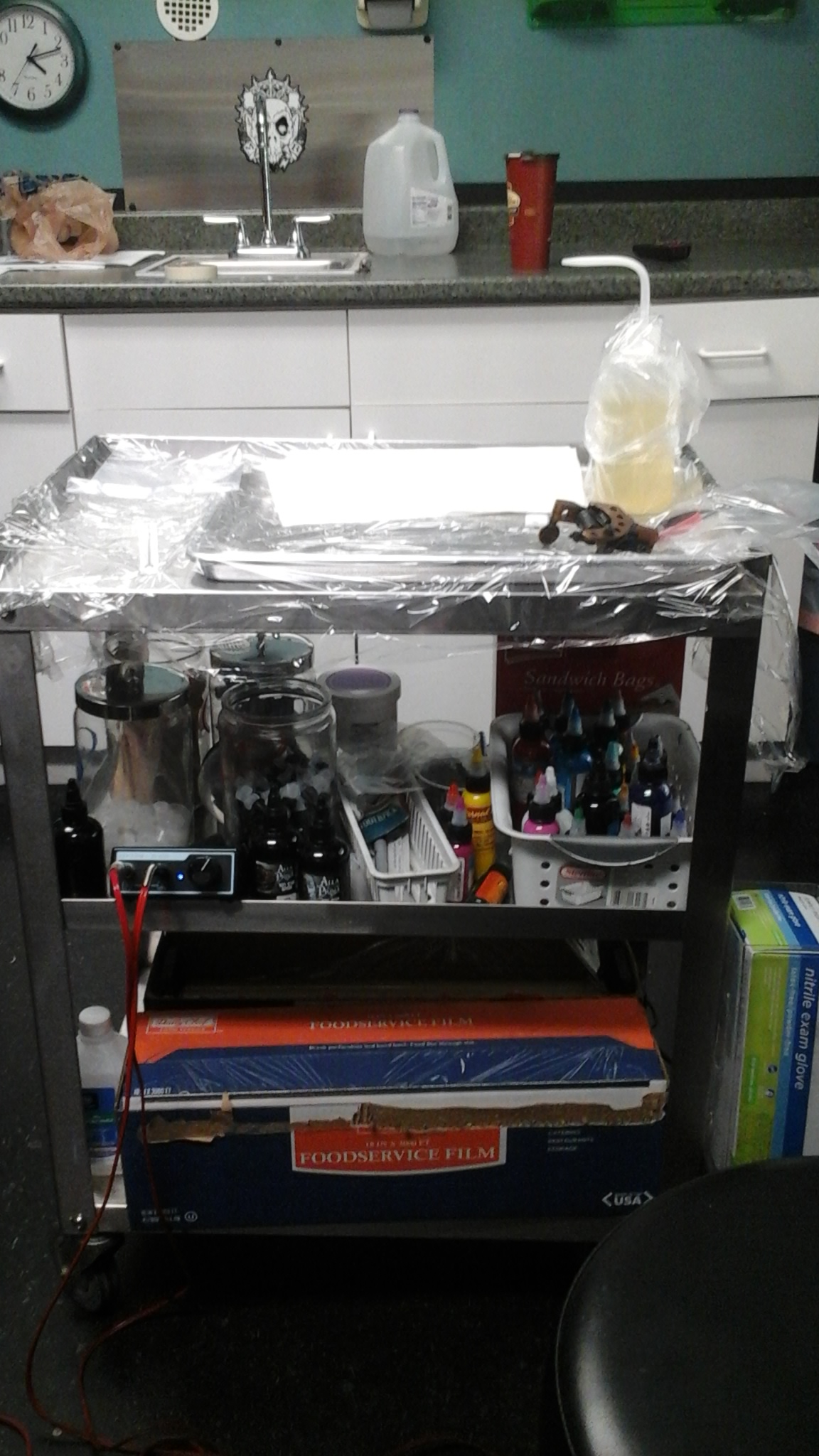
The tattoo artist’s work station.
He presented me with stencils of three different sizes of semicolons. I chose the in-between one. My wrist is fairly small, so the big one would have looked out of place, but the small one wasn’t noticeable enough. The idea is for people to see it and ask, so you can share the meaning and talk to them about mental health and combatting the stigma.
I sat in the dentist-type chair, listened to a brief explanation, got answers to some questions, and was ready to start.

In progress.
Did it hurt? Not particularly. It was a feeling between a scratch and a sting, and took only about ten minutes. Some aftercare instructions and I was done.

Success!
Then I paid ($80, the shop minimum), tipped Mike, and was on my way. Now I care for the tattoo while it heals, anointing it with unscented lotion several times a day, avoiding sunlight or soaking, and trying my very best not to scratch or pick at it.

The results.
Am I happy with it? You bet!
And, like I said, it’s for life! My story isn’t finished yet.
When my brain broke back in 2001 or so, I thought it was the first time that had happened. Later, on reflection, it turned out that wasn’t so.
The 21st-century breakdown was certainly the most dramatic. Although I had just quit working in an office to start a freelance career, I found myself unable to work after a few months.
I had become unable to work in the office because of mounting difficulties that I now realize were warning signs of the impending breakdown: inability to concentrate, increased anxiety (the feeling that an angry badger was about to claw its way out of my stomach), lessened ability to interact with coworkers, sudden flares of temper, turning people away with unintendedly cutting remarks and sarcasm, isolating, inappropriate affect, catastrophizing – you name it, I had it.
What was causing all these symptoms? My bipolar disorder, obviously. But I’ve had that for years. What was pushing me over the edge this time? I had trouble at work. My boss left and, when I “came out” to my new boss as depressed (which is what I was diagnosed with at the time), she reacted with wariness and incomprehension. She gave me the first bad review I ever had at that job.
My mother’s health was deteriorating seriously, too, about then. I lost time at work taking her to various appointments and I had to have “the talk” with her about how much longer she could live alone. Eventually I took over her finances – and by then I was scarcely handling my own.
I experienced a lift when I quit my job and began freelancing. Hypomania? You bet! My new flexibility allowed me to take better care of my mother, and the assignments kept coming in.
Then everything came crashing down. I screwed up my finances and my mother’s. She began having worse falls and injuries, hospital stays and drug reactions, even hallucinations which scared the hell out of me. I emotionally judo-ed my sister to come up and help, then fought with and resented her, and had to take care of parts of her life as well.
Those and other difficulties on top of my mental disorder added up to a non-functioning me. I dumped all the chores and coping onto my husband, which was a rotten thing to do, fought with him, sobbed for no discernible reason, became unable to work, or care, or do much of anything except think up at least three different ways (and reasons) to kill myself. Fortunately, I was too immobilized to try any of them.
I’ve written before about the things that helped me get back to some kind of functioning – a proper diagnosis, the right meds, time without work (as we gutted our retirement savings), lots of psychotherapy, and my wonderful, patient, ever-helpful, devoted husband.
But now, looking back, I can see that it had happened before, though not so dramatically and completely. In childhood, in my teens, in college – at every stage of my life I had at least one breakdown, often triggered by the circumstances of my life, but fueled and stoked by my mental illness. In every one, my ability to function deteriorated a little more.
The first one that I remember clearly was when I was around 12. My best friend and I were in charge of a birthday party for her younger sister and some friends. This was the old-fashioned kind of party that everyone in the neighborhood had then: cake and ice cream, party games, presents, and not much else. It happened during pin-the-tail-on-the-donkey. I was blindfolded – literally – and my friend kicked me in the ass – again, literally. In front of all those younger children.
I ran home sobbing. And I curled up into a fetal ball and didn’t quit for at least three days. Non-functioning, non-responsive, non-everything. What finally brought me out of it was seeing my mother’s pain at this inexplicable (to her) meltdown.
I had a mini-meltdown in my freshman year of college, which involved sitting in my nightgown in the hallway, staring for hours at a richly detailed poster of a fantasy realm. (I managed to frighten an intruder by arising, ghost-like, in my pale yellow shroud as he entered the suite.)
This one was triggered by my realization that I had probably chosen the wrong major and that there were no job prospects ahead for me. (It turns out I was wrong about that. Maybe I should have stuck with it, but my next choice turned out pretty well.) I took a year off college and took a job as a cashier in a restaurant, where I spent a lot of time crying into the roller towel and being told I should smile more. This convinced me that going back to college, with a new major (and even fewer job prospects), was the right thing to do.
The next meltdown was major. I had finished college, endured a year-long train wreck of a relationship, and lost a job as an assistant restaurant manager (I hadn’t fully learned that lesson yet). I got unemployment, which meant I lay around the apartment for most of the week (except for making half-hearted attempts at job hunting).
One notable symptom of this breakdown was my near-complete immobility. One errand in a day – say, going to the post office for stamps – made it a productive one for me. I had maybe three of those a month, with one being the obligatory visit to the unemployment office – a supremely depressing place to be depressed.
I had some truly irrational thinking that time, too. I thought I could cheer myself up by watching light, fluffy sitcoms on TV. But as I lay there on the couch, I found myself crying with every upbeat, cheery theme song that came with them. Laverne and Shirley making their dreams come true. One Day at a Time, which advised me to get up on my feet because somewhere there was music playing. And, oh, Mary Tyler Moore. Love is all around, my ass.
After that, it was a long, slow slide to my major breakdown. It wasn’t unrelieved misery. I got married. I got a master’s degree and a job in publishing. We acquired a house and cats. We traveled. But the Big One was waiting for me.
Nowadays, I still have mini-meltdowns, but they usually last a maximum of three days, rather than weeks, months, or even years. They still tend to be triggered by stressful life events, especially financial ones. But when I get one, I know I’ll be coming out of it soon. And that’s a wonderful feeling buried in all the misery.
Once I knew a man whose wife was going to leave him. I knew he was in a lot of pain and despair about it, though he also turned into a huge asshole before everything was said and done. He was also suicidal for a time.
One day when I was trying to talk him through a bad patch, I asked whether he might turn to music to help him. “What?” he said. “Do you think I should listen to country music and cry in a beer?”
I wasn’t suggesting that at all. I just knew that he was a singer and songwriter of talented amateur status and was known for this in various circles. I honestly thought that music might help.
On the other hand, I always forget, when I am on the downswing, how much music can do for me. It soothes and heals, but it also lets me tap into the emotions that I have been suppressing.
Do I have the inexplicable blues that are part and parcel of my condition? There’s a song for that. Am I feeling unrequited love? Unrequited lust? There’s a song for those too. Is the world spinning too fast for me? Do I need to know that everything will be all right? Or do I just need to know that someone, somewhere and somewhen, has also felt this way? I can turn to music.
“Music, uniquely among the arts, is both completely abstract and profoundly emotional. It has no power to represent anything particular or external, but it has a unique power to express inner states or feelings. Music can pierce the heart directly; it needs no mediation.”
– Oliver Saks, Musicophilia
Saks also says, “The power of music, whether joyous or cathartic, must steal on one unawares, come spontaneously as a blessing or a grace.” There he and I part company.
Music can certainly steal on us unawares, whack us upside the head with a memory, a feeling, a piercing stab of emotional intensity, all the stronger for being unexpected.
But we can also choose to bring music into our lives when nothing else seems to touch us. We can tap into those memories and feelings – good or bad – and let the music wash over us as we listen and feel.
According to scientific experiments with fMRI, music uses more parts of the brain than almost any other activity. The neural connections fire all over the place – more so if one is playing an instrument, but even when just listening. The memory centers, artistic areas, language centers, emotional areas – even the motor complexes – are stimulated.
My problem is remembering all that music can do for me. When my emotions are dulled, flattened by the steamroller of depression, I sometimes forget that I can be any other way. The music I love is always there for me. I can bathe in it, wallow in it, be uplifted by it, float on it, join in with it, feel it emotionally and viscerally and intellectually all at once or one at a time. It can express the things that I just can’t.
When you’re depressed is a time for writing bad poetry. Or you can let good poets and songwriters take you with them as they explore the human condition in ways you’re not capable of. I think that’s why they do it – create their art. The really good ones anyway.
There’s also something to be said for music as distraction. A song from years ago – even a frivolous one – can take you away from your troubles, even if only for a moment. This is not the time for exploring new musical avenues. Remembering that things once were good can feed your sadness, your depression, but it can also give you perspective. If you took joy in this music once, there will come a time when you will again. And maybe that time is now.
Perhaps the most amazing power of music is to provoke catharsis. Certain songs leave me sobbing like a baby. They don’t even have to be sad songs, though many of them are. “The Mary Ellen Carter” by Stan Rogers is about as life-affirming as you can get, but it can still turns me into a weeping puddle. (https://www.youtube.com/watch?v=Fhop5VuLDIQ) His song “Lies” has nothing to do with my situation personally, but its evocative power touches me nonetheless. (https://www.youtube.com/watch?v=D79XOc1vKzQ) And almost no one I know can make it through Kathy Mar’s “Velveteen.” (http://www.last.fm/music/Kathy+Mar/_/Velveteen)
Afterwards, I feel drained and, if not exactly better, less emotionally constipated, I guess you’d say. Clearing away a bit of blockage can be cleansing. If music can do that – and it can – then I don’t care if its country with a beer, jazz with a glass of wine, or hip hop with an energy drink. Even easy listening with a glass of milk, if that’s your thing.
So thank God and Apple for iTunes. And here’s hoping that my Swiss cheese of a memory will give me a nudge in the right direction when I need it next time.
The air is still and blankets all my sense.
I’m muffled, muzzled in the sheltering dark
But dare not hope for fire, with bright, intense,
loud flames that rend the silence with a spark.
I breathe or not. It’s sometimes hard to tell
When swathed in dimness. Stifling, musty scent
Fills up my nostrils and my brain as well –
Which cannot will the veil be shredded, rent
to save from suffocation. How shall I
Withstand this cycle till the day appears
And breezes blow the dust away from my
Stopped ears and eyes and lungs, plugged full with fears?
Pull off the cover and let free the soul.
Take broken breath and heal it into whole.
 Janet Coburn


Recent Comments