Bipolar 2 From Inside and Out

Posts tagged ‘psychological pain’

Not Waving but Drowning

Consider this a trigger warning. The third section is going to talk about some difficult stuff, although in mostly general terms.

Here’s a list of how I know how bad my mood disorder is at any given time. Being bipolar, I cycle in and out of these phases, along with periods of reasonably competent functioning and even, occasionally, contentment or even happiness.

There are basically three stages of increasing dysfunction.

Starting to Sink
My sense of humor takes a hike.
I need more alone time.
I take mega-naps.
I forget that music can help.
I snap at my husband.
Noises irritate me.
I can force myself to work.

Floundering
I don’t want to eat.
I turn off my phone.
I sleep up to 14 hours a day.
Attention span is one hour (or one average book chapter).
I can trick myself into working.

Going Under
Can’t sleep.
Can’t work.
Can’t read.
Attention span: 15 minutes max.
Thinking “Maybe the plane will crash and I won’t have to deal with this anymore.”
Regretting I flushed my stash of pills.
Urge to cut.

Fortunately, I am well-medicated enough that category 3 doesn’t happen nowadays, though I remember it clearly and am appalled. At that point, the only things I can do are keep seeing my doctors and taking my meds. And remember to thank my husband when I come out of it.

(The title of this post is from a poem by Stevie Smith. The last two lines are: I was much too far out all my life / And not waving but drowning.)

The Myth of Closure

For some reason, it’s called “closure.” But for some wounds there is no such thing. And for some of us – those with emotional and mental disorders – there is no way to achieve closure.

Take, for example, the invisible injuries I experienced while living with Rex (a pseudonym), for a year in college. He was a master of intermittent reinforcement, the trap that keeps abused women (and men sometimes) from getting themselves out of the situation to someplace safe. He was never physically abusive, which I have vowed never to put up with (and to this day haven’t), but verbally and emotionally, he was, well, a veritable artist of psychological bullying.

Here are just a few examples.

When he was unhappy with me for some reason, he would sigh and glare. I swear he could sigh and glare even over the telephone. And when I would freeze up and not be able to think of any word that would make things better, he said my silence made him want to kick me.

I slept in the car on the streets of Buffalo if there was a late-night party he wanted to go to. It was out of the way to take me back to where we were staying.

When I was responsible for feeding guests, and botched it, he said I had tarnished his honor.

He took the decision to tell my parents about our relationship out of my hands, ripping apart the face-saving fiction that I was renting a room in his large house. After I left, I even sent him money to pay the supposed rent.

When I asked him to go to couples counseling with me, he said, “Are you sure? The therapist and I could have you declared a danger to yourself and have you put away.” At the session, he tenderly held my hand and asserted that he just wanted to get help for me.

So what does this all have to do with mental health? I certainly wasn’t mentally healthy when I met him, and was a basket case by the time I left. When I was immobilized, I was not embracing his projects with “alacrity.” When I was insomniac, only his cat comforted me. When I was in the Pit of Despair, everything was All My Fault.

So what do people tell you in cases like this?

Look how much you learned from the experience. And I always reply that the lesson wasn’t worth the price I paid. All that I want to keep from that time are a few dear friends.

Forgive and forget. I can’t do either. The memories have faded over time and seldom give me flashbacks anymore. (The dreams still come.) As for forgiving? He’s never asked for it and never would. I’m sure he doesn’t think he did anything that needed forgiving. If that makes me a hard-hearted bitch or a bad Christian, so be it.

That emotional abuse happened, and I can’t forget it. It was my first serious relationship and I left chunks of my soul and most of my barely existent self-esteem in that house on the hilltop. I had failed – at the relationship, at meeting my parents’ expectations, at so many things. I felt I was the one who needed forgiveness and spent much of the following years repeating incessantly, “I’m sorry.”

Let go of anger; it will only hurt you. When I first left, I didn’t feel anger toward Rex. I felt a lot of other things, mostly directed at myself. But I didn’t recognize or own my anger until much later, after lots of therapy and the good kind of love. Now that I realize I was (and am) angry, it feels wrong to think of him without feeling that. The things he did were wrong, and it is not irrational of me to still believe that. I earned that anger. It is part of me now. I can lay it aside to the extent that I don’t have revenge fantasies, but that’s about all.

So, closure? Not a chance. Saying as Oscar Wilde did, “Living well is the best revenge”? That’s more like it. Even learning to live well has been an uphill battle. I’m still struggling with the definition.

The wound may scab over, or it may continue to trickle blood at times. Some of it may even form scars. But take my word for it, the wounds are still there. They never really close.

Missing Friends

Last week I wrote about the controversial subject of self-harm. In my post, I said:

One of my dearest friends once said that if he ever found out I was a cutter, I would never hear from him again. Except for his publicly mocking me for being so stupid.

Naturally, this sort of reaction, though common, is not helpful. I didn’t tell him (or practically anyone else). And I didn’t tell him that at least two other people he knew – one fairly intimately – were also cutters.

Anyway, Tom, if you’re reading this and still feel the same, I guess this is goodbye – just not the long goodbye. I would rather skip the public mocking, though. I’ll just assume you’ve done it while I wasn’t there, mm-kay?

Finally, I got tired of wondering, withholding a part of my past from someone with whom I have practically no secrets, sometimes to the point of TMI.

So I called him and asked, “Are we OK?” At first he didn’t know what I meant, since he hadn’t read the post, but after a brief nudge I could tell he knew exactly what I was referring to.

Just as a (very rational) mutual friend had predicted, Tom chalked it up to the hyperbole of his callow youth and reassured me that we were fine.

Still.

I had lived with the fear of losing that important relationship (and being publicly mocked) for over 20 years. I had never dared mention it to any people in our circle either.

And, let’s face it, I have lost other friends and can attribute at least some of these losses to my bipolar disorder. It harms me, but it also harms those around me, and especially relationships.

I have shot my mouth off and driven away friends and colleagues with bitterness and sarcasm but without realizing how I sounded.

I have ratted out a friend to his therapist and his wife when he was suicidal, which he found unforgivable.

I have turned down invitations to go out or agreed to and then backed out one too many times. My friend gave up the effort since I wasn’t responding.

I have abused the hospitality of friends. When I was at my still functioning moderately well, I would visit and we would enjoy activities, food, conversation, and music. When I was near or at the depths, I would invite myself to visit and turn into an uncommunicative, disengaged, immobilized lump. I was a mooch and a leech, and a real downer generally. I didn’t like spending time with myself, so it’s no wonder they didn’t either.

And I miss every single one of them. I wish I hadn’t driven them away. I wish I could make things right again, now that I’m functioning at a higher level. But I can’t. And that hurts.

In some cases, I’ve tried – sent brief notes of apology. They have been acknowledged with cold politeness that does not invite more contact. I don’t know what else I can do.

Bipolar is a cyclical illness and, though I’m much improved, I can’t promise that I will never sink that low, be that inconsiderate, offend those I deeply care about again. And I can’t blame them for not wanting to deal with that. I don’t want to deal with it.

But I have no choice in the matter. And that hurts too.

Fortunately, there’s one friend I cannot lose, no matter what – my husband. He’s ridden the roller coaster with me, put up with the huge mood swings, ignored the irrational remarks, offered to help in any way, encouraged me to go out but understands when I can’t, and dispensed hugs on a regular basis. He respects alone time and is there when I need company or distraction. If things are really bad, he gets me to eat and helps me shower and takes care of the pets and picks up my refills and does whatever else needs doing.

He’s a man who takes “in sickness and in health” seriously. I wouldn’t have made it this far without him. And I won’t ever lose him, till death do us part.

Cutters

If that title wasn’t enough of a trigger warning, well, here goes:

TRIGGER WARNING: Self-Harm

Recently a small discount store a couple of miles from my house was caught up in a furor because a “Princess Wand” toy they were selling (ominously named an “EvilStick”) would reveal a hidden image of a teenage girl cutting her arm with a knife. Here’s a link to a local news story about it, and the snopes.com report verifying it. If you want to, you can easily search out a copy of the image, but I don’t recommend it.

Self-Injury

http://www.snopes.com/photos/odd/evilstick.asp

The “toy” is in horrifically bad taste (so, for that matter, is the snopes article’s headline, “Wristcutters – A Toy Story”). But items that adults consider dreadful can attract kids (remember the Garbage Pail Kids trading cards?). The image of the teenage cutter looks like a macabre Halloween costume rather than anything realistic (I’ve seen it), but we don’t really know whether a mistake, an error in judgment, a misunderstanding, or a prank at the factory that went way over the line resulted in the image on the toy. I kind of hope so, because if it was intentional, that’s way worse.

But bad taste is the least of the problem. The toy and the reaction to it have introduced the subject of cutting to a wider audience, if they choose to look beyond the squick factor and think about what the image really means. Cutting is a reality that’s mostly hidden from view.

Of course, it’s not always cutting. Burning is popular too. But cutting is perhaps the most common name. There are websites devoted to it, some offering help, facts, and information on quitting (see below) – but others glorifying it as, I don’t know, a creative expression of teen angst or something.

The name does keep changing. The last I heard, the “approved” psychiatric term was “Non-Suicidal Self-Injury” (NSSI). Self-mutilation, deliberate self-harm, non-fatal self-harm, self-destructive acts, self-inflicted violence, parasuicide, and self-wounding are all names for the dangerous practice performed by desperate people. The subject still isn’t talked about much and carries a huge stigma. As if the mental and physical scars were not enough.

Some facts: Self-harm is not attempted suicide, though with some miscalculation it can lead to serious permanent injury or death. Most people associate it with teenage girls, but I’ve know at least one man in his 50s who cut himself fairly regularly. It is not a matter of attention-seeking, since most cutters hide their physical wounds.

As I understand it, the practice results from one of two phenomena: the build-up of painful pressure such as perfectionism, or a feeling of severe alienation to the point of numbness. Cutting is a coping mechanism, though a dangerous, dysfunctional, and unsuccessful one, to deal with pain.

In my case, it was probably the numbness. I was feeling a lot of psychological pain at the time (college age) and irrationally wondered if physical pain would lessen that, or increase it, or feel any different. Like I said, irrational. All this was before I was diagnosed bipolar, had a therapist, or was medicated.

I made a few small cuts on my wrist to watch the blood well up. (Ironically, they became mildly infected; I neglected to sterilize the knife.)

I wasn’t suicidal. They weren’t that kind of cuts. I do know the difference. (I didn’t realize that I could have damaged tendons or nerves in my hand or arm, perhaps permanently.) It was more like when you stand on a bridge or balcony and look over the edge. You walk away. But you know the bridge is always there.

All told, I cut myself maybe three or four times. The scars are very faint now, white against my pale inner wrist, almost invisible. The memories are vivid. A friend who’s a psychologist once asked me why I stopped. “Because I didn’t need to any more,” was the only answer I could give. I’ve only felt the urge once since, and it was easy enough to push aside. But I recognized it.

I hesitated to write and post this, though I knew I would have to sooner or later, if I meant this blog to share my experiences truthfully. One of my dearest friends once said that if he ever found out I was a cutter, I would never hear from him again. Except for his publicly mocking me for being so stupid.

Naturally, this sort of reaction, though common, is not helpful. I didn’t tell him (or practically anyone else). And I didn’t tell him that at least two other people he knew – one fairly intimately – were also cutters.

Anyway, Tom, if you’re reading this and still feel the same, I guess this is goodbye – just not the long goodbye. I would rather skip the public mocking, though. I’ll just assume you’ve done it while I wasn’t there, mm-kay?

Cutting isn’t going away if we ignore it. It won’t go away even if we do talk about it. (Or mock it, or gasp in horror.) But understanding self-injury is a big step.

If you’re a cutter, or know someone who is, here are some places you can go for information, hope, and help:

Suffering and Train Wrecks

What doesn’t kill you makes you stronger.

Right.

This is one of the world’s biggest falsehoods, right up there with “Sticks and stones may break my bones, but words will never hurt me.”

But it’s a platitude we hear all the time, particularly those of us with mental illnesses.

And it’s about time to call bs on the saying. Here’s why people say it:

Suffering hurts. It grinds you down. It makes you less able to function. It keeps you from being the person you want to be.

Except in literature. There, suffering ennobles one – makes one a finer person, a more worthy person, and, yes, stronger.

Once in a graduate-level literature class, I objected to this. I said the thing about suffering hurting and grinding you down.

I got called a sociologist, which apparently is a terrible insult in literary circles. But they were talking about literature and I was talking about real life, so maybe we both had a point.

But back to the saying. There are lots of things that don’t kill you, but also don’t make you stronger. Train wrecks, for example. If they don’t kill you, they can leave you on the brink of death or physically maimed or with PTSD. You may recover some, with help, but your back will still hurt and your leg won’t regrow and you can suffer from memories and dreams.

I’ve compared some relationships with train wrecks – probably most of us have. They simply cause you to suffer and the memories of them may always pain you like a damaged joint in bad weather. One can come through ordinary bad relationships and be stronger for it. But train wreck relationships, the toxic ones that erode your soul, do not ennoble or strengthen you.

Mental disorders can be like that. Yes, you may improve. Yes, you may become stronger in some ways. You may become more compassionate, more aware of others’ pain, better able to avoid situations that will cause you harm, capable of rebuilding a different life with the parts you want to keep. But it’s just as likely that when your brain breaks, it will never be good as new again. There will be cracks in your emotions or reasoning or moods that will be weaker, not stronger, and more likely to rupture again in the future.

We sufferers need strength, but it won’t come from platitudes and bumperstickers.

And you can’t explain this to people who haven’t been there.

Also, don’t get me started on that thing about God not giving you more than you can handle. We’ll be here all week.

As always, these are my experiences only. Your mileage may vary.

On the Inside

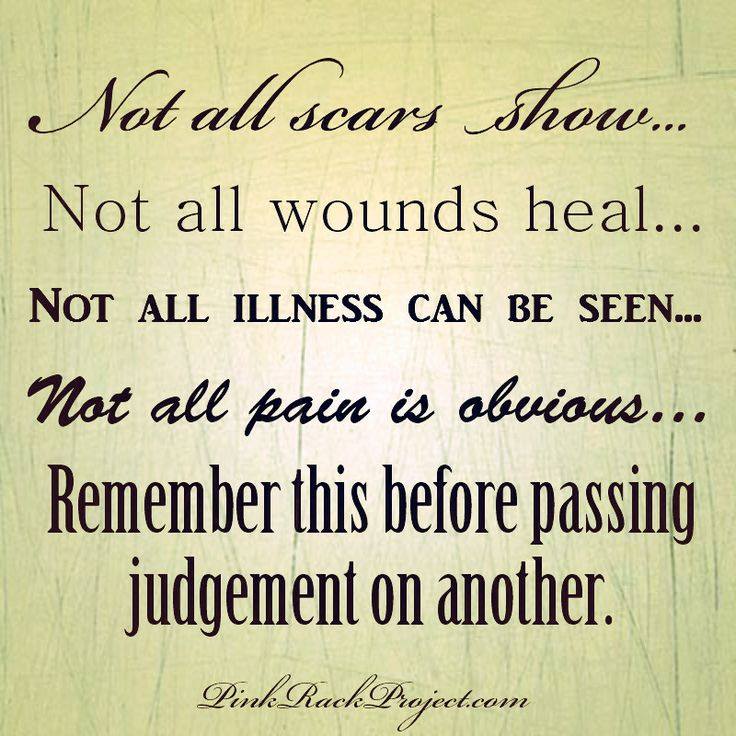
I saw this pass-along the other day and felt compelled to, well, pass it along.

wounds

It reminded me of a lot of things. Things I try not to remember.

Not all scars show. Some of mine do. The one where kids threw a rock at me, requiring seven stitches in my forehead. The ones where I cut myself. (I’ll write more about that later.)

Others don’t. I’ve often described my relationship with Rex as a train wreck. People wonder why I haven’t gotten over it, all these years later. It was the sort of train wreck in which you lose pieces of yourself, some of them irreplaceable. These scars aren’t the visible kind.

Not all wounds heal. Especially the wounds that happen when you’re too young to know how to treat them. Cutting words. Emotional bruises. Neglect. Loneliness. There are no bandages that can cover them, no ointments that can soothe them, no miracle cures.

Not all illness can be seen. If we’re high-functioning or have learned enough coping mechanisms, others may not notice. But bipolar disorder – and other mental illnesses – are, if not immediately visible, lurking just below the surface. And ready to break through at any time.

Not all pain is obvious. But it can leak out, especially around the eyes.

Remember this before passing judgment on another. But judgment-passing is practically an Olympic sport these days, along with shaming.

Scars. Wounds. Illness. Pain. These are things that those of us with mental disorders know all too well. What if our conditions are chemical imbalances in our brains? The consequences of having them, the misunderstandings they cause, the messages we receive, the behaviors we can’t understand or control or mimic, the friends we lose, the opportunities and joys we miss out on, are very real. And don’t let anyone tell you different.

Our disorders may be in our brains, but they’re not all in our heads.

But you knew that, didn’t you?

Can’t Write Today, So Here’s a Cat

maggie

I have been avoiding the Internet for days (and TV news and commentary as well) because I just can’t handle it right now. Actions, reactions, reactions to the reactions, et endless cetera. I’m depressed enough without all that.

There are plenty of thoughts I have on the Isla Vista shootings, and the media coverage of it, and mental health, and gun regulations. I’m sure most of them have already been said, and probably better than I could, and everything about the subject makes me angry, confused, outraged, despairing, hopeless, helpless, and majorly depressed.

Then there’s everything I’ve read lately about bodily autonomy and male privilege and the “war on women” (why does everything have to be a war?) and politics and climate change and all of those make me angry, confused, outraged, despairing, hopeless, helpless, and majorly depressed too.

But it is TBT, so here is a picture of Maggie, a cat who saw the glowing design on Dan’s forehead that reads “Sucker.” He instantly scooped her up and brought her home. She was thereafter totally devoted to him. He could arouse her to a fever pitch of writhing and seduction with only the use of his voice. I mean, if they had been the same species, I wouldn’t have stood a chance.

Maybe next week I’ll have pulled myself together a bit and can write about something. For now, I’ll just say the best things that have happened to me today are a head-bonk, a nose-touch, and two nose-licks from Dushenka (Little Soul) with the Crazy Eyes.

Dushenkacu

Yours truly,

A Truly Crazy Crazy Cat Lady


Hired Help

Remember when you go to a therapist, you hire him or her. She/he works for you. And if it doesn’t work out you can fire your therapist.

I hate breaking in a new therapist. I hate having to do the little tap dance that is the Reader’s Digest Condensed version of my screwed-up life. But if I have to find a new therapist, I’ll keep reciting it until I find the right one.

Of course your choices may be limited by location, finances, or other factors (EAPs, for instance). You may not have that wide a range to choose from. But the better the “fit” between you and your therapist, the more likely you’ll make some progress.

When I need a new therapist (when mine has moved away, for instance) I go through a process.

Step One: I identify my current needs. Do I need counseling for grief? Mood disorders? Anxiety?

Step Two: I do research. Most therapists have websites and most of them list what they specialize in. Start making a list of those whose practices meet my needs.

Step 3: I make a list of my preferences. For me, this is easy. By now I know I need a therapist who is not Freudian or cognitive behavioralist or comes from any particular religious approach, but does deal with women’s issues and has a sense of humor.

Step 4: I make some calls. Is the therapist taking new patients? Is there a waiting list? Does he/she take my insurance? If not, is there a sliding fee scale based on need? Is long-term therapy possible, or is it 30 days max?

Step 5: I set up an “interview” appointment. I do the even-more-condensed version of my screwed-up life, ask a few questions and, if everything “feels” pretty good, make a follow-up appointment.

I know, that’s a lot of work. But in the long run, you can save yourself a lot of grief.

I’ve been to a couples counselor who absolutely shredded me, latching on to my husband’s difficulties with me and running with them. I felt she didn’t hear anything I said, or if she did, discounted it. I felt ganged up on. It was not pleasant. More important, it was not helpful.

(I’m not saying that she should have ignored my husband’s issues, which were important and valid. But I really needed to be navigating on a two-way street.)

Another therapist I went to decided that my problems stemmed from being an innocent led astray by an older man (ten years older) who got me into practices that went against my upbringing. Which is not the way it was at all. (It was the 70s. Some experimentation with sex and drugs for a woman in her 20s was not considered total depravity then.)

She also diagnosed me with PTSD because I said I had flashbacks and dreams about the bad parts.

In both of those cases, I got the hell out.

And that’s my point. I had a choice and I exercised it. I went looking for someone else who could help me with my problems. And I found a psychotherapist who could and has, plus a psychiatrist for my meds.

I’m not saying you should ditch your therapist when the process hits uncomfortable or even painful patches. It’s pretty much got to if it’s going to help.

But you made the choice of hiring this person. You also have the choice – and the right– to leave and go looking for someone else.


(Disclaimer again: I am not a medical or psychiatric professional and my comments are based on my own experience. YMMV.)

Drugs vs. Drugs

I’ve been vastly depressed lately – Pit of Despair depressed. And let’s not forget anxiety; there’s plenty of that too.

I’m sure that the Vicodin I’m taking for my bulging disk/pinched nerve isn’t helping any with my moods.

So, physical misery or emotional misery? Which do I choose?

Either way, it’s hard to get any work done.

__________________________________________________

By the way, the combo that the Vicodin is fighting is Zoloft, Ativan, Ambien, Inderal, and Lamictal. But more on that later.