Bipolar 2 From Inside and Out

Posts tagged ‘mutual support’

Self-Care and Human Needs
Self-care is one of the hot topics these days in the world of bipolar disorder and the people who live with it. Self-care can be as basic as remembering to eat or as complicated as knowing and avoiding your triggers.

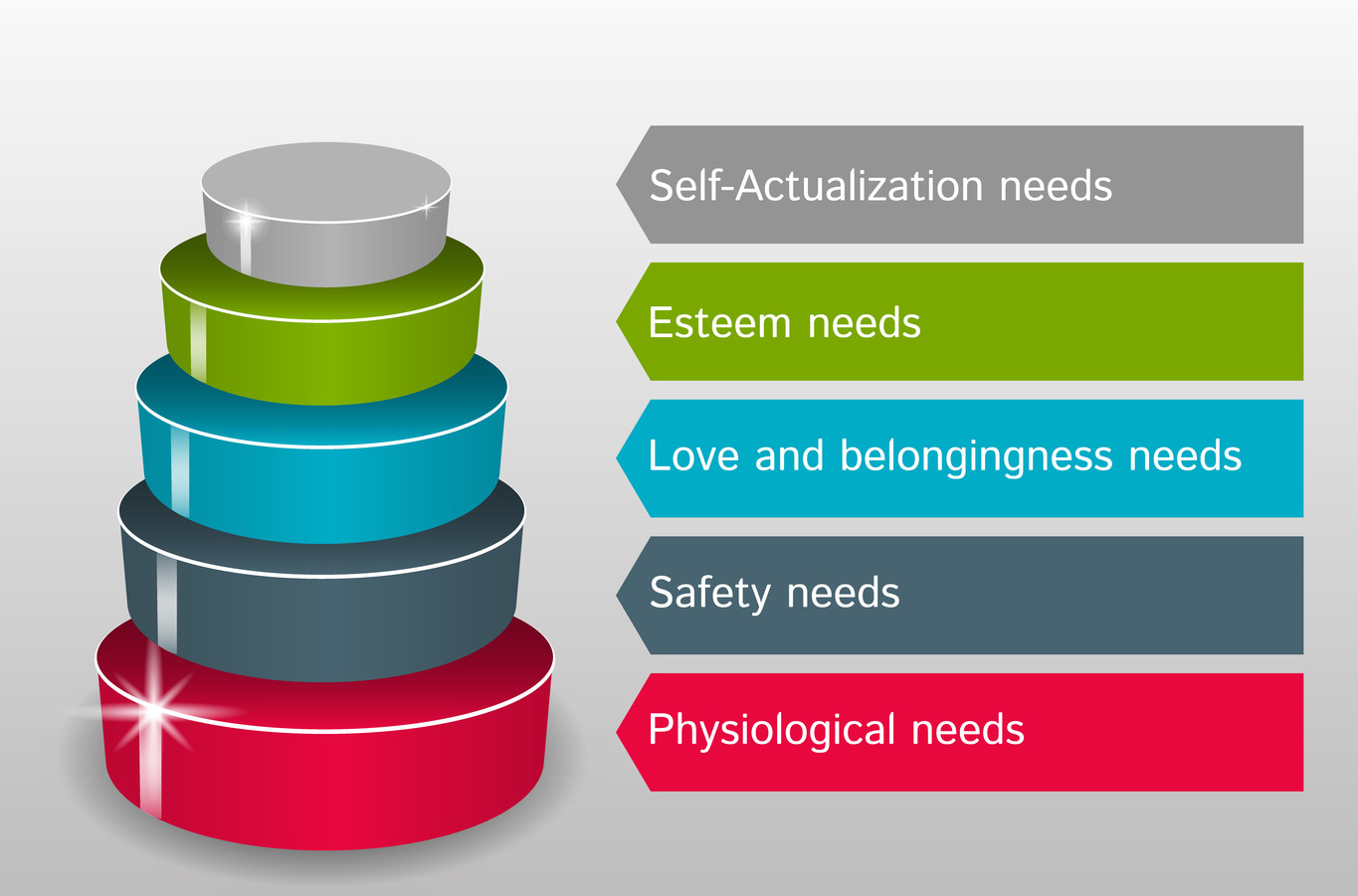
Back in 1943, psychologist Abraham Maslow created what he called a “hierarchy of needs” – a series of stages that human beings must go through on the way to the ultimate goal of “self-actualization.” With few changes, the concept, usually illustrated as a pyramid, has continued to influence the study of human motivation and developmental psychology.

So what does self-care have to do with the hierarchy of needs?

The most basic needs of human life form the base of the pyramid. These are called “physiological needs” and are essentially what a person needs to stay alive: air, water, food, shelter, sleep, clothing. Without meeting these needs, a person cannot move up to the next level of the hierarchy.

A large part of self-care is devoted to meeting these very basic, fundamental needs. Air is usually not a problem but shelter and clothing can be, for those bipolar persons who are homeless – and there are more than a few. Many of us are just one financial reverse – loss of income, insurance, options – from being homeless.

The most common advice for self-care is to pay attention to these base-level needs: Remember to eat. Stay hydrated. Get enough sleep. At times, it’s a real struggle just to meet these self-care needs. Add “get exercise” to the list and it can suddenly be overwhelming. People with bipolar or major depressive disorder often need help accomplishing them. That’s as high as we get on the pyramid.

The second step of the pyramid, which people need to work on after they’ve met the requirements of the first step is called “safety needs”: personal security, employment, resources, and health. Again, the needs on this step may seem insurmountable, and may – probably will – require help to achieve.

But they are self-care needs too. Current society may not view them as such, but that’s because they tend not to struggle with them, at least not on the level of a person with a mental disorder. Individuals can sometimes help meet these needs, but more often government, community, or charitable organizations provide necessary help. Talking about self-care at this second level may seem like pie-in-the-sky to those who have not yet conquered the first. But truly, taking care of these needs is a form of self-care, enabling one to maintain the gains represented by achieving those of the first level.

The third level of human needs – and self-care – is called “love and belonging”: friendship, intimacy, family, sense of connectedness. Again, this is not usually thought of as a part of self-care. But it certainly is. Many of us – I include myself – lose friends, become estranged from family, fail at intimate relationships. There are other places to look for ways to practice self-care on this level, however.

Therapy groups and self-help groups can lead you to people who share your problems and may be able to help you in achieving self-care. (My husband met one of his dearest friends, who provided support, listening, understanding, and companionship, at a self-help group meeting.) If in-person meetings are not possible, social media such as Facebook, Twitter, and WordPress provide opportunities to meet some social self-care needs through various groups and online communities.

The top two levels of the pyramid are not as easy to think of as self-care, and not as easy to tackle. Level four is esteem: respect, self-esteem, status, recognition, strength, freedom. And five is self-actualization: to become the most that one can be. Realistically, these are not strictly speaking things that can be accomplished through self-care. Even neurotypical people may never complete step four, and there is reason to think that few people ever reach self-actualization. These are goals to strive for, but not guarantees.

Wherever you may currently be on the pyramid, the important thing to remember is that self-care will help you reach the next step; that each follows the one before; and that your bipolar life will improve with every step you achieve.


Caregivers Need Care Too

While there are professional caregivers, family members often provide care and support for those with bipolar disorder and other mental illnesses.

My husband of 35 years is my caregiver. He does a spectacular job – making sure I have my meds, taking me to my appointments, running the errands that I have no spoons to do, keeping the house quiet when I need to sleep, making sure I eat at least one nutritious meal a day.

It’s a lot. And there are things I can give him in return. Things he needs.

Appreciation. When my father was dying of cancer, my mother was his primary caregiver. One day she came to me, wanting me to tell her that she was doing a good job. She knew that she was. She just needed to hear it from someone else, someone who could tell her that her excellent care had been noticed and appreciated.

Appreciation – validation – is the thing that caregivers need most, to replenish themselves, to allow them to keep doing the things that are so vital for their charges. And it’s the easiest to give. When you’re in the depths of depression, it may be difficult to remember to say “thank you,” but it means a lot to your caregiver.

Now I’m mostly out of my depression (usually), and I say “thank you” a dozen times a day. And he always responds, “You’re welcome, friend.”

Alone time. Primary caregiving can be a full-time job. I know that one thing I need in the process of healing is alone time. Dan needs it too. He needs time off, even if that’s just time to retreat to his study and watch a movie or go outside and dig in the garden. I can always reach him if I really need him – for example, if I have a panic attack – via cell phone if nothing else. But, as the saying goes, you can’t pour from an empty vessel. That’s part of the reason that he’s able to give me so much of what I need.

Couples time. This doesn’t necessarily mean sex. It means time spent together, doing something other than dealing with mood swings and trauma. It’s a little gift we give each other. Sometimes I sit through a movie I don’t really care for, just to give him the gift of snuggling on the couch. He got me color-and-bake ceramic mugs that are great for creativity and distraction. One rainy afternoon we sat together and each colored one side of the mugs.

Life stuff. Dan does most of the chores and tasks of daily living, but I do what I’m able to. I earn money. I pay bills online and do most of the other computing, except what he does for leisure. I help with cooking to the extent I can – sous-chefing, finding recipes, breading or mixing or inventing dressings and sauces, making grocery lists. He can ask me for help too.

Sharing my spoons. When I do find myself with a few spare spoons – a little extra energy occasionally – I try not to be selfish with it. When I have spoons to spend, I like to shower and dress and go out for lunch. But the other day, I showered and dressed and went for a walk in the woods with Dan, something he’s been longing for. My spoons ran out pretty rapidly, but he appreciated that I made the effort and shared one of his delights. It was another gift that cost no money.

In other words, when you have a caregiver, don’t think it’s all one way. Your caregiver needs care too. Small or large, what you are able to give will be appreciated.


The Tools for Tackling Bipolar Disorder

When you’re facing bipolar disorder – which is, when you have it, nearly every day – there are some things you can do to lessen its hold on you. But in order to do so, you’ve got to have the right tools. Try to collect as many as possible for best effect.

Shall we take a look at what they are?

The Usual Suspects

  • medication – to tame your symptoms, level your moods, get your brain back in gear, and/or regulate your energy
  • psychiatrist – to prescribe your medications (a primary care physician may also do this)
  • psychotherapist – to discuss with you the issues you haven’t resolved, the problems you still have, and the things the medication can’t do

Self-Care 

The two most important tools you need for self-care are sleep and food. Without either, the body can’t function properly, and if the body doesn’t function, the brain is less likely to function properly either.

Ideally, the food should be nutritious and eaten regularly, but let’s face it, that doesn’t always happen. But you’ve got to give your body something to run on. If there are carrot sticks there, eat them; if there is mac-n-cheese, eat that. If there’s Raisin Bran, well, it’s easy to eat and requires no preparation. Try for at least one substantial meal per day – two is better, if you can manage it.

(Of course, this advice doesn’t count if you have an eating disorder. In that case, see your doctor or psychotherapist or support group.)

Support

Find support where you can – a friend who’s willing to listen, a support group online or in real life. Try for a combination of these and don’t rely on any one of them for too much. Maybe you have a friend you can phone once a week; a support group that meets every two weeks; and an online group or two of people who really understand, with links to helpful articles and blogs. Before you know it, you’ve got a support system, especially if you count your therapist (which I do) or have a supportive family (which I don’t).

Spoon Theory

If you don’t know what this is, see https://butyoudontlooksick.com/articles/written-by-christine/the-spoon-theory/. Basically, Spoon Theory is a way to measure how much energy you have on any given day – and an understandable metaphor for explaining your symptoms to others, and a shorthand for other people who are also up on the theory. It can also help alleviate the guilt of not being able to do all the things you are “supposed” to do in a day. It’s not an excuse, but an explanation.

Distraction

Let’s face it, it’s all too easy to dwell on your symptoms and how miserable you are. And if you’re at the bottom of the depressive well and your meds haven’t kicked in yet, there may be nothing you can do about it.

But maybe there is. Do you know a person who tells good jokes – or really bad ones? Do you have music you used to play but have forgotten about? Do you know of a TV show that features people whose lives are an even worse train wreck than yours? Do you have a go-to movie that never gets old no matter how many times you see it? (Mine is The Mikado. )

Creativity

If that distraction involves creativity, so much the better. Coloring books and pages for adults have been the trend for a while now. (Some of them are really for adults.) Jenny Lawson draws and also puts together tiny little Ferris wheels. I know someone who can make little sculptures out of drink stirrers or paper clips. The point is, you don’t have to paint masterpieces. Just keeping your brain and your hands occupied is a good idea.

Comfort

Soft warm, fluffy things and smooth, silky things are soothing. They just are. Cats and dogs come instantly to mind (they also provide distraction). But I also have a collection of teddy bears and other plushies that I sometimes cuddle with. These are “comfort objects,” which is an actual psychological Thing. (I wrote about them once: http://wp.me/p4e9wS-k9.) I even took a plush bunny with me when I went to have a sleep study.

Stubbornness

This may be the most important tool of all. Be stubborn. Take those meds, even if you hate them. Eat that egg, even if you don’t feel like it. Go to that appointment, even if will take all your spoons for the day. Call that friend, even if you don’t think a joke will help. Post on your support group, even if you feel you are alone.

We can’t let bipolar disorder beat us. Not when we’ve got so much to beat it back with.

Why Do I Write About Mental Illness?

I have bipolar disorder. But that by itself isn’t the answer. Here’s why I write about mental illness and mental health.

It’s what I do. I’m a writer. It’s what I would be, bipolar disorder or not. I’ve been writing since I was a kid, and writing and editing professionally for decades. But that isn’t the whole answer either.

It’s what I have to do. I have plenty of topics to write about besides mental illness. Over the years I have written poetry; a few children’s stories; and articles about martial arts, religion, cats, education and teachers, technology, architecture, and other subjects. In addition to this blog, I have another – janetcobur.wordpress.com – in which I write about whatever crosses my mind or my path – books, news, humor, and the things that made me name my blog Et Cetera, etc.

But this blog is the one that I have to write. It started as journaling but quickly – in a matter of weeks – became more.

It’s what I am. Mentally ill, that is. A life-long acquaintance with – or rather, experience of – a mental illness makes the subject one that goes to the bone. I can’t call up a memory from my childhood that doesn’t involve desperation, sobbing, and disaffection, or fragile, giggling glee at things no one else noticed or cared about. My college years were marred by distress, anxiety, and apathy. My adulthood has been marked by breakdowns, immobility, and psychotropics. I can’t get away from the subject, even if I try.

I have the skills for it. I have read a lot about mental illness and bipolar disorder, in self-help books, more scholarly works, memoirs, and even fiction (http://wp.me/p4e9Hv-nE). I have an academic background and an intelligent layperson’s knowledge of science and psychology. I can share that perspective with others.

It helps me and others understand. Examining aspects of bipolar disorder necessitates that I learn more about it – and therefore about myself. Planning, writing, and editing posts help me clarify my thinking about this illness I live with every day. Sometimes I am just too close to it until I step back and look at it from a different or even new perspective. That’s one of the benefits for me.

The feedback I get – comments from readers and other bloggers – leads me to believe that what I write has value for them too.

It needs to be talked about. The general public – society at large – doesn’t understand mental illness. There are widespread jokes, misunderstandings, and inaccurate media portrayals. Above all, there is discrimination – in jobs, housing, medical treatment, the legal system, and more. There is more trash talked about mental illness and psychotropics every time there is a mass shooting incident or a domestic terrorist bombing.

One of the solutions to these problems is education. Most of the writing I’ve done in my life has been on (or near) the subject of education. I consider myself an advocate for education. And now I am an advocate for education about mental illness. That education should start in public and private school health or social sciences classes. It should continue in adulthood for those who never learned it in school.

Celebrities like Glenn Close and Richard Dreyfuss have big names and big audiences and a vital message to spread about mental illness. I don’t have the big name or the big audience, but I do what I can.

Because the people, including me, who live with bipolar disorder and other mental illnesses every day, need messages of hope and sympathy and experience and activism and explanation and thought and outrage and kindness.

And that’s why I write about mental illness.


The Comfort That Remains

Here I am, caught between reactive depression and clinical depression.

If you’ve been reading my last several posts, you know that I’ve been having a rough month. Several months. It’s been a real challenge to my hard-won quasi-stability.

3ff82b43-7ccd-4bde-8219-be5598c73452Last week, my 20+ year old cat, Louise died. The week before that, my husband’s 17+ year old cat died. So now I am trying to deal with those reactive feelings of grief and loss, without losing myself in the eternally waiting Pit of Despair that is clinical depression.

In doing that, I am trying to find things that remain to take comfort in.

I take comfort that my husband was here with me, to help me through.

That Louise had a good, long life spent in our loving care since she was a tiny kitten.

That she died peacefully, at home, in my lap, with me petting her.

That I had a chance to say goodbye to her.

That I know she loved me as much as I loved her.

That her presence and her purr helped calm me and helped me when nothing else could.

That she gave me a constant presence through a third of my life, and all of hers.

We have two cats now – Dushenka and Toby. They are young and healthy, but of course our time with them is not guaranteed. I know that, just by having them and loving them, we are inviting future grief into our lives, along with the joy. That’s just how it is.

I’ve been reflecting a lot lately on animals, humans, and what we share with each other. I know this is likely to happen again, and soon, for our dog is also aged and nearly ready to go. It’s hard. Is it harder when your brain doesn’t work right and tries to tell you that sorrow doesn’t end?

I don’t know.There’s no scale by which to compare pain, and loss, and despair, and grief. We each go through it the only way we can.

I hope that soon, at least a few of the clouds will part and I can feel something besides sorrow, express something other than pain. Maybe next week’s blog will be about healing, or coping, or sharing strengths.

Those are all things I need to be doing – that we all need to be doing.

Someone remarked this week that a recent post (http://wp.me/p4e9Hv-k8) was not about healing. It reflected, the commenter said, all the privileges I have – money (or those who can lend it to me), drugs I can take to help me through a crisis (too many, according to the commenter), a supportive husband. And that’s all true. I have these privileges and more besides – a home, work that I can do without leaving the house, insurance, a psychiatrist and a psychotherapist. Some of these come to me because of circumstances I don’t control, and some I have had to work very hard for, as I have worked hard for the ability to heal, a little bit at a time.

There are still things I cannot do – leave the house more than twice a month or so, shop for groceries, see the dentist without massive panic, stop taking the psychotropic meds that allow me to think, have a healthy sexual relationship. I expect that some of these will get better and others won’t.

But, no matter our symptoms or their severity, we as people with bipolar disorder are all in this together – or as the Bloggess would say, alone together. Maybe I have an easier time of it, but that’s far from saying it’s easy for me.

I still experience grief and sorrow, depression and anxiety, irrationality and immobilization, pain and despair, relief and help, struggle and hard work, love and loneliness.

And always, I look for the comfort that comes when I need it most, or expect it least, or believe I’ll never feel again. We all do.

How a Cat Helped Me Stay Sane

Queen LouiseAny pet can help with mental health, really. But in my case, it was a cat.

I was living alone after a bad breakup that had shattered me, mind and spirit. After moving twice, once from another state and once from an apartment complex after I lost the job that paid for it.

I was damaged, and I was alone, in the upstairs of a small house in a small town. I asked my landlady if I could have a cat. She was dubious, but said yes.

I found a cat at a shelter. She was an adult tortoiseshell calico named Bijou. She was small and shy and quiet. The first night I took her home, she slept across my throat.

We needed each other. I needed someone to care about, to focus my attention outward on. She needed someone  to draw her out of her shell, to care for and about her.

We took it slowly. At first she didn’t like to be held. When I got home from work she would meet me at the door. I would pick her up, give her a quick kiss on the head, and set her right back down. Soon she learned that being held wasn’t such a bad thing.

Since then I have never been without a cat.

And they have improved my mental health. Pets do.

Pets entertain when we need distraction.  They can make us smile and even laugh.

Petting them brings tactile comfort and purring offers a soothing sound.

Caring for a pet makes us feel – be – needed. Even when we have a hard time caring for ourselves, a pet becomes a responsibility bigger than we are.

Losing a pet teaches us about the process of necessary grieving. Then getting another pet teaches us about the process of loving someone new, opening our hearts again.

Pets listen. They don’t judge.

Pets communicate with us, and teach us their personal language.

Pets are now being used as therapy animals and comfort animals for the anxious, the aged, prisoners – and psychiatric patients. The laws and policies regarding “assistance animals” are only just beginning to be enacted. They are far from catching up with the need.

Even visits with farm animals – lambs and chickens and ponies – are fulfilling vital roles in people’s lives.

I’ve written about “crazy cat ladies” before and even identified myself as one (http://wp.me/p4e9Hv-bI). There is a stigma that goes along with the label – yet another kind of stigma that we would be better off without. Admittedly, we can become obsessed with our companion animals, even to an extent that is unhealthy. They can be burdens, and annoyances, and expenses.

There are some people – perhaps people with rage issues, for example – who should not own pets. Having pets is a choice that should only be made if they and you fit together well. We’ve all read the stories and seen the pictures online of people who abuse pets horribly. Now those are the ones that I consider crazy.

Pets may not me be the right choice for other reasons. A person who travels a lot, or has extended hospital stays, may not be able to make the commitment. Germophobes and emetophobes may not be able to handle the inevitable messes that come with pets. Even pet fish need their bowls cleaned.

Personally, I would avoid fish, unless the care of, say, tropical fish fascinates you. And their placid swimming can be calming. But for most of us, a pet that interacts with us is preferable. Birds aren’t very cuddly, but they make agreeable (to some) sounds. Reptiles have their own fascination and aficionados. Me, I want something I can pet.

The picture that accompanies this post is of Louise (aka The Queen of Everything). She is 20 years old and, although she is hanging in there, I will be devastated when she goes. My husband’s 17-year-old cat, Garcia, has some health problems, though again, not terrible ones considering his age. Then there are our youngsters, Dushenka and Toby.

I don’t think it’s too much of a stretch to say that they are as much a part of my support system as I am theirs.


Who’s a Spoonie?

With all the talk about cultural appropriation lately, I’m hesitant to wear Kokopelli earrings or eat at the Chinese buffet. I understand that some people object to Canadians playing Englishmen who are pretending to be Japanese for a production of The Mikado is offensive or racist. I don’t always agree, but I understand the principle involved. Even I, a WASP, find Mickey Rooney’s character in Breakfast at Tiffany’s to be egregious, appalling, and insulting to everyone involved, including the audience.

Hand XrayBut recently there’s come the claim that those who are not entitled to it are appropriating Spoon Theory language. And in this case, “entitled to it” means someone with an “invisible illness” – chronic pain, chronic fatigue, and other conditions that do not announce themselves to the public with visible cues such as wheelchairs, crutches, missing limbs, or guide dogs.

If you don’t already know Spoon Theory, you should. You can find the explanation here: http://www.butyoudontlooksick.com/articles/written-by-christine/the-spoon-theory/. Basically, “spoonies” have only a limited amount of energy units per day, represented by spoons. Spoonies must use a ridiculous amount of spoons to get through tasks that others accomplish normally in the course of life – showering, driving to work, driving home, fixing dinner, et endless cetera.

In fact, on any given day a Spoonie may not have enough spoons to get out of bed and get showered and dressed. It’s not that Spoonies are lazy; they may have only three metaphoric spoons that day, compared to a non-Spoonie’s typical, oh, I don’t know, 20? 30?

A few weeks ago, I wrote about whether bipolar disorder and other mental disorders are invisible illnesses: https://bipolarjan.wordpress.com/2016/03/06/is-bipolar-disorder-an-invisible-illness/. (I said they mostly are.) As far as I’m concerned, we’re Spoonies and “entitled” to Spoonie language. Most of us have had the experience of not having enough spoons to spend on a morning shower, having to choose between hygiene and, say, eating breakfast.

So now, apparently, the general public is picking up Spoonie language – saying “I’m out of spoons” when they simply mean “I’m tired” or “That was an exhausting day. I’m done.” And some Spoonies resent that. See http://m.dailylife.com.au/news-and-views/dl-culture/stop-appropriating-the-language-that-explains-my-condition-20160113-gm4whc.html

I have two things to say about it. The first is that language is always growing and changing. But it does it on its own, without our control. (Unless we’re France. France at least tries.) We may wish to eradicate the “n-word,” but we can’t. It’s less socially acceptable to use in polite company, but you know people still use it. Read the comments section on any social media post about President Obama if you don’t believe me.

The second thing is that at least Spoon Theory and language are entering the mainstream. People without invisible illnesses are at least getting a clue of what it means. They may not have the details right, but at least now when we explain it to them, they won’t be starting from scratch.

And after all, isn’t that how Spoon language started – as a way to begin a conversation on what invisible illnesses are and how they affect our lives? Not a secret language that only those who know the password and handshake can use.

Support and Non-Support Groups

My family has never been big on support groups. When my father had multiple myeloma (which killed him after 15 years), he turned down any opportunities he was given to join cancer support groups with names like Make Today Count. He preferred to go it alone. He was stubborn.

So am I.

I have actually been to support groups for mental illness once or twice, but they were never a success or, I guess, just never right for me.

The first one was when I was in college. That one was a bust because I wasn’t really ready to address my problems and because I had the ability to appear “normal” for an hour at a time while sitting cross-legged on the floor. I couldn’t do that now. (The floor-sitting part.)

The second time was after I saw a brochure for a group called High Flyers and Low Landers, which met in the church I was going to at the time. (I don’t think the organization still exists. The church is still there.)

It was a very odd experience. Everyone had a book, many with needlepoint covers. It was their bible, though not the Bible, which I know many people needlepoint covers for, or at least did back then.

The meetings consisted of a little ritual. One person read a passage from the book. Then each person in the circle had to tell an event that happened to them in the past week. The recital had to be in a specific format: what happened, what symptoms the person experienced (dry mouth, racing thoughts – there was a list), how the person would have handled it before reading the book, and how the person did handle it. There was much quoting of the book and certain specific phrases that everyone had to use.

Some of the quotations were helpful, or at least true. (People do things that annoy us, not to annoy us.) But as I recall, those were the only sorts of comments the people in the circle were allowed to make. Not “How did that work out?” or “What did your mother do next?” or “I hate when people get passive-aggressive.”

It was just too weird and formulaic for me, so I never went back. (As I was leaving, I offered someone a mint. Everyone laughed and said, “Dry mouth!”)

Since I don’t seem to do so well in actual support groups, I recently thought I would check out some virtual ones. I’m not going to name the groups I joined or where I found them, because all of them stressed privacy and confidentiality.

What I found was both support and non-support.

Some of the groups were associated with national organizations or publications, and they pretty much stuck to sharing articles about scientific research or political news about mental illness, along with lists of resources, hotlines, and the like.

So far, so good.

Other groups were more like traditional support groups, with members asking questions or relating accounts of what had happened or how they felt. There were administrators who tried to keep the members to more or less stick to the topic and rules of the group (give trigger warnings, no suicide threats, or whatever).

Some of the groups were peaceful. People asked standard questions (Who’s on this med? Should I take something else too?) and received fairly standard answers (Worked for me. Didn’t work for me. Ask your doctor.) People related similar events and how they handled them, or asked for more specifics so they could understand the situation better. People posted assorted uplifting memes and affirmations.

Then there was the other sort. People did not know how to use trigger warnings or simply didn’t bother. Others shared people’s posts without removing identifying information. Some posted truly vulgar jokes that had nothing whatsoever to do with bipolar disorder. Negativity overflowed. Arguments raged. (Some of the topics were “Bipolar is not an excuse for bad behavior” and “Don’t buy into the drug companies’ propaganda by taking meds.”) There was the online equivalent of name-calling and shouting. People reported other people to the admins. People accused people of reporting people to the admins.

The administrators did try to keep a handle on these groups, but couldn’t always, most likely because they were busy with their own lives and issues and difficulties.

It got so bad that I took to lurking instead of participating. Every week or so I would go back to take a peek and check on the drama llamas. Mostly they were still running around spitting. I think I had helpful things to add to the discussions and times when I needed help with feelings, but I just couldn’t trust enough to jump back in. I know other people left these groups for similar reasons, and some were blocked or banned or given warnings about their behavior.

In general, I have this to say about online support groups. You’d do well to sit back and watch their interactions before you try participating on anything but a “Congratulations! You got a job!” level. If the group seems truly helpful – supportive – then dive in. You may be able to give and receive help.

But non-support is exhausting. And I’m too stubborn to put up with it.

I May Have Miscounted My Spoons

This week I actually got out of the house, going for lunch and a little shopping with an old friend. (Another friend of mine calls these “pants days” because they obviously require putting on pants, for going out farther than the mailbox.)

After less than three hours I went home, did some work, and promptly collapsed. All told, I think I was either active, sociable, or some combination thereof for at most five hours – most likely more like four. That for me is an exceptional day of fortitude, stamina, spoons, and hypomania.

However, I have gotten myself into a situation that will require much more than that. I am going to a writer’s conference – three days of thrill-packed seminars, lunches and dinners, and other business and social-type events. I’ve done half-day business meetings lately, but nothing so extended, crowded, or spoon-depleting. It will hit a lot of my anxiety triggers – crowds, noise, small talk, social events, and more. I know that by the time we gather for dinner in the evening, I’ll already be extra crispy.

The three days of the conference will not allow for much of any downtime – although I have fantasized about asking someone who’s staying in the hotel if I can borrow a room for an afternoon nap. (The conference is local so I don’t have a room of my own or it wouldn’t be a problem. Less of one, anyway. All I’d have to do would be pick which seminars to skip. But the idea of asking a relative stranger for the use of a room or the idea of a relative stranger letting me use a room is pretty ludicrous.) Fortunately, I have to get the car home by 10:00 so my husband can go to work. That means I can’t stay for the after-hours socializing, even though that’s said to be one of the highlights. But it does mean I get a few more hours in pjs instead of pants.

Back before I had my most recent major meltdown, I was able to attend business conventions and do at least most of the requisite functions. I could and did give little talks at power breakfasts or afternoon cocktail parties – even opened with a joke. I could meet and greet the public at our booth – “howdy and shake,” as my father would have called it. I could have lunch with potential writers. I could almost interact with our sales force.

Those days are long past. So now I ask myself, how can I build up my stamina for the writers conference? Maybe it’s time for me to try to reclaim some of those parts of myself.

It feels like I’m going to be training for a marathon – or maybe the Normandy invasion. I know that in order to get through it, I will have to prepare in advance: writing my Sunday blog posts before the conference starts, assembling my wardrobe, checking out the parking situation, stocking up on business cards, and all the other little details that make me so frantic at the last minute.

Perhaps during the next two months I can keep track of how many pants days I’m able to have and gradually increase them. Perhaps I can arrange more lunches and shoppings. Perhaps I can improve my usual record of doing only one major thing per day. Perhaps I can try to work up to three pants days in a row.

The conference itself is certainly a massive and major incentive. Plus I’ve already paid for it – yet another reason to get myself in shape to take advantage of it.

Right now the conference looks like rather an ordeal, but I hope that by the time it rolls around I’ll be in good enough shape to both enjoy it and benefit from it. At least it’ll be a group of writers, and humor writers at that. They’re known for being at least a little odd. Maybe I’ll fit right in. I’ll be the one napping on a couch in the hotel lobby in fuzzy slippers. And pants.

Bipolar Basics for the Newly Diagnosed

If you have recently been diagnosed as bipolar, there are a few basics you should know. You’ll likely find them out on your own, but it might take a while.

So, here are some tips.

    1. Being bipolar isn’t necessarily a tragedy. It’s a chronic illness. At times it’s better, at others, worse. It’s not a death sentence and it’s treatable. You can still live a reasonably full and satisfying life.
    2. You need help. To live with bipolar disorder, you need a support system. Unfortunately, your friends and family may not be all that supportive. Fortunately, there are online support groups. But the most important parts of your support system, at least at first, are your psychiatrist and your psychotherapist. I recommend having one of each – psychiatrist for medication, therapist for talk or cognitive behavioral therapy, or whatever works for you.
    3. You will most likely need medication. And the odds are good that you will need it for the rest of your life. Don’t panic. After all, diabetics need insulin, usually for life. You may hate taking pills, you may hate the idea that you are dependent on them, you may hate the fact that they remind you of your brain’s difficulty functioning. But realize that meds will make your brain’s functioning less difficult. They are worth the hassle.
    4. Everyone is different. Everyone’s symptoms are slightly different. Everyone’s medications are slightly different. Everyone’s reactions to their medications are slightly different. A support group can help you with general information, but they cannot tell you what is ultimately best for you. Your particular symptoms and your unique version of bipolar disorder may well require different medications, in different amounts, than your friends. And you may have different reactions to them. Some pills have no effect at all on one person and are life-savers for another.
    5. Getting better takes time. Once you have your diagnosis and your medication, don’t expect to feel better quickly. Most medications for bipolar disorder take a while to build up in the body. Six weeks is not unheard of. Then your doctor may assess how well the medication is working, and change the dose or even the medication itself. Then you may go through another six weeks of waiting for the new dose or drug to take effect. Each case of bipolar disorder requires a medication regimen tailored specifically to the individual, and that often takes some doing.
    6. There are several different types of bipolar disorder. The two main types are called type 1 and type 2. Type 1 is the classical bipolar disorder, which used to be called manic-depressive illness. Type 2, a more recently identified version of the disorder, often manifests as mostly depression, possibly with hypomania, a less severe version of the ups that accompany bipolar 1. Other forms of bipolar disorder are rapid cycling, in which one’s mood states alter quickly, even within a few hours. Another version of bipolar disorder is called mixed states. Mixed states occur when a person experiences both extremes of emotion at the same time – for instance, depression and irritability, or fatigue despite racing thoughts.
    7. The odds are that you already know someone with bipolar disorder, or at least some kind of mood disorder. One in four Americans will have a psychiatric or emotional illness at some time during their lives. Because we don’t talk about it, though, no one may ever know. Especially when the disorder is treated properly, a person with bipolar illness can maintain function in society and choose whether or not to share the diagnosis with friends and coworkers. Many people choose not to because of the stigma surrounding mental illness. It’s a valid choice, but it cuts the bipolar person off from possible support and understanding from others who may share the disorder.
    8. Relationships can be difficult but not impossible. Relationships are difficult for everyone. People with bipolar disorder have relationships that are difficult too. The disorder may make the relationships even more difficult, especially when the family member or loved one or even close friend does not understand the symptoms, the medication, the mood swings, the anxiety or fatigue, or all the other facets of bipolar. The best cure for this is education. However, it may not be possible for a relationship to survive bipolar disorder, just as a relationship may not survive trauma, grief, addiction, infertility, incompatibility, meddling relatives, infidelity, parenting, or a host of other conditions. It may be better to look at all the circumstances surrounding a troubled relationship rather than automatically blaming bipolar disorder for difficulties.
    9. Learn all you can. Because bipolar disorder is so little understood by the public, because it manifests differently in nearly every case, because a person can be actively suffering or in remission, because a person may have any of the different types of bipolar disorder, because everyone is different – the need to educate yourself and probably those around you is essential. The more you know, the less you’ll panic when a symptom you haven’t experienced before suddenly hits. Rely on reputable sources. Medical, psychiatric, or psychological websites are usually the best. Support groups can offer much information, but the people in a support group may not be any more well-informed than you are. And there are lots of people selling “miracle cures” that can lure a person away from needed medication and other services.
    10. Keep trying. It’s hard. It’s frustrating. It’s difficult. It’s painful. It’s confusing. But bipolar disorder is something you can live with, and even something you can rise above. The secret is to keep trying. Keep seeking out therapy and friends who support you. Keep taking your medication, even if you don’t want to. (Stopping your medication without advice from your doctor can be dangerous, so don’t try that.) Be stubborn. When you feel like giving up, tell yourself that maybe things will get a little better in the morning. Hang in there. You may not realize it, but there are people who need you in the world, who need you to be functioning and happy, who need you to keep fighting the disorder.

Do you have any other tips for the newly diagnosed? Please share them in the Comments section.