Bipolar 2 From Inside and Out

Posts tagged ‘mental illness’

The Spike

It was The Year of Living With Rex, and for me that meant dangerously. I was undiagnosed and unmedicated, except for wine. I had already been through an episode of cutting. I was clueless and stubborn, isolated and emotionally abused. Tired to my soul and trying to claw my way through my last year of college and a relationship that has affected me to this day.

Then the pain started. Without warning, I would feel a railroad spike being driven through my right temple. It was blinding, all-consuming, and lasted for as much as 30 minutes straight, sometimes. If I was lucky, it was only a few seconds, but I was seldom lucky.

I didn’t know anything that would make it better. All I could do was lie down and weep until it went away.

As this continued, the fear grew in me that I had something dire, like a brain tumor. In addition to my major depressive episode, I was living with massive anxiety.

I don’t know how I made it through my senior year. I don’t know how I made it through the train wreck I was living.

But here’s how I made it through the railroad spike.

Actually, it was kind of amusing, if you weren’t me and it wasn’t happening to you. I went to a doctor, a neurologist, who took one look at me and said,”I can give you any test you want, but I’ll tell you what it is right now. Your jaw is crooked.”

It was Temporomandibular Joint (TMJ) syndrome. And this was before it got trendy and over-diagnosed, the way way gluten sensitivity is now.

My jaw was indeed as crooked as could be. When the doctor put his fingertips on my jaw and asked me to open my mouth, we could both feel it slipping sideways. I’ve been told it feels like my jaw is going to fall off in the doctor’s hands. It made clicking and cracking noises that I had somehow never noticed, and occasionally seemed to get stuck briefly.

How did this explain the railroad spike? When I was anxious, my jaw muscles would clench – and since my jaw was crooked, they would tighten up unevenly. Causing much pain.

“What can you do for it?” I asked.

“We could break your jaw and put it back together, but there’s no guarantee that would work,” he said. (This was in the ’70s. I believe treatments have improved since then.)

While I contemplated whether I really wanted to have a surgically broken jaw (I did not), he gave me a prescription to calm my anxiety so the muscles wouldn’t tighten up and trigger the pain spasms.

Good ol’ Valium.

Now I was officially medicated with benzos and self-medicated with wine. It did take down the anxiety, but plunged me even further into the depression. And I was still living with academic pressure, isolation, no psychiatric diagnosis. And Rex.

I finished up the year, grabbed my diploma, and lit out for my home state as fast as I possibly could. Rex threatened to send the police after me if I took my things while he wasn’t home to supervise and prevent theft of any of his goods. Fine, I thought. Just let him try. I was across two state lines before he got home from work. No, geographic cures don’t work, but sometimes retreating to a safer place can help.

So, all in all, a truly rotten experience. But did I have a psychiatric problem? After all, a crooked jaw is a decidedly, visibly, diagnosably physical ailment.

Of course I did. The crooked jaw was just one component of my condition. The anxiety was another –  a big, huge, whopping one. After all, I’d had a crooked jaw my entire life, and it never sent me railroad spikes until that year. And the depression made it all harder to see and to get away from.

If you ever needed proof the mind and the body are so intertwined that you can hardly tell one from the other, there it is. Physical problem + psychological problem = pain, of both sorts. Good luck trying to sort the two out. And medicating one without making the other worse.
Things That Work – Sometimes

Right now I am in the middle of a fairly deep depression. It has gone on for days, which is unusual now that I am more or less stabilized on medication. But there is no let-up in sight.

This time is one of those I-have-nothing-to-look-forward-to moments; plus the holidays; plus the need-to-see-my-therapist thing; plus the have-an-appointment-with-new psychiatrist-but-it’s-not-till-March thing; plus the whole no-spoons-to-get-out-but-really-need to-get-out-of-the-house feeling; plus the various catastrophizing-about-finances-and-the-IRS problem; plus the there’s-something-I-really-want-to-happen-but-if-it does-it-won’t-be-soon-and-may-not-happen-at-all.

Let’s see. Is there anything else?

Oh, probably, but that will do for starters. Of course to a lot of people, those would be everyday annoyances and I would be having your standard pity party. But for a bipolar person, with my brain chemistry, it’s an invitation to a deep, dark pit.

So what are the things that help pull me through, or out, or up? And what are the things I can do while I just ride it out?

Well, there’s music. I’ve written about that before (http://wp.me/p4e9Hv-42). There are two long-form musical bits that have been known to lure me out: The Mikado and The Pirates of Penzance. Occasionally when I haven’t gotten out of bed in a while, my husband will put on a DVD of one or the other and wait for me to appear in the door of his study. There is usually beer or snacks, and I can sing along (badly but loudly) to my heart’s content. Heart’s content – now there’s a good thing. Going to see live productions of Gilbert & Sullivan was an activity my sorority used to do, and one of my best memories of otherwise-difficult sorority life. (I mean, really, can you picture me in a sorority?)

Then there are distractions. These don’t actually improve my mood, but they can help me avoid dwelling on the above list of what’s-wrongs. If I have the concentration needed to read, that’s my go-to choice. (I’ve also written about “comfort reading”: http://wp.me/p4e9wS-3n.) I usually try to keep one fiction and one nonfiction going, so I can switch back and forth.

Sometimes, though, I don’t have the concentration to make it through a chapter. Then it’s time to try TV. Something familiar, non-challenging, not too fast-paced. Cooking shows work, or something like Pawn Stars. True crime or true medicine. Shows where I already know the characters and the back-stories: Castle, Bones.

When I don’t even have enough concentration for that, I go for stupid clicky games. One round of Candy Crush Soda Saga is about as mindless as you can get and still be breathing. Even playing out all five lives takes about 15 minutes. Or I can turn off my brain entirely, play obsessively, and get lost for hours of not-worrying about anything more important than making six-letter words in AlphaBetty.

Occasionally I can do light-as-popcorn forms of social interaction. Phone calls with a depressed friend or one who always has a silly joke ready or one who reads the same sorts of things that I do. Instant messaging. Facebook.

Sometimes, though not often in this state, I can force myself to work a little. Or work on my blogs. It’s difficult and not really satisfying and sometimes even painful, but if I can do it, it’s probably the best thing for me. Accomplishing something – anything – helps build a step out of the pit.

As for the usual advice – rest, exercise, nutrition, meditation – I usually can’t manage those. Except for sleeping. I’m a world-class napper. Also a world-class insomniac. Don’t ask me how I manage that. It’s a gift. I have a new exercise regimen that involves walking up and down the stairs more times than I really have to. My husband makes sure I eat at least one good meal a day. For meditation I pet a cat.

Then I wait.

I know that this will not last for weeks or months or years the way it used to. I’m just going to be miserable until I’m not anymore.

The Bloggess and Mental Health

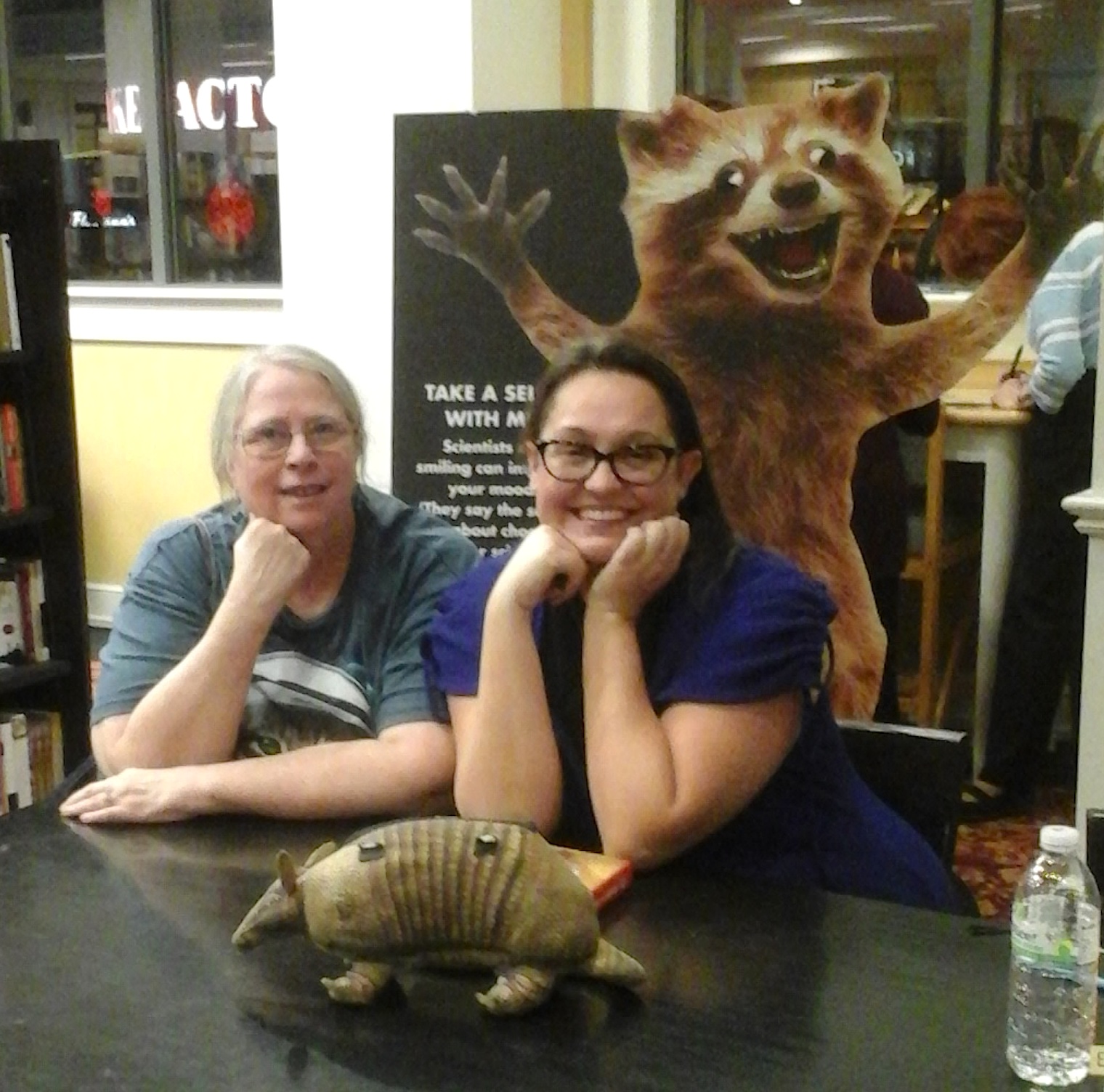
I met the Bloggess (aka Jenny Lawson) recently at a book signing for Furiously Happy, her second book. (Her first book was Let’s Pretend This Never Happened.)

Back row: Rory, the Furiously Happy Raccoon; middle row: me, Jenny Lawson; front row: Erma the Armadillo

Back row: Rory, the Furiously Happy Raccoon; middle row: me, Jenny Lawson; front row: Erma the Armadillo

The space at the bookstore was full to overflowing. (People had driven for as much as five hours to see her.) Jenny read two chapters of her new book to riotous laughter and applause. There was a brief Q&A session. (I figured she got the same questions all the time and wanted to ask her something that no one else had. I imagine that writers on tour need a little variety.So I asked: If you could be any animal, what would you be and why? Her answer: A tapeworm, because I could just not move and have people feed me.)

I joined the signing line (#17). She signed my copy of her book (“Our story is not over.”) and I showed her the semicolon tattoo that goes with that saying. She also signed my armadillo purse (Erma) and a piece of glass for my husband, who wants to put it over a picture of her or of a vagina; he hasn’t decided which. She laughed. He was one of the many that ask for perhaps her most famous – or at least most quoted – phrase, “Knock knock, motherfucker.” (It comes from her story about leaving a giant metal chicken on someone’s doorstep. There were also a lot of metal chickens she was asked to sign.) The bookstore personnel made sure that everyone knew it was okay to ask for that. In fact, they announced it just before the signings, reassuring the shy or inhibited.

The title of her new book, Furiously Happy, is Lawson’s way of telling depression to fuck off: If part of her life is misery and pain, she’s going to damn well make the most of the parts that aren’t. And while she’s at it, she’ll spread the word that mental illness is not a thing to be hidden or ashamed of.

This is not to say that her mental disorders are cured or that she no longer suffers from them. She was clearly anxious when reading aloud the two chapters, and visibly relieved when that part of the evening was done. Her strategy is to laugh at mental illness, joke about her meds, and speak bluntly to those in the audience who also suffer or have a person in their life who does.

Furious Happiness is a worthy goal, and her out-there enjoyment of life leads her into some of the hysterical situations she has written about in both books. These are the stories that make you say – only you, Jenny! Then she turns around and tells you that you are just like her in the ways that count.

The readers of her books and her blog – thebloggess.com – have formed an odd mutual support community. Although we may feel alone, Jenny rallies us to be alone together. Since one of the major difficulties with being a psychiatric patient is the feeling that no one else understands or experiences the same feelings, bringing people together in the virtual world or between the covers of a book is a valuable form of networking, especially for those who can’t network any other way.

Myself, I can’t manage the Furious Happiness. Too long dealing with the black dog and relatively little experience of even the mild highs of hypomania have left me depleted. Jenny will just have to do it for both of us. This is not to say I don’t love her or her work. I do, despite the blog post that I wrote, “Seven Reasons I Hate the Bloggess” (http://wp.me/p4e9wS-56). I can see myself in her and her in me, but for the moment I’m not able to follow her exuberant example. But she gives me hope. And I’m sure that’s one of her most important goals.

The Wrong Life

Nothing prepared me for this.

This is not the life my upbringing prepared me for. I don’t just mean the special guest speakers we had in home economics class who tried to introduce us to the subtleties of silver, china, and stemware. No, I was also misled by the books I read.

If Life Is a Bowl of Cherries, What Am I Doing in the Pits? and Please Don’t Eat the Daisies led me astray. Don’t get me wrong, I’m a total fan of Erma Bombeck’s writing style, but the quirky suburban life she loved and lamented was not what I got. Bombeck and Kerr both made light – and fortunes – of portraying the petty foibles and cute misunderstandings of women and their husbands, women and their children, women and their neighbors, women and other women.

Daily disasters with dishwashers, sticky-fingered children, and clueless husbands were an endless source of amazement and amusement for them. They soldiered on, supported by an innate buoyancy, faith in the divinity, and the occasional glass of wine.

My glasses of wine have been more than occasional. My disasters have not been humorous. I do not have children, and the cats are somewhat deficient in making adorable conversation in high-pitched, lisping voices. Sometimes all I can get out of them is “meh,” which is pretty much how I feel too.

As for the trappings of the genteel life, we eat off paper plates more often then not. I did once have a set of Limoges, but only because I was acting as a pawnbroker for a friend who needed ready cash. I fed one of the cats on the Limoges saucer, just to say that I had.

My parents used to say that their house was decorated in early married junk and I have followed in that fine tradition. Most of our furnishings are a demonstration of the maxim: If it’s not from Kmart or Goodwill you won’t find it here.

No one’s life prepares them for clinical depression, hypomania, bipolar disorder, or any other mental illnesses. I’ll wager that even psychologists’ kids don’t have a clue when they escalate from picking scabs to experimenting with lit cigarettes. Maybe their parents don’t either.

Either the mental disorder has been going on so long that you don’t know what it’s like without it, or it comes on so suddenly that you desperately hope that it goes away just as suddenly. Or it comes in a way that you can just convince yourself is no big deal. “I overspend? That’s just because I love shopping, not because I have mania or need to validate myself with expensive things.”

Perhaps people who grow up with a mentally disturbed loved one have a chance of understanding the underlying mechanisms. But with the number of families who don’t discuss the “elephant in the room,” or pass it off as, “Your sister is just high-strung” or say, “Uncle Ted is a little odd. Just ignore him,” not even that exposure may help.

How do young people learn about mental illness? Or even – gasp! – get help for one? If not at home, maybe at school? The National Association of Secondary School Principals cites the U.S. Surgeon General’s report saying that “one in five children and adolescents will face a significant mental health condition during their school years” and that the ratio of school counselors to students is 471:1. Add to that the fact that most school counselors have been shifted away from offering personal and emotional support to offering academics-only services. (http://www.nassp.org/Content.aspx?topic=57948)

Most of us struggle alone. Some never find a proper diagnosis and treatment. We have to be our own resources and our own advocates much of the time, even if our illnesses do not allow us to get out of bed. If we have one family member – or even a close friend – who understands, we are lucky beyond measure.

I wish that I had been even slightly prepared for the life I now lead, instead of the one I was “supposed” to have. No one can predict the future, but why can’t we at least have a bit of mental health education in school? I suppose that’s a lot to ask, when even sexuality education varies from the merely adequate to the appalling, when schools are barely able to stay abreast of the teach-to-the-test curriculum, and when Texas’s governor vetoes a bipartisan bill allocating resources for mental health, based on lobbying by Scientologists.

Do I sound bitter because I didn’t get to live the genteel suburban life? Probably. But there are aspects of that life that likely would have actively impeded my search for mental health. So I’ve had to do it on my own, or nearly so, at least until recently. A lot of us go DIY for mental health.

But a lot of us are accomplishing it. Living the life we have and not some fictitious pie-in-the-sky one. We may not have been prepared for it, but we muddle through anyway – and sometimes even realize that imperfect real life is better than a perfect lie.

Confessions of a Crazy Cat Lady

One can be a crazy cat lady without living alone in a cavernous house with a dozen or more cats. I should know. I am one, and I don’t.

First let’s start with definitions. I’m crazy. I think we all know that by now and I don’t mind saying so. (See “Yes, I Am Crazy. Thanks for Asking” http://wp.me/p4e9Hv-4h.) I’m also a cat lady. We had dogs growing up, but I never got very close with them. I did have a rabbit that I was awfully fond of, but this was in the days before lop-eared rabbits became house pets. She lived in a cage in the garage, or in the back yard when the weather was nice.

To me a crazy cat lady is someone who has eight or more cats, lives alone with them, usually in a large house, but one not quite big enough for all the inhabitants. Often you hear news stories about crazy cat ladies who die alone and are eaten by their cats, or crazy cat ladies whose pets are taken away from them because of inadequate care – especially sanitation.

I have a friend who was had more than eight cats at once, and is just as crazy as I am. She does not, however, believe that she is a crazy cat lady because another lady down the street has more cats. And truthfully, she doesn’t meet the other requirements of crazy-cat-lady-hood. She has a family, and keeps up with the care and feeding of her menagerie.

Do crazy cat ladies have an actual mental disorder? If so, do they all have the same kind? Maybe not. The crazy cat lady on The Simpsons (Eleanor Abernathy) is pretty clearly schizophrenic, though I doubt that many are in real life. Real-life cat ladies may demonstrate obsessive-compulsive tendencies, or their isolation may be due to depression. Or something else entirely.

Psychology Today tells us there is no real basis for the stereotype.

The stereotypic term “crazy cat lady” is used in a pejorative sense to classify an older, female animal hoarder and there is no research to support such correlation. Research on animal hoarding is lacking and there is not one plausible theory that suggests why older females tend to hoard animals more than men.

https://www.psychologytoday.com/blog/when-more-isnt-enough/201106/animal-hoarding-is-there-such-thing-the-crazy-cat-lady

Still, crazy cat lady behavior may be psychologically classified as a “hoarding disorder.” Mother Nature Network reports that the condition…

…is only now getting the recognition that will prove helpful to sufferers. Recent research has revealed abnormal brain activity in people with hoarding disorder. And both experts and hoarders hope and believe that the new DSM classification will help bring about better treatment.

Read more: http://www.mnn.com/health/fitness-well-being/stories/crazy-cat-ladies-to-get-a-new-clinical-definition#ixzz3nG9WWESM

I would make the case that crazy-cat-lady-hood is actually a defense against mental disorders. Carried to an extreme, perhaps, but beneficial nonetheless.

Caring for cats – even multiple ones – gives a person another living being to care about. Patients in geriatric facilities are often brought into contact with small domesticated farm animals or cats and dogs (therapy animals), which pretty clearly help them deal with isolation and depression.

For an isolated person, cats provide someone to talk to. Not that the cats necessarily listen or respond, of course, except in the most perverse ways possible. They are cats, after all.

I got my first cat when I was living alone and recovering from several years of psychological trauma. My future husband went with me to the shelter, but was studiously unhelpful in selecting a cat, thereby proving that he had some sense and a grasp of how important it was for me to find a kitty I could bond with.

“Which one should I get?” I asked.

“Gee,” he replied, “I dunno, honey. They all look like nice cats to me.” The one I chose was Bijou, a tortoiseshell.

We as a couple have since had up to five cats at one time, and through the years a total of well over a dozen.

When my bipolar disorder was at its worst, after I had suffered a major meltdown (nervous breakdown, decompensation, or whatever you call it), I was certainly crazy, but hardly a cat lady. I was unable to take care of my own daily needs, much less those of anyone else, human or feline. My husband, who was taking up enormous amounts of slack, took over pet care as well. Now that I’m back on a fairly even keel, I can do my part with feeding, litter box tending, grooming, and so forth.

Fortunately, even when I was immobilized, my cats, in addition to my husband, gave me emotional sustenance. The therapeutic effects of a purr, a gentle kneading, and a nice snuggle are not to be underestimated. The antics of a kitten may be exhausting to watch, but they provide more than a little distraction, if that’s what you need.

Do dogs have the same therapeutic effect? I don’t know. For some people I suppose they do, but I have never bonded with a dog as I have with my cats.

In psychological terms, my cats are “comfort objects,” like furry, living security blankets, or teddy bears that shit and meow. I hope never to be without a cat again. I need them for my mental health.

The Quest for a Psychiatrist

I have been seeing Dr. R. for eight years. He helped me through my major meltdown and skillfully, gradually mixed the cocktail of medications that would get me and keep me functioning at an acceptable, livable level. He got me through my near-brush with ECT (although he also suggested it).

Dr. R. is moving to another state. He sent all his clients a letter listing half a dozen or so local psychiatrists he could recommend, though he didn’t know if they were accepting new patients or what insurance plans they took. This week was my last appointment with him.

I looked at the inch-thick file he was holding. “I was really messed up back then,” I said.

“Yep,” he replied.

I left with a hearty handshake, good luck wishes, a paper stating my diagnosis (bipolar disorder, anxiety disorder – I guess there was no insurance code for bipolar 2) and six months of refills on my prescriptions. That’s how long I have to find a new psychiatrist.

So where will my inch-thick file end up next? That’s a good question.

I’ve written before about finding a psychotherapist (http://wp.me/p4e9Hv-1m), but oh, I hate the process of finding and breaking in a new shrink.

At least this time I probably won’t have to go through the whole Reader’s Digest Condensed Version of my screwed-up life, since what I really need at this point is someone who will prescribe and monitor my meds, though it will also be nice to have someone standing by in case of another major meltdown, should I have one.

My first avenue of exploration is whether my primary care physician will prescribe my psychotropics, so I can continue with just a psychotherapist. Dr. R. says that most GPs would shy away from the somewhat lengthy list of meds, but every time I see Dr. S. I update him on what meds I am taking, and I always mention the psychotropics, which have mostly been the same for years.

I have an appointment to see Dr. S. next month and sent a query about the prescription issue (his office has a robust online presence), so with luck, I may have a solution before Halloween.

My next step would be to start with the list that Dr. R. provided. Only one of the offices is at all close to me and I’ll likely start there. Does the doctor accept new patients? Does the practice take my insurance? What’s the charge if they don’t?

I’ll also need to contact my insurance provider for a list of local psychiatrists who do take that insurance, but with that I’ll be flying blind. Dr. R.’s recommendations are people he knows, and knows are good.

I hope they’re as good as Dr. R.

What Was I Thinking?

When I was a kid, I had irrational thoughts all the time. I think most kids do. They were harmless – even amusing.

It’s when you’re older that they become problems, or even dangers.

My younger self wouldn’t eat rhubarb because I knew that some part of the plant was poisonous and I didn’t want to take a chance. (I still don’t eat rhubarb. Any vegetable that needs that much sugar to make it palatable hardly seems worth it.) I suppose that could be considered an early OCD-type thought, since it was about potentially toxic food.

Another paranoid idea I had was that when someone threw a cigarette out of a car window, it could cause a major fireball explosion if it just happened to land underneath another car that just happened to have a leaking gas tank. I always looked around and braced for disaster when I saw someone fling a death-stick onto the road. It might as well have been dynamite, as far as I was concerned. (And I was very concerned.)

Yet another irrational fear (looking back, my irrational thoughts were almost all fears) was based on the fact that I had no idea how plumbing really worked. I was afraid that if I flushed the toilet right before I brushed my teeth, the waste water somehow flowed past the tap and could end up on my toothbrush.

(Another plumbing-related misconception dealt with sex (though not conception), but we won’t go into that now. Let’s just say that they never covered it in health class back then. For all I know, they still don’t. I had my mother buy me a copy of Everything You Always Wanted to Know About Sex But Were Afraid to Ask so I could find the answer.)

In my teen years, my irrational thoughts became more delusional, and more related to my by-then-shaky mental health. At some point it was recommended (I think by the high school, though I don’t remember the circumstances) that I should visit a counselor. And they were right. I certainly should have, although in retrospect, child psychiatry in those days was fairly primitive and I most likely wouldn’t have received a correct diagnosis or treatment. I don’t think bipolar type 2 even existed.

I’ll say this for my parents: They consulted me on whether I wanted to go or not, which was not what I would have expected. I declined.

My “reason”? I somehow thought that having such a thing on my permanent record would keep me from getting into a good – or perhaps any – college. (When I started applying, of course, no one even asked.)

And once I was in college and knew that my sanity was truly on shaky ground, my life goal was to graduate, and then work enough quarters (at pretty much anything) until I qualified for Social Security before I was put away. I was convinced that was likely to be my fate. I’m not sure why I thought that having Social Security would have helped.

None of those irrational fears were ever addressed in a timely manner. Except the sex one. Yay, me! for finding some accurate information on that one and Yay, Mom! for facilitating my enlightenment.

If you’ve noticed a trend of increasing irrationality and increasing potential for sabotaging my own life, you’re not wrong.

*** TRIGGER WARNING ***

The rest of this is tough stuff. You know what’s coming, so stop now if you’re not ready to hear about it.

When I had my major meltdown ten or so years ago, I had the worst irrational thought of all. My mother had just died, so my thought processes were pretty scrambled anyway.

Then my husband did something that I thought was unethical and likely illegal as well. Then he said he’d do it again. I managed to talk our way out of the first instance as a simple mistake, but his statement that he might do it again haunted me.

I catastrophized, of course. This time, however, the potential catastrophe loomed large and to me very real. If he did repeat his actions. there would be no possibility of smoothing things over. He would be culpable. And I would be in the position of needing to report it.

Then he would lose his job – at the very least – which was at the time loosely related to the legal system. They wouldn’t be able to overlook it.

I was unable to work at the time, trying to get disability, and we were barely staying afloat. Without his job, we would sink.

So I thought that, if he did it again, and I reported it, and he lost his job, the only thing left for me to do was kill myself.

Like I said, pretty irrational.

I had a plan, though. In fact, I had three or four different plans and I couldn’t decide among them. Indecision is part of what kept me alive.

As it turns out, my husband did not choose to repeat his actions, and I was spared the necessity of choosing among mine.

Soon thereafter, I got help. I never mentioned the suicidal thoughts till they were long gone, so I never even had to fear the dreaded lock-up that I had anticipated all those years before.

I kept one of the intended means of exit for a while, though. Just in case.

It was a major day in my healing when I finally let that go. That irrational thought had been dismissed and conquered.


A Tattoo Is for Life…

…this one, especially so.

As soon as I learned about the semicolon tattoo, I knew I had to get one – and not just because I’m a huge grammar nerd. Because I’m bipolar and want to spread the word about mental health issues.

In writing, the semicolon indicates a place where a writer could have finished a sentence, but instead chose to go on. This makes the semicolon an effective and beautiful symbol for suicide prevention efforts and those who struggle with mental disorders.

Every day we choose to get out of bed; choose to take our medications; choose to make and go to our therapist appointments; choose to live another day; and choose to go on with our story.

This is not something I invented. Here are the people behind it: http://www.projectsemicolon.com/. And here are some stories about the phenomenon that have been working their way through the media and around the internet.

http://www.upworthy.com/have-you-seen-anyone-with-a-semicolon-tattoo-heres-what-its-about?c=ufb1

9 beautiful semicolon tattoos our readers shared to destigmatize mental health challenges

Here is my story.

I am possibly the last person you would ever expect to get a tattoo. I am probably the last person I would ever expect to get a tattoo. I’m in my 50s, a former English teacher, married for over 30 years, fond of reading and word puzzles and cats.

Nevertheless, the professionals at Monkey Bones Tattoos in Beavercreek, OH, did not seem surprised when I showed up one day and presented my wrist.

The naked wrist.

The naked wrist.

When I explained what I wanted – to put down a deposit and book an appointment to get a semicolon tattoo – I learned that they had a cancellation and could ink me right away.

What the hell, I thought. Might as well. I had learned about the tattoos about a month before and had thought it over plenty. It was by no means a spur-of-the-moment (or drunken) impulse.

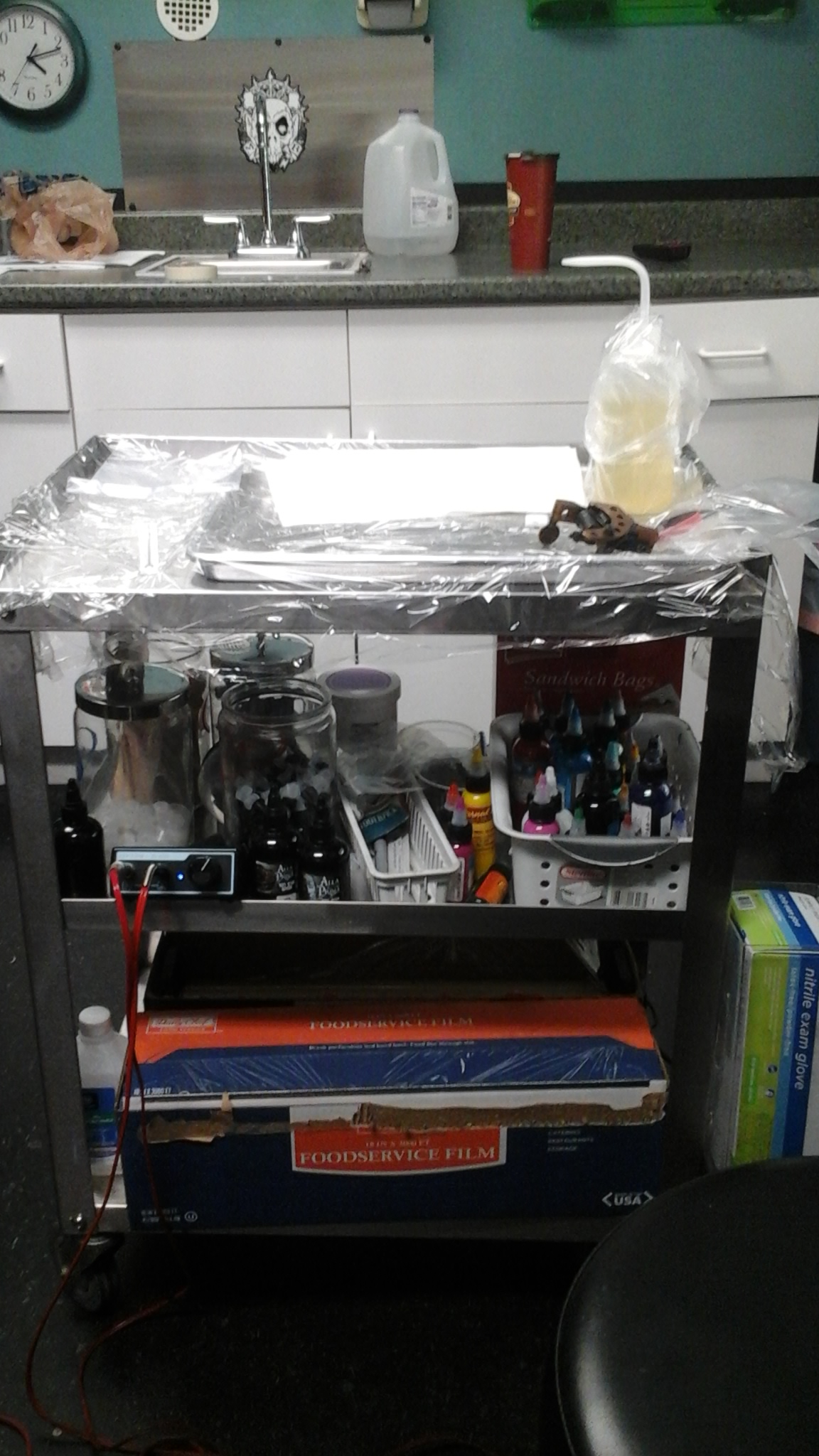
Mike Guidone showed me into his studio and explained the procedure.

The tattoo artists work station.

The tattoo artist’s work station.

He presented me with stencils of three different sizes of semicolons. I chose the in-between one. My wrist is fairly small, so the big one would have looked out of place, but the small one wasn’t noticeable enough. The idea is for people to see it and ask, so you can share the meaning and talk to them about mental health and combatting the stigma.

I sat in the dentist-type chair, listened to a brief explanation, got answers to some questions, and was ready to start.

In progress.

Did it hurt? Not particularly. It was a feeling between a scratch and a sting, and took only about ten minutes. Some aftercare instructions and I was done.

finished1

Success!

Then I paid ($80, the shop minimum), tipped Mike, and was on my way. Now I care for the tattoo while it heals, anointing it with unscented lotion several times a day, avoiding sunlight or soaking, and trying my very best not to scratch or pick at it.

The results.

The results.

Am I happy with it? You bet!

And, like I said, it’s for life! My story isn’t finished yet.

Music Charms the Troubled Mind

Once I knew a man whose wife was going to leave him. I knew he was in a lot of pain and despair about it, though he also turned into a huge asshole before everything was said and done. He was also suicidal for a time.

One day when I was trying to talk him through a bad patch, I asked whether he might turn to music to help him. “What?” he said. “Do you think I should listen to country music and cry in a beer?”

I wasn’t suggesting that at all. I just knew that he was a singer and songwriter of talented amateur status and was known for this in various circles. I honestly thought that music might help.

On the other hand, I always forget, when I am on the downswing, how much music can do for me. It soothes and heals, but it also lets me tap into the emotions that I have been suppressing.

Do I have the inexplicable blues that are part and parcel of my condition? There’s a song for that. Am I feeling unrequited love? Unrequited lust? There’s a song for those too. Is the world spinning too fast for me? Do I need to know that everything will be all right? Or do I just need to know that someone, somewhere and somewhen, has also felt this way? I can turn to music.

“Music, uniquely among the arts, is both completely abstract and profoundly emotional. It has no power to represent anything particular or external, but it has a unique power to express inner states or feelings. Music can pierce the heart directly; it needs no mediation.”
– Oliver Saks, Musicophilia

Saks also says, “The power of music, whether joyous or cathartic, must steal on one unawares, come spontaneously as a blessing or a grace.” There he and I part company.

Music can certainly steal on us unawares, whack us upside the head with a memory, a feeling, a piercing stab of emotional intensity, all the stronger for being unexpected.

But we can also choose to bring music into our lives when nothing else seems to touch us. We can tap into those memories and feelings – good or bad – and let the music wash over us as we listen and feel.

According to scientific experiments with fMRI, music uses more parts of the brain than almost any other activity. The neural connections fire all over the place – more so if one is playing an instrument, but even when just listening. The memory centers, artistic areas, language centers, emotional areas – even the motor complexes – are stimulated.

My problem is remembering all that music can do for me. When my emotions are dulled, flattened by the steamroller of depression, I sometimes forget that I can be any other way. The music I love is always there for me. I can bathe in it, wallow in it, be uplifted by it, float on it, join in with it, feel it emotionally and viscerally and intellectually all at once or one at a time. It can express the things that I just can’t.

When you’re depressed is a time for writing bad poetry. Or you can let good poets and songwriters take you with them as they explore the human condition in ways you’re not capable of. I think that’s why they do it – create their art. The really good ones anyway.

There’s also something to be said for music as distraction. A song from years ago – even a frivolous one – can take you away from your troubles, even if only for a moment. This is not the time for exploring new musical avenues. Remembering that things once were good can feed your sadness, your depression, but it can also give you perspective. If you took joy in this music once, there will come a time when you will again. And maybe that time is now.

Perhaps the most amazing power of music is to provoke catharsis. Certain songs leave me sobbing like a baby. They don’t even have to be sad songs, though many of them are. “The Mary Ellen Carter” by Stan Rogers is about as life-affirming as you can get, but it can still turns me into a weeping puddle. (https://www.youtube.com/watch?v=Fhop5VuLDIQ) His song “Lies” has nothing to do with my situation personally, but its evocative power touches me nonetheless. (https://www.youtube.com/watch?v=D79XOc1vKzQ) And almost no one I know can make it through Kathy Mar’s “Velveteen.” (http://www.last.fm/music/Kathy+Mar/_/Velveteen)

Afterwards, I feel drained and, if not exactly better, less emotionally constipated, I guess you’d say. Clearing away a bit of blockage can be cleansing. If music can do that – and it can – then I don’t care if its country with a beer, jazz with a glass of wine, or hip hop with an energy drink. Even easy listening with a glass of milk, if that’s your thing.

So thank God and Apple for iTunes. And here’s hoping that my Swiss cheese of a memory will give me a nudge in the right direction when I need it next time.

A Response to the Dalai Lama

This Friday, my Facebook newsfeed included a quotation from the Dalai Lama.

Depression seems to be related to fear, anger and frustration. When you’re in a bad mood, even if you meet with your friends, you don’t take pleasure in their company. But when you’re in a good mood, even if things go wrong, you can cope with them without difficulty. This is why putting yourself in a good mood, making a point of developing a sense of loving kindness gives you greater inner strength.

While I respect and admire the Dalai Lama, on this subject he is wrong.

I wrote a blog post to tell him and his followers so. I posted it on Blogher.com. (Blogher is a site for women bloggers that sometimes syndicates content. It is more general than what I usually post here, so I wrote something special for them.)

As I researched, trying to find when and where the Dalai Lama said this (I couldn’t), I discovered several articles about research into depression and Buddhist principles and techniques.

One was an article by Kathy Gilsinan at The Atlantic
(http://www.theatlantic.com/health/archive/2015/07/dalai-lama-neuroscience-compassion/397706/). It talked about “high-amplitude gamma-oscillations in the brain, which are indicative of plasticity.” What that is or has to do with depression, I don’t know. It sounds like “handwavium” to me.

One that made more sense was this, from Jeanie Lerche Davis at
WebMD: http://www.theatlantic.com/health/archive/2015/07/dalai-lama-neuroscience-compassion. (The feature was reviewed by Louise Chang, MD.)

While meditation can help many who are depressed, it’s not a sure-fire cure, [Charles W.] Raison [psychiatry professor and co-director of Emory’s Collaborative for Contemplative Studies] tells WebMD. “In fact, many people with mood disorders find they can’t do meditation when they’re depressed.” Their thoughts are too overwhelming. They are anxious, nervous, and can’t sit – and likely they need antidepressants, he says.

That’s more like it.

In my response to the Dalai Lama, I said,

Real, clinical depression is not about being in a “bad mood.” It’s true that a truly depressed person does not find pleasure even in ordinarily pleasurable things, such as meeting with friends. But we cannot simply put ourselves in a good mood.

That’s the hell of depression. We want to enjoy the good times. We want to put ourselves into a place of inner strength. But we can’t. Not without help.

In fact, your advice is hurtful to depressed people. Too many times we have been told, “Cheer up.” “Smile! You’ll feel better.” “Think about someone else for a change.” “What do you have to feel bad about?”

Don’t you think we would if we could?

Remarks like these remind us that we have an illness and we cannot cure ourselves by willpower alone – no more than a person with hepatitis or tuberculosis or even schizophrenia can. We need help, and most of us need medication.

You do a disservice to people with depression when you tell them to put themselves in a good mood. You, an enlightened spiritual leader, may be able to do it, but we can’t.

Certainly we can benefit from practicing loving kindness and developing inner strength.

But without treatment for depression, how many of us can do that?

It angers me when people say that depression – or any mental disorder – is something people can or should be able to cure with an attitude adjustment. I’ve heard it too many times from people in my life, and I’m sure you have too.

What’s really disappointing is that someone like the Dalai Lama, with his legion of followers and enormous credibility, is perpetuating this old way of thinking.

This lie.