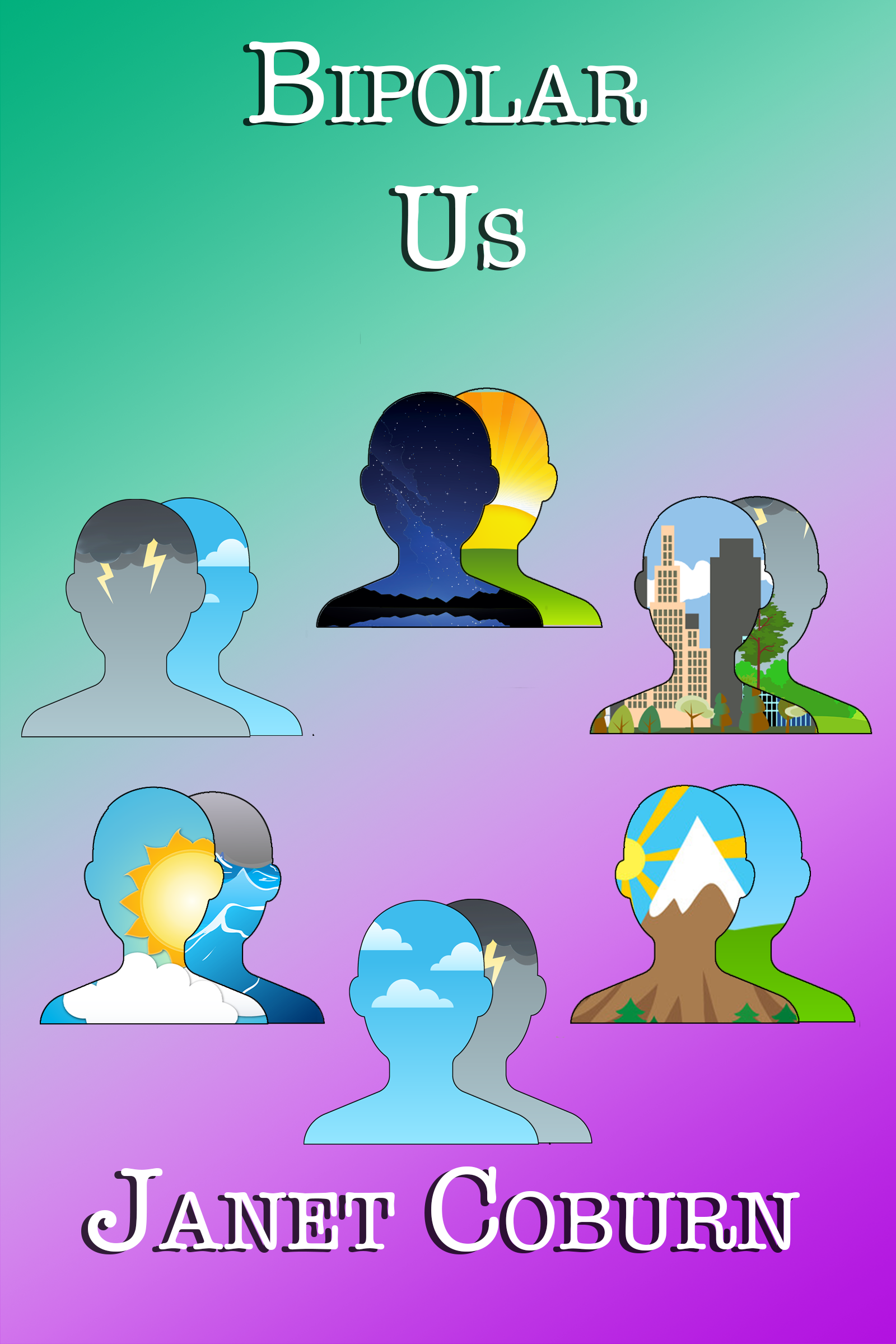
Bipolar 2 From Inside and Out

As they say, of all the things I’ve lost, I miss my mind the most. Or anyway, a properly functioning brain.

I love my brain, despite all the trouble it’s given me. For many years I thought it was the only measure of my worth, the only thing about me that made me special, the only thing that I could truly rely on.

I reveled in learning, in thinking, in reading, in questioning, in contemplating, in discovering. My body was not dependable; my brain was.

Little did I know the biochemical pitfalls that were waiting for me. Little did I know that my brain was ill. Disordered. Unbalanced. At the very least, uncooperative.

For instance, my brain decided other people were always pointing and laughing at me. Sometimes they were, of course, but that paranoia became my baseline assumption. (Shrinks call that “ideas of reference.” I just called it life.)

My brain played back for me every socially awkward or embarrassing thing I ever did, either randomly or at the worst possible moments.

My brain made me cry at the stupidest times – at an upbeat sitcom theme song, when someone mentioned foreign travel, when opening boxes from the garage, when thinking about my college years or birthday parties. Whenever I was confronted with how damaged I am.

My brain had irrational thoughts. Bad thoughts. Cutting. Worse. You know what I mean.

Eventually my brain refused to let me live any kind of a normal life – go out, talk to people, care for my house or my pets or myself, or even read, once the greatest joy of my life, the thing my brain and I best liked to do together.

But my brain also worked just well enough to send me looking for the help I needed. I’ve gotten back parts of who I was and what my mind was. And for that, I’m grateful. Even with it disorderly and uncooperative, it’s still the best part of me.

Crazy Pills

Once upon a time in the land of Jublia lived a kind and powerful queen named Lunesta. One day the dragon Cialis and the evil sorceress Humira attacked the castle, but Jublia was saved by Lunesta and her faithful dog Boniva.

And the peasants rejoiced.

Honestly! The names that pharmaceutical companies give their drugs these days! It’s bad enough that the drugs have a list of side effects longer than the symptoms they’re supposed to cure. Not to mention the drugs where the side effects are the same symptoms they are supposed to cure, or the ones where the side effects are considerably worse than the condition they’re being prescribed for.

My favorite has always been, may cause death (excuse me, “increases risk of death”). That has to be the ultimate side effect. You’ll be dead, but your toenails will look great for the funeral. Leave instructions that include sandals.

I made a list of all the drugs that I’ve been prescribed in my pursuit of something resembling sanity. It’s quite long. I’ve tried almost every class of drugs there is – tricyclics, atypical, SSRIs, anti-anxiety drugs, and hypnotics – in various combinations and assorted doses, and even for off-label uses. (TIL that Abilify can be classed as an “atypical atypical,” which makes me feel a certain kinship with it.)

The only ones I know I haven’t taken are lithium and the MAOI inhibitors. which is a good thing, because I do so like red wine and cheese.

Here’s the list, as nearly as I can remember:
Abilify
buproprion
Desyrel
Effexor
Inderal
Lamictal
Lexapro
desipramine
Prozac
Sinequan
Tofranil
Topamax
Wellbutrin
Zoloft
Ativan
BuSpar
Ambien
Valium

I may have missed a few, what with the brand names and generics, the decades over which all this occurred, the memory deficits, and the ones I took for only a month or two before the side effects became too heinous.

The side effects I’ve encountered along the way include:
dry mouth
memory loss
nightmares
agitation
lethargy
weight gain

Not all at the same time, of course, thank heavens. Right now I seem to have dry mouth, residual memory loss, and weight gain. Given the alternatives, I can live with these. More or less. (That is to say, I have to.) The memories, I understand, are not coming back. I just hope I don’t lose any more, especially ones of the hot-n-juicy variety.

The side effects I haven’t suffered include:
death (obviously)
fatal skin rash (Stevens-Johnson Syndrome, which I wrote bout a while back: https://bipolarjan.wordpress.com/2014/03/07/saving-face-or…-die-from-that/)
tardive dyskinesia

I hope the drug regimen has settled down for a while. I must admit that I don’t follow the instructions to the letter. They’re simply too overwhelming: Take this one on a full stomach, this on an empty stomach, another with milk or never with grapefruit juice; something else at bedtime or half an hour before bedtime, or with the noon meal. And don’t forget the non-psychotropics (cholesterol, blood pressure, etc.), or the vitamin, fiber, and calcium pills my GP prescribes or recommends. Well, and the OTC Benadryl, Tylenol, and Immodium, as needed.

(Yes, I did once look up all my meds in a drug interaction database. Every one interacts with every other one. Maybe that’s one reason mixing an effective cocktail has been such a crapshoot.)

I knew a woman who took so many different drugs for her variety of illnesses and conditions that she had a kitchen timer that she continually set and reset every time she had to take a dose of something. Her meds were more precise than mine, though. If she screwed it up, the consequences would be dire. Her side effects did include death.

The regimen I’ve settled on is this: one set of pills when I wake up (whenever that is) and one set at 11:00 p.m. I eat whenever I’m hungry, and I don’t like grapefruit juice anyway. Anything more complicated than that I can’t be sure of remembering. It’s still complex, what with the only-in-the-morning pills, the only-at-night pills, and the take-twice-a-day things.

I have little tricks to help me remember the routine – daytime-only pills in a plastic bag, nighttime-only on the lamp base, twice a day on the tea cart. Turn the vitamin bottle upside down after taking morning pills. I suppose I should get one of those daily pill caddy things, but they never seem to have enough, or big enough, compartments.

Is this routine crazy? You should see me without the pills.

Well, no, you shouldn’t.

Haiku Cycle

Break time here at the
synaptic schoolyard. You can
ride the swings all day.

Day lights sights you see,
saw before and that may be
In sight tomorrow.

Tomorrow times out
Wheels round and ticks away the
Body clock of mind.

Mind and brain play tag
I’m it as ducks and geese still
Wait while we circle.

Circle back and start
again, or stop before my
feelings crack and break.

Note: Poetry is something I used to do, years ago. After my Great Meltdown, my therapist suggested that I view it as an opportunity to rebuild myself, discarding things that were no longer useful and reclaiming things I want in my life.

So I decided to try poetry again. I used to write mostly free verse, but I decided to start with more structured forms because of needing some structure in my life now.

I have started with a cycle of haikus. They do not have to be read in order. Picture them as a ring. Pick any one as the starting point.

If you like this, and as inspiration strikes, I may attempt some more poetry for this blog. Is there a sonnet in our future? Dare I say it – a villanelle? Someday a sestina? We’ll see.

Where’s the Anger?

Depression used to be defined as anger turned inward. Now we consider depression to be a biochemical imbalance in the brain. At least that’s the current thought as the pendulum swings back and forth between brain and mind.

There is a case to be made, though, that anger is at least one component of depression. And that anger may indeed be turned inward.

Take, for example, the anger you may feel when a loved one doesn’t understand what depression makes you go through, or when a coworker says something clueless and cruel. These are incidents that can make you justifiably angry.

It’s all too easy to turn that anger inward. You say to yourself, “I’m crazy or I’m broken or I’m damaged and it’s no wonder they don’t understand. Maybe they’re right. Maybe most people can just cheer up and I’m defective because I can’t.” These thoughts, in addition to prompting anger, are likely to depress a depressed person even more.

When anger masquerades as depression, it becomes difficult to recognize the anger for what it is. After a difficult relationship ended – badly – I was unable to see that I was indeed angry. I could have sworn that I wasn’t. In fact, I told people that I wasn’t angry. It took a long time for me to recognize and acknowledge that anger. By then it was too late to do much about it, except work through it with my therapist. But that’s all right, because that’s what I needed to do with the anger anyway. I’m at that awkward age when I can be tried as an adult.

So while I don’t think that depression is caused by anger turned inward, I do believe that depression can cause you to internalize anger and beat yourself up for things that you can’t control, like your brain.

Depression makes a hash out of feelings. Is it anger? Is it pain? Is it loneliness? Is it despair? The answer, usually, is one from column A and two from column B.

The Hypomanic Blogger

When I thought I had unipolar depression, I used to wish I were bipolar, on the theory that I could get a lot more done. (I later found that not to be true, as I’m sure many of you can attest.)

I had a lot more experience with depression than with mania. My bipolar disorder is Type 2, which means I get hypomania instead of full-blown mania. And most of the time the hypomania comes out sideways as anxiety and/or irritability.

(Don’t ask me why I get the full-monty-style depression and only a smidge of hypomania. I don’t know. If my shrink does, he hasn’t told me.)

Looking back, I can remember only one hypomanic episode before my new diagnosis made me more aware of the possibility. I was working at writing and editing – the same things I do now, only then I could do it in an office full-time instead of at home and freelance. A woman came to me, asking about how she could become a writer for magazines.

I positively burbled and babbled. I gave her all sorts of advice on query letters and Writer’s Market and niche publications and getting bylines and clips. I told her about how I started, writing for I Love Cats magazine and editing my martial arts club’s journal, and working my way up. (Incidentally, I am, as far as I know, the only person ever to have articles published in both Black Belt and Catechist magazines.)

The woman went away inspired, she said, though I never heard how she made out.

Now I can more easily recognize hypomania when it hits. I still get the anxious and irritable sort, but now I get more of the buzzy kind. And even though it makes me twitchy, I can make use of it.

It was in a bout of hypomania that I decided to start this blog (and my other, general-purpose one – janetcobur.wordpress.com).
It’s hypomania that has kept me going for over a year so far. Though I can now, thanks to medication, force myself to work while in the dysthymic stage or the “meh” stage, if I hit a spell of hypomania, I can use it to write and edit. Right now I’m using a hypomanic swing to stockpile ideas and first drafts against the inevitable downswing.

Of course, the ramblings that go with hypomania are not worth posting (or submitting to a client) the way they hit the screen. When I’m less jazzed, but not in the Pit of Despair, I can re-read, edit, and improve. It’s a fine balance, a tightrope I’m learning to walk. And it takes both therapy and medication to maintain.

In essence, the not-properly-treated bipolar 2 made my work go downhill (even as I did), until I was unable to work at all. Now that my diagnosis and my meds are more on track, so am I. I may not be well, but I certainly am better. I can live with what I’ve got, and even re-learn how to use some of the abilities I lost in my most recent, largest, most devastating crash.

I wouldn’t recommend mania or even hypomania to anyone, but as long as I’ve got it, I might as well make it be good for something.

To have a friend, be a friend.

That’s how the saying goes, and it goes double for friends with mental disorders.

But.

There are limits. Boundaries. You may call them self-serving or self-saving, but there they are.

When you are depressed, you neglect friends, and I have certainly done that. I permanently lost one friend over it. But another kept reaching out to me and I eventually responded. (We then had a good game of “I’m a bad friend.” “No, I’m a bad friend.” She thought she hadn’t reached out often enough. I was glad she put up with my silence as long as she did, until I was able to reach back.)

But I have this friend. We used to be tight. When we were both depressed, we shared our misery and so lessened it. But now that the Pit of Despair is no longer my permanent abode…I have to limit my contact.

Why? My social skills have never been terrific, but now I frequently find myself walking that invisible line between Bad Friend and burnout.

Why is it so hard to be a Good Friend?

First, there is the Disaster Report. Whenever I talk to her, I hear a litany of all that is going wrong in her life. Almost never anything else. I’m no fan of relentless positivity, but its opposite is sometimes hard to bear too, even though I’ve been guilty of the same.

Then there is the fact that any suggestions are pushed away, denied as impossible, dismissed as unworkable. Granted, we have completely different styles of coping, but I feel discounted, unheard. Eventually I gave up sharing anything but a few of my own tribulations, some awful jokes, and commiseration.

Then I get off the phone or off Facebook, usually after half an hour or so. That’s about my limit.

I still keep reaching out. I don’t want to be a Bad Friend. I know I can’t fix her, or even her day-to-day difficulties, the kind even non-depressed people have. But I sure wish there were a way I could help, short of climbing down into the Pit with her. I hope that listening, even half an hour at a time, does some good.

And when I talk to other friends of mine, I try to remember to ask how their day was and what’s new in their life and have they seen any good movies and what is a mutual friend doing. I try to listen if they have something to share, good or bad, and I try not to overwhelm them or play whose-life-sucks-the-most. I try to be a Not-Bad Friend, even if I do have to lean on my friends, at times pretty heavily.

And they do likewise, when they can.

Depression Hurts

You’ve probably seen those commercials where the announcer and the actress playing the part of a depressed person try to answer the question: Does depression hurt?

Once when we saw this commercial, my mother turned to me and asked whether my depression hurt me physically.

I had to say yes. I don’t think I ever took Cymbalta, the medication that the commercial was touting, but I was clear on the fact that physical pain is involved along with the psychological suffering of depression.

My head and eyes hurt from all the crying spells. My back hurt from lying in bed all day. I had painful knotted muscles from the anxiety that went with the depression. I had intestinal cramps because my overactive nerves led to irritable bowel syndrome. I had headaches and eye strain from the over sensitivity to light and noise. And I had the general flu-like malaise that is practically the hallmark of depression. You know the one. Every bone and muscle aches, but you can’t think why.

Were these aches and pains psychogenic? Undoubtedly some of them were. But others, like the irritable bowel, were all too demonstrably physical phenomena.

The mind and body and soul are inextricably intertwined. We know this to be true. Depression affects them all.

And it does hurt.

Mr. Fix-It

Him: I just groomed the cat. I used a cat-a-comb.

Me: *total silence*

Him: Hey, honey! I just groomed the cat – with a cat-a-comb!

Me: *more silence*

I was depressed, and he was trying to cheer me up. Using exactly the same joke that had gotten no response only seconds before. I don’t know why he thought it would work better the second time.

Many men have the instinct that, when confronted with a problem, they will try to solve it. When something is broken, they will try to fix.

I wasn’t broken, exactly, but I was deep in the Pit of Despair, aka the lower mood swing of my bipolar disorder. At that stage I am immobilized, uncommunicative, and utterly humorless.

The fact that Dan had worked in hospitals and psychiatric facilities was actually a bad thing, despite what you might expect. He had run laughter therapy groups, he knew the jargon, and he sincerely wanted to be helpful.

But he didn’t know – viscerally – what depression was like. How it felt in your body and mind and soul, how it damped down your personality and blunted your reactions and removed your ability to view life as anything other than miserable. Certainly not funny.

Later Dan learned all this when he experienced his own bout of clinical depression and became another one of my Prozac pals. But until then, he would occasionally come shrinking at me, until I had to tell him to stop. I could accept a hug, but not a joke or a “remedy.”

But all that was early in our relationship and before I had begun to heal or even get proper treatment. And I literally would not have made it this far without Dan. I need him and likely always will.

When it’s Pit of Despair time again (which it sometimes still is), he checks on me to see if I need that hug, or some food, or a kind word, or just to be left alone. When I am better, he still does the cooking and shopping, and reminds me to eat regular meals and take showers and tells me I smell nice after I do. Sometimes he can coax me out of bed with a tape of The Mikado or out of the house with lunch at Frisch’s. If I’m too nervous to drive to my appointments, he takes me. When I’m together enough to work, he keeps the house quiet and fixes food when I need a break and validates me for being able to bring in money, even when it’s difficult.

But he can’t fix me. And now he knows that.

I pledge my commitment to the Blog for Mental Health 2014 Project. I will blog about mental health topics not only for myself, but for others. By displaying this badge, I show my pride, dedication, and acceptance for mental health. I use this to promote mental health education in the struggle to erase stigma.

This issue is of great importance to everyone – not just those people who have mental disorders. Everyone’s life will be touched by mental health issues at some time, whether by your family, friends, co-workers, neighbors, or even yourself. Learn as much as you can about mental illness and mental health and remember it when you see or hear fear-mongering about the mentally disordered.

This blog is primarily about bipolar disorder type 2 and my experiences with it. But anyone interested in the subject of mental health is invited to visit any time to read, comment, share, or what you will. You will all be welcome.

When my husband, Dan, and I were dating, he would sometimes tickle me, or poke me, or make embarrassing jokes about bodily functions. And I would shut him down. “Stop that!” in the tone of voice that says, “I mean it and I’m angry.” If he persisted, I put my foot down even harder.

“You know what’s wrong with you?” he would say (and don’t you love sentences that start that way?). “You’ve forgotten how to have fun.”

I had to admit it was partly true. I had just come off a relationship in which I could set no boundaries. Rex would tickle me, for example, past the point of enjoyment until it was actually physically painful. I taught myself to shut down my tickle response (and who knows how many other responses along with it). I was depressed and I was damaged and I didn’t know what fun looked like anymore. But I knew that for me, tickling was not it, and that I had to clamp down on it or it might turn into pain.

A Facebook post brought this all back to me. Judi Miller, an awesome teacher of troubled teens, told of a time when a male student, “Johnny,” was teasing a girl, poking and tickling her and saying he wanted to handcuff her and tickle her till she screamed.

Judi objected. She explained, “Johnny, when you say to a woman who says ‘No’ to you that you’re going to restrain her with handcuffs and touch her without her permission until she screams, that sounds really rape-y to me.”

The boy protested that he hadn’t done anything wrong, and Judi took advantage of the teachable moment for a lesson on bodily autonomy: “That means you have a say in who touches you and how far you’re willing to go. In my family, if someone says ‘Stop tickling,’ we do, because consent is important to fun. If it’s all fun for you, and not for your partner, you aren’t listening to her needs.”

She added, “If you don’t respect her bodily autonomy when she says no tickling, or no touching, or to leave her alone, then will you respect her saying no when she doesn’t want to hug, or kiss, or get it on after a date? The pattern is the same. There’s the connection to rape.”

As with most teachers, she had no idea whether her message had an effect.

Until later that day, when a boy from a different class started an argument with his girlfriend, and grabbed her wrist, because she wouldn’t hug him.

Johnny was right there. “That ain’t cool. If she doesn’t want to hug right now, you got no call to get mad at her. You don’t own her ass, or her. She gets to decide if she feels like hugging you, kissing you, whatever. It’s called BODILY AUTONOMY, asshole. No wonder she don’t want to hug you if you won’t take NO for an answer!” Johnny said.

Judi thanked Johnny for listening to her and said she was proud of him. In fact, she later described this as her proudest moment of teaching all year.

Dan and I worked through our problem, I’m glad to say. I learned that I could say “no” and he learned not to push it. We both learned how to do things that were fun for both of us. Back then, I had never heard about “bodily autonomy.” We learned.

I wonder if Rex ever did.