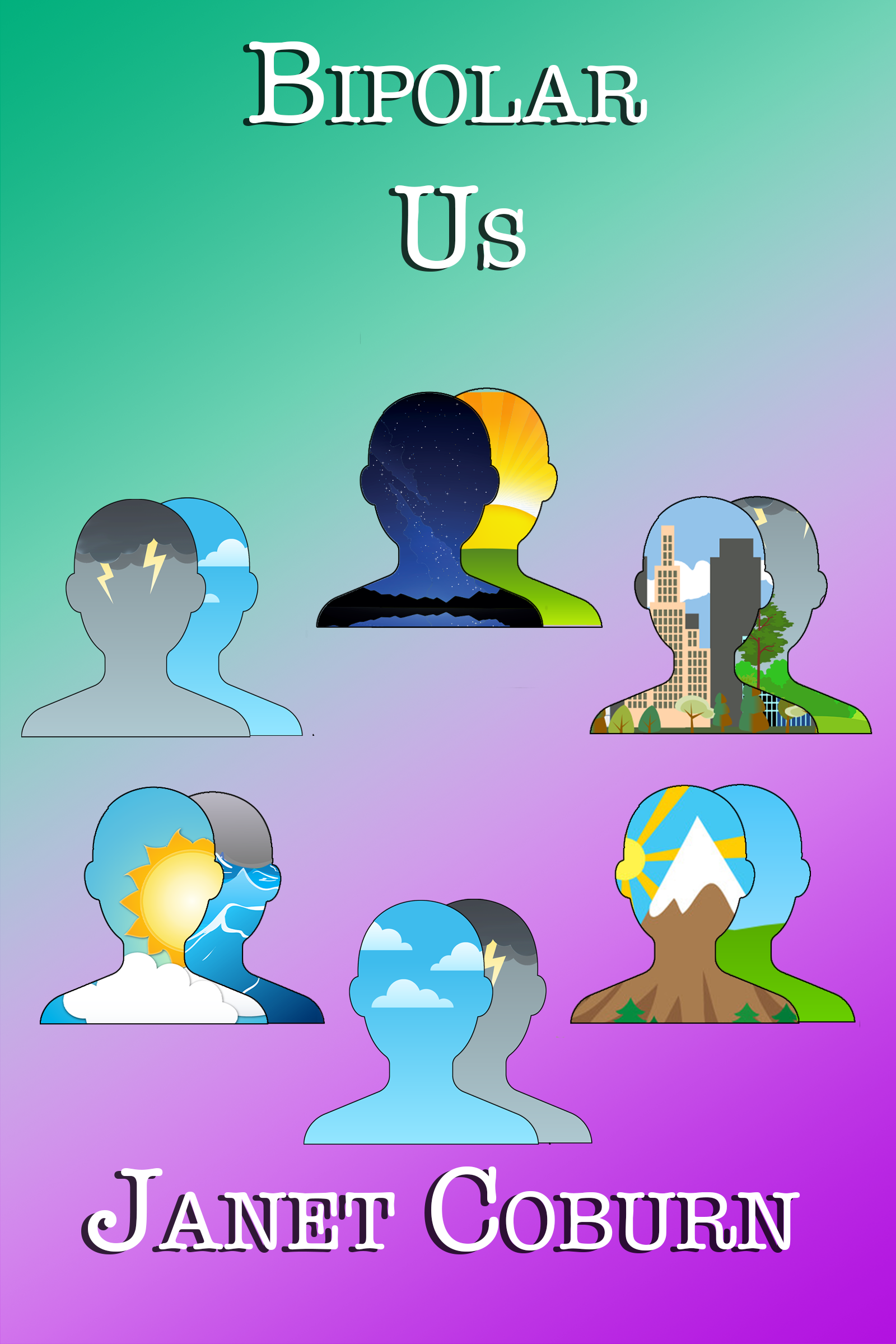
Bipolar 2 From Inside and Out

The Wrong Life

Nothing prepared me for this.

This is not the life my upbringing prepared me for. I don’t just mean the special guest speakers we had in home economics class who tried to introduce us to the subtleties of silver, china, and stemware. No, I was also misled by the books I read.

If Life Is a Bowl of Cherries, What Am I Doing in the Pits? and Please Don’t Eat the Daisies led me astray. Don’t get me wrong, I’m a total fan of Erma Bombeck’s writing style, but the quirky suburban life she loved and lamented was not what I got. Bombeck and Kerr both made light – and fortunes – of portraying the petty foibles and cute misunderstandings of women and their husbands, women and their children, women and their neighbors, women and other women.

Daily disasters with dishwashers, sticky-fingered children, and clueless husbands were an endless source of amazement and amusement for them. They soldiered on, supported by an innate buoyancy, faith in the divinity, and the occasional glass of wine.

My glasses of wine have been more than occasional. My disasters have not been humorous. I do not have children, and the cats are somewhat deficient in making adorable conversation in high-pitched, lisping voices. Sometimes all I can get out of them is “meh,” which is pretty much how I feel too.

As for the trappings of the genteel life, we eat off paper plates more often then not. I did once have a set of Limoges, but only because I was acting as a pawnbroker for a friend who needed ready cash. I fed one of the cats on the Limoges saucer, just to say that I had.

My parents used to say that their house was decorated in early married junk and I have followed in that fine tradition. Most of our furnishings are a demonstration of the maxim: If it’s not from Kmart or Goodwill you won’t find it here.

No one’s life prepares them for clinical depression, hypomania, bipolar disorder, or any other mental illnesses. I’ll wager that even psychologists’ kids don’t have a clue when they escalate from picking scabs to experimenting with lit cigarettes. Maybe their parents don’t either.

Either the mental disorder has been going on so long that you don’t know what it’s like without it, or it comes on so suddenly that you desperately hope that it goes away just as suddenly. Or it comes in a way that you can just convince yourself is no big deal. “I overspend? That’s just because I love shopping, not because I have mania or need to validate myself with expensive things.”

Perhaps people who grow up with a mentally disturbed loved one have a chance of understanding the underlying mechanisms. But with the number of families who don’t discuss the “elephant in the room,” or pass it off as, “Your sister is just high-strung” or say, “Uncle Ted is a little odd. Just ignore him,” not even that exposure may help.

How do young people learn about mental illness? Or even – gasp! – get help for one? If not at home, maybe at school? The National Association of Secondary School Principals cites the U.S. Surgeon General’s report saying that “one in five children and adolescents will face a significant mental health condition during their school years” and that the ratio of school counselors to students is 471:1. Add to that the fact that most school counselors have been shifted away from offering personal and emotional support to offering academics-only services. (http://www.nassp.org/Content.aspx?topic=57948)

Most of us struggle alone. Some never find a proper diagnosis and treatment. We have to be our own resources and our own advocates much of the time, even if our illnesses do not allow us to get out of bed. If we have one family member – or even a close friend – who understands, we are lucky beyond measure.

I wish that I had been even slightly prepared for the life I now lead, instead of the one I was “supposed” to have. No one can predict the future, but why can’t we at least have a bit of mental health education in school? I suppose that’s a lot to ask, when even sexuality education varies from the merely adequate to the appalling, when schools are barely able to stay abreast of the teach-to-the-test curriculum, and when Texas’s governor vetoes a bipartisan bill allocating resources for mental health, based on lobbying by Scientologists.

Do I sound bitter because I didn’t get to live the genteel suburban life? Probably. But there are aspects of that life that likely would have actively impeded my search for mental health. So I’ve had to do it on my own, or nearly so, at least until recently. A lot of us go DIY for mental health.

But a lot of us are accomplishing it. Living the life we have and not some fictitious pie-in-the-sky one. We may not have been prepared for it, but we muddle through anyway – and sometimes even realize that imperfect real life is better than a perfect lie.

One can be a crazy cat lady without living alone in a cavernous house with a dozen or more cats. I should know. I am one, and I don’t.

First let’s start with definitions. I’m crazy. I think we all know that by now and I don’t mind saying so. (See “Yes, I Am Crazy. Thanks for Asking” http://wp.me/p4e9Hv-4h.) I’m also a cat lady. We had dogs growing up, but I never got very close with them. I did have a rabbit that I was awfully fond of, but this was in the days before lop-eared rabbits became house pets. She lived in a cage in the garage, or in the back yard when the weather was nice.

To me a crazy cat lady is someone who has eight or more cats, lives alone with them, usually in a large house, but one not quite big enough for all the inhabitants. Often you hear news stories about crazy cat ladies who die alone and are eaten by their cats, or crazy cat ladies whose pets are taken away from them because of inadequate care – especially sanitation.

I have a friend who was had more than eight cats at once, and is just as crazy as I am. She does not, however, believe that she is a crazy cat lady because another lady down the street has more cats. And truthfully, she doesn’t meet the other requirements of crazy-cat-lady-hood. She has a family, and keeps up with the care and feeding of her menagerie.

Do crazy cat ladies have an actual mental disorder? If so, do they all have the same kind? Maybe not. The crazy cat lady on The Simpsons (Eleanor Abernathy) is pretty clearly schizophrenic, though I doubt that many are in real life. Real-life cat ladies may demonstrate obsessive-compulsive tendencies, or their isolation may be due to depression. Or something else entirely.

Psychology Today tells us there is no real basis for the stereotype.

The stereotypic term “crazy cat lady” is used in a pejorative sense to classify an older, female animal hoarder and there is no research to support such correlation. Research on animal hoarding is lacking and there is not one plausible theory that suggests why older females tend to hoard animals more than men.

https://www.psychologytoday.com/blog/when-more-isnt-enough/201106/animal-hoarding-is-there-such-thing-the-crazy-cat-lady

Still, crazy cat lady behavior may be psychologically classified as a “hoarding disorder.” Mother Nature Network reports that the condition…

…is only now getting the recognition that will prove helpful to sufferers. Recent research has revealed abnormal brain activity in people with hoarding disorder. And both experts and hoarders hope and believe that the new DSM classification will help bring about better treatment.

Read more: http://www.mnn.com/health/fitness-well-being/stories/crazy-cat-ladies-to-get-a-new-clinical-definition#ixzz3nG9WWESM

I would make the case that crazy-cat-lady-hood is actually a defense against mental disorders. Carried to an extreme, perhaps, but beneficial nonetheless.

Caring for cats – even multiple ones – gives a person another living being to care about. Patients in geriatric facilities are often brought into contact with small domesticated farm animals or cats and dogs (therapy animals), which pretty clearly help them deal with isolation and depression.

For an isolated person, cats provide someone to talk to. Not that the cats necessarily listen or respond, of course, except in the most perverse ways possible. They are cats, after all.

I got my first cat when I was living alone and recovering from several years of psychological trauma. My future husband went with me to the shelter, but was studiously unhelpful in selecting a cat, thereby proving that he had some sense and a grasp of how important it was for me to find a kitty I could bond with.

“Which one should I get?” I asked.

“Gee,” he replied, “I dunno, honey. They all look like nice cats to me.” The one I chose was Bijou, a tortoiseshell.

We as a couple have since had up to five cats at one time, and through the years a total of well over a dozen.

When my bipolar disorder was at its worst, after I had suffered a major meltdown (nervous breakdown, decompensation, or whatever you call it), I was certainly crazy, but hardly a cat lady. I was unable to take care of my own daily needs, much less those of anyone else, human or feline. My husband, who was taking up enormous amounts of slack, took over pet care as well. Now that I’m back on a fairly even keel, I can do my part with feeding, litter box tending, grooming, and so forth.

Fortunately, even when I was immobilized, my cats, in addition to my husband, gave me emotional sustenance. The therapeutic effects of a purr, a gentle kneading, and a nice snuggle are not to be underestimated. The antics of a kitten may be exhausting to watch, but they provide more than a little distraction, if that’s what you need.

Do dogs have the same therapeutic effect? I don’t know. For some people I suppose they do, but I have never bonded with a dog as I have with my cats.

In psychological terms, my cats are “comfort objects,” like furry, living security blankets, or teddy bears that shit and meow. I hope never to be without a cat again. I need them for my mental health.

Stress Plus

Mental stress plus physical stress = Stress Plus.

The mind and the body are part of the same system. What affects the one affects the other as well. When the body is stressed, the mind suffers. When the mind is stressed, the body suffers.

When both are stressed, you get Stress Plus.

Here’s how it works for people with mental disorders. You feel depressed or immobilized and you don’t get up and move around. Your body responds by becoming lethargic and flabby. Your mind responds to that by becoming discouraged and self-blaming. What you have there is a feedback loop.

My body and brain have been going different directions of late. My mood disorder has lessened and my brain doesn’t seem to be trying to kill me at the moment. This is good.

However, my body is experiencing all kinds of unpleasant disorders and sensations. Some – the thinning hair, the jowls, the weakened eyesight – are simply functions of aging. This does not make them any easier to deal with. They are wrapped up in my self-confidence, my sexuality, my identity, how others perceive me, and how congruent my self-image is with reality.

Stress symptoms have affected me at least since junior high. I developed a tic in which my chin would jerk up and to the left, making it hard for me (or anyone sitting behind me) to study. My doctor put me on Valium, which stopped the tic, but did no good, I’m sure, for my then-undiagnosed bipolar disorder.

Other physical ailments and disorders are the result of specific events or diseases. I have a bad back, which required two operations, the second because I irrationally thought it would be a good idea to ride an Arabian horse bareback. The experience has left me with nerve damage in my left toes – idiopathic radiculopathy, they call it – and an unsteady gait that sometimes necessitates the use of a cane for balance. It does not make me look or feel any younger.

Also, my hands shake. My neurologist called this an “essential tremor,” which means it’s caused by nothing in particular. He noticed that I often sit with my hands folded in my lap to call less attention to it. Between this and my balance issues, sometimes I stagger and shake like an old street rummy. A friend, God bless him, once told me I had a long way to go before looking like a street rummy. It was nice to hear, no matter what my brain tells me.

When my brain was acting up the worst, it also gave me the worst physical symptoms. My reflexes were hypersensitive and that included the reflex that empties my bowels. Just imagine the literal shitstorm I created in the bathroom of a bookstore one day. Then imagine how much of my self-esteem got flushed along with the rolls of toilet paper I used to try to clean it up. Imagine the humiliation of telling a store clerk, “Someone’s been very sick in the bathroom and you probably need to send a janitor.” I’m sure she knew it was me, because of how embarrassed and sickly I must have looked, but we both pretended that I was simply informing them that an accident had occurred.

Needless to say, all these conditions make me not want to go out amongst people, which adds to the isolation that my bipolar disorder already exacerbates. And when I don’t get out, my body doesn’t get moving, and I become even more immobilized – both physically and mentally.

Like I said, Stress Plus – a vicious circle.

I posted this just after the Charleston shootings, but it needs saying again.

The media don’t say it in so many words, but that’s what they mean when they talk about “mental illness” after a tragedy, especially one that involves gun violence and mass murder.

Demons are responsible. And those demons are the mentally ill (and/or) their medications (or lack of medications). Any way you look at it, we are the demons.

Here’s one of my favorite examples lately:

“It seems to me, again without having all the details about this, that these individuals have been medicated and there may be a real issue in this country from the standpoint of these drugs and how they’re used.”

This was from Rick Perry, Daily Kos reminds us, “the fellow who destroyed his last presidential bid after a bizarre debate performance that he later blamed on prescription painkillers he had taken beforehand.”

(Don’t you love that part about speaking without having the details?)

And this, from Mike Adams, who calls himself “The Health Ranger” and Editor of NaturalNews.com:

The headline is “Every mass shooting over last 20 years has one thing in common… and it’s not guns.” The article is actually a reprint of “an important article written by Dan Roberts from AmmoLand.com.”

(NaturalNews sounds maybe okay, but when the source is AmmoLand, you’ve got to wonder about bias.)

Here goes:

“The overwhelming evidence points to the signal [sic] largest common factor in all of these incidents is the fact that all of the perpetrators were either actively taking powerful psychotropic drugs or had been at some point in the immediate past before they committed their crimes.”

Then follows a list of people, crimes, and drug names. The list was compiled and published to Facebook by “John Noveske, founder and owner of Noveske Rifleworks just days before he was mysteriously killed in a single car accident.”

(Again note the source and possible bias, plus the hint of conspiracy theory. Gotta love it.)

Want something more mainstream? How about Newsweek?

“Charleston Massacre: Mental Illness Common Thread for Mass Shootings,” by Matthew Lysiak:

“…. If history is any indication, the shooter most likely has a history of severe mental health issues that have either gone untreated or undiagnosed.”

He then provides a list of crimes and psychiatric diagnoses with a number of the same instances as the AmmoLand account, though not a listing of medications.

The author goes on to say that the “rise [in mass shootings] correlates directly with the closure of the mental health institutions in 1969, according to mental health experts.”

(Correlates with – not caused – please note. That’s important. I’ll have more to say about that, probably next week.)

Lysiak goes on to say that the requirements for civil commitment (read: involuntary) are too loose. He quotes Liza Gold, a forensic psychiatrist in Arlington, Virginia: “The commitment requirement needs to be less strict. Today it currently requires both mental illness and dangerousness to have someone committed. I think we need to focus more on the dangerousness and keep these people from getting guns.”

If that’s so, we should be worried more about “sane” people such as abusive partners with histories of violence and restraining orders than about the mentally disordered, shouldn’t we? Comments revealing that “most people who commit acts of violence don’t exhibit signs of mental illness, and most people who are mentally ill are not violent” are buried near the end of the article.

Fortunately, not all the media are demonizing the mentally ill, though the dissent doesn’t seem to be coming from the major media. Slate and Salon have published articles that question the automatic connection.

The article on Slate, by Anne Skomorowsky, is long, and refers to the Germanwings airplane deaths, but it’s thoughtful reading and well worth the time.

“Because Germanwings pilot Andreas Lubitz killed himself when he purposefully drove a plane carrying 149 other people into a mountain in the Alps, there has been an assumption that he suffered from “depression” — an assumption strengthened by the discovery of antidepressants in his home and reports that he had been treated in psychiatry and neurology clinics.” She adds, “Lubitz did not die quietly at home. He maliciously engineered a spectacular plane crash and killed 150 people. Suicidal thoughts can be a hallmark of depression, but mass murder is another beast entirely.”

And the take-away: “Many patients and other interested parties are rightly concerned that Lubitz’s murderous behavior will further stigmatize the mentally ill.”

Salon’s Arthur Chu talked about the more recent Charleston, SC, shootings and other incidents in “It’s not about mental illness: The big lie that always follows mass shootings by white males.”

“I get really really tired of hearing the phrase ‘mental illness’ thrown around as a way to avoid saying other terms like ‘toxic masculinity,’ ‘white supremacy,’ ‘misogyny’ or ‘racism.’

“’The real issue is mental illness’ is a goddamn cop-out. I almost never hear it from actual mental health professionals, or advocates working in the mental health sphere….Seeking medical help for depression or anxiety is apparently stronger evidence of violent tendencies than going out and purchasing a weapon….Doing the former is something we’re OK with stigmatizing but not the latter.”

I’ll let that be the last word, fellow demons. Until the next time, that is. Until the next time.

Correction: The Skomorowsky article appeared on Slate, not Business Insider, as originally stated. I have fixed the text and regret the error.

Here are the references for the articles cited, in order:

http://www.dailykos.com/story/2015/06/19/1394713/-Rick-Perry-says-guns-aren-t-to-blame-for-Charleston-accident-it-was-prescription-drugs

http://www.naturalnews.com/039752_mass_shootings_psychiatric_drugs_antidepressants.html

http://www.newsweek.com/charleston-massacre-mental-illness-common-thread-mass-shootings-344789

http://www.slate.com/articles/health_and_science/medical_examiner/2015/03/germanwings_co_pilot_mental_illness_suicide_is_linked_to_depression_but.html

http://www.salon.com/2015/06/18/its_not_about_mental_illness_the_big_lie_that_always_follows_mass_shootings_by_white_males/

Social But Spoonless

In the past week I have been out of the house more and seen more people than I have in years. It’s almost like having a social life.

In the past week I have also slept more than I usually do in my sloth-like, torpid existence.

I think the two are not unrelated.

If you follow Spoon Theory (http://www.butyoudontlooksick.com/articles/written-by-christine/the-spoon-theory/) you know that each spoon represents an amount of coping that you can do.

Every day you get a certain number of spoons – not the same number every day.  You use them to perform everyday tasks that most people think nothing of – things like getting out of bed (some days you don’t even have that spoon), taking a shower (1/2 spoon for Janet’s patented “super-fast smelly-bits sink wash-up”), getting dressed, finding something to eat, fixing that something (keep a box of Cheerios by the bed in case you run out of spoons at this point), and all that is without even leaving the house. Some days that’s all the spoons you have and when you’ve used up your spoons, that’s it.

Other days you can manage to do all that and leave the house, go to work, run errands, and assorted other normal activities. But for those of us who have mental disorders, such days are few and far between.

You hear depressed people talk of not being able to get out of bed, and for the most part that’s caused by lack of spoons. I am usually notoriously low on spoons. My husband now understands Spoon Theory and we use it as common shorthand for “I’m too tired” or “That’s all I can handle right now.”

Dan, however, is an over-scheduler and I often have to rein him in by pointing out that his proposed slate of activities will not be possible because I, for one, will run out of spoons, and he may too.

The dry run for my recent spurt of socializing began last week. After I went for my final session with Dr R., I managed a trip to the bank, a trip to the place where I could pay my power bill, and since it was right next door, a stop at Kmart to buy underwear. It was a good thing that was a hypomanic day, but it floored me for the rest of that day and the next. And it started a cycle of bipolar up-and-down oscillations that were clearly related to spoon usage.

My spate of social endeavors started with a double-header. On Saturday I had lunch with a friend at a favorite restaurant I almost never get to go to. We talked about politics, social issues, and book proposals. Then I went home and had a little nap.

That evening Dan and I went to Monkey Bones for Zombie Dogz. I know that takes a little explaining. Monkey Bones is the tattoo studio where I got my semicolon tattoo (http://wp.me/p4e9Hv-9G). Zombie Dogz is a local food truck. (Also, it’s fun to say “We went to Monkey Bones for Zombie Dogz.”)

Notice that in a single day I had to get up, out of bed, and get dressed twice. That’s a lot of spoons. Sunday I was not able to get out of bed at all.

Monday did not involve socializing, but it was another hellacious spoon-eater. Dan and I spent the day scrounging for documents and information that the IRS wanted. It was taxing. (See what I did there?)

Tuesday was an extra-special social event, though it did not involve getting dressed and going out, or even interacting with other people. It was Jenny Lawson’s online book launch party. Better known as the Bloggess, Jenny has severe social anxiety. At this stage in my life, I certainly would not be able to dress up, mingle, and make polite conversation with both friends and complete strangers. The online party was a genius idea.

I sat at home in my pajamas with some red wine while the Bloggess read chapters from her new book, Furiously Happy. (You should get it, by the way. It’s about mental illness, but funny.) As low-key a social situation as that was, it still used up spoons because it was something I had never done before. Making sure I had the right URL, converting Central Time to Eastern, not being able to ask questions because I don’t Tweet, worrying that Dan was getting bored – not a lot a lot of spoons, but still some.

The effects were getting cumulative. Again I was unable to get out of bed the next day. In fact, Dan and I both slept away most of the daylight hours. For him it’s understandable because he works third shift, but I have no such excuse. Except that if you borrow from the next day’s spoons, or try to keep going without them, you will pay.

Thursday, I was determined, with or without spoons, I was going to meet a friend for coffee. I’ve seen her only once, briefly, in several years. In a way, it was a test of my ability to maintain anything approaching a real social life.

I put forth the extra effort because a mutual friend cut her ties with me because I canceled so often on social engagements. I suppose I really have nothing to prove to anyone but myself but it seems important that I do so. It’s not like coffee with a friend is an ordeal or anything. It’s just that I know I’ll be using a spoon for more than stirring my coffee.

And I hope I have enough spoons left over to work on my other blog.

The Quest for a Psychiatrist

I have been seeing Dr. R. for eight years. He helped me through my major meltdown and skillfully, gradually mixed the cocktail of medications that would get me and keep me functioning at an acceptable, livable level. He got me through my near-brush with ECT (although he also suggested it).

Dr. R. is moving to another state. He sent all his clients a letter listing half a dozen or so local psychiatrists he could recommend, though he didn’t know if they were accepting new patients or what insurance plans they took. This week was my last appointment with him.

I looked at the inch-thick file he was holding. “I was really messed up back then,” I said.

“Yep,” he replied.

I left with a hearty handshake, good luck wishes, a paper stating my diagnosis (bipolar disorder, anxiety disorder – I guess there was no insurance code for bipolar 2) and six months of refills on my prescriptions. That’s how long I have to find a new psychiatrist.

So where will my inch-thick file end up next? That’s a good question.

I’ve written before about finding a psychotherapist (http://wp.me/p4e9Hv-1m), but oh, I hate the process of finding and breaking in a new shrink.

At least this time I probably won’t have to go through the whole Reader’s Digest Condensed Version of my screwed-up life, since what I really need at this point is someone who will prescribe and monitor my meds, though it will also be nice to have someone standing by in case of another major meltdown, should I have one.

My first avenue of exploration is whether my primary care physician will prescribe my psychotropics, so I can continue with just a psychotherapist. Dr. R. says that most GPs would shy away from the somewhat lengthy list of meds, but every time I see Dr. S. I update him on what meds I am taking, and I always mention the psychotropics, which have mostly been the same for years.

I have an appointment to see Dr. S. next month and sent a query about the prescription issue (his office has a robust online presence), so with luck, I may have a solution before Halloween.

My next step would be to start with the list that Dr. R. provided. Only one of the offices is at all close to me and I’ll likely start there. Does the doctor accept new patients? Does the practice take my insurance? What’s the charge if they don’t?

I’ll also need to contact my insurance provider for a list of local psychiatrists who do take that insurance, but with that I’ll be flying blind. Dr. R.’s recommendations are people he knows, and knows are good.

I hope they’re as good as Dr. R.

What Was I Thinking?

When I was a kid, I had irrational thoughts all the time. I think most kids do. They were harmless – even amusing.

It’s when you’re older that they become problems, or even dangers.

My younger self wouldn’t eat rhubarb because I knew that some part of the plant was poisonous and I didn’t want to take a chance. (I still don’t eat rhubarb. Any vegetable that needs that much sugar to make it palatable hardly seems worth it.) I suppose that could be considered an early OCD-type thought, since it was about potentially toxic food.

Another paranoid idea I had was that when someone threw a cigarette out of a car window, it could cause a major fireball explosion if it just happened to land underneath another car that just happened to have a leaking gas tank. I always looked around and braced for disaster when I saw someone fling a death-stick onto the road. It might as well have been dynamite, as far as I was concerned. (And I was very concerned.)

Yet another irrational fear (looking back, my irrational thoughts were almost all fears) was based on the fact that I had no idea how plumbing really worked. I was afraid that if I flushed the toilet right before I brushed my teeth, the waste water somehow flowed past the tap and could end up on my toothbrush.

(Another plumbing-related misconception dealt with sex (though not conception), but we won’t go into that now. Let’s just say that they never covered it in health class back then. For all I know, they still don’t. I had my mother buy me a copy of Everything You Always Wanted to Know About Sex But Were Afraid to Ask so I could find the answer.)

In my teen years, my irrational thoughts became more delusional, and more related to my by-then-shaky mental health. At some point it was recommended (I think by the high school, though I don’t remember the circumstances) that I should visit a counselor. And they were right. I certainly should have, although in retrospect, child psychiatry in those days was fairly primitive and I most likely wouldn’t have received a correct diagnosis or treatment. I don’t think bipolar type 2 even existed.

I’ll say this for my parents: They consulted me on whether I wanted to go or not, which was not what I would have expected. I declined.

My “reason”? I somehow thought that having such a thing on my permanent record would keep me from getting into a good – or perhaps any – college. (When I started applying, of course, no one even asked.)

And once I was in college and knew that my sanity was truly on shaky ground, my life goal was to graduate, and then work enough quarters (at pretty much anything) until I qualified for Social Security before I was put away. I was convinced that was likely to be my fate. I’m not sure why I thought that having Social Security would have helped.

None of those irrational fears were ever addressed in a timely manner. Except the sex one. Yay, me! for finding some accurate information on that one and Yay, Mom! for facilitating my enlightenment.

If you’ve noticed a trend of increasing irrationality and increasing potential for sabotaging my own life, you’re not wrong.

*** TRIGGER WARNING ***

The rest of this is tough stuff. You know what’s coming, so stop now if you’re not ready to hear about it.

When I had my major meltdown ten or so years ago, I had the worst irrational thought of all. My mother had just died, so my thought processes were pretty scrambled anyway.

Then my husband did something that I thought was unethical and likely illegal as well. Then he said he’d do it again. I managed to talk our way out of the first instance as a simple mistake, but his statement that he might do it again haunted me.

I catastrophized, of course. This time, however, the potential catastrophe loomed large and to me very real. If he did repeat his actions. there would be no possibility of smoothing things over. He would be culpable. And I would be in the position of needing to report it.

Then he would lose his job – at the very least – which was at the time loosely related to the legal system. They wouldn’t be able to overlook it.

I was unable to work at the time, trying to get disability, and we were barely staying afloat. Without his job, we would sink.

So I thought that, if he did it again, and I reported it, and he lost his job, the only thing left for me to do was kill myself.

Like I said, pretty irrational.

I had a plan, though. In fact, I had three or four different plans and I couldn’t decide among them. Indecision is part of what kept me alive.

As it turns out, my husband did not choose to repeat his actions, and I was spared the necessity of choosing among mine.

Soon thereafter, I got help. I never mentioned the suicidal thoughts till they were long gone, so I never even had to fear the dreaded lock-up that I had anticipated all those years before.

I kept one of the intended means of exit for a while, though. Just in case.

It was a major day in my healing when I finally let that go. That irrational thought had been dismissed and conquered.


When Anxiety Attacks

I was grocery shopping and when I came to the cereal aisle, I found myself light-headed and breathing raggedly.

My husband dropped a knife in the kitchen; I jumped and all my muscles tightened up.

We were driving down the highway, when suddenly I flung my arms out to the side and gasped loudly.

In none of these cases was anything actually wrong. (Although the incident in the car nearly caused an accident when my husband turned and yelled, “What? What?”)

My depression has always been accompanied by anxiety. That’s one of the reasons I was later given a diagnosis of bipolar disorder, type 2. It seems that, where other people get hypomania, I get anxiety. (There is a thorough explanation of bipolar disorder and anxiety (or “mixed states) at http://psycheducation.org/diagnosis/mixed-states/anxiety-and-bipolar-disorder/.)

I have had generalized anxiety, where I have no idea whether anything specific is actually wrong or doom is impending. I have had phobic-type anxiety, where I imagine that any bee in the neighborhood is going to choose to sting me and I freeze up. I have had anxiety reactions to loud noises or sudden movements, where I feel like I’m jumping out of my skin and actually do physically jump. And I’ve had irrational moments of anxiety, as when I can’t sleep because I don’t know where I put my passport. (Naturally, I have to get up and look for it.)

Now that I am relatively well controlled on medication, the various anxieties don’t plague me nearly as much. And I’ve developed coping mechanisms for a number of them. For example, when I get anxious in the car on the highway I no longer fling out my arms and gasp. My husband notices my tension and asks if anything would make me feel better. “Drive in the other lane,” I say, “and not next to the concrete divider.” I take an extra Ativan (which my doctor allows) before social events I can’t avoid. My husband warns me if he is going to hammer a nail in another room, or reassures me that the cat just knocked over a glass.

I still don’t know what was going on in the cereal aisle. I thought it might be the imposing wall of large, brightly colored boxes, visual noise that seemed to overwhelm me. My therapist at the time said that it was likely that I was just having a random anxiety attack and happened to be in the cereal aisle when it happened. After that I associated the two.

Now I’m not sure. I may have been right about the visual noise. Auditory noises certainly provoke anxiety in me, and I know that some people on the autism spectrum can be overwhelmed by visual stimuli. (I’ve never been diagnosed on the autism spectrum, but I do share certain traits with Aspies.)

I think the anxiety will always be with me, to some extent, just like the depression. My meds make them bearable and my ways of handling them improve. But I don’t think I’ll ever get used to the fact that there are bees, wasps, and ticks in the world, all of them with a thirst for my blood.

Not everyone will consider this funny, but I think it’s a riot.

http://www.theonion.com/article/depression-symptom-checklist-speaking-area-man-no–51251

There has recently been a huge kerfuffle in the science fiction community regarding the Hugo Awards. You don’t really need to know much about it and probably don’t want to. Suffice it to say that two groups had it out over the past and future direction of science fiction and fantasy, and the meaning of the asterisk.

The awards have now been given, but still the blogosphere is full of recriminations, sour grapes, and schadenfreude.

What does this have to do with mental health? Aside from the fact that very smart people can behave like vicious toddlers, it’s interesting to note that the various sides in this dispute did not always, shall we say, acted rationally. You probably guessed that from the asterisks.

This phenomenon is not unique to the Hugo Awards. If you have never been to a science fiction convention, let me tell you about it.

Most of the people there will be very intelligent, obsessive about their particular fields of interest, lacking in social skills to various degrees, and will have a history of being outcast or bullied in their youth.

Does any of that sound familiar?

I’m not a psychologist (nor do I play one on TV), but I can’t help thinking that if you tested everyone at one of these events they would score higher than a random group of people on the autism spectrum. Simply put, the SF community appears to have more than its share of Aspies – and a fair sprinkling of bipolar, depressive, and OCD people.

When their oddities are carried to the extreme – and they often are – SF fandom can devolve into incivility that results in unconscionable threats and exceedingly ugly online behavior.

When you see these kinds of behavior, it is tempting to dismiss science fiction fans as being the caricatures that the media have instilled in us – clueless losers who live in their parents’ basements, show up at jury duty dressed in Star Trek uniforms, and insist that Harry should have ended up with Hermione.

Admittedly, to a certain extent that is true. If you look around at a convention you will almost certainly see a number of people who conform to that stereotype. I myself have a relative who could be Queen of the Get-a-Lifes.

What you may not see is that, despite the cluelessness, rudeness, sometimes elitist or misogynistic behavior, obsessiveness, and disregard for the feelings of others, the science fiction community is actually, at heart, a place where the non-typical person can find a group of like-minded individuals to talk with, obsess with, bond with, and occasionally practice social skills with. It fullfills a very real social and psychological need. Without the science fiction community, whether online or in “meatspace,” many of these people would have little or even no place to have much of a social life at all.

Certainly the stereotype is not true of all members of fandom. Most hold regular jobs in technical, creative, or other fields, have families and close relationships, and negotiate their way through modern society as well or poorly as anyone else. But there are consistencies in their background. Most are incessant readers and have been since childhood. Many have been the targets of cliques in school and the workplace. A number would be described by their neighbors as quiet loners (though this is not to imply that SF fandom harbors more spree killers  than any other group). They have odd senses of humor or in some cases none at all. In a very real sense, sf fandom is for them, as one song would have it, made up of “My Thousand Closest Friends.”

So if you happen to be in a hotel and find the meeting space is overflowing with people dressed as Klingons, robots, and giant furry animals, remember that they are mostly harmless and enjoying a moment of fitting in to a part of society that celebrates and honors their differences and shares their pride in their oddness. Where they can relax and be themselves, without worrying about seeming weird or threatening or being put down, avoided, or scorned. Think of it as a support group with parties, art shows, panel discussions, music, costumes, movies, and chocolate.

A lot of us with mental disorders are glad to know that such places exist. A lot of us wish we could find or make such places, too.