Bipolar 2 From Inside and Out

Archive for May, 2018

Would You Try Electroshock?

Photo by Mike T

In the course of dealing with my bipolar disorder, I had a near brush with electroshock. I managed to avoid it, but I did give it serious thought.

Now 60 Minutes has come out with a piece called “Is Shock Therapy Making a Comeback?” You can see the segment here: 60 Minutes.

ECT(electroconvulsive therapy, the modern name for the procedure), which is often done on an outpatient basis, works by inducing a brief seizure in a patient. The seizure, which lasts about a minute, releases multiple neurotransmitters in the brain, all at once. The patient is required to have someone to transport them to and from the appointment. Treatments are typically applied one or two times per week for 6-8 weeks.

In a brief article excerpted from the news show segment, Dr. Charlie Welch, of McLean Psychiatric Hospital, explains how ECT differs from how it was performed in the past: “What’s different first of all is that it’s done under general anesthesia with a muscle relaxant. So when the treatment is done, the patient is sound asleep and completely relaxed.” Call it a kinder, gentler shock treatment.

That was the procedure that my psychiatrist offered me after he had spent a number of years trying me on various medications that either didn’t work, or helped only partially.

My immediate reaction was negative. I recall thinking, “Fuck, NO! Keep away from my brain, you Nazi sadist!” After I calmed down a bit, I did some research.

ECT, my sources said, was a long way from the cruel, stigmatizing procedure portrayed in One Flew Over the Cuckoo’s Nest. The Internet was little help, though. The opinions and experiences of people who had undergone electroshock ranged from “It was hideous” to “It was a miracle.”

Truthfully, I was appalled by the notion of electrical jolts surging through my brain. My precious brain, which had both sustained me and betrayed me throughout my life.

Then I thought some more. So ECT sometimes causes memory loss. I already had that, thanks to some of my meds. I would be altering my brain with electricity. But hadn’t I been altering it for years with chemicals – medications that no one seemed to know how they worked?

So I went back to my doctor and said I would at least talk to the doctor who would perform the procedure. And I lined up a journalist friend to write about my experiences if her editor approved. (Note: In the 60 Minutes piece, former Massachusetts First Lady Kitty Dukakis gave permission to have her treatment filmed and broadcast.)

My psychiatrist, however, had one more medication that he wanted me to try before we took that next step. And it worked. So much for electroshock.

Now as to that side effect of memory loss – Dr. Sarah Lisanby of the National Institute of Mental Health in Maryland has developed a new treatment that seems to avoid that particular consequence.

The procedure is called Magnetic Seizure Therapy (MST) and it uses magnets (duh!) to stimulate more precisely focused seizures than ECT does. These focused seizures seem to avoid the parts of the brain associated with memories. As Dr. Lisanby told the 60 Minutes reporters, “For some people, ECT may still be needed. But if Magnetic Seizure Therapy could be effective without the memory loss who wouldn’t want to try that first?”

Would I try MST if I relapsed into treatment-resistant depression? I would certainly consider it, if it were out of the testing stage by then. And I’d do that before I signed up for ECT. While I have memories I’d prefer to forget, with my luck, those would be the ones left unaffected.

The cynical side of me says that these seizure-causing therapies are becoming more popular because insurance companies like the notion of a short course of 6-8 weeks of treatment instead of years of talk-and-medication. (Although Kitty Dukakis said that she has done ECT for years now and expects to continue into the foreseeable future.)

But I could be wrong. It is possible that some kind of treatment could be short in length but longer-lasting in effectiveness. I’m not ruling it out. At this point I’m not ruling out anything that could aid in my progress and my healing.

 

Bad Thoughts and Tattoos

Sometimes I have bad thoughts. We all do. I find that mine fall into three groups.

The first kind of bad thoughts are when I want to snap or snipe or snark at my husband, despite the fact that he is indispensable to me. He takes care of me, understands me, helps me, hugs me, feeds me in ways I can’t begin to describe.

When those bad thoughts arise, I have a brief internal chat with myself. (It looks like I’m thinking what to say because that’s exactly what I’m doing.) Then I choose not to say the nasty thing or I think of a less-nasty way of saying it. (I’ve written about the phenomenon before in “Managing My Anger” https://wp.me/p4e9Hv-kw.)

The skills involved are impulse control, the use of “I statements,” and the ability to rephrase. I try to say something that will get my point across without hurting or making things worse. These are techniques I have learned over the years, which makes me think they are things that can be developed with a little practice.

Learning to restrain myself has prevented many a fight. Some people find this style of communication inauthentic or wishy-washy – that I am tiptoeing around my husband instead of saying what I really think. All I can say to that is that it works for me and for our marriage.

The next kind of bad thought is the kind that comes with depression: I’m useless. I’m pathetic. I can’t do anything right. I’m worthless. Jenny Lawson (aka The Bloggess) talks about these thoughts in her book Furiously Happy, and she has one thing to say about them: Depression lies. These are the thoughts of a biochemically influenced brain that makes you miserable and sometimes wants to kill you, or at least kill your possibility of happiness.

Fortunately, my husband has read Jenny Lawson too. When I express these bad self-thoughts – and it’s best if you have a safe person to tell them to – he reminds me. He doesn’t try to deny the thoughts (You know you’re not worthless. You do lots of things right). He tells me, “That’s depression lying to you.” I used to get stuck in these cycles a lot before I was properly medicated and before I had his help and that of my therapist.

Then there are the really bad thoughts, those of self-harm or worse. Most of the time I don’t have these anymore, but when I do, there is one thing I can do. (Actually, there are more things I can do, but this is one that works for me.) I look at my tattoos.

The one on the right wrist is a symbol for bipolar disorder made up of punctuation : ) :  in the form of a smiley face/frowny face. This reminds me that my brain isn’t working right and is sometimes out to get me.

The other is on my left wrist, near my scars from self-harm. It is a semicolon. You may have heard about the Semicolon Project or seen the semicolon symbol on t-shirts or jewelry.

The semicolon is my favorite punctuation mark. It comes at the place in a sentence where a writer could choose to put a period and stop; instead, she continues the sentence. The semicolon says, “My story isn’t over,” something you’ll also see on t-shirts and such. (I’m thinking of making that sentence my third tattoo.)

Recently I had a bout of those really bad thoughts. But I looked at my tattoos and told myself, “My story isn’t over yet. I still have things I need to do.” One of them is to tell my story, in this blog and in a book I’m trying to write.

My tattoos helped me get over the bad thoughts. They have paid for themselves many times over. I never regret getting them. They may have saved my life.

Drug Therapy: The Short Form

From what I’ve read in Facebook support groups – and noticed from my own experience – the effects of antidepressants don’t always last as long as we might want.

My first psychotropic medication was, as nearly as I can remember, imipramine (Tofranil). At the time I was only diagnosed with unipolar depression, so it seemed like a good choice. Imipramine is what is called a “tricyclic” antidepressant because of its chemical structure. Many people complained of the side effects.

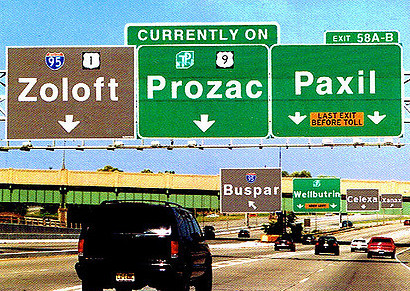
Tricyclics were about all the medical community had to offer until 1987, when Prozac hit the market, followed by its cousins Zoloft and Paxil. All of these were classified as SSRI drugs, ones that selectively acted on the neurochemical serotonin in the brain, rather than a wide variety of brain chemicals as the tricyclics had.

Since then we have listened to Prozac, talked back to Prozac, and been referred to as a Prozac Nation. Prozac has been hailed as a miracle drug, damned as a gateway to violence or suicide, and prescribed in phenomenal amounts.

And Prozac has helped me. After about six weeks on it, when the drug started to kick in, I was on a sailing trip. One of the crew said I was the passenger most at peace with myself that he knew. It was a revelation to me and a new way of thinking of myself.

Prozac changed my life – possibly saved it. And then, not so much. I moved on to other medications.

“Major Study Finds Antidepressants Work, But May Have Limitations,” by Brigit Katz, published on The Smithsonian.com, validates my perception.

Her article states, “A meta-analysis [or study of studies] of existing trials suggests that the drugs are mostly effective on a short-term basis for patients suffering from acute depression.” Katz’s article also cites articles in the New York Times and The Lancet that report similar findings.

The Lancet study “analyzed 522 double-blind studies that included 116,477 patients and 21 commonly prescribed antidepressants. The results of the study showed that all 21 of the antidepressants were more effective than placebos in reducing depressive symptoms during the first eight weeks of treatment.”

“The new analysis suggests, however, that the efficacy of the drugs may be limited,” Katz reports. “For one thing, the benefits applied in the short term, and only to patients who are suffering from acute major depression.” [emphasis added]

The Smithsonian.com article and the studies conclude that “while the new study suggests that antidepressants are more effective than a placebo, at least in some cases, media reports claiming [as an article in Newsweek did] that the research shows ‘antidepressants do work, and many more people should take them’ are not entirely accurate.”

(This hearkens back to a pet peeve of mine: that headline writers (who are almost never the authors of the articles) do a poor job of summarizing articles in favor of more definitive or appealing descriptions of the text. https://wp.me/p4e9Hv-Br)

At any rate, the meta-analysis bears out my experience. Although I was bipolar 2, my disorder first manifested as major depression. I got relief from Prozac, results that later diminished. Since my proper diagnosis I have found more relief from a combination of an SSRI, an anticonvulsant medication often used for bipolar disorder, and an atypical antipsychotic also useful for bipolar as well as schizophrenia. Even though I do not have seizures or schizophrenia, these medications work for me and have not worn off for several years now.

So, what’s the takeaway from all this? I think it is that, if your medication for bipolar or depression seems to be “wearing off,” your perception may indeed be valid. But that’s no reason to give up on psychotropics altogether. People and their disorders differ in ways we just don’t know. You can ask your doctor to try a different medication or combination of medications that may work better for you.

The benefits of medication for psychiatric disorders do not simply go away just because the effect of one does.

Read more: https://www.smithsonianmag.com/smart-news/major-study-finds-antidepressants-work-may-have-limitations-180968452/#vjLKOqe2JdKEWOe3.99

Mental Illness and Gun Violence

photo by Thomas Hawk

There’s been a lot of talk lately that not allowing the mentally ill to own guns would curb the trend of gun violence in the U.S. There are just a few things wrong with that theory.

Are background checks the answer? They aren’t. Such checks at certified gun dealers screen out only the very few who have been hospitalized for mental illness – involuntarily committed, that is, not just referred for a 72-hour hold for observation or self-referred. That’s only a very small portion of those with mental illnesses. Most people with mental disorders are never hospitalized and some never receive any diagnosis or treatment from a psychiatrist, psychologist, or another counselor, which means that background checks would never turn them up. And there are loopholes in many states’ versions of background checks that, for example, allow private sales of guns without them.

To take this to the next level of absurdity, it would be a severe breach of confidentiality if therapists had to report every client to a database somewhere, just in case, and would lead to fewer people being treated for mental health issues, for fear of being put on a registry that might be used for any purpose eventually, even employment. Gun owners don’t want to be on a nebulous registry “somewhere,” and neither do the mentally ill.

Can psychiatrists and other counselors report to the authorities clients they fear may become violent? Again, laws differ from state to state. Usually, the question comes up only when a client makes specific threats against a specific person or a government official. The therapist must make a judgment about whether the client is a danger to self and others, which could result in a 72-hour hold, and may of course be correct or incorrect. A client with generalized anger issues is probably not mandated to be reported.

And to whom and for what purpose would the person be reported? To the police, when no crime has been committed? Is a therapist’s report of a client’s report of feeling angry enough to shoot “someone” sufficient to justify a search warrant of the person’s house for a legally owned firearm?

Are mentally ill people more likely to be violent than other people? No. In fact, mentally ill people are much more likely to be the victims of violence than they are to be perpetrators. But no matter how many times we say that, few listen or believe it. Some mentally ill people turn violence – and guns –against themselves. Some are killed by police officers with no training in handling confrontations with differently abled people, including the mentally disordered.

Not only are mentally ill people more likely to be accused of violence, violent people are more likely to be accused of being mentally ill. That’s practically the first thing anyone says after a mass shooting – “Oh, he must be crazy” (or on psychotropic medications). Of course, with one in four adults being likely to experience some form of mental distress in their lifetimes, it is possible that a shooter is one of those people.

But newscasters and politicians and people on the street are, by and large, not psychiatrists or psychologists. They are no more able to diagnose mental illness than burger-flippers, dairy farmers, lawyers, or business executives. Not that that stops them. Mental diagnoses are flung about indiscriminately nowadays, from people who call themselves OCD because they straighten pictures to psychiatrists who claim to diagnose public figures without having spoken to them once, much less having developed a therapeutic relationship with them.

But can’t potential violence be predicted? No. It can’t. The prison system can’t do it, or there wouldn’t be so many parolees and probationers and those who have served their time who go right back to crime and violence. Mandatory sentencing laws and the political climate have reduced the problem in some areas, but there are still plenty of cases in which the system fails. At trials and parole hearings and sentencing hearings, there is always someone – doctor or lawyer or family member – to say that the offender will not offend again.

But the only known predictor of violence is past violence. That’s why some people think it’s more sensible to restrict the gun ownership rights of domestic abusers rather than someone mentally ill who has no record of violence.

Can’t mentally ill people who’ve proven to be violent be required not to own guns? Theoretically yes, but we know how well it works to tell people on probation who have no record of mental illness that they can’t own guns, drink liquor, or associate with known criminals. The probation system is too understaffed to enforce these requirements already. Who would be willing – or should have the responsibility – to check up on everyone, even the small proportion of the mentally ill who have been involuntarily committed or convicted and then released, and make sure they don’t acquire any guns? If the parole and probation people can’t handle the caseload they already have, why would we think that mental health professionals have any more time, capacity, training, or know-how to do it?

Would banning guns prevent gun violence by the mentally ill? In a word, no. There are already too many guns in circulation in this country for that to be possible, and those guns are too easy to get. And again, there would still be the problems of determining who is mentally ill, by whose definition, and how such a gun ban could be enforced.

So, I hear you asking, you’ve told us all the things that won’t work. Is there anything that will?

Not if you think that the problem of gun violence and the problem of treating the mentally ill overlap. Gun violence is one topic and the mental health system is another. There is a lot that can be said about fixing one or the other, but nothing that would solve both at once.

Not that a lot is being done now, unless you count blaming, finger-pointing, and spreading stigma.


For more discussion on the topic, see http://www.amhca.org/blogs/joel-miller/2017/10/03/gun-violence-and-mental-illnessmyths-and-evidence-based-facts from the American Mental Health Counselors Association.