Bipolar 2 From Inside and Out

Posts tagged ‘public perception’

I Chose Fat Over Misery

I was a skinny kid who grew a lot less skinny.

Do my bipolar meds have something to do with that?

Probably.

Do I care?

No.

I’ve noticed a lot of people with bipolar disorder panicking over the topic of weight gain. “I know I need meds, but I’m afraid of weight gain.” “What meds can I take that don’t cause weight gain?” “I tried X med but I quit because of the weight gain.”

It’s true that mental health and physical health are linked – what affects one may affect the other. And it’s true that medications have side effects, among which may be weight gain.

What I don’t get is why some people are so afraid of weight gain that they would sacrifice their mental health to avoid it.

Actually, I do sort of get it. There are ads everywhere that promote thinness – even to the point of illness – as the ideal for both feminine and masculine. There is a “War on Obesity” and plenty of people who will tell you that your body mass index is the most important number that identifies you. There are fat people jokes and gags that could not be told about any other group, be it race, sex, ethnicity, or religion. Plenty of comedians have made a good living making fun of fat – even their own. On TV, the fat character is never the hero.

Now back to the skinny, scrawny, bony kid I was. Undiagnosed and untreated. Aware that there was something wrong with me, but no idea what.

I had mini-meltdowns and major meltdowns. I had anxious twitches. I burst into tears when certain songs came on the radio – and not necessarily sad ones. “Take Me Home, Country Roads” tore me up. “I Am a Rock” could leave me sobbing. I took walks in the rain till I was soaked to the skin. I would laugh out loud for no reason that anyone else could see.

I was a mess. But a thin one.

It’s relatively recently that doctors and scientists have explored the connection between psychotropic medications and weight gain. Some have speculated that people who are depressed don’t eat much. Then, when their meds kick in and they feel better, their appetites return. In my case, I ate more when depressed and less when anxious. By the end of my undergraduate years, I was drinking banana milkshakes so my parents wouldn’t worry about how thin I was when they saw me at graduation.

Slowly, I got better with therapy and meds. Slowly, I gained weight. At first I didn’t notice. Then I did. I tried prescription diet pills and Lean Cuisine, which worked – for a while. But eventually, as is true of most dieters, I started piling the pounds back on. If one of my psychotropics was to blame, I couldn’t pinpoint which one, what with going on and off so many different ones and the cocktail of several I ended up with.

But as I got better and gained weight, I also started making friends, going on dates, finding lovers, and eventually meeting the man I would marry. Some of them were overweight, too. But that wasn’t what mattered most to them – or to me. Oh, I suppose there were people who were turned off by my well-padded physique. Maybe some of them were marvelous people, and maybe I would have enjoyed their company if they could have seen past the weight.

But the fact is, I now have plenty of close friends who just don’t give a damn about weight. Sometimes one of us will need to lose weight for a specific health reason like diabetes, and the rest of us will offer encouragement. But for the most part, we are who we are and love each other that way.

Given the choice – and I do have the choice – I will take the psychotropics that keep me reasonably stable and happy and productive. And yes, overweight. I remember the misery, the despair and pain, and no matter how I look, I don’t ever want to go back there. Self-esteem, for me at least, is better if it comes from the inside out, not the other way around.

The bottom line?

I’ve been skinny. I’ve been fat. Either way, I’m still me.


We Are Not Amused

In the last few days the bipolar blogosphere has been in an uproar about a post from OpinionatedMan. In it he said,“I get amused by people who claim to be bi polar.” [sic]
Naturally, some people were upset.

It is hurtful to think that someone is amused by our illness. We do not have it in order to be entertainment for others. We do not expect a mild chuckle or a small, wry grin when we reveal that we have a psychiatric illness. We do not find the symptoms, the therapy, the medication, the limitations – the bipolar life – amusing. Not to ourselves and certainly not for the amusement of others.

It is also offensive that he spoke of people who “claim” to have bipolar disorder. There is some debate about whether he meant “claim” in the sense of “say they have but not necessarily truthfully” or in the sense of “own the reality of and identify with,” and, to be fair, since the post was intended as poetry, it could be both.

Although “bipolar” is popular shorthand for someone who has ordinary mood swings, making free with the term “bipolar” is like comparing someone who’s in a bad mood with someone who is clinically depressed. We wouldn’t claim it (in either sense) if it weren’t so.

That’s enough to be upset about, but I think the rest of the post was troubling as well. OM portrayed himself as “multipolar,” implying that his multipolar life is a source of his depth of feeling and writing prowess.

The author thereby denigrates others who struggle with bipolar disorder yet try to create meaning. Many of us write, blog, draw, sculpt, or otherwise avail ourselves of creative outlets. For OM to think that his supposed extreme affliction makes him more creative, a better wordsmith, a creator of higher art than anyone with ordinary bipolar disorder is insulting.

Saying that his condition is multipolar as opposed to bipolar gets us into a game of “Whose life sucks the most?” (The loser is also the winner.) We are to think that no one has suffered as he does, and that no one is a comparable artist. It’s a version of the humble-brag – I’m worse off than you and I’m also better than you.

Of course the author has the right to believe as he does and to say what he does. I would not have him stop writing. But those of us who felt his words as wounds are entitled to speak up as well. Though he has a much larger platform than most of us, his words are not automatically more powerful than ours.

This is my opinion. Others differ. Here’s the link (http://aopinionatedman.com/2015/12/02/journal-entry-4/) so you can read and decide for yourself how you feel about it. He has apologized and claimed he meant no harm, and has been bashed and trolled, which is not my intention. Think of this as literary criticism from a former English teacher. As always, YMMV.

My New Mental Health Tattoo

Once again I have gotten a tattoo, supporting the cause of mental health.

A few months ago, I became a part of what’s called the semicolon project and wrote about it in this post: http://wp.me/p4e9Hv-9G. For those of you who aren’t up on the terminology, a semicolon tattoo represents mental health awareness, especially erasing the stigma, and suicide prevention.

The semicolon was chosen as the symbol because in writing, a semicolon indicates a place where a writer could have completed – or stopped – a sentence, but chose to go on. The semicolon says, in effect, “My story isn’t over.” The idea is to have the tattoo someplace visible – in my case, on my left wrist – and use it as a conversation starter.

Most people will assume that since I am a huge grammar nerd, my semicolon tattoo is some weird manifestation of love for punctuation. Then I can tell them that it’s a whole lot more. You can find out more about the semicolon project at http://www.projectsemicolon.org/.

My new tattoo represents bipolar disorder. Again it’s made up of punctuation: two colons and a paren. These symbols, unlike the semicolon, have no special meaning in writing and are never seen together in that order. Instead they make up a double emoticon: looked at one way, the colon and paren make up a smiley face. Looked at the other way, a frowny face.

New mental health tattoo

New mental health tattoo

This symbolism is easier for anyone seeing the tattoo to grasp. In a way, it’s a minimalist version of the comedy and tragedy masks you often see in theaters.

Again, it’s a conversation starter. Bipolar disorder is not well understood by the general public. This is particularly true of bipolar disorder type 2 – the kind I have – which many people have never even heard of.

Since I have gone public with having a mental illness, it seems only appropriate to introduce people to the disorder in a way that’s creative, nonthreatening, and understandable.  It’s a lot less abrupt than blurting out, “Hey, I have a mental illness!” Even my mother-in-law recognizes that these tattoos are not just a whim, but for a good cause.

The second tattoo is on my right wrist, so no matter which hand I extend, I can open up new understanding about a very real problem that many people live with daily.

A number of articles have come out lately questioning whether a person who gets a tattoo will regret it when they grow older. I think I can say with complete confidence that I will never regret these tattoos. They say something about who I am, something that will not change as I grow older. The disorder will always be with me and so will these symbols. For the rest of my life I can use them to educate, identify with other bipolar people, and remind myself that wrists are not for cutting.

I will say, however, that whoever thinks of these things had better put the brakes on new mental health-related tattoo designs – especially those made of punctuation – or I will soon become the illustrated editor/blogger. At the moment I have no plans for any further ink. My friends, however, tell me that tattoos are addictive. So we’ll see.

A few notes, since everyone asks: These simple tattoos take 10 minutes or less to apply. They hurt a little bit, but not much – a stinging sensation. They may fade a bit at first and need a touch-up. Because they are so quick and simple, you will not pay a lot to have them done. After you get the tattoo you have to take care of it while it heals, moisturizing it regularly for the first 3-6 weeks or so.

If you decide to get a tattoo, check out the studio before you have it done. It should be a professional operation, with high standards of cleanliness and concern for health. Tattoo artists should wear surgical gloves and change them frequently. There may be a consent form to fill out, indicating that you know what you are getting into, and even indicating whether you have various medical conditions or allergies, or have drunk alcohol within the previous eight hours. A reputable tattoo studio will not work on a drunken client.

Do you have a tattoo related to mental health? I’d love to hear about it. But don’t tell me if it’s more punctuation. I only have two wrists.

The Bloggess and Mental Health

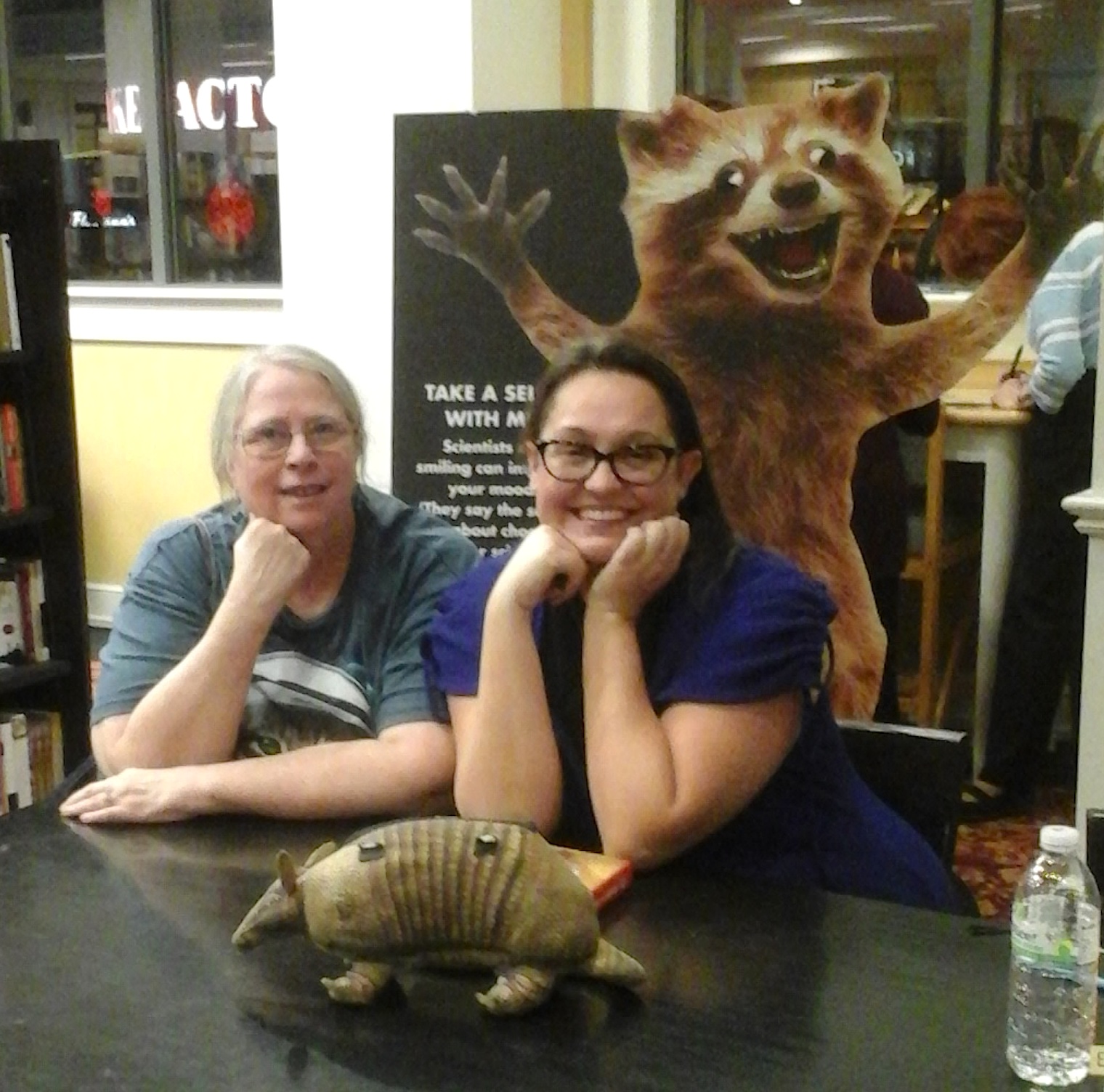
I met the Bloggess (aka Jenny Lawson) recently at a book signing for Furiously Happy, her second book. (Her first book was Let’s Pretend This Never Happened.)

Back row: Rory, the Furiously Happy Raccoon; middle row: me, Jenny Lawson; front row: Erma the Armadillo

Back row: Rory, the Furiously Happy Raccoon; middle row: me, Jenny Lawson; front row: Erma the Armadillo

The space at the bookstore was full to overflowing. (People had driven for as much as five hours to see her.) Jenny read two chapters of her new book to riotous laughter and applause. There was a brief Q&A session. (I figured she got the same questions all the time and wanted to ask her something that no one else had. I imagine that writers on tour need a little variety.So I asked: If you could be any animal, what would you be and why? Her answer: A tapeworm, because I could just not move and have people feed me.)

I joined the signing line (#17). She signed my copy of her book (“Our story is not over.”) and I showed her the semicolon tattoo that goes with that saying. She also signed my armadillo purse (Erma) and a piece of glass for my husband, who wants to put it over a picture of her or of a vagina; he hasn’t decided which. She laughed. He was one of the many that ask for perhaps her most famous – or at least most quoted – phrase, “Knock knock, motherfucker.” (It comes from her story about leaving a giant metal chicken on someone’s doorstep. There were also a lot of metal chickens she was asked to sign.) The bookstore personnel made sure that everyone knew it was okay to ask for that. In fact, they announced it just before the signings, reassuring the shy or inhibited.

The title of her new book, Furiously Happy, is Lawson’s way of telling depression to fuck off: If part of her life is misery and pain, she’s going to damn well make the most of the parts that aren’t. And while she’s at it, she’ll spread the word that mental illness is not a thing to be hidden or ashamed of.

This is not to say that her mental disorders are cured or that she no longer suffers from them. She was clearly anxious when reading aloud the two chapters, and visibly relieved when that part of the evening was done. Her strategy is to laugh at mental illness, joke about her meds, and speak bluntly to those in the audience who also suffer or have a person in their life who does.

Furious Happiness is a worthy goal, and her out-there enjoyment of life leads her into some of the hysterical situations she has written about in both books. These are the stories that make you say – only you, Jenny! Then she turns around and tells you that you are just like her in the ways that count.

The readers of her books and her blog – thebloggess.com – have formed an odd mutual support community. Although we may feel alone, Jenny rallies us to be alone together. Since one of the major difficulties with being a psychiatric patient is the feeling that no one else understands or experiences the same feelings, bringing people together in the virtual world or between the covers of a book is a valuable form of networking, especially for those who can’t network any other way.

Myself, I can’t manage the Furious Happiness. Too long dealing with the black dog and relatively little experience of even the mild highs of hypomania have left me depleted. Jenny will just have to do it for both of us. This is not to say I don’t love her or her work. I do, despite the blog post that I wrote, “Seven Reasons I Hate the Bloggess” (http://wp.me/p4e9wS-56). I can see myself in her and her in me, but for the moment I’m not able to follow her exuberant example. But she gives me hope. And I’m sure that’s one of her most important goals.

The Wrong Life

Nothing prepared me for this.

This is not the life my upbringing prepared me for. I don’t just mean the special guest speakers we had in home economics class who tried to introduce us to the subtleties of silver, china, and stemware. No, I was also misled by the books I read.

If Life Is a Bowl of Cherries, What Am I Doing in the Pits? and Please Don’t Eat the Daisies led me astray. Don’t get me wrong, I’m a total fan of Erma Bombeck’s writing style, but the quirky suburban life she loved and lamented was not what I got. Bombeck and Kerr both made light – and fortunes – of portraying the petty foibles and cute misunderstandings of women and their husbands, women and their children, women and their neighbors, women and other women.

Daily disasters with dishwashers, sticky-fingered children, and clueless husbands were an endless source of amazement and amusement for them. They soldiered on, supported by an innate buoyancy, faith in the divinity, and the occasional glass of wine.

My glasses of wine have been more than occasional. My disasters have not been humorous. I do not have children, and the cats are somewhat deficient in making adorable conversation in high-pitched, lisping voices. Sometimes all I can get out of them is “meh,” which is pretty much how I feel too.

As for the trappings of the genteel life, we eat off paper plates more often then not. I did once have a set of Limoges, but only because I was acting as a pawnbroker for a friend who needed ready cash. I fed one of the cats on the Limoges saucer, just to say that I had.

My parents used to say that their house was decorated in early married junk and I have followed in that fine tradition. Most of our furnishings are a demonstration of the maxim: If it’s not from Kmart or Goodwill you won’t find it here.

No one’s life prepares them for clinical depression, hypomania, bipolar disorder, or any other mental illnesses. I’ll wager that even psychologists’ kids don’t have a clue when they escalate from picking scabs to experimenting with lit cigarettes. Maybe their parents don’t either.

Either the mental disorder has been going on so long that you don’t know what it’s like without it, or it comes on so suddenly that you desperately hope that it goes away just as suddenly. Or it comes in a way that you can just convince yourself is no big deal. “I overspend? That’s just because I love shopping, not because I have mania or need to validate myself with expensive things.”

Perhaps people who grow up with a mentally disturbed loved one have a chance of understanding the underlying mechanisms. But with the number of families who don’t discuss the “elephant in the room,” or pass it off as, “Your sister is just high-strung” or say, “Uncle Ted is a little odd. Just ignore him,” not even that exposure may help.

How do young people learn about mental illness? Or even – gasp! – get help for one? If not at home, maybe at school? The National Association of Secondary School Principals cites the U.S. Surgeon General’s report saying that “one in five children and adolescents will face a significant mental health condition during their school years” and that the ratio of school counselors to students is 471:1. Add to that the fact that most school counselors have been shifted away from offering personal and emotional support to offering academics-only services. (http://www.nassp.org/Content.aspx?topic=57948)

Most of us struggle alone. Some never find a proper diagnosis and treatment. We have to be our own resources and our own advocates much of the time, even if our illnesses do not allow us to get out of bed. If we have one family member – or even a close friend – who understands, we are lucky beyond measure.

I wish that I had been even slightly prepared for the life I now lead, instead of the one I was “supposed” to have. No one can predict the future, but why can’t we at least have a bit of mental health education in school? I suppose that’s a lot to ask, when even sexuality education varies from the merely adequate to the appalling, when schools are barely able to stay abreast of the teach-to-the-test curriculum, and when Texas’s governor vetoes a bipartisan bill allocating resources for mental health, based on lobbying by Scientologists.

Do I sound bitter because I didn’t get to live the genteel suburban life? Probably. But there are aspects of that life that likely would have actively impeded my search for mental health. So I’ve had to do it on my own, or nearly so, at least until recently. A lot of us go DIY for mental health.

But a lot of us are accomplishing it. Living the life we have and not some fictitious pie-in-the-sky one. We may not have been prepared for it, but we muddle through anyway – and sometimes even realize that imperfect real life is better than a perfect lie.

Those Science Fiction Crazies

There has recently been a huge kerfuffle in the science fiction community regarding the Hugo Awards. You don’t really need to know much about it and probably don’t want to. Suffice it to say that two groups had it out over the past and future direction of science fiction and fantasy, and the meaning of the asterisk.

The awards have now been given, but still the blogosphere is full of recriminations, sour grapes, and schadenfreude.

What does this have to do with mental health? Aside from the fact that very smart people can behave like vicious toddlers, it’s interesting to note that the various sides in this dispute did not always, shall we say, acted rationally. You probably guessed that from the asterisks.

This phenomenon is not unique to the Hugo Awards. If you have never been to a science fiction convention, let me tell you about it.

Most of the people there will be very intelligent, obsessive about their particular fields of interest, lacking in social skills to various degrees, and will have a history of being outcast or bullied in their youth.

Does any of that sound familiar?

I’m not a psychologist (nor do I play one on TV), but I can’t help thinking that if you tested everyone at one of these events they would score higher than a random group of people on the autism spectrum. Simply put, the SF community appears to have more than its share of Aspies – and a fair sprinkling of bipolar, depressive, and OCD people.

When their oddities are carried to the extreme – and they often are – SF fandom can devolve into incivility that results in unconscionable threats and exceedingly ugly online behavior.

When you see these kinds of behavior, it is tempting to dismiss science fiction fans as being the caricatures that the media have instilled in us – clueless losers who live in their parents’ basements, show up at jury duty dressed in Star Trek uniforms, and insist that Harry should have ended up with Hermione.

Admittedly, to a certain extent that is true. If you look around at a convention you will almost certainly see a number of people who conform to that stereotype. I myself have a relative who could be Queen of the Get-a-Lifes.

What you may not see is that, despite the cluelessness, rudeness, sometimes elitist or misogynistic behavior, obsessiveness, and disregard for the feelings of others, the science fiction community is actually, at heart, a place where the non-typical person can find a group of like-minded individuals to talk with, obsess with, bond with, and occasionally practice social skills with. It fullfills a very real social and psychological need. Without the science fiction community, whether online or in “meatspace,” many of these people would have little or even no place to have much of a social life at all.

Certainly the stereotype is not true of all members of fandom. Most hold regular jobs in technical, creative, or other fields, have families and close relationships, and negotiate their way through modern society as well or poorly as anyone else. But there are consistencies in their background. Most are incessant readers and have been since childhood. Many have been the targets of cliques in school and the workplace. A number would be described by their neighbors as quiet loners (though this is not to imply that SF fandom harbors more spree killers  than any other group). They have odd senses of humor or in some cases none at all. In a very real sense, sf fandom is for them, as one song would have it, made up of “My Thousand Closest Friends.”

So if you happen to be in a hotel and find the meeting space is overflowing with people dressed as Klingons, robots, and giant furry animals, remember that they are mostly harmless and enjoying a moment of fitting in to a part of society that celebrates and honors their differences and shares their pride in their oddness. Where they can relax and be themselves, without worrying about seeming weird or threatening or being put down, avoided, or scorned. Think of it as a support group with parties, art shows, panel discussions, music, costumes, movies, and chocolate.

A lot of us with mental disorders are glad to know that such places exist. A lot of us wish we could find or make such places, too.

A Tattoo Is for Life…

…this one, especially so.

As soon as I learned about the semicolon tattoo, I knew I had to get one – and not just because I’m a huge grammar nerd. Because I’m bipolar and want to spread the word about mental health issues.

In writing, the semicolon indicates a place where a writer could have finished a sentence, but instead chose to go on. This makes the semicolon an effective and beautiful symbol for suicide prevention efforts and those who struggle with mental disorders.

Every day we choose to get out of bed; choose to take our medications; choose to make and go to our therapist appointments; choose to live another day; and choose to go on with our story.

This is not something I invented. Here are the people behind it: http://www.projectsemicolon.com/. And here are some stories about the phenomenon that have been working their way through the media and around the internet.

http://www.upworthy.com/have-you-seen-anyone-with-a-semicolon-tattoo-heres-what-its-about?c=ufb1

9 beautiful semicolon tattoos our readers shared to destigmatize mental health challenges

Here is my story.

I am possibly the last person you would ever expect to get a tattoo. I am probably the last person I would ever expect to get a tattoo. I’m in my 50s, a former English teacher, married for over 30 years, fond of reading and word puzzles and cats.

Nevertheless, the professionals at Monkey Bones Tattoos in Beavercreek, OH, did not seem surprised when I showed up one day and presented my wrist.

The naked wrist.

The naked wrist.

When I explained what I wanted – to put down a deposit and book an appointment to get a semicolon tattoo – I learned that they had a cancellation and could ink me right away.

What the hell, I thought. Might as well. I had learned about the tattoos about a month before and had thought it over plenty. It was by no means a spur-of-the-moment (or drunken) impulse.

Mike Guidone showed me into his studio and explained the procedure.

The tattoo artists work station.

The tattoo artist’s work station.

He presented me with stencils of three different sizes of semicolons. I chose the in-between one. My wrist is fairly small, so the big one would have looked out of place, but the small one wasn’t noticeable enough. The idea is for people to see it and ask, so you can share the meaning and talk to them about mental health and combatting the stigma.

I sat in the dentist-type chair, listened to a brief explanation, got answers to some questions, and was ready to start.

In progress.

Did it hurt? Not particularly. It was a feeling between a scratch and a sting, and took only about ten minutes. Some aftercare instructions and I was done.

finished1

Success!

Then I paid ($80, the shop minimum), tipped Mike, and was on my way. Now I care for the tattoo while it heals, anointing it with unscented lotion several times a day, avoiding sunlight or soaking, and trying my very best not to scratch or pick at it.

The results.

The results.

Am I happy with it? You bet!

And, like I said, it’s for life! My story isn’t finished yet.

A Response to the Dalai Lama

This Friday, my Facebook newsfeed included a quotation from the Dalai Lama.

Depression seems to be related to fear, anger and frustration. When you’re in a bad mood, even if you meet with your friends, you don’t take pleasure in their company. But when you’re in a good mood, even if things go wrong, you can cope with them without difficulty. This is why putting yourself in a good mood, making a point of developing a sense of loving kindness gives you greater inner strength.

While I respect and admire the Dalai Lama, on this subject he is wrong.

I wrote a blog post to tell him and his followers so. I posted it on Blogher.com. (Blogher is a site for women bloggers that sometimes syndicates content. It is more general than what I usually post here, so I wrote something special for them.)

As I researched, trying to find when and where the Dalai Lama said this (I couldn’t), I discovered several articles about research into depression and Buddhist principles and techniques.

One was an article by Kathy Gilsinan at The Atlantic
(http://www.theatlantic.com/health/archive/2015/07/dalai-lama-neuroscience-compassion/397706/). It talked about “high-amplitude gamma-oscillations in the brain, which are indicative of plasticity.” What that is or has to do with depression, I don’t know. It sounds like “handwavium” to me.

One that made more sense was this, from Jeanie Lerche Davis at
WebMD: http://www.theatlantic.com/health/archive/2015/07/dalai-lama-neuroscience-compassion. (The feature was reviewed by Louise Chang, MD.)

While meditation can help many who are depressed, it’s not a sure-fire cure, [Charles W.] Raison [psychiatry professor and co-director of Emory’s Collaborative for Contemplative Studies] tells WebMD. “In fact, many people with mood disorders find they can’t do meditation when they’re depressed.” Their thoughts are too overwhelming. They are anxious, nervous, and can’t sit – and likely they need antidepressants, he says.

That’s more like it.

In my response to the Dalai Lama, I said,

Real, clinical depression is not about being in a “bad mood.” It’s true that a truly depressed person does not find pleasure even in ordinarily pleasurable things, such as meeting with friends. But we cannot simply put ourselves in a good mood.

That’s the hell of depression. We want to enjoy the good times. We want to put ourselves into a place of inner strength. But we can’t. Not without help.

In fact, your advice is hurtful to depressed people. Too many times we have been told, “Cheer up.” “Smile! You’ll feel better.” “Think about someone else for a change.” “What do you have to feel bad about?”

Don’t you think we would if we could?

Remarks like these remind us that we have an illness and we cannot cure ourselves by willpower alone – no more than a person with hepatitis or tuberculosis or even schizophrenia can. We need help, and most of us need medication.

You do a disservice to people with depression when you tell them to put themselves in a good mood. You, an enlightened spiritual leader, may be able to do it, but we can’t.

Certainly we can benefit from practicing loving kindness and developing inner strength.

But without treatment for depression, how many of us can do that?

It angers me when people say that depression – or any mental disorder – is something people can or should be able to cure with an attitude adjustment. I’ve heard it too many times from people in my life, and I’m sure you have too.

What’s really disappointing is that someone like the Dalai Lama, with his legion of followers and enormous credibility, is perpetuating this old way of thinking.

This lie.

New Hope for Mental Illness

Did you hear the news?

Bullying, inflammation, anger, low self-esteem, abuse, biochemicals, unsettled gender identity, cat parasites, and anything bad causes depression/bipolar disorder/PTSD. (Double-jointedness, too, except I don’t know if that’s bad or not.)

But don’t worry. Reading, happy memories, cat videos, a new vaccine, or Tylenol can help!

Science reporting these days is confusing, deceptive, and sometimes just plain wrong. Perhaps science reporters don’t mean to mislead, but that’s exactly what they do. Among the problems are publishing demands, lack of knowledge, logical fallacies, and the difference between correlation and causation.

Let me explain.

Publishers demand big, catchy headlines, and they prefer “New Hope for Bipolar on Your Grocer’s Shelf” to “Experiments on Genes and Diseases Continue.” Add to that the fact that editorial budgets have been slashed and personnel shuffled around so much that todays’s “science reporter” may have been last month’s “political correspondent” – and trained only in basic journalism, if that.

Science is complicated and difficult to understand, unless you’ve got special training. Even then, your expertise is likely to be only in one area – the microbiology of prostate cancer in mice, for example. And most people’s understanding of how scientific research works is, well, not understanding so much as knowing that DNA is somehow like a fingerprint.

Here’s a website with videos that tackle the subject quite nicely. My personal favorite is the one about animal trials in research, which explains (among other things) why my father, who had bone cancer, always said he was tired of being compared to a white rat.

http://www.vocativ.com/culture/junk-science/

Another problem is argument by analogy, which appears more in opinion pieces than in stories labeled as science. But here’s a sample, damning research on psychotropic drugs, written by Kelly Brogan, MD, ABIHM (American Board of Integrative Holistic Medicine).

The most applicable analogy is that of the woman with social phobia who finds that drinking two cocktails eases her symptoms. One could imagine how, in a 6 week randomized trial, this “treatment” could be found efficacious and recommended for daily use and even prevention of symptoms. How her withdrawal symptoms after 10 years of daily compliance could lead those around her to believe that she “needed” the alcohol to correct an imbalance. This analogy is all too close to the truth.

Well, no it’s not, for a number of reasons. Analogies always break down after a while, some sooner than others. For example, that hypothetical six-week trial would be longer than six weeks, come only after years of animal studies (including ones that focused on unwanted side effects like, I don’t know, hangovers or liver damage). The trial would have included control groups, placebos, and other research protocols. The ten-year “withdrawal” effect wouldn’t show up in six weeks; people who drink only two drinks per day are not generally considered alcoholics or go into withdrawal (indeed they may be drinking wine for heart health).

(See http://www.madinamerica.com/2014/12/depression-serotonin/)

And so forth. Having two drinks per day is not analogous to taking a medication for social anxiety disorder. It’s associating the disliked thing (psychotropic meds) with a thing known to be bad (alcoholism) and damning by association.

Here’s another flaw: the principle that “correlation does not equal causation.” The classic example comes from the 1950s, when it was claimed that rock and roll music would lead to teenage pregnancies. It’s true that some teenagers who listened to rock and roll became pregnant (correlation). But some didn’t. And some teenagers who listened to country or jazz became pregnant. And I think by now we know what really causes pregnancy (causation).

This problem is illustrated by an article, “Scientists: The ‘Tortured Artist’ Is a Real Thing.”
The first thing to notice is that the headline is misleading, or possibly completely untrue. The article explains a study that supposedly shows that “creative genius and mental disorders are connected at a genetic level,” then goes on to debunk it:

“Any particular set of genes is only going to explain a very small part of variation in any psychological trait,” says Scott Barry Kaufman, a psychologist at the University of Pennsylvania. Indeed, the variants in the new study have a tiny, miniscule impact on creativity – less than 1 percent.

The rest of the article waffles back and forth and concludes inconclusively. Are creativity and “madness” linked somehow? Possibly. Does one cause the other? We don’t know, but there are a lot of theories. There are lots of other possible factors. Without the headline, would anyone read that? How do you define “creativity,” anyway?

(See http://mentalfloss.com/article/64852/scientists-tortured-artist-real-thing).

Here’s a selection of recent articles that purport to have some relevance to mental illness or mental health.

Can Reading Make You Happier?
Answer: Bibliotherapy helps some people, possibly because of changes in the brain.
(http://www.newyorker.com/culture/cultural-comment/can-reading-make-you-happier?)

Artificial Recreation Of Happy Memories May Become The Next Big Weapon Against Depression
Thesis: “Urging a depressed person to stay positive by remembering the good things in life is unlikely to be helpful advice. That is because depression blocks access to happy memories. But what if we could somehow artificially recreate such memories to allow for some more positive thinking? A study suggests that this is indeed possible – at least in rats….However, more research will be necessary to obtain a clearer picture of how this might work in humans.”
(Again with the rats.)
(http://www.iflscience.com/health-and-medicine/artificial-recreation-happy-memories-may-become-next-big-weapon-against)

Science Shows that Watching Cat Videos is Good for You
The article, which says “research suggests that the pleasure you derive from watching cat videos can often outweigh the guilt of procrastination,” is largely tongue-in-cheek, but that headline is a grabber. Headlines that use “waffle words” like may, can, might, possibly, someday, appears to usually indicate a story that says nothing significant. They build up hope, but if a study comes along that disproves the theory, it will never be reported.
(http://www.iflscience.com/environment/science-shows-watching-cat-videos-good-you)

Researchers Are Developing A Vaccine For Post-Traumatic Stress Disorder
It begins: “New studies are suggesting a link between the immune system and the way the body reacts to stress. Research with rodents are raising hopes that one day, tweaking a person’s immune system could be a way to treat or even prevent conditions like PTSD, Nature reports.” How many warning signs can you spot there?
(http://www.iflscience.com/health-and-medicine/vaccine-help-ptsd)

Double-Jointedness Is Linked to Anxiety
One of my favorites. Correlation/causation much?
(http://mentalfloss.com/article/65333/double-jointedness-linked-anxiety)

Your pain reliever may also be diminishing your joy
Actually it says that acetaminophen blunts both positive and negative emotions. And, it adds, “this study offers support to a relatively new theory that says that common factors may influence how sensitive we are to both the bad as well as the good things in life.” Gee, who would have guessed?
(https://news.osu.edu/news/2015/04/13/emotion-reliever/)

Is Depression a Mental or Physical Illness? Unravelling the Inflammation Hypothesis
This is actually a good article. The headline question is a valid and interesting one, and the author states, “But while there may be a connection between inflammation and depression, one doesn’t necessarily lead to the other. So it’s too simplistic to say depression is a physical, rather than a psychiatric, illness.” Hooray for correlation/causation!
(http://www.iflscience.com/health-and-medicine/depression-mental-or-physical-illness-unravelling-inflammation-hypothesis)

What does all this reporting prove? Almost nothing. Except “let the reader beware.”

We’ve Got Demons in Our Heads

I posted this just after the Charleston shootings, but it needs saying again.

The media don’t say it in so many words, but that’s what they mean when they talk about “mental illness” after a tragedy, especially one that involves gun violence and mass murder.

Demons are responsible. And those demons are the mentally ill (and/or) their medications (or lack of medications). Any way you look at it, we are the demons.

Here’s one of my favorite examples lately:

“It seems to me, again without having all the details about this, that these individuals have been medicated and there may be a real issue in this country from the standpoint of these drugs and how they’re used.”

This was from Rick Perry, Daily Kos reminds us, “the fellow who destroyed his last presidential bid after a bizarre debate performance that he later blamed on prescription painkillers he had taken beforehand.”

(Don’t you love that part about speaking without having the details?)

And this, from Mike Adams, who calls himself “The Health Ranger” and Editor of NaturalNews.com:

The headline is “Every mass shooting over last 20 years has one thing in common… and it’s not guns.” The article is actually a reprint of “an important article written by Dan Roberts from AmmoLand.com.”

(NaturalNews sounds maybe okay, but when the source is AmmoLand, you’ve got to wonder about bias.)

Here goes:

“The overwhelming evidence points to the signal [sic] largest common factor in all of these incidents is the fact that all of the perpetrators were either actively taking powerful psychotropic drugs or had been at some point in the immediate past before they committed their crimes.”

Then follows a list of people, crimes, and drug names. The list was compiled and published to Facebook by “John Noveske, founder and owner of Noveske Rifleworks just days before he was mysteriously killed in a single car accident.”

(Again note the source and possible bias, plus the hint of conspiracy theory. Gotta love it.)

Want something more mainstream? How about Newsweek?

“Charleston Massacre: Mental Illness Common Thread for Mass Shootings,” by Matthew Lysiak:

“…. If history is any indication, the shooter most likely has a history of severe mental health issues that have either gone untreated or undiagnosed.”

He then provides a list of crimes and psychiatric diagnoses with a number of the same instances as the AmmoLand account, though not a listing of medications.

The author goes on to say that the “rise [in mass shootings] correlates directly with the closure of the mental health institutions in 1969, according to mental health experts.”

(Correlates with – not caused – please note. That’s important. I’ll have more to say about that, probably next week.)

Lysiak goes on to say that the requirements for civil commitment (read: involuntary) are too loose. He quotes Liza Gold, a forensic psychiatrist in Arlington, Virginia: “The commitment requirement needs to be less strict. Today it currently requires both mental illness and dangerousness to have someone committed. I think we need to focus more on the dangerousness and keep these people from getting guns.”

If that’s so, we should be worried more about “sane” people such as abusive partners with histories of violence and restraining orders than about the mentally disordered, shouldn’t we? Comments revealing that “most people who commit acts of violence don’t exhibit signs of mental illness, and most people who are mentally ill are not violent” are buried near the end of the article.

Fortunately, not all the media are demonizing the mentally ill, though the dissent doesn’t seem to be coming from the major media. Slate and Salon have published articles that question the automatic connection.

The article on Slate, by Anne Skomorowsky, is long, and refers to the Germanwings airplane deaths, but it’s thoughtful reading and well worth the time.

“Because Germanwings pilot Andreas Lubitz killed himself when he purposefully drove a plane carrying 149 other people into a mountain in the Alps, there has been an assumption that he suffered from “depression” — an assumption strengthened by the discovery of antidepressants in his home and reports that he had been treated in psychiatry and neurology clinics.” She adds, “Lubitz did not die quietly at home. He maliciously engineered a spectacular plane crash and killed 150 people. Suicidal thoughts can be a hallmark of depression, but mass murder is another beast entirely.”

And the take-away: “Many patients and other interested parties are rightly concerned that Lubitz’s murderous behavior will further stigmatize the mentally ill.”

Salon’s Arthur Chu talked about the more recent Charleston, SC, shootings and other incidents in “It’s not about mental illness: The big lie that always follows mass shootings by white males.”

“I get really really tired of hearing the phrase ‘mental illness’ thrown around as a way to avoid saying other terms like ‘toxic masculinity,’ ‘white supremacy,’ ‘misogyny’ or ‘racism.’

“’The real issue is mental illness’ is a goddamn cop-out. I almost never hear it from actual mental health professionals, or advocates working in the mental health sphere….Seeking medical help for depression or anxiety is apparently stronger evidence of violent tendencies than going out and purchasing a weapon….Doing the former is something we’re OK with stigmatizing but not the latter.”

I’ll let that be the last word, fellow demons. Until the next time, that is. Until the next time.

Correction: The Skomorowsky article appeared on Slate, not Business Insider, as originally stated. I have fixed the text and regret the error.

Here are the references for the articles cited, in order:

http://www.dailykos.com/story/2015/06/19/1394713/-Rick-Perry-says-guns-aren-t-to-blame-for-Charleston-accident-it-was-prescription-drugs

http://www.naturalnews.com/039752_mass_shootings_psychiatric_drugs_antidepressants.html

http://www.newsweek.com/charleston-massacre-mental-illness-common-thread-mass-shootings-344789

http://www.slate.com/articles/health_and_science/medical_examiner/2015/03/germanwings_co_pilot_mental_illness_suicide_is_linked_to_depression_but.html

http://www.salon.com/2015/06/18/its_not_about_mental_illness_the_big_lie_that_always_follows_mass_shootings_by_white_males/