Bipolar 2 From Inside and Out

Posts tagged ‘guns’

Murder and Mental Illness

Murder is associated in the public mind with brain illnesses, particularly schizophrenia, bipolar disorder, and PTSD. David Hogg, anti-gun activist and mass shooting survivor has a lot to say about the topic: “If you believe it’s mental illness, call your reps and ask that they fund mental h[ealth] programs in our schools and communities. I don’t agree it’s mental illness that causes these shootings But we do need more funding for mental health programs to reduce the growing rate of suicide.”

Hogg has said that systemic poverty, race, and hatred are bigger motivators of mass shootings than mental illness. He also notes, “I do think it’s important to note the shooter at my high school had tons of mental health stuff. From my understanding, … there were school psychologists, there were therapists, there were all these different things involved. And I don’t think one more therapist would have made the difference for him. We need to put our politics aside, and get something done.”

The assassination attempt on former President Trump has stirred up the debate again. The assumption that mental illness is the cause of public acts of violence persists. The usual suspects include bullying, psychotropic medication, and social isolation. There have also been a lot of conspiracy theories and blame tossed around. It was Democrats. It was a “false flag” operation. It was staged. It was a foreign plot. The injury was minor. The injury almost took his life. (There may well be more I haven’t heard.)

I fully expect the mental illness hue and cry to start. In fact, it’s already begun. There have been reports that Thomas Crooks sought information on major depressive disorder and was bullied at school. (He was 20 years old when he fired at Trump. Apparently, he committed no violence while at school.) I stress that these are not facts. They have only been reported in the media and tempered by the term “allegedly.”

Personally, I don’t accept such reports at face value. Media reports in the aftermath of a shooting have so often turned out to be unwarranted, misguided, or premature. I prefer to wait for more reliable, less heated reporting that comes from official sources who have actual knowledge of the situation.

I will say that major depressive disorder is a disorder that leads to violence against oneself rather than others. Even if the Crooks did have it (not proven), it seems unlikely that it was a factor in the incident. Depression more often results in suicidal ideation or attempted or completed suicide than in homicide. That he might have been seeking “suicide by cop” is even more unsupported so far and probably unknowable.

It may be true that Crooks had a mental illness, but we don’t know that yet—if we ever will—and there are other possible explanations for his actions, including garden-variety hatred, violent extremism, and political motivation.

What I do think we know is that mental illness will once again be assumed to be the cause by both the public at large and the media. They may even find some psychological “experts” who never met Crooks and never treated him to expound on his diagnosis or motivation in media interviews. That’s usually the course these things follow. Lilliana Mason, a political scientist at Johns Hopkins University, said today, “It sounds like he was relatively isolated and troubled, sad and looking for attention.”

I also firmly believe that this incident will make no difference whatsoever in the debate on gun control. And if mental illness is the cause, it will be acknowledged as a Bad Thing but will not result in any initiative that would provide funding for better care of those with SMI. A massive tut-tut and a hearty shrug are about all I expect.

I’d love to be proved wrong.
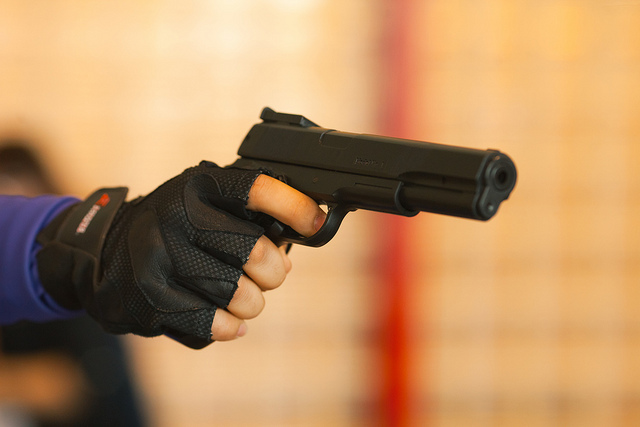
Mental Illness and Gun Violence

photo by Thomas Hawk

There’s been a lot of talk lately that not allowing the mentally ill to own guns would curb the trend of gun violence in the U.S. There are just a few things wrong with that theory.

Are background checks the answer? They aren’t. Such checks at certified gun dealers screen out only the very few who have been hospitalized for mental illness – involuntarily committed, that is, not just referred for a 72-hour hold for observation or self-referred. That’s only a very small portion of those with mental illnesses. Most people with mental disorders are never hospitalized and some never receive any diagnosis or treatment from a psychiatrist, psychologist, or another counselor, which means that background checks would never turn them up. And there are loopholes in many states’ versions of background checks that, for example, allow private sales of guns without them.

To take this to the next level of absurdity, it would be a severe breach of confidentiality if therapists had to report every client to a database somewhere, just in case, and would lead to fewer people being treated for mental health issues, for fear of being put on a registry that might be used for any purpose eventually, even employment. Gun owners don’t want to be on a nebulous registry “somewhere,” and neither do the mentally ill.

Can psychiatrists and other counselors report to the authorities clients they fear may become violent? Again, laws differ from state to state. Usually, the question comes up only when a client makes specific threats against a specific person or a government official. The therapist must make a judgment about whether the client is a danger to self and others, which could result in a 72-hour hold, and may of course be correct or incorrect. A client with generalized anger issues is probably not mandated to be reported.

And to whom and for what purpose would the person be reported? To the police, when no crime has been committed? Is a therapist’s report of a client’s report of feeling angry enough to shoot “someone” sufficient to justify a search warrant of the person’s house for a legally owned firearm?

Are mentally ill people more likely to be violent than other people? No. In fact, mentally ill people are much more likely to be the victims of violence than they are to be perpetrators. But no matter how many times we say that, few listen or believe it. Some mentally ill people turn violence – and guns –against themselves. Some are killed by police officers with no training in handling confrontations with differently abled people, including the mentally disordered.

Not only are mentally ill people more likely to be accused of violence, violent people are more likely to be accused of being mentally ill. That’s practically the first thing anyone says after a mass shooting – “Oh, he must be crazy” (or on psychotropic medications). Of course, with one in four adults being likely to experience some form of mental distress in their lifetimes, it is possible that a shooter is one of those people.

But newscasters and politicians and people on the street are, by and large, not psychiatrists or psychologists. They are no more able to diagnose mental illness than burger-flippers, dairy farmers, lawyers, or business executives. Not that that stops them. Mental diagnoses are flung about indiscriminately nowadays, from people who call themselves OCD because they straighten pictures to psychiatrists who claim to diagnose public figures without having spoken to them once, much less having developed a therapeutic relationship with them.

But can’t potential violence be predicted? No. It can’t. The prison system can’t do it, or there wouldn’t be so many parolees and probationers and those who have served their time who go right back to crime and violence. Mandatory sentencing laws and the political climate have reduced the problem in some areas, but there are still plenty of cases in which the system fails. At trials and parole hearings and sentencing hearings, there is always someone – doctor or lawyer or family member – to say that the offender will not offend again.

But the only known predictor of violence is past violence. That’s why some people think it’s more sensible to restrict the gun ownership rights of domestic abusers rather than someone mentally ill who has no record of violence.

Can’t mentally ill people who’ve proven to be violent be required not to own guns? Theoretically yes, but we know how well it works to tell people on probation who have no record of mental illness that they can’t own guns, drink liquor, or associate with known criminals. The probation system is too understaffed to enforce these requirements already. Who would be willing – or should have the responsibility – to check up on everyone, even the small proportion of the mentally ill who have been involuntarily committed or convicted and then released, and make sure they don’t acquire any guns? If the parole and probation people can’t handle the caseload they already have, why would we think that mental health professionals have any more time, capacity, training, or know-how to do it?

Would banning guns prevent gun violence by the mentally ill? In a word, no. There are already too many guns in circulation in this country for that to be possible, and those guns are too easy to get. And again, there would still be the problems of determining who is mentally ill, by whose definition, and how such a gun ban could be enforced.

So, I hear you asking, you’ve told us all the things that won’t work. Is there anything that will?

Not if you think that the problem of gun violence and the problem of treating the mentally ill overlap. Gun violence is one topic and the mental health system is another. There is a lot that can be said about fixing one or the other, but nothing that would solve both at once.

Not that a lot is being done now, unless you count blaming, finger-pointing, and spreading stigma.


For more discussion on the topic, see http://www.amhca.org/blogs/joel-miller/2017/10/03/gun-violence-and-mental-illnessmyths-and-evidence-based-facts from the American Mental Health Counselors Association.