Bipolar 2 From Inside and Out

Posts tagged ‘bipolar disorder’

Live for Today

I see a lot of memes exhorting us to “live for today.” Sometimes these are in the context of life being uncertain and needing to live each day as if we’re going to die tomorrow. And it’s true that the future isn’t guaranteed to any of us.

This has evolved into the “YOLO” (or “You Only Live Once”) philosophy. It’s not clear what YOLO really means. To some, it’s a challenge and defiance – the idea that you should try something even if it’s dangerous because you may never again get the opportunity to do it. If you look at it this way, it’s the opposite of the previous understanding of “live for today,” in that one can actually hasten the absence of tomorrows based on what potentially terminally stupid thing one decides to try or is goaded or shamed into trying. I followed this philosophy one time when I decided to go for a ride on a zipline. Stepping off the platform frightened me, but I did it. Now I’m too old and decrepit to do it again, so I’m glad I did it then.

On the other hand, “You only live once” could also mean that you should take care of yourself. You only live once, after all, so why not live as long as possible? Nutrition; sleep; exercise; avoiding drugs, smoking, alcohol, and unhealthy foods; and relaxation techniques are all considered factors that will lead to long life – as long as you don’t consider factors such as genetic disorders, cancer, and tragic accidents you can’t control.

If those behaviors sound an awful lot like self-care, well, they are. And for those of us with brain disorders, self-care is perhaps the most often recommended thing we can do to keep ourselves functioning as well as possible. Of course, if I were a cynic, I would say that self-care might be recommended so often because it’s an easy thing for businesses and insurance companies to recommend rather than actually helpful, but more extensive or expensive, interventions.

Living with a brain disorder is in many ways a day-by-day challenge. Every day, we must do the things that will lead to stability (we hope), including taking our meds if they’re prescribed, going to therapy, building a support system, and performing self-care. It’s true that we only live once, but that once proves to have its own unique challenges.

At times, it feels like we have been cheated by life by having our once around be so difficult. And I’m not going to say that isn’t true. I don’t think that having a brain illness makes us more sensitive or understanding or creative – except that we may be more sensitive to the needs of others who also have brain disorders. Mostly, it just makes life more – challenging is about the best spin I can put on it. And everyone in this life has their own challenges. There’s no use comparing whose life is worse.

Still, it’s a worthy goal to try to live the best life we possibly can within the limitations that our disorders impose on us. The fact that we only live once – and that our lifespan may be reduced by our illnesses – makes it all the more important that we make the most of what we are given.

Keep This Blog Alive!

Choose an amount

¤2.50
¤5.00
¤10.00

Or enter a custom amount

¤

Your contribution is appreciated.

Donate
Can I Choose My Emotional Reactions?

Back before he started on his path to learning how to live with me, my husband used to refuse to say he was sorry if he hurt my feelings. “I didn’t mean to,” he would say.

“If you stepped on my toe without meaning to, you’d say you were sorry,” I replied.

“Yes, but if I stepped on your toe, I’d know I hurt you.”

“I tell you that you hurt my feelings. That’s how you know you did.”

“I can’t control your reactions. I say something and you react with hurt.”

“I can’t choose my reactions when you step on my toe. It hurts and I say ouch. It’s the same when you hurt my feelings.”

We’d go around like this for a while.

Later, he came around to the idea that I couldn’t control my reactions. There were things that he couldn’t see inside me, from my emotional triggers to my bipolar disorder. At last, he admitted that I couldn’t control my reactions and learned to apologize even for things he didn’t mean to do.

Later still, he claimed that maybe I couldn’t control my emotional reactions, but that I had control over what I did about them. I maintained that I couldn’t necessarily do that. My feelings were hurt and I cried. I could choose whether or not to leave the room or stop speaking to him, but the tears were not optional. They were not something I could choose or control. Believe me, I’ve tried.

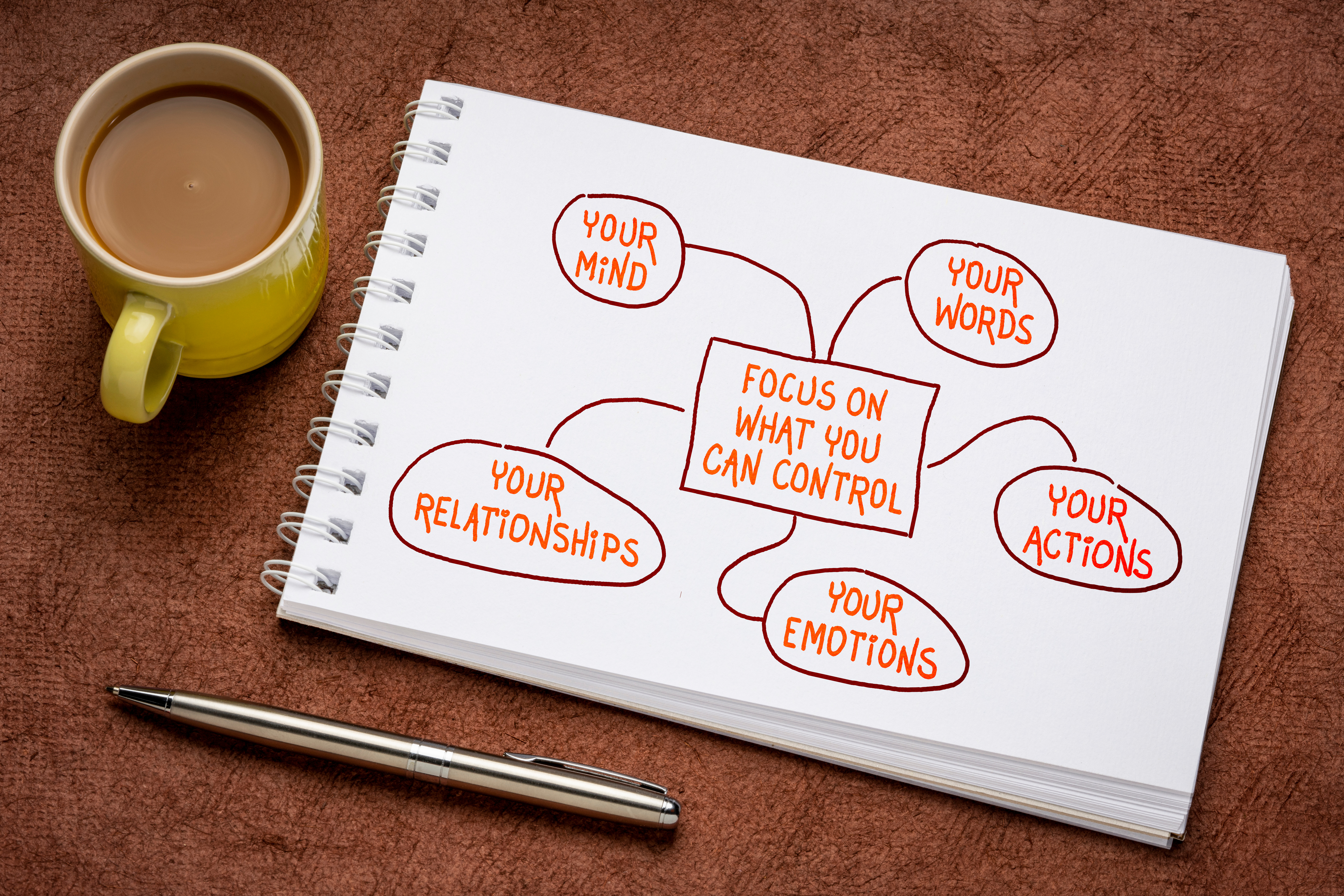
Our admittedly small example has larger implications. There seems to be a lot of things we’re supposed to be able to control. In the illustration above, your mind, your relationships, your emotions, your actions, and your words are said to be things you can control.

I would disagree with some of that. As my experience with my husband showed, I couldn’t control my emotions – I didn’t choose them. I can’t control my relationships. There’s another person involved, with a lack of control over their emotions as well.

And my mind. When you live with serious mental illness (SMI), you’re acutely aware that, a lot of the time, you can’t control your mind. From overthinking at one end of the continuum to psychosis at the other, the mentally ill mind does what it will. Personal choice can’t control it. We’re not able to reach inside and change our brain chemicals or the past traumas that influence our minds and our choices. Sometimes medication and therapy can’t control the mind either.

There are also a lot of memes – and people’s opinions and statements – saying that we can control whether we are happy or not. “Choose happiness.” “The only difference between a good day and a bad day is your attitude.”

I’m not even sure that’s true for people who don’t have SMI. Emotions aren’t something that can easily be switched on and switched off. Before I was correctly diagnosed and properly treated, I simply had to go through a spell of depression and wait for it to pass. It’s still largely true for me, except that now I know that the depression will pass, and a lot sooner than it used to.

I don’t think that it’s a good idea to deny your emotions, either. If you feel hurt or sad, let yourself feel that feeling and work through it. It may be trying to tell you something – that you’re angry for a reason, for example, and need to address that reason. Or if you’re sad, recognize that there’s something making you sad and stay with that sadness for a while. Forcing yourself to behave cheerfully denies the reality of your emotions and merely puts a mask on them. And that’s not healthy. Sooner or later, those feelings will leak out from behind the mask or shatter it.

I’ve always been a great believer in choice. But there are things I don’t think a person can or should have to choose. Emotions and our reactions to them are not within our control. Our actions are – leave an abusive relationship, seek help for mental illness, take medication every day, and so much more.

But not everything about us is subject to choice, and I think it’s better to recognize that than to deny it.

(And for those of you who are curious about it, my husband and I have chosen to work on our individual and mutual problems and have accomplished 40 years of struggle and working together to control what we can accept and what we can’t. We choose that struggle and that work every day.)

Keep This Blog Alive!

Choose an amount

¤2.50
¤5.00
¤10.00

Or enter a custom amount

¤

Your contribution is appreciated.

Donate

Adjusting the Dosage

I go to a psychiatrist four times a year for med checks and a psychotherapist every month to six weeks or so for my ongoing mental health care. When I think a change in medication dosage might help, I always ask my therapist if she thinks I need to consult the psychiatrist and ask the psychiatrist if he thinks my medication should be adjusted.

Recently, I noticed that I had been in a hypomanic phase for a period of several months, something that doesn’t usually happen to me. At first, I thought it was the winter holiday shopping season that was the cause of my overspending. But as January rolled through and I was still running up the credit cards with online purchases, I had to admit that I was definitely in the clutches of full-blown hypomania.

I discussed this with my therapist, who approved my plan of telling my psychiatrist about it and asking if adjusting my medication was appropriate.

So I did. While we were discussing the problem, I asked whether upping my anti-anxiety med might help.

After considering it, Dr. G. said he didn’t think that would help, but that increasing the dosage of my atypical antipsychotic might. He wrote me a new prescription and instructed me to call him right away if it had unexpected side effects.

In one of the Facebook mental health groups I belong to, another member said that he thought titration (trying to find the right dosage by adding and subtracting) led to overmedication. That hasn’t been my experience.

My first experience with psychotropics was with Prozac, back in the day when that was the new wonder drug. It worked great for me – until it didn’t anymore. (This was, no doubt, partly due to the fact that it treated only my depression but not the other symptoms of bipolar disorder.) After that, a succession of drugs came along, until I started going to Dr. R.

My second psychiatrist, Dr. R., titrated my medication for literally years before we found a level and a combination that worked for me. He would start me on a new medication and then slowly and carefully increase the dosage until either it helped or didn’t help, or the side effects became intolerable. Then he would titrate the medication downward, again gradually, to prevent withdrawal symptoms. This made the process long and slow, but ultimately safer. Eventually, we found a “cocktail” that worked for me.

If titration means only upping the dosage of a medication rather than adjusting it both up and down or discontinuing it entirely, then I admit that the process can lead to overmedication. But I think that’s bad psychiatric practice. (The group member commented that I had had a good psychiatrist once I explained his process.)

My current psychiatrist has adjusted my dosages several times in conjunction with my changing needs. Over the years, my sleep aid has been entirely discontinued and my anti-anxiety med reduced from twice a day to as needed. The most recent change has been only a slight bump in dosage, carefully monitored, with a promise of attention in between my regular sessions if I experience problems.

That’s my idea of a good relationship between practitioner and patient and a sensible approach to changing medication. I do admit that it has been luck that put me in touch with psychiatrists who had the wisdom and regard for safety to change my meds only when necessary and only gradually. Now that I know what to look for, I feel better about changing psychiatrists should Dr. G. retire (which is why I needed a change after Dr. R.).

Will the change in my current meds help in curbing my hypomania? That’s still up in the air. It may be that the hypomania will subside on its own and the meds will have nothing to do with it. Or it may be that the higher dosage will prove ineffective and I’ll have to ask Dr. G. if starting a higher dosage or a different medication would be sensible. Either way, I have learned to trust the process.

Keep This Blog Alive!

Choose an amount

¤2.50
¤5.00
¤10.00

Or enter a custom amount

¤

Your contribution is appreciated.

Donate

The Year Past, The Year to Come

There are two things associated with the new year – looking backward and looking forward. Looking backward is easier for me, so I’ll start there.

The year 2022 has presented both challenges and joys for me. There was our trip to Ireland, which was a joy but provoked overthinking and anxiety. An over-ambitious schedule and over-packing made the journey less successful than it could have been. Miscalculations on our part meant difficulty with flights and panic over finances when we had to extend our hotel stays and spend more money than we had budgeted. Driving on the “wrong” side of the road made me unable to do any of the driving and panicky whenever we negotiated a corner, encountered a curve, or parallel parked. I spent a lot of the car rides holding on to the “oh, shit” handle and pressing my hand to the roof of the small rental car. I was relieved to have remembered to take my anti-anxiety meds with me, and my husband helped by suggesting when my behavior might necessitate taking some.

Then there was our experience with COVID. My husband was diagnosed. I never was, but I had all the same symptoms, so I assume that I also had it. I remember being concerned, but not unduly anxious. We had (relatively) mild cases, so we sheltered in place and took over-the-counter remedies to combat our symptoms. We had groceries delivered and slept a lot, so I guess I would have to say we coped. When the immediate danger was over, I had COVID anxiety regarding my husband’s job, which includes lots of contact with the public. We both knew it could have been a lot worse and were grateful that it wasn’t.

I kept up with my therapy appointments via WebEx. We both liked the process so well that we have continued meeting that way even though the danger of COVID has lessened. My med appointments were somewhat more problematic. These I had to attend in person, braving the masked world four times during the year. My psychiatrist is less tech-savvy than my therapist, but he did learn how to send my scripts to the pharmacy electronically, so the process was easier for me.

When my typing job slowed way down and was in danger of disappearing, I was able to find a new gig ghostwriting, which added a steady supplement to our income and lessened my perpetual anxiety and preoccupation with financial matters. Now that the typing is almost nil, ghostwriting has proved to be not only a financial boon but a boost to my self-esteem. After a rocky beginning with my first couple of assignments, I’ve had much better success and now feel both competent and confident.

All in all, the past year has been pretty good, I would say. Despite the anxiety I suffered, it never proved crippling. And I didn’t notice any real depression. Relative stability, which is what I felt, is a good thing.

It’s also a harbinger for the coming year, or at least I hope so. I don’t make New Year’s resolutions per se, but my goal for the year is to keep on keepin’ on. I will continue to take all my meds as prescribed. I will continue seeking ghostwriting assignments and doing my best to fulfill them. I will try to rein in my anxiety when we go to Gatlinburg for a few days this spring. I will keep a close eye on our finances but try to avoid major anxiety about them. I will also try to keep a lid on my overspending when I get hypomanic.

I have developed a new sleep-wake cycle in order to be with my husband in the mornings when he gets ready to go to work. I now go to bed at around 8:00 and get up around 6:00, or even 4:30 when Dan has an earlier workday. On those days, we both take a nap in the late afternoon, which sometimes makes our meal times more irregular. Generally speaking, it all works out, for the most part, and I see no reason to change it during the coming year.

Taking my meds faithfully and keeping up with my therapist and psychiatrist appointments are givens. I know that they are the linchpins of my stability. But I will keep on the lookout for depression, anxiety, and hypomania and try to deal with them as soon as I notice the symptoms.

In other words, if I can be said to have plans or goals for the coming year, I intend to continue as I have been and hope that my bipolar disorder doesn’t shake up those plans or goals. As always, it’s a crapshoot.

I see a lot of recommendations that you live not in the past or the future but in the now or in the moment. I have a hard time doing that. I look back on the past – not merely for one year, but for my whole life. I look forward to the future – the idea that there are still good things to come. I look back at how far I’ve come. I look forward to how far I can go.

Keep This Blog Alive!

Choose an amount

¤2.50
¤5.00
¤10.00

Or enter a custom amount

¤

Your contribution is appreciated.

Donate
What’s Good About Drug Commercials?

I’ve often bitched about TV (and, I assume, magazine) ads for psychotropics. I’ve said that I despise the fact that they make the entire public their own experts on what they need and shills for “Big Pharma.” I’ve complained that they hamper doctors by encouraging consumers to “ask if drug X is right for you” and to accept no substitutes. I’ve also said that the ads present unrealistic pictures of very serious mental conditions by making depression, for example, no worse than the flu or a hangover.

Nonetheless, I’ve decided that drug commercials do have some beneficial purposes and effects. They aren’t all evil after all. They send messages to the viewing public that are actually positive. These messages contradict the prevailing public conception that people with mental illnesses are different from other people – that the entirety of their lives is taken over by their illness. People with bipolar disorder change from the depths of despair to uncontrollable, laughing lunacy within the span of hours or even minutes. People with OCD are picture-straighteners and tile-counters. People with schizophrenia are violent criminals or raving crazies, often hospitalized for life. None of these brain illnesses can be treated, according to the general wisdom.

Modern drugs have improved people’s lives and improved the general public’s conception of what mental illness is like.

First, more of the commercials now present understandable views of what some mental illnesses are like. They do this primarily when they use analogies or metaphors. Bipolar mania is like climbing a house of cards that is destined to collapse inevitably at some point. Depression is like darkness, and medications can lessen it by bringing light. They even make the symptoms and side effects more understandable: tardive dyskinesia, for example, is depicted with actual twitches, intractable movements, and mobility issues.

Also, the ads do emphasize that there are treatments, if not actual cures, for disorders that the general public views in a stereotypical way. Take schizophrenia, for example. Most people associate schizophrenia with homelessness, psychosis, and/or raving unintelligibly. Yes, those are sometimes the consequences of the disorder, but they’re far from the whole story. I’ve seen commercials for schizophrenia medications that show a man with a family playing guitar, two women with schizophrenia calmly discussing their symptoms, and a comparison of daily pills and twice-yearly injections for treatment. They humanize an illness that too many view as intractable and untreatable.

I stand by most of my criticism of ads for psych meds. They are shallow and simplistic. They do promote self-diagnosing and self-prescription and demands on doctors. They minimize the good that talk therapy can do, concentrating instead on medical and pharmaceutical interventions. At the same time, though, these ads promote more accurate, healthier views of mental illnesses, even the most severe. They portray people who have the illnesses as having alternatives, socially productive lives, and “normal” interactions with others despite their psychiatric conditions.

I have no scientific evidence to support this theory, but my guess is that after viewing these ads, often several times a day, a poll would reveal changes in attitude. That, combined with the public service announcements about depression and even ads for telemedicine therapy sessions, may indeed make it more likely that people who live with these conditions without realizing it to better understand their own possible mental problems and those of their friends and family, and to have greater empathy toward them.

And those are good things. May the trend continue.

Keep This Blog Alive!

Choose an amount

¤2.50
¤5.00
¤10.00

Or enter a custom amount

¤

Your contribution is appreciated.

Donate

Healing My Heart as Well as My Brain

My brain is notoriously glitchy. Whatever the current state of thought about what causes bipolar disorder, I feel the illness as residing in my brain. It’s a mood disorder, of course, but I can’t locate my moods in any place except my brain.

It’s taken a lot of time and effort – and money, to tell the truth – to get my brain to the point where I can live with it instead of in spite of it. It was badly in need of repair for so long that I didn’t quite realize that my heart needed repair as well.

Look, I know that bipolar moods come and go with little to no reason. That’s one of the hallmarks of the disorder. But the combination of depression and a train wreck of a relationship left me shattered. It’s hard enough to come out of that kind of depression, but add to it the fact that my first real love relationship had imploded so spectacularly and I was a total mess in both brain and heart.

I met my future husband about a week before I fled that situation, heading back to my hometown. After a couple of years of long-distance getting to know each other, he moved here, and together we started the process of helping me achieve healing.

Dan had experience working in psychiatric facilities, so he had some kind of an idea of what I had been going through. But he couldn’t help me psychologically – though he tried. It didn’t work. I needed professional help, from someone not personally or romantically involved with me. “Don’t come shrinking at me,” I once told him. If I had to rely on him for mental healing, I would become unhealthily dependent on him. What he could do was support me through the process. He was enormously patient, helping me with the small things like driving me to my therapy appointments. He sat with me when I cried and dispensed hugs liberally. It was a long journey to some kind of mental stability.

But my heart needed healing as well as my brain. I was emotionally damaged, as much as I was psychologically impaired. The two problems were intertwined, of course. My thinking and feeling lived in the same space – inside my head. And healing both problems had to happen concurrently.

There’s not a lot of point in having your moods stabilized when you’re hurting so badly inside. But a therapist can only do so much. I learned a lot about myself in therapy, but healing my heart was largely a joint project between my husband and myself.

It wasn’t quick or easy. After my previous relationship, I was not inclined to trust anyone with my heart. That’s one of the side effects of being gaslighted. I needed to relearn trust and renew my ability to let someone inside the barriers I had established. I needed relearn intimacy.

Intimacy isn’t just about sex, though it encompasses that too. Intimacy certainly relies on physical touch, which I definitely had trouble with. In my previous relationship, my bodily autonomy was not respected. Touch was an issue. Fortunately, Dan never uses anything except gentle touch.

Play was an issue, too. True intimacy involves being able to play together, and at some level play involves trust – trust that it won’t go too far, trust that it’s fun and not mean, trust that everyone is playing by the same “rules.” Dan is nothing if not playful.

Talk was always the biggest builder of intimacy for me, though. Call me a sapiosexual, but I find the ability to have deep, meaningful conversations a real turn-on. Dan and I have the best conversations. Sometimes I wake up when he does at 4:00 a.m. and we have tea and oatmeal and just chat in the morning. He helps me with ideas for my blogs and tells me things he read in his Archaeology magazine. We look up songs online and play them and sometimes we chair-dance. It’s play and conversation both, and we build intimacy that way.

So, it has taken a lot of work to heal my brain, but also my heart. Both are much better now.

Keep This Blog Alive!

Choose an amount

¤2.50
¤5.00
¤10.00

Or enter a custom amount

¤

Your contribution is appreciated.

Donate
Do My Friends Really Like Me?

There have been times in my life when I thought I didn’t have a friend in the world, and my disorder was the cause of it. I was just too weird, too odd – unlovable. I didn’t fit in anywhere, with anyone.

Actually, it started in my childhood. I had the idea that my parents only loved me because they had to – because I was their child. Ergo, if I weren’t their child, they would never love me. This was very untrue and unfair, I now realize, but I lived the early part of my life believing it.

I had very little evidence that I could make friends. I just never seemed to get the hang of it. There were kids in the suburban neighborhood where I lived, but we didn’t form what you would call lasting friendships. As I recall, there were two sisters who tried to humiliate me with a cruel prank involving a Ouija board and tape-recorded “messages” from the beyond.

In third grade, children threw stones at me. I had to have three stitches in my forehead. Another kid chased me around the schoolyard with a hypodermic needle that I hope was imaginary. My “best” friend in junior high school literally kicked me in the ass in front of a group of younger kids, which led to the first major meltdown that I can remember.

Though now, looking back, high school was the time when I began to embrace my oddity. I wasn’t diagnosed yet, so I didn’t know that the depressive and manic episodes were responsible, but I was learning that there were people who would accept me regardless. I had a tight little group of three or four friends, most of whom are still my friends to this day. They taught me that lasting friendship was possible. In college, I acquired another tight little circle of friends – and one disastrous train wreck of a relationship that left me with defective coping mechanisms such as self-harm.

Since my diagnosis, I’ve found more friends. Several have not been able to adjust to my mood disorder and have broken off contact. It hurt badly, of course, but I could see their point. When I was at my lowest point, I was not able to be a good friend to them either.

So, how has bipolar disorder been involved in my friendships (or lack thereof)? First, with all the chaos inside my head and my constant need to deal with it, I didn’t have much energy left to find friends. When I did get close to people, I ended up pushing them away with my erratic behavior. Only a few kindred souls stuck with me.

I suffered from imposter syndrome too. I thought that it might look like I had friends, but they would soon realize how damaged I was and leave. Or I believed that I was faking being a friend and really had no idea how to go about it.

I ghosted people without intending to when I went into a depressive episode. If I met them when I was manicky, I might be the proverbial life of the party, entertaining with my peculiar sense of humor. The next time they saw me, though, I might be an uncommunicative, weepy lump.

Still, there are people who have known me through the whole range of my moods and my disorder, and I am confident that they are my true friends. They really like me (shades of Sally Field!) and some even love me. I have Facebook friends that I keep in touch with regularly. They provide me a link to the outside world. I have IRL friends whom I see occasionally (we tend to live in different states). I even have a few friends nearby.

I love my friends. Because of how hard they’ve been to come by, I value them greatly. They have stood by me. They have invited me to dinner, to their parties, and on their vacations. They have comforted me when I was down, distracted me when I was anxious, and enjoyed my company when I’ve been stable. They’ve cried on my shoulder and I have cried on theirs. They’ve bought my books. Some have even lent me money when I really, really needed it. They have become my family of choice.

I treasure every one of my friends – especially my husband, who is my best friend. I wouldn’t be where I am today without them.

Keep This Blog Alive!

Choose an amount

¤2.50
¤5.00
¤10.00

Or enter a custom amount

¤

Your contribution is appreciated.

Donate

What’s Really Scary

It’s very nearly Halloween and there are lots of scary things out there, from costumes to movies. But here’s what I find scary.

My number one fear is the return of my bipolar symptoms, especially the depression. I’ve been mostly stable for years now, with only occasional and relatively mild symptoms when I relapse. But I still remember what it was like and I don’t want to go back there. The misery and the hopelessness. The numbness and the pain. The lack of joy, or contentment or, for that matter, even blankness.

Hypomania isn’t as scary, though I know it can and does recur from time to time. I don’t have a history of extreme symptoms and, with my husband’s help, I’m able to navigate the ones that do occur.

I can handle it if I get mild “breakthrough” symptoms when I encounter triggers. I have coping mechanisms in place, including simply waiting for them to pass, because I know they will. That trust in my resiliency – and my medications – has grown over the years.

Still, there’s always the thought in the back of my mind that the efficacy of my meds could wane. I could crash again. There’s no guarantee.

Then there’s the fear that I could develop a batch of new symptoms, triggered by God only knows what. I know that some people with bipolar disorder have hallucinations, hearing or seeing things that aren’t there. One friend of mine has heard voices for years, and another one is visited at times by an imaginary animal. (He doesn’t mind it; he says it’s always been pleasant.) Again, not likely, but then again, my brain has already been proven to be glitchy.

Of course, I do find other things scary. I am terrified of bees, wasps, ticks – anything that impinges on my dermal boundaries. I’ve been stung once and suffered no symptoms beyond the usual, but it did nothing to allay my fears. In fact, I took beekeeping in college, hoping that I would get over the fear. That didn’t work either. I still freeze, shake, scream, cover my head, or run. It’s a phobia, though not a crippling one. It doesn’t bother me enough to try eradicating it via therapy. Besides, if the beekeeping class didn’t help with desensitization, I’m not sure what would.

But there are less personal fears that I have too.

Some are societal problems. Stigma regarding serious mental illness still exists. And although people increasingly seem to be concerned about “mental health,” it turns out what they really mean is usually substance abuse or crime. Initiatives and funding tend to focus on those problems, sometimes to the exclusion of actual brain illnesses – except maybe schizophrenia, and then only as it relates to violence or homelessness. Of course, those are real problems, but there are a lot more people who need to be helped that aren’t getting attention, funding, or treatment.

Speaking of treatment, that’s another subject that’s frightening. It just isn’t available in many locations. I don’t know what the situation is regarding available beds in my geographic area, but I doubt there are many, given national trends and the complete lack of an inpatient ward at the hospital nearest me. If I did experience more extreme symptoms, I’m not altogether sure I could get good, prompt treatment.

Finding a psychiatrist or a therapist can also be difficult, bordering on impossible. When Dr. R., my longtime psychiatrist, retired, I tried to find a new one. I called the doctors he recommended, but none had openings. I turned to my primary care physician, who at least agreed to continue my psychotropics until I could find a psychiatrist. Six months later, I got in to see someone. And that was only for med checks. I had slightly better luck finding a therapist, but it was by no stretch of the imagination a breeze. Fortunately, both have managed to avoid retiring.

Call me a pessimist (okay, I’m a pessimist), but I also fear that things aren’t going to get much better anytime soon.

Keep This Blog Alive!

Choose an amount

¤2.50
¤5.00
¤10.00

Or enter a custom amount

¤

Your contribution is appreciated.

Donate

On My Own

Earlier this month, my husband went away for 11 days to visit his 96-year-old mother, leaving me at home to fend for myself. I didn’t object to his going (though that hasn’t always been the case on other occasions). But it left us both concerned about how I was going to manage without him for nearly two weeks.

My husband helps me with most of my self-care needs. I guess I shouldn’t even call it self-care because he does so much of it. He makes sure I eat regularly, shops for food, and usually prepares dinner. He recognizes when I’m overwhelmed and gives me a hug. He helps me get ready if I have to go out. He does most of the physical chores. (I do the ones involving a computer, like correspondence, bill-paying, and scheduling appointments.) He calls me twice a day to make sure I haven’t fallen and been unable to get up. If I don’t answer the phone, he rushes home on his break to help me. I really don’t know what I would do without him.

For 11 days, though, I was going to have to. We hadn’t been apart this long for years.

Since one of my major self-care problems is forgetting to eat or not having the energy to make myself something to eat, he stocked up with all the things I like that were easy to fix and eat: juice, cola, ginger ale, yogurt, cans of soup, whole wheat bread, bologna and salami, assorted kinds of cheese, applesauce, and those little frozen meals for useless people like me. There were muffins and frozen waffles for breakfast, peanut butter and mac-n-cheese and spaghetti for lunch and dinner, and even jello and pudding for dessert. Everything that needed heating was microwaveable.

I often eat in my study, where there is a little tray table, so we devised a strategy for getting to and from the refrigerators. The time when I trip and fall most often is when I’m carrying several items and lose my balance. He came up with the idea that I should carry my food items in a plastic grocery bag to and from my room. We have hundreds of those bags. And it worked. I didn’t fall once. I don’t know why we didn’t think of that before.

He still called me every day, though of course there was nothing he could do for me if I fell. In fact, he called me much more often than twice a day, just to talk. We found the thing we miss most when we’re away from each other is simply shared conversation.

I developed a little routine to see me through the days. In the morning, I would have breakfast and watch a cooking show till I was awake and alert enough to start my day. Then I would do my work in the mid-morning until lunch. After lunch, more writing. After dinner, music or TV, or more work, if I had an especially pressing assignment. Go to bed early. Lather, rinse, repeat. Repetitive, certainly, but it seemed to work.

So, what did I learn from this exercise? Well, first of all, I found out that 11 days on my own is a doable thing – if we anticipate difficulties and prep for them. That I am able to continue my daily rhythms and keep up with my work, eating, and sleeping. That I experienced no recurrence of my bipolar symptoms even though my usual environment had changed. (I had been worried about depression or anxiety setting in.) That the loss of my husband’s presence wasn’t crippling. That we managed to retain our important connection despite the physical distance between us.

That photo with this post isn’t entirely accurate, though. I didn’t meet my own needs completely on my own. My continuing self-care still required my husband’s help. But once the systems were in place, I managed. On my own.

Keep This Blog Alive!

Choose an amount

¤2.50
¤5.00
¤10.00

Or enter a custom amount

¤

Your contribution is appreciated.

Donate

Three Days in the Life

What’s it like to have bipolar type 2? Here’s a look at three typical days.

It’s a day when I’m depressed. I wake up late and try to decide whether to get out of bed. I do so in order to take my meds, since I have to go to the bathroom anyway. If I have anticipated this depression, I will have left a box of Cocoa Puffs by my bedside, and these constitute my breakfast.

If I stay in bed all day, I am bored, because I can’t even focus enough to read. Everything I try to read means nothing to me. If I get up, I spend a large part of the day on the sofa, watching horrible reality shows that remind me that there are other people with crappy lives too. I skip lunch. I forget that I have an iPod with thousands of songs on it. I skip therapy appointments because I’m unable to get up and dressed and drive there. I feel numb and useless and pathetic. My brain reinforces this belief.

In the evening, I cry. I weep. I sob. Snot runs from my nose. I have circling thoughts about every stupid, embarrassing thing I’ve ever done. I try to wait till my husband’s asleep so he won’t hear me crying. I wake in the middle of the night, still crying.

I have anxiety attacks too, particularly when I’m in bed at night. I wake gasping. My husband holds me and strokes my hair until I fall asleep again. It’s really all he can do for me.

My psychiatrist and I keep trying different meds, but none of them does more than take the edge off a little. I still can’t function.

There is nothing I can do to change any of this. I can’t cheer up. I can’t even see a time when I won’t feel this way. This goes on every day for months. For years, even. I’d hope for an end to this, but I have given up on hope.

______________________________________________________

It’s a day when I’m hypomanic. I wake up early, not exactly refreshed, but with a more-than-usual alertness. I take my meds, then go downstairs and have a muffin and a container of yogurt for breakfast.

I go to my computer and start writing. I may have an assignment – typing or ghostwriting – or I may just work on new blog posts. The momentum of writing stays with me and presses me to keep going. I write lots, but badly. Maybe I forge ahead and write another blog post or volunteer for more typing. I forget that I need lunch.

I jump around from project to project. I scroll and scroll through Facebook. I check my email every few minutes. I go to clothing websites and order underwear and pajamas and blouses. I look at jewelry, too. I check my bank account at least four times.

I don’t read, because nothing holds my attention. I watch competition shows because of the excitement. I try to listen to music, but I can’t finish one song without flipping to another.

I may notice that I’m hypomanic and try to control it. This goes on for a week or so. I hope it ends soon.

______________________________________________________________

It’s a day when I’m stable. I wake up after nine hours of sleep and take my meds. I have a bowl of oatmeal and a cup of tea for breakfast. I check my calendar and see what I have scheduled for the next few days, such as an appointment with my therapist or finishing my writing or typing assignment. I have peanut butter and fruit for lunch.

I do my work. I reread what I wrote when I was hypomanic and immediately start revising it – if I haven’t already submitted it. I take on new assignments and try to space them out so they’re not overwhelming. Sometimes I even succeed. I keep a calendar on my computer with dates of appointments for both me and my husband, when assignments are due and when bills need to be paid, and which week is recycling week.

I meet with my therapist once a month via video chat and see my psychiatrist four times a year for medication updates. The only time I miss one of those is when my car is at the mechanic.

I’m very close to “normal.” I hope this goes on forever.

This post first appeared on The Mighty.

Keep This Blog Alive!

Choose an amount

¤2.50
¤5.00
¤10.00

Or enter a custom amount

¤

Your contribution is appreciated.

Donate