Bipolar 2 From Inside and Out

Posts tagged ‘anxiety’

Not Breathing Affects Our Mental Health

My husband and I both have sleep apnea. We also both have depression, or at least he does and I have bipolar disorder with a pretty hefty depressive bent.

Sleep apnea is a medical condition in which a person stops breathing multiple times a night. The body responds to this by resuming breathing after a second or two, but sleep disruption has already occurred. For my husband, this occurs up to 60 times a night, while it happens to me more like six times. (Technically, my version is called “hypopnea” (hypo+pnea – low+breath; apnea, a+pnea – no+breath.))

The body depends on breathing, of course, for oxygen, but it also depends on sleep – which is disrupted in sleep apnea – for proper functioning. REM sleep, for example, is vital for dreaming, which has multiple beneficial effects on the body and mind. REM sleep has been known to be altered in depression, and studies have suggested that it is involved in modulating mood symptoms, including psychological distress in general.

One of the more observable symptoms of sleep apnea is loud and prolonged snoring, which both my husband and I have suffered from. While I was traveling with my mother, she even requested that I let her go to sleep first since my snoring kept her awake.

But what does sleep apnea actually do to the sufferer’s brain? Surely lack of oxygen to the brain has some effect.

Indeed it does.

According to research conducted at UCLA, “gasping during the night that characterizes obstructive sleep apnea can damage the brain in ways that lead to high blood pressure, depression, memory loss, and anxiety.”

Sleep apnea has been associated with difficulty concentrating, memory problems, poor decision-making, depression, and stress. Psych Central reports that untreated sleep apnea increases the chance of anxiety by over three and a half times; depression, by more than three times; severe psychological distress, by not quite three times; and suicidal thoughts, by more than two and a half times. Sleep apnea has also been associated with PTSD. The Journal of Clinical Sleep Medicine recommends that “in individuals with [obstructive sleep apnea] and psychiatric illness, treatment of both disorders should be considered for optimal treatment outcomes.”

Studies suggest that sleep apnea is linked with changes in at least two neurotransmitters in the brain (GABA and glutamate) that combine and coordinate signals that help regulate emotions, thinking, and some physical functions. Researchers plan to investigate whether treatments for sleep apnea will help these brain chemical levels return to normal.

SSRIs (selective serotonin reuptake inhibitors) such as fluoxetine and sertraline (Prozac and Zoloft) are thought to be valuable in treating sleep apnea. One study indicated that SSRIs may be a good treatment option for [sleep apnea], particularly for those [patients] with epilepsy. Another study showed a link between “having sleep apnea and increased odds of having a mental health issue” or symptoms such as anxiety or thoughts of suicide.

Treatments for sleep apnea include dental appliances to be worn while sleeping, lifestyle changes, and even surgeries. These treatments sometimes address snoring directly, but not the underlying mechanism. The more effective treatment is “positive air pressure,” delivered by CPAP machines.

CPAPs use positive air pressure to keep the sleeper’s airway from collapsing, which is what impedes their breathing and jolts thie brains into resuming it. They consist of a unit that generates air pressure, a hose and mask to deliver it, and assorted straps to keep the hose in place throughout the night. The masks can be ones that cover the entire nose and mouth or cannulas that are simply placed in the nostrils. There are also cushions on the masks or available separately that reduce discomfort as well as waking up with “mask face.” Many people find the masks uncomfortable to wear all night, but others use them not only at night but also for naps. Unlike a ventilator, the CPAP doesn’t breathe for a person. It allows them to breathe more effectively on their own.

Diagnosing sleep apnea requires a “sleep study” ordered by a doctor. Assorted leads are attached to the subject, who then spends all night sleeping (or trying to). Breathing rate, heart rate, oxygen saturation, and other parameters are measured and a record is kept of the number of times the subject stops breathing during the night. This is sent to the doctor, who can then prescribe a CPAP unit and mask.

Dan and I both use CPAP machines. They are a bit inconvenient, especially when we travel and have to take power cords so we both can use them at the same time (and power converters when we travel abroad). When it comes to packing, the machines are a bit bulky and somewhat heavy. Still, we take them with us religiously.

Has sleep apnea treatment improved our mental health? It’s hard to tell, especially since we’re both taking SSRIs anyway. I know correlation isn’t causation, but our depression and bipolar have certainly eased up since we started getting treatment and our sleep cycles have become more regular. But if all it does is stop the snoring, that’s still a win for us.

So, if you snore a lot and have mental health issues, you might want to be tested for sleep apnea and treated if you do. Like chicken soup, it can’t hurt and might help.

Remote Work and Mental Health

Nowadays, many workplaces have a toxic culture or at least a dysfunctional one. They demand – not just expect – more from their employees than any human being should have to, or be willing to, give. Sixty-hour weeks. Twelve-hour days. Giving up weekends and holidays. They treat employees as fungible things that can be easily replaced and regularly are, especially if they don’t live up to the brutal “standards” that are supposedly required by the free market.

Toxic workplaces are also full of toxic people. Bullying of employees and coworkers is common. Gaslighting even happens, more regularly than we’d like to admit. Required conformity and enforced corporate “team-building” parties and picnics suck the meaning out of workplace enjoyment. Exhortations that the workplace is a “family” and then behaving in ways that belie this are rampant – false, harmful, and destructive.

Corporate practices aren’t human-friendly, much less family-friendly. Flexible working hours, job-sharing, onsite childcare, remote work, part-time work, and extended sick and other types of leave are largely reserved for only the highest echelons or never even considered for any workers. Health and disability insurance are nonexistent or ultra-expensive for workers because of the monetary costs to the company. Discussions about the stress caused by work end in suggestions to try yoga. Employee Assistance Programs (EAPs), if they exist, provide some therapy, but only with a provider of the company’s choosing and usually only for six weeks or so.

Then along comes the COVID pandemic. Suddenly, corporations and other, smaller businesses were faced with the difficulties of staffing during lockdowns and quarantines. All of a sudden, workers weren’t so available or so desperate. Owners had to scramble to hire enough workers to keep the wheels turning. Some businesses were forced to raise wages. Others had to rethink corporate travel to cut costs.

And some turned to remote work. Not all could, of course. Some jobs simply can’t be done from home. Construction workers, wait staff, airline attendants, and countless others were simply let go or put on furlough, many of them without even partial pay. But many jobs, particularly office jobs, were the sorts that could be done from home, on the phone or via computer. And that proved beneficial both for the affected companies and for the mental health of their workers. Bosses suddenly realized that work-from-home even improved the bottom line, reducing overhead. It soon became clear that home-workers were able to be as or even more productive when not being constantly interrupted by mandatory meetings and other useless exercises.

How did telecommuting affect workers’ mental health? First, remote workers were spared from many aspects of toxic workplaces. Micromanaging became largely unfeasible.

This certainly helped improve their working conditions and stress. So did getting respectably dressed only from the waist up, especially for those of us with limited spoons. Being able to step away from the computer for a half-hour or more to do something about chores or even hobbies provided a welcome break. Lunches could now be taken whenever you were hungry and last more than 30 minutes. Even spending more time with pets reduced stress and provided emotional support that’s next to impossible in most workplaces.

Many of the stresses that so exacerbate mental health conditions were at least lessened. People were more comfortable in their own homes, with comfort objects and self-care items more readily available. Those with a greater need for alone time suddenly had more of it. If they found that they could work better or more productively part-time at home, it was a benefit for the companies as well.

Of course, not all bosses took to this new way of working. Once they figured out that employees could be more productive when working at home, some of them upped output requirements. They could insist that employees remain logged in during standard working hours, making flex-time less doable. Or they started requiring more output from those telecommuting, or scheduling Skype meetings that cut into employees’ time.

I work at home, remotely, and have for a number of years. I do so because I have been fortunate enough to find jobs that pay (though not a lot), jobs that match my skill set, jobs that aren’t 9-5, and jobs that are conducive to working around my days of depression and hypomania. I’ve considered going back to work in an office from time to time when funds were low, but not enough to actively pursue it. Truth to tell, I don’t think I’ll ever be able to do that again, and not just because I like working in my pajamas. (For those who are curious, I’m doing transcription and ghostwriting at the moment. They provide a supplement to Social Security and allow me time to work on my blogs.)

Did toxic work environments cause mental illness? Probably not, though they have pushed some people closer to the edge and others past the breaking point. It’s hard to work in corporate culture with any kind of mental disorder (except possibly narcissism). For these people, remote working is a blessing. COVID has been devastating, but one of its side effects has been to improve working conditions for millions of people – and especially those living with mental illnesses.

Anxious in Ireland

So not us.

Over the last couple of months, I’ve written about the anxiety I’ve been having regarding our vacation in Ireland. There’s been the overplanning, overscheduling, overspending, and the trying to make sure that everything went perfectly (like that was going to happen). I had anxiety about whether I would pack too much or too little, whether I could sleep on the plane, whether I could find things to eat comfortably (after recovering from dental surgery). Anxiety about whether I could find help with my mobility challenges in the airports and at my destinations. Anxiety about driving on the left. Et endless cetera.

As my therapist noted when I spoke to her after my return, it was good I took my anti-anxiety meds with me. (I made sure to pack them, even though I haven’t been taking them every day since consulting with my prescribing psychiatrist. I packed all my other psychotropics too, of course. I also carried my sleeping aid, which I’ve also stopped taking regularly, for the plane flights, but didn’t need it.)

Many of the anxieties I encountered in Ireland did indeed have to do with driving. I tried driving the rental car once, but I was too nervous to continue that. My husband ended up doing all the driving and I navigated. After some bad experiences with the GPS unit that the car rental company provided, we switched to using Google Maps on my phone, both of which fortunately worked in Ireland. I was in charge of transmitting the directions to Dan and trying to translate kilometers into miles for him.

One of the first difficulties we had before we defaulted to Google Maps was when we were heading to our first bed-and-breakfast reservation (the accommodations were arranged in advance by the travel company, so I didn’t have to have anxiety about where we were going to sleep each night). The GPS took us on a series of narrow, stony roads that ended up with us running off the one lane and into a ditch. After the initial shock and the realization that we couldn’t simply rock the car out of it, though, I wasn’t really all that anxious, perhaps because it was late at night and I was emotionally as well as physically exhausted.

I had a flashlight in my purse (something I almost always carry). My husband took it and set off on foot to find help, while I waited with the car. In about half an hour he returned with a local couple of lovely, helpful people, who drove us and our luggage to the b-n-b (which was actually quite nearby). They also came back in the morning to pull the car out of the ditch and pulled out a minor dent for us, and they accepted a modest amount of Euros for all their help. All things considered, it could have been much worse. I fell into bed that night and slept soundly.

During the whole trip, I never got really used to the driving situation. Dan noticed that I was making humming noises as we drove and bracing my hand on the dashboard (or the roof) at times. He called this “vibrating” and gently reminded me that I had the anti-anxiety meds with me. Eventually, I got used to taking them every morning before we began our day’s wanderings. My vibration was particularly noticeable when we passed another car or when I thought we were swerving too close to the edges of the road (the ditch situation made this seem all too plausible). Parking in cities – and indeed simply trying to navigate in them – also triggered my anxiety.

Then there were the godawful problems with our flights and our finances. Back in December, the airline had changed our flight out but never notified us about it, so we showed up at the airport four hours after our flight left. I spent several hours on the phone with the airline, our bank, and our credit card company trying to make arrangements for the first flight out the next day and the money to pay for it (since we were considered no-shows). Fortunately, I went into task-oriented mode (which I am sometimes capable of) and shuffled money and flights around before I collapsed. We did miss our scheduled first day in Ireland, though.

Getting a flight back was even worse. There was a problem with our COVID certification (we needed an antigen test, not just a triple-vax card) and later flights were booked solid. In the end, we had to spend two days in a Dublin airport hotel while trying to make arrangements with a dying phone and no charging cable. Dan came through there too when I was at the end of my proverbial rope (or in this case cable) and managed somehow to get a replacement. But by then we were out of money and I had to ask friends and family to PayPal us money for the extra nights in the hotel. It was all quite nerve-fraying and close to panic-inducing.

We’re back home now and I have settled down quite a bit, though I’m still dealing with financial repercussions, which have always been one of my major anxiety triggers. But I’m not taking the anti-anxiety pills daily anymore. And, as always, Dan is helping me.

The good news is that, throughout and despite all this, we managed to have a great time in Ireland. Sure, I had anxiety – and quite a bit of it – but I was still able to enjoy the country, the scenery, the food, the activities, and the wonderful people. We’re already talking about saving to go back.

Traveling – and Planning – While Bipolar

Traveling is often a challenge for people who have bipolar disorder. Some people can’t do it at all or can’t even leave their houses, which I certainly sympathize with. I really do. There have been times in my life when I could travel and times when I could not, because of my mental state.

Right now, I’m able to. I’m taking advantage of this to go with my husband to Ireland for ten days. We started planning this trip last fall, which has, of course, given me plenty of time to overthink everything – but not to reconsider. I think this will be one of the best things we have ever done together, apart from getting married.

If everything (and by everything I mean Facebook) works right, this post will appear while I’m overseas. I didn’t want to just skip a week in my blog, so I’m trying out the feature that lets you schedule posts ahead of time. I worry that it won’t work, which in the greater scheme of things wouldn’t really be so bad. Just more overthinking.

In addition to overthinking, I am over-scheduling and over-packing. I have been bothering our travel agent with questions about driver’s licenses and phone service. I have made reservations for eight different scenic places and interesting events. (I think they require reservations because of COVID, because they don’t want too many people to show up for tours at the same time.) I have a list of things I need to do before we leave. Every time I cross one thing off, I add another at the bottom. I used to be able to pack for a long weekend for both of us with only one tote bag, but those days are long gone. My list of what I will need to have with me threatens to spill over my luggage allowance.

In the past when I’ve traveled, I’ve had some success with giving myself permission to feel the way I feel – to take a day off from activities if I feel low, for example. This time, what with all the pre-booking, I may not be as inclined to do that. We do have days scheduled with less driving around and I have noted times when we can simply explore local pubs and restaurants. We’re even bringing along a card game in case we feel too useless to leave our bed-and-breakfast.

I have no guarantees that my mood swings will abate while I’m gone, of course. Making sure all my meds are refilled and packed is top on my to-do list. That’s much more important than packing a card game. I can see myself getting cranky about getting to the various locations in time for our reservations, but I’ve been fairly stable lately, so I hope I don’t tip over into something worse than grumpiness. At least my husband will be there to help me laugh and decompress.

I think that time to decompress is necessary while traveling. It may have been my hypomania that told me to make reservations for every occasion. And I hope the looming shadow of my bipolar disorder doesn’t sabotage the whole thing. This vacation is very important for us, which probably means I have too much invested in it, and I don’t mean just monetarily. It’s most likely the last time we’ll ever be able to travel abroad, so I want to make the most of it.

I just hope that making the most of it doesn’t send me tipping over the edge into depression or hypomania. I’m never good psychologically with financial affairs or not knowing what’s going to happen. I’ve seen those tendencies in myself increase with time. I hope that this vacation is what I need to shake me loose from some of those feelings. I hope that I will look back on it, after this bit of writing becomes public, and realize that I have proved my relative stability by being able to go through what is intended to be a magical time. But I guess expecting magic is too big an expectation to put on a vacation.

Hypomanic, Anxious, and Overextended

My hypomania and my anxiety are fighting each other. Here’s what happened to start the quarrel.

There wasn’t much work for me over the holidays and into February. The transcription company that I freelance for didn’t have many assignments to give out, and, being part-time, I was low on the list to get them. Plus, one of the company’s biggest clients was leaving. And my husband and I got COVID, so it was impossible for him and difficult for me to work.

The job at the transcription company isn’t great. I make a few hundred dollars a month, which is a good supplement to my Social Security and my husband’s pay. I’m really a crappy typist, though, so it takes me longer to finish assignments than it does for most people. I work only four days a week, but it feels like full-time.

But, with the job likely to go away entirely, my anxiety was triggered. I figured it was time to look for a new part-time gig, maybe one that wouldn’t be as taxing.

I started my job search and eventually found a company that was hiring remote online tutors, which seemed perfect for me. My bipolar disorder makes it difficult for me to work in an office, especially in a 9-to-5 job. I’ve done it in the past, but don’t think I could anymore.

Then good news came – the transcription job wasn’t going away after all. A new client had signed on (though the work hasn’t started to come in yet, so I have no idea what the pattern of assignments will be).

I didn’t want to give up on the tutoring job. (I haven’t started yet, as they are still processing my paperwork.) I figured I might be able to do both, tutoring on the three days per week that I wasn’t transcribing, or in the mornings between assignments. The tutoring gig requires only five hours per week, though you can take on more.

Then I got a lead on a job editing, which is my real love when it comes to work. And I began to wonder whether I could do that in addition to both the tutoring job and the typing job.

Of course, that’s hypomania talking. I don’t get hypomania very often and when I do, I have a hard time recognizing it. My husband sometimes notices it before I do and gently reminds me when he sees me starting to go overboard. “You’d be awfully busy,” he said, looking dubious. It made me stop and think. For one thing, it made me think that it might not have been a good idea to buy the new computer that the tutoring job would require. For another, my time off with him is precious, and I wouldn’t like losing that.

The typing job is supposed to get rolling again, but I like it the least, as it isn’t a good use of my real skill set. But I’ve been doing it for several years now, so I’m kind of used to it. The prospect of having no extra money coming in scares me, though, enough that I am really considering getting that second part-time job. That’s my anxiety talking as well as my hypomania.

Realistically, I ought to just stay with the job I have and hope that the new client works out. Now that that is a possibility, maybe I should give up the idea of more work. But the uncertainty that I’ve recently experienced tells me that I ought to have another way to jump, just in case.

Which will win – my anxiety, my hypomania, or my husband’s common sense? I really want that editing job . . . .

COVID News and Mental Health

Many people have been blaming COVID for depression and other mental health problems. They have said that quarantining and uncertainty have raised the level of anxiety in the general population, and quarantining has caused depression. These increased levels may be – probably are – accurately reported, but I don’t think they necessarily indicate an increase in the incidence of mental illness in our society.

The depression and anxiety that people are feeling are, I believe, natural and expected reactions to the pandemic conditions that prevail. I’m not trying to minimize these experiences, but most people have never experienced clinical depression or anxiety and so don’t understand the nature of the actual illnesses. What depression and anxiety the pandemic has caused is likely to clear up when (if) the pandemic does. This is situational depression and anxiety.

This is not to say that people experiencing pandemic-related depression and anxiety don’t need help. Of course they do. “Talk therapy” may do them a lot of good, and there has been an upswing in the number of online and virtual counseling services available. Whether these people need antidepressants and anti-anxiety meds is a question I’m not able to answer. My best guess is that they don’t, at least not long-term courses of drug treatment, as their symptoms are probably not indicative of mental illness. Short-term anti-anxiety meds may do some good.

I do think that the pandemic and the reactions to it have been triggering for many people who do have mental health conditions. People with OCD who are germophobic saw their most extreme fears become reality. People who have Seasonal Affective Disorder may have suffered more from lack of sunlight during the stay-at-home orders and quarantines.

Many people are in extreme denial, believing that the pandemic is a hoax and refusing to take any steps to prevent its spread. Is this a symptom of mental illness? I don’t see how threatening officials and doctors who promote pandemic precautions is a sign of mental health, but are the people who do this delusional or are they merely at one extreme end of the anxiety spectrum?

I understand that people’s perceptions of reality differ, but it annoys me when people deny mine, which currently is made up of snot and phlegm, as well as depression and anxiety. We can have these academic debates, but for my husband and me, at least, the pandemic has pushed us from believing that it is “out there” to realizing that it’s in here, in the most literal and alarming sense.

My husband has tested positive for COVID, and I have a terrible sore throat and cough, so I likely have it too. We’re resting and taking Coricidin until we hear from our doctors what to do. A dear friend has sent us a pulse oximeter, with instructions to get more help if our O-sats fall below 90.

All this is messing with my head. I was entering a depressive phase anyway. Now I’m not sure if it was due to my bipolar disorder or my immune system crapping out. (Just FYI, my husband and I are both triple-vaxxed. He probably got the virus at work and undoubtedly passed it on to me. I can’t imagine I would test negative now.)

I don’t think our illness is life-threatening, though honestly, it could be. You never know with COVID. And now, that’s part of my reality.

My Happy Holiday Hypomania

This holiday season is likely to be an up and down thing with me. (Imagine that!) I started out with a definite fit of hypomania that has lasted for several weeks, but I fully expect to hit a patch of depression, which is common for me around the holidays.

That manicky feeling was exacerbated by preparations for Thanksgiving, which largely centered on finding a local restaurant that was going to be open and deciding among the choices. We did find a place that was open and merrily over-ate, with drinks and dinners and desserts galore. (There are only the two of us, with no family in town. I cooked ratatouille for Thanksgiving last year, but was too jittery to plan anything of the kind for this year.)

In the past, over-cooking has been one of my slightly manicky reactions to the holidays. Over-baking, really. I remember baking multiple loaves of banana bread and raisin spice cake as Christmas gifts for all our friends one year, even those who lived out of town. (Mailing baked goods is probably best left to the professionals.) Manicky cooking behavior can be seen as normal, or even celebrated, during the holidays. We all know someone who gives out not just leftovers from Thanksgiving dinner, but whole home-baked pies.

The shopping that surrounds Hannukah and Christmas and the partying that goes with Thanksgiving and New Year’s Eve make it easier for one to indulge in hypomanic or manic behavior without sending up as many red flags as they might at any other time of the year. Usually, holiday depression gets all the attention, and there is certainly more than enough of that to go around. But this year my anxieties – which is how my hypomania usually manifests – have tipped over into a spending spree.

Shopping online made it an easy thing to fall into. Having PayPal and, this year, credit cards, made it even easier. I did try to shop around and limit myself to sale items, but by Black Friday and Cyber Monday, I had packages being delivered nearly every day – sometimes more than one. I like to think that I was able to keep the total down, but it really was excessive compared to my normal purchasing patterns. I primarily bought ebooks and pajamas, which says a lot about my lifestyle. I also ordered two expensive gifts for my husband, one of which is stashed in the back of my closet and the other not scheduled to arrive until January. Today I ordered a small gift ($25) for him and then two tie-dyed t-shirts. I stopped myself before I ordered more underwear for myself. I still might get Dan more underwear.

My husband noticed the packages that have arrived, of course, and mentioned hypomania to me just as I was about to order more pajamas. “You already have a lot of pajamas,” he said. “You asked me to tell you if I thought you were getting carried away.” That’s true. He does help me track my moods when I don’t realize I’m veering one way or the other, and I have asked him to try to help me keep it in check. I didn’t order that last pair of pajamas, though it was a great sale price.

We’re lucky that this year we had an unexpected windfall, so all my holiday purchasing hasn’t pushed us into financial problems. But as I settle in for the winter in my cozy pajamas, reading my books, I know I’ll have to keep in mind that rush I’ve been feeling ordering online and try to recognize that it’s a function of my bipolar disorder and not just normal holiday cheer.

Down in the Mouth

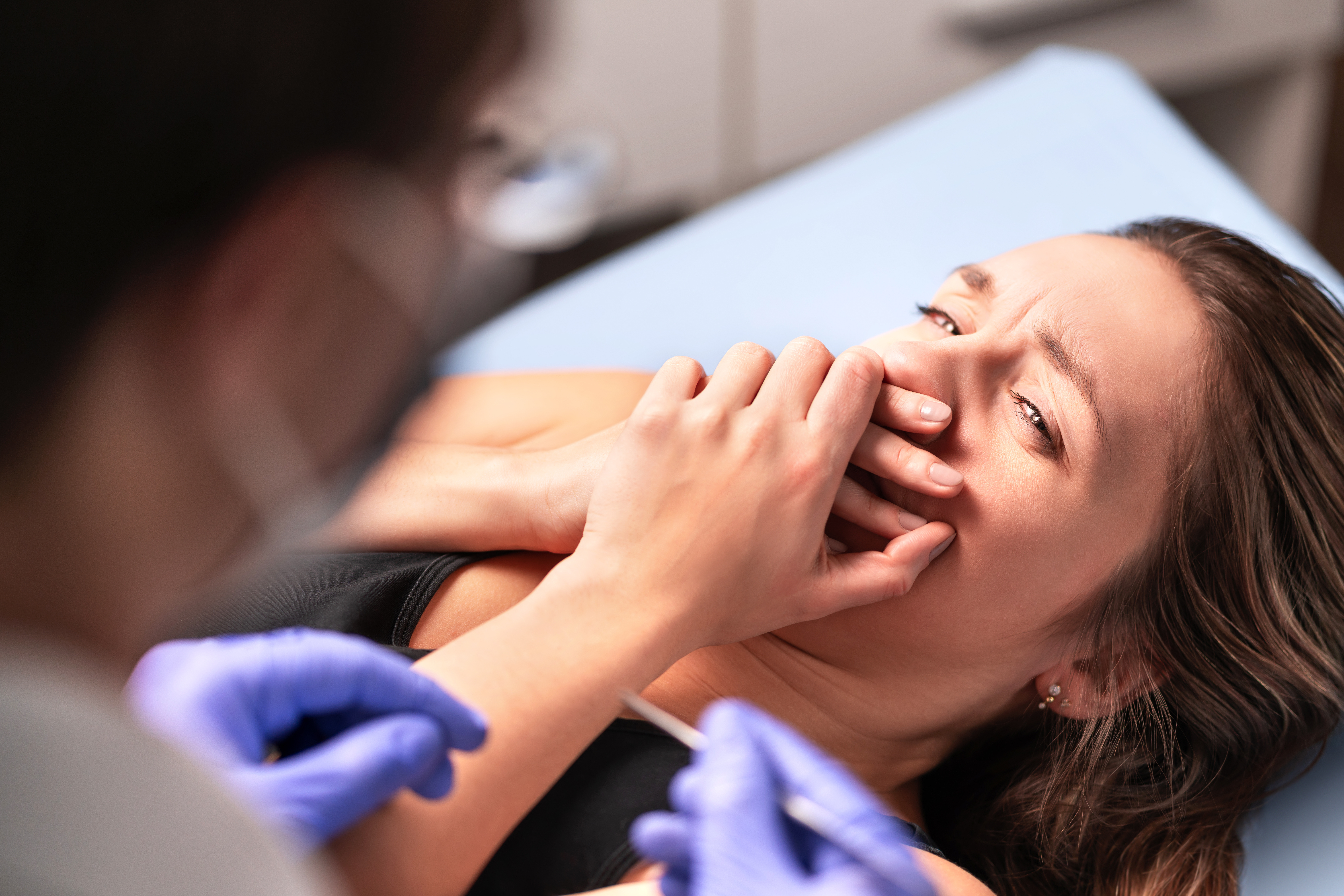
Tomorrow I’m going under the knife (forceps, pliers, whatever) to get teeth removed. I’ve written before about my severe dental phobia, but this time there is no other solution. My teeth are bad; my gums are bad. Hell, even my breath is bad.

For this procedure, I will have IV sedation, which is a great relief. Nitrous oxide has never had any effect on me. I have had IV sedation for a dental procedure once before, so I know it works for me.

Due to COVID restrictions, my husband (my emotional support animal) is not even allowed to come into the building or the waiting room. For other, less drastic procedures, he has even been allowed in the treatment room with me, to pat my foot and offer me encouragement. This time he has to wait in the car until the nurse brings me out. That means he stays in the car for up to two hours while I am worked on. I’m glad he has an e-reader and that it’s recently been updated and charged, but still I would prefer a pat on the foot to knowing he’s several doors and a parking space away.

Oddly, I was not nearly this fearful when I had two operations (microlaminectomies) on my back a number of years ago. Perhaps that was because the pinched nerve caused me untold physical pain. That was pain I could understand. All I have with my teeth is emotional pain. For now. I’m sure physical pain will come later, after I regain consciousness.

My memories of dentists and former dental procedures are not good. There have been both physical and psychic pain, shaming, guilt, assorted bodily reactions, and a creeping physical numbness that had nothing to do with Novocain. I have been through procedures both with and without IV sedation. I’ve had my wisdom teeth removed, and another tooth removed and replaced with a partial bridge. I had a tooth that broke and I had a tooth bonded in place, designed to get me through a month or two until I could do a reading from my book. Through careful eating, I made it last five years.

Now, though, there is no getting out of it. I was unable to get these expensive procedures in the past because of a lack of money. Now I don’t have that excuse. Money has been set aside and no other emergency has arisen that requires using it for something else. Needless to say, my insurance doesn’t cover this, and especially not the traveling anesthesiologist. Once I had to abandon fixing my teeth because our transportation gave out, but that’s not a problem this time.

Do I want to get out of it? Yes and no. Dentistry is one of my major phobias (which has no doubt contributed to how bad my teeth are). This has been true since I was a child, and has only grown more extreme. It would be understating the matter to say dental procedures are a major trigger for my anxiety and panic attacks.

I’m also unnerved by how the procedures will resonate through my life for an unknown time. That dental bridge was a significant factor in my self-esteem. If I forgot it, I had to turn around and go home. More tooth extractions will no doubt feed into my isolation. And then there’s the indignity of eating applesauce, soft-boiled eggs, and chicken broth until my poor, abused gums heal. As little as I leave my house now, I will be even less willing to do so for quite some time.

So, wish me luck. Both my husband and I are taking a few days off work, on the theory that the sedation and analgesics may leave me woozy. At least I will be able to keep up with my blogging, since that doesn’t require going outside.

I’ll get through this. But I’m afraid it will leave my emotions as disordered as my mouth.

What Is Bipolar Disorder Like?

There are a number of metaphors that try to express what it’s like to have bipolar disorder, and none of them is accurate. Thanks to television commercials for bipolar medications, we have even more metaphors, none of which express the reality of the disorder. Maybe, at heart, it is futile to try to come up with a metaphor. The map is never the territory. But let’s examine some of the most common and see where they succeed and where they fail.

Depression

The Black Dog

Winston Churchill was notoriously given to episodes of depression, and he referred to them as “The Black Dog.” It would come and go, but when it was with him, he descended into the depths. (Of course, this did not prevent him from becoming Prime Minister of England and making significant policy decisions and speeches during World War II.)

Dementors

J.K. Rowling has said that the soul-sucking monsters that appeared in the Harry Potter books were metaphors for depression, being able to remove not only joy and happiness from a person’s soul, but the memories of those emotions, and the possibility of ever feeling them again. (Incidentally, once out of the Dementors’ grasp, chocolate is said to help the person recover.)

Masks

This one is popular in TV commercials. A woman (almost always a woman) holds a smiley-face mask in front of her face to cover up her sad expression. Then, after she takes psychotropic medication, she puts the mask in her purse or pocket and suddenly reveals her own smiling face. Or a stock photo shows one person with a brown paper bag over his or her head with a sad face drawn on with marker. This bothers me because it implies that medication takes effect almost immediately, but I suppose there’s no way to show the six-week lag in TV ads.

Fog

The underlying metaphor here is being lost and being unable to find your way out. Everything around you is gray (and most likely rainy) and indistinguishable. It’s difficult to impossible to find your way through. This is actually a fairly accurate metaphor for severe depression or a major depressive episode. The sense of futility, of immobilization or being lost, of being unable to see a way out, is common to people with depression.

Anxiety

Skin

One of the most common sensations reported by people with anxiety is being about to jump out of their skin, or feeling itchy or twitchy all over. The itchiness or twitchiness may manifest in actual physical symptoms, in which case they’re a perception, not a metaphor anymore.

Electricity

The feeling of shocks running through the body or the brain is another way we describe anxiety. It can feel like jolts of current that only add to the twitchiness or agitation.

Indecision

Sometimes the paralyzing side of anxiety is represented by having too many choices or being unable to decipher a map. Instead of being agitated, the person is stymied and motionless. Make no mistake, this is a symptom of anxiety as much as it is one of depression.

Mania

House of cards

This metaphor comes to us thanks to a TV commercial. A person suffering from mania confronts a pyramid made of playing cards, climbs it, and keeps climbing until there are only a few cards left, with the idea that they will ultimately tumble. There’s no indication, though, that the person with mania built the pyramid of cards themselves, and the medication kicks in before the stack ever falls.

Soaring

The feeling of flying is often associated with mania. Soaring far above the mundane and the insignificant, the person with mania feels a sense of grandeur and empowerment, the ability to do anything – and to sustain it. Of course, sustaining the feeling never quite happens. Persons flying high with mania never see the inevitable crash that is coming.

Bipolar Disorder

Playground equipment

The seesaw. The teeter-totter. Even the swings. These metaphors certainly catch the up-and-down, back-and-forth motion of bipolar cycles. There are just two things wrong with these metaphors: They portray movements of equal length. And they’re fun. Bipolar moods do not come on a schedule or last a predictable amount of time. And there’s nothing fun about bipolar disorder.

Rollercoaster

A rollercoaster is perhaps the most common metaphor for bipolar disorder. It improves on the playground equipment analogy some. A rollercoaster, like bipolar, can be scary, especially the first time you experience it. It does involve up and down motions of unequal length. But the rollercoaster has the process backward. The climb up is slow, not an exhilarating whoosh. The swift ride to the bottom is the exciting part, which of course it isn’t. And, of course, once you’ve been through the whole route once, you have to get off and pay to get on again.

We use these metaphors because it’s almost impossible to convey what bipolar disorder is like to someone who’s never experienced it. And they can never convey the reality. Among those of us who have experienced the disorder, we use them as shorthand to describe the feelings we share, at least to some degree, with one another and with others, in hopes that they’ll “get it,” even just a bit.

But language has its limits, especially when it comes to describing what’s going on with our brains and emotions. Sometimes metaphors are as close as we can get.

When Your Thoughts Run Away With You

Overthinking. It’s something we all do at times – so many of us that it cannot really be said that it is automatically related to mental illness. But in some cases, it is a symptom.

Let’s start with depression, a subject about which I know a thing or two. When I was in a depressive phase of my (undiagnosed) bipolar disorder, I could, as the saying goes, overthink a ham sandwich (once I actually overthought a BLT). When I was depressed and/or anxious, it seemed as though I had a recorder in my head that would play back for me every stupid thing I had ever done – even such a small thing as handing the wrong person a glass of water. At random moments, the memory would pop up, usually with full color and sound, and I would again castigate myself for being so stupid.

I agonized over decisions. Should I call a friend to tell him or her about a phone call I received that might affect them? One time it was the right thing to do, with positive consequences. Another time it was also the right thing to do, but with negative consequences. Dilemmas like that made it even more difficult to know what to do. Indecision paralyzed me. When I couldn’t figure out the consequences ahead of time, I couldn’t know if my decision was correct. Of course, this is true of most people and many decisions, but the dilemma would derail my thoughts and leave me vacillating.

Intrusive thoughts are quite often symptoms of depression and bipolar disorder, and they can be valid or nonsensical. Are my children getting an appropriate religious education? Where is my passport (when no trip is remotely planned)? They can keep one awake at night.

Psychologically speaking, overthinking and intrusive thoughts are definitely symptoms of OCD. Did I lock the door? Better check three times. Did I leave the stove on? Better check four times. Has the milk in the refrigerator expired? Did my cat get out the door when I wasn’t looking? Better go out and look around. Will I throw up when I ask my boss for a raise? Better not try. Does my aching knee mean I’m getting arthritis? Should I call my doctor about it? Will he think I’m imagining it? My mother only loves me because she’s my mother, not because of who I am. These kinds of thoughts can be disabling, crippling, or at the very least painful. They can cause you to doubt yourself and everything you do.

In mania, overthinking comes later. While you are spending or gambling or having risky sex or driving recklessly you don’t question it. It’s only later, when the episode wears off, that you have intrusive or obsessive thoughts. Oh, my God, why did I do that? How can I ever pay for all that? Are my finances so screwed up now that I can’t pay my rent? Did I binge drink and hurt someone? I’m so ashamed. I feel so guilty.

Cognitive Behavioral Therapy (CBT) may be one way to confront your intrusive thoughts and push them aside in favor of more productive thinking. Talk therapy of the usual sort may help you develop coping mechanisms for when your thoughts run away with you. And psychotropic medication may lessen or eliminate the underlying problem that causes you to have intrusive or obsessive thoughts. In my case, it was the latter two. I still get stymied by some decisions, but I don’t lie awake and think about them. I discuss them with someone else (my husband, my therapist) to get feedback. Then I make a decision and stick with it, or move on to thinking about something else.