Having Pets and Service Animals
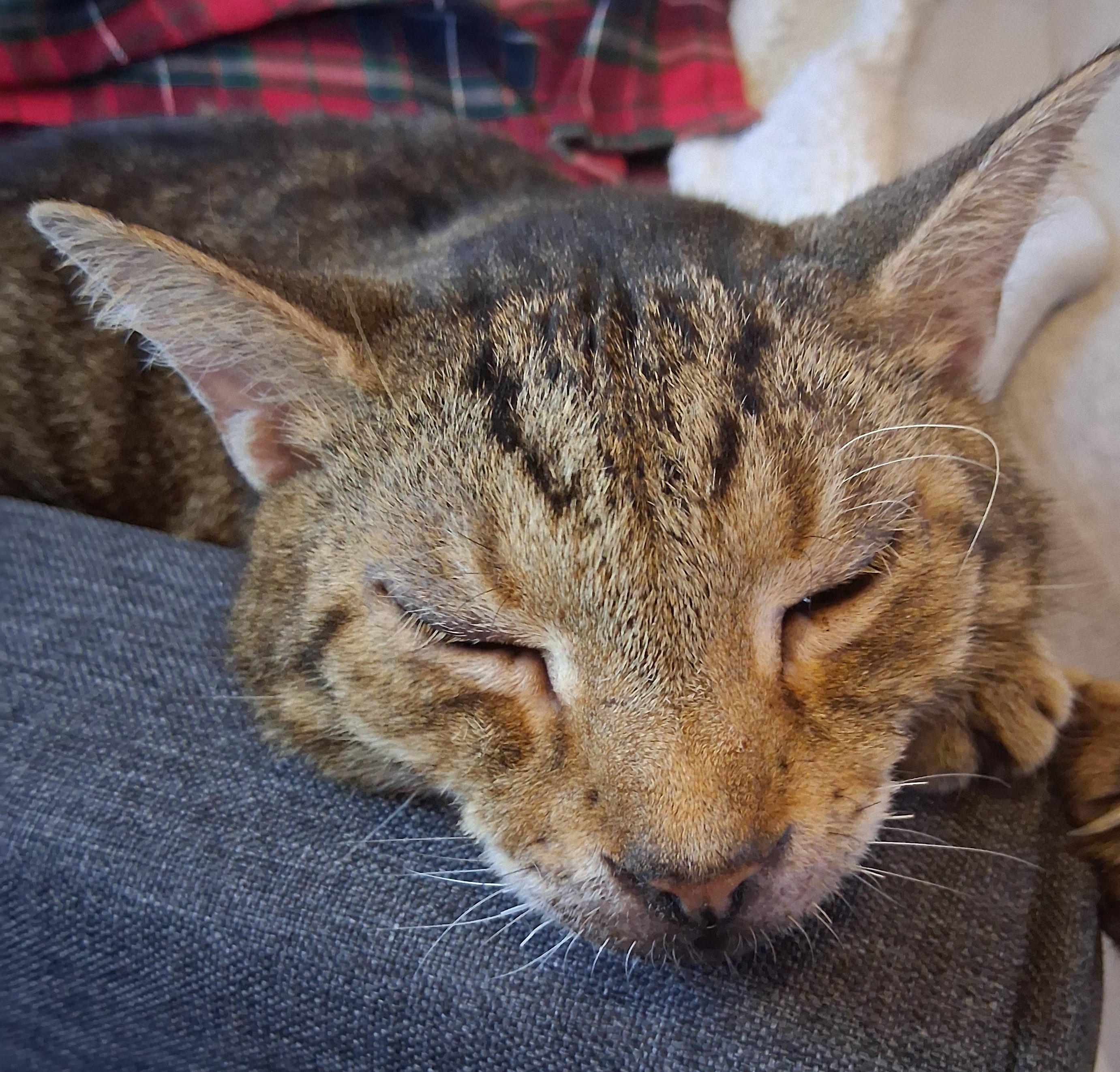
I’ve had cats for a little longer than I’ve been married. That’s more than 40 years. I’ve also had bipolar disorder 2 at least that long.
For me, the two go together. My cats give me things that help me through my difficulties—companionship, amusement, distraction, fascination, and, yes, even love. (I know cats are rumored to be aloof, but mine have been very affectionate. Maybe that’s just the kind of cat I bond with.)
I love it when they purr, of course, and when they nestle on my lap, but I also find it soothing to watch them wash themselves. I especially love it when they trust me enough to roll on their back, show their belly, and accept a belly rub.
I also know the difficulties. When you can’t even get out of bed, when you can’t make yourself eat, when you can’t take care of yourself, it’s hard to take care of another being. Even the very basics—feeding and watering, cleaning the litter box, or in the case of dogs, walking them—seem like just too much. You don’t want to bring an animal into that environment.
On the other hand, tending to the needs of another being can provide a reason to get out of bed, to keep moving. I have even heard of people who say that not wanting to abandon a pet has kept them alive.
But then, there’s the inevitable parting. It can rip your heart apart. You can grieve for weeks or more. You will swear you’ll never get another pet, but one day you do.
Dogs and cats are the most common companion animals, but birds and fish, rabbits, pot-bellied pigs, and even Guinea pigs and hamsters are good choices. Cats and dogs are the most demonstrative, but all pets need care.
There are also animals that can live with you and provide special support for you. These support or service animals can meet your needs for companionship and more. There are different types of these animals, with different functions and different requirements.
Emotional Support Animals
- An ESA can be any pet that has a positive effect on your emotional state, such as calming you down when you’re anxious or agitated. Dogs and cats are the most common ESAs.
- The Fair Housing Act requires landlords to allow ESAs even in pet-free buildings, and they are not allowed to charge extra for having the animal.
- Landlords, however, may require a letter from a psychiatrist or doctor stating that you need an ESA.
- ESAs do not require any training or certification.
- ESAs are not allowed in businesses or restaurants that have a “No Pets” sign.
- ESAs must fly as pets in airplanes, which usually means in the cargo hold.
ADA Regulations for Service Animals
- A service animal is any breed or size of dog that is trained to perform a task directly related to a person’s disability.
- They’re not required to be certified or go through a professional training program. The training can be provided by the owner.
- They’re not required to wear a vest or other ID that identifies them as a service dog.
- Many communities maintain a voluntary registry that serves a public purpose, for example, to ensure that emergency staff know to look for service animals during an emergency evacuation process. Some offer a benefit, such as a reduced dog license fee, for individuals who register their service animals. Registries for purposes like this are permitted under the ADA. An entity may not, however, require that a dog be registered as a service animal as a condition of being permitted in public places. This would be a violation of the ADA.
- Examples of services that a service dog may perform include, but are not limited to: retrieving objects for a person in a wheelchair; reminding a person with depression to take their medication; alerting a person with PTSD of an oncoming panic attack; detecting the onset of a seizure in a person with epilepsy and making sure the person remains safe during the seizure.
- Service animals are allowed to go with their person into restaurants and businesses, even ones that do not allow pets.
- The only questions a business owner may ask are whether the dog is a service animal required because of a disability, and what work or task the dog has been trained to perform. They cannot ask what your disability is.
- A business can ask that a service animal be removed if the dog is not housebroken or is out of control and the person cannot get the dog under control.
- The Fair Housing Act, the Air Carrier Access Act, and the Equal Employment Opportunity Commission, not the ADA, cover service animals in those situations.
- State and local laws may require service dogs to be licensed and vaccinated, if all dogs are required to be licensed and vaccinated.
Psychiatric Service Animals
- Psychiatric Service Animals are a type of service animal covered by the ADA and the above regulations.
- People with the following conditions may have Psychiatric Service Dogs: anxiety and panic attacks, clinical depression, phobias, bipolar disorder, ADHD, OCD, PTSD, schizophrenia, or autism.
- Some tasks a Psychiatric Service Dog may be trained to perform include: interrupting repetitive or self-harming behaviors; reminding the person to take prescribed medication; creating a physical buffer or “space” in crowded areas; or waking the person from night terrors.
- To get permission to own a Psychiatric Service Dog, under the Fair Housing Act, landlords may request a letter from a licensed healthcare provider verifying the disability-related need for the assistance animal.
- Psychiatric Service Dogs need to be trained to perform tasks related to the person’s psychiatric disabilities.
Many places online provide training, registration, or certification for service animals, but these are not required under the ADA. Persons with disabilities have the right to train their own service animal. Vests, badges, or other identifying harnesses or markings that identify the dog as a service animal are not required.
You should be very cautious about an organization that provides training for service dogs. They are not required, as you may train the animal yourself. But they may prove helpful in training your animal. It’s up to you.
No one should order a service animal vest over the internet and use it with an untrained pet just to get them into places where only legitimate service animals are allowed. ESAs DO NOT qualify for this accommodation under the ADA. It also weakens people’s respect for ADA-approved service animals.
 Janet Coburn


Recent Comments