Bipolar 2 From Inside and Out

Posts tagged ‘bipolar type 2’

Love, Hate, and Mania

Mania, or in my case hypomania, is easy to love. It creates a buzz that carries you along, although you’re not always sure where to. Ordinary things become extraordinary, and extraordinary things become magical. I love mania. It can be fizzy, like champagne.

I hate mania, too. When it leaves, it leaves a hole behind. It leaves depression that’s like a nasty hangover. And many times, it can leave consequences. Sometimes dangerous. Sometimes shameful. Always unexpected.

I’m in the grip of hypomania right now. I recently got through a series of medical difficulties. Now, I’m back home, and not dependent on nurses and aides to bring me meals and wipe my ass. It’s glorious. And I’m celebrating by enjoying a burst of benevolence. It’s holiday time, and I’m back to my computer with a debit card and a desire to shop. That gives me an excuse, if not a reason.

I’m buying gifts for Dan and a few friends. I’ve bought so many for Dan that, now that the packages have started arriving, even I am a bit embarrassed. Fortunately, he has a birthday in April, and I can save some of the gifts for that.

In the past, Dan had the advantage. He could follow me around and watch what I oohed and aahed over, then sneak back and get it for me. But I am buying exclusively online now because I rarely go out. Dan doesn’t know how to buy online. I’ve offered to show him, but all the financial stuff goes to me, so I’d know where he bought stuff and how much he spent on it. This leaves only the store where he works to buy gifts. And he says he doesn’t know what to get me anymore, as I spend most of the day in pajamas and don’t wear earrings at home, so clothes and jewelry are pretty much out.

Anyway, I’m definitely manicky. I can tell. And I’m definitely spending more than I should. Fortunately, I just got paid for a freelance job I did, more than I usually get, so I haven’t gotten us into financial trouble, though it was a close thing. The check came just in time.

So. I’ve loved buying presents. I hate that I almost overdrew the bank account. I’m happy that I was saved by a check. I hate that the shower of presents may embarrass Dan, who won’t be able to reciprocate in a like manner.

Manic and hypomanic episodes are like that. A buzz and then self-doubt. A thrill and then regret.

I used to wish that I had mania too, instead of just depression. My theory was that if I were manic, I would get more accomplished. But I once knew a woman who had bipolar 1, rather than 2, so her manic episodes were more extreme. And her plans crashed and burned around her. She would start a project, tear it up, and redo it, even more than once. Her sense of humor was extreme and not really funny. (Once she mimed swallowing a whole bottle of pills.)

After that, I no longer wanted to be manic. But, as it happens, when my depression stabilized, my hypomania had more room to express itself. I haven’t indulged in the more dangerous behaviors, like drinking and driving. But this month, I can’t deny that I have hypomania.

I’m getting better at telling when it’s going to happen. Once I’m in the episode, I know. I feel the buzz. I notice the bank account dwindling.

Dan notices when I’m getting manicky, too. I can usually tell him that I feel it coming on and check it out with him. But this time, secrecy was part and parcel (literally) of it. Once it was getting beyond my control, I told him. Not about almost overdrawing our account, though. Once there was money back in the bank account, it didn’t seem necessary.

I’m not quite over this episode. I’m cooled down enough to rein in the buying. Just a couple more small presents for friends. I swear. It’s progress, anyway.

My Two Diagnoses

For all my childhood, I assumed I had depression, though I didn’t know that it was a psychiatric diagnosis. I was always a moody child, given to bursting into tears at the slightest provocation.

My first really major depressive meltdown came when I was humiliated by another child at a birthday party. I ran home, curled up in a beanbag chair, and sobbed for days. The only thing that snapped me out of it was the fact that my mother was being hurt by it too. She was crying too and had no idea what to do about my emotional implosion. At that point, I went down the street and yelled at the girl who had instigated the incident. (I suppose this could have been bipolar rage. I was pretty incoherent.)

I still remember this event as clearly as when it happened.

Another time, some friends were making fun of the way I laughed. Without saying a word, I got in my car and drove home, removing myself from what was distressing me. They followed me home and apologized. Then, I practiced laughing until I came up with something more acceptable. I think I accomplished it, though who really knows?

In my college years, I spiraled further. I was prescribed benzos for a TMJ problem, and I was in such a bad emotional place that I supplemented them with wine. There was some risky sexual behavior, too. It was the first time I recognized that I had a hypomanic episode. After I got out of the situation, I stopped relying on the benzos. (Actually, I had first experienced benzos in my junior high school years, when they were prescribed for an uncontrollable tic.)

Eventually, I went into therapy where I was diagnosed, as I expected, with depression. I continued that way for years, being prescribed various medications but still having symptoms.

Finally, I went to a new psychiatrist who, after some time, said he thought I had bipolar disorder. Eventually, we found a drug regimen that worked to alleviate my symptoms to an acceptable point.

I was still having symptoms, though, before the right cocktail was achieved. I was unable to work, get out of bed, or do much of anything, unhappy all the time. I applied for disability—and didn’t get it. When I got my file from Dr. R., I saw that my diagnosis was actually both bipolar and anxiety.

That threw me for a while. But looking backward and forward, I realize that he was right. I had anxiety episodes when I was a kid, usually regarding finding and keeping friends. I was terrified when my high school counselor suggested therapy. (I declined.) I panicked when it looked like I would have to go to community college instead of a four-year school, which I had always assumed was in my future. When I did get to that college, I had a mixture of the depression and anxiety, and took a year off to work and reset my brain.

Now, years later, my bipolar disorder is largely under control. But the anxiety haunts me to this day. I am anxious about family finances (which I am in charge of). Many nights my brain won’t shut up and I can’t sleep. (Sometimes it won’t shut up about the unfortunate episodes in my past.) I had massive anxiety recently regarding a trip to Florida.

So, I think Dr. R. was right when he diagnosed me with bipolar and anxiety. One has been tamed, but the other lingers. I am now working with Dr. G. to help me alleviate the anxiety without letting the bipolar kick up again. It’s a delicate balance.

My Brazen Hussy Phase

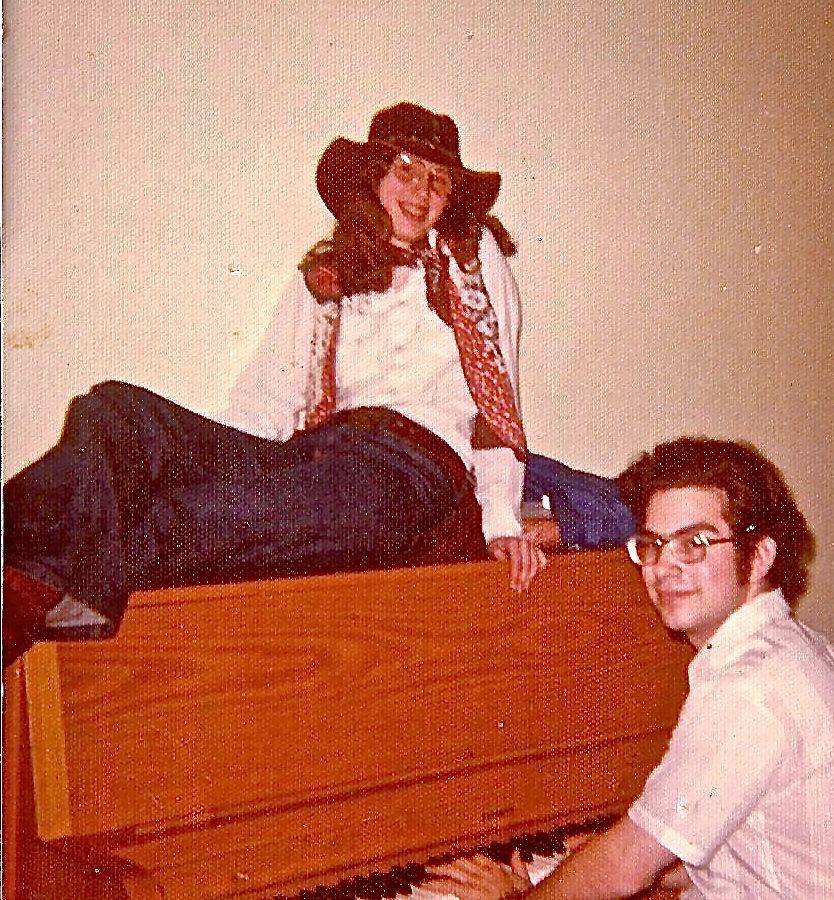
This is me in my Brazen Hussy phase, back in my college days. The piano player is a friend that I sometimes went places with. (We tried dating once, but it was a total bust.) We decided to recreate a saloon girl-type photo at the piano in the student union building. There was a lot of hooting and cheering as we got in position. I didn’t have a saloon-girl outfit, so I dressed Western instead. The vest was one my mother made for me out of various calico fabric scraps. I don’t remember just when or where I got the leather hat, but it went with me throughout college and beyond.

My Brazen Hussy phase was the first time that hypomania hit, except for the many times that it appeared as anxiety before I went to college, and after.

As many people do the first time they experience hypomania, especially the sexual kind, I rather enjoyed it. I flirted and dated, which I never did in high school. I joined a sorority and went to frat parties. I enjoyed my first kiss and then many more. I had a mad crush on a musician and eventually got to know him too. He was exciting and passionate and awakened something in me that never even seemed to exist before. When he broke up with me, I went into a deep downward spiral. I won’t say that was why I took a year off college, but I was confused about my future, and that surely didn’t help.

Back in my hometown for the next year, I got my hypomanic mojo back. I engaged in what I knew was a risky relationship with a coworker. I kept up with him for years and told him about my former life as a Brazen Hussy and about my depression. We went out during the former and he stuck with me through the latter. But he always said he wanted Brazen Hussy Jan rather than timid, depressed Jan.

I was back in Brazen Hussy mode when I met the man who would become my husband. We were with a couple of women who already knew him and greeted him with a kiss. “Don’t I get one too?” I asked boldly and got one. He kissed me again around the campfire and followed me around all weekend. I basked in the attention. It was exactly what I needed at the time.

Shortly thereafter, I moved back to my hometown. But we conducted a long-distance relationship until finally he moved out to be with me and, eventually, we married.

I won’t say I never went back into Brazen Hussy mode again. Hypomania still affected me. I still got mad crushes and flirted outrageously. Finally, however, I was diagnosed with bipolar and properly medicated. I won’t say the Brazen Hussy mode went away entirely, but episodes were fewer and further between and easier to understand.

I didn’t originally mean this post to be so confessional, but hypomania and hypersexuality are a very real part of bipolar disorder that I didn’t miss out on in my younger years. And that I sometimes miss in my later years. I know that not having those surges of intense feeling is better for me. Nowadays, however, when my bipolar disorder kicks up, it’s generally bipolar depression. I’m a lot more settled now and don’t have much room in life for hypomania. When I experience it now, it usually manifests as anxiety again or mild euphoria and overspending.

But I’d be lying if I said I didn’t miss my Brazen Hussy phase from time to time.

Bipolar Robbed Me of Reading

I don’t remember a time when I couldn’t read.

Except when bipolar disorder took it away from me.

I was what they call a “natural reader” – someone who learns to read without being taught. Someone who just picks it up out of the air. And for me, reading was like breathing. It kept me going, kept me alive. Reading was part and parcel of my identity. I was never without a book within reach. I read while eating, walking down the hall, going to sleep, riding in a car. (Fortunately, I didn’t get carsick.)

Throughout my undiagnosed childhood years, reading was a way for me and my brain to play nicely together. If I was depressed, I could lose myself in escapist fantasy. If I was hypomanic, I could soar on adventures. And during the in-between times, I had access to unlimited worlds – places, people, situations, ideas, conversations – both familiar and strangely new. Reading was my joy and my solace.

For many years, reading was therapeutic. I could not only lose myself and escape the unpleasantness of my disorder for a time, I could learn more about depression and bipolar disorder, compare my experiences with those of others who struggled with mental illness, discover how medicine and law and psychology and sociology could shine a light on my experiences. I could even (God help me!) read self-help books, which were popular at the time, and learn all sorts of theories and techniques that didn’t improve what was wrong with me.

Books and words were my life. I got degrees in English language and literature. I read for work and for fun. I edited magazines, wrote articles and (occasionally) children’s stories, and worked on textbooks.

Then my brain broke and reading went away.

I had a major depressive episode, which lasted literally years, and during that time I found it nearly impossible to read.

Why? My old companions, depression and hypomania.

Depression made me dull. I didn’t care about anything and found no happiness even in the books that had always been my refuge. I remember picking up a book that I more than loved and had returned to dozens of times, that had shaped my life in many ways, thinking that the familiar words would touch something still buried inside me. But this time there was no magic. Not even interest. The words were flat and dull, mere ink on the page or pixels on the screen. Reading – engaging with an author’s ideas, imagining characters, following plots and dialogue, discovering facts – was beyond me.

And hypomania? My version, instead of bringing euphoria, brought anxiety – an overwhelming twitchiness and fear of the unknown, jumping not just at shadows, but at the idea of shadows, things that had never happened. My attention span shrank to nearly nothing. I could barely read a few pages, not even a chapter, and when I was finally able to get back to a book, I was lost, disconnected.

Now that I have recovered from that episode, I am glad to say, I can read again. I read myself to sleep at night once again instead of crying myself to sleep. I devour entire chapters, keep at least two books going at once (one fiction, one nonfiction), delight in revisiting old favorites and seeking out new authors and genres (YA fiction and steampunk, recently) and topics. I’ve even picked up that beloved fantasy trilogy again and been swept away once more.

Not everything I read is uplifting. At the moment I’m deep into Cult Trip, a horrendous true account of an abusive sex cult in New Zealand. But I can tell when it’s getting too deep and frightening and switch over to Jasper Fforde’s Thursday Next literary fantasy Lost in a Good Book before the awful realities can drag me down.

And I can tell you this: It’s better to be lost in a good book than lost in your own broken brain.

Brain vs. Brain

Having bipolar disorder is like having cognitive dissonance all the time.

What is cognitive dissonance? When people ask, I usually describe it as when the two halves of your brain slam forcefully into each other and give you a brain-ache. It’s also known as “brain go ‘splodey.”

Take, for instance, the time when I saw excerpts from the musical Cabaret, with the dancers portrayed by women of at least 65. As I reeled out of the theater, my mother saw the dazed look on my face and said, “Don’t you like Cabaret?”

“I love Cabaret!” I replied. Meanwhile, the other side of my brain was saying, ”Oh my God, if they had tried to do the Bob Fosse choreography, someone would have broken a hip for sure!” Slam! Pow! ‘Splodey! Cognitive dissonance.

You can probably see how this relates to bipolar. One half of your brain says, “If you just take a shower, you can go out to lunch.” The other half says, “A shower?!? First I have to find a clean towel and a bar of soap, get undressed without seeing myself in the mirror, fiddle with the water temperature, wash and shampoo, dry off, find clean underwear, and that’s not even thinking about drying my hair and figuring out what I can wear! Oh, my God, I’ve used up all my spoons just thinking about it! I should just eat Cocoa Puffs and go back to bed.”

Instant cognitive dissonance.

Or try this scenario: You see on your newsfeed that the government is considering a new law with a feel-good title regarding mental health issues. “Hooray!” one side of your brain says. “At last! Everyone should support this fabulous bill!” Then you look at the whole article and find that one provision in the bill allows violating the privacy protections of HIPAA, as an example.

“Oh no!” the other half of your brain says. “Any person, even one who’s mentally ill, has the right to medical privacy. What if an abuser gets information about his victim? I’ve got to write a letter protesting this bill. Where are my spoons? Did someone steal my spoons?

There are lots of these situations, hence the near-permanent state of cognitive dissonance.

I want to be around people but I don’t want to talk to anyone.

I want to be left alone but then I’m lonely.

I really want to make love to my partner but I can’t get aroused.

I want to be cured but I hate the idea of being “normal.”

That degree of cognitive dissonance is positively exhausting. No wonder we never want to do anything but lie in bed, not read, not interact, not reach out, not try to do anything but survive another day.

If we think too hard about anything, our brains may go ‘splodey.

I Love/Hate My Brain

My brain is special and magical. It makes me who I am and has often seemed to me to be the best part of who I am. I have always been intelligent and a quick learner. And I thank my brain for that.

On the other hand, my brain is deficient in some ways. It doesn’t have the correct balance of neurotransmitters (or has been adversely affected by trauma as I’ve lived my life or inherited from my parents). When it comes to bipolar disorder, I blame my brain. It’s glitchy, unpredictable, and guilty of making my life miserable at times.

So, I have cause to both love and hate my brain.

The thing is, I have no control over either of those perspectives. I didn’t make my brain smart and adaptable. I can’t take credit for that. I also didn’t make my brain misfire and become my biggest enemy. I can’t take the blame for that.

Much of what I am, my brain is responsible for. I am a moderately successful writer. That can be attributed to my brain as well. I’m creative, too, another quality that resides in my brain. But when I’m depressed, I lose the ability to write, and when I’m hypomanic, I lose the coherence I need to write well. It would be easy enough to say that I love my brain when it’s functioning well and hate it when it’s not. That’s not completely true, though. I’d have to say that my brain is my frenemy.

I am notoriously moody and difficult – hardly surprising since I have bipolar disorder. My intellect doesn’t go away when I’m depressed or hypomanic, but sometimes it goes into hibernation. It makes poorer decisions, it’s true. It’s led me astray many times, even to the edge of death. And I can’t always recognize when it does that. My brain is not the best gatekeeper of my behavior. But my brain does help me clean up the consequences when it does occur.

There is currently a great debate on whether bipolar disorder even comes from the brain. It may not be because of my neurotransmitters, though I still consider them complicit. It may be because of my childhood trauma (at the hands of children my age, not my parents). But again, trauma is said to make physical changes in the brain, so perhaps it is a brain-related reason as well. The other prevailing theory is that bipolar disorder has a genetic component. I don’t know if that means that my genetic heritage affected my brain development, though I suppose it could have. I just don’t know.

I do know that it feels like my brain is at fault. Bipolar is, after all, a mood disorder, and I don’t know where my moods reside, if not in the brain.

So, what can I do with my brain to increase the love and lessen the hate? First, I try to keep my brain fed. I read every day and play jigsaw sudoku to keep it lively and stave off dementia – and to stretch my brain because so much of what I do is word-related, not mathematical. My reading is varied, from novels to nonfiction. I revisit beloved novels from my past, which keeps me grounded in who I am, and explore new books and authors I find, which keeps me excited and open to the new. I try to lessen the opportunities for hate by keeping my brain stable with medication, therapy, and listening to my husband and my friends when they tell me I am loved.

On balance, I love my brain more than I hate it. But I have to keep an eye on it (as it were) to make sure that the hated half doesn’t take over.

Keep This Blog Alive!

Choose an amount

¤2.50
¤5.00
¤10.00

Or enter a custom amount

¤

Your contribution is appreciated.

Donate

Three Days in the Life

What’s it like to have bipolar type 2? Here’s a look at three typical days.

It’s a day when I’m depressed. I wake up late and try to decide whether to get out of bed. I do so in order to take my meds, since I have to go to the bathroom anyway. If I have anticipated this depression, I will have left a box of Cocoa Puffs by my bedside, and these constitute my breakfast.

If I stay in bed all day, I am bored, because I can’t even focus enough to read. Everything I try to read means nothing to me. If I get up, I spend a large part of the day on the sofa, watching horrible reality shows that remind me that there are other people with crappy lives too. I skip lunch. I forget that I have an iPod with thousands of songs on it. I skip therapy appointments because I’m unable to get up and dressed and drive there. I feel numb and useless and pathetic. My brain reinforces this belief.

In the evening, I cry. I weep. I sob. Snot runs from my nose. I have circling thoughts about every stupid, embarrassing thing I’ve ever done. I try to wait till my husband’s asleep so he won’t hear me crying. I wake in the middle of the night, still crying.

I have anxiety attacks too, particularly when I’m in bed at night. I wake gasping. My husband holds me and strokes my hair until I fall asleep again. It’s really all he can do for me.

My psychiatrist and I keep trying different meds, but none of them does more than take the edge off a little. I still can’t function.

There is nothing I can do to change any of this. I can’t cheer up. I can’t even see a time when I won’t feel this way. This goes on every day for months. For years, even. I’d hope for an end to this, but I have given up on hope.

______________________________________________________

It’s a day when I’m hypomanic. I wake up early, not exactly refreshed, but with a more-than-usual alertness. I take my meds, then go downstairs and have a muffin and a container of yogurt for breakfast.

I go to my computer and start writing. I may have an assignment – typing or ghostwriting – or I may just work on new blog posts. The momentum of writing stays with me and presses me to keep going. I write lots, but badly. Maybe I forge ahead and write another blog post or volunteer for more typing. I forget that I need lunch.

I jump around from project to project. I scroll and scroll through Facebook. I check my email every few minutes. I go to clothing websites and order underwear and pajamas and blouses. I look at jewelry, too. I check my bank account at least four times.

I don’t read, because nothing holds my attention. I watch competition shows because of the excitement. I try to listen to music, but I can’t finish one song without flipping to another.

I may notice that I’m hypomanic and try to control it. This goes on for a week or so. I hope it ends soon.

______________________________________________________________

It’s a day when I’m stable. I wake up after nine hours of sleep and take my meds. I have a bowl of oatmeal and a cup of tea for breakfast. I check my calendar and see what I have scheduled for the next few days, such as an appointment with my therapist or finishing my writing or typing assignment. I have peanut butter and fruit for lunch.

I do my work. I reread what I wrote when I was hypomanic and immediately start revising it – if I haven’t already submitted it. I take on new assignments and try to space them out so they’re not overwhelming. Sometimes I even succeed. I keep a calendar on my computer with dates of appointments for both me and my husband, when assignments are due and when bills need to be paid, and which week is recycling week.

I meet with my therapist once a month via video chat and see my psychiatrist four times a year for medication updates. The only time I miss one of those is when my car is at the mechanic.

I’m very close to “normal.” I hope this goes on forever.

This post first appeared on The Mighty.

Keep This Blog Alive!

Choose an amount

¤2.50
¤5.00
¤10.00

Or enter a custom amount

¤

Your contribution is appreciated.

Donate

The Difference a Diagnosis Makes

I thought I had depression and that’s what I was first diagnosed with. Later, I learned that I really had bipolar disorder, type 2, with an anxiety disorder on top of it. Here’s what I learned on my journey to a proper diagnosis.

Understanding. Once I was diagnosed with bipolar disorder, a lot of things from my life started making more sense. I finally realized that some of the inane things I thought and did as a child/teen were attributable to hypomania. Being idiotically happy when I won a goldfish at a carnival, carrying it before me, grinning like a loon. Near-constant mirth when I read a novel parody, laughing long and loudly every time someone used a word or phrase that reminded me of it. Luckily, I didn’t have any money to spend, or I would have done that too, based on my later behavior. Even things I did as an adult before my proper diagnosis made more sense – flight of ideas, pressured speech, and the like.

Second opinion. Going to a different psychiatrist and finally getting the right diagnosis was, in many ways, like getting a second opinion. We don’t often hesitate to get a second opinion on matters concerning our physical health (and insurance companies may require it). Why is it different when it comes to our mental health? I’m not saying that doctor-shopping is a good idea or that a diagnosis of depression did me no good at all. It just took a different psychiatrist to put together all my symptoms in a way that made sense to me as well as to him.

The “Aha Moment.” When I got my bipolar diagnosis, it was like a wake-up call. I instantly understood that my psychiatrist was right. Once I had that insight, I was able to explore my actual disorder in various ways – further sessions with him and with my psychotherapist, reading books and reliable online sources, sharing with other people who have the same diagnosis and listening to their experiences.

Getting the right meds. I had been taking medications for depression for many years. Then I learned that I might – did – need treatment with anti-anxiety medications, mood levelers, and other kinds of drugs that specifically targeted bipolar symptoms. I still needed meds for depression, but I needed a “cocktail” of drugs that addressed all my difficulties, not just one.

Going on maintenance meds. The process of settling on that cocktail of meds took a long and difficult time, but once I had the right diagnosis and the right meds, I was able to cut back to seeing a psychiatrist four times a year to get renewals on my “maintenance” medications. The process that stabilized me also allowed me and my doctor to make “tweaks” to the dosages to correspond with increased or lessened symptoms.

A new revelation. My learning about my disorder didn’t stop with my new diagnosis. Recently I learned that my depression could be what is called “dysthymia,” a type of depression that is roughly equivalent to the difference between mania and hypomania in bipolar 2. I wasn’t sure this applied to me, as my depressive episodes seemed long enough and severe enough to be considered major depression, but after consulting my therapist and other reliable sources, I began to see how a dysthymia diagnosis actually did correspond to my symptoms.

Having hope. The most important thing that the right diagnosis gave me was hope. Properly understanding my disorder and the correct treatments for it allowed me to hope that I could achieve stability and healing from all the years when I didn’t realize I was suffering from hypomania as well as depression. I could at last look forward to a life where my disorder didn’t control me. With help from my psychiatrist and the medications he prescribed, I have been able to live a contented and productive life. Work, stable relationships, and the other benefits of having proper treatment are achievable – and I have largely achieved my goals in life.

And my new diagnosis has been responsible for it.

Help keep this blog going.

Choose an amount

¤1.00
¤5.00
¤10.00

Or enter a custom amount

¤

Your contribution is appreciated.

Donate

Releasing Old Ghosts

I don’t know what the proper term is (exorcise? banish? reject?), probably because I don’t believe in ghosts. What I do believe in are memories – persons and situations that haunt you, follow you, and inhabit your dreams.

I’ve had my share, especially of the dreams sort.

When I first got out of a truly destructive relationship, I was undiagnosed with bipolar disorder, medicated with valium (prescribed for temporomandibular joint syndrome) and self-medicated with wine. I was not in good shape.

For a long while, anything associated with that harrowing relationship, I shunned. Rex had like blue spruce trees. I avoided them. He had collected cobalt blue glassware. I could barely stand to look at them. He gave me heart-shaped boxes as gifts. I threw away every one I had, even the ones that were actually pretty and useful. He shamed me for my cooking. I gave it up. I gave up things I enjoyed, things that had been part of me. And I didn’t allow myself to explore things that Rex once loved.

He haunted me. I would have dreams in which I was going to meet him, where I was in a place I knew he might show up. I dreamed I was in his house, with cheerful parties going on around me as I panicked. I would have flashbacks to cruel things he had said, such as an obscene song he had written “in my honor.” Times when he said I had “betrayed his honor” for something as simple as cooking the wrong dish for a gathering. Plenty of others.

Now, it seems, the dreams have faded. I have reclaimed parts of my life I used to enjoy. I have banished things that were only his obsessions. The flashbacks are nearly gone.

What has helped me banish these destructive ghosts?

Time, of course, though you’d be surprised how many years it took. And it was gradual. He didn’t vanish from my brain like a puff of smoke. At times I still remembered music in particular – festivals and concerts we had been to together, the obscene song. (As I write this, they come bubbling up again.)

People. A few even from the time that the relationship was going on, who have helped me realize that I should not have been there, that I should not have gone through what I did, that I should have left sooner. I treasure these people. They saw me at my worst, knew me as I was recovering, and are still my friends today.

Other people – friends I had from long before Rex – have steadfastly remained in or reappeared in my life. I may have been bipolar and undiagnosed when I knew them, but these people stood by me, put up with my mood swings and odd behaviors. They have been part of my support system. And new friends, who have no association with those times, but who have had similar feelings and experiences.

Psychiatrists and therapists – also important parts of my support system for all these years. Ones who diagnosed my illness and medicated me properly so that I could deal with the issues that remained. Ones who helped me realize that I had some good memories from those times, that I could rebuild myself by retaining anything that I liked, that I had tools and techniques that I could develop and use to help me do that. I had done bargello needlework for Rex. I switched to cross-stitch. He called the kind of music I liked shit. I delved even further into it, reveled in it. Having developed a love of cats when I lived with him, I’ve never been without one again.

Love. One of the people I met during the next-to-last weekend of my time with Rex is now my husband. He has been with me through the dreams, the flashbacks, and the memories and has been the mainstay of my support system. And there are other people I love, and who have loved me back.

It seems strange that I was with Rex only a little over a year and it has taken me decades to work to this point where the memories have faded, the ghosts no longer haunt me, when it all seems like simply a bad time that has receded into, if not oblivion, at least only a clog that has slowly been removed from my psychological plumbing.

Now I know the right word. It’s time to flush those ghosts that plug up our mental and emotional systems.

Did this resonate with you? Why not donate?

Choose an amount

¤1.00
¤5.00
¤10.00

Or enter a custom amount

¤

Your contribution is appreciated.

Donate

When Depression Doesn’t Go Away

Back in the day, I suffered from treatment-resistant depression. (This was likely due to the fact that what I had was actually bipolar 2, but never mind that for now.) My psychiatrist prescribed me medication after medication, but none of them worked, or at least not for long. We got into a seemingly endless spiral of trying one drug, adding another, weaning me off one drug and ramping up another, then another and another.

Some of them just plain didn’t work. Others had intolerable side effects, from vivid horrible nightmares to making me feel like I was about to jump out of my skin.

All this went on for certainly months – maybe years. (Memory problems were one of the many intolerable side effects.)

Eventually, my doctor reached the correct diagnosis, and then there were months of trying medications that were targeted for bipolar disorder instead of plain depression with anxiety. Again, nothing worked, or didn’t work adequately.

Nowadays, there are non-pharmaceutical methods of coping with treatment-resistant depression, including ECT (better known as electroshock), TMS (transcranial magnetic stimulation), and ketamine treatment.

I never had any of these treatments, since my psychiatrist and I finally worked out a drug combo that brought me back to balance, with only minor tweaks in dosage over the years. Nonetheless, I’ve become interested in the alternate means of dealing with treatment-resistant depression, and here’s what I now know. (If you want a patient’s own experience with ECT, TMS, and ketamine treatment, look up Kitty Dukakis or read some of the Bloggess’s posts.)

ECT, or electroconvulsive therapy, is what used to be known as shock treatment. For a long time it went the way of prefrontal lobotomy, stigmatized as a cruel and harmful procedure. The portrayal of ECT in Ken Kesey’s novel One Flew Over the Cuckoo’s Nest and then the movie of the same name were major influences in terrifying the general public, leading to a nearly complete disavowal of its use.

It’s making a comeback, though. The theory behind it is that electric stimulation of the brain will shock the brain back into normal functioning. The American Psychiatric Association notes that it is now performed under anesthesia, with medical personnel attending the procedure. They report improvement in 80% of patients.

(ECT is the alternative treatment that I was ready to try when none of the drugs prescribed for me proved effective. Then my doctor wanted to try one last drug, and that was the one that did the trick.)

TMS, or transcranial magnetic simulation, is described by the Mayo Clinic as “a noninvasive procedure that uses magnetic fields to stimulate nerve cells in the brain to improve symptoms of depression.” It’s also called rTMS, or Repetitive Transcranial Magnetic Stimulation, because more than one treatment is generally needed. The theory is that the magnetic pulses stimulate areas of the brain involved with mood control and depression. It doesn’t cause seizures or require anesthesia. The exact mechanism of how it works isn’t really understood, but that’s true of many other treatments for depression, including medications.

Harvard’s Health Blog reports that rTMS helps about 50% to 60% of people who did not respond to drug treatment “experience a clinically meaningful response.” They do note that treatments, “while encouraging, are not permanent,” which is true of many other forms of treatment.

Ketamine is the newest of the treatments for treatment-resistant depression. Ketamine was once known as a “party drug” called “Special K,” described by the DEA as “a short-acting anesthetic with hallucinogenic effects.” As a treatment for depression, however, it is thought to “enable brain connections to regrow,” according to scientists at Yale. The American Association of Nurse Anesthetists notes that ketamine “is not a first-line therapy for psychiatric disorders,” but then, neither are ECT and TMS.

Ketamine can be administered via nasal spray, but for psychiatric purposes (including to treat bipolar disorder and PTSD) it is often given as a series of infusions. An article in The Lancet says that “Ketamine is thought to act by blocking … receptors in the brain.” Another article by doctors at the National Institutes of Health comments that ketamine “has a robust and rapid effect on depression, which was seen immediately after the administration of ketamine and sustained at the end of 1 month.” Repeated treatments are generally necessary.

I don’t know about other patients and doctors, but after years of drug therapy not working, I was ready to give almost anything a try. ECT was next on the list, and the only likely alternative, as TMS and ketamine were not available at that time. I’m just glad that now patients and their doctors have more options when depression resists drug treatment and “talk therapy.” And I hope that even more alternatives become available for people with depression who are desperate to find a treatment that works for them.