Bipolar 2 From Inside and Out

I have been manicky lately, and it has expressed itself, as it does for so many people, with spending money we don’t have. Or at least spending money we’re supposed to be getting but don’t have yet on things which we can’t afford until we get it.

The thing is, we have a nice lump sum of money coming, but we don’t know when it will arrive. And instead of sensibly waiting for it to arrive, I have already begun spending it. A new-old truck for Dan; passport applications for us both; tattoos for us both; concert tickets; clothes and maps and guidebooks and airline tickets for a trip we plan to take next year; a short getaway vacation last week; gardening and home improvement supplies. Just to name a few.

All this leaves us very little for necessities like mortgage, electricity, internet (essential for my work), and even food. We can probably live on our credit card for a while, but I know that’s only a temporary solution, and a bad solution at that, even though the credit company increased my credit limit so we could pay for the airline tickets.

Of course, I am mostly responsible for all this spending. Some of the expenditures wouldn’t wait – the airline tickets, which we had to buy immediately to lock in the current price, and the passports, which I understand can take months to arrive and we shouldn’t wait till the last minute to apply for.

But for other purchases, Dan has been enabling me – “You know you want to go hear Emmylou Harris,” for example. “She’s one of your heroes.” “Might as well get the ticket for Rodney Crowell, too. How likely is it that he’ll be playing in this area again, at least anytime soon?”

Now the proverbial chickens are coming home to roost. Last week I had to deal with a guy at the door who was there to shut off our electricity unless I gave him a check for the past-due balance on the spot. The credit card company may come to regret the limit increase. I’m sure they gave it to me because I regularly paid them more than the amount due, and I can’t do that anymore.

I realize this is relatively minor compared to some spending jags that people in the manic phase of bipolar have gone on – gambling debts, for example, and even ones that end in homelessness. But the spending adds up, and we are strained past our limit until that windfall finally arrives.

Naturally, because that’s the way things go, now that I have come to and realized the reckless spending, it has triggered my anxiety. Financial troubles have always been one of my triggers, but it’s appalling to realize that I have dug this hole myself.

And naturally, because that’s the way things go, that anxiety triggers my depression – maybe not a full-blown depressive episode, but enough to affect my life and actions. I isolate. I grow surly with my husband. I have trouble sleeping or sleep too much.

In truth, I am angry with myself and with this damned disorder. When I get manicky, I generally am able to limit my spending to amounts of $25 or less, if sometimes for several such items (or meals). But this time I have overwhelmed myself, and my husband as well. I know we’re not supposed to use bipolar disorder as an excuse for bad behavior, but I can’t help thinking that hypomania is involved at some level. The idea of live music and foreign travel were just so irresistible. I couldn’t make myself wait until a better time.

We’ll get through this, I know. Someday the expected check will come and I can start straightening out some of the mess I’ve created. But until then, anxiety and depression will be my companions. I hope the mania stays fully tamped down until then. At least, I’ll take my meds and hope so. And not skip my therapist appointment in a week and a half. We haven’t had much to discuss lately, but now I’m sure we do.

Naming Names

A lot of us I know write about our bipolar disorder or other mental conditions, whether it’s in a letter, journal, blog, or elsewhere. One of the problems that comes up is how to refer to other people who have affected your story or been involved in your life.

When I blog, for example, I try to disguise – at least thinly – the person (other than me) I’m writing about. For family members, I usually leave it at “my sister,” “my mother,” “my aunt,” “my cousin,” etc. Admittedly that’s not much of a disguise, as I’m estranged from my sister (which is a story I’m not likely to tell) and my parents have both passed away. But I have only one sibling and two parents, which makes their identities easy enough to guess, if you know my family at all.

My husband I refer to as Dan, having gotten his permission and never using his last name, which is different from mine. And my doctors I simply call Dr. G and Dr. B, or “my psychiatrist” and “my therapist.”

For friends or others who have affected my life, I invent pseudonyms, usually beginning with the same letter of the alphabet – Brandon for Bob, Joan for Julie, and the like, or a descriptive phrase – my friend the artist, my friend the writer, the rotten-ex-boyfriend-who-almost-ruined-my-life (I assure you he would be unable to recognize himself from that, even if he read my blog, which I’m sure he doesn’t). Some of these people are vital to my past, my present, and my stories, but I don’t feel I have the right to divulge their names.

If I write about these people in my other blog, the non-bipolar one (butidigress.blog), I might – and sometimes do – call my friends by their first names: Peggy the artist, Michael the writer, or sometimes leave them anonymous. In those blogs, I mention them with no pejoratives attached, or I use pseudonyms if I do.

When you’re writing in a letter or a journal which someone else might read (journals are not as sacrosanct as you might think or wish), it’s hard to avoid naming names. Once I was writing in my journal and a nearby person happened to glance over my shoulder and see what I was writing. Or you might let your therapist read a few pages of your journal to explain a situation that you were reacting to in the past. That’s safe, though. Your therapist is your therapist and not allowed to discuss your case with anyone you know.

Letters, however, are dangerous. First, there’s the kind that your therapist has you write to a person who hurt you, for example, as an exercise on how to express your feelings. Never send these letters. Even if you want to tell the person exactly how you really feel or felt, your raw, uncensored emotions and view of events are more likely to do harm than good. Especially if you’ve been in an abusive relationship or have been gaslighted, never reach out. It gives the person another way to be involved with your life, which is what you don’t want.

Then there’s the possibility that whoever you wrote about accidentally reads the letter or journal. This can ruin whatever chance you might have had to repair the relationship (if that’s what you really want to do). Tear letters up, delete them, put them in a file called Never Send if you feel you must keep them to remind yourself of how you felt back then. But don’t send them or show them to anyone other than your therapist. (And keep in mind that your letters can be found accidentally, or after your death.)

I have known a couple, one of whom wrote to the other to present an ultimatum, and it didn’t work. The oblivious partner simply ignored it, which you’ll understand also caused great pain. It was a significant factor in breaking up their marriage. They were both, by profession, supposed to be good with words, but in this case, neither writing the letter nor reading it succeeded.

I suppose it’s time to resurrect that old adage, “Sticks and stones may break my bones, but words will never hurt me.” When used to “encourage” children who have been bullied, it is a lie. But keep in mind that your words can definitely hurt someone else – or yourself – too. Try not to do that.

Back in the day, I suffered from treatment-resistant depression. (This was likely due to the fact that what I had was actually bipolar 2, but never mind that for now.) My psychiatrist prescribed me medication after medication, but none of them worked, or at least not for long. We got into a seemingly endless spiral of trying one drug, adding another, weaning me off one drug and ramping up another, then another and another.

Some of them just plain didn’t work. Others had intolerable side effects, from vivid horrible nightmares to making me feel like I was about to jump out of my skin.

All this went on for certainly months – maybe years. (Memory problems were one of the many intolerable side effects.)

Eventually, my doctor reached the correct diagnosis, and then there were months of trying medications that were targeted for bipolar disorder instead of plain depression with anxiety. Again, nothing worked, or didn’t work adequately.

Nowadays, there are non-pharmaceutical methods of coping with treatment-resistant depression, including ECT (better known as electroshock), TMS (transcranial magnetic stimulation), and ketamine treatment.

I never had any of these treatments, since my psychiatrist and I finally worked out a drug combo that brought me back to balance, with only minor tweaks in dosage over the years. Nonetheless, I’ve become interested in the alternate means of dealing with treatment-resistant depression, and here’s what I now know. (If you want a patient’s own experience with ECT, TMS, and ketamine treatment, look up Kitty Dukakis or read some of the Bloggess’s posts.)

ECT, or electroconvulsive therapy, is what used to be known as shock treatment. For a long time it went the way of prefrontal lobotomy, stigmatized as a cruel and harmful procedure. The portrayal of ECT in Ken Kesey’s novel One Flew Over the Cuckoo’s Nest and then the movie of the same name were major influences in terrifying the general public, leading to a nearly complete disavowal of its use.

It’s making a comeback, though. The theory behind it is that electric stimulation of the brain will shock the brain back into normal functioning. The American Psychiatric Association notes that it is now performed under anesthesia, with medical personnel attending the procedure. They report improvement in 80% of patients.

(ECT is the alternative treatment that I was ready to try when none of the drugs prescribed for me proved effective. Then my doctor wanted to try one last drug, and that was the one that did the trick.)

TMS, or transcranial magnetic simulation, is described by the Mayo Clinic as “a noninvasive procedure that uses magnetic fields to stimulate nerve cells in the brain to improve symptoms of depression.” It’s also called rTMS, or Repetitive Transcranial Magnetic Stimulation, because more than one treatment is generally needed. The theory is that the magnetic pulses stimulate areas of the brain involved with mood control and depression. It doesn’t cause seizures or require anesthesia. The exact mechanism of how it works isn’t really understood, but that’s true of many other treatments for depression, including medications.

Harvard’s Health Blog reports that rTMS helps about 50% to 60% of people who did not respond to drug treatment “experience a clinically meaningful response.” They do note that treatments, “while encouraging, are not permanent,” which is true of many other forms of treatment.

Ketamine is the newest of the treatments for treatment-resistant depression. Ketamine was once known as a “party drug” called “Special K,” described by the DEA as “a short-acting anesthetic with hallucinogenic effects.” As a treatment for depression, however, it is thought to “enable brain connections to regrow,” according to scientists at Yale. The American Association of Nurse Anesthetists notes that ketamine “is not a first-line therapy for psychiatric disorders,” but then, neither are ECT and TMS.

Ketamine can be administered via nasal spray, but for psychiatric purposes (including to treat bipolar disorder and PTSD) it is often given as a series of infusions. An article in The Lancet says that “Ketamine is thought to act by blocking … receptors in the brain.” Another article by doctors at the National Institutes of Health comments that ketamine “has a robust and rapid effect on depression, which was seen immediately after the administration of ketamine and sustained at the end of 1 month.” Repeated treatments are generally necessary.

I don’t know about other patients and doctors, but after years of drug therapy not working, I was ready to give almost anything a try. ECT was next on the list, and the only likely alternative, as TMS and ketamine were not available at that time. I’m just glad that now patients and their doctors have more options when depression resists drug treatment and “talk therapy.” And I hope that even more alternatives become available for people with depression who are desperate to find a treatment that works for them.

My husband and I have been waiting for various pieces of good news for several weeks. If they come, and the money associated with them, we could accomplish a few things, both necessary and frivolous, that have been on our minds.

Naturally, the waiting that triggers my anxiety isn’t over yet. One of the good things that we’re hoping to indulge in is a trip abroad, in the early part of next year. Since I learned of this, I’ve been preparing for it like it was the Normandy Invasion.

I got a travel agent (my husband’s nephew) and spent a lot of time with him, going over what we wanted to see (scenic things, not big cities), what we wanted in the way of accommodations (guesthouses and bed-and-breakfasts), airline details, passport details, COVID details, birth certificate details, and more.

Though the trip is over six months away (which should be about right for getting passports), I’ve fallen into a morass of hypomania/anxiety. I’ve been checking what the weather will be like, how much local money we’ll need, any language difficulties, etc. I’ve started ordering things we’ll need, like rain slickers, a road map, power converters (I found ones with USB ports), extra underwear (I have a fear of running out), and so on. I’ve been poring over suggestions that our travel agent sent detailing interesting sights along the route he roughly mapped out for us, given that we’re going on a fly-drive plan. I suppose I’ll settle down at some point and just wait for everything to come together, but then again, maybe not.

Another anxiety-producing (or really, dread-producing) thing that may happen in the near future is getting my teeth fixed. I have a major phobia regarding dentists and have avoided them for far too long. I now have an appointment for a consultation. Even for that, I’ll probably need Ativan. If I make it through the anxiety and phobia, I perhaps will have done something that will bolster my sometimes-quite-low self-esteem. I’ve had problems with my teeth for years, but I am determined (well, sort of determined) that this will be the time that I will conquer them.

Our other new addition is a work truck for my husband, who needs to haul gardening equipment (including dirt and rocks) and timber and large tools around. This is also a piece of good news for me. Because of his work schedule and our one car, I have been unable to go out during the day. Not that I usually need to go out during the day, as I work from home, but it’s nice to have the choice.

Plus, I’ll be able to schedule appointments not just on Mondays, when my husband has off work, but during the rest of the week as well. With only one car, if I have a medical appointment, I’m limited in my choices of appointments and times. I have to drop my husband off at work at 6:00 a.m. to have the car for most of the day. Now I can have much more freedom and don’t have to feel trapped in the house. If I want or need to go somewhere, I can.

If we were sensible people (we aren’t), we would settle for using the infusion of money to fix my teeth and buy the work truck, then put the rest away for a nest egg. But, damn it, after all we’ve been through in the past few years, frankly, we need a break. I know that many people with bipolar disorder are not able to travel, even outside the town where they live. I know that I am lucky to be able to. I imagine I will still have some anxiety when we get there, such as when trying to adjust to driving on the wrong side of the road. But we’ve built rest and self-care into the plan.

Another time when we traveled, I gave myself permission to be depressed if I felt it coming on. It was a revelation. I didn’t have to force myself to participate in all the activities. I could sleep late if I needed to. I didn’t have to resort to “smiling depression” to seem “normal.”

I hope that on this vacation I can do the same. I hope I won’t get depressed very much, but if I want to skip part of the many activities that our travel agent has found, or sleep late in the b-n-b, I can choose to do that. And that’s part of how I practice self-care when traveling abroad.

There’s been a lot of media interest lately in Simone Biles. The gymnast described by many as the Greatest of All Time withdrew from the Olympics, citing mental health reasons. Many news outlets and commenters have been understanding, but some have not. A Texas Deputy Attorney General, for example, called Biles a “selfish, childish national embarrassment,” which he apologized for six hours later. A podcaster called her “weak,” and said that her performance showed that “when things get tough, you shatter into a million pieces.” After Biles pulled out, the team won a silver medal, with the Russians getting the gold.

Many have compared Biles with Kerri Strug, who performed the vault in the 1996 Olympics, despite having an injured leg. At the time she was praised for her courage and strength, although it turned out that the American Women’s Gymnastic Team would have won the gold even without Strug’s dramatic vault.

Biles’s situation and its comparison with Kerri Struggs serves to reinforce the idea that only physical injuries are “real” and that talking about and acting on mental health matters is not acceptable. Yes, Olympic swimmer Michael Phelps has talked about his struggle with depression, but only after the Games were over. It was brave of him to talk about it, but he received little to no backlash after deciding to talk openly about depression and suicidal ideation.

As in so many other situations, mental health and mental disorders are considered less “real” than physical disorders. And the pressure put on athletes and Olympic athletes in particular can be a factor in damaging their mental health. Athletes have long been encouraged to “play through the pain,” even when that results in severe physical injury. Few have considered how playing through psychological pain affects athletes.

Added to the stress of competition and the pressures of fans, parents, and coaches to succeed, many athletes have suffered through physical and sexual abuse. Simone Biles has commented that she is part of the #MeToo movement that has brought attention to previously unrecognized instances of sexual harassment and exploitation. In a lengthy tweet, Biles revealed that she was one of the victims of team physician Larry Nasser, who is now in jail following over 100 counts of such behavior. “As I continue to work through the pain,” Biles tweeted, “I kindly ask everyone to respect my privacy. This is a process, and one that I need more time to work through.” She could have tweeted the same thing regarding her recent mental health problems.

Another factor in the language surrounding Biles’s decision to remove herself from the Olympic competition is how many people talk about how she personally denied “us” a gold medal (as if all Americans were in contention for the medal) or ceded the victory to the Russians. Ideological matters ought not to be a point of discussion regarding an athlete’s mental health. But they are. People forget that the Olympic Games are just that – games. Too much patriotic fervor is whipped up based on the outcome and the international goodwill of the Games has been lost.

Along with the fact that an amazing athlete was strong enough not to let the pressures of competition further affect her mental health. Simone should be praised for her decision, not called weak and childish.

Words Matter

“Sticks and stones may break my bones, but words will never hurt me” is one of the worst lies that grownups tell to children. Children threw stones at me when I was a child (though they fortunately never broke my bones). But the many, many words they hurled hurt me deeply internally, rather than externally. I was bleeding inside from them, as much as I bled externally from the rocks.

Plenty of children feel the pain of words. We say, “Children are cruel” and leave it at that, or tell children to simply ignore cruel remarks. We have anti-bullying campaigns that are notably ineffective, especially in the face of cyberbullying. Children who hear demeaning words from their parents, teachers, or other adults are likely the most damaged.

People with mental disorders feel the pain of words, too. There are many ways this happens.

One of the most common taunts, often used in popular media, is “psycho.” One may possibly excuse Robert Bloch, who wrote the book Psycho in 1959, and Alfred Hitchcock, who made the movie in 1960, because they were products of their time, when microaggressions and the concept of nonracial slurs did not exist. American Psycho (2000), has much less of an excuse. In movies such as these, “psycho” is shorthand for “serial killer.”

But now “psycho” is in common usage in phrases such as “psycho bitch from hell” (which is anti-woman as well as offensive to persons with mental illness). Songs such as “Sweet But Psycho,” “I Might Just Go Psycho,” and “Am I Psycho?” are recorded.

“Craziness” is also taken lightly in words and phrases such as “cray-cray,” “cuckoo,” “maniac,” “lunatic,” and “cracked,” not to mention “bonkers,” “bananas,” and the more offensive “batshit crazy,” “bug-fuck crazy,” and dozens of other words. There’s even the stereotype of “crazy cat lady.” It may seem cute or silly to call a friend one of these words in a joking manner, but the person who does have a mental illness hears such a word as an insult. Even if it is just overheard, it tells a lot about how the speaker regards the seriousness – or unseriousness – of mental disorders.

There are lots of other examples. “Off their meds” is one. It, along with plain “crazy” or “psycho,” is quite often applied to mass shooters, suicide bombers, and other offenders. While it is true that some of such people have mental disorders, the terms are thrown around long before anyone finds out whether the person is diagnosed with a mental illness or is on psychotropic medication. It is the default explanation. Julie Beck, in an article in the Atlantic, called the easy leap from mass killing to mental illness “a consistent and dangerous narrative.”

Other usages seem innocent enough, but really aren’t. “The weather is bipolar,” meaning it changes quickly, is common. It isn’t accurate, however. Only a person can have bipolar disorder, a serious illness. Applying it to oneself when you change your mind or have a momentary mood swing, is also inaccurate. Likewise, “schizophrenic” is used to describe something or someone that has two sides, or that seems incomprehensible to the viewer. “Multiple personality” (more correctly called Dissociative Identity Disorder, or DID) is shorthand for someone who exhibits different sides of his or her personality on different occasions. People who disagree with you politically are not “insane” or “crazy” either, unless they have been diagnosed with a psychiatric disorder by a professional.

These ways of speaking hurt the persons they are spoken about, but also the mental health community. Fear of being called “psycho” or “crazy” is one reason that some people don’t seek treatment for a disorder or conceal it if they do.

And that’s a sin and a shame.

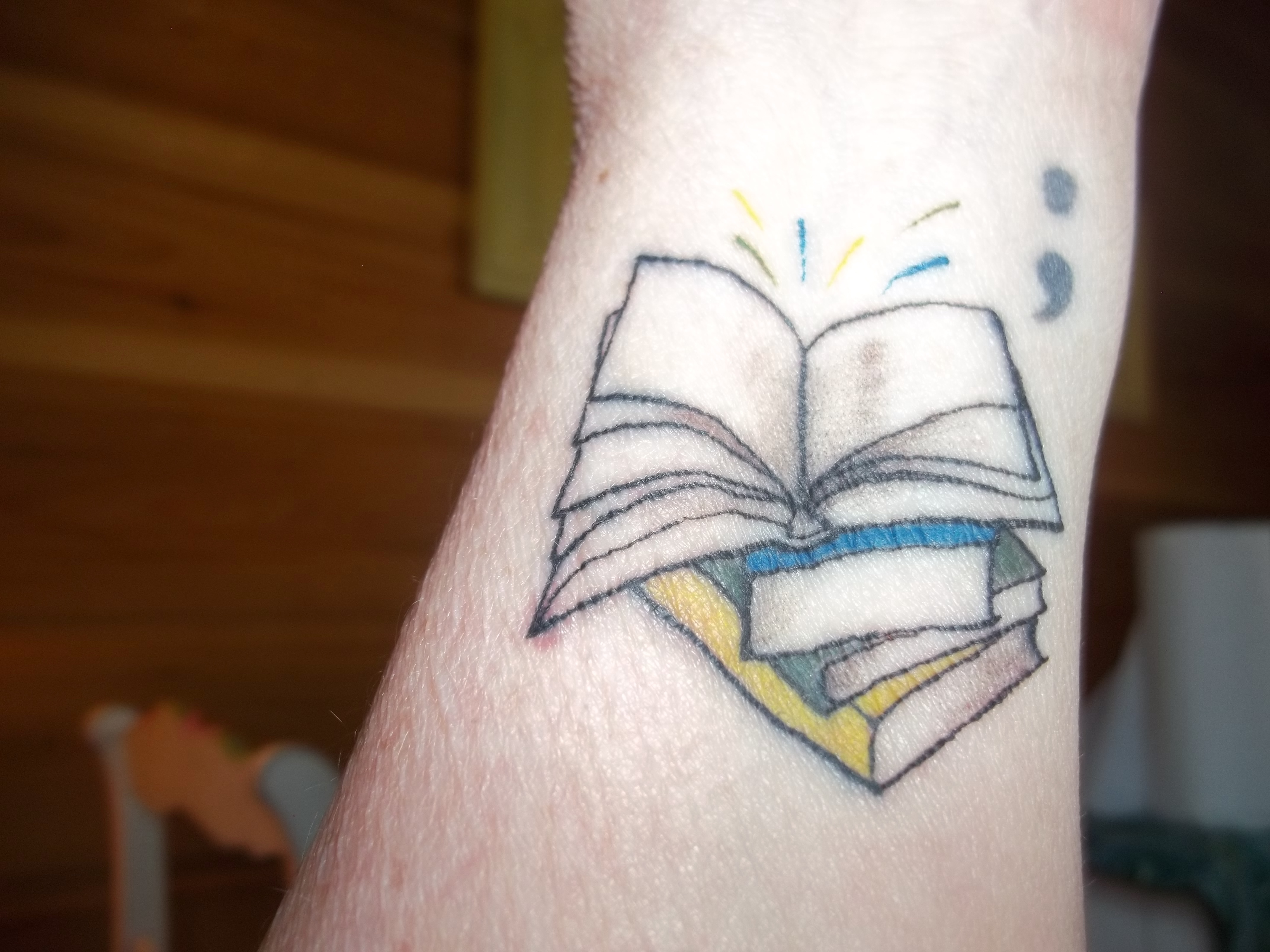
My next mental health tattoo isn’t going to be about mental health at all – except that it will be.

I have had several ideas for tattoos recently: a yellow rose for my mother (whose maiden name was Rose and whose favorite flower was yellow roses); a compass rose to celebrate my love for travel; or the constellation Orion for my love of astronomy. I also thought of getting a script “My story isn’t over,” which would, of course, be a mental health tattoo.

But what I decided on was a stack of books.

Why is this a mental health tattoo? Because books have saved my life so many times when I was at the bottom of the pit. I find books the best distraction from thinking about my misery. They are the best escape from what is going on around, and inside, me. They take me to places I never imagined I’d go. They have helped me understand my condition.

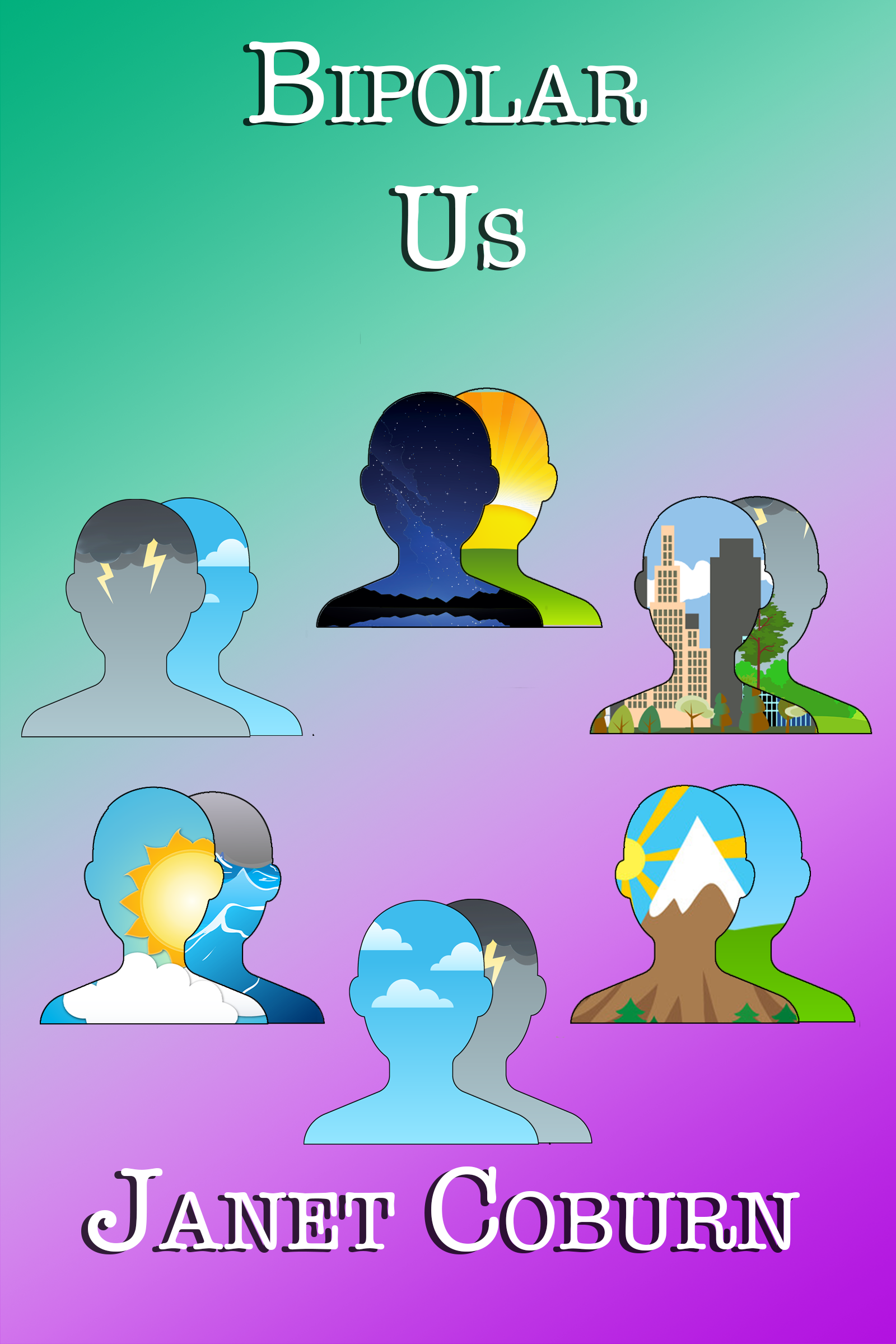
And I have written two books myself on mental health topics, Bipolar Me and Bipolar Us. They were compilations of these blog posts, including some of my most popular ones, such as “What Is It with Showers, anyway?,” “When You Don’t Want to Live But You Don’t Want to Die,” “The Fire and the Window,” and several on gaslighting and bipolar disorder.

The tattoo will not be about those particular books specifically, as the tattoo will be too small to have titles on the books. Instead, it will represent all the books that have nourished me, supported me, surprised me, touched me, informed me, and delighted me. Books I return to again and again, sometimes every year. Books that I own, or borrowed, or lost in the tornado that destroyed our house.

There was one time in my life when books were not an option for me – during my last major depressive episode. Then I was so deep in despair that no book appealed to me. I couldn’t concentrate enough to read more than a couple of pages. I missed my books (and my music), but I was unable to respond to them as I normally would. I even tried reading one of my favorites, a novel called Memory, but found it upsetting at that time, as I was having trouble retaining or accessing memories because of one of the medications I was on.

When the depressive episode ended, I was once again able to read and enjoy, for which I am infinitely thankful.

These days, I don’t read many books that are about bipolar disorder or other mental conditions, though books like The Noonday Demon have helped me in the past. In my young adulthood, I did read self-help books that I thought would help me with psychological issues, feminist issues, alienation issues, relationship issues, and more. I no longer read those sorts of books, especially workbooks that are supposed to reveal the inner workings of one’s mind and to help discover how various therapies can help get through the bad patches.

Perhaps I don’t like that kind of workbook because they’re too much like journaling. I once kept a journal, an erratic one that I wrote in irregularly over a year or more. I can’t bear to read it now because it was written when I was undiagnosed, unmedicated, and dealing with a lot of confusion and psychic pain. When, later in life, I tried to return to journaling, it quickly turned into this blog. It contains things I want to say to my old self and my new self, but also things I want to share with others. A blog (and the resulting books) seemed the best way to do that.

Right now I am reading that yearly series of books, plus nonfiction ones (I try to balance my reading between fiction and nonfiction). And when I finish those, I have over a thousand more to choose from, as I keep nearly all my books stored in electronic form on my Nook reader.

So, that’s why I chose books as my next tattoo, and why they represent mental health as well as just plain enjoyment. I have had so little enjoyment in my life when depression has hit me hard. I think it’s time to celebrate the times when books and reading have held me up and helped me through the bad times.

I used to have a couple of suits hanging in my closet. One was oatmeal-colored. One was blue tweed. One was rust-colored. I had a couple of silk blouses and a jacket or two that I could wear over a dress.

I called them my “Respectable Business Lady” disguises.

At the time I was working at a 9-to-5 job where the dress code was pretty casual. Fridays were jeans days, not casual days. But every so often I had to go to meetings or business conventions, and for them, I needed the disguises. I was dressing to “fit in” and to give an impression that I was competent and stable.

I don’t honestly know if the suits worked as a disguise, but I made it through meetings and conventions fairly successfully (I think), if I was allowed to collapse afterward, at home or in a hotel room. I think the disguises were as much to remind me how to behave as they were to convince people that I was indeed respectable and a business lady.

Nevertheless, I can’t really buy into the “fake it till you make it” philosophy that has been so popular in self-help books, including those promoting business and entrepreneurship help. I had no notion of becoming a respectable business lady by wearing those suits. I was always going to be awkward and out of my league. I was only trying to pretend by using protective coloration.

The essence of “fake it till you make it” is practice. As the saying goes, you get good at what you practice. Unfortunately, you can’t practice not having bipolar or another disorder. You can practice assorted coping mechanisms and get better at doing them, but they’re a solution to some of the symptoms, not the disease.

I don’t think that “fake it till you make it” really applies to people with mental health problems. No matter how much or how long you fake it, your mental disorders are not going to disappear, though they may ease up at times. I certainly don’t think the business lady disguises made me go into remission for a week or a weekend. They were merely a coping mechanism and nothing I practiced enough to get really good at.

One danger of trying to fake your way through mental illness is that you can fall into the trap of what’s called “smiling depression.” When this happens, people don’t notice that you’re miserable because your smile makes it seem you are happy. It’s another disguise, but not a permanently successful one.

Once I was teaching a class, and several women gathered around another woman and asked her what was wrong. “I didn’t think it showed,” she said. “No, honey,” I said, “it leaks out around the eyes.” She wasn’t crying or anything like that, but we could all tell something was wrong, despite her smile. We offered her conversation and sympathy until she pulled herself together a bit.

I’ve never been able to school my face into any kind of smiling depression anyway. If some people have “resting bitch face,” I have “resting sad face.” I can’t count the number of times when I didn’t feel particularly sad, but someone asked me what I was sad about. Of course, I was probably suffering from low-grade depression, like a low-grade fever, but at the time I was undiagnosed and had no idea that I had a mental problem that caused me to look that way.

Basically, what I’m saying is that when you have a mental illness like bipolar disorder, you can fake being psychologically together for a while, but you can’t sustain it forever. Certainly not until you “make it.” After I took off my Respectable Business Lady disguise, I would revert to my original self, as far from a respectable business lady as ever. Sometimes it would take me days to recover enough to feel that I was functioning again on any sort of level.

I think it’s better, ultimately, to admit who you are and what you need rather than to try to disguise or fake it. Even if your authentic self is depressed and miserable, getting help for it is still better than trying to cover it up.

Once upon a time, when I was diagnosed with unipolar depression, I wished I had bipolar disorder so that at least I could get things done when I was manic. Then I met someone with bipolar disorder and learned how foolish that wish was. Her manic phase led her to begin projects she would never finish, make loud, inappropriate jokes, and have difficulty with social interactions.

I have bipolar 2, and am fairly well controlled on medication, so I don’t get hypomania often, and when I do, it doesn’t usually last very long. Last month, however, I had a manicky time, and the results of it will affect me for several months. In June I also started on a new medication – though one for my physical health, not my mental health. My primary care physician doubled my dose of thyroid supplement. It had an almost immediate effect. After about a week, I became stronger, steadier, in less pain, and – oh yes, – rather manic.

I tend to have the rapid cycling version of my disorder, so when I do get hypomanic, it seldom lasts more than a few days. This time, however, I have had a longer time to experience the hypomania in a way I can’t remember having had before.

Some good things happened and some bad things happened. I got tickets to two live music events that I desperately wanted to see, one in August and one in September. We went out to eat at least twice. I made appointments for tattoos for both myself and my husband, both also in August. I booked us for a weekend getaway vacation in August. I bought myself a pair of earrings to replace ones I had lost.

In other words, I spent a lot of money.

Then July came and I don’t know if we will have enough money to get through it all. I snapped out of the hypomania and reverted to anxiety, which is how my depression often expresses itself. I paid the major bills during the first week. I put us on a strict budget for groceries. I put a little money aside so that I could possibly get a t-shirt at one of the concerts. I determined that the tattoo studio takes credit cards. (I don’t really want to take this option, but if we run out of cash, I may have to.)

Money worries are among my triggers for anxiety and depression, along with thunderstorms, overscheduling, noise, and too many people. When August comes, I will certainly need the bed-and-breakfast getaway, because my nerves will by then be frazzled.

The real question, though, is will I have enough energy to enjoy all the plans I have made for August?

A friend, who goes to DisneyWorld fairly often, learned that he should not do what he calls the “Bataan Fun March,” trying to cram every possible attraction and experience into a single visit. Now he prefers a more leisurely Disney experience, visiting a few of his old favorites and a few new attractions, while leaving time for relaxed dining and time in the pool.

This would probably have been a better approach for me to apply to August. A few events then, a few in September.

It would be convenient if my hypomania returned in August, to allow me to do all the fun things I have committed to. But as we know, bipolar disorder is an unpredictable beast. In the past, I have missed concerts that I had no more spoons for. I have rescheduled appointments that I wasn’t physically or psychologically in any shape to attend. (Most of these were appointments with my therapist, who sometimes agreed to a phone session instead.)

But these commitments are ones that I can’t phone in. All of them require my actual, physical presence. I don’t want to cancel any of them, some I can’t cancel at all, and I can’t phone in any of them. My best hope is that my symptoms will allow me to both attend and enjoy, if that’s possible.

Maybe the new pep I am experiencing from the thyroid meds will help. It does seem to help regulate my moods a bit, as well as affecting my body. Maybe it will allow me to have more spoons for August. Maybe in September I can decompress. Maybe in October, I will be back somewhere near level ground.

Across the Spectra

Most often when “the spectrum” is mentioned, it’s the autism spectrum that springs to mind. There’s good reason for that. Autism affects varying people in varying ways and to various degrees.

But there are other conditions, disorders, and traits that vary across a spectrum as well: right brain/left brain, introvert/extrovert/, depressed/manic, and many others. The one I’m most familiar with, of course is the depressed/manic spectrum (or in my case depressed/hypomanic), but I’ve recently been reading about the other spectra I mentioned.

The first thing to know about spectra is that no one is fully at either end of the spectrum, or at least not all of the time. Think of a spectrum as the weight gauge on an old-fashioned scale at a doctor’s office. Most people’s weight tips the scale at somewhere other than the middle, and if they are all the way to one end or the other, the clinician moves the weight and starts over until the pointer rests in between the two extremes and the heavy weight falls somewhere between either end.

So, to use myself as an example (the one I’m most familiar with), when I am stable (properly medicated), I am close to the middle of the depressed/hypomanic spectrum, with the “weight” perhaps listing just a wee bit toward the depressed side. During depressive or hypomanic episodes, I slide toward one end or the other. No one is either all depressed or all hypomanic, though it feels like it at times, and people don’t stay at one end or the other all the time, except perhaps for the unmedicated person who has never had proper treatment and self-care.

Then consider the right-brain/left-brain scenario. When this theory was first proposed, it associated various traits with one or the other side of the brain. Type-A, energetic, risk-taking, mathematically oriented people were said to be left-brained, while shy, creative, language-loving, and risk-averse types were said to be “right-brained.”

This theory was extrapolated into the real world. Naturally, society at large was judged to be left-brained and that was deemed the better thing to be. These people got things done – businesspeople, politicians, scientists, and the like. Artists, writers, and other creative types were said to be right-brained, and not well adjusted to the left-brained society. There was even a book called Drawing on the Right Side of the Brain, which tried to harness that hemisphere in pursuit of artistic accomplishments and getting left-brained people in touch with their other “side” for a while.

Whenever I’ve taken one of those sided-ness tests, though, I almost always come out somewhere near the middle. What does this mean? I suppose either that my corpus callosum (which connects the two hemispheres) is particularly robust, or that I partake of both natures to some extent, more or less, and at different times. For example, I am mostly a stay-at-home reader and writer, but I am also a closet science geek, and like foreign travel, considered a risk-taking pursuit.

The same with introvert/extrovert (which seems to me to overlap considerably with right/left brainedness, and indeed with depressive/manic). I prefer to stay at home and pursue quiet activities like reading and writing, but I also enjoy going to science fiction conventions, which are known to be rather people-y. I can also tolerate moderate sized gatherings such as parties and book signings, as long as they aren’t filled with loud noise such as screaming children.

What I’m getting at here is that most scales are fairly useless and most people are somewhere in the middle of them, partake of both ends, and slide back and forth to some degree. I suppose there are people who are all one or the other, but I don’t know many and probably wouldn’t find them very interesting if there were.